An Investigative Approach to E-commerce Platform Success Factors
VerifiedAdded on 2022/08/25
|16
|6630
|16
Report
AI Summary
This report examines the antecedents for the success of e-commerce platforms, focusing on the application of the DeLone and McLean (2003) information systems success model. The study investigates the critical success factors (CSFs) of e-commerce platforms, including system quality, information quality, service quality, use, user satisfaction, and net benefits. The research applies the model to compare Flipkart and Snapdeal, two major e-commerce players in India, to identify the relative importance of each factor in enhancing customer value. The report reviews the literature on e-commerce and the evolution of the DeLone and McLean model, highlighting how the model's six dimensions contribute to e-commerce success. The study emphasizes the importance of factors like usability, information accuracy, and service responsiveness in driving user satisfaction and achieving overall platform success in a competitive market. The paper aims to provide insights into how e-commerce companies can leverage these factors to enhance customer value and ensure their survival.
See discussions, stats, and author profiles for this publication at: https://www.researchgate.net/publication/317681416
Antecedents for success of e-commerce platforms: an investigative approach
Article in International Journal of Information Technology and Management · January 2017
DOI: 10.1504/IJITM.2017.10005709
CITATIONS
0
READS
183
3 authors:
Some of the authors of this publication are also working on these related projects:
Consumer Welfare and ProtectionView project
Anjali Pathania
Central University of Jammu
4 PUBLICATIONS2 CITATIONS
SEE PROFILE
Asif Ali
Hochschule Anhalt
30PUBLICATIONS192CITATIONS
SEE PROFILE
Gowhar Rasool
Central University of Jammu
5 PUBLICATIONS4 CITATIONS
SEE PROFILE
All content following this page was uploaded by Gowhar Rasool on 18 February 2018.
The user has requested enhancement of the downloaded file.
Antecedents for success of e-commerce platforms: an investigative approach
Article in International Journal of Information Technology and Management · January 2017
DOI: 10.1504/IJITM.2017.10005709
CITATIONS
0
READS
183
3 authors:
Some of the authors of this publication are also working on these related projects:
Consumer Welfare and ProtectionView project
Anjali Pathania
Central University of Jammu
4 PUBLICATIONS2 CITATIONS
SEE PROFILE
Asif Ali
Hochschule Anhalt
30PUBLICATIONS192CITATIONS
SEE PROFILE
Gowhar Rasool
Central University of Jammu
5 PUBLICATIONS4 CITATIONS
SEE PROFILE
All content following this page was uploaded by Gowhar Rasool on 18 February 2018.
The user has requested enhancement of the downloaded file.

Paraphrase This Document
Need a fresh take? Get an instant paraphrase of this document with our AI Paraphraser
376 Int. J. Information Technology and Management, Vol. 16, No. 4, 2017
Copyright © 2017 Inderscience Enterprises Ltd.
Antecedents for success of e-commerce platforms:
an investigative approach
Asif Ali*, Gowhar Rasool and Anjali Pathania
Department of HRM and OB,
Central University of Jammu,
Jammu, India
Email: easif.101@gmail.com
Email: gowhar2@gmail.com
Email: anjalipathania88@gmail.com
*Corresponding author
Abstract: A plethora of literature is available highlighting the critical success
factors (CSFs) of information systems (IS). While most of the studies were
elusive in determining CSFs, the research of DeLone and McLean (1992)
proposed an IS success model which is most comprehensive and widely applied
model in various research studies carried out in this context. The model was
later updated to incorporate parsimony by DeLone and McLean (2003). The
updated model is based on six success factors, i.e., system quality, information,
service quality use, user satisfaction and net benefits. This paper attempts to
examine the role of each critical success factors as suggested by DeLone and
McLean (2003) towards the success of e-commerce platforms and how it can
be leveraged for enhancing customer value by laying strong foundation on most
vital factor. DeLone and McLean (2003) model was applied to make a
comparison between Flipkart and Snapdeal which are two dominant players of
e-commerce in India, so as to investigate the antecedents for the success of
e-commerce platforms.
Keywords: information systems; e-commerce platforms; user experiences;
critical success factors.
Reference to this paper should be made as follows: Ali, A., Rasool, G. and
Pathania, A. (2017) ‘Antecedents for success of e-commerce platforms: an
investigative approach’, Int. J. Information Technology and Management,
Vol. 16, No. 4, pp.376–390.
Biographical notes: Asif Ali is an Assistant Professor in School of Business
Studies at Central University of Jammu, Jammu, India. He did his MBA from
University of Kashmir and is a Junior Associate from Indian Institute of
Banking and Finance. He has about three years of corporate and one and a half
years of teaching experience. His research interests are in the area of finance,
organisational behaviour and e-commerce.
Gowhar Rasool is an Assistant Professor in School of Business Studies at
Central University of Jammu, Jammu, India. He did his MBA in the area of HR
and has also done international business from UNCC, USA. He has about one
year of corporate and two years of teaching experience. His research interests
are in the area of quantitative research methods, human resource management
and financial inclusion.
Copyright © 2017 Inderscience Enterprises Ltd.
Antecedents for success of e-commerce platforms:
an investigative approach
Asif Ali*, Gowhar Rasool and Anjali Pathania
Department of HRM and OB,
Central University of Jammu,
Jammu, India
Email: easif.101@gmail.com
Email: gowhar2@gmail.com
Email: anjalipathania88@gmail.com
*Corresponding author
Abstract: A plethora of literature is available highlighting the critical success
factors (CSFs) of information systems (IS). While most of the studies were
elusive in determining CSFs, the research of DeLone and McLean (1992)
proposed an IS success model which is most comprehensive and widely applied
model in various research studies carried out in this context. The model was
later updated to incorporate parsimony by DeLone and McLean (2003). The
updated model is based on six success factors, i.e., system quality, information,
service quality use, user satisfaction and net benefits. This paper attempts to
examine the role of each critical success factors as suggested by DeLone and
McLean (2003) towards the success of e-commerce platforms and how it can
be leveraged for enhancing customer value by laying strong foundation on most
vital factor. DeLone and McLean (2003) model was applied to make a
comparison between Flipkart and Snapdeal which are two dominant players of
e-commerce in India, so as to investigate the antecedents for the success of
e-commerce platforms.
Keywords: information systems; e-commerce platforms; user experiences;
critical success factors.
Reference to this paper should be made as follows: Ali, A., Rasool, G. and
Pathania, A. (2017) ‘Antecedents for success of e-commerce platforms: an
investigative approach’, Int. J. Information Technology and Management,
Vol. 16, No. 4, pp.376–390.
Biographical notes: Asif Ali is an Assistant Professor in School of Business
Studies at Central University of Jammu, Jammu, India. He did his MBA from
University of Kashmir and is a Junior Associate from Indian Institute of
Banking and Finance. He has about three years of corporate and one and a half
years of teaching experience. His research interests are in the area of finance,
organisational behaviour and e-commerce.
Gowhar Rasool is an Assistant Professor in School of Business Studies at
Central University of Jammu, Jammu, India. He did his MBA in the area of HR
and has also done international business from UNCC, USA. He has about one
year of corporate and two years of teaching experience. His research interests
are in the area of quantitative research methods, human resource management
and financial inclusion.
Antecedents for success of e-commerce platforms: an investigative approach 377
Anjali Pathania is an Assistant Professor in School of Business Studies at
Central University of Jammu, Jammu, India. She did her MBA (Gold
Medallist) and Bachelor of Engineering (BE) from University of Jammu. She
has about four years of teaching experience. Her research interests are in the
area of human resource management, financial inclusion and information
systems.
This paper is a revised and expanded version of a paper entitled ‘Antecedents
for success of e-commerce platforms: an investigative approach’ presented at
International Conference on Advances in Management and Technology in a
Global World (ICAMT-15), Noida, Uttar Pradesh, India, 18–20 December
2015.
1 Introduction
The advent of information communication technology (ICT) has revolutionised the
world. The ICT on account of its ease of use and usefulness got acceptance in conduct of
business (Davis et al., 1989). This acceptance transformed the businesses we deal with,
markets we buy-sell from and has pushed the customer expectations to new heights. This
facilitation of internet to execute and process business transactions online led to
development of e-commerce (DeLone and McLean, 2004). E-commerce is of recent
origin but since inception e-commerce has been growing exponentially with India being
no exception. Indian online retail industry in last five years has grown from around
Rs.15 billion revenues in 2007–2008 to Rs.139 billion in 2012–2013, i.e., compounded
annual growth rate (CAGR) of over 56%. Reasons for such an increase can be seen as
internet penetration, changing lifestyles and segments. Segments of books, electronics
and apparel have been the main contributors so far (CRISIL, 2014). Alongside these slew
of changes and robust growth numbers e-commerce poses some major challenges.
Sustainable success of e-commerce is one of the crucial challenges that all e-commerce
companies need to address tactfully for their survival in highly competitive and volatile
market. Thus, this research paper attempts to study the application of most
comprehensive and widely applied model of DeLone and McLean (2003) which proposes
six critical success factors for IS success model (i.e., system quality, information quality,
service quality, use, user satisfaction and net benefits) to deliberate upon the research
question, “Which are the most important antecedents contributing towards the success of
e-commerce platforms”.
2 Review of literature
E-business covers activities ranging from e-mail to e-enabled supply chain management
(Fusilier and Durlabhji, 2003; Parker and Castleman, 2007). E-commerce is considered as
a sub-set of e-business (Kim et al., 2006) which simply means purchasing and selling
products or services through the medium of the internet (Grandon and Pearson, 2004).
Anjali Pathania is an Assistant Professor in School of Business Studies at
Central University of Jammu, Jammu, India. She did her MBA (Gold
Medallist) and Bachelor of Engineering (BE) from University of Jammu. She
has about four years of teaching experience. Her research interests are in the
area of human resource management, financial inclusion and information
systems.
This paper is a revised and expanded version of a paper entitled ‘Antecedents
for success of e-commerce platforms: an investigative approach’ presented at
International Conference on Advances in Management and Technology in a
Global World (ICAMT-15), Noida, Uttar Pradesh, India, 18–20 December
2015.
1 Introduction
The advent of information communication technology (ICT) has revolutionised the
world. The ICT on account of its ease of use and usefulness got acceptance in conduct of
business (Davis et al., 1989). This acceptance transformed the businesses we deal with,
markets we buy-sell from and has pushed the customer expectations to new heights. This
facilitation of internet to execute and process business transactions online led to
development of e-commerce (DeLone and McLean, 2004). E-commerce is of recent
origin but since inception e-commerce has been growing exponentially with India being
no exception. Indian online retail industry in last five years has grown from around
Rs.15 billion revenues in 2007–2008 to Rs.139 billion in 2012–2013, i.e., compounded
annual growth rate (CAGR) of over 56%. Reasons for such an increase can be seen as
internet penetration, changing lifestyles and segments. Segments of books, electronics
and apparel have been the main contributors so far (CRISIL, 2014). Alongside these slew
of changes and robust growth numbers e-commerce poses some major challenges.
Sustainable success of e-commerce is one of the crucial challenges that all e-commerce
companies need to address tactfully for their survival in highly competitive and volatile
market. Thus, this research paper attempts to study the application of most
comprehensive and widely applied model of DeLone and McLean (2003) which proposes
six critical success factors for IS success model (i.e., system quality, information quality,
service quality, use, user satisfaction and net benefits) to deliberate upon the research
question, “Which are the most important antecedents contributing towards the success of
e-commerce platforms”.
2 Review of literature
E-business covers activities ranging from e-mail to e-enabled supply chain management
(Fusilier and Durlabhji, 2003; Parker and Castleman, 2007). E-commerce is considered as
a sub-set of e-business (Kim et al., 2006) which simply means purchasing and selling
products or services through the medium of the internet (Grandon and Pearson, 2004).
⊘ This is a preview!⊘
Do you want full access?
Subscribe today to unlock all pages.

Trusted by 1+ million students worldwide
378 A. Ali et al.
A typical online transaction is characterised by a spatial and temporal separation
between buyer and seller. As exchange of goods or services is not simultaneous, it poses
challenge of risk (Zahir et al., 2002) and uncertainty (Cheung and Lee, 2006). Besides
this there are many other challenges for e-commerce like rapid technology changes,
information overload, govt. regulations, increasing expectations of consumers, etc.
Online vendors having realised these challenges make significant investments in
information systems (e-commerce platforms) so as to reduce risk, uncertainty and to cope
up with other challenges. Various models have been proposed from time to time to
measure the effectiveness or success of these e-commerce platforms. Various researches
have been undertaken to evaluate the effectiveness or success of e-commerce platforms.
Traces of initial theoretical foundation of success of Information Systems can be seen
in study by DeLone and McLean (1992). Delone and Mclean (1992) proposed a
multidimensional information systems success model to evaluate success of information
systems (based on six factors, i.e., system quality, information quality, use, user
satisfaction, individual impact and organisational impact). Following the adoption of
DeLone and McLean information systems success model in e-commerce setting, a
myriad of other models were proposed by researchers from time to time as better
measures of success of e-commerce platforms. Application of this model in various
research studies has further validated the framework. Like Seddon and Kiew (1996)
validated the DeLone and McLean model as they suggested that the inclusion of
perceived usefulness as a replacement to use is not reflective of success in contexts where
usage is compulsory.
The original DeLone and McLean (1992) model included individual impact and
organisational but the further updates of information system success model DeLone and
McLean (2003) suggested that individual, organisational and other impacts are combined
into a single net benefits construct.
Iivari (2005) also tried to validate the DeLone and McLean (1992) model by
demonstrating that individual impact could be assessed with perceived usefulness
measure. Molla and Licker (2001) proposed a model of e-commerce success based on
study of DeLone and McLean (1992). In this study they added information quality,
system quality, use and user satisfaction, support and service quality and trust as
additional factors to be considered in e-commerce environment.
However, DeLone and McLean (2003) proposed an updated version of original model
that can be applied purely for measurement of e-commerce success based upon the
empirical and theoretical contributions made by researchers either by testing or
discussing original model from 1992 to 2003. The updated model consists of six
interrelated dimensions of information systems success: system quality, information
quality, service quality, use, user satisfaction, net benefits. DeLone and McLean (2004)
in their study further exemplified as to how the updated model can be used to evaluate
e-commerce success.
A typical online transaction is characterised by a spatial and temporal separation
between buyer and seller. As exchange of goods or services is not simultaneous, it poses
challenge of risk (Zahir et al., 2002) and uncertainty (Cheung and Lee, 2006). Besides
this there are many other challenges for e-commerce like rapid technology changes,
information overload, govt. regulations, increasing expectations of consumers, etc.
Online vendors having realised these challenges make significant investments in
information systems (e-commerce platforms) so as to reduce risk, uncertainty and to cope
up with other challenges. Various models have been proposed from time to time to
measure the effectiveness or success of these e-commerce platforms. Various researches
have been undertaken to evaluate the effectiveness or success of e-commerce platforms.
Traces of initial theoretical foundation of success of Information Systems can be seen
in study by DeLone and McLean (1992). Delone and Mclean (1992) proposed a
multidimensional information systems success model to evaluate success of information
systems (based on six factors, i.e., system quality, information quality, use, user
satisfaction, individual impact and organisational impact). Following the adoption of
DeLone and McLean information systems success model in e-commerce setting, a
myriad of other models were proposed by researchers from time to time as better
measures of success of e-commerce platforms. Application of this model in various
research studies has further validated the framework. Like Seddon and Kiew (1996)
validated the DeLone and McLean model as they suggested that the inclusion of
perceived usefulness as a replacement to use is not reflective of success in contexts where
usage is compulsory.
The original DeLone and McLean (1992) model included individual impact and
organisational but the further updates of information system success model DeLone and
McLean (2003) suggested that individual, organisational and other impacts are combined
into a single net benefits construct.
Iivari (2005) also tried to validate the DeLone and McLean (1992) model by
demonstrating that individual impact could be assessed with perceived usefulness
measure. Molla and Licker (2001) proposed a model of e-commerce success based on
study of DeLone and McLean (1992). In this study they added information quality,
system quality, use and user satisfaction, support and service quality and trust as
additional factors to be considered in e-commerce environment.
However, DeLone and McLean (2003) proposed an updated version of original model
that can be applied purely for measurement of e-commerce success based upon the
empirical and theoretical contributions made by researchers either by testing or
discussing original model from 1992 to 2003. The updated model consists of six
interrelated dimensions of information systems success: system quality, information
quality, service quality, use, user satisfaction, net benefits. DeLone and McLean (2004)
in their study further exemplified as to how the updated model can be used to evaluate
e-commerce success.
Paraphrase This Document
Need a fresh take? Get an instant paraphrase of this document with our AI Paraphraser
Antecedents for success of e-commerce platforms: an investigative approach 379
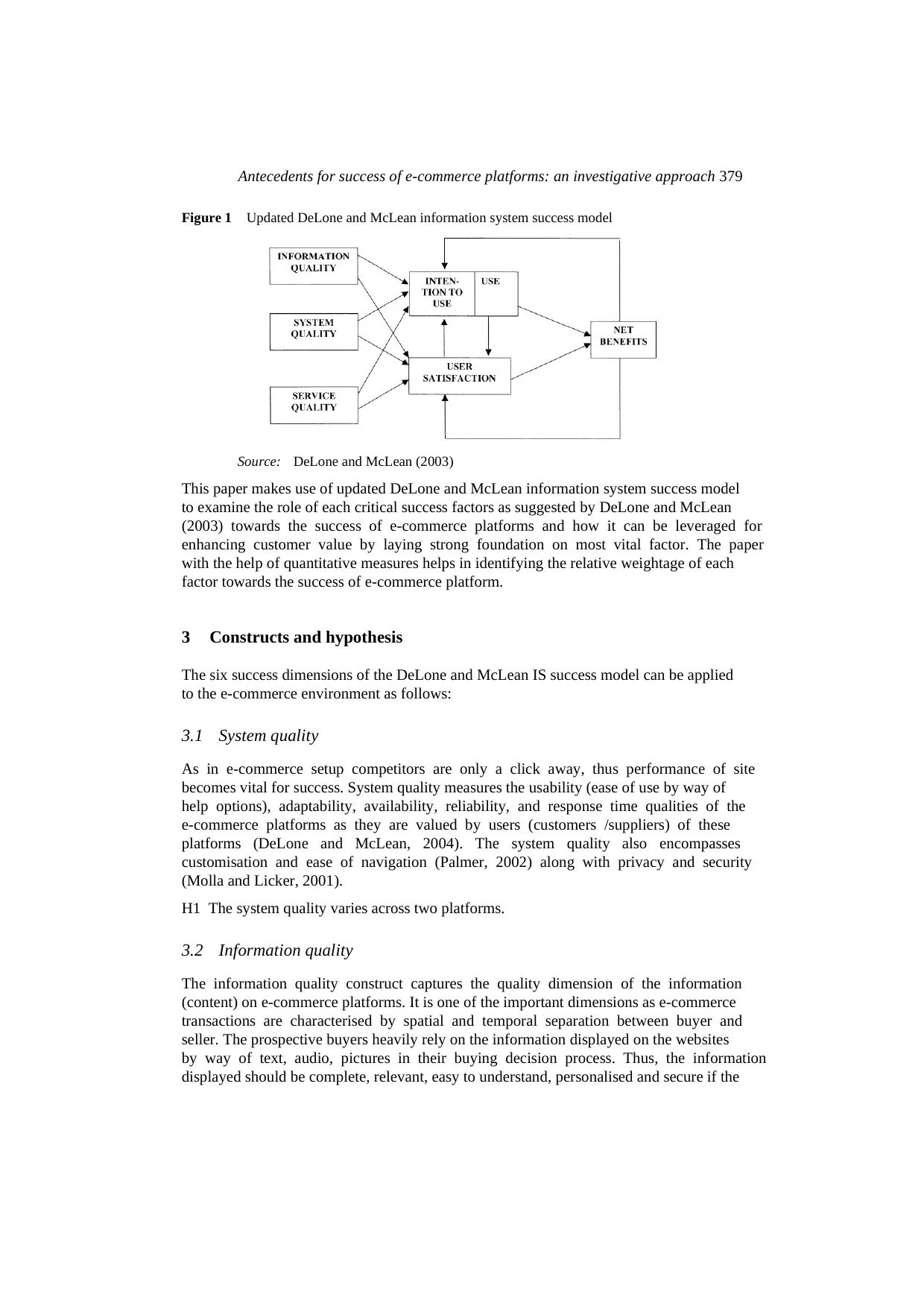
Figure 1 Updated DeLone and McLean information system success model
Source: DeLone and McLean (2003)
This paper makes use of updated DeLone and McLean information system success model
to examine the role of each critical success factors as suggested by DeLone and McLean
(2003) towards the success of e-commerce platforms and how it can be leveraged for
enhancing customer value by laying strong foundation on most vital factor. The paper
with the help of quantitative measures helps in identifying the relative weightage of each
factor towards the success of e-commerce platform.
3 Constructs and hypothesis
The six success dimensions of the DeLone and McLean IS success model can be applied
to the e-commerce environment as follows:
3.1 System quality
As in e-commerce setup competitors are only a click away, thus performance of site
becomes vital for success. System quality measures the usability (ease of use by way of
help options), adaptability, availability, reliability, and response time qualities of the
e-commerce platforms as they are valued by users (customers /suppliers) of these
platforms (DeLone and McLean, 2004). The system quality also encompasses
customisation and ease of navigation (Palmer, 2002) along with privacy and security
(Molla and Licker, 2001).
H1 The system quality varies across two platforms.
3.2 Information quality
The information quality construct captures the quality dimension of the information
(content) on e-commerce platforms. It is one of the important dimensions as e-commerce
transactions are characterised by spatial and temporal separation between buyer and
seller. The prospective buyers heavily rely on the information displayed on the websites
by way of text, audio, pictures in their buying decision process. Thus, the information
displayed should be complete, relevant, easy to understand, personalised and secure if the
Figure 1 Updated DeLone and McLean information system success model
Source: DeLone and McLean (2003)
This paper makes use of updated DeLone and McLean information system success model
to examine the role of each critical success factors as suggested by DeLone and McLean
(2003) towards the success of e-commerce platforms and how it can be leveraged for
enhancing customer value by laying strong foundation on most vital factor. The paper
with the help of quantitative measures helps in identifying the relative weightage of each
factor towards the success of e-commerce platform.
3 Constructs and hypothesis
The six success dimensions of the DeLone and McLean IS success model can be applied
to the e-commerce environment as follows:
3.1 System quality
As in e-commerce setup competitors are only a click away, thus performance of site
becomes vital for success. System quality measures the usability (ease of use by way of
help options), adaptability, availability, reliability, and response time qualities of the
e-commerce platforms as they are valued by users (customers /suppliers) of these
platforms (DeLone and McLean, 2004). The system quality also encompasses
customisation and ease of navigation (Palmer, 2002) along with privacy and security
(Molla and Licker, 2001).
H1 The system quality varies across two platforms.
3.2 Information quality
The information quality construct captures the quality dimension of the information
(content) on e-commerce platforms. It is one of the important dimensions as e-commerce
transactions are characterised by spatial and temporal separation between buyer and
seller. The prospective buyers heavily rely on the information displayed on the websites
by way of text, audio, pictures in their buying decision process. Thus, the information
displayed should be complete, relevant, easy to understand, personalised and secure if the
380 A. Ali et al.
intended users, customers or suppliers are to be motivated to transact via the internet and
encouraged for repeated purchase (DeLone and McLean, 2004). In e-commerce,
information is a source of value and containers (products, services, transactions, etc.)
without information e-commerce platforms are simply valueless (Hartman et al., 2000).
The information quality also means presentation of the information content and to what
extent a user controls (customises) the content (Von Dran et al., 1999).
H2 The information quality of two platforms differs.
3.3 Service quality
The service quality dimension was neglected in previous information systems success
models. Pitt et al. (1995) reported measures of information system success mainly focus
on the products rather than the services of the IS. Thus, researchers will not measure IS
effectiveness correctly if they do not include in their assessment a measure of IS service
quality. Liu and Arnett (2000) first identified service quality as an important measure of
website success. They measured service quality as responsiveness, assurance, empathy,
and following-up service. In e-commerce setup the dimension of service quality becomes
pivotal as there is separation between buyer and seller, buyers demand support (service)
for online platforms so that they can make informed decision. Sellers provide support or
enhance service quality by providing access to frequently asked questions, online chat,
hot line numbers and customer service centre’s. A poor service quality will translate into
lost customers and lost sales. For better understanding, the service quality dimension can
be divided into two broad categories, that is customer service quality and online system
quality (Cox and Dale, 2001). Customer service quality involves responsiveness,
competence, courtesy, access and communication whereas online system quality includes
accuracy, ease of use, timeliness, aesthetics, and security.
H3 The service quality of two platforms differs.
3.4 Use
The basic challenge for e-commerce platforms is to get online traffic directed to their site.
As usage of e-commerce platforms is often voluntary than compulsory by customers, thus
usage measures of e-commerce platforms has often been associated with success of
information systems. Usage has been defined as “everything from a visit to a Web site
and navigation within the site to information retrieval and execution of a transaction”
(DeLone and McLean, 2004). In e-commerce systems, Young and Benamati (2000)
suggested that use of e-commerce system could likewise be divided into informational
use (using site for sake of obtaining information about product or service), transactional
use (actively using site purpose of placing order and making payment) or customer
service (follow up from delivery or after sale service).
H4 The usage of patterns varies across two e-commerce platforms.
intended users, customers or suppliers are to be motivated to transact via the internet and
encouraged for repeated purchase (DeLone and McLean, 2004). In e-commerce,
information is a source of value and containers (products, services, transactions, etc.)
without information e-commerce platforms are simply valueless (Hartman et al., 2000).
The information quality also means presentation of the information content and to what
extent a user controls (customises) the content (Von Dran et al., 1999).
H2 The information quality of two platforms differs.
3.3 Service quality
The service quality dimension was neglected in previous information systems success
models. Pitt et al. (1995) reported measures of information system success mainly focus
on the products rather than the services of the IS. Thus, researchers will not measure IS
effectiveness correctly if they do not include in their assessment a measure of IS service
quality. Liu and Arnett (2000) first identified service quality as an important measure of
website success. They measured service quality as responsiveness, assurance, empathy,
and following-up service. In e-commerce setup the dimension of service quality becomes
pivotal as there is separation between buyer and seller, buyers demand support (service)
for online platforms so that they can make informed decision. Sellers provide support or
enhance service quality by providing access to frequently asked questions, online chat,
hot line numbers and customer service centre’s. A poor service quality will translate into
lost customers and lost sales. For better understanding, the service quality dimension can
be divided into two broad categories, that is customer service quality and online system
quality (Cox and Dale, 2001). Customer service quality involves responsiveness,
competence, courtesy, access and communication whereas online system quality includes
accuracy, ease of use, timeliness, aesthetics, and security.
H3 The service quality of two platforms differs.
3.4 Use
The basic challenge for e-commerce platforms is to get online traffic directed to their site.
As usage of e-commerce platforms is often voluntary than compulsory by customers, thus
usage measures of e-commerce platforms has often been associated with success of
information systems. Usage has been defined as “everything from a visit to a Web site
and navigation within the site to information retrieval and execution of a transaction”
(DeLone and McLean, 2004). In e-commerce systems, Young and Benamati (2000)
suggested that use of e-commerce system could likewise be divided into informational
use (using site for sake of obtaining information about product or service), transactional
use (actively using site purpose of placing order and making payment) or customer
service (follow up from delivery or after sale service).
H4 The usage of patterns varies across two e-commerce platforms.
⊘ This is a preview!⊘
Do you want full access?
Subscribe today to unlock all pages.
Trusted by 1+ million students worldwide
Antecedents for success of e-commerce platforms: an investigative approach 381
3.5 User satisfaction
User satisfaction is a means to measure the customers’ opinion about the e-commerce
platforms and covers the entire customer experience cycle from basic information
retrieval search through placing order, making payment, receipt of goods and service
(DeLone and McLean, 2004). User satisfaction is an attitude and has also been proposed
to be measures of e-commerce success (Mehta and Sivadas, 1995). As in e-commerce
related services, interpersonal service encounters are few and self-service e-commerce
platforms are prevalent that need less direct human interaction. For such systems, Molla
and Licker (2001) adopted user satisfaction as ‘Customer e-commerce satisfaction’ (CES)
and defines CES as evaluation of the reaction or feeling of a customer in relation to
his/her experience with all aspects of an e-commerce system (such as informational,
transactional and service and support) put in place by an organisation to market (pre,
during and after sale) its products and services.
H5 The customer’s satisfaction levels vary across the two e-commerce platforms.
3.6 Net benefits
Net benefits cover positive and negative impacts of e-commerce on internal as well as
external stakeholders. Thus it is one of the most crucial success measures of any
e-commerce platform. It covers various aspects as to how the investment in e-commerce
platforms has saved time and money of consumers, has lead to supply-chain efficiencies,
has resulted in overall net positive benefit for an organisation and net positive growth in
GNP, etc. (DeLone and McLean, 2004)
H6 The net benefits associated differ across e-commerce platforms.
4 Methodology
The study employed methodology that was quantitative and hypothetic-deductive.
Hypotheses were derived from the literature on information system and e-commerce
success. DeLone McLean (2003) updated model was applied to make a comparison
between Flipkart and Snapdeal which are two dominant players of e-commerce in India,
so as to investigate the antecedents for the success of e-commerce platforms. Further
survey instrument was developed in order to assess and measure the different success
dimensions of above two e-commerce platforms.
4.1 Instrument development
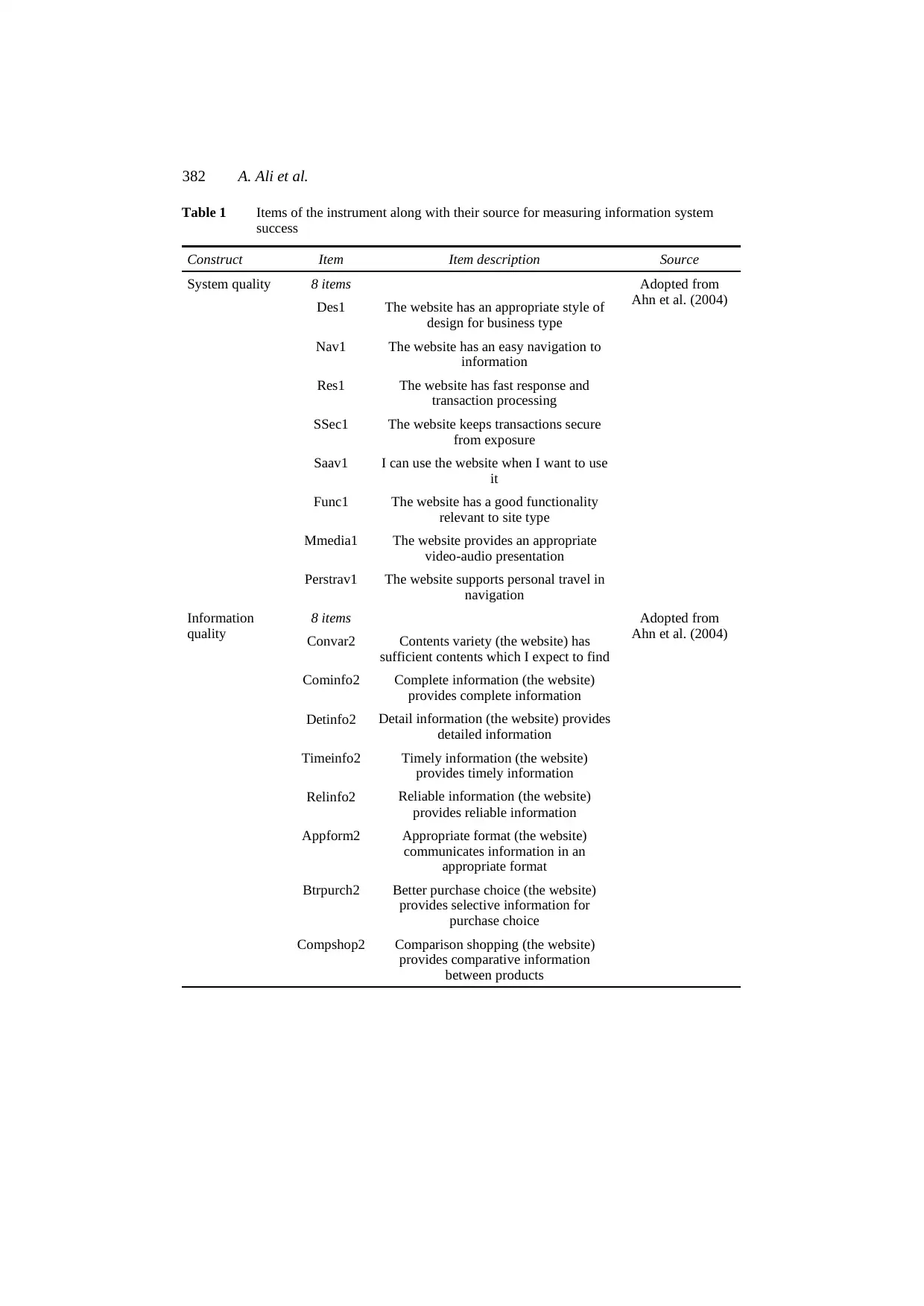
The instrument designed to conduct the field research is a five-point Likert scale-based,
containing six constructs and 34 items as follows:
3.5 User satisfaction
User satisfaction is a means to measure the customers’ opinion about the e-commerce
platforms and covers the entire customer experience cycle from basic information
retrieval search through placing order, making payment, receipt of goods and service
(DeLone and McLean, 2004). User satisfaction is an attitude and has also been proposed
to be measures of e-commerce success (Mehta and Sivadas, 1995). As in e-commerce
related services, interpersonal service encounters are few and self-service e-commerce
platforms are prevalent that need less direct human interaction. For such systems, Molla
and Licker (2001) adopted user satisfaction as ‘Customer e-commerce satisfaction’ (CES)
and defines CES as evaluation of the reaction or feeling of a customer in relation to
his/her experience with all aspects of an e-commerce system (such as informational,
transactional and service and support) put in place by an organisation to market (pre,
during and after sale) its products and services.
H5 The customer’s satisfaction levels vary across the two e-commerce platforms.
3.6 Net benefits
Net benefits cover positive and negative impacts of e-commerce on internal as well as
external stakeholders. Thus it is one of the most crucial success measures of any
e-commerce platform. It covers various aspects as to how the investment in e-commerce
platforms has saved time and money of consumers, has lead to supply-chain efficiencies,
has resulted in overall net positive benefit for an organisation and net positive growth in
GNP, etc. (DeLone and McLean, 2004)
H6 The net benefits associated differ across e-commerce platforms.
4 Methodology
The study employed methodology that was quantitative and hypothetic-deductive.
Hypotheses were derived from the literature on information system and e-commerce
success. DeLone McLean (2003) updated model was applied to make a comparison
between Flipkart and Snapdeal which are two dominant players of e-commerce in India,
so as to investigate the antecedents for the success of e-commerce platforms. Further
survey instrument was developed in order to assess and measure the different success
dimensions of above two e-commerce platforms.
4.1 Instrument development
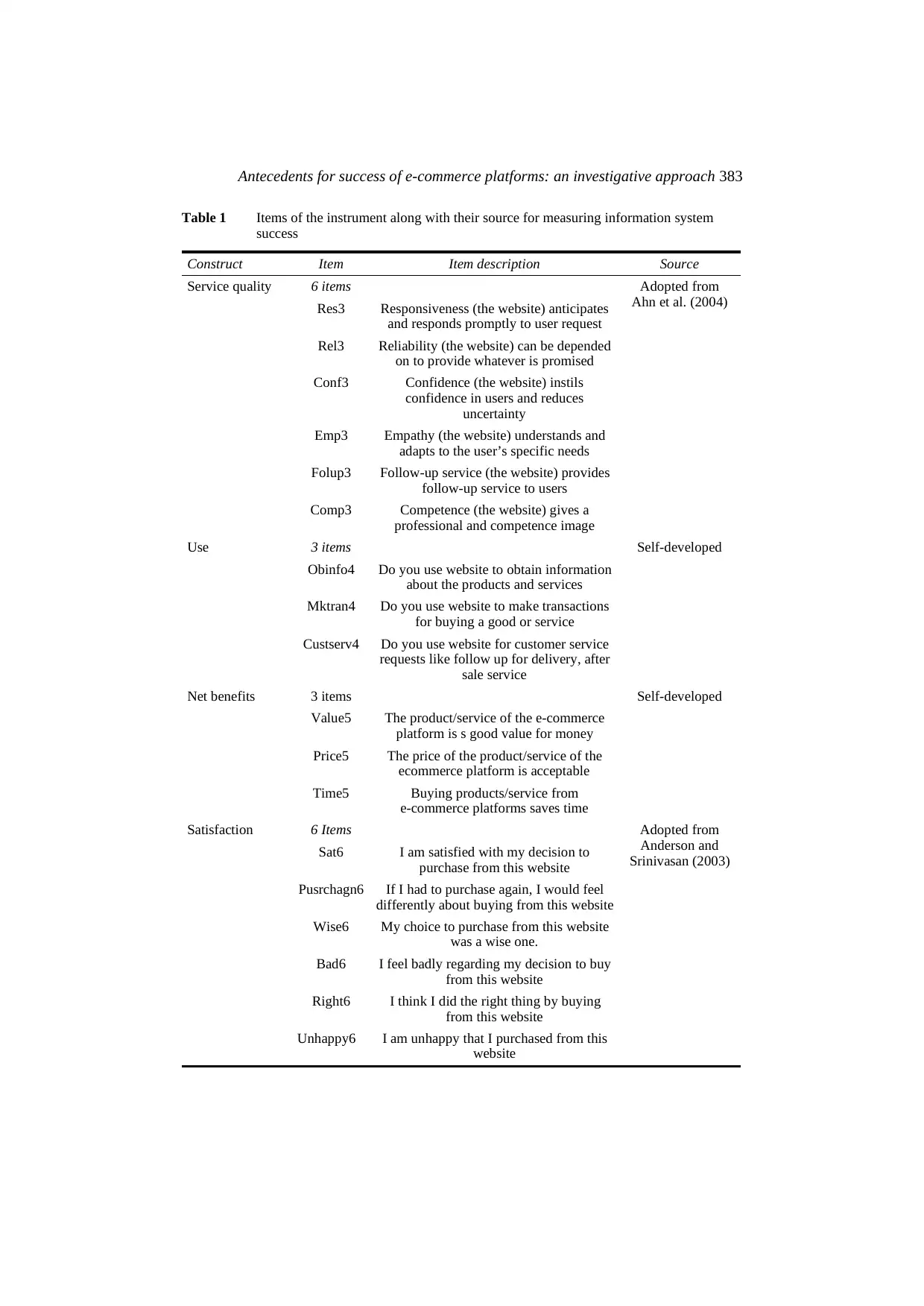
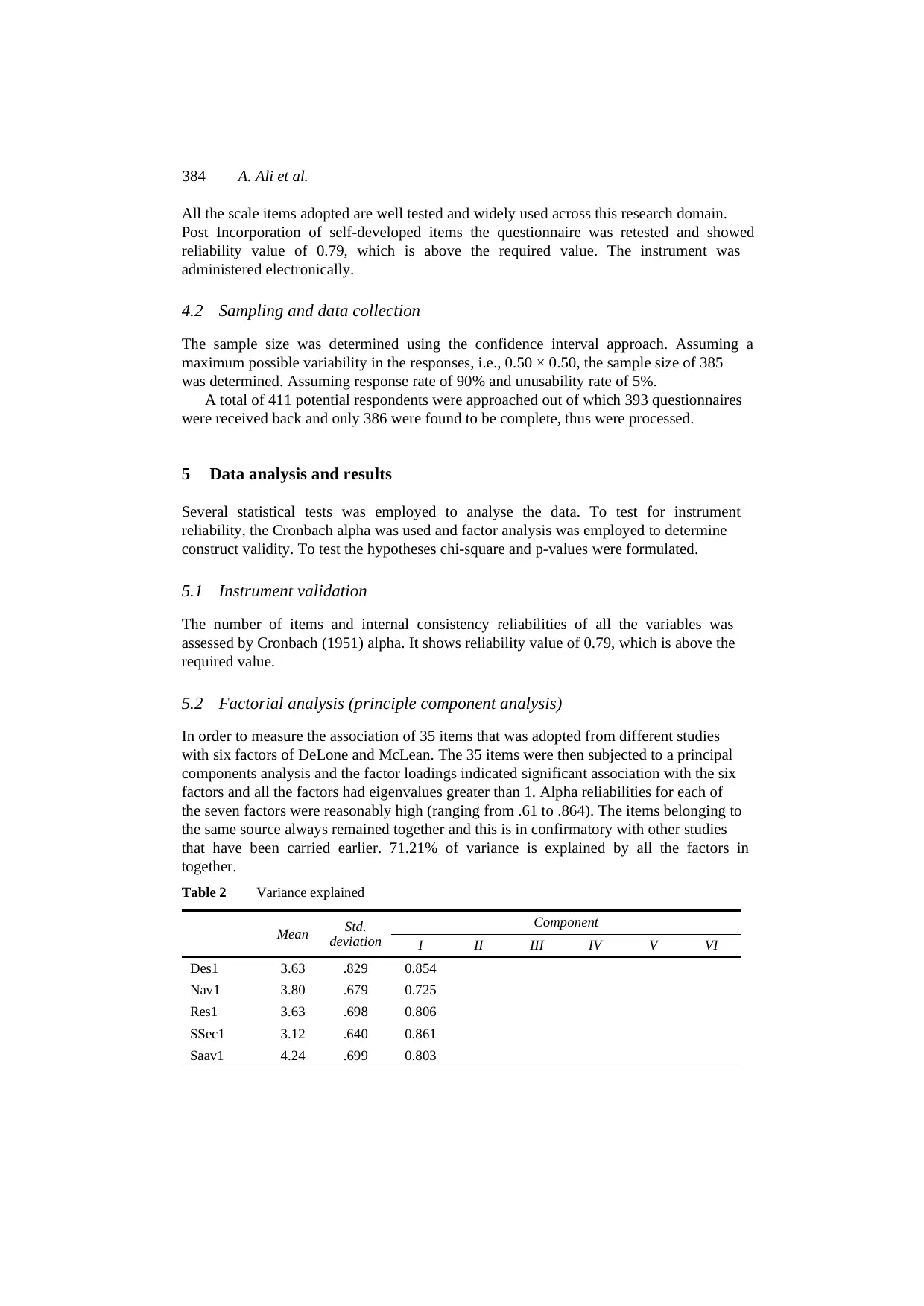
The instrument designed to conduct the field research is a five-point Likert scale-based,
containing six constructs and 34 items as follows:
Paraphrase This Document
Need a fresh take? Get an instant paraphrase of this document with our AI Paraphraser
382 A. Ali et al.
Table 1 Items of the instrument along with their source for measuring information system
success
Construct Item Item description Source
System quality 8 items Adopted from
Ahn et al. (2004)
Des1 The website has an appropriate style of
design for business type
Nav1 The website has an easy navigation to
information
Res1 The website has fast response and
transaction processing
SSec1 The website keeps transactions secure
from exposure
Saav1 I can use the website when I want to use
it
Func1 The website has a good functionality
relevant to site type
Mmedia1 The website provides an appropriate
video-audio presentation
Perstrav1 The website supports personal travel in
navigation
Information
quality
8 items Adopted from
Ahn et al. (2004)
Convar2 Contents variety (the website) has
sufficient contents which I expect to find
Cominfo2 Complete information (the website)
provides complete information
Detinfo2 Detail information (the website) provides
detailed information
Timeinfo2 Timely information (the website)
provides timely information
Relinfo2 Reliable information (the website)
provides reliable information
Appform2 Appropriate format (the website)
communicates information in an
appropriate format
Btrpurch2 Better purchase choice (the website)
provides selective information for
purchase choice
Compshop2 Comparison shopping (the website)
provides comparative information
between products
Table 1 Items of the instrument along with their source for measuring information system
success
Construct Item Item description Source
System quality 8 items Adopted from
Ahn et al. (2004)
Des1 The website has an appropriate style of
design for business type
Nav1 The website has an easy navigation to
information
Res1 The website has fast response and
transaction processing
SSec1 The website keeps transactions secure
from exposure
Saav1 I can use the website when I want to use
it
Func1 The website has a good functionality
relevant to site type
Mmedia1 The website provides an appropriate
video-audio presentation
Perstrav1 The website supports personal travel in
navigation
Information
quality
8 items Adopted from
Ahn et al. (2004)
Convar2 Contents variety (the website) has
sufficient contents which I expect to find
Cominfo2 Complete information (the website)
provides complete information
Detinfo2 Detail information (the website) provides
detailed information
Timeinfo2 Timely information (the website)
provides timely information
Relinfo2 Reliable information (the website)
provides reliable information
Appform2 Appropriate format (the website)
communicates information in an
appropriate format
Btrpurch2 Better purchase choice (the website)
provides selective information for
purchase choice
Compshop2 Comparison shopping (the website)
provides comparative information
between products
Antecedents for success of e-commerce platforms: an investigative approach 383
Table 1 Items of the instrument along with their source for measuring information system
success
Construct Item Item description Source
Service quality 6 items Adopted from
Ahn et al. (2004)Res3 Responsiveness (the website) anticipates
and responds promptly to user request
Rel3 Reliability (the website) can be depended
on to provide whatever is promised
Conf3 Confidence (the website) instils
confidence in users and reduces
uncertainty
Emp3 Empathy (the website) understands and
adapts to the user’s specific needs
Folup3 Follow-up service (the website) provides
follow-up service to users
Comp3 Competence (the website) gives a
professional and competence image
Use 3 items Self-developed
Obinfo4 Do you use website to obtain information
about the products and services
Mktran4 Do you use website to make transactions
for buying a good or service
Custserv4 Do you use website for customer service
requests like follow up for delivery, after
sale service
Net benefits 3 items Self-developed
Value5 The product/service of the e-commerce
platform is s good value for money
Price5 The price of the product/service of the
ecommerce platform is acceptable
Time5 Buying products/service from
e-commerce platforms saves time
Satisfaction 6 Items Adopted from
Anderson and
Srinivasan (2003)
Sat6 I am satisfied with my decision to
purchase from this website
Pusrchagn6 If I had to purchase again, I would feel
differently about buying from this website
Wise6 My choice to purchase from this website
was a wise one.
Bad6 I feel badly regarding my decision to buy
from this website
Right6 I think I did the right thing by buying
from this website
Unhappy6 I am unhappy that I purchased from this
website
Table 1 Items of the instrument along with their source for measuring information system
success
Construct Item Item description Source
Service quality 6 items Adopted from
Ahn et al. (2004)Res3 Responsiveness (the website) anticipates
and responds promptly to user request
Rel3 Reliability (the website) can be depended
on to provide whatever is promised
Conf3 Confidence (the website) instils
confidence in users and reduces
uncertainty
Emp3 Empathy (the website) understands and
adapts to the user’s specific needs
Folup3 Follow-up service (the website) provides
follow-up service to users
Comp3 Competence (the website) gives a
professional and competence image
Use 3 items Self-developed
Obinfo4 Do you use website to obtain information
about the products and services
Mktran4 Do you use website to make transactions
for buying a good or service
Custserv4 Do you use website for customer service
requests like follow up for delivery, after
sale service
Net benefits 3 items Self-developed
Value5 The product/service of the e-commerce
platform is s good value for money
Price5 The price of the product/service of the
ecommerce platform is acceptable
Time5 Buying products/service from
e-commerce platforms saves time
Satisfaction 6 Items Adopted from
Anderson and
Srinivasan (2003)
Sat6 I am satisfied with my decision to
purchase from this website
Pusrchagn6 If I had to purchase again, I would feel
differently about buying from this website
Wise6 My choice to purchase from this website
was a wise one.
Bad6 I feel badly regarding my decision to buy
from this website
Right6 I think I did the right thing by buying
from this website
Unhappy6 I am unhappy that I purchased from this
website
⊘ This is a preview!⊘
Do you want full access?
Subscribe today to unlock all pages.
Trusted by 1+ million students worldwide
384 A. Ali et al.
All the scale items adopted are well tested and widely used across this research domain.
Post Incorporation of self-developed items the questionnaire was retested and showed
reliability value of 0.79, which is above the required value. The instrument was
administered electronically.
4.2 Sampling and data collection
The sample size was determined using the confidence interval approach. Assuming a
maximum possible variability in the responses, i.e., 0.50 × 0.50, the sample size of 385
was determined. Assuming response rate of 90% and unusability rate of 5%.
A total of 411 potential respondents were approached out of which 393 questionnaires
were received back and only 386 were found to be complete, thus were processed.
5 Data analysis and results
Several statistical tests was employed to analyse the data. To test for instrument
reliability, the Cronbach alpha was used and factor analysis was employed to determine
construct validity. To test the hypotheses chi-square and p-values were formulated.
5.1 Instrument validation
The number of items and internal consistency reliabilities of all the variables was
assessed by Cronbach (1951) alpha. It shows reliability value of 0.79, which is above the
required value.
5.2 Factorial analysis (principle component analysis)
In order to measure the association of 35 items that was adopted from different studies
with six factors of DeLone and McLean. The 35 items were then subjected to a principal
components analysis and the factor loadings indicated significant association with the six
factors and all the factors had eigenvalues greater than 1. Alpha reliabilities for each of
the seven factors were reasonably high (ranging from .61 to .864). The items belonging to
the same source always remained together and this is in confirmatory with other studies
that have been carried earlier. 71.21% of variance is explained by all the factors in
together.
Table 2 Variance explained
Mean Std.
deviation
Component
I II III IV V VI
Des1 3.63 .829 0.854
Nav1 3.80 .679 0.725
Res1 3.63 .698 0.806
SSec1 3.12 .640 0.861
Saav1 4.24 .699 0.803
All the scale items adopted are well tested and widely used across this research domain.
Post Incorporation of self-developed items the questionnaire was retested and showed
reliability value of 0.79, which is above the required value. The instrument was
administered electronically.
4.2 Sampling and data collection
The sample size was determined using the confidence interval approach. Assuming a
maximum possible variability in the responses, i.e., 0.50 × 0.50, the sample size of 385
was determined. Assuming response rate of 90% and unusability rate of 5%.
A total of 411 potential respondents were approached out of which 393 questionnaires
were received back and only 386 were found to be complete, thus were processed.
5 Data analysis and results
Several statistical tests was employed to analyse the data. To test for instrument
reliability, the Cronbach alpha was used and factor analysis was employed to determine
construct validity. To test the hypotheses chi-square and p-values were formulated.
5.1 Instrument validation
The number of items and internal consistency reliabilities of all the variables was
assessed by Cronbach (1951) alpha. It shows reliability value of 0.79, which is above the
required value.
5.2 Factorial analysis (principle component analysis)
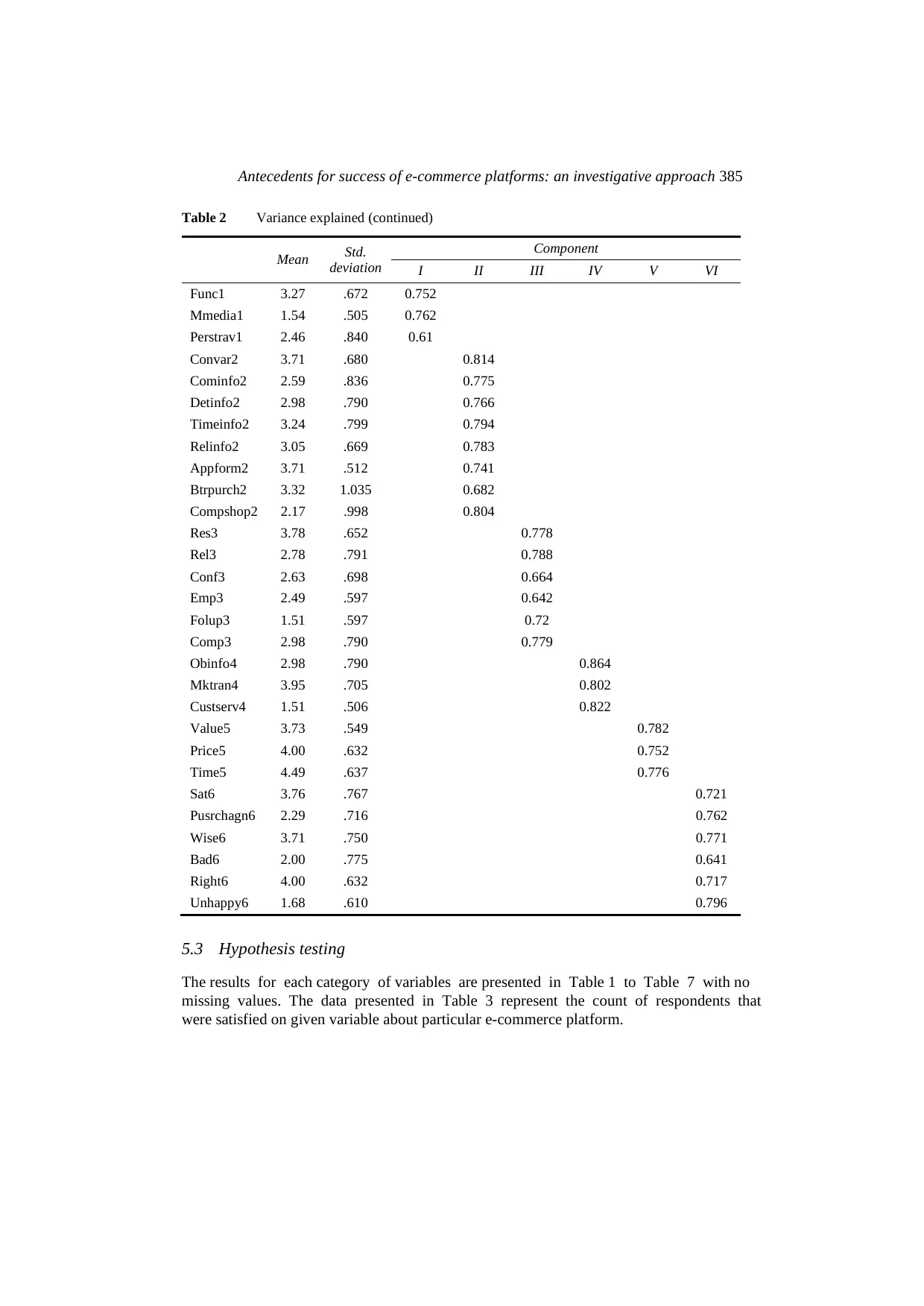
In order to measure the association of 35 items that was adopted from different studies
with six factors of DeLone and McLean. The 35 items were then subjected to a principal
components analysis and the factor loadings indicated significant association with the six
factors and all the factors had eigenvalues greater than 1. Alpha reliabilities for each of
the seven factors were reasonably high (ranging from .61 to .864). The items belonging to
the same source always remained together and this is in confirmatory with other studies
that have been carried earlier. 71.21% of variance is explained by all the factors in
together.
Table 2 Variance explained
Mean Std.
deviation
Component
I II III IV V VI
Des1 3.63 .829 0.854
Nav1 3.80 .679 0.725
Res1 3.63 .698 0.806
SSec1 3.12 .640 0.861
Saav1 4.24 .699 0.803
Paraphrase This Document
Need a fresh take? Get an instant paraphrase of this document with our AI Paraphraser
Antecedents for success of e-commerce platforms: an investigative approach 385
Table 2 Variance explained (continued)
Mean Std.
deviation
Component
I II III IV V VI
Func1 3.27 .672 0.752
Mmedia1 1.54 .505 0.762
Perstrav1 2.46 .840 0.61
Convar2 3.71 .680 0.814
Cominfo2 2.59 .836 0.775
Detinfo2 2.98 .790 0.766
Timeinfo2 3.24 .799 0.794
Relinfo2 3.05 .669 0.783
Appform2 3.71 .512 0.741
Btrpurch2 3.32 1.035 0.682
Compshop2 2.17 .998 0.804
Res3 3.78 .652 0.778
Rel3 2.78 .791 0.788
Conf3 2.63 .698 0.664
Emp3 2.49 .597 0.642
Folup3 1.51 .597 0.72
Comp3 2.98 .790 0.779
Obinfo4 2.98 .790 0.864
Mktran4 3.95 .705 0.802
Custserv4 1.51 .506 0.822
Value5 3.73 .549 0.782
Price5 4.00 .632 0.752
Time5 4.49 .637 0.776
Sat6 3.76 .767 0.721
Pusrchagn6 2.29 .716 0.762
Wise6 3.71 .750 0.771
Bad6 2.00 .775 0.641
Right6 4.00 .632 0.717
Unhappy6 1.68 .610 0.796
5.3 Hypothesis testing
The results for each category of variables are presented in Table 1 to Table 7 with no
missing values. The data presented in Table 3 represent the count of respondents that
were satisfied on given variable about particular e-commerce platform.
Table 2 Variance explained (continued)
Mean Std.
deviation
Component
I II III IV V VI
Func1 3.27 .672 0.752
Mmedia1 1.54 .505 0.762
Perstrav1 2.46 .840 0.61
Convar2 3.71 .680 0.814
Cominfo2 2.59 .836 0.775
Detinfo2 2.98 .790 0.766
Timeinfo2 3.24 .799 0.794
Relinfo2 3.05 .669 0.783
Appform2 3.71 .512 0.741
Btrpurch2 3.32 1.035 0.682
Compshop2 2.17 .998 0.804
Res3 3.78 .652 0.778
Rel3 2.78 .791 0.788
Conf3 2.63 .698 0.664
Emp3 2.49 .597 0.642
Folup3 1.51 .597 0.72
Comp3 2.98 .790 0.779
Obinfo4 2.98 .790 0.864
Mktran4 3.95 .705 0.802
Custserv4 1.51 .506 0.822
Value5 3.73 .549 0.782
Price5 4.00 .632 0.752
Time5 4.49 .637 0.776
Sat6 3.76 .767 0.721
Pusrchagn6 2.29 .716 0.762
Wise6 3.71 .750 0.771
Bad6 2.00 .775 0.641
Right6 4.00 .632 0.717
Unhappy6 1.68 .610 0.796
5.3 Hypothesis testing
The results for each category of variables are presented in Table 1 to Table 7 with no
missing values. The data presented in Table 3 represent the count of respondents that
were satisfied on given variable about particular e-commerce platform.
386 A. Ali et al.
Table 3 Construct name: system quality
Variable Actual Expected Chi-square Df p-value
Flipkart Snapdeal
Design 179 147 163 20.207771 1 0.000
Navigation 154 141 147.5 2.43002421 1 0.305
Response 154 179 166.5 13.6693297 1 0.001
Security 134 147 140.5 2.2109473 1 0.334
Availability 179 135 157 33.054494 1 0.000
Functionality 150 125 137.5 7.90335743 1 0.006
Multimedia 13 6 9.5 2.71246235 1 0.2695
Personal navigation 115 51 83 43.2928806 1 0.000
The data from Table 4 supported hypothesis H1. System quality appears to vary across
Flipkart and Snapdeal as suggested by data. The variables personal navigation,
availability, design and response contributed significantly to variation in system quality
construct. The variable functionality pointed a less significant variation in system quality
where as variables navigation, security multimedia pointed an insignificant variation in
system quality construct across Flipkart and Snapdeal.
Table 4 Construct name: information quality
Variable Actual Expected Chi-square Df p-value
Flipkart Snapdeal
Content variety 173 174 173.5 0.02852287 1 0.881
Complete information 122 90 106 10.71524615 1 0.006
Detail information 179 77 128 120.6713942 1 0.000
Timely information 166 134 150 15.32031008 1 0.000
Reliable information 26 141 83.5 139.5797446 1 0.000
Appropriate format 173 178 175.5 0.785510786 1 0.738
Better purchase choice 134 147 140.5 2.210947297 1 0.334
Comparison shopping 122 19 70.5 118.5431756 1 0.000
The data from Table 4 supported hypothesis H2. Information quality appears to vary
across Flipkart and Snapdeal as can be examined from data. The variables detail
information, reliable information, comparison shopping and complete information
contribute significantly to variation in information quality construct. The variable better
purchase choice, content variety and appropriate format pointed an insignificant variation
in information quality construct across Flipkart and Snapdeal. Thus, it can be concluded
while Flipkart is providing the detailed information than Snapdeal. However, the
information provided on website by Snapdeal is viewed more reliable than that of
Flipkart as suggested by data. On variables content variety and appropriate format
Snapdeal and Flipkart do not show much difference as suggested by data.
Table 3 Construct name: system quality
Variable Actual Expected Chi-square Df p-value
Flipkart Snapdeal
Design 179 147 163 20.207771 1 0.000
Navigation 154 141 147.5 2.43002421 1 0.305
Response 154 179 166.5 13.6693297 1 0.001
Security 134 147 140.5 2.2109473 1 0.334
Availability 179 135 157 33.054494 1 0.000
Functionality 150 125 137.5 7.90335743 1 0.006
Multimedia 13 6 9.5 2.71246235 1 0.2695
Personal navigation 115 51 83 43.2928806 1 0.000
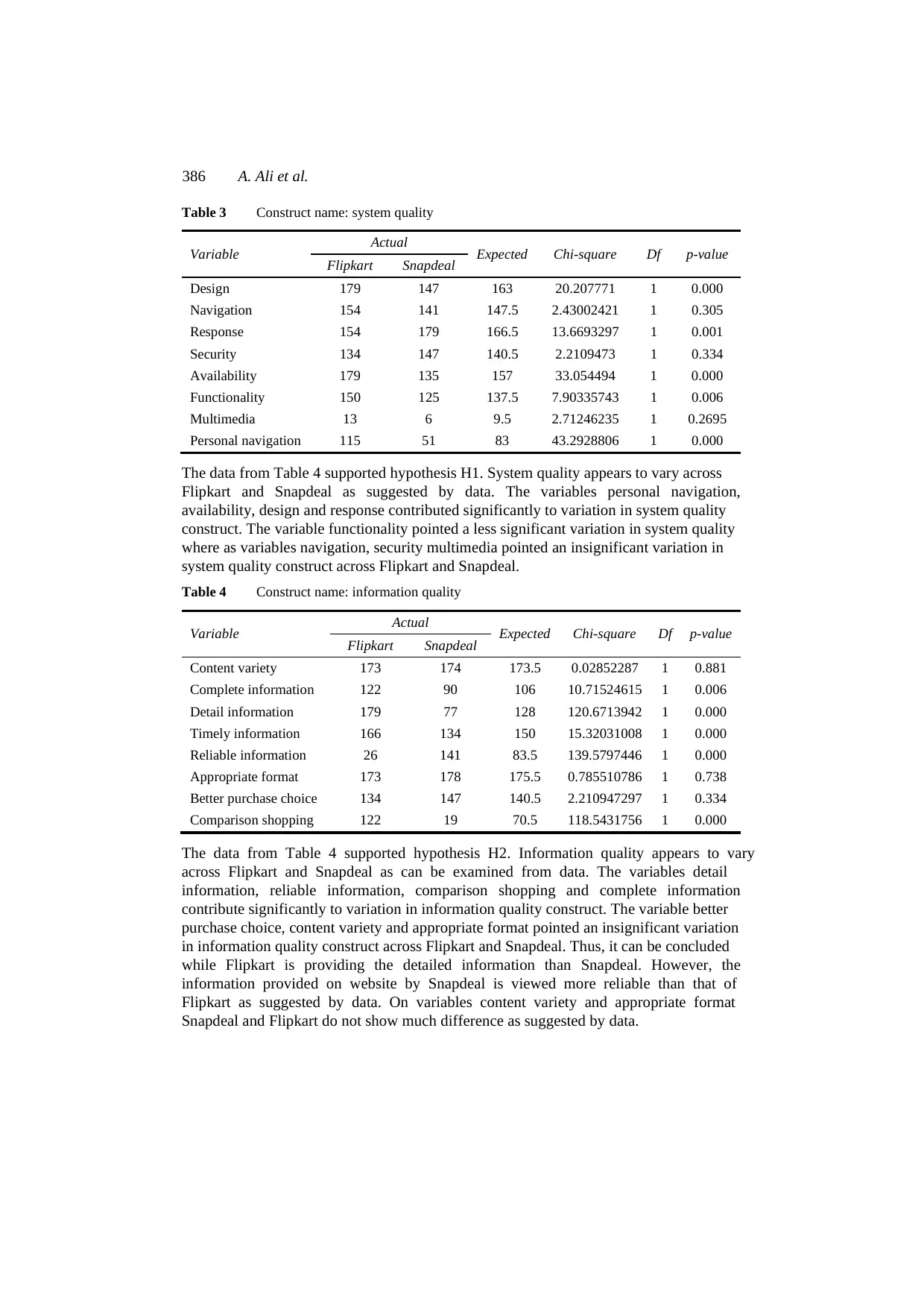
The data from Table 4 supported hypothesis H1. System quality appears to vary across
Flipkart and Snapdeal as suggested by data. The variables personal navigation,
availability, design and response contributed significantly to variation in system quality
construct. The variable functionality pointed a less significant variation in system quality
where as variables navigation, security multimedia pointed an insignificant variation in
system quality construct across Flipkart and Snapdeal.
Table 4 Construct name: information quality
Variable Actual Expected Chi-square Df p-value
Flipkart Snapdeal
Content variety 173 174 173.5 0.02852287 1 0.881
Complete information 122 90 106 10.71524615 1 0.006
Detail information 179 77 128 120.6713942 1 0.000
Timely information 166 134 150 15.32031008 1 0.000
Reliable information 26 141 83.5 139.5797446 1 0.000
Appropriate format 173 178 175.5 0.785510786 1 0.738
Better purchase choice 134 147 140.5 2.210947297 1 0.334
Comparison shopping 122 19 70.5 118.5431756 1 0.000
The data from Table 4 supported hypothesis H2. Information quality appears to vary
across Flipkart and Snapdeal as can be examined from data. The variables detail
information, reliable information, comparison shopping and complete information
contribute significantly to variation in information quality construct. The variable better
purchase choice, content variety and appropriate format pointed an insignificant variation
in information quality construct across Flipkart and Snapdeal. Thus, it can be concluded
while Flipkart is providing the detailed information than Snapdeal. However, the
information provided on website by Snapdeal is viewed more reliable than that of
Flipkart as suggested by data. On variables content variety and appropriate format
Snapdeal and Flipkart do not show much difference as suggested by data.
⊘ This is a preview!⊘
Do you want full access?
Subscribe today to unlock all pages.
Trusted by 1+ million students worldwide

1 out of 16


Your All-in-One AI-Powered Toolkit for Academic Success.
+13062052269
info@desklib.com
Available 24*7 on WhatsApp / Email
![[object Object]](/_next/static/media/star-bottom.7253800d.svg)
Unlock your academic potential
Copyright © 2020–2026 A2Z Services. All Rights Reserved. Developed and managed by ZUCOL.