EMTH6013: Knowledge Management & E-commerce - Emerging Themes Analysis

Verified

Added on  2023/06/11

|6
|1455
|498
Essay
AI Summary
This essay critically analyzes the impact of knowledge management on e-commerce through social media, highlighting the emerging theme of social media evolution in online business. It explores how knowledge management enhances e-commerce performance, focusing on the role of social media platforms like Starbucks in driving revenue and customer engagement. The study emphasizes the importance of knowledge sharing, transfer, and evaluation within social media contexts, and discusses the integration of Web 2.0 technologies to improve customer relationships. It further examines the future prospects of knowledge management in e-commerce, emphasizing the increasing role of customer feedback and online presence, and concludes that knowledge management implications will significantly benefit e-commerce through social media, enhancing customer satisfaction and business growth. Desklib offers a wealth of resources, including past papers and solved assignments, to support students in their academic endeavors.

Document Page
Running head: EMERGING THEMES
EMERGING THEMES
Name of the Student
Name of the University
Author Note
tabler-icon-diamond-filled.svg

Paraphrase This Document

Need a fresh take? Get an instant paraphrase of this document with our AI Paraphraser
Document Page
1EMERGING THEMES
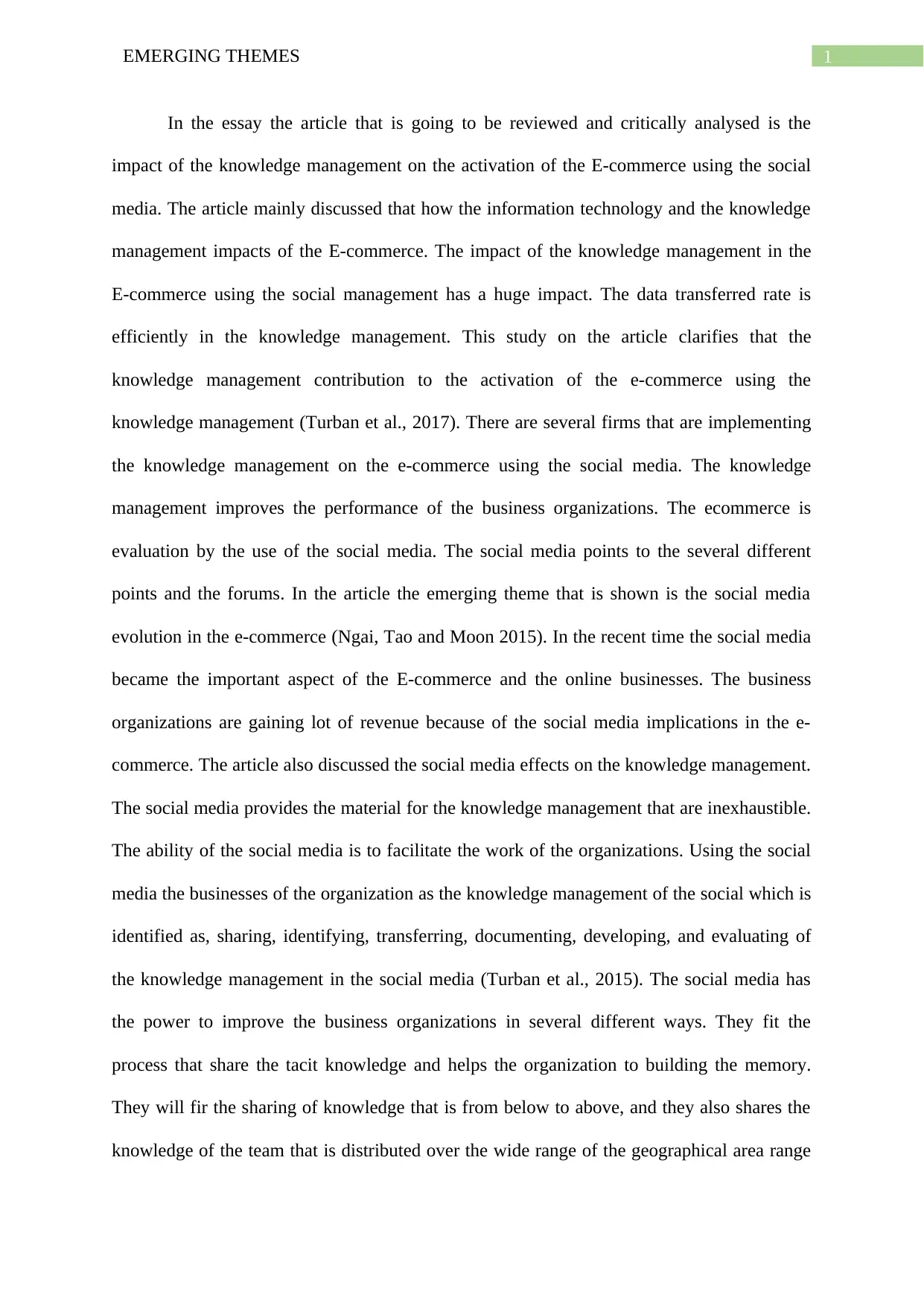
In the essay the article that is going to be reviewed and critically analysed is the
impact of the knowledge management on the activation of the E-commerce using the social
media. The article mainly discussed that how the information technology and the knowledge
management impacts of the E-commerce. The impact of the knowledge management in the
E-commerce using the social management has a huge impact. The data transferred rate is
efficiently in the knowledge management. This study on the article clarifies that the
knowledge management contribution to the activation of the e-commerce using the
knowledge management (Turban et al., 2017). There are several firms that are implementing
the knowledge management on the e-commerce using the social media. The knowledge
management improves the performance of the business organizations. The ecommerce is
evaluation by the use of the social media. The social media points to the several different
points and the forums. In the article the emerging theme that is shown is the social media
evolution in the e-commerce (Ngai, Tao and Moon 2015). In the recent time the social media
became the important aspect of the E-commerce and the online businesses. The business
organizations are gaining lot of revenue because of the social media implications in the e-
commerce. The article also discussed the social media effects on the knowledge management.
The social media provides the material for the knowledge management that are inexhaustible.
The ability of the social media is to facilitate the work of the organizations. Using the social
media the businesses of the organization as the knowledge management of the social which is
identified as, sharing, identifying, transferring, documenting, developing, and evaluating of
the knowledge management in the social media (Turban et al., 2015). The social media has
the power to improve the business organizations in several different ways. They fit the
process that share the tacit knowledge and helps the organization to building the memory.
They will fir the sharing of knowledge that is from below to above, and they also shares the
knowledge of the team that is distributed over the wide range of the geographical area range
Document Page
2EMERGING THEMES
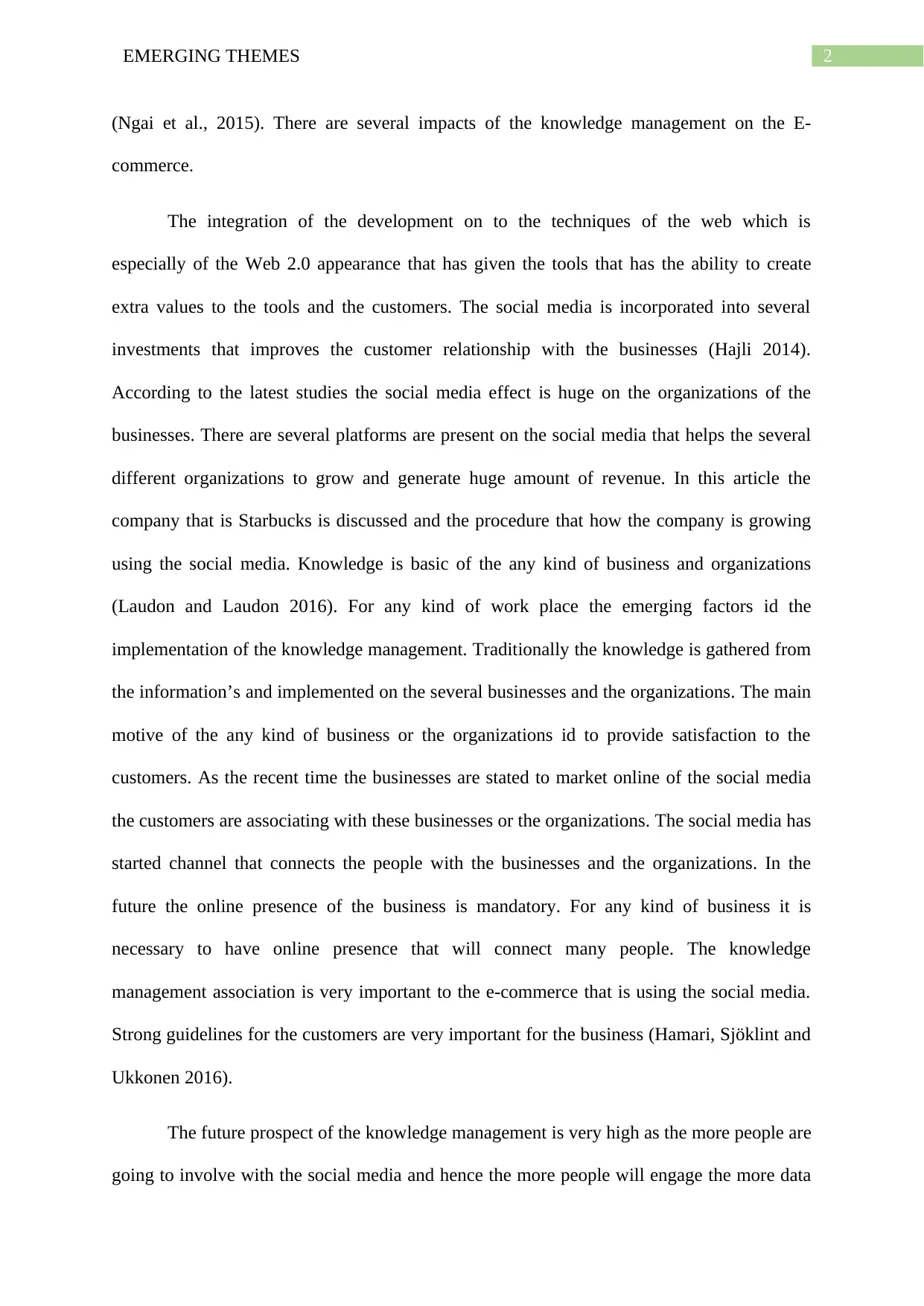
(Ngai et al., 2015). There are several impacts of the knowledge management on the E-
commerce.
The integration of the development on to the techniques of the web which is
especially of the Web 2.0 appearance that has given the tools that has the ability to create
extra values to the tools and the customers. The social media is incorporated into several
investments that improves the customer relationship with the businesses (Hajli 2014).
According to the latest studies the social media effect is huge on the organizations of the
businesses. There are several platforms are present on the social media that helps the several
different organizations to grow and generate huge amount of revenue. In this article the
company that is Starbucks is discussed and the procedure that how the company is growing
using the social media. Knowledge is basic of the any kind of business and organizations
(Laudon and Laudon 2016). For any kind of work place the emerging factors id the
implementation of the knowledge management. Traditionally the knowledge is gathered from
the information’s and implemented on the several businesses and the organizations. The main
motive of the any kind of business or the organizations id to provide satisfaction to the
customers. As the recent time the businesses are stated to market online of the social media
the customers are associating with these businesses or the organizations. The social media has
started channel that connects the people with the businesses and the organizations. In the
future the online presence of the business is mandatory. For any kind of business it is
necessary to have online presence that will connect many people. The knowledge
management association is very important to the e-commerce that is using the social media.
Strong guidelines for the customers are very important for the business (Hamari, Sjöklint and
Ukkonen 2016).
The future prospect of the knowledge management is very high as the more people are
going to involve with the social media and hence the more people will engage the more data
Document Page
3EMERGING THEMES
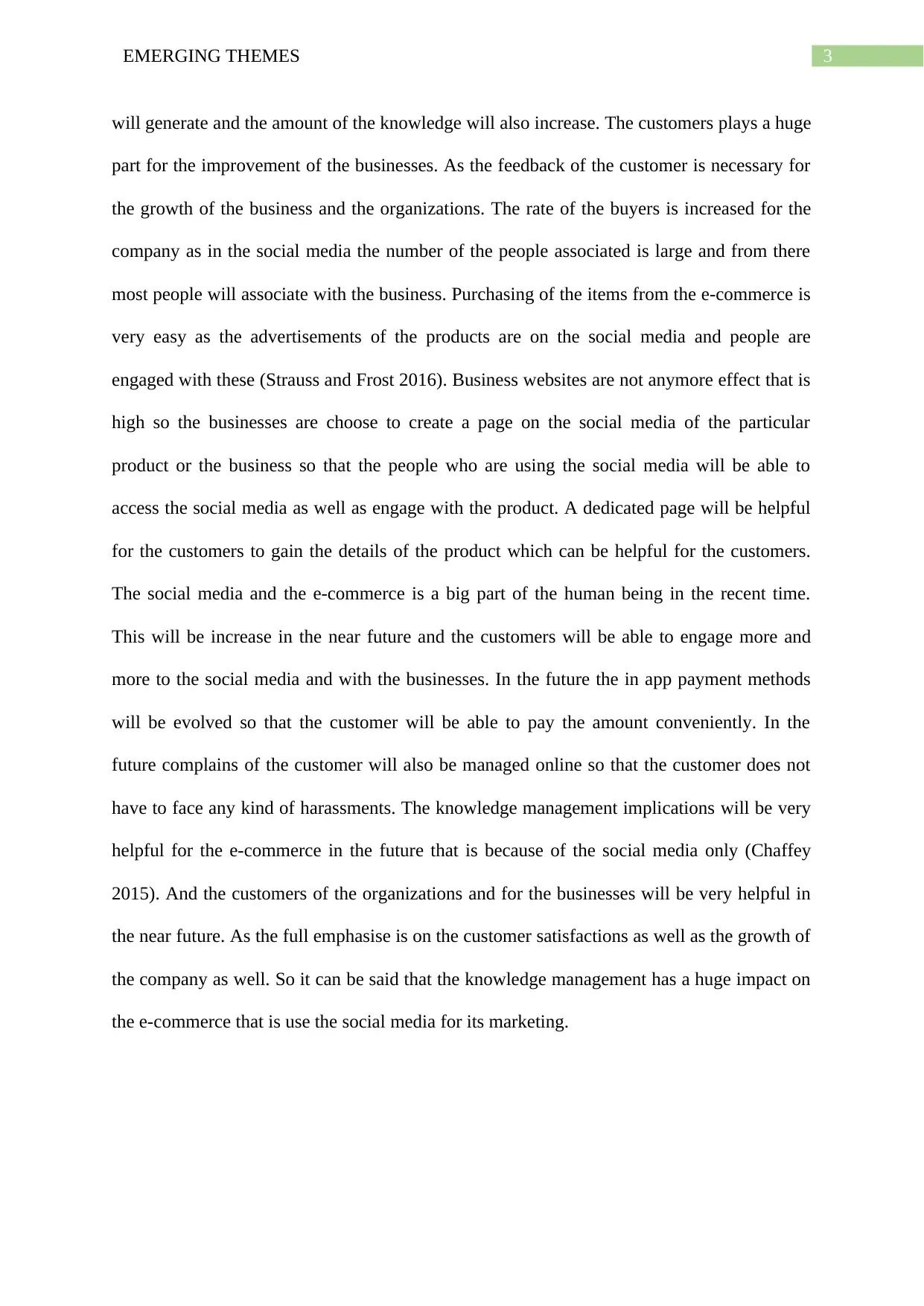
will generate and the amount of the knowledge will also increase. The customers plays a huge
part for the improvement of the businesses. As the feedback of the customer is necessary for
the growth of the business and the organizations. The rate of the buyers is increased for the
company as in the social media the number of the people associated is large and from there
most people will associate with the business. Purchasing of the items from the e-commerce is
very easy as the advertisements of the products are on the social media and people are
engaged with these (Strauss and Frost 2016). Business websites are not anymore effect that is
high so the businesses are choose to create a page on the social media of the particular
product or the business so that the people who are using the social media will be able to
access the social media as well as engage with the product. A dedicated page will be helpful
for the customers to gain the details of the product which can be helpful for the customers.
The social media and the e-commerce is a big part of the human being in the recent time.
This will be increase in the near future and the customers will be able to engage more and
more to the social media and with the businesses. In the future the in app payment methods
will be evolved so that the customer will be able to pay the amount conveniently. In the
future complains of the customer will also be managed online so that the customer does not
have to face any kind of harassments. The knowledge management implications will be very
helpful for the e-commerce in the future that is because of the social media only (Chaffey
2015). And the customers of the organizations and for the businesses will be very helpful in
the near future. As the full emphasise is on the customer satisfactions as well as the growth of
the company as well. So it can be said that the knowledge management has a huge impact on
the e-commerce that is use the social media for its marketing.
tabler-icon-diamond-filled.svg

Paraphrase This Document

Need a fresh take? Get an instant paraphrase of this document with our AI Paraphraser
Document Page
4EMERGING THEMES
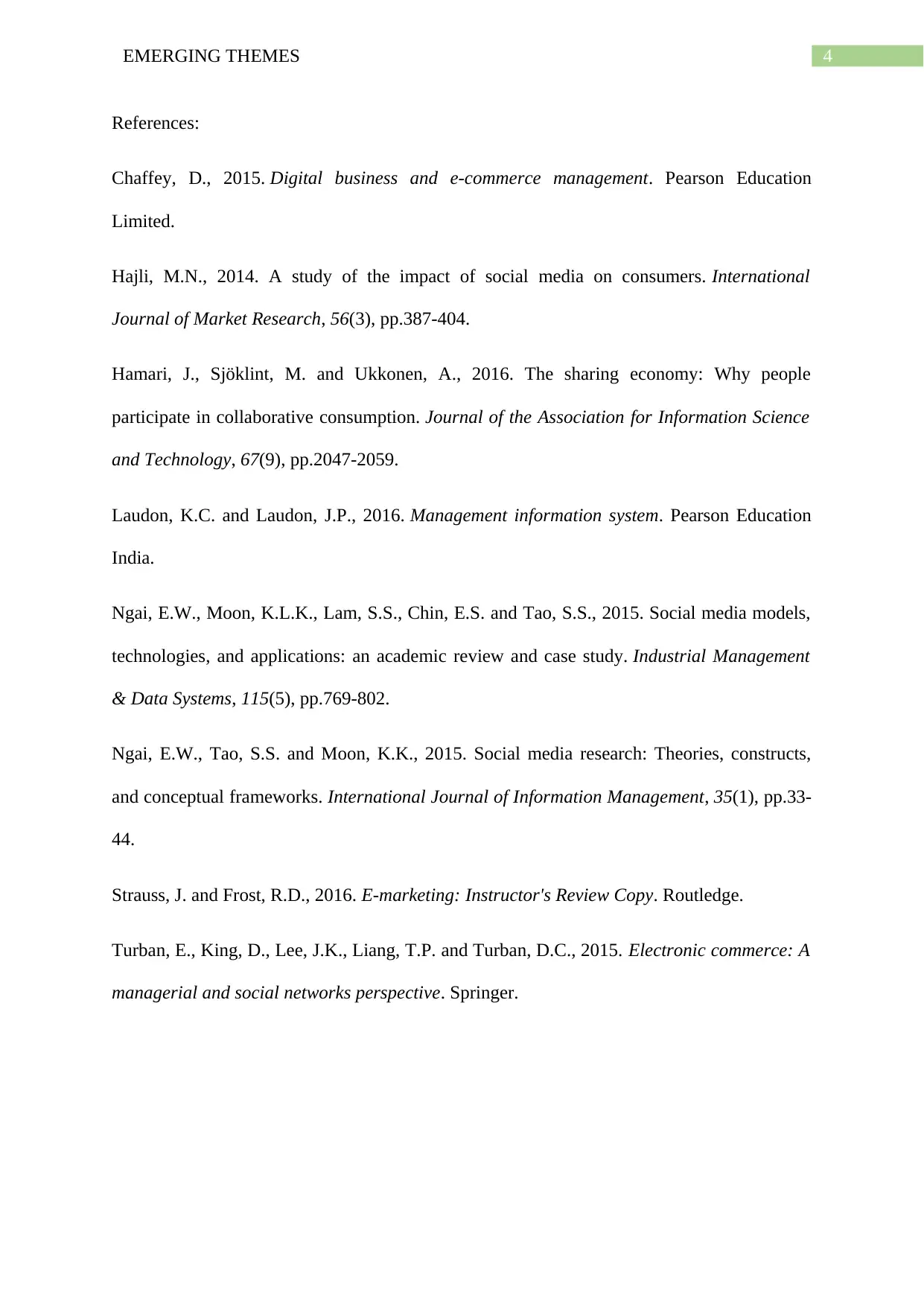
References:
Chaffey, D., 2015. Digital business and e-commerce management. Pearson Education
Limited.
Hajli, M.N., 2014. A study of the impact of social media on consumers. International
Journal of Market Research, 56(3), pp.387-404.
Hamari, J., Sjöklint, M. and Ukkonen, A., 2016. The sharing economy: Why people
participate in collaborative consumption. Journal of the Association for Information Science
and Technology, 67(9), pp.2047-2059.
Laudon, K.C. and Laudon, J.P., 2016. Management information system. Pearson Education
India.
Ngai, E.W., Moon, K.L.K., Lam, S.S., Chin, E.S. and Tao, S.S., 2015. Social media models,
technologies, and applications: an academic review and case study. Industrial Management
& Data Systems, 115(5), pp.769-802.
Ngai, E.W., Tao, S.S. and Moon, K.K., 2015. Social media research: Theories, constructs,
and conceptual frameworks. International Journal of Information Management, 35(1), pp.33-
44.
Strauss, J. and Frost, R.D., 2016. E-marketing: Instructor's Review Copy. Routledge.
Turban, E., King, D., Lee, J.K., Liang, T.P. and Turban, D.C., 2015. Electronic commerce: A
managerial and social networks perspective. Springer.
Document Page
5EMERGING THEMES
Turban, E., Outland, J., King, D., Lee, J.K., Liang, T.P. and Turban, D.C., 2017. Electronic
Commerce 2018: A Managerial and Social Networks Perspective. Springer.
chevron_up_icon
1 out of 6
circle_padding
hide_on_mobile
zoom_out_icon
[object Object]