ECON 214 Problem Set 5: Money, Banking, and Monetary Policy Analysis

Verified

Added on  2022/10/12

|6
|789
|437
Homework Assignment
AI Summary
This document presents the solutions to Problem Set 5 for the Principles of Macroeconomics (ECON 214) course. The assignment addresses core macroeconomic concepts, including the functions of money (medium of exchange, unit of account, and store of value), and the distinction between the discount rate and the federal funds rate. It also provides detailed analysis of a bank's balance sheet, illustrating the impact of various transactions such as withdrawals and government securities purchases on the bank's assets and liabilities. Furthermore, the solution explores the effects of changes in reserve ratios and government actions on the money supply, demonstrating the multiplier effect and calculating the required government securities purchases to achieve a specific increase in the money supply. The document provides a step-by-step breakdown of the problem-solving process with references to support the answers.
Document Page
Running head: PRINCIPLES OF MACROECONOMICS
Macro Economics
Name of the Student:
Name of the University:
Author’s Note:
tabler-icon-diamond-filled.svg

Paraphrase This Document

Need a fresh take? Get an instant paraphrase of this document with our AI Paraphraser
Document Page
1PRINCIPLES OF MACROECONOMICS
Table of Contents
Problem Set 5...................................................................................................................................2
Question 1........................................................................................................................................2
Question 2........................................................................................................................................2
Question 3........................................................................................................................................2
Question 4........................................................................................................................................3
Question 5........................................................................................................................................3
References........................................................................................................................................5
Document Page
2PRINCIPLES OF MACROECONOMICS
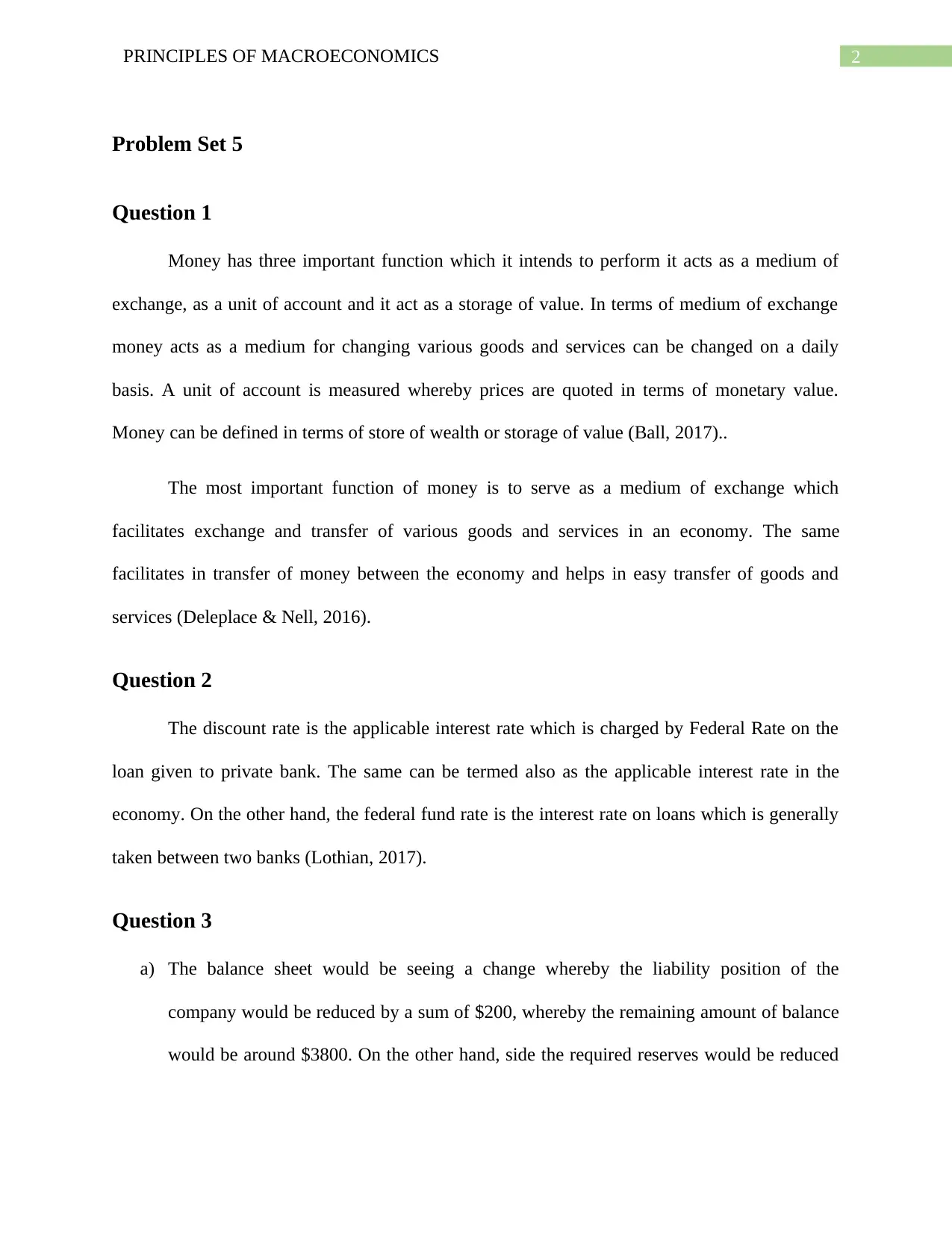
Problem Set 5
Question 1
Money has three important function which it intends to perform it acts as a medium of
exchange, as a unit of account and it act as a storage of value. In terms of medium of exchange
money acts as a medium for changing various goods and services can be changed on a daily
basis. A unit of account is measured whereby prices are quoted in terms of monetary value.
Money can be defined in terms of store of wealth or storage of value (Ball, 2017)..
The most important function of money is to serve as a medium of exchange which
facilitates exchange and transfer of various goods and services in an economy. The same
facilitates in transfer of money between the economy and helps in easy transfer of goods and
services (Deleplace & Nell, 2016).
Question 2
The discount rate is the applicable interest rate which is charged by Federal Rate on the
loan given to private bank. The same can be termed also as the applicable interest rate in the
economy. On the other hand, the federal fund rate is the interest rate on loans which is generally
taken between two banks (Lothian, 2017).
Question 3
a) The balance sheet would be seeing a change whereby the liability position of the
company would be reduced by a sum of $200, whereby the remaining amount of balance
would be around $3800. On the other hand, side the required reserves would be reduced
Document Page
3PRINCIPLES OF MACROECONOMICS
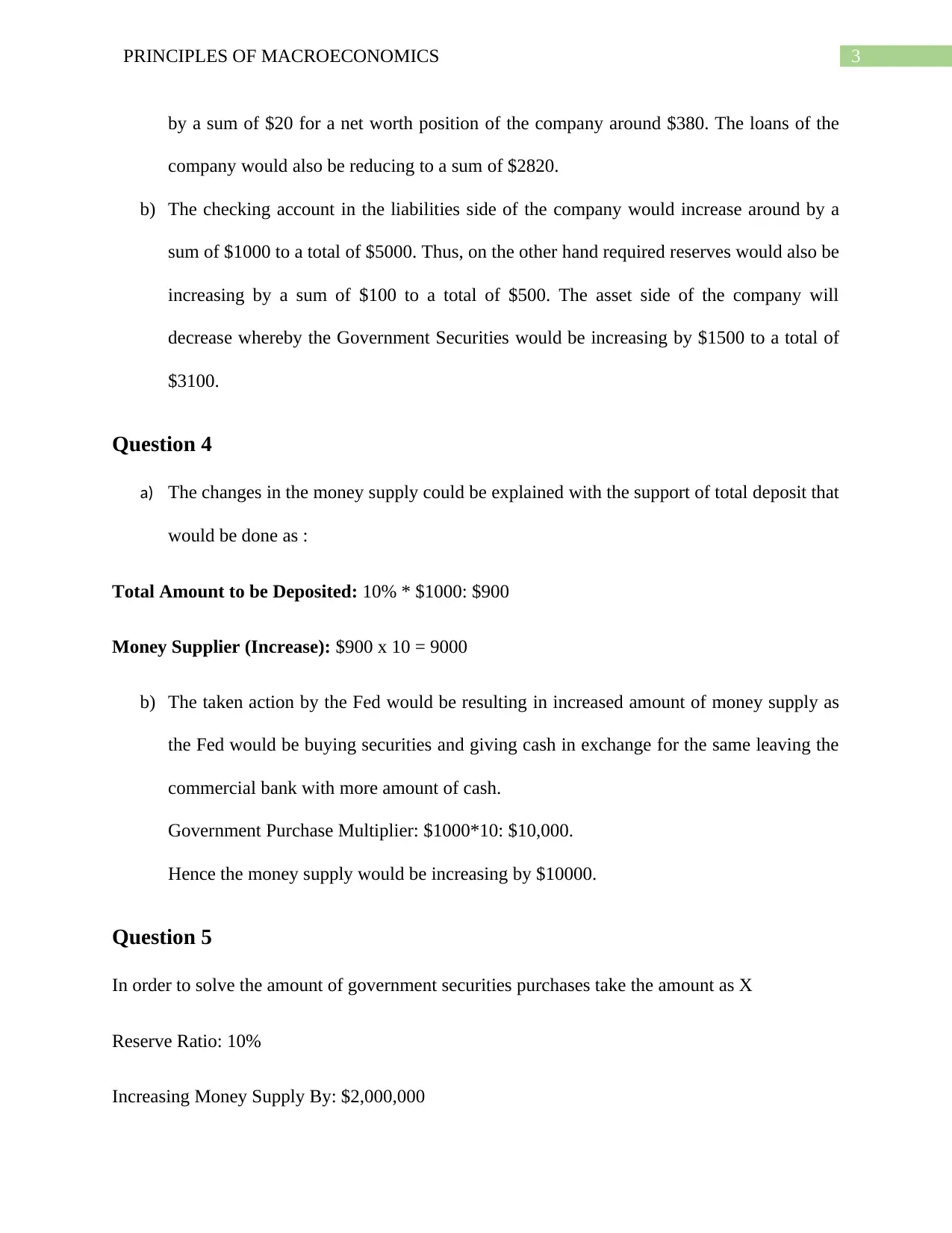
by a sum of $20 for a net worth position of the company around $380. The loans of the
company would also be reducing to a sum of $2820.
b) The checking account in the liabilities side of the company would increase around by a
sum of $1000 to a total of $5000. Thus, on the other hand required reserves would also be
increasing by a sum of $100 to a total of $500. The asset side of the company will
decrease whereby the Government Securities would be increasing by $1500 to a total of
$3100.
Question 4
a) The changes in the money supply could be explained with the support of total deposit that
would be done as :
Total Amount to be Deposited: 10% * $1000: $900
Money Supplier (Increase): $900 x 10 = 9000
b) The taken action by the Fed would be resulting in increased amount of money supply as
the Fed would be buying securities and giving cash in exchange for the same leaving the
commercial bank with more amount of cash.
Government Purchase Multiplier: $1000*10: $10,000.
Hence the money supply would be increasing by $10000.
Question 5
In order to solve the amount of government securities purchases take the amount as X
Reserve Ratio: 10%
Increasing Money Supply By: $2,000,000
tabler-icon-diamond-filled.svg

Paraphrase This Document

Need a fresh take? Get an instant paraphrase of this document with our AI Paraphraser
Document Page
4PRINCIPLES OF MACROECONOMICS
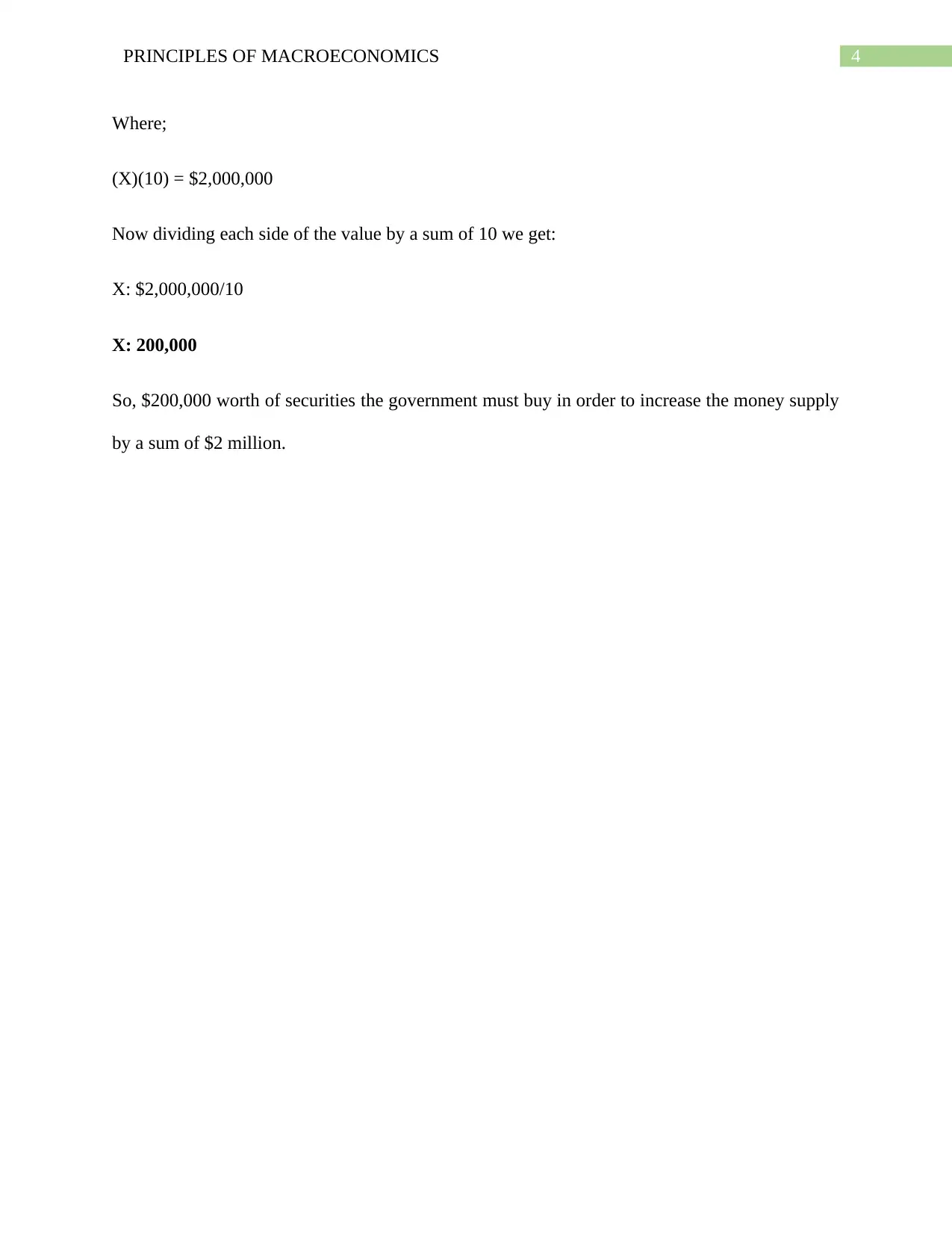
Where;
(X)(10) = $2,000,000
Now dividing each side of the value by a sum of 10 we get:
X: $2,000,000/10
X: 200,000
So, $200,000 worth of securities the government must buy in order to increase the money supply
by a sum of $2 million.
Document Page
5PRINCIPLES OF MACROECONOMICS
References
Ball, R. J. (2017). Inflation and the Theory of Money. Routledge.
Deleplace, G., & Nell, E. J. (Eds.). (2016). Money in Motion: the post-Keynesian and circulation
approaches. Springer.
Lothian, J. R. (2017). Equilibrium relationships between money and other economic variables.
Essays in International Money and Finance: Interest Rates, Exchange Rates, Prices and
the Supply of Money Within and Across Countries, 31.
Mansoor, A., Shoukat, Q., Bibi, S., Iqbal, K., Saeed, R., & Zaman, K. (2018). The Relationship
between Money Supply, Price Level and Economic Growth In Pakistan: Keynesian
versus Monetarist View. Review of Economic and Business Studies, 11(2), 49-64.
chevron_up_icon
1 out of 6
circle_padding
hide_on_mobile
zoom_out_icon
[object Object]