Price Theory: Analysis of a Proposed Merger in the Concrete Industry
VerifiedAdded on 2023/01/19
|12
|1522
|28
Report
AI Summary
This report analyzes the proposed merger of two firms (Big Industries and ConCorp) in the pre-mixed concrete industry, operating under an oligopoly market structure. The analysis, conducted from the perspective of an expert economist advising a regulatory authority, compares pre-merger and post-merger industry scenarios. Using the Cournot model, the report calculates output, price, profit, and consumer surplus for each scenario. The findings indicate that the merger, despite reducing overall industry output and increasing prices, leads to an increase in aggregate industry welfare due to significant profit gains that offset the loss in consumer surplus. The recommendation is to approve the merger, while also suggesting government monitoring of the merged firm's cost reduction claims. The financial implications of the merger, including potential tax revenue increases, are also considered. The analysis highlights the importance of considering both producer and consumer welfare when evaluating merger proposals.

Running head: PRICE THEORY
Price Theory
Name of the Student
Name of the University
Student ID
Course ID
Price Theory
Name of the Student
Name of the University
Student ID
Course ID
Paraphrase This Document
Need a fresh take? Get an instant paraphrase of this document with our AI Paraphraser

1PRICE THEORY
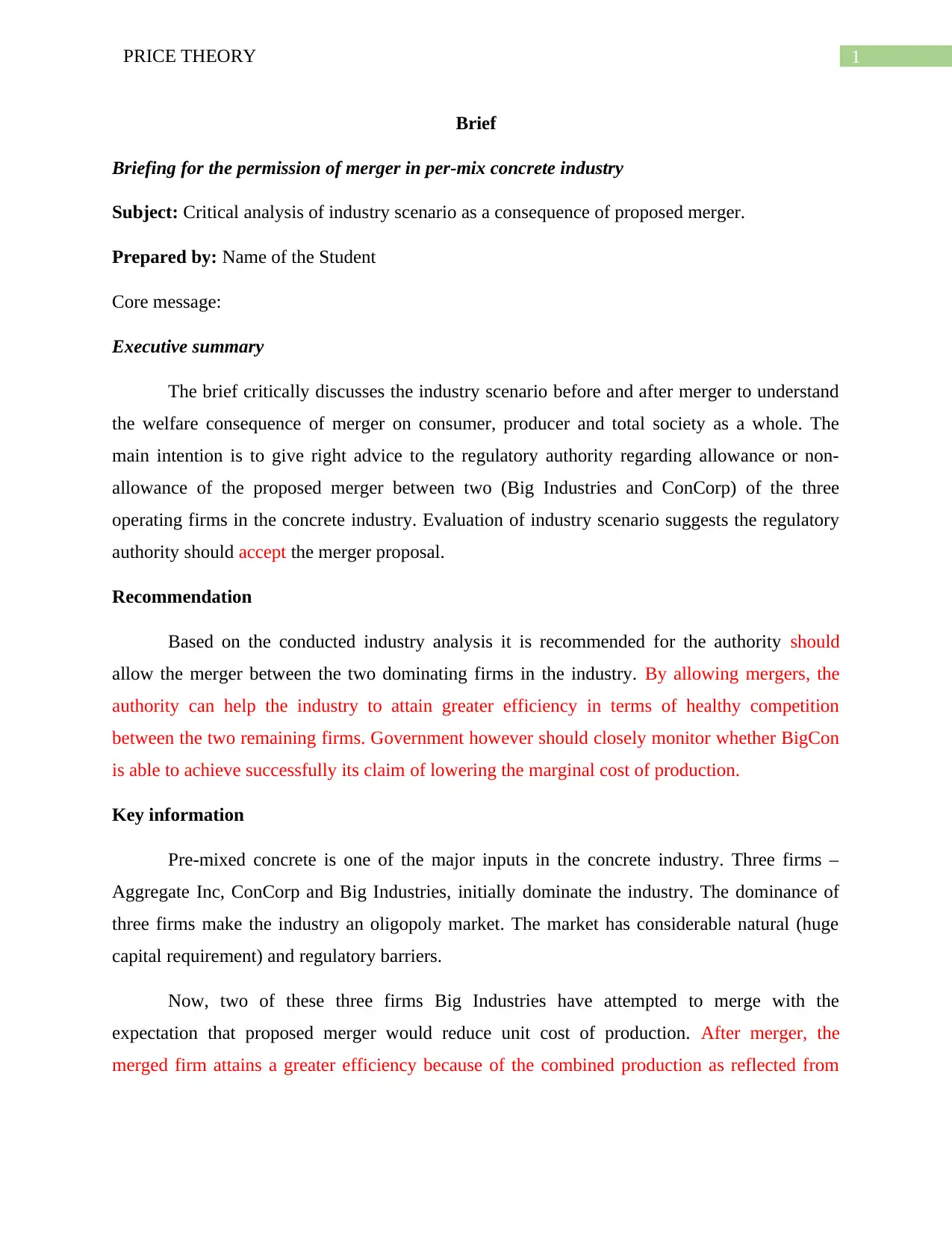
Brief
Briefing for the permission of merger in per-mix concrete industry
Subject: Critical analysis of industry scenario as a consequence of proposed merger.
Prepared by: Name of the Student
Core message:
Executive summary
The brief critically discusses the industry scenario before and after merger to understand
the welfare consequence of merger on consumer, producer and total society as a whole. The
main intention is to give right advice to the regulatory authority regarding allowance or non-
allowance of the proposed merger between two (Big Industries and ConCorp) of the three
operating firms in the concrete industry. Evaluation of industry scenario suggests the regulatory
authority should accept the merger proposal.
Recommendation
Based on the conducted industry analysis it is recommended for the authority should
allow the merger between the two dominating firms in the industry. By allowing mergers, the
authority can help the industry to attain greater efficiency in terms of healthy competition
between the two remaining firms. Government however should closely monitor whether BigCon
is able to achieve successfully its claim of lowering the marginal cost of production.
Key information
Pre-mixed concrete is one of the major inputs in the concrete industry. Three firms –
Aggregate Inc, ConCorp and Big Industries, initially dominate the industry. The dominance of
three firms make the industry an oligopoly market. The market has considerable natural (huge
capital requirement) and regulatory barriers.
Now, two of these three firms Big Industries have attempted to merge with the
expectation that proposed merger would reduce unit cost of production. After merger, the
merged firm attains a greater efficiency because of the combined production as reflected from
Brief
Briefing for the permission of merger in per-mix concrete industry
Subject: Critical analysis of industry scenario as a consequence of proposed merger.
Prepared by: Name of the Student
Core message:
Executive summary
The brief critically discusses the industry scenario before and after merger to understand
the welfare consequence of merger on consumer, producer and total society as a whole. The
main intention is to give right advice to the regulatory authority regarding allowance or non-
allowance of the proposed merger between two (Big Industries and ConCorp) of the three
operating firms in the concrete industry. Evaluation of industry scenario suggests the regulatory
authority should accept the merger proposal.
Recommendation
Based on the conducted industry analysis it is recommended for the authority should
allow the merger between the two dominating firms in the industry. By allowing mergers, the
authority can help the industry to attain greater efficiency in terms of healthy competition
between the two remaining firms. Government however should closely monitor whether BigCon
is able to achieve successfully its claim of lowering the marginal cost of production.
Key information
Pre-mixed concrete is one of the major inputs in the concrete industry. Three firms –
Aggregate Inc, ConCorp and Big Industries, initially dominate the industry. The dominance of
three firms make the industry an oligopoly market. The market has considerable natural (huge
capital requirement) and regulatory barriers.
Now, two of these three firms Big Industries have attempted to merge with the
expectation that proposed merger would reduce unit cost of production. After merger, the
merged firm attains a greater efficiency because of the combined production as reflected from

2PRICE THEORY
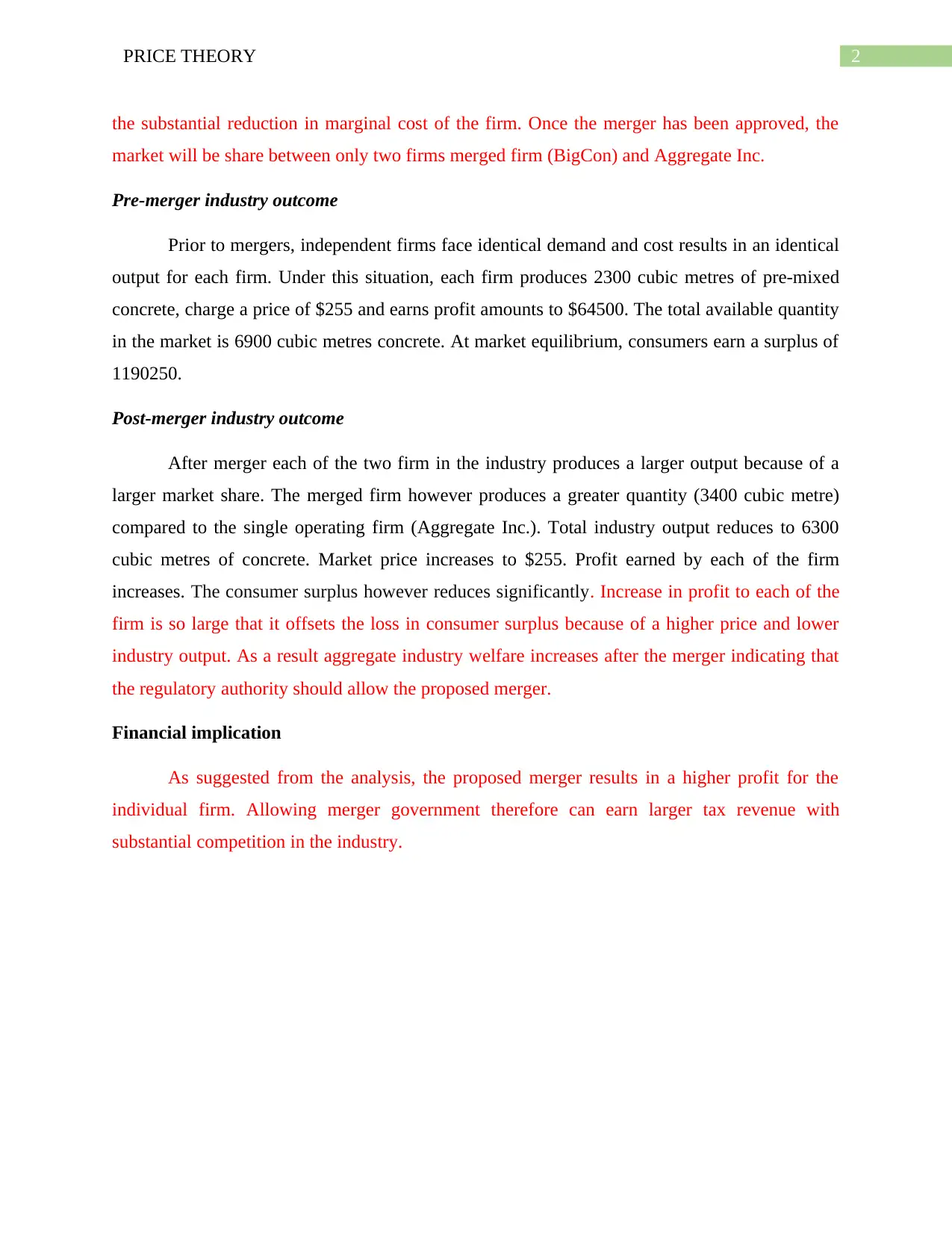
the substantial reduction in marginal cost of the firm. Once the merger has been approved, the
market will be share between only two firms merged firm (BigCon) and Aggregate Inc.
Pre-merger industry outcome
Prior to mergers, independent firms face identical demand and cost results in an identical
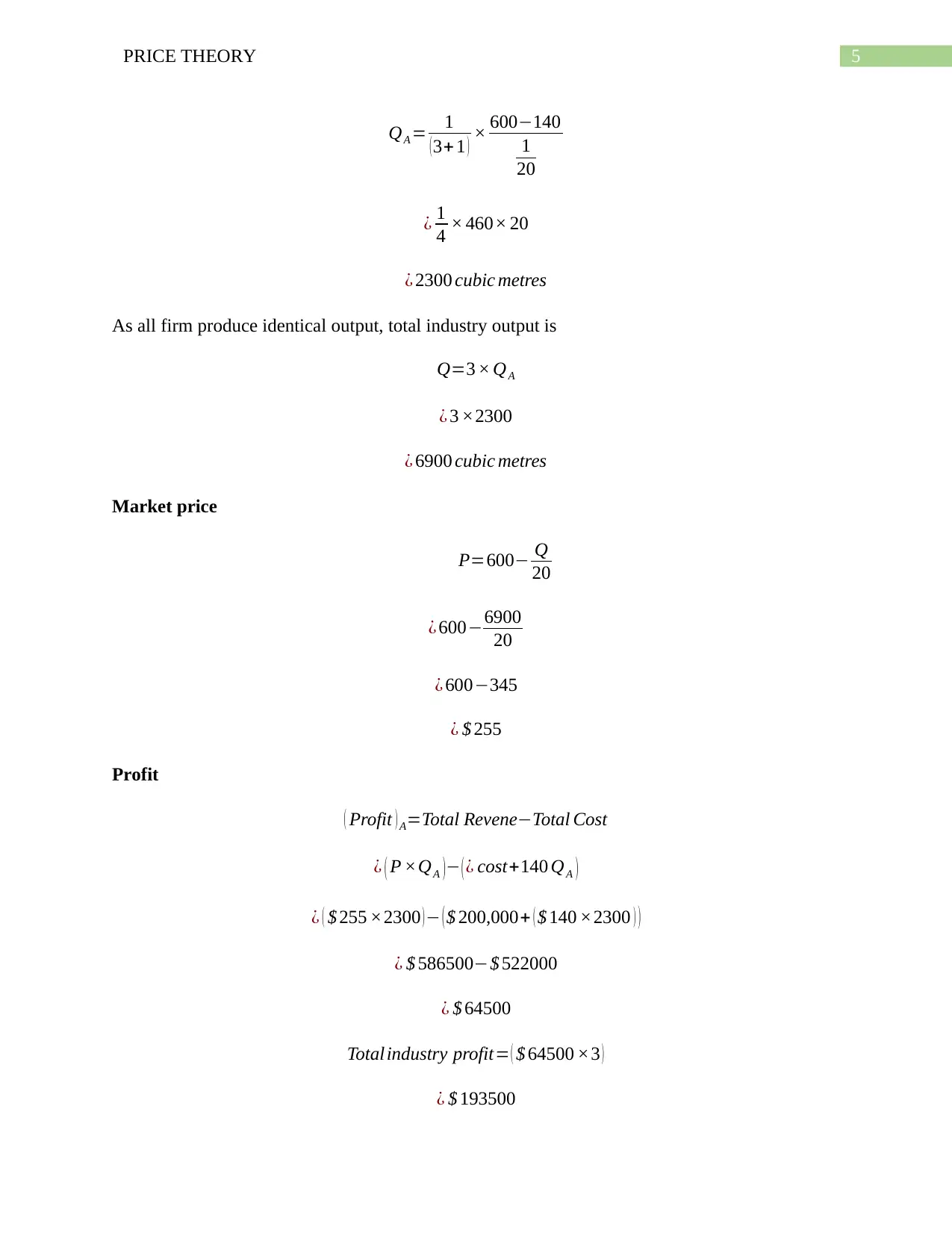
output for each firm. Under this situation, each firm produces 2300 cubic metres of pre-mixed
concrete, charge a price of $255 and earns profit amounts to $64500. The total available quantity
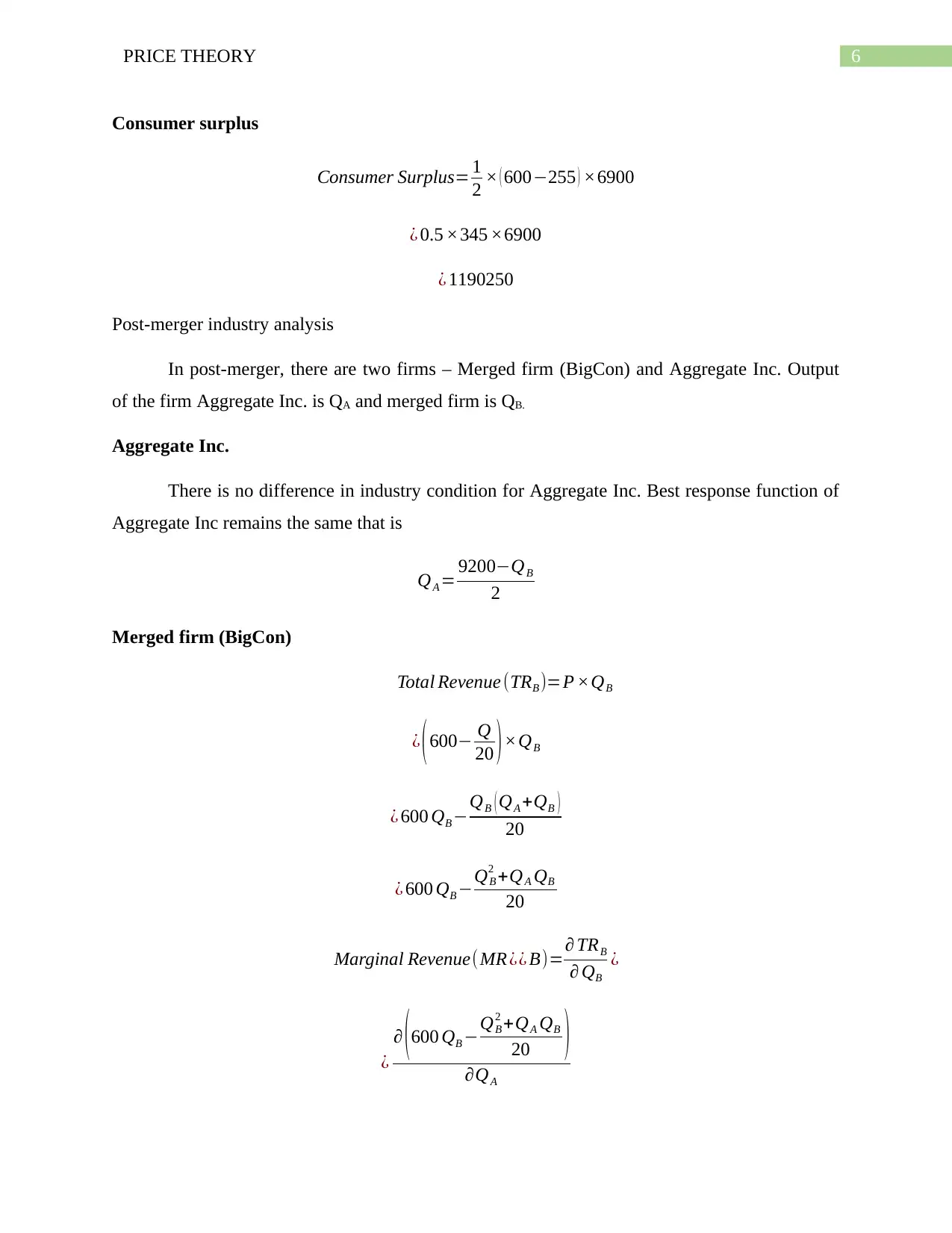
in the market is 6900 cubic metres concrete. At market equilibrium, consumers earn a surplus of
1190250.
Post-merger industry outcome
After merger each of the two firm in the industry produces a larger output because of a
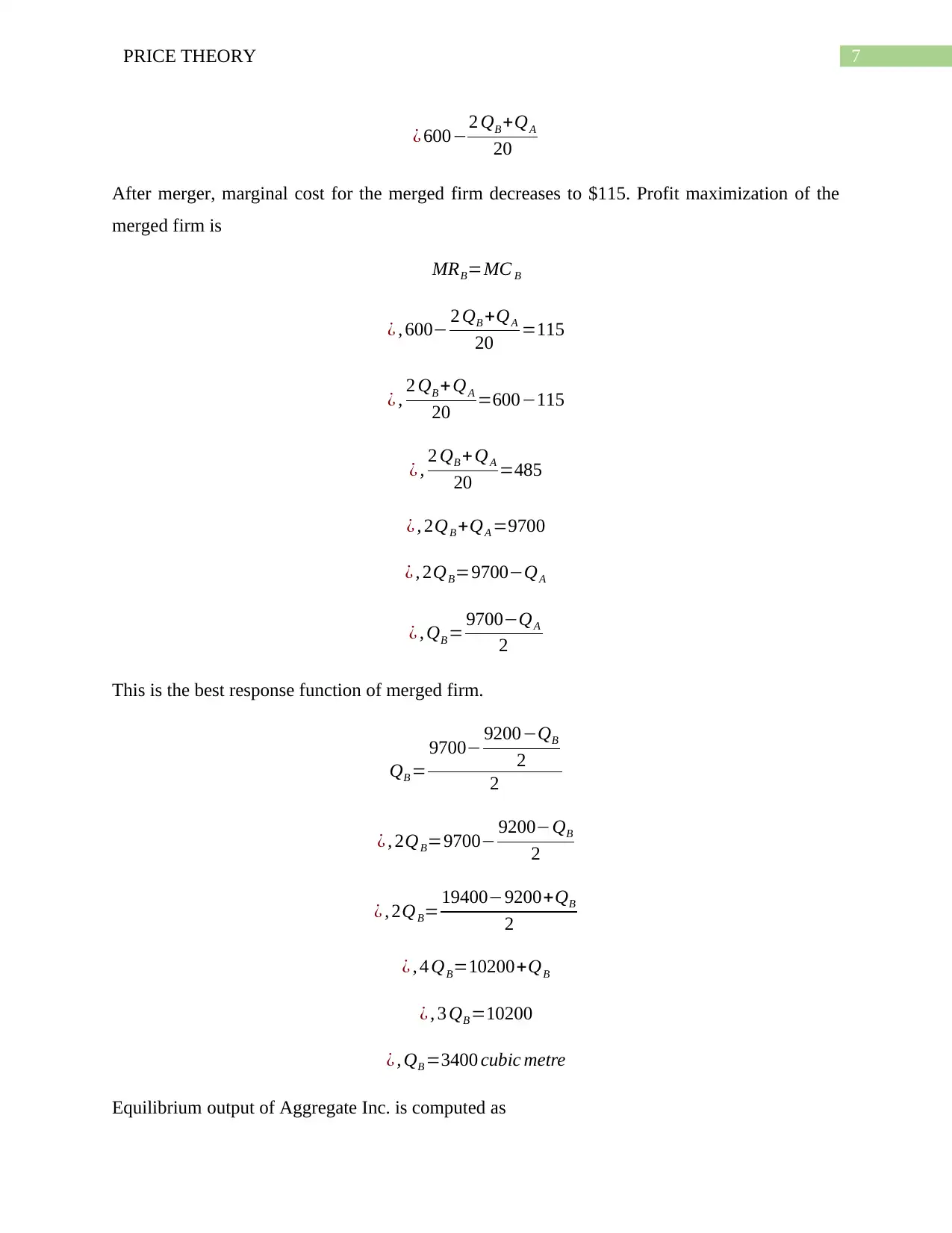
larger market share. The merged firm however produces a greater quantity (3400 cubic metre)
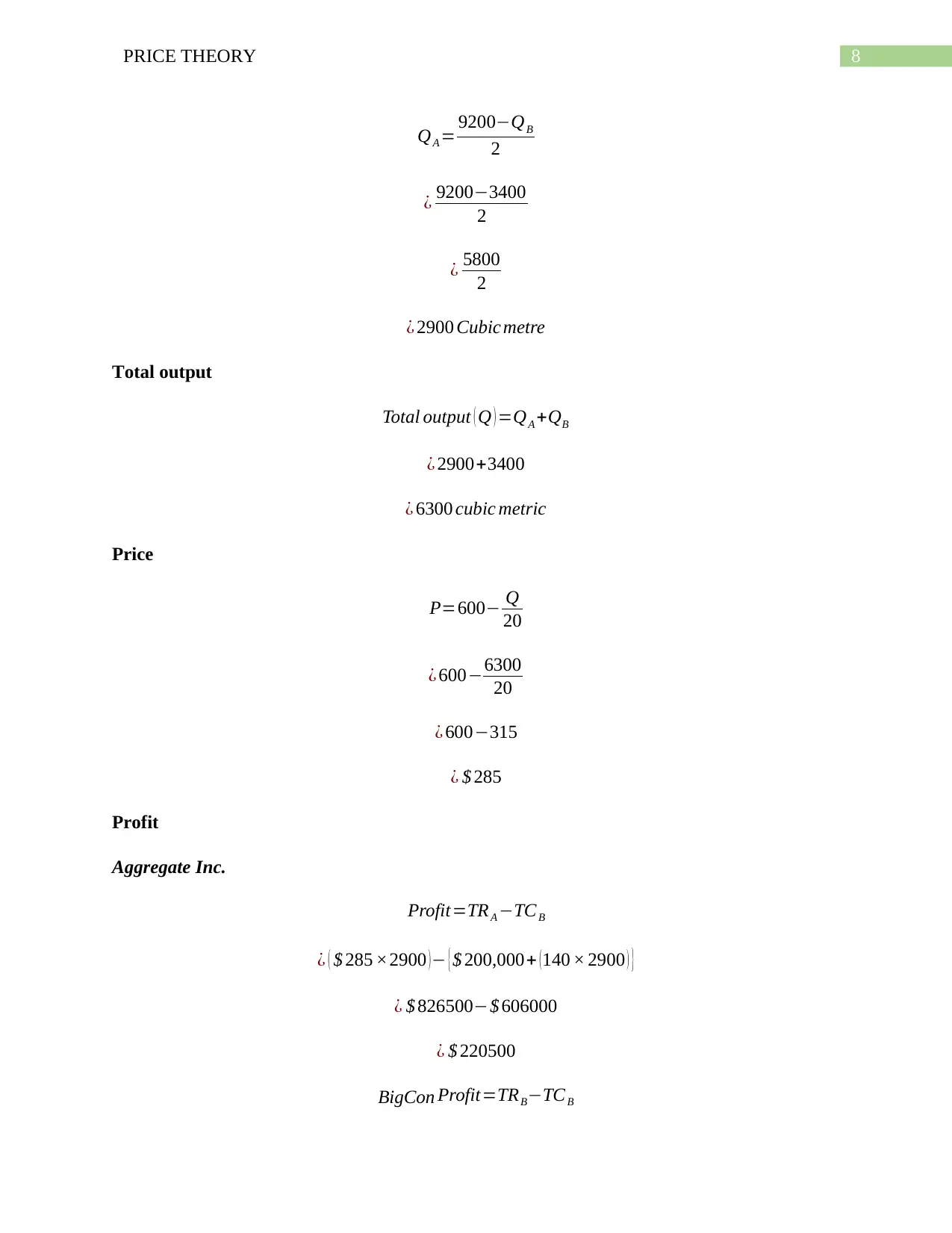
compared to the single operating firm (Aggregate Inc.). Total industry output reduces to 6300
cubic metres of concrete. Market price increases to $255. Profit earned by each of the firm
increases. The consumer surplus however reduces significantly. Increase in profit to each of the
firm is so large that it offsets the loss in consumer surplus because of a higher price and lower
industry output. As a result aggregate industry welfare increases after the merger indicating that
the regulatory authority should allow the proposed merger.
Financial implication
As suggested from the analysis, the proposed merger results in a higher profit for the
individual firm. Allowing merger government therefore can earn larger tax revenue with
substantial competition in the industry.
the substantial reduction in marginal cost of the firm. Once the merger has been approved, the
market will be share between only two firms merged firm (BigCon) and Aggregate Inc.
Pre-merger industry outcome
Prior to mergers, independent firms face identical demand and cost results in an identical
output for each firm. Under this situation, each firm produces 2300 cubic metres of pre-mixed
concrete, charge a price of $255 and earns profit amounts to $64500. The total available quantity
in the market is 6900 cubic metres concrete. At market equilibrium, consumers earn a surplus of
1190250.
Post-merger industry outcome
After merger each of the two firm in the industry produces a larger output because of a
larger market share. The merged firm however produces a greater quantity (3400 cubic metre)
compared to the single operating firm (Aggregate Inc.). Total industry output reduces to 6300
cubic metres of concrete. Market price increases to $255. Profit earned by each of the firm
increases. The consumer surplus however reduces significantly. Increase in profit to each of the
firm is so large that it offsets the loss in consumer surplus because of a higher price and lower
industry output. As a result aggregate industry welfare increases after the merger indicating that
the regulatory authority should allow the proposed merger.
Financial implication
As suggested from the analysis, the proposed merger results in a higher profit for the
individual firm. Allowing merger government therefore can earn larger tax revenue with
substantial competition in the industry.
⊘ This is a preview!⊘
Do you want full access?
Subscribe today to unlock all pages.

Trusted by 1+ million students worldwide

3PRICE THEORY
Industry Analysis
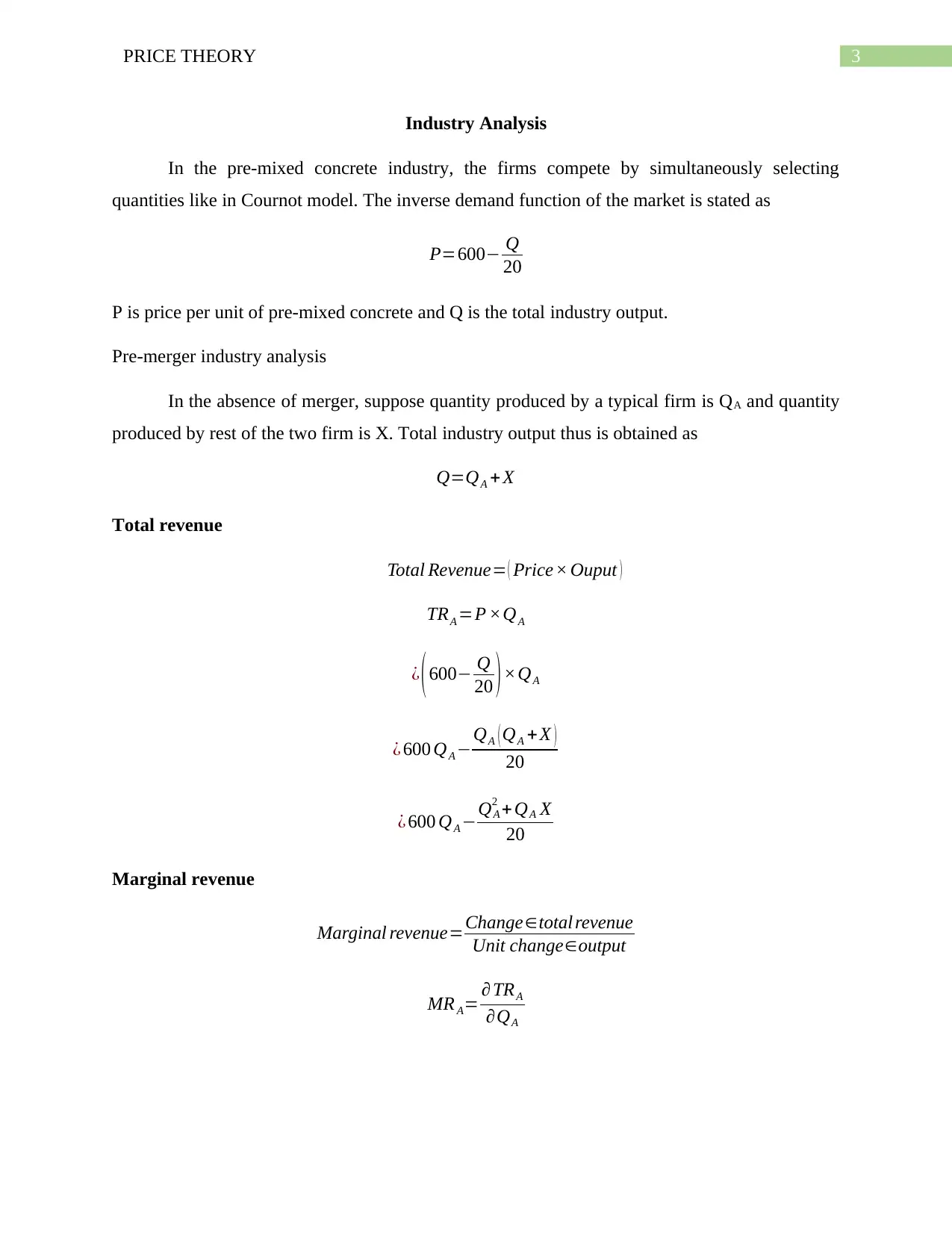
In the pre-mixed concrete industry, the firms compete by simultaneously selecting
quantities like in Cournot model. The inverse demand function of the market is stated as
P=600− Q
20
P is price per unit of pre-mixed concrete and Q is the total industry output.
Pre-merger industry analysis
In the absence of merger, suppose quantity produced by a typical firm is QA and quantity
produced by rest of the two firm is X. Total industry output thus is obtained as
Q=QA + X
Total revenue
Total Revenue= ( Price× Ouput )
TRA =P ×QA
¿ (600− Q
20 )×QA
¿ 600 QA −QA ( QA +X )
20
¿ 600 QA −QA
2 +QA X
20
Marginal revenue
Marginal revenue=Change∈total revenue
Unit change∈output
MR A= ∂ TRA
∂QA
Industry Analysis
In the pre-mixed concrete industry, the firms compete by simultaneously selecting
quantities like in Cournot model. The inverse demand function of the market is stated as
P=600− Q
20
P is price per unit of pre-mixed concrete and Q is the total industry output.
Pre-merger industry analysis
In the absence of merger, suppose quantity produced by a typical firm is QA and quantity
produced by rest of the two firm is X. Total industry output thus is obtained as
Q=QA + X
Total revenue
Total Revenue= ( Price× Ouput )
TRA =P ×QA
¿ (600− Q
20 )×QA
¿ 600 QA −QA ( QA +X )
20
¿ 600 QA −QA
2 +QA X
20
Marginal revenue
Marginal revenue=Change∈total revenue
Unit change∈output
MR A= ∂ TRA
∂QA
Paraphrase This Document
Need a fresh take? Get an instant paraphrase of this document with our AI Paraphraser

4PRICE THEORY
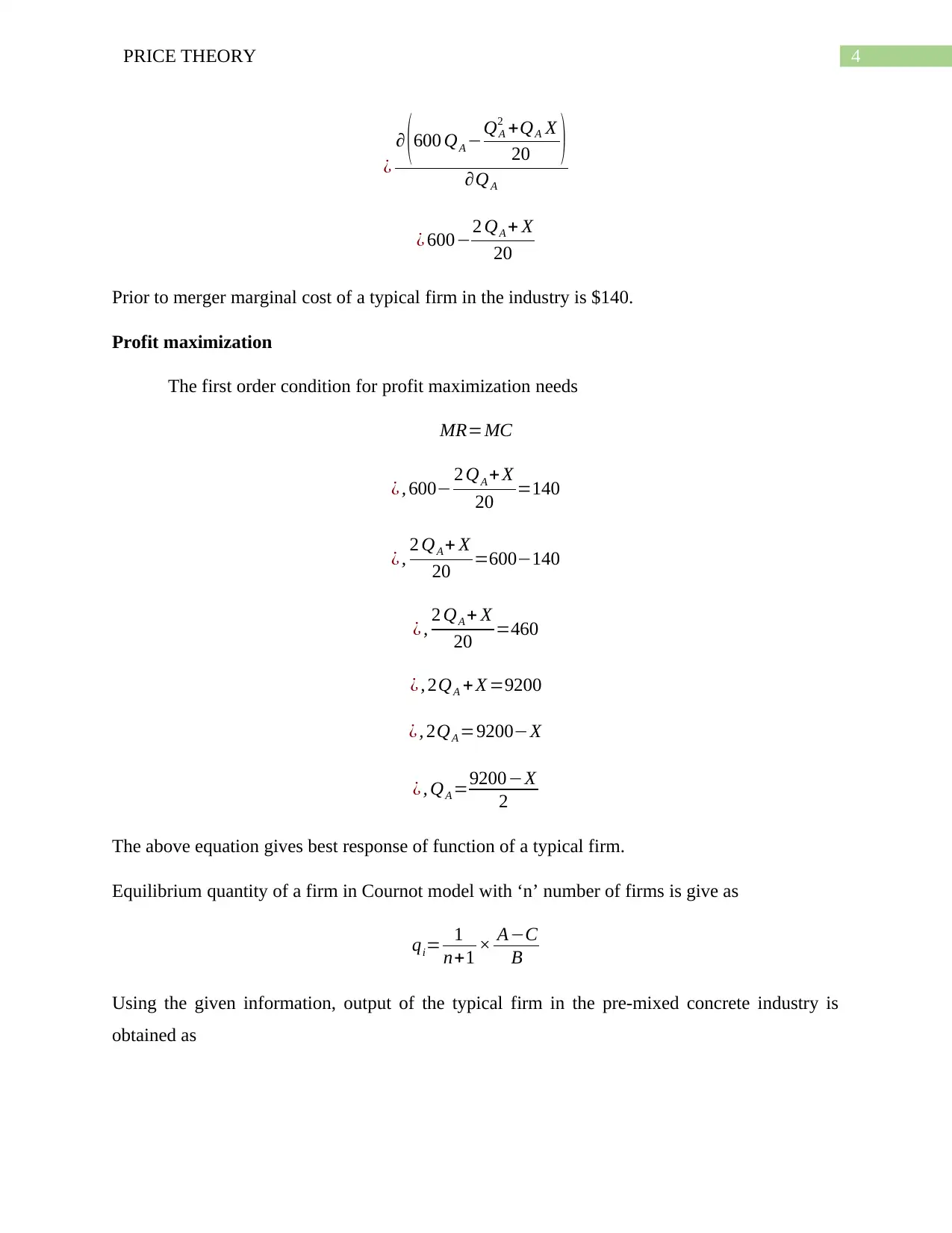
¿
∂ (600 QA −QA
2 +QA X
20 )
∂QA
¿ 600−2 QA + X
20
Prior to merger marginal cost of a typical firm in the industry is $140.
Profit maximization
The first order condition for profit maximization needs
MR=MC
¿ , 600− 2 QA + X
20 =140
¿ , 2 QA + X
20 =600−140
¿ , 2 QA + X
20 =460
¿ , 2QA + X =9200
¿ , 2QA =9200−X
¿ , QA =9200−X
2
The above equation gives best response of function of a typical firm.
Equilibrium quantity of a firm in Cournot model with ‘n’ number of firms is give as
qi= 1
n+1 × A−C
B
Using the given information, output of the typical firm in the pre-mixed concrete industry is
obtained as
¿
∂ (600 QA −QA
2 +QA X
20 )
∂QA
¿ 600−2 QA + X
20
Prior to merger marginal cost of a typical firm in the industry is $140.
Profit maximization
The first order condition for profit maximization needs
MR=MC
¿ , 600− 2 QA + X
20 =140
¿ , 2 QA + X
20 =600−140
¿ , 2 QA + X
20 =460
¿ , 2QA + X =9200
¿ , 2QA =9200−X
¿ , QA =9200−X
2
The above equation gives best response of function of a typical firm.
Equilibrium quantity of a firm in Cournot model with ‘n’ number of firms is give as
qi= 1
n+1 × A−C
B
Using the given information, output of the typical firm in the pre-mixed concrete industry is
obtained as

5PRICE THEORY
QA = 1
( 3+ 1 ) × 600−140
1
20
¿ 1
4 × 460× 20
¿ 2300 cubic metres
As all firm produce identical output, total industry output is
Q=3 × QA
¿ 3 ×2300
¿ 6900 cubic metres
Market price
P=600− Q
20
¿ 600−6900
20
¿ 600−345
¿ $ 255
Profit
( Profit ) A=Total Revene−Total Cost
¿ ( P ×QA )− ( ¿ cost+140 QA )
¿ ( $ 255 ×2300 ) − ( $ 200,000+ ( $ 140 ×2300 ) )
¿ $ 586500−$ 522000
¿ $ 64500
Total industry profit= ( $ 64500 ×3 )
¿ $ 193500
QA = 1
( 3+ 1 ) × 600−140
1
20
¿ 1
4 × 460× 20
¿ 2300 cubic metres
As all firm produce identical output, total industry output is
Q=3 × QA
¿ 3 ×2300
¿ 6900 cubic metres
Market price
P=600− Q
20
¿ 600−6900
20
¿ 600−345
¿ $ 255
Profit
( Profit ) A=Total Revene−Total Cost
¿ ( P ×QA )− ( ¿ cost+140 QA )
¿ ( $ 255 ×2300 ) − ( $ 200,000+ ( $ 140 ×2300 ) )
¿ $ 586500−$ 522000
¿ $ 64500
Total industry profit= ( $ 64500 ×3 )
¿ $ 193500
⊘ This is a preview!⊘
Do you want full access?
Subscribe today to unlock all pages.

Trusted by 1+ million students worldwide

6PRICE THEORY
Consumer surplus
Consumer Surplus= 1
2 × ( 600−255 ) ×6900
¿ 0.5 ×345 ×6900
¿ 1190250
Post-merger industry analysis
In post-merger, there are two firms – Merged firm (BigCon) and Aggregate Inc. Output
of the firm Aggregate Inc. is QA and merged firm is QB.
Aggregate Inc.
There is no difference in industry condition for Aggregate Inc. Best response function of
Aggregate Inc remains the same that is
QA = 9200−QB
2
Merged firm (BigCon)
Total Revenue (TRB )=P ×QB
¿ (600− Q
20 )×QB
¿ 600 QB −QB ( QA +QB )
20
¿ 600 QB −QB
2 +QA QB
20
Marginal Revenue(MR ¿¿ B)=∂ TRB
∂ QB
¿
¿
∂ (600 QB −QB
2 +QA QB
20 )
∂QA
Consumer surplus
Consumer Surplus= 1
2 × ( 600−255 ) ×6900
¿ 0.5 ×345 ×6900
¿ 1190250
Post-merger industry analysis
In post-merger, there are two firms – Merged firm (BigCon) and Aggregate Inc. Output
of the firm Aggregate Inc. is QA and merged firm is QB.
Aggregate Inc.
There is no difference in industry condition for Aggregate Inc. Best response function of
Aggregate Inc remains the same that is
QA = 9200−QB
2
Merged firm (BigCon)
Total Revenue (TRB )=P ×QB
¿ (600− Q
20 )×QB
¿ 600 QB −QB ( QA +QB )
20
¿ 600 QB −QB
2 +QA QB
20
Marginal Revenue(MR ¿¿ B)=∂ TRB
∂ QB
¿
¿
∂ (600 QB −QB
2 +QA QB
20 )
∂QA
Paraphrase This Document
Need a fresh take? Get an instant paraphrase of this document with our AI Paraphraser

7PRICE THEORY
¿ 600−2 QB +QA
20
After merger, marginal cost for the merged firm decreases to $115. Profit maximization of the
merged firm is
MRB=MC B
¿ , 600− 2 QB +QA
20 =115
¿ , 2 QB +QA
20 =600−115
¿ , 2 QB +QA
20 =485
¿ , 2QB +QA =9700
¿ , 2QB=9700−QA
¿ , QB = 9700−QA
2
This is the best response function of merged firm.
QB =
9700− 9200−QB
2
2
¿ , 2QB=9700− 9200−QB
2
¿ , 2QB= 19400−9200+QB
2
¿ , 4 QB=10200+QB
¿ , 3 QB =10200
¿ , QB =3400 cubic metre
Equilibrium output of Aggregate Inc. is computed as
¿ 600−2 QB +QA
20
After merger, marginal cost for the merged firm decreases to $115. Profit maximization of the
merged firm is
MRB=MC B
¿ , 600− 2 QB +QA
20 =115
¿ , 2 QB +QA
20 =600−115
¿ , 2 QB +QA
20 =485
¿ , 2QB +QA =9700
¿ , 2QB=9700−QA
¿ , QB = 9700−QA
2
This is the best response function of merged firm.
QB =
9700− 9200−QB
2
2
¿ , 2QB=9700− 9200−QB
2
¿ , 2QB= 19400−9200+QB
2
¿ , 4 QB=10200+QB
¿ , 3 QB =10200
¿ , QB =3400 cubic metre
Equilibrium output of Aggregate Inc. is computed as

8PRICE THEORY
QA = 9200−QB
2
¿ 9200−3400
2
¿ 5800
2
¿ 2900 Cubic metre
Total output
Total output ( Q ) =QA +QB
¿ 2900+3400
¿ 6300 cubic metric
Price
P=600− Q
20
¿ 600−6300
20
¿ 600−315
¿ $ 285
Profit
Aggregate Inc.
Profit=TRA −TC B
¿ ( $ 285 ×2900 ) − { $ 200,000+ ( 140 × 2900 ) }
¿ $ 826500−$ 606000
¿ $ 220500
BigCon Profit=TRB−TCB
QA = 9200−QB
2
¿ 9200−3400
2
¿ 5800
2
¿ 2900 Cubic metre
Total output
Total output ( Q ) =QA +QB
¿ 2900+3400
¿ 6300 cubic metric
Price
P=600− Q
20
¿ 600−6300
20
¿ 600−315
¿ $ 285
Profit
Aggregate Inc.
Profit=TRA −TC B
¿ ( $ 285 ×2900 ) − { $ 200,000+ ( 140 × 2900 ) }
¿ $ 826500−$ 606000
¿ $ 220500
BigCon Profit=TRB−TCB
⊘ This is a preview!⊘
Do you want full access?
Subscribe today to unlock all pages.

Trusted by 1+ million students worldwide

9PRICE THEORY
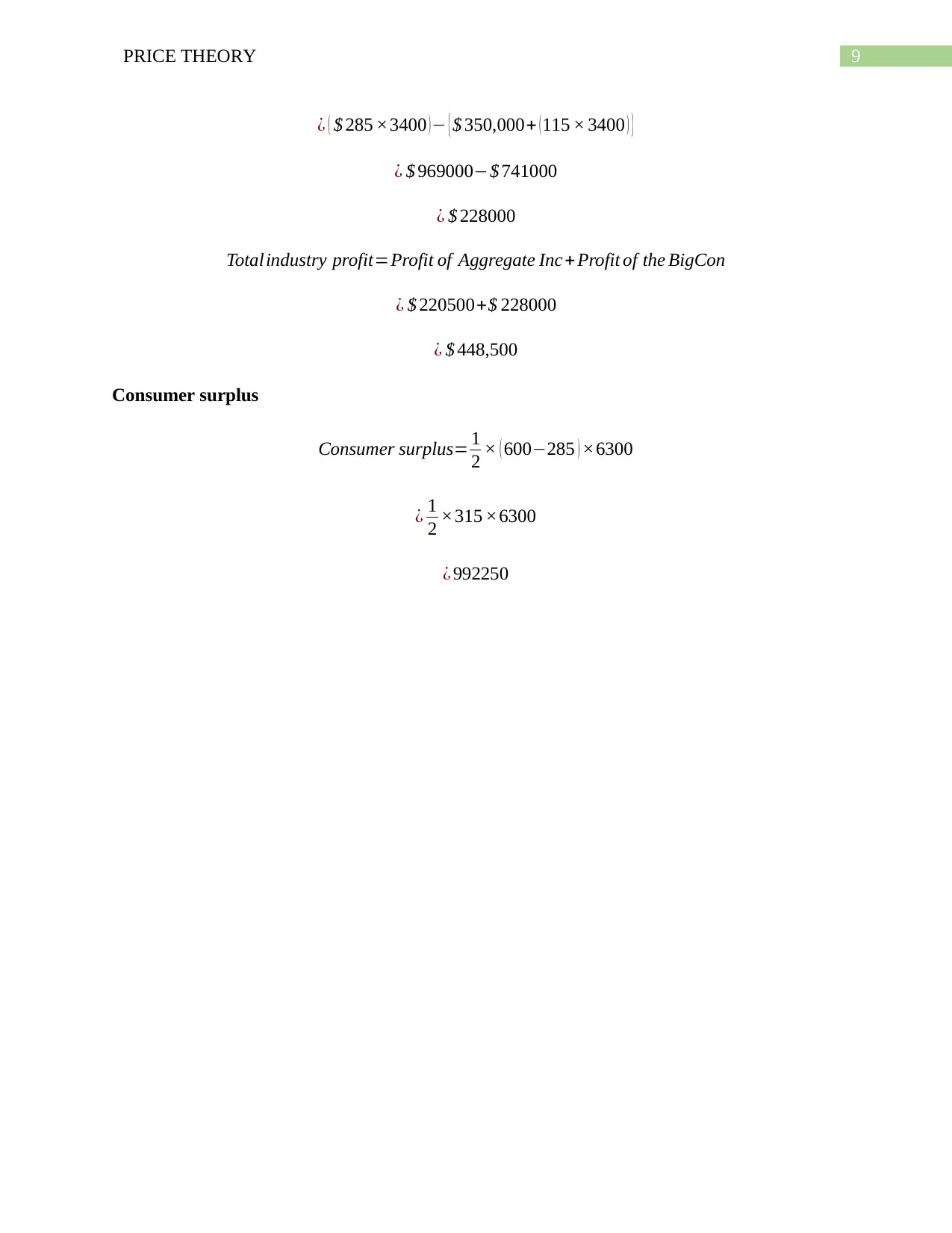
¿ ( $ 285 ×3400 ) − { $ 350,000+ ( 115 × 3400 ) }
¿ $ 969000−$ 741000
¿ $ 228000
Totalindustry profit=Profit of Aggregate Inc+ Profit of the BigCon
¿ $ 220500+$ 228000
¿ $ 448,500
Consumer surplus
Consumer surplus= 1
2 × ( 600−285 ) ×6300
¿ 1
2 ×315 ×6300
¿ 992250
¿ ( $ 285 ×3400 ) − { $ 350,000+ ( 115 × 3400 ) }
¿ $ 969000−$ 741000
¿ $ 228000
Totalindustry profit=Profit of Aggregate Inc+ Profit of the BigCon
¿ $ 220500+$ 228000
¿ $ 448,500
Consumer surplus
Consumer surplus= 1
2 × ( 600−285 ) ×6300
¿ 1
2 ×315 ×6300
¿ 992250
Paraphrase This Document
Need a fresh take? Get an instant paraphrase of this document with our AI Paraphraser

10PRICE THEORY

11PRICE THEORY
Bibliography
Baumol, W.J. and Blinder, A.S., 2015. Microeconomics: Principles and policy. Nelson
Education.
Friedman, L.S., 2017. The microeconomics of public policy analysis. Princeton University Press.
Kreps, D.M., 2019. Microeconomics for managers. Princeton University Press.
Mochrie, R., 2015. Intermediate microeconomics. Macmillan International Higher Education.
Bibliography
Baumol, W.J. and Blinder, A.S., 2015. Microeconomics: Principles and policy. Nelson
Education.
Friedman, L.S., 2017. The microeconomics of public policy analysis. Princeton University Press.
Kreps, D.M., 2019. Microeconomics for managers. Princeton University Press.
Mochrie, R., 2015. Intermediate microeconomics. Macmillan International Higher Education.
⊘ This is a preview!⊘
Do you want full access?
Subscribe today to unlock all pages.

Trusted by 1+ million students worldwide
1 out of 12
Your All-in-One AI-Powered Toolkit for Academic Success.
+13062052269
info@desklib.com
Available 24*7 on WhatsApp / Email
Unlock your academic potential
Copyright © 2020–2025 A2Z Services. All Rights Reserved. Developed and managed by ZUCOL.