University Microeconomics Assignment: ECON3000 Solution Analysis

Verified

Added on  2022/09/18

|17
|451
|20
Homework Assignment
AI Summary
This document provides a comprehensive solution to a microeconomics assignment, addressing key concepts such as price elasticity of demand, Lagrangian functions, and various market structures. The assignment covers topics including Bertrand price competition, monopoly, Cournot, and the Stackelberg model. Solutions are presented for multiple-choice questions and problem-solving exercises, with detailed calculations and explanations. The document analyzes profit maximization conditions, reaction functions, and the effects of different market structures on output, prices, and profits. Furthermore, it includes calculations for deadweight loss, consumer surplus, and producer surplus under different scenarios. The assignment also addresses the application of microeconomic principles to real-world scenarios, such as revenue maximization for a university parking system. Overall, the document serves as a valuable resource for students studying microeconomic theory, offering insights into problem-solving techniques and the application of economic concepts.
Document Page
Running head: MICROECONOMICS
Microeconomics
Name of the Student
Name of the University
Course ID
tabler-icon-diamond-filled.svg

Paraphrase This Document

Need a fresh take? Get an instant paraphrase of this document with our AI Paraphraser
Document Page
1MICROECONOMICS
Table of Contents
Question 1........................................................................................................................................2
Question 7........................................................................................................................................3
Question 2........................................................................................................................................4
Question 10......................................................................................................................................4
Question 11......................................................................................................................................5
Question 12......................................................................................................................................7
Question 15......................................................................................................................................7
Question 16......................................................................................................................................7
Question 17......................................................................................................................................7
Question 18......................................................................................................................................8
Question 19......................................................................................................................................8
Question 20....................................................................................................................................10
Question 21....................................................................................................................................11
Question 22....................................................................................................................................14
Question 23....................................................................................................................................14
Document Page
2MICROECONOMICS
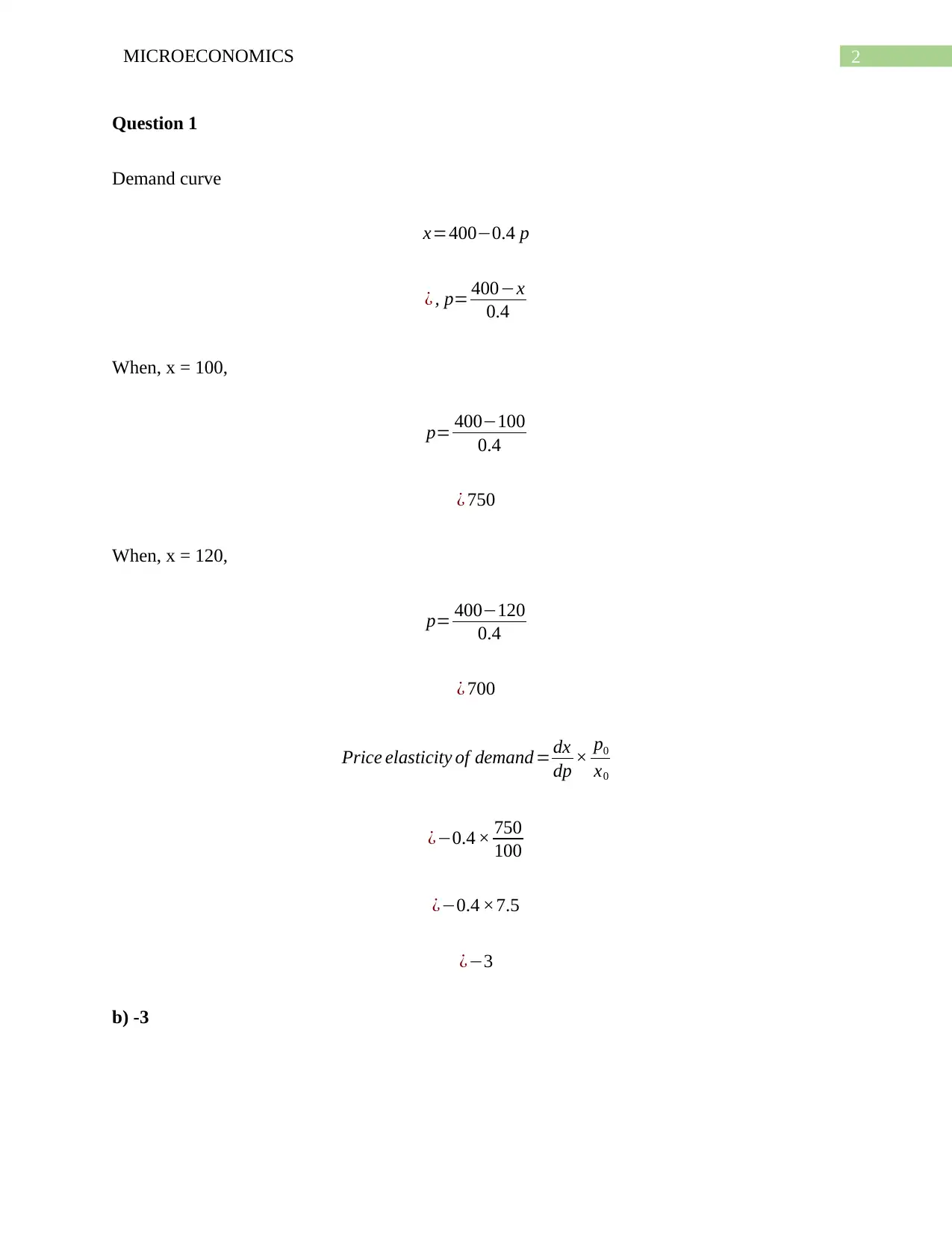
Question 1
Demand curve
x=4000.4 p
¿ , p= 400x
0.4
When, x = 100,
p= 400100
0.4
¿ 750
When, x = 120,
p= 400120
0.4
¿ 700
Price elasticity of demand = dx
dp × p0
x0
¿0.4 × 750
100
¿0.4 ×7.5
¿3
b) -3
Document Page
3MICROECONOMICS
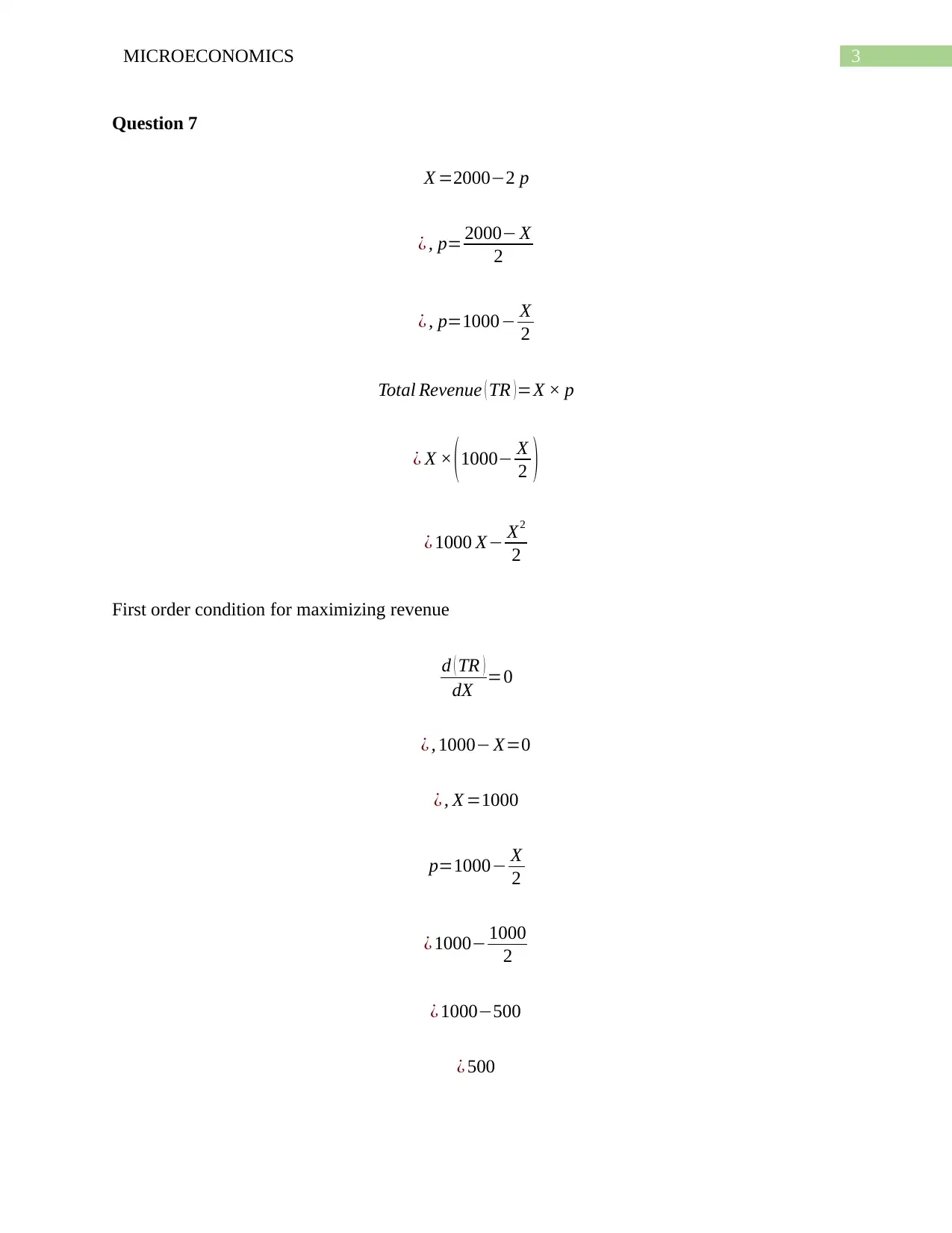
Question 7
X =20002 p
¿ , p= 2000 X
2
¿ , p=1000 X
2
Total Revenue ( TR )=X × p
¿ X × (1000 X
2 )
¿ 1000 X X2
2
First order condition for maximizing revenue
d ( TR )
dX =0
¿ , 1000 X=0
¿ , X =1000
p=1000 X
2
¿ 1000 1000
2
¿ 1000500
¿ 500
tabler-icon-diamond-filled.svg

Paraphrase This Document

Need a fresh take? Get an instant paraphrase of this document with our AI Paraphraser
Document Page
4MICROECONOMICS
d. p = 500$/year
Question 2
b. The slope of the line that is tangent to y=f(x) at the point (2,f(2)) in the (x,y) Cartesian space.
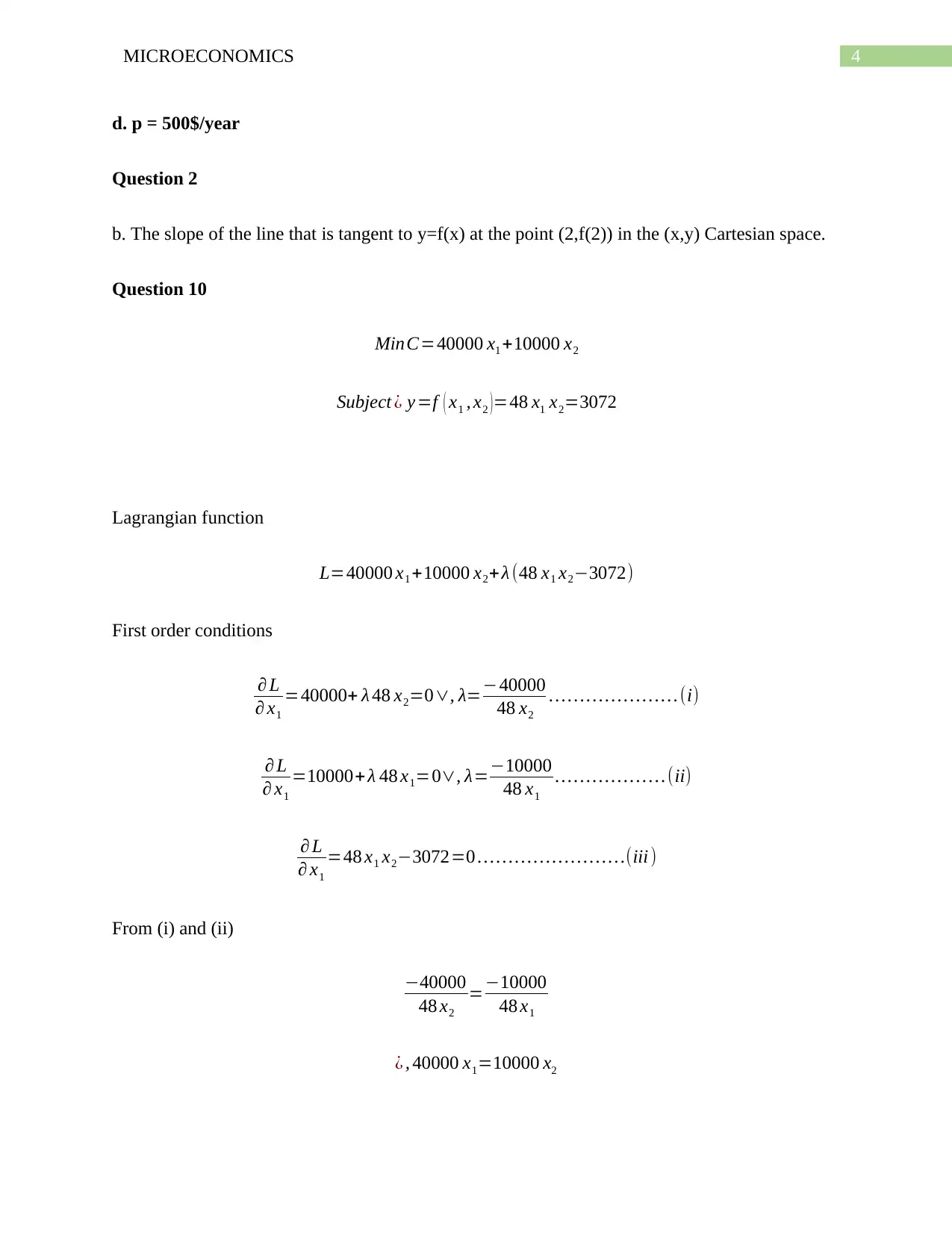
Question 10
MinC=40000 x1 +10000 x2
Subject ¿ y =f ( x1 , x2 ) =48 x1 x2=3072
Lagrangian function
L=40000 x1 +10000 x2+ λ (48 x1 x23072)
First order conditions
L
x1
=40000+ λ 48 x2=0, λ=40000
48 x2
(i)
L
x1
=10000+λ 48 x1=0, λ=10000
48 x1
(ii)
L
x1
=48 x1 x23072=0 (iii )
From (i) and (ii)
40000
48 x2
=10000
48 x1
¿ , 40000 x1=10000 x2
Document Page
5MICROECONOMICS
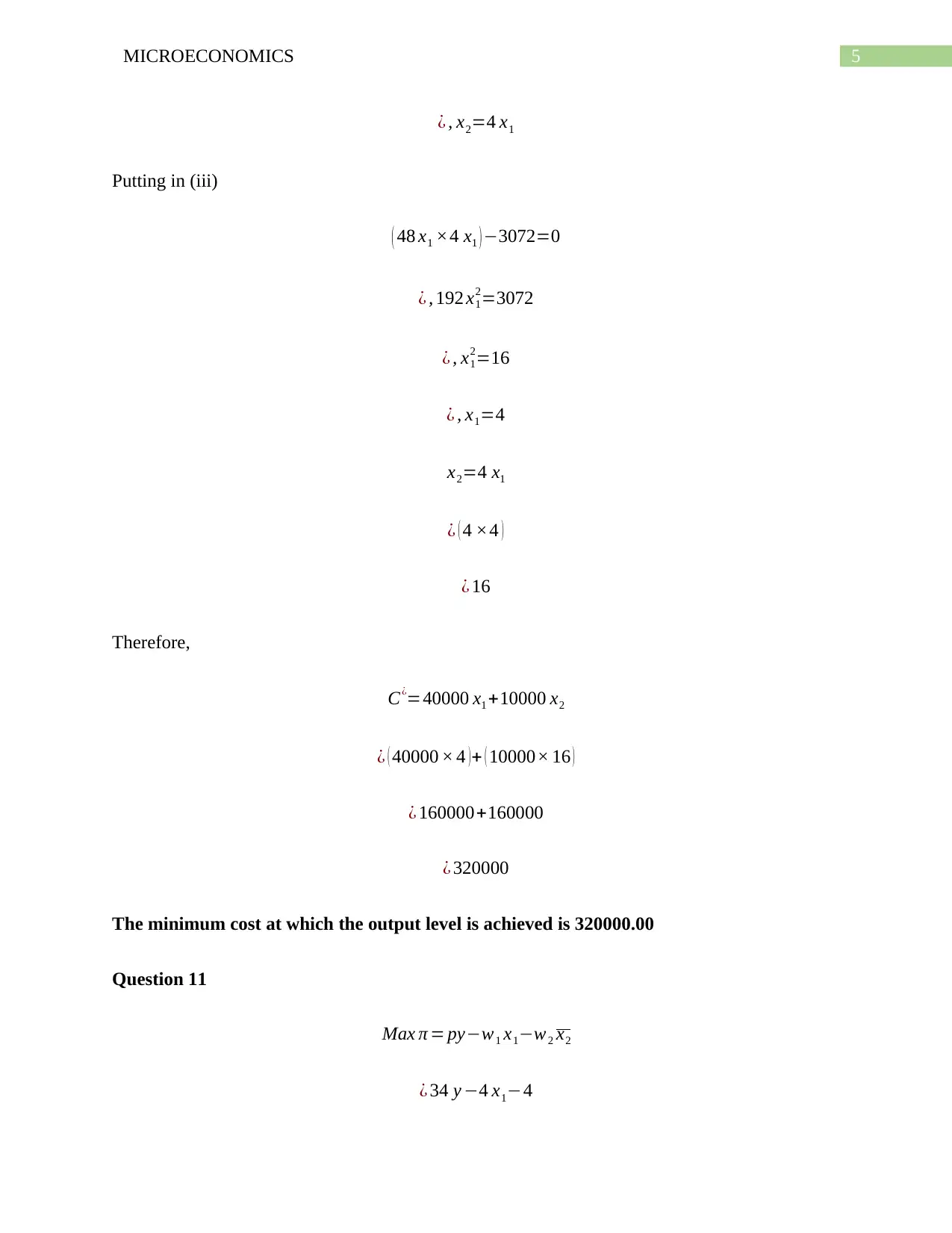
¿ , x2=4 x1
Putting in (iii)
( 48 x1 ×4 x1 ) 3072=0
¿ , 192 x1
2=3072
¿ , x1
2=16
¿ , x1=4
x2=4 x1
¿ ( 4 ×4 )
¿ 16
Therefore,
C¿=40000 x1 +10000 x2
¿ ( 40000 × 4 ) + ( 10000× 16 )
¿ 160000+160000
¿ 320000
The minimum cost at which the output level is achieved is 320000.00
Question 11
Max π = pyw1 x1w2 x2
¿ 34 y 4 x14
Document Page
6MICROECONOMICS
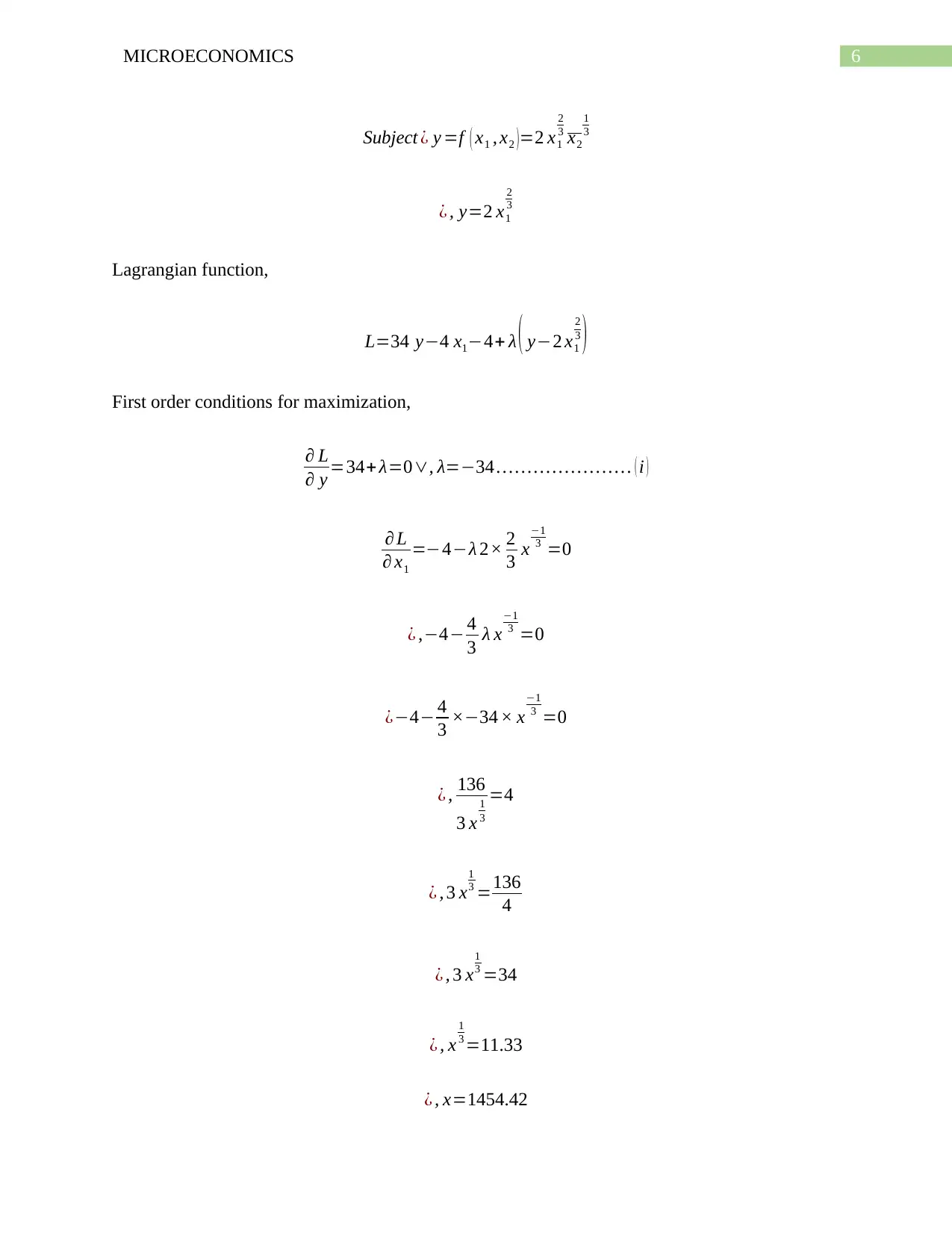
Subject ¿ y =f ( x1 , x2 )=2 x1
2
3 x2
1
3
¿ , y=2 x1
2
3
Lagrangian function,
L=34 y4 x14+ λ ( y2 x1
2
3 )
First order conditions for maximization,
L
y =34+ λ=0, λ=34 . ( i )
L
x1
=4λ 2× 2
3 x
1
3 =0
¿ ,4 4
3 λ x
1
3 =0
¿4 4
3 ×34 × x
1
3 =0
¿ , 136
3 x
1
3
=4
¿ , 3 x
1
3 =136
4
¿ , 3 x
1
3 =34
¿ , x
1
3 =11.33
¿ , x=1454.42
tabler-icon-diamond-filled.svg

Paraphrase This Document

Need a fresh take? Get an instant paraphrase of this document with our AI Paraphraser
Document Page
7MICROECONOMICS
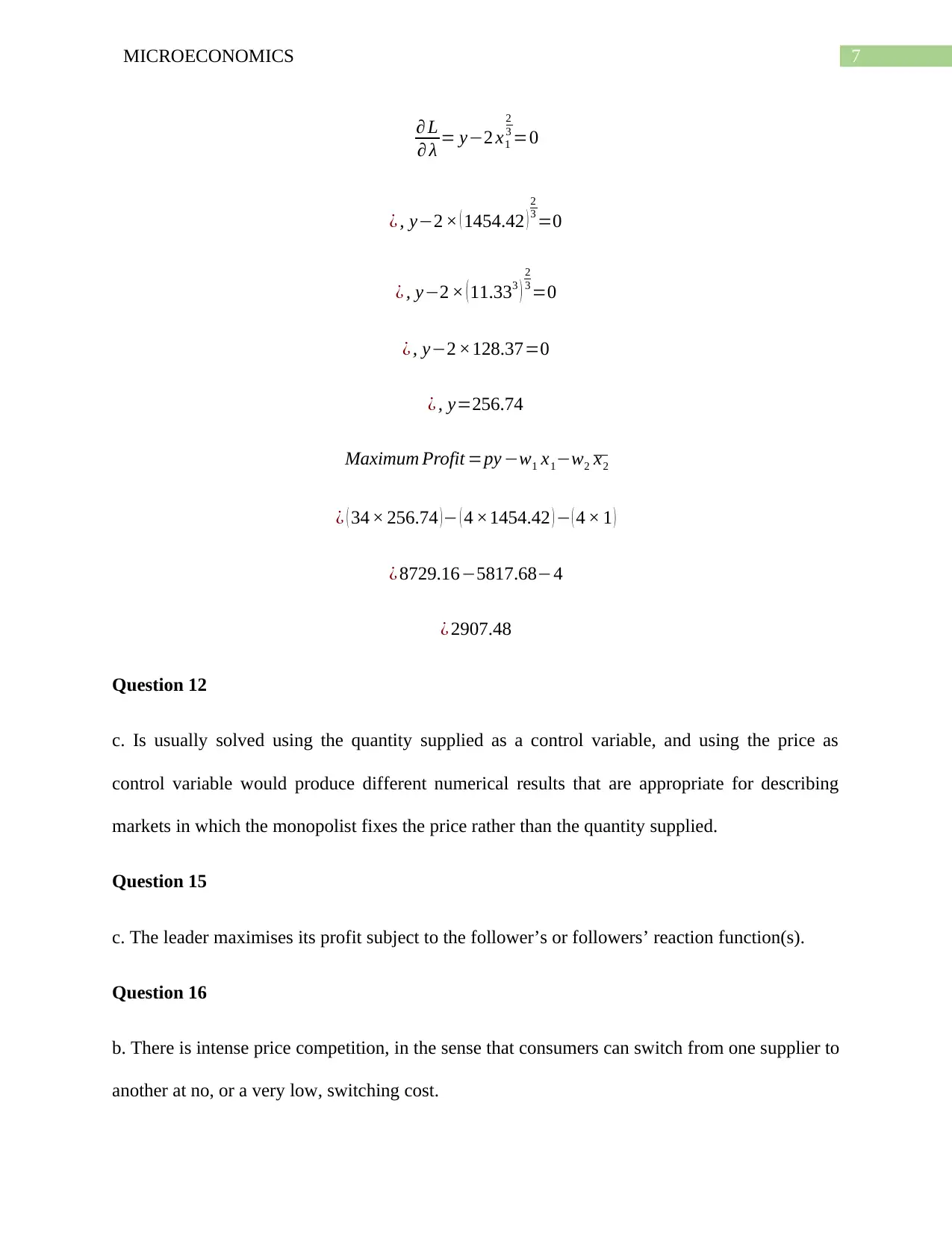
L
λ = y2 x1
2
3 =0
¿ , y2 × ( 1454.42 )
2
3 =0
¿ , y2 × ( 11.333 )
2
3 =0
¿ , y2 ×128.37=0
¿ , y=256.74
Maximum Profit =py w1 x1w2 x2
¿ ( 34 × 256.74 ) ( 4 ×1454.42 ) ( 4 × 1 )
¿ 8729.165817.684
¿ 2907.48
Question 12
c. Is usually solved using the quantity supplied as a control variable, and using the price as
control variable would produce different numerical results that are appropriate for describing
markets in which the monopolist fixes the price rather than the quantity supplied.
Question 15
c. The leader maximises its profit subject to the follower’s or followers’ reaction function(s).
Question 16
b. There is intense price competition, in the sense that consumers can switch from one supplier to
another at no, or a very low, switching cost.
Document Page
8MICROECONOMICS
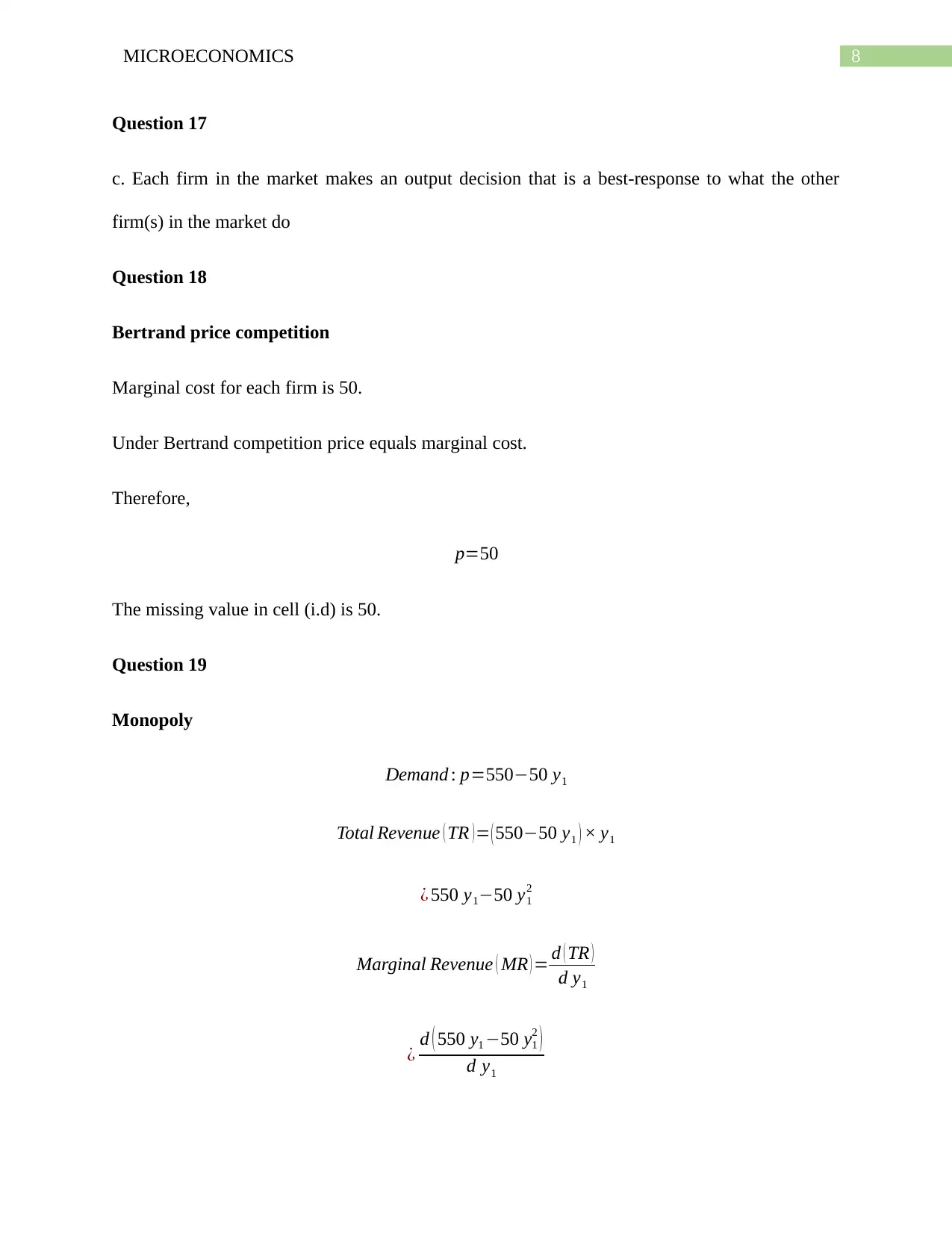
Question 17
c. Each firm in the market makes an output decision that is a best-response to what the other
firm(s) in the market do
Question 18
Bertrand price competition
Marginal cost for each firm is 50.
Under Bertrand competition price equals marginal cost.
Therefore,
p=50
The missing value in cell (i.d) is 50.
Question 19
Monopoly
Demand : p=55050 y1
Total Revenue ( TR ) = ( 55050 y1 ) × y1
¿ 550 y150 y1
2
Marginal Revenue ( MR ) = d ( TR )
d y1
¿ d ( 550 y1 50 y1
2 )
d y1
Document Page
9MICROECONOMICS
¿ 550100 y1
Cost function : C1=50 y1
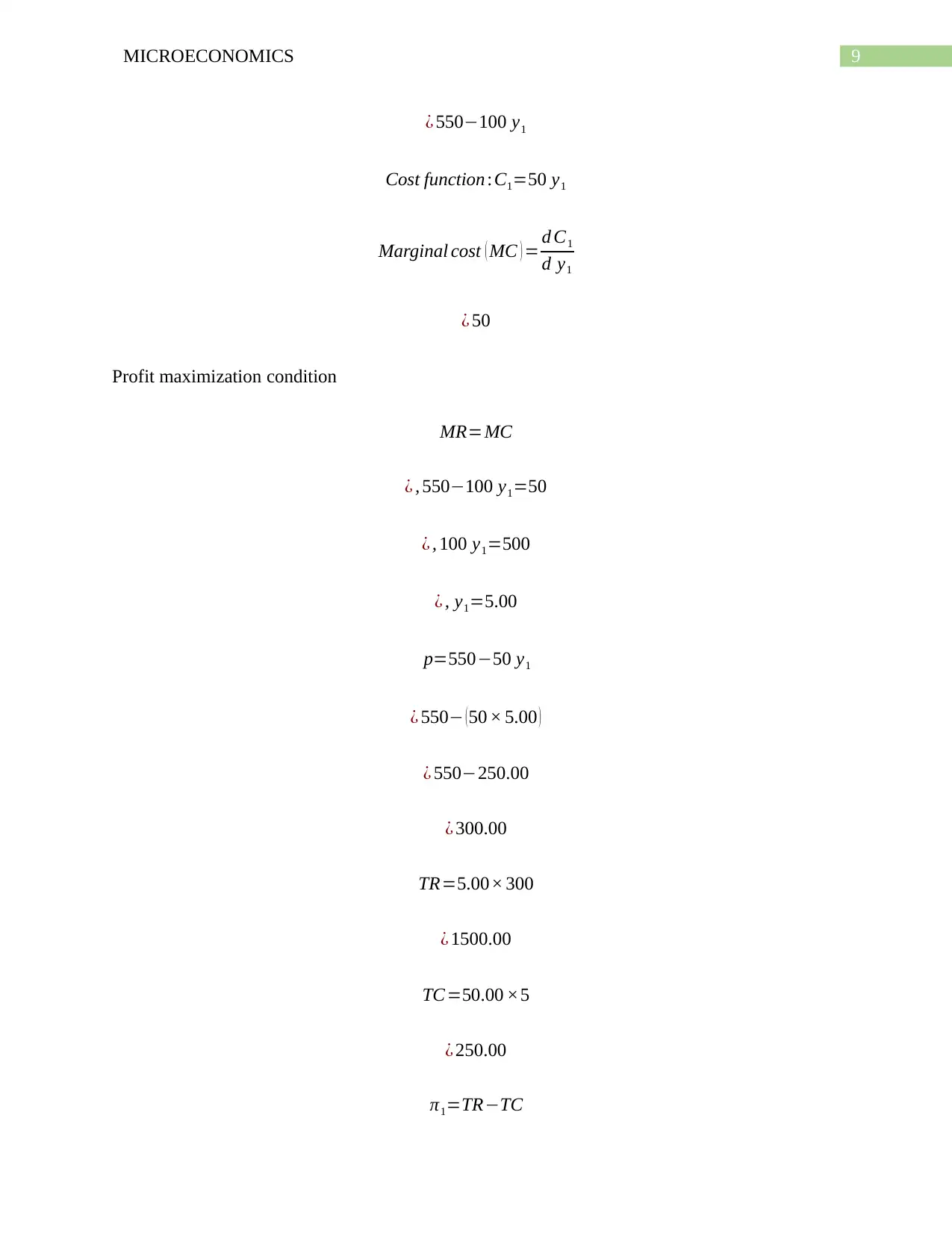
Marginal cost ( MC ) = d C1
d y1
¿ 50
Profit maximization condition
MR=MC
¿ , 550100 y1=50
¿ , 100 y1=500
¿ , y1=5.00
p=55050 y1
¿ 550 (50 × 5.00 )
¿ 550250.00
¿ 300.00
TR=5.00× 300
¿ 1500.00
TC=50.00 ×5
¿ 250.00
π1=TRTC
tabler-icon-diamond-filled.svg

Paraphrase This Document

Need a fresh take? Get an instant paraphrase of this document with our AI Paraphraser
Document Page
10MICROECONOMICS
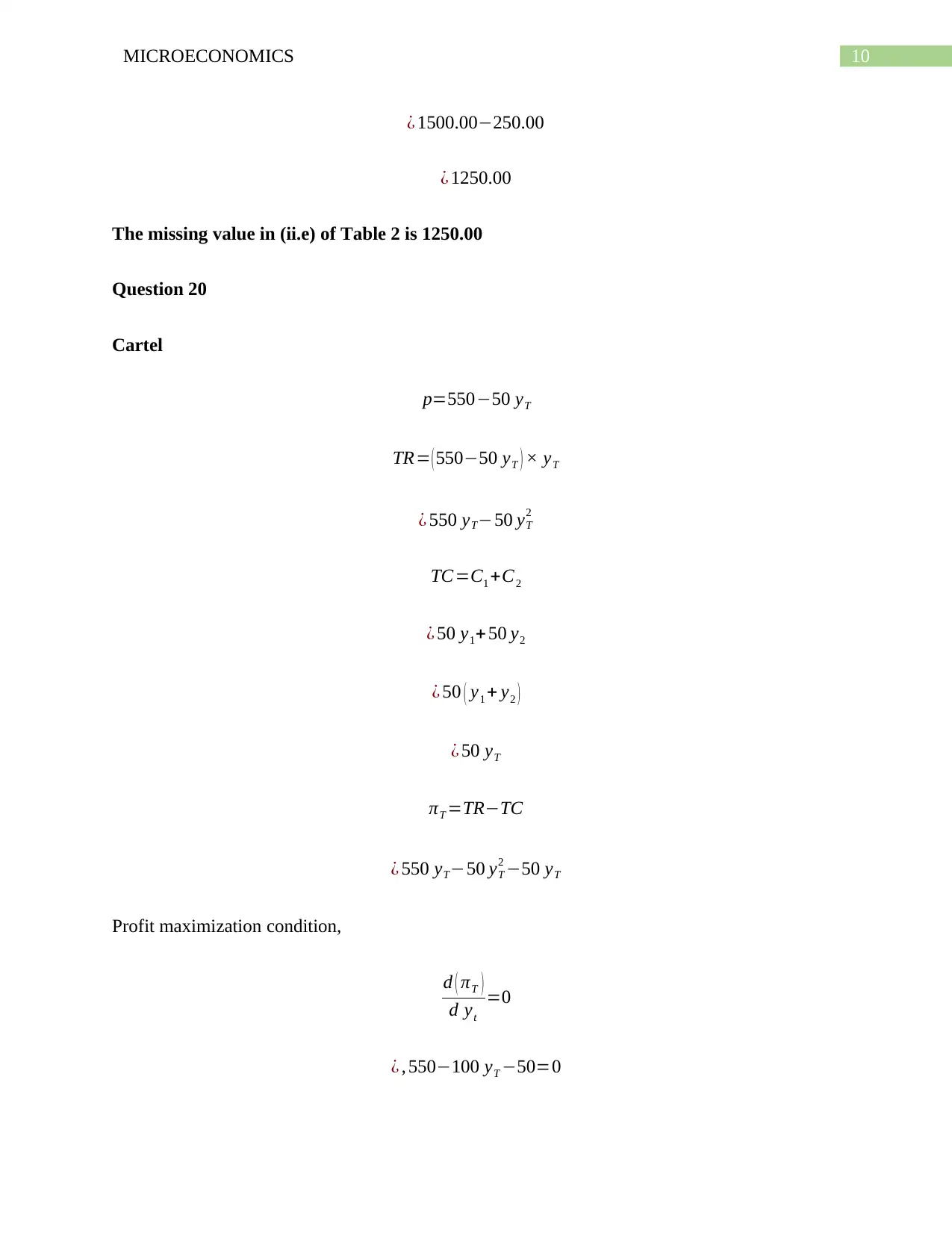
¿ 1500.00250.00
¿ 1250.00
The missing value in (ii.e) of Table 2 is 1250.00
Question 20
Cartel
p=55050 yT
TR= ( 55050 yT ) × yT
¿ 550 yT50 yT
2
TC=C1 +C2
¿ 50 y1+ 50 y2
¿ 50 ( y1 + y2 )
¿ 50 yT
πT =TRTC
¿ 550 yT50 yT
2 50 yT
Profit maximization condition,
d ( πT )
d yt
=0
¿ , 550100 yT 50=0
Document Page
11MICROECONOMICS
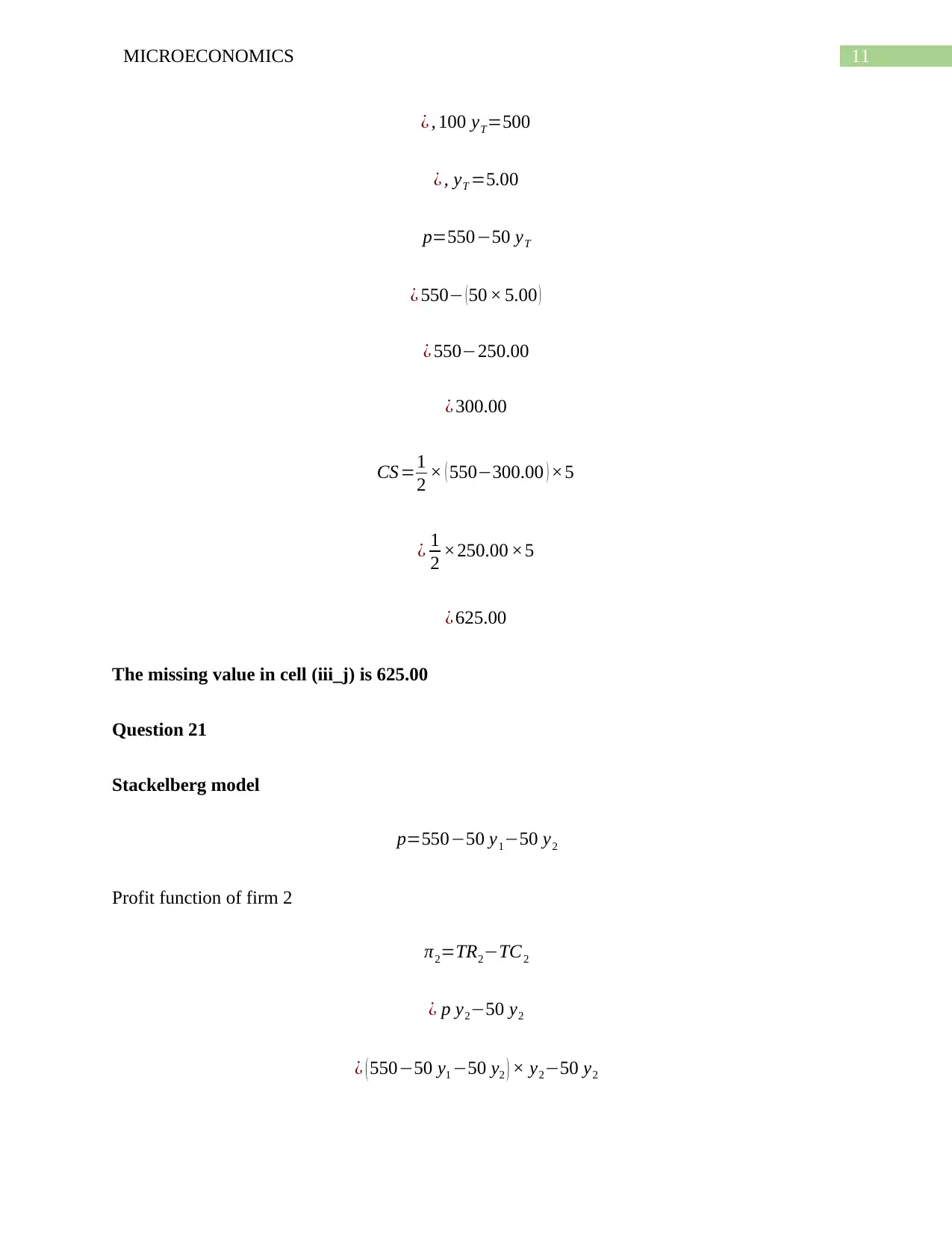
¿ , 100 yT=500
¿ , yT =5.00
p=55050 yT
¿ 550 (50 × 5.00 )
¿ 550250.00
¿ 300.00
CS=1
2 × ( 550300.00 ) ×5
¿ 1
2 ×250.00 ×5
¿ 625.00
The missing value in cell (iii_j) is 625.00
Question 21
Stackelberg model
p=55050 y150 y2
Profit function of firm 2
π2=TR2TC2
¿ p y250 y2
¿ ( 55050 y1 50 y2 ) × y250 y2
chevron_up_icon
1 out of 17
circle_padding
hide_on_mobile
zoom_out_icon
[object Object]