Economic Base Analysis of Australia: Employment & Real Estate
VerifiedAdded on 2023/06/04
|9
|2645
|145
Report
AI Summary
This report presents an economic base analysis of Australia, utilizing economic base theory to identify key sectors and their impact on the country's economy. The analysis covers industries such as mining, manufacturing, services, agriculture, and real estate, examining their contributions to GDP and employment rates. While the service sector dominates Australia's knowledge-based economy, the manufacturing sector has experienced a decline. The report also highlights the implications of employment trends on the real estate market, noting a positive growth in recent years. The study concludes by emphasizing the importance of balancing part-time and full-time employment to avoid underemployment and maximize the potential of the Australian workforce, while also addressing the gender dynamics in employment contributions to the GDP.
Economic Base Analysis 0
Title: Economic Base Analysis of Australia
Assignment Name:
Student Name:
Course Name and Number:
Professor:
Date:
Title: Economic Base Analysis of Australia
Assignment Name:
Student Name:
Course Name and Number:
Professor:
Date:

Paraphrase This Document
Need a fresh take? Get an instant paraphrase of this document with our AI Paraphraser
Economic Base Analysis 1
Executive Summary
With the changes in the regulations made for the workforce of an industry, it is very important
for the economist to conduct a research on the various industry or sector of a company. In this
assignment, the country that has been selected for the research is Australia and the analysis has
been conducted with the help of economic base theory. The Australian economy has been rapidly
developing with each passing year. The economic base theory helps in identifying the strength
sectors of the country and also the sectors that are witnessing a drastic downfall. This assignment
helped in gaining detailed information about the Australian economy, the employment in
Australia and how they both are interrelated for the overall development of the country.
Executive Summary
With the changes in the regulations made for the workforce of an industry, it is very important
for the economist to conduct a research on the various industry or sector of a company. In this
assignment, the country that has been selected for the research is Australia and the analysis has
been conducted with the help of economic base theory. The Australian economy has been rapidly
developing with each passing year. The economic base theory helps in identifying the strength
sectors of the country and also the sectors that are witnessing a drastic downfall. This assignment
helped in gaining detailed information about the Australian economy, the employment in
Australia and how they both are interrelated for the overall development of the country.
Economic Base Analysis 2
Contents
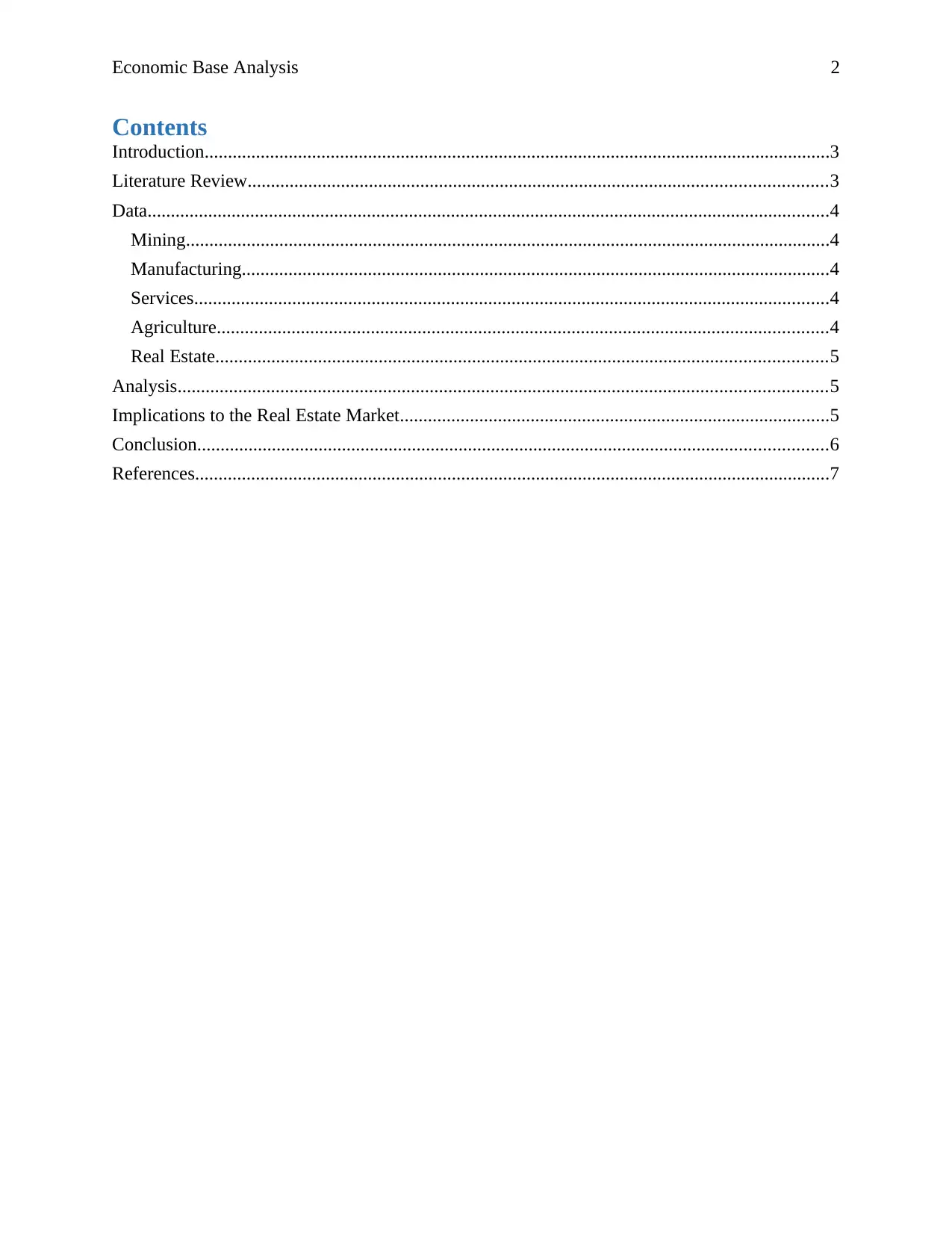
Introduction......................................................................................................................................3
Literature Review............................................................................................................................3
Data..................................................................................................................................................4
Mining..........................................................................................................................................4
Manufacturing..............................................................................................................................4
Services........................................................................................................................................4
Agriculture...................................................................................................................................4
Real Estate...................................................................................................................................5
Analysis...........................................................................................................................................5
Implications to the Real Estate Market............................................................................................5
Conclusion.......................................................................................................................................6
References........................................................................................................................................7
Contents
Introduction......................................................................................................................................3
Literature Review............................................................................................................................3
Data..................................................................................................................................................4
Mining..........................................................................................................................................4
Manufacturing..............................................................................................................................4
Services........................................................................................................................................4
Agriculture...................................................................................................................................4
Real Estate...................................................................................................................................5
Analysis...........................................................................................................................................5
Implications to the Real Estate Market............................................................................................5
Conclusion.......................................................................................................................................6
References........................................................................................................................................7
⊘ This is a preview!⊘
Do you want full access?
Subscribe today to unlock all pages.

Trusted by 1+ million students worldwide
Economic Base Analysis 3
Introduction
The term “economic base” can be described as a company, industry, or various different
employers that create a number of jobs in the local, regional and national areas. These
employers, though are mainly companies, but they may also include a department of civil
services and the government. The economic base can be referred to as a business or an industry
that generates opportunities for employment in a geographical area or in a community. The
concept of economic base is crucial for economic development. It can be determined as a sector
that facilitates exports, from the regional or local areas to the entire world. The economic base
analysis is conducted to recognize the contribution of different industries to the economy of a
country both on the local and regional level. The economic base analysis is utilized by the
economists and the policy formulators, for the decision making process related to economic
development and targeting the workforce. In a country like Australia, the economic base mainly
made of jobs in the public sector. The economy of Australia is very resilient and is built on a
stable institution that functions around sound regulations and policies, which has made it one of
the fastest growing economies and stands in the fifth position all around the world. The
economic base analysis is being conducted in Australia, to analyze the effect of different industry
employment in the Australian economy, especially the implications on the real estate market of
Australia.
Literature Review
For the analysis of the regional economy, the economic base theory is one of the most
respectful approach. According to Fan Li, the economic base theory offers an analysis that is
very accurate along with being an inexpensive method, which is very effective for understanding
the regional impacts, which can be smaller and also the employment impact on the overall
economy of a country (Li, 2010). The current employment rate in Australia still remains the
same in comparison to the employment rate in August 2018, which is 62.20. This is a high
employment rate in a country, but in Australia, the highest employment rate has been 62.90, in
the year 2008. This signals that the country’s knowledge based economy has been able to
maintain high consistency standards in Australia by maintaining the employment rate that
impacts the overall economy of the country. The GDP growth of the country is 0.6% and the
contribution of the construction sector is the highest in the GDP of the country, with 8.1%. The
economic base theory can be utilized with the help of two models that are, aggregate model and
disaggregate models. But there are many different approaches among which the regression based
approach results provides with impact multipliers whereas the other approaches provide with
only average multipliers.
There is a huge difference between the aggregate model and the disaggregate model. The
aggregate model considers and utilizes the entire regional economy, whereas the disaggregate
model has a different approach than the aggregate model as it recognizes specific industries or
sectors of interest in a regional economy. In Australia, the industries or sectors that contribute
largely to the economy due to the high percentage of job opportunities offered by those
industries include construction, manufacturing, mining, services, and agriculture. The other
sectors that contribute to the economy of Australia are education, finance, tourism, media,
transport, and some others. In the disaggregate model of the economic base theory, specific
figures of the various sectors are recorded, that is utilized for deriving details about the different
employment ratios. The different employment ratios include basic employment, non-basic
employment, and the total employment. This information helps in finding the contribution of
Introduction
The term “economic base” can be described as a company, industry, or various different
employers that create a number of jobs in the local, regional and national areas. These
employers, though are mainly companies, but they may also include a department of civil
services and the government. The economic base can be referred to as a business or an industry
that generates opportunities for employment in a geographical area or in a community. The
concept of economic base is crucial for economic development. It can be determined as a sector
that facilitates exports, from the regional or local areas to the entire world. The economic base
analysis is conducted to recognize the contribution of different industries to the economy of a
country both on the local and regional level. The economic base analysis is utilized by the
economists and the policy formulators, for the decision making process related to economic
development and targeting the workforce. In a country like Australia, the economic base mainly
made of jobs in the public sector. The economy of Australia is very resilient and is built on a
stable institution that functions around sound regulations and policies, which has made it one of
the fastest growing economies and stands in the fifth position all around the world. The
economic base analysis is being conducted in Australia, to analyze the effect of different industry
employment in the Australian economy, especially the implications on the real estate market of
Australia.
Literature Review
For the analysis of the regional economy, the economic base theory is one of the most
respectful approach. According to Fan Li, the economic base theory offers an analysis that is
very accurate along with being an inexpensive method, which is very effective for understanding
the regional impacts, which can be smaller and also the employment impact on the overall
economy of a country (Li, 2010). The current employment rate in Australia still remains the
same in comparison to the employment rate in August 2018, which is 62.20. This is a high
employment rate in a country, but in Australia, the highest employment rate has been 62.90, in
the year 2008. This signals that the country’s knowledge based economy has been able to
maintain high consistency standards in Australia by maintaining the employment rate that
impacts the overall economy of the country. The GDP growth of the country is 0.6% and the
contribution of the construction sector is the highest in the GDP of the country, with 8.1%. The
economic base theory can be utilized with the help of two models that are, aggregate model and
disaggregate models. But there are many different approaches among which the regression based
approach results provides with impact multipliers whereas the other approaches provide with
only average multipliers.
There is a huge difference between the aggregate model and the disaggregate model. The
aggregate model considers and utilizes the entire regional economy, whereas the disaggregate
model has a different approach than the aggregate model as it recognizes specific industries or
sectors of interest in a regional economy. In Australia, the industries or sectors that contribute
largely to the economy due to the high percentage of job opportunities offered by those
industries include construction, manufacturing, mining, services, and agriculture. The other
sectors that contribute to the economy of Australia are education, finance, tourism, media,
transport, and some others. In the disaggregate model of the economic base theory, specific
figures of the various sectors are recorded, that is utilized for deriving details about the different
employment ratios. The different employment ratios include basic employment, non-basic
employment, and the total employment. This information helps in finding the contribution of
Paraphrase This Document
Need a fresh take? Get an instant paraphrase of this document with our AI Paraphraser
Economic Base Analysis 4
each industry in the overall economy of the country. It is due to the effectiveness of this model
that facilitates with detailed information that the disaggregate model is utilized for analysis by
the economists and the policy makers of the country.
Data
The Knowledge based economy of Australia is dominated by the country’s service sector.
The service sector of Australia contributes by 61.1% to the GDP of the country. The service
sector employs around 79.2% of the workforce in the year 2016. Also, the unemployment rate in
the year 2017 was decreased by 0.1%. The different industries in Australia have been fluctuating
with the employment of the newly qualified individual’s rate in the last five years with only
dentistry, architecture and the post initial education industries have a positive rate of 3.1%, 6.3%,
and 13.9% respectively, from the year 2012 to 2015. The contribution of the various industries in
providing job opportunities and in the Australian economy is-
Mining
According to the Australian Department of Education, Employment and Workplace
Relations (DEEWR), the mining industry will be one of those industries that will witness a huge
growth in the upcoming years. The mining industry will grow by 7.5% every year and the
industry will provide more than 104,000 jobs per year. The increase in demand of the iron ore
and coal in the country pushes the industry to create new job opportunities. The contribution of
the mining industry in the GDP of Australia is by 6.9%.
Manufacturing
The other important sector that contributes hugely to the Australian economy is the
manufacturing industry with 6.0% in the year 2016. The contribution of the manufacturing
industry to the Australian economy was highest in the year 1960 with 30%, but it witnessed the
biggest fallout in the year 2007 and was brought to 12%. The industry is continuously declining
with each passing fiscal year. From the time period of 2008 to 2017, four companies that were
involved in mass production of cars in Australia ceased their production. The companies include
Mitsubishi, Ford, Holden, and Toyota. The reduction in the manufacturing of textile industry has
also impacted the employment rate and on the economy. By the end of the fiscal year 2016,
employment in the manufacturing industry has been declined by 24%.
Services
The service industry contributed to the GDP of Australia by 61.1%. According to the
reports of the Department of Foreign Affairs & Trade, the service sector of Australia employs
four out of every five people. The service sector of Australia is made up of education, tourism,
professional services, environmental services, financial services, financial technology, Media
and many others. Amongst the various sub-sectors of the service industry, the biggest
contribution is made by the education and tourism industry to the national income of Australia.
The service sector in Australia has transformed completely over the year with women
employment ratio increasing with high percentage every year (López-Villavicencio & Silva,
2011).
Agriculture
The agriculture industry contribution to the GDP of Australia in 2016 was by 2.2%. The
farm products, of Australia, are majorly exported, approximately around 60% of the Australian
farm produce. The growth of employment in the agriculture sector for the year 2013-2015 has
been from 295,495 to 325,321.
each industry in the overall economy of the country. It is due to the effectiveness of this model
that facilitates with detailed information that the disaggregate model is utilized for analysis by
the economists and the policy makers of the country.
Data
The Knowledge based economy of Australia is dominated by the country’s service sector.
The service sector of Australia contributes by 61.1% to the GDP of the country. The service
sector employs around 79.2% of the workforce in the year 2016. Also, the unemployment rate in
the year 2017 was decreased by 0.1%. The different industries in Australia have been fluctuating
with the employment of the newly qualified individual’s rate in the last five years with only
dentistry, architecture and the post initial education industries have a positive rate of 3.1%, 6.3%,
and 13.9% respectively, from the year 2012 to 2015. The contribution of the various industries in
providing job opportunities and in the Australian economy is-
Mining
According to the Australian Department of Education, Employment and Workplace
Relations (DEEWR), the mining industry will be one of those industries that will witness a huge
growth in the upcoming years. The mining industry will grow by 7.5% every year and the
industry will provide more than 104,000 jobs per year. The increase in demand of the iron ore
and coal in the country pushes the industry to create new job opportunities. The contribution of
the mining industry in the GDP of Australia is by 6.9%.
Manufacturing
The other important sector that contributes hugely to the Australian economy is the
manufacturing industry with 6.0% in the year 2016. The contribution of the manufacturing
industry to the Australian economy was highest in the year 1960 with 30%, but it witnessed the
biggest fallout in the year 2007 and was brought to 12%. The industry is continuously declining
with each passing fiscal year. From the time period of 2008 to 2017, four companies that were
involved in mass production of cars in Australia ceased their production. The companies include
Mitsubishi, Ford, Holden, and Toyota. The reduction in the manufacturing of textile industry has
also impacted the employment rate and on the economy. By the end of the fiscal year 2016,
employment in the manufacturing industry has been declined by 24%.
Services
The service industry contributed to the GDP of Australia by 61.1%. According to the
reports of the Department of Foreign Affairs & Trade, the service sector of Australia employs
four out of every five people. The service sector of Australia is made up of education, tourism,
professional services, environmental services, financial services, financial technology, Media
and many others. Amongst the various sub-sectors of the service industry, the biggest
contribution is made by the education and tourism industry to the national income of Australia.
The service sector in Australia has transformed completely over the year with women
employment ratio increasing with high percentage every year (López-Villavicencio & Silva,
2011).
Agriculture
The agriculture industry contribution to the GDP of Australia in 2016 was by 2.2%. The
farm products, of Australia, are majorly exported, approximately around 60% of the Australian
farm produce. The growth of employment in the agriculture sector for the year 2013-2015 has
been from 295,495 to 325,321.
Economic Base Analysis 5
Real Estate
The real estate industry has witnessed a strong growth in the employment rate and it’s
going to further grow by 8.5% by the end of the year 2022. The current employees in the real
estate industry, mostly comprised of the people who work as sales workers and agents of real
estate. But with the growth in the coming years, it will witness an increase in the number of
property operators in the real estate industry.
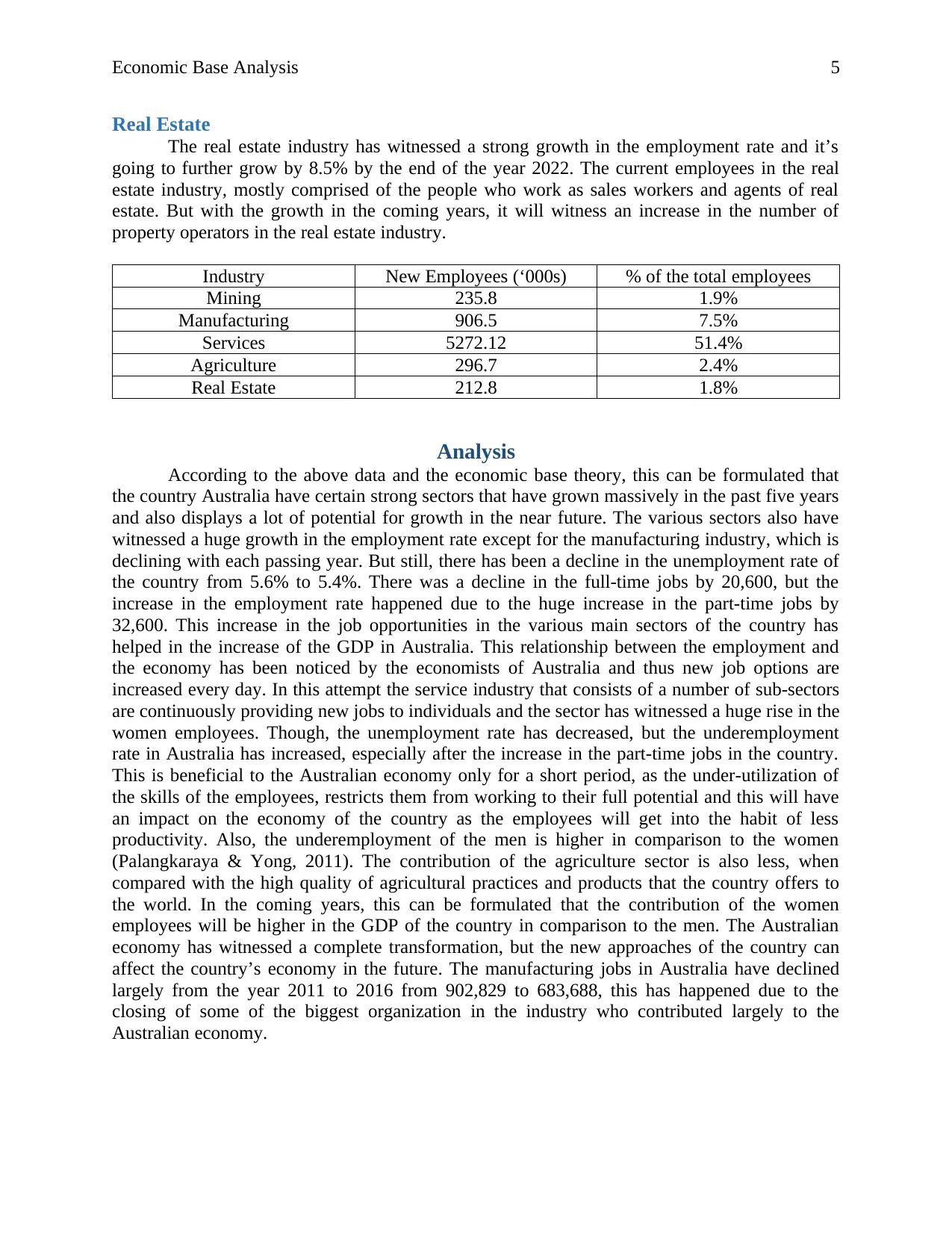
Industry New Employees (‘000s) % of the total employees
Mining 235.8 1.9%
Manufacturing 906.5 7.5%
Services 5272.12 51.4%
Agriculture 296.7 2.4%
Real Estate 212.8 1.8%
Analysis
According to the above data and the economic base theory, this can be formulated that
the country Australia have certain strong sectors that have grown massively in the past five years
and also displays a lot of potential for growth in the near future. The various sectors also have
witnessed a huge growth in the employment rate except for the manufacturing industry, which is
declining with each passing year. But still, there has been a decline in the unemployment rate of
the country from 5.6% to 5.4%. There was a decline in the full-time jobs by 20,600, but the
increase in the employment rate happened due to the huge increase in the part-time jobs by
32,600. This increase in the job opportunities in the various main sectors of the country has
helped in the increase of the GDP in Australia. This relationship between the employment and
the economy has been noticed by the economists of Australia and thus new job options are
increased every day. In this attempt the service industry that consists of a number of sub-sectors
are continuously providing new jobs to individuals and the sector has witnessed a huge rise in the
women employees. Though, the unemployment rate has decreased, but the underemployment
rate in Australia has increased, especially after the increase in the part-time jobs in the country.
This is beneficial to the Australian economy only for a short period, as the under-utilization of
the skills of the employees, restricts them from working to their full potential and this will have
an impact on the economy of the country as the employees will get into the habit of less
productivity. Also, the underemployment of the men is higher in comparison to the women
(Palangkaraya & Yong, 2011). The contribution of the agriculture sector is also less, when
compared with the high quality of agricultural practices and products that the country offers to
the world. In the coming years, this can be formulated that the contribution of the women
employees will be higher in the GDP of the country in comparison to the men. The Australian
economy has witnessed a complete transformation, but the new approaches of the country can
affect the country’s economy in the future. The manufacturing jobs in Australia have declined
largely from the year 2011 to 2016 from 902,829 to 683,688, this has happened due to the
closing of some of the biggest organization in the industry who contributed largely to the
Australian economy.
Real Estate
The real estate industry has witnessed a strong growth in the employment rate and it’s
going to further grow by 8.5% by the end of the year 2022. The current employees in the real
estate industry, mostly comprised of the people who work as sales workers and agents of real
estate. But with the growth in the coming years, it will witness an increase in the number of
property operators in the real estate industry.
Industry New Employees (‘000s) % of the total employees
Mining 235.8 1.9%
Manufacturing 906.5 7.5%
Services 5272.12 51.4%
Agriculture 296.7 2.4%
Real Estate 212.8 1.8%
Analysis
According to the above data and the economic base theory, this can be formulated that
the country Australia have certain strong sectors that have grown massively in the past five years
and also displays a lot of potential for growth in the near future. The various sectors also have
witnessed a huge growth in the employment rate except for the manufacturing industry, which is
declining with each passing year. But still, there has been a decline in the unemployment rate of
the country from 5.6% to 5.4%. There was a decline in the full-time jobs by 20,600, but the
increase in the employment rate happened due to the huge increase in the part-time jobs by
32,600. This increase in the job opportunities in the various main sectors of the country has
helped in the increase of the GDP in Australia. This relationship between the employment and
the economy has been noticed by the economists of Australia and thus new job options are
increased every day. In this attempt the service industry that consists of a number of sub-sectors
are continuously providing new jobs to individuals and the sector has witnessed a huge rise in the
women employees. Though, the unemployment rate has decreased, but the underemployment
rate in Australia has increased, especially after the increase in the part-time jobs in the country.
This is beneficial to the Australian economy only for a short period, as the under-utilization of
the skills of the employees, restricts them from working to their full potential and this will have
an impact on the economy of the country as the employees will get into the habit of less
productivity. Also, the underemployment of the men is higher in comparison to the women
(Palangkaraya & Yong, 2011). The contribution of the agriculture sector is also less, when
compared with the high quality of agricultural practices and products that the country offers to
the world. In the coming years, this can be formulated that the contribution of the women
employees will be higher in the GDP of the country in comparison to the men. The Australian
economy has witnessed a complete transformation, but the new approaches of the country can
affect the country’s economy in the future. The manufacturing jobs in Australia have declined
largely from the year 2011 to 2016 from 902,829 to 683,688, this has happened due to the
closing of some of the biggest organization in the industry who contributed largely to the
Australian economy.
⊘ This is a preview!⊘
Do you want full access?
Subscribe today to unlock all pages.
Trusted by 1+ million students worldwide
Economic Base Analysis 6
Implications to the Real Estate Market
The real estate industry has also had a positive implication in recent years. The real estate
industry has risen by 14.7 percent from the year 2011 to 2016. During the year the employees in
this industry who were newly hired were around 158,853, but in the year 2016, this figure
increased to 182,151. This highlights that the contribution of the real estate industry to the
Australian economy is increasing with each passing year. Also, the Fair Work Commission in
Australia has imposed some changes that each employer in the real estate industry has to follow.
These changes have been implicated from the 2nd April 2018, according to which there has been
a rise in the wages of the employees in this field and this will help in the overall growth of the
economy. According to the newly introduced regulations, the pay of the employees in this
industry will increase every year in the month of July. This has also been conducted so that the
productivity standards of this industry rise by each passing year that will ultimately have an
implication in the contribution of the industry to the country’s GDP. According to the new
regulation, the employers are now not entitled to hire an employee only for commission. This is a
very big change as the agents who work only for the commission will also receive a fixed
income. This will increase the job opportunities in this industry and according to the economic
base theory, a rise in job opportunity means a rise in the economy of the country (Weder, 2010).
Conclusion
From the above analysis, this can be concluded that the economic base theory is a very
effective approach to understanding the main sectors of a country’s economy and their
contribution through the rate of employment. Also, the theory helps in recognizing the weak
sectors of the country or the industries which are suffering like the manufacturing industry in
Australia. The economy based theory also helps in identifying the changes through which the
economy will go through and also highlights the promising industries for the future. The
disaggregate model of the economic base theory is a better approach in comparison to the other
concepts as this provides with all the information in detail, which will be very beneficial for an
economist in making policies and plans for a country.
Implications to the Real Estate Market
The real estate industry has also had a positive implication in recent years. The real estate
industry has risen by 14.7 percent from the year 2011 to 2016. During the year the employees in
this industry who were newly hired were around 158,853, but in the year 2016, this figure
increased to 182,151. This highlights that the contribution of the real estate industry to the
Australian economy is increasing with each passing year. Also, the Fair Work Commission in
Australia has imposed some changes that each employer in the real estate industry has to follow.
These changes have been implicated from the 2nd April 2018, according to which there has been
a rise in the wages of the employees in this field and this will help in the overall growth of the
economy. According to the newly introduced regulations, the pay of the employees in this
industry will increase every year in the month of July. This has also been conducted so that the
productivity standards of this industry rise by each passing year that will ultimately have an
implication in the contribution of the industry to the country’s GDP. According to the new
regulation, the employers are now not entitled to hire an employee only for commission. This is a
very big change as the agents who work only for the commission will also receive a fixed
income. This will increase the job opportunities in this industry and according to the economic
base theory, a rise in job opportunity means a rise in the economy of the country (Weder, 2010).
Conclusion
From the above analysis, this can be concluded that the economic base theory is a very
effective approach to understanding the main sectors of a country’s economy and their
contribution through the rate of employment. Also, the theory helps in recognizing the weak
sectors of the country or the industries which are suffering like the manufacturing industry in
Australia. The economy based theory also helps in identifying the changes through which the
economy will go through and also highlights the promising industries for the future. The
disaggregate model of the economic base theory is a better approach in comparison to the other
concepts as this provides with all the information in detail, which will be very beneficial for an
economist in making policies and plans for a country.
Paraphrase This Document
Need a fresh take? Get an instant paraphrase of this document with our AI Paraphraser
Economic Base Analysis 7
References
Li, F. (2010). Economic Base Analysis Using Panel Data Regression: A Case Study of the
Florida Regional Economy. Retrieved from http://etd.fcla.edu/UF/UFE0041842/li_f.pdf
López-Villavicencio, A., & Silva, J. (2011). Employment Protection and the Non-Linear
Relationship between the Wage-Productivity Gap and Unemployment. Scottish Journal of
Political Economy, 58(2), 200-220.
Palangkaraya, A., & Yong, J. (2011). Trade Liberalisation, Exit, and Output and Employment
Adjustments of Australian Manufacturing Establishments. The World Economy, 34(1), 1-22.
Weder, M. (2010). Economic Crisis and Economic Theory*. Economic Record, 86(1), 7-12.
References
Li, F. (2010). Economic Base Analysis Using Panel Data Regression: A Case Study of the
Florida Regional Economy. Retrieved from http://etd.fcla.edu/UF/UFE0041842/li_f.pdf
López-Villavicencio, A., & Silva, J. (2011). Employment Protection and the Non-Linear
Relationship between the Wage-Productivity Gap and Unemployment. Scottish Journal of
Political Economy, 58(2), 200-220.
Palangkaraya, A., & Yong, J. (2011). Trade Liberalisation, Exit, and Output and Employment
Adjustments of Australian Manufacturing Establishments. The World Economy, 34(1), 1-22.
Weder, M. (2010). Economic Crisis and Economic Theory*. Economic Record, 86(1), 7-12.

Economic Base Analysis 8
⊘ This is a preview!⊘
Do you want full access?
Subscribe today to unlock all pages.
Trusted by 1+ million students worldwide

1 out of 9


Related Documents


Your All-in-One AI-Powered Toolkit for Academic Success.
+13062052269
info@desklib.com
Available 24*7 on WhatsApp / Email
![[object Object]](/_next/static/media/star-bottom.7253800d.svg)
Unlock your academic potential
Copyright © 2020–2026 A2Z Services. All Rights Reserved. Developed and managed by ZUCOL.