ECO202: Analyzing Okun's Law, Planned Expenditure, and Trade Tariffs
VerifiedAdded on 2024/06/04
|14
|2054
|363
Report
AI Summary
This report provides an analysis of Okun's Law, explaining the relationship between unemployment and GNP, and calculates unemployment rates using the law. It also examines planned aggregate expenditure, equilibrium points, and the impact of tariffs on domestic supply and demand in the Australian economy. The report further includes calculations of private, public, and business savings to analyze national income. It concludes by summarizing the effects of taxes, savings, tariffs, and the interplay between demand and supply, offering insights into consumer and producer surplus.

ECO202
1
1

Paraphrase This Document
Need a fresh take? Get an instant paraphrase of this document with our AI Paraphraser
Contents
Introduction.................................................................................................................................................3
Question 1...................................................................................................................................................4
Question 2...................................................................................................................................................6
Question 3...................................................................................................................................................8
Question 4.................................................................................................................................................11
Conclusion.................................................................................................................................................13
References:................................................................................................................................................14
2
Introduction.................................................................................................................................................3
Question 1...................................................................................................................................................4
Question 2...................................................................................................................................................6
Question 3...................................................................................................................................................8
Question 4.................................................................................................................................................11
Conclusion.................................................................................................................................................13
References:................................................................................................................................................14
2
Introduction
This report deals with the explanation about the Okun’s law and how through this law the actual
and the natural unemployment rate is calculated. With this it also deals with the explanation
about planned aggregate expenditure and its practical implementation with respect of the interest
and output. The equilibrium point is that point where the demand of the product and services is
equal to its supply. Besides this the report also provides the explanation about the imposition of
the tariffs and how it impact on the domestic quantity demanded and what is supplied. The light
has also been thrown on the import and export quantity so that the overall impact can be
evaluated and the effects on that in the Australian economy can be determined. The calculation
about the private, public and the business savings is also depicted which will help in analyzing
the national income of the economy.
3
This report deals with the explanation about the Okun’s law and how through this law the actual
and the natural unemployment rate is calculated. With this it also deals with the explanation
about planned aggregate expenditure and its practical implementation with respect of the interest
and output. The equilibrium point is that point where the demand of the product and services is
equal to its supply. Besides this the report also provides the explanation about the imposition of
the tariffs and how it impact on the domestic quantity demanded and what is supplied. The light
has also been thrown on the import and export quantity so that the overall impact can be
evaluated and the effects on that in the Australian economy can be determined. The calculation
about the private, public and the business savings is also depicted which will help in analyzing
the national income of the economy.
3
⊘ This is a preview!⊘
Do you want full access?
Subscribe today to unlock all pages.

Trusted by 1+ million students worldwide
Question 1
Okun’s Law
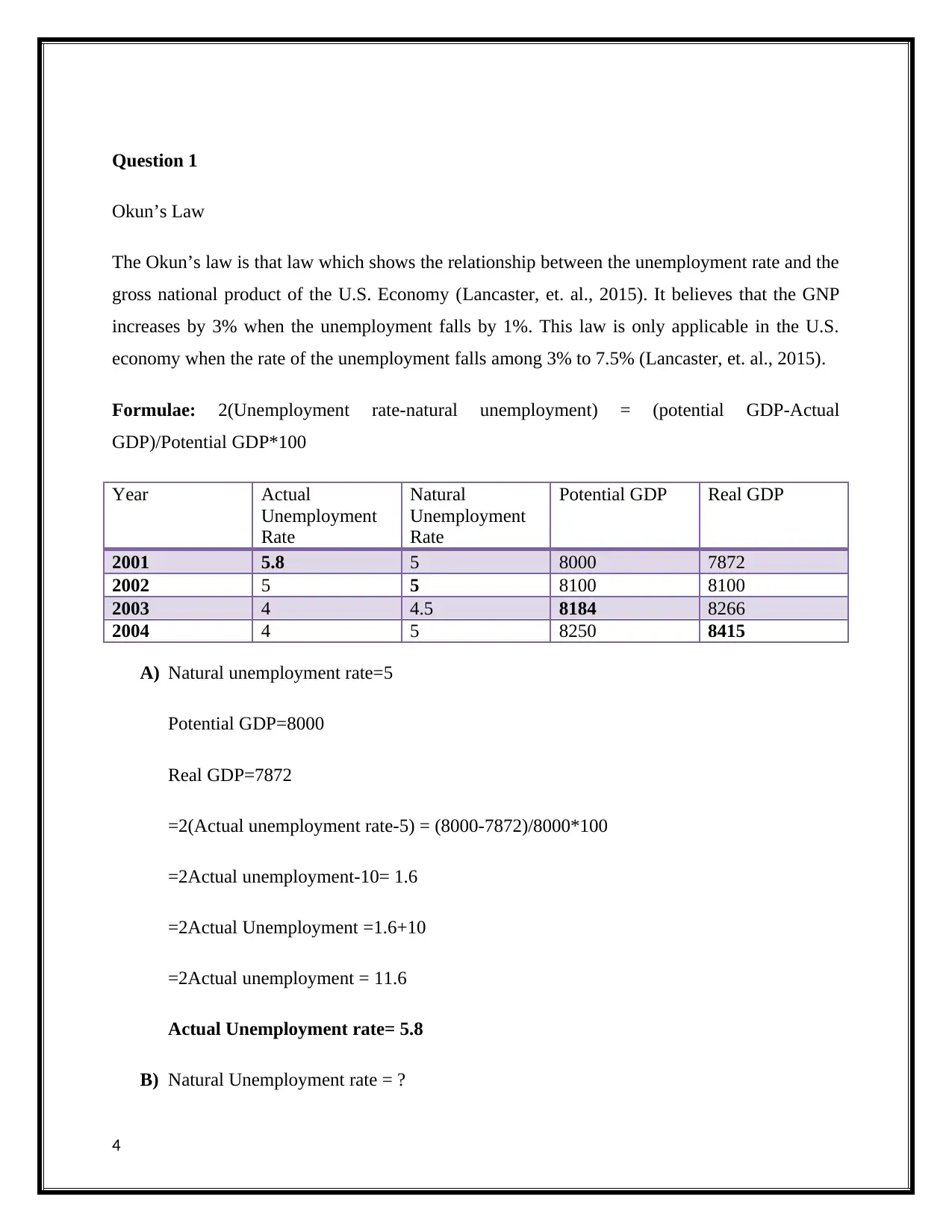
The Okun’s law is that law which shows the relationship between the unemployment rate and the
gross national product of the U.S. Economy (Lancaster, et. al., 2015). It believes that the GNP
increases by 3% when the unemployment falls by 1%. This law is only applicable in the U.S.
economy when the rate of the unemployment falls among 3% to 7.5% (Lancaster, et. al., 2015).
Formulae: 2(Unemployment rate-natural unemployment) = (potential GDP-Actual
GDP)/Potential GDP*100
Year Actual
Unemployment
Rate
Natural
Unemployment
Rate
Potential GDP Real GDP
2001 5.8 5 8000 7872
2002 5 5 8100 8100
2003 4 4.5 8184 8266
2004 4 5 8250 8415
A) Natural unemployment rate=5
Potential GDP=8000
Real GDP=7872
=2(Actual unemployment rate-5) = (8000-7872)/8000*100
=2Actual unemployment-10= 1.6
=2Actual Unemployment =1.6+10
=2Actual unemployment = 11.6
Actual Unemployment rate= 5.8
B) Natural Unemployment rate = ?
4
Okun’s Law
The Okun’s law is that law which shows the relationship between the unemployment rate and the
gross national product of the U.S. Economy (Lancaster, et. al., 2015). It believes that the GNP
increases by 3% when the unemployment falls by 1%. This law is only applicable in the U.S.
economy when the rate of the unemployment falls among 3% to 7.5% (Lancaster, et. al., 2015).
Formulae: 2(Unemployment rate-natural unemployment) = (potential GDP-Actual
GDP)/Potential GDP*100
Year Actual
Unemployment
Rate
Natural
Unemployment
Rate
Potential GDP Real GDP
2001 5.8 5 8000 7872
2002 5 5 8100 8100
2003 4 4.5 8184 8266
2004 4 5 8250 8415
A) Natural unemployment rate=5
Potential GDP=8000
Real GDP=7872
=2(Actual unemployment rate-5) = (8000-7872)/8000*100
=2Actual unemployment-10= 1.6
=2Actual Unemployment =1.6+10
=2Actual unemployment = 11.6
Actual Unemployment rate= 5.8
B) Natural Unemployment rate = ?
4
Paraphrase This Document
Need a fresh take? Get an instant paraphrase of this document with our AI Paraphraser
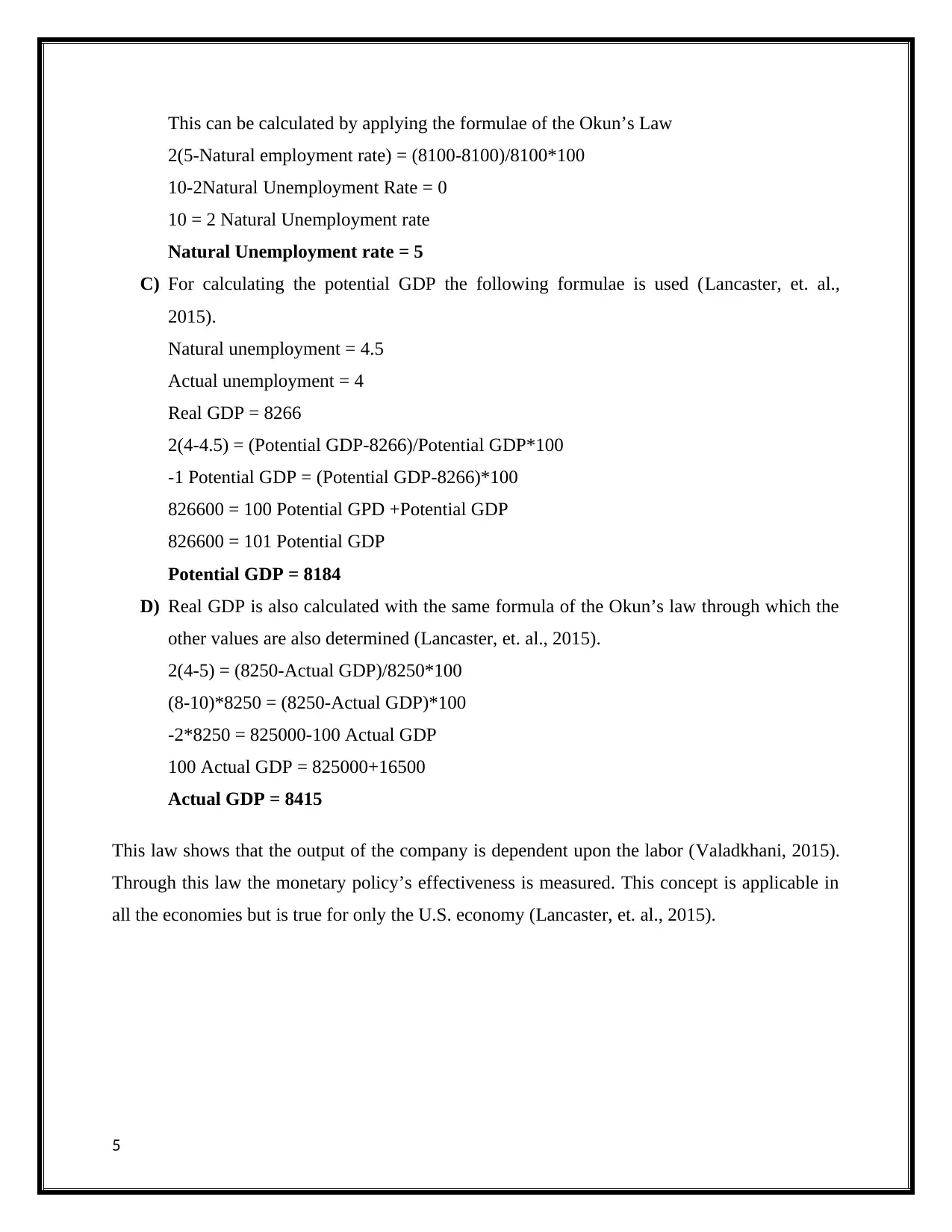
This can be calculated by applying the formulae of the Okun’s Law
2(5-Natural employment rate) = (8100-8100)/8100*100
10-2Natural Unemployment Rate = 0
10 = 2 Natural Unemployment rate
Natural Unemployment rate = 5
C) For calculating the potential GDP the following formulae is used (Lancaster, et. al.,
2015).
Natural unemployment = 4.5
Actual unemployment = 4
Real GDP = 8266
2(4-4.5) = (Potential GDP-8266)/Potential GDP*100
-1 Potential GDP = (Potential GDP-8266)*100
826600 = 100 Potential GPD +Potential GDP
826600 = 101 Potential GDP
Potential GDP = 8184
D) Real GDP is also calculated with the same formula of the Okun’s law through which the
other values are also determined (Lancaster, et. al., 2015).
2(4-5) = (8250-Actual GDP)/8250*100
(8-10)*8250 = (8250-Actual GDP)*100
-2*8250 = 825000-100 Actual GDP
100 Actual GDP = 825000+16500
Actual GDP = 8415
This law shows that the output of the company is dependent upon the labor (Valadkhani, 2015).
Through this law the monetary policy’s effectiveness is measured. This concept is applicable in
all the economies but is true for only the U.S. economy (Lancaster, et. al., 2015).
5
2(5-Natural employment rate) = (8100-8100)/8100*100
10-2Natural Unemployment Rate = 0
10 = 2 Natural Unemployment rate
Natural Unemployment rate = 5
C) For calculating the potential GDP the following formulae is used (Lancaster, et. al.,
2015).
Natural unemployment = 4.5
Actual unemployment = 4
Real GDP = 8266
2(4-4.5) = (Potential GDP-8266)/Potential GDP*100
-1 Potential GDP = (Potential GDP-8266)*100
826600 = 100 Potential GPD +Potential GDP
826600 = 101 Potential GDP
Potential GDP = 8184
D) Real GDP is also calculated with the same formula of the Okun’s law through which the
other values are also determined (Lancaster, et. al., 2015).
2(4-5) = (8250-Actual GDP)/8250*100
(8-10)*8250 = (8250-Actual GDP)*100
-2*8250 = 825000-100 Actual GDP
100 Actual GDP = 825000+16500
Actual GDP = 8415
This law shows that the output of the company is dependent upon the labor (Valadkhani, 2015).
Through this law the monetary policy’s effectiveness is measured. This concept is applicable in
all the economies but is true for only the U.S. economy (Lancaster, et. al., 2015).
5
Question 2
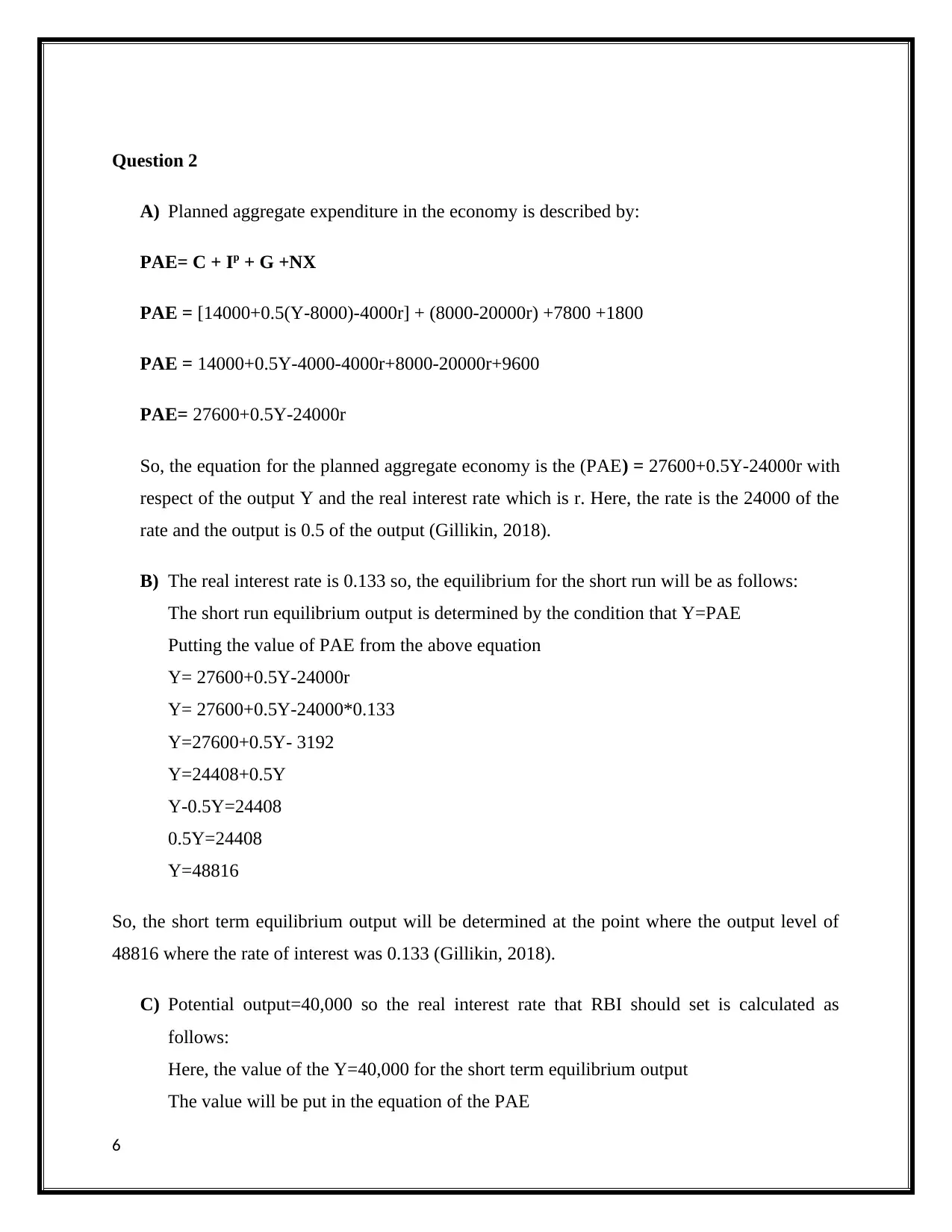
A) Planned aggregate expenditure in the economy is described by:
PAE= C + Ip + G +NX
PAE = [14000+0.5(Y-8000)-4000r] + (8000-20000r) +7800 +1800
PAE = 14000+0.5Y-4000-4000r+8000-20000r+9600
PAE= 27600+0.5Y-24000r
So, the equation for the planned aggregate economy is the (PAE) = 27600+0.5Y-24000r with
respect of the output Y and the real interest rate which is r. Here, the rate is the 24000 of the
rate and the output is 0.5 of the output (Gillikin, 2018).
B) The real interest rate is 0.133 so, the equilibrium for the short run will be as follows:
The short run equilibrium output is determined by the condition that Y=PAE
Putting the value of PAE from the above equation
Y= 27600+0.5Y-24000r
Y= 27600+0.5Y-24000*0.133
Y=27600+0.5Y- 3192
Y=24408+0.5Y
Y-0.5Y=24408
0.5Y=24408
Y=48816
So, the short term equilibrium output will be determined at the point where the output level of
48816 where the rate of interest was 0.133 (Gillikin, 2018).
C) Potential output=40,000 so the real interest rate that RBI should set is calculated as
follows:
Here, the value of the Y=40,000 for the short term equilibrium output
The value will be put in the equation of the PAE
6
A) Planned aggregate expenditure in the economy is described by:
PAE= C + Ip + G +NX
PAE = [14000+0.5(Y-8000)-4000r] + (8000-20000r) +7800 +1800
PAE = 14000+0.5Y-4000-4000r+8000-20000r+9600
PAE= 27600+0.5Y-24000r
So, the equation for the planned aggregate economy is the (PAE) = 27600+0.5Y-24000r with
respect of the output Y and the real interest rate which is r. Here, the rate is the 24000 of the
rate and the output is 0.5 of the output (Gillikin, 2018).
B) The real interest rate is 0.133 so, the equilibrium for the short run will be as follows:
The short run equilibrium output is determined by the condition that Y=PAE
Putting the value of PAE from the above equation
Y= 27600+0.5Y-24000r
Y= 27600+0.5Y-24000*0.133
Y=27600+0.5Y- 3192
Y=24408+0.5Y
Y-0.5Y=24408
0.5Y=24408
Y=48816
So, the short term equilibrium output will be determined at the point where the output level of
48816 where the rate of interest was 0.133 (Gillikin, 2018).
C) Potential output=40,000 so the real interest rate that RBI should set is calculated as
follows:
Here, the value of the Y=40,000 for the short term equilibrium output
The value will be put in the equation of the PAE
6
⊘ This is a preview!⊘
Do you want full access?
Subscribe today to unlock all pages.
Trusted by 1+ million students worldwide
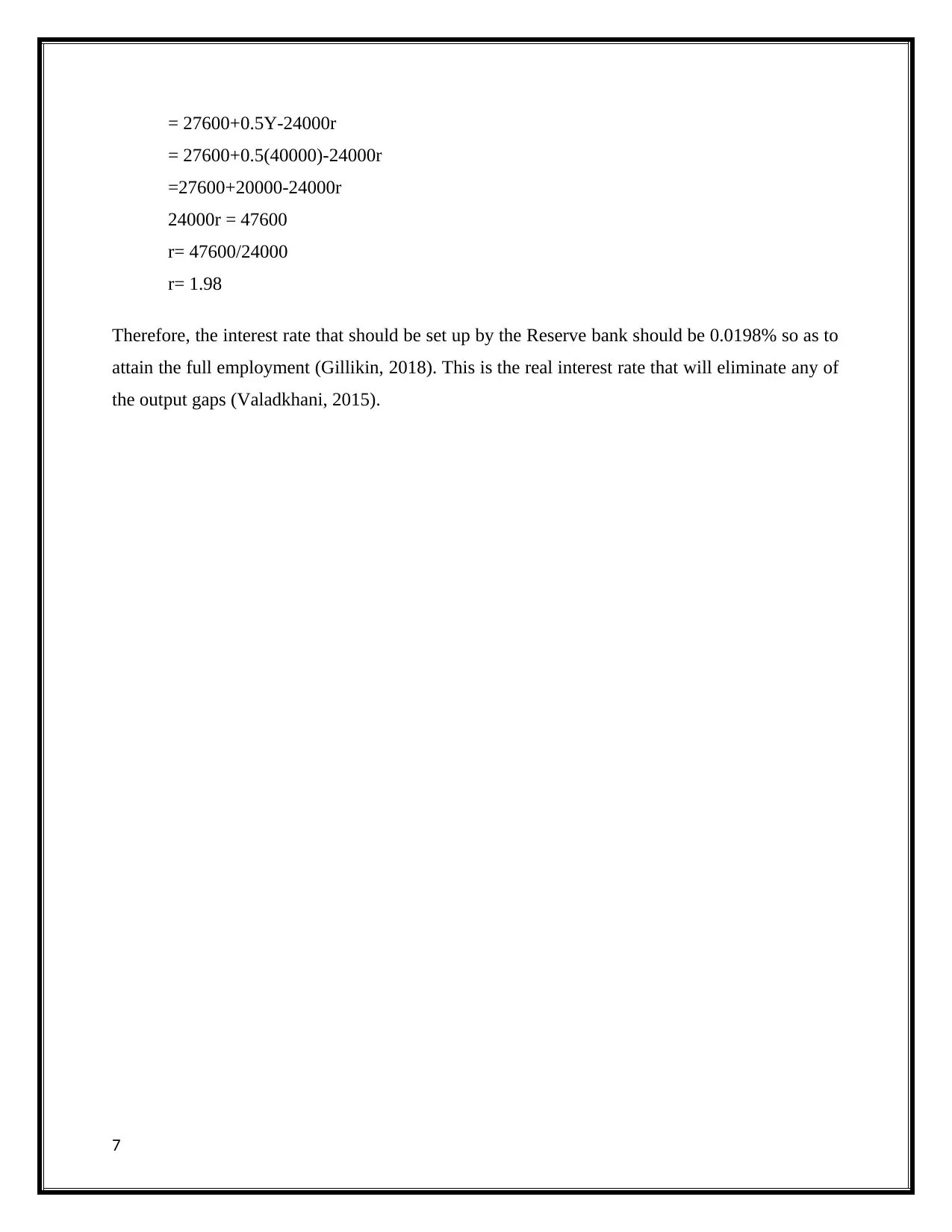
= 27600+0.5Y-24000r
= 27600+0.5(40000)-24000r
=27600+20000-24000r
24000r = 47600
r= 47600/24000
r= 1.98
Therefore, the interest rate that should be set up by the Reserve bank should be 0.0198% so as to
attain the full employment (Gillikin, 2018). This is the real interest rate that will eliminate any of
the output gaps (Valadkhani, 2015).
7
= 27600+0.5(40000)-24000r
=27600+20000-24000r
24000r = 47600
r= 47600/24000
r= 1.98
Therefore, the interest rate that should be set up by the Reserve bank should be 0.0198% so as to
attain the full employment (Gillikin, 2018). This is the real interest rate that will eliminate any of
the output gaps (Valadkhani, 2015).
7
Paraphrase This Document
Need a fresh take? Get an instant paraphrase of this document with our AI Paraphraser
Question 3
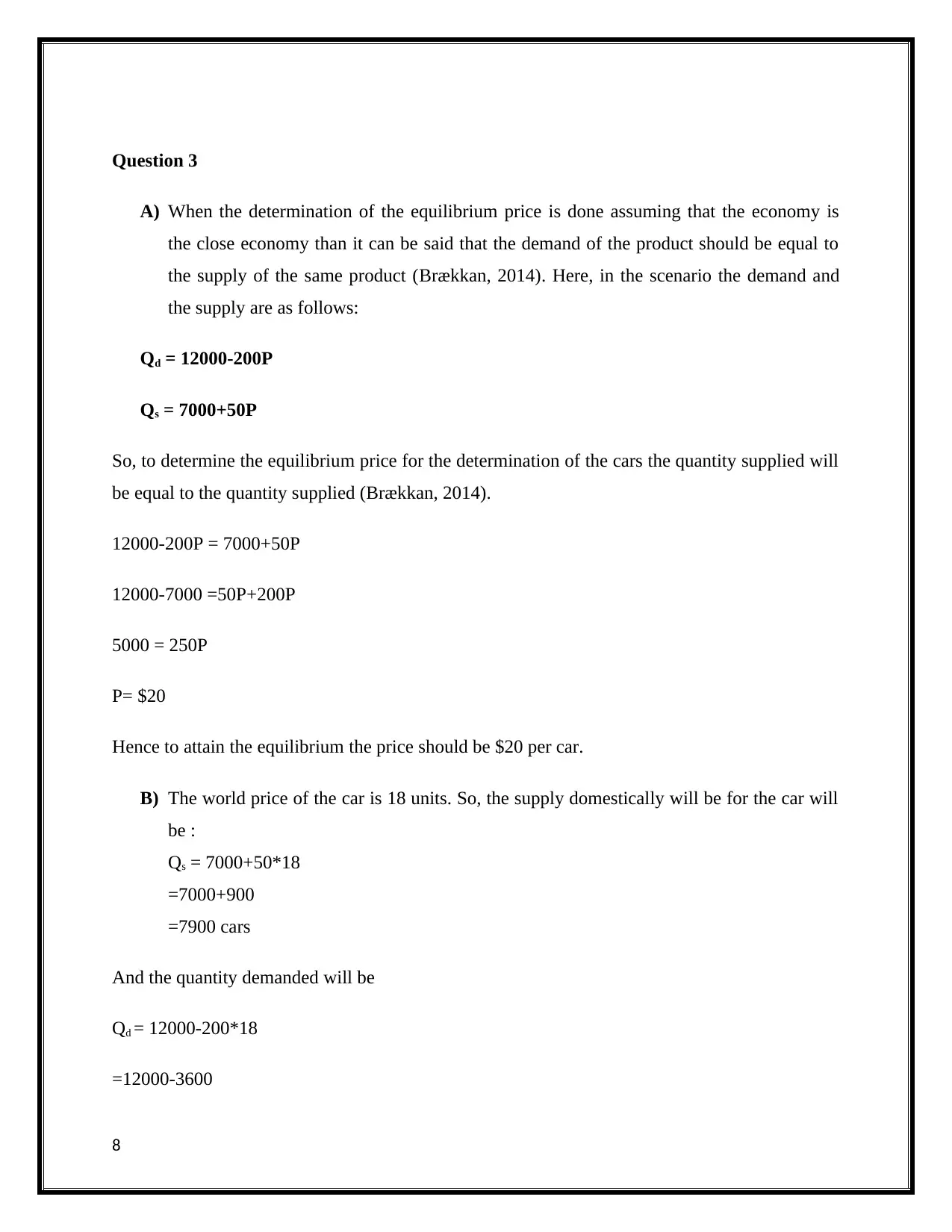
A) When the determination of the equilibrium price is done assuming that the economy is
the close economy than it can be said that the demand of the product should be equal to
the supply of the same product (Brækkan, 2014). Here, in the scenario the demand and
the supply are as follows:
Qd = 12000-200P
Qs = 7000+50P
So, to determine the equilibrium price for the determination of the cars the quantity supplied will
be equal to the quantity supplied (Brækkan, 2014).
12000-200P = 7000+50P
12000-7000 =50P+200P
5000 = 250P
P= $20
Hence to attain the equilibrium the price should be $20 per car.
B) The world price of the car is 18 units. So, the supply domestically will be for the car will
be :
Qs = 7000+50*18
=7000+900
=7900 cars
And the quantity demanded will be
Qd = 12000-200*18
=12000-3600
8
A) When the determination of the equilibrium price is done assuming that the economy is
the close economy than it can be said that the demand of the product should be equal to
the supply of the same product (Brækkan, 2014). Here, in the scenario the demand and
the supply are as follows:
Qd = 12000-200P
Qs = 7000+50P
So, to determine the equilibrium price for the determination of the cars the quantity supplied will
be equal to the quantity supplied (Brækkan, 2014).
12000-200P = 7000+50P
12000-7000 =50P+200P
5000 = 250P
P= $20
Hence to attain the equilibrium the price should be $20 per car.
B) The world price of the car is 18 units. So, the supply domestically will be for the car will
be :
Qs = 7000+50*18
=7000+900
=7900 cars
And the quantity demanded will be
Qd = 12000-200*18
=12000-3600
8
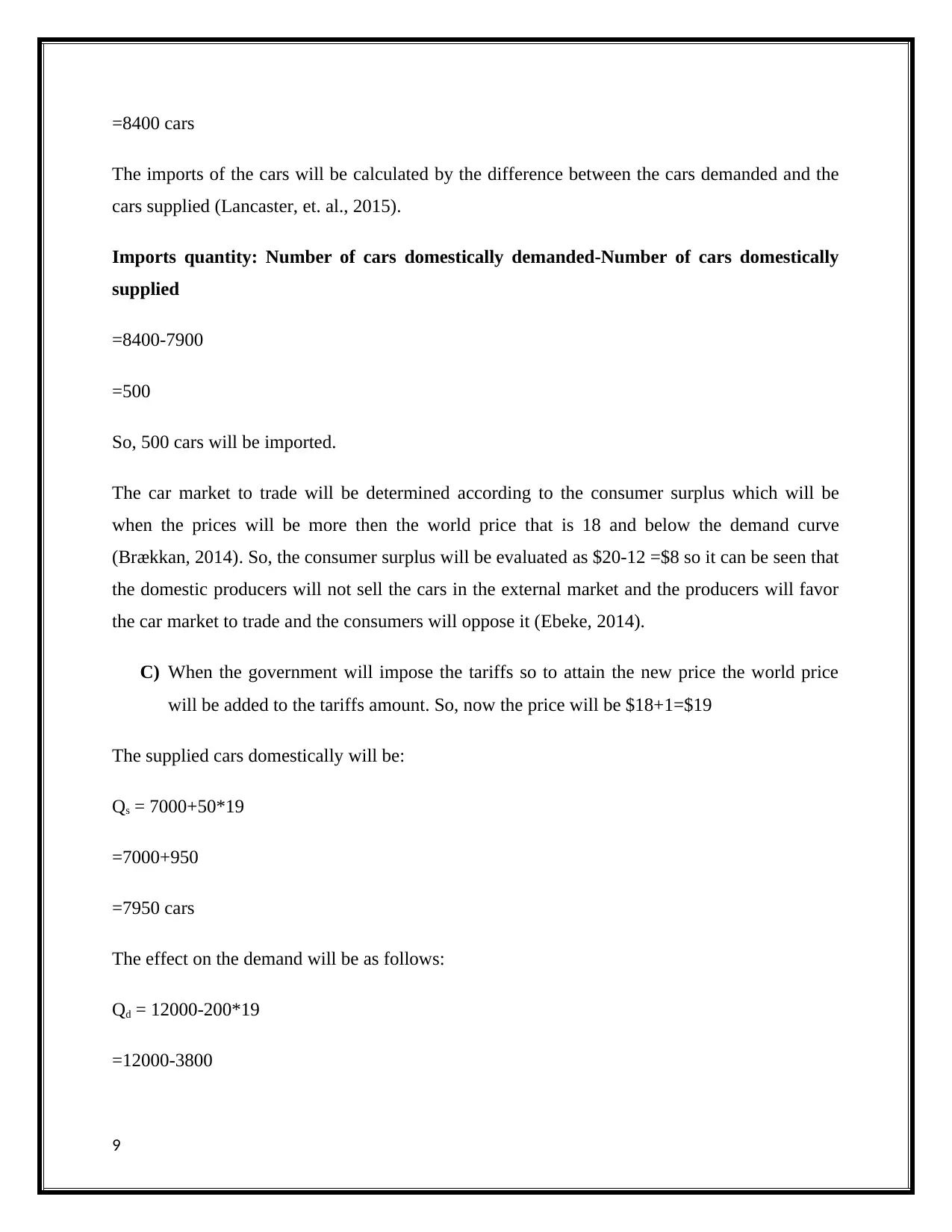
=8400 cars
The imports of the cars will be calculated by the difference between the cars demanded and the
cars supplied (Lancaster, et. al., 2015).
Imports quantity: Number of cars domestically demanded-Number of cars domestically
supplied
=8400-7900
=500
So, 500 cars will be imported.
The car market to trade will be determined according to the consumer surplus which will be
when the prices will be more then the world price that is 18 and below the demand curve
(Brækkan, 2014). So, the consumer surplus will be evaluated as $20-12 =$8 so it can be seen that
the domestic producers will not sell the cars in the external market and the producers will favor
the car market to trade and the consumers will oppose it (Ebeke, 2014).
C) When the government will impose the tariffs so to attain the new price the world price
will be added to the tariffs amount. So, now the price will be $18+1=$19
The supplied cars domestically will be:
Qs = 7000+50*19
=7000+950
=7950 cars
The effect on the demand will be as follows:
Qd = 12000-200*19
=12000-3800
9
The imports of the cars will be calculated by the difference between the cars demanded and the
cars supplied (Lancaster, et. al., 2015).
Imports quantity: Number of cars domestically demanded-Number of cars domestically
supplied
=8400-7900
=500
So, 500 cars will be imported.
The car market to trade will be determined according to the consumer surplus which will be
when the prices will be more then the world price that is 18 and below the demand curve
(Brækkan, 2014). So, the consumer surplus will be evaluated as $20-12 =$8 so it can be seen that
the domestic producers will not sell the cars in the external market and the producers will favor
the car market to trade and the consumers will oppose it (Ebeke, 2014).
C) When the government will impose the tariffs so to attain the new price the world price
will be added to the tariffs amount. So, now the price will be $18+1=$19
The supplied cars domestically will be:
Qs = 7000+50*19
=7000+950
=7950 cars
The effect on the demand will be as follows:
Qd = 12000-200*19
=12000-3800
9
⊘ This is a preview!⊘
Do you want full access?
Subscribe today to unlock all pages.
Trusted by 1+ million students worldwide
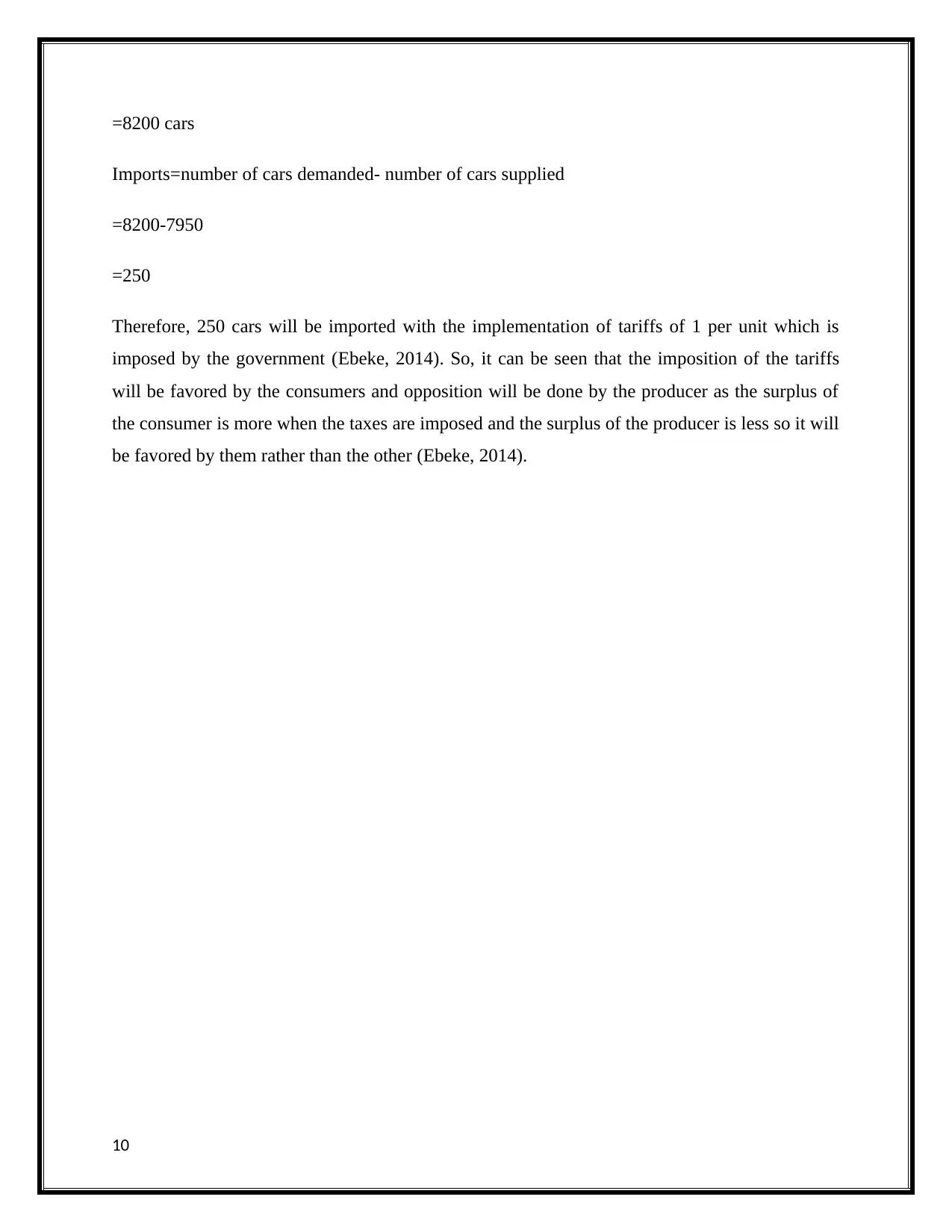
=8200 cars
Imports=number of cars demanded- number of cars supplied
=8200-7950
=250
Therefore, 250 cars will be imported with the implementation of tariffs of 1 per unit which is
imposed by the government (Ebeke, 2014). So, it can be seen that the imposition of the tariffs
will be favored by the consumers and opposition will be done by the producer as the surplus of
the consumer is more when the taxes are imposed and the surplus of the producer is less so it will
be favored by them rather than the other (Ebeke, 2014).
10
Imports=number of cars demanded- number of cars supplied
=8200-7950
=250
Therefore, 250 cars will be imported with the implementation of tariffs of 1 per unit which is
imposed by the government (Ebeke, 2014). So, it can be seen that the imposition of the tariffs
will be favored by the consumers and opposition will be done by the producer as the surplus of
the consumer is more when the taxes are imposed and the surplus of the producer is less so it will
be favored by them rather than the other (Ebeke, 2014).
10
Paraphrase This Document
Need a fresh take? Get an instant paraphrase of this document with our AI Paraphraser
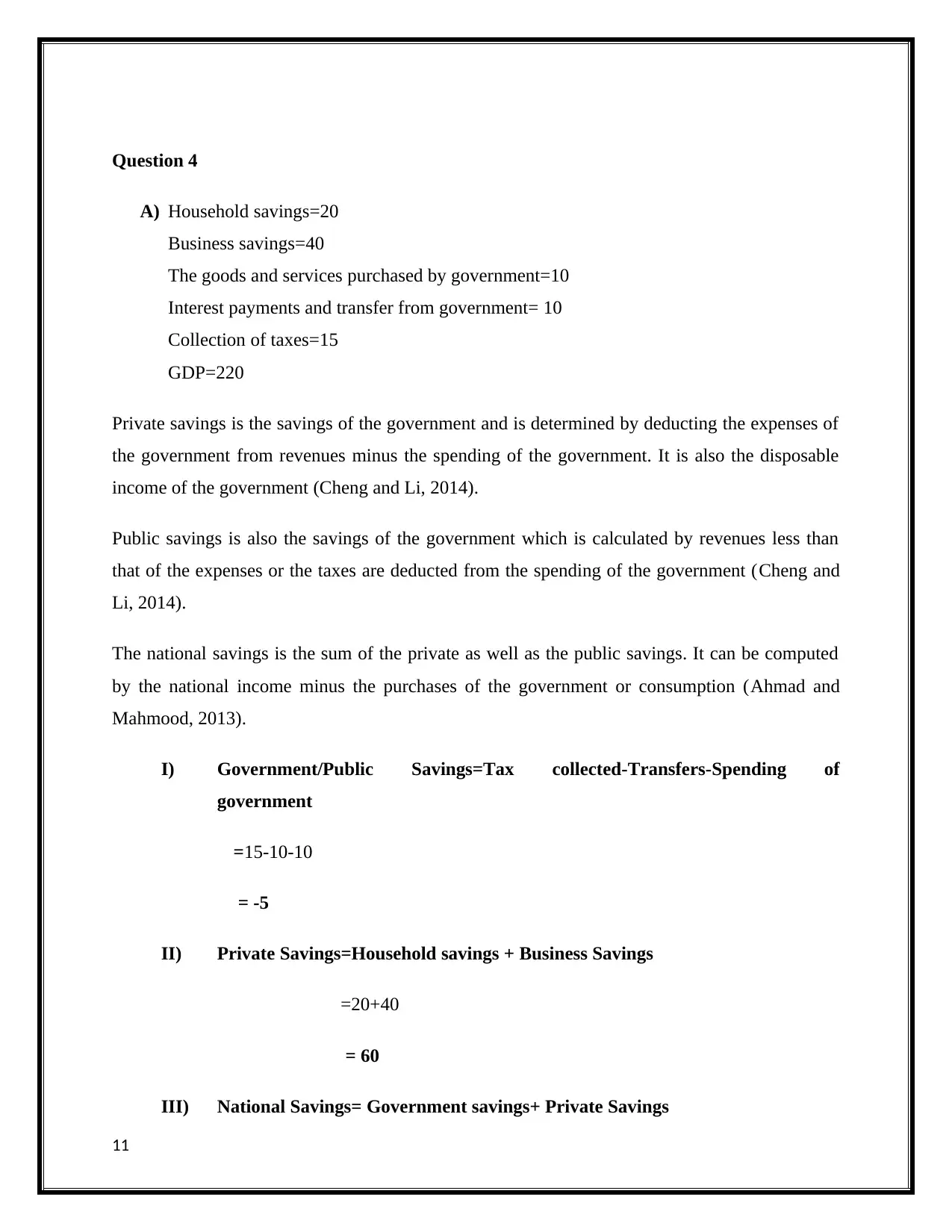
Question 4
A) Household savings=20
Business savings=40
The goods and services purchased by government=10
Interest payments and transfer from government= 10
Collection of taxes=15
GDP=220
Private savings is the savings of the government and is determined by deducting the expenses of
the government from revenues minus the spending of the government. It is also the disposable
income of the government (Cheng and Li, 2014).
Public savings is also the savings of the government which is calculated by revenues less than
that of the expenses or the taxes are deducted from the spending of the government (Cheng and
Li, 2014).
The national savings is the sum of the private as well as the public savings. It can be computed
by the national income minus the purchases of the government or consumption (Ahmad and
Mahmood, 2013).
I) Government/Public Savings=Tax collected-Transfers-Spending of
government
=15-10-10
= -5
II) Private Savings=Household savings + Business Savings
=20+40
= 60
III) National Savings= Government savings+ Private Savings
11
A) Household savings=20
Business savings=40
The goods and services purchased by government=10
Interest payments and transfer from government= 10
Collection of taxes=15
GDP=220
Private savings is the savings of the government and is determined by deducting the expenses of
the government from revenues minus the spending of the government. It is also the disposable
income of the government (Cheng and Li, 2014).
Public savings is also the savings of the government which is calculated by revenues less than
that of the expenses or the taxes are deducted from the spending of the government (Cheng and
Li, 2014).
The national savings is the sum of the private as well as the public savings. It can be computed
by the national income minus the purchases of the government or consumption (Ahmad and
Mahmood, 2013).
I) Government/Public Savings=Tax collected-Transfers-Spending of
government
=15-10-10
= -5
II) Private Savings=Household savings + Business Savings
=20+40
= 60
III) National Savings= Government savings+ Private Savings
11
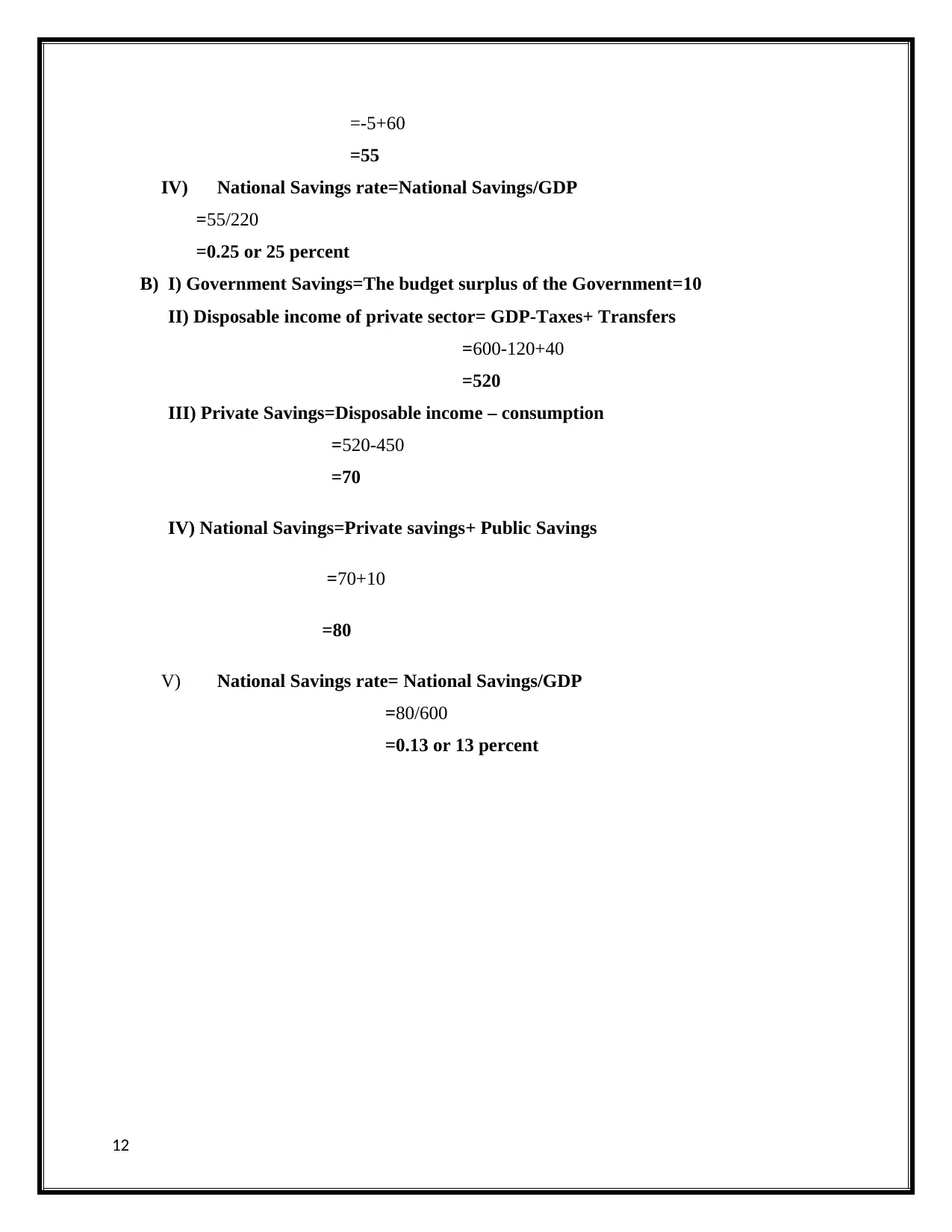
=-5+60
=55
IV) National Savings rate=National Savings/GDP
=55/220
=0.25 or 25 percent
B) I) Government Savings=The budget surplus of the Government=10
II) Disposable income of private sector= GDP-Taxes+ Transfers
=600-120+40
=520
III) Private Savings=Disposable income – consumption
=520-450
=70
IV) National Savings=Private savings+ Public Savings
=70+10
=80
V) National Savings rate= National Savings/GDP
=80/600
=0.13 or 13 percent
12
=55
IV) National Savings rate=National Savings/GDP
=55/220
=0.25 or 25 percent
B) I) Government Savings=The budget surplus of the Government=10
II) Disposable income of private sector= GDP-Taxes+ Transfers
=600-120+40
=520
III) Private Savings=Disposable income – consumption
=520-450
=70
IV) National Savings=Private savings+ Public Savings
=70+10
=80
V) National Savings rate= National Savings/GDP
=80/600
=0.13 or 13 percent
12
⊘ This is a preview!⊘
Do you want full access?
Subscribe today to unlock all pages.
Trusted by 1+ million students worldwide

1 out of 14


Related Documents


Your All-in-One AI-Powered Toolkit for Academic Success.
+13062052269
info@desklib.com
Available 24*7 on WhatsApp / Email
![[object Object]](/_next/static/media/star-bottom.7253800d.svg)
Unlock your academic potential
Copyright © 2020–2026 A2Z Services. All Rights Reserved. Developed and managed by ZUCOL.