BM533 Contemporary Economic Analysis: Tesco, Demand, Supply, Theories
VerifiedAdded on 2023/06/08
|12
|2974
|456
Report
AI Summary
This report provides a detailed economic analysis of Tesco, focusing on demand and supply dynamics. It explores the laws of demand and supply, elasticity, and factors affecting these elements. Furthermore, it contrasts Keynesian (20th century) and Marxism (21st century) economic theories, evaluating their relevance to Tesco's operational environment. The report highlights how Tesco can leverage these economic principles to maintain competitiveness and manage market challenges, considering factors like production costs, government subsidies, and technological advancements.
BM533 Contemporary
Economic Analysis
Economic Analysis

Paraphrase This Document
Need a fresh take? Get an instant paraphrase of this document with our AI Paraphraser
Table of Contents
INTRODUCTION : ........................................................................................................................3
MAIN BODY...................................................................................................................................3
TASK 1............................................................................................................................................3
TASK 2: ..........................................................................................................................................9
CONCLUSION..............................................................................................................................11
REFERENCES..............................................................................................................................12
INTRODUCTION : ........................................................................................................................3
MAIN BODY...................................................................................................................................3
TASK 1............................................................................................................................................3
TASK 2: ..........................................................................................................................................9
CONCLUSION..............................................................................................................................11
REFERENCES..............................................................................................................................12
INTRODUCTION :
Microeconomics is the study of characteristics of the decision makers within the
economy such as individuals, households and enterprises. Economics is the framework which
focuses on production, distribution and consumption of goods and services. It is the study of the
economic resources along with their use in different conditions. There are various problems
which are faced by the organisations in the market which can make an impact on the working of
the business. There are several factors which are to be considered by the companied such as
customer's, suppliers, competitors and government(Anokhina, Maksimov and Seredina, 2019).
The report will discuss the two main factors of economics which are demand and supply. The
law related to demand and supply along with their curves will also be covered in the report. This
report also covers the contrast of various theories and models which were developed in 20th and
21st century. The report will be prepared on Tesco which is a British international groceries and
general merchandise organisation. The organisation was established in the year 1919 by Jack
Cohen. The company has its headquarter in Welwyn Garden City, Hertfordshire, England, UK.
MAIN BODY
TASK 1
DEMAND:
Demand is the quantity of the consumers who are willing and are able to purchase the
goods and services at particular price in the market. It is the want of the individuals for buying
the products which is associated with sufficient purchasing power. Tesco should study demand
for determining the prices of the products to meet the demand and generate the profits. It has
been seen that businesses can spend a considerable amount of money to identify the amount of
demand the customer's has for the goods and services in the market.
Law of demand
Microeconomics is the study of characteristics of the decision makers within the
economy such as individuals, households and enterprises. Economics is the framework which
focuses on production, distribution and consumption of goods and services. It is the study of the
economic resources along with their use in different conditions. There are various problems
which are faced by the organisations in the market which can make an impact on the working of
the business. There are several factors which are to be considered by the companied such as
customer's, suppliers, competitors and government(Anokhina, Maksimov and Seredina, 2019).
The report will discuss the two main factors of economics which are demand and supply. The
law related to demand and supply along with their curves will also be covered in the report. This
report also covers the contrast of various theories and models which were developed in 20th and
21st century. The report will be prepared on Tesco which is a British international groceries and
general merchandise organisation. The organisation was established in the year 1919 by Jack
Cohen. The company has its headquarter in Welwyn Garden City, Hertfordshire, England, UK.
MAIN BODY
TASK 1
DEMAND:
Demand is the quantity of the consumers who are willing and are able to purchase the
goods and services at particular price in the market. It is the want of the individuals for buying
the products which is associated with sufficient purchasing power. Tesco should study demand
for determining the prices of the products to meet the demand and generate the profits. It has
been seen that businesses can spend a considerable amount of money to identify the amount of
demand the customer's has for the goods and services in the market.
Law of demand
⊘ This is a preview!⊘
Do you want full access?
Subscribe today to unlock all pages.

Trusted by 1+ million students worldwide
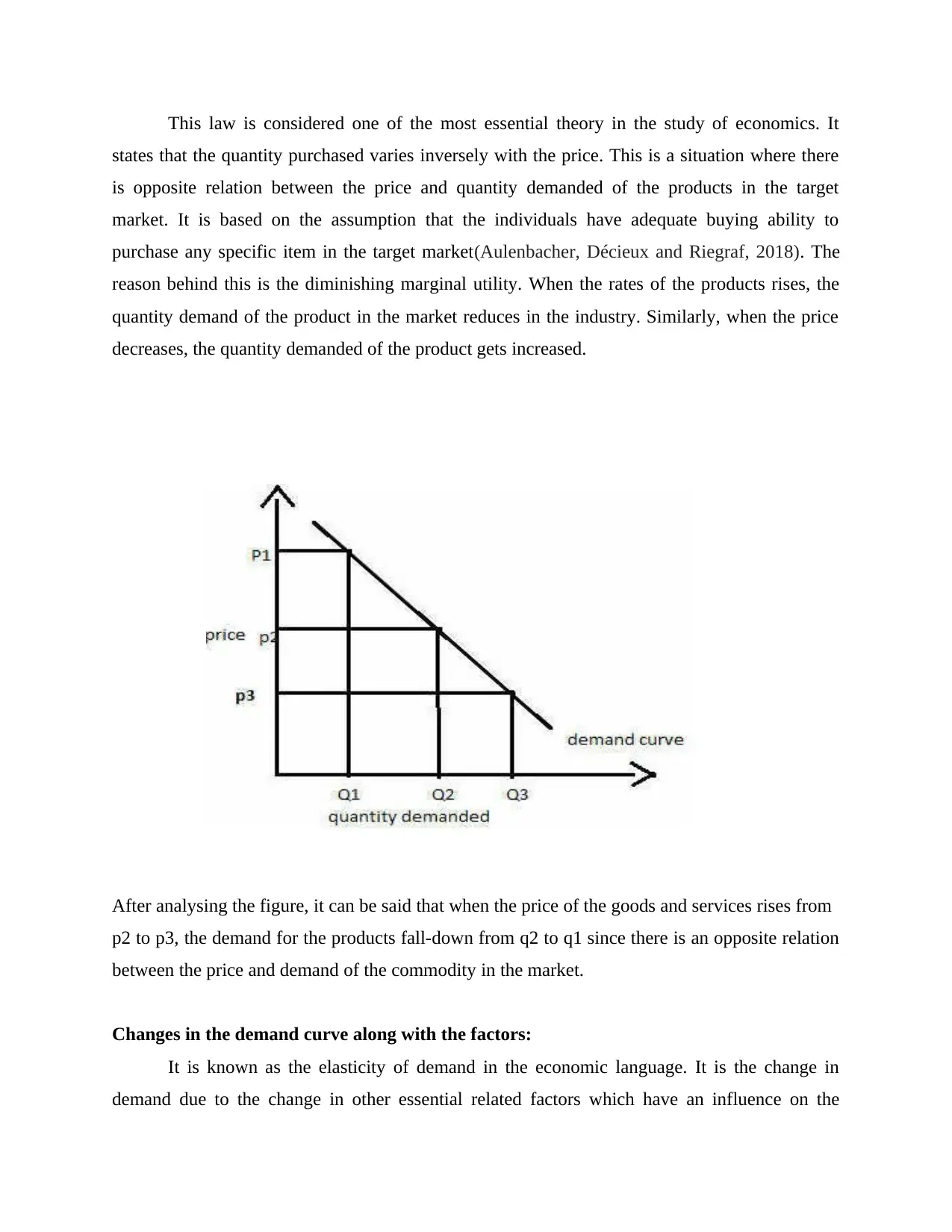
This law is considered one of the most essential theory in the study of economics. It
states that the quantity purchased varies inversely with the price. This is a situation where there
is opposite relation between the price and quantity demanded of the products in the target
market. It is based on the assumption that the individuals have adequate buying ability to
purchase any specific item in the target market(Aulenbacher, Décieux and Riegraf, 2018). The
reason behind this is the diminishing marginal utility. When the rates of the products rises, the
quantity demand of the product in the market reduces in the industry. Similarly, when the price
decreases, the quantity demanded of the product gets increased.
After analysing the figure, it can be said that when the price of the goods and services rises from
p2 to p3, the demand for the products fall-down from q2 to q1 since there is an opposite relation
between the price and demand of the commodity in the market.
Changes in the demand curve along with the factors:
It is known as the elasticity of demand in the economic language. It is the change in
demand due to the change in other essential related factors which have an influence on the
states that the quantity purchased varies inversely with the price. This is a situation where there
is opposite relation between the price and quantity demanded of the products in the target
market. It is based on the assumption that the individuals have adequate buying ability to
purchase any specific item in the target market(Aulenbacher, Décieux and Riegraf, 2018). The
reason behind this is the diminishing marginal utility. When the rates of the products rises, the
quantity demand of the product in the market reduces in the industry. Similarly, when the price
decreases, the quantity demanded of the product gets increased.
After analysing the figure, it can be said that when the price of the goods and services rises from
p2 to p3, the demand for the products fall-down from q2 to q1 since there is an opposite relation
between the price and demand of the commodity in the market.
Changes in the demand curve along with the factors:
It is known as the elasticity of demand in the economic language. It is the change in
demand due to the change in other essential related factors which have an influence on the
Paraphrase This Document
Need a fresh take? Get an instant paraphrase of this document with our AI Paraphraser
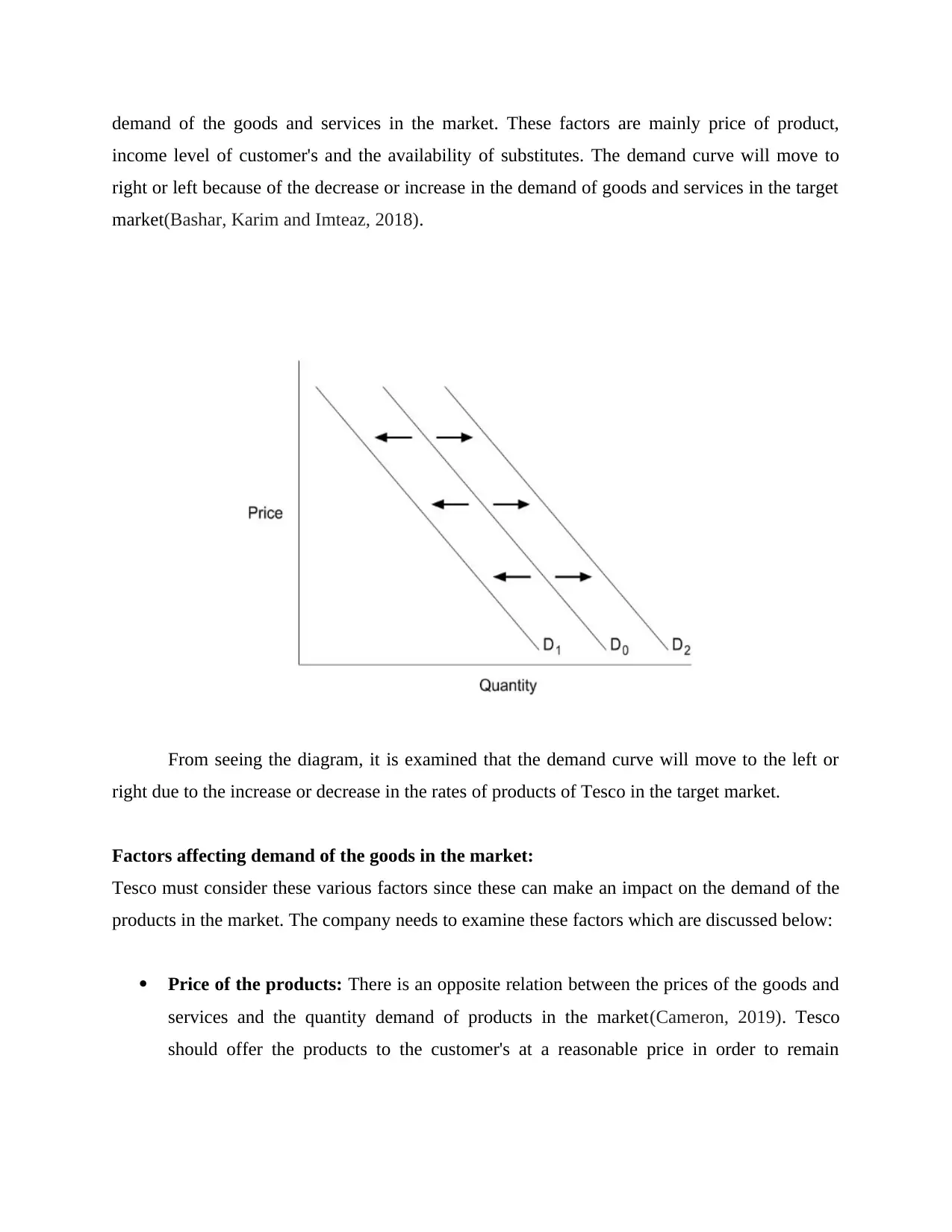
demand of the goods and services in the market. These factors are mainly price of product,
income level of customer's and the availability of substitutes. The demand curve will move to
right or left because of the decrease or increase in the demand of goods and services in the target
market(Bashar, Karim and Imteaz, 2018).
From seeing the diagram, it is examined that the demand curve will move to the left or
right due to the increase or decrease in the rates of products of Tesco in the target market.
Factors affecting demand of the goods in the market:
Tesco must consider these various factors since these can make an impact on the demand of the
products in the market. The company needs to examine these factors which are discussed below:
Price of the products: There is an opposite relation between the prices of the goods and
services and the quantity demand of products in the market(Cameron, 2019). Tesco
should offer the products to the customer's at a reasonable price in order to remain
income level of customer's and the availability of substitutes. The demand curve will move to
right or left because of the decrease or increase in the demand of goods and services in the target
market(Bashar, Karim and Imteaz, 2018).
From seeing the diagram, it is examined that the demand curve will move to the left or
right due to the increase or decrease in the rates of products of Tesco in the target market.
Factors affecting demand of the goods in the market:
Tesco must consider these various factors since these can make an impact on the demand of the
products in the market. The company needs to examine these factors which are discussed below:
Price of the products: There is an opposite relation between the prices of the goods and
services and the quantity demand of products in the market(Cameron, 2019). Tesco
should offer the products to the customer's at a reasonable price in order to remain
competitive in the industry. If the prices of the goods and services are increased by the
company, then it will have a negative impact on the sales of the business.
Income of consumer: It is another essential factor which makes an impact on the
purchasing power of the customer's in the market. There is a positive relationship
between the earning of people and the demand of goods and services(Carnevali and
PedersenYstehede, 2022). Tesco must realise that when the income of consumers
increases, the demand for their products also increases. It should try to minimise the price
of its products so that individuals can purchase the product even after having less income.
Availability of substitutes: The availability of substitutes also affect the demand of the
products in the market. When there are more similar products available for the customer's
to buy, then the demand of products of Tesco will decrease. The company needs to
innovate new products which are not available in the market(Faust, 2019). This will help
the organisation in increasing the sales and gaining an competitive advantage in the
industry.
SUPPLY:
Supply can be defined as the fundamental aspect which is the overall available amount
for the given goods and services to the purchasers. It is simply the total amount which is
available for further sale at the given prices which helps in achieving higher profits margins in
the business.
Law of supply: This states that there is direct relation between the rates and quantity supply of
the products. When the prices of products rises, the supply of the products also rises since the
manufacturer will sell more products at a higher price which lead to increased profits(Liao, Xu
and Herrera, 2020). Similarly, when the prices of the products reduces, the quantity supply of
these goods and services also decreases. This law is based on the hypothesis that other related
factors does not change.
company, then it will have a negative impact on the sales of the business.
Income of consumer: It is another essential factor which makes an impact on the
purchasing power of the customer's in the market. There is a positive relationship
between the earning of people and the demand of goods and services(Carnevali and
PedersenYstehede, 2022). Tesco must realise that when the income of consumers
increases, the demand for their products also increases. It should try to minimise the price
of its products so that individuals can purchase the product even after having less income.
Availability of substitutes: The availability of substitutes also affect the demand of the
products in the market. When there are more similar products available for the customer's
to buy, then the demand of products of Tesco will decrease. The company needs to
innovate new products which are not available in the market(Faust, 2019). This will help
the organisation in increasing the sales and gaining an competitive advantage in the
industry.
SUPPLY:
Supply can be defined as the fundamental aspect which is the overall available amount
for the given goods and services to the purchasers. It is simply the total amount which is
available for further sale at the given prices which helps in achieving higher profits margins in
the business.
Law of supply: This states that there is direct relation between the rates and quantity supply of
the products. When the prices of products rises, the supply of the products also rises since the
manufacturer will sell more products at a higher price which lead to increased profits(Liao, Xu
and Herrera, 2020). Similarly, when the prices of the products reduces, the quantity supply of
these goods and services also decreases. This law is based on the hypothesis that other related
factors does not change.
⊘ This is a preview!⊘
Do you want full access?
Subscribe today to unlock all pages.
Trusted by 1+ million students worldwide
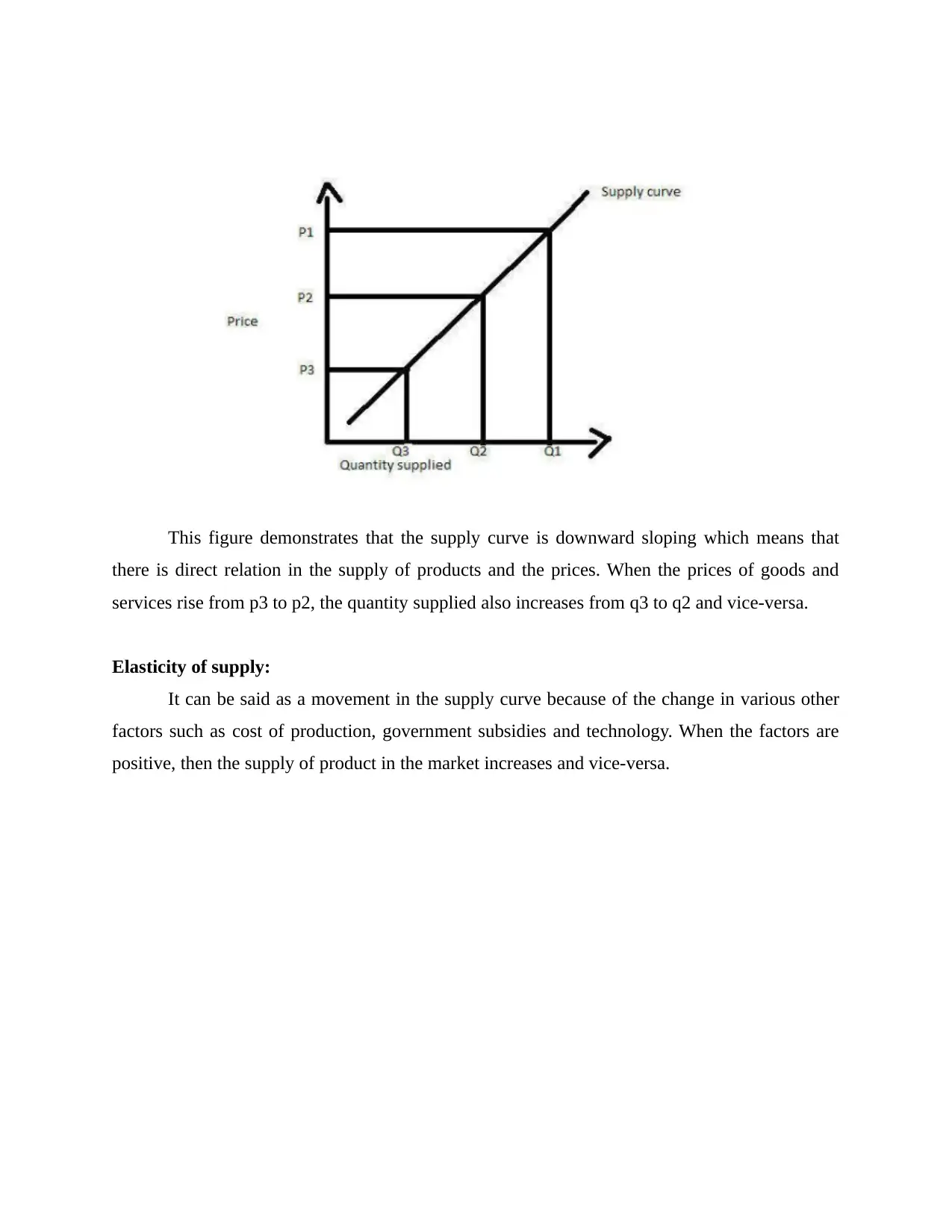
This figure demonstrates that the supply curve is downward sloping which means that
there is direct relation in the supply of products and the prices. When the prices of goods and
services rise from p3 to p2, the quantity supplied also increases from q3 to q2 and vice-versa.
Elasticity of supply:
It can be said as a movement in the supply curve because of the change in various other
factors such as cost of production, government subsidies and technology. When the factors are
positive, then the supply of product in the market increases and vice-versa.
there is direct relation in the supply of products and the prices. When the prices of goods and
services rise from p3 to p2, the quantity supplied also increases from q3 to q2 and vice-versa.
Elasticity of supply:
It can be said as a movement in the supply curve because of the change in various other
factors such as cost of production, government subsidies and technology. When the factors are
positive, then the supply of product in the market increases and vice-versa.
Paraphrase This Document
Need a fresh take? Get an instant paraphrase of this document with our AI Paraphraser
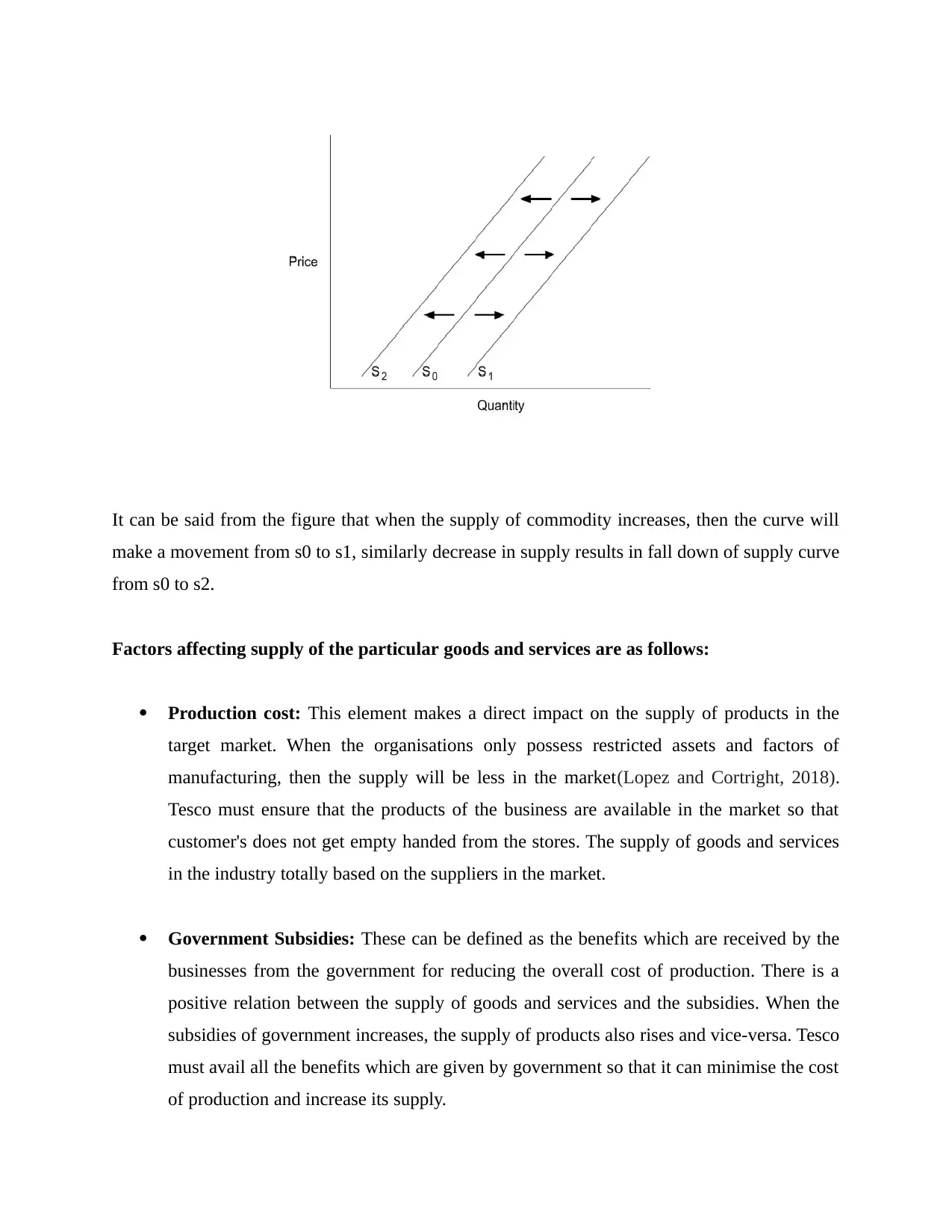
It can be said from the figure that when the supply of commodity increases, then the curve will
make a movement from s0 to s1, similarly decrease in supply results in fall down of supply curve
from s0 to s2.
Factors affecting supply of the particular goods and services are as follows:
Production cost: This element makes a direct impact on the supply of products in the
target market. When the organisations only possess restricted assets and factors of
manufacturing, then the supply will be less in the market(Lopez and Cortright, 2018).
Tesco must ensure that the products of the business are available in the market so that
customer's does not get empty handed from the stores. The supply of goods and services
in the industry totally based on the suppliers in the market.
Government Subsidies: These can be defined as the benefits which are received by the
businesses from the government for reducing the overall cost of production. There is a
positive relation between the supply of goods and services and the subsidies. When the
subsidies of government increases, the supply of products also rises and vice-versa. Tesco
must avail all the benefits which are given by government so that it can minimise the cost
of production and increase its supply.
make a movement from s0 to s1, similarly decrease in supply results in fall down of supply curve
from s0 to s2.
Factors affecting supply of the particular goods and services are as follows:
Production cost: This element makes a direct impact on the supply of products in the
target market. When the organisations only possess restricted assets and factors of
manufacturing, then the supply will be less in the market(Lopez and Cortright, 2018).
Tesco must ensure that the products of the business are available in the market so that
customer's does not get empty handed from the stores. The supply of goods and services
in the industry totally based on the suppliers in the market.
Government Subsidies: These can be defined as the benefits which are received by the
businesses from the government for reducing the overall cost of production. There is a
positive relation between the supply of goods and services and the subsidies. When the
subsidies of government increases, the supply of products also rises and vice-versa. Tesco
must avail all the benefits which are given by government so that it can minimise the cost
of production and increase its supply.
Technology: Technology is considered an essential aspect in the operations of
organisation. Every business should adopt new and modern technology in order to
minimise the overall production cost and enhance the quality of goods and services.
Tesco must adopt new and advanced technology in its business for supplying more
product and sustaining in the market.
TASK 2:
Contrasting theories and models in and 20th and 21st Century in contemporary economics:
Theory of 20th Century:
Keynesian Theory: This theory consists of a macroeconomic theory related to the
overall spending in the nation along with the effects on various aspects such as inflation,
unemployment and output. This theory was established by John Maynard Keynes in the
1930s for understanding the Great Depression. It denoted a modern view of seeing at
things like spending, output and inflation. This theory states that if the aggregate demand
in the economy decreases, then it will result in jobs and production which will lead to
reduction in the wages and prices. The inflation of lower level would encourage the
employers to make more capital investments and hire more people in the business which
will recover the economic growth and stimulate unemployment(Murteira, 2021). In view
of Keynesian, the total demand does not need to be equivalent to the productive capacity
of the nation. It mainly focuses on the fact that government should increase the demand
for boosting the growth of the economy. The collective demand is determined by private
and public sector decisions. Private sector decisions can reduce the consumer spending in
the time of recession. The changes in consumer spending whether known or unknown,
have the effect on short term output and on employment, not on prices of the
commodities. Prices and the wages will effect slowly on demand and supply, which
results in shortage of labour. Keynesian models of economics also involves the multiplier
factors. This economics is measured as a theory which emphasizes on fluctuations in the
organisation. Every business should adopt new and modern technology in order to
minimise the overall production cost and enhance the quality of goods and services.
Tesco must adopt new and advanced technology in its business for supplying more
product and sustaining in the market.
TASK 2:
Contrasting theories and models in and 20th and 21st Century in contemporary economics:
Theory of 20th Century:
Keynesian Theory: This theory consists of a macroeconomic theory related to the
overall spending in the nation along with the effects on various aspects such as inflation,
unemployment and output. This theory was established by John Maynard Keynes in the
1930s for understanding the Great Depression. It denoted a modern view of seeing at
things like spending, output and inflation. This theory states that if the aggregate demand
in the economy decreases, then it will result in jobs and production which will lead to
reduction in the wages and prices. The inflation of lower level would encourage the
employers to make more capital investments and hire more people in the business which
will recover the economic growth and stimulate unemployment(Murteira, 2021). In view
of Keynesian, the total demand does not need to be equivalent to the productive capacity
of the nation. It mainly focuses on the fact that government should increase the demand
for boosting the growth of the economy. The collective demand is determined by private
and public sector decisions. Private sector decisions can reduce the consumer spending in
the time of recession. The changes in consumer spending whether known or unknown,
have the effect on short term output and on employment, not on prices of the
commodities. Prices and the wages will effect slowly on demand and supply, which
results in shortage of labour. Keynesian models of economics also involves the multiplier
factors. This economics is measured as a theory which emphasizes on fluctuations in the
⊘ This is a preview!⊘
Do you want full access?
Subscribe today to unlock all pages.
Trusted by 1+ million students worldwide
economy in the short period of time. The government intervention can stabilize the
economy. The main aim is to achieve price stability and full employment. If government
spending increases and all other spending factors remain constant then the output will
increase. Thus to create employment the buying power of the consumer should also
increase. The theory forces government to cut down the deficits and save the next cycle
in the economy. The businesses have to realize that overdoing the theory can result in
increased inflation.
Tesco should take into consideration this theory since it is a large retail business in the world. It
should focus on formulating policies and strategies which will help in overcoming the issues
which are prevailing in the business. This will help in maintaining its dominant position in the
market. The company mainly operates in UK which has a political stable economy. The
organisation receives the benefit of high demand by the customer's in the market. This allows the
business to sell more products and increase the profits in the industry. The prices and the wages
are not immediately affected by the changes in the market. They are sticky which makes it
difficult for the economy to reconstruct the potential GDP. The main tools of the theory are
government spending on infrastructure, education and unemployment benefits. There is a
increase in the inflation rates because of Keynesian theory to Tesco.
Theory of 21st Century:
Marxism Theory: This theory was named after Karl Marx and it is a social, political and
economic philosophy. It examines the effect of capitalism on the productivity, labour and
economic developments. It is mainly related to the battle between the working class and
the employer class and it supports communism and socialism over capitalism. This theory
states that increasing the competition would lead to bankruptcy among capitalists and the
rise of monopolies instead of producing better goods and services for the customer's.
Marxism theory suggests the class conflicts between the workers and the business
owners. Both the classes are unequal as one is the employer and one is employee(Romão,
2018). At first the political power and interest of workers will decrease, while the number
of workers will increase while taking the means of production. Marxism is a orientation
economy. The main aim is to achieve price stability and full employment. If government
spending increases and all other spending factors remain constant then the output will
increase. Thus to create employment the buying power of the consumer should also
increase. The theory forces government to cut down the deficits and save the next cycle
in the economy. The businesses have to realize that overdoing the theory can result in
increased inflation.
Tesco should take into consideration this theory since it is a large retail business in the world. It
should focus on formulating policies and strategies which will help in overcoming the issues
which are prevailing in the business. This will help in maintaining its dominant position in the
market. The company mainly operates in UK which has a political stable economy. The
organisation receives the benefit of high demand by the customer's in the market. This allows the
business to sell more products and increase the profits in the industry. The prices and the wages
are not immediately affected by the changes in the market. They are sticky which makes it
difficult for the economy to reconstruct the potential GDP. The main tools of the theory are
government spending on infrastructure, education and unemployment benefits. There is a
increase in the inflation rates because of Keynesian theory to Tesco.
Theory of 21st Century:
Marxism Theory: This theory was named after Karl Marx and it is a social, political and
economic philosophy. It examines the effect of capitalism on the productivity, labour and
economic developments. It is mainly related to the battle between the working class and
the employer class and it supports communism and socialism over capitalism. This theory
states that increasing the competition would lead to bankruptcy among capitalists and the
rise of monopolies instead of producing better goods and services for the customer's.
Marxism theory suggests the class conflicts between the workers and the business
owners. Both the classes are unequal as one is the employer and one is employee(Romão,
2018). At first the political power and interest of workers will decrease, while the number
of workers will increase while taking the means of production. Marxism is a orientation
Paraphrase This Document
Need a fresh take? Get an instant paraphrase of this document with our AI Paraphraser
of how a economy exploits workers while collecting more capital for business owners.
The employees are replaceable at the time of unemployment, which decreases the value
of workers. The modern and technological development is out of control. The effect of
capitalism highly effects the labour, productivity and economic development for a
worker. The theory has several core elements which are political power that is held by the
working classes, public ownership etc. Marxism has taken the form of capitalism.
Tesco can use this theory in its business operations since it has some kind of monopoly in the
market. The company should formulate the strategies and do not discriminate between the
employee's. The organisation can focus more on developing making a community within the
organisation so that it can properly implement its strategies and achieve its objectives in the
business. The theory can create an imbalance between owners and the labourers, because
workers have personal interest in the process of production and manufacturing. So TESCO need
to rectify its labour laws so as to provide basic employment opportunities. It needs to see the
value of goods produced and then pay the workers according to the cost and profits. The basic
necessities of a worker need to be fulfilled.
CONCLUSION
It can be concluded from the above report that demand and supply are two most essential
concepts of economics. Tesco must examine the factors which can make an impact on the
demand and supply of the products in the market. The report has discussed the laws of demand
and supply along with the factors affecting it. The company must formulate the policies and
strategies by keeping in consideration these elements of economics. The various theories and
models relating to contemporary economics are discussed which give an idea about the mindset
which is essential while formulating objectives of the business. Tesco must focus on its strengths
and follow those practises which it is practising from earlier. The company is prepared for any
contingency which can arise in the future. The various factors which affect the demand are cost
of the goods, income of the consumer and availability of substitutes. The factors which affect the
supply of goods and services are cost of manufacturing goods, government subsidies and
technology. The company must concentrate on achieving its goals and targets so that it can
maintain a strong position in the industry.
The employees are replaceable at the time of unemployment, which decreases the value
of workers. The modern and technological development is out of control. The effect of
capitalism highly effects the labour, productivity and economic development for a
worker. The theory has several core elements which are political power that is held by the
working classes, public ownership etc. Marxism has taken the form of capitalism.
Tesco can use this theory in its business operations since it has some kind of monopoly in the
market. The company should formulate the strategies and do not discriminate between the
employee's. The organisation can focus more on developing making a community within the
organisation so that it can properly implement its strategies and achieve its objectives in the
business. The theory can create an imbalance between owners and the labourers, because
workers have personal interest in the process of production and manufacturing. So TESCO need
to rectify its labour laws so as to provide basic employment opportunities. It needs to see the
value of goods produced and then pay the workers according to the cost and profits. The basic
necessities of a worker need to be fulfilled.
CONCLUSION
It can be concluded from the above report that demand and supply are two most essential
concepts of economics. Tesco must examine the factors which can make an impact on the
demand and supply of the products in the market. The report has discussed the laws of demand
and supply along with the factors affecting it. The company must formulate the policies and
strategies by keeping in consideration these elements of economics. The various theories and
models relating to contemporary economics are discussed which give an idea about the mindset
which is essential while formulating objectives of the business. Tesco must focus on its strengths
and follow those practises which it is practising from earlier. The company is prepared for any
contingency which can arise in the future. The various factors which affect the demand are cost
of the goods, income of the consumer and availability of substitutes. The factors which affect the
supply of goods and services are cost of manufacturing goods, government subsidies and
technology. The company must concentrate on achieving its goals and targets so that it can
maintain a strong position in the industry.
REFERENCES
Books and Journals
Anokhina, M.E., Maksimov, M.I. and Seredina, N.S., 2019. A guide to contemporary strategic
analysis.
Aulenbacher, B., Décieux, F. and Riegraf, B., 2018. The economic shift and beyond: Care as a
contested terrain in contemporary capitalism. Current Sociology, 66(4), pp.517-530.
Bashar, M.Z.I., Karim, M.R. and Imteaz, M.A., 2018. Reliability and economic analysis of urban
rainwater harvesting: A comparative study within six major cities of
Bangladesh. Resources, Conservation and Recycling, 133, pp.146-154.
Cameron, S., 2019. Contemporary challenges to cultural economics. In A Research Agenda for
Cultural Economics. Edward Elgar Publishing.
Carnevali, E. and Pedersen Ystehede, A., 2022. Is socialism back? A review of contemporary
economic literature. Journal of Economic Surveys.
Faust, F., 2019. Comparative law and economic analysis of law.
Liao, H., Xu, Z. and Herrera, F., 2020. Applications of contemporary decision-making methods
to the development of economy and technology. Technological and Economic
Development of Economy, 26(3), p.546.
Lopez, G.Α. and Cortright, D., 2018. Economic sanctions in contemporary global relations.
In Economic Sanctions (pp. 3-16). Routledge.
Murteira, M., 2021. 11. The Present Economic Situation: Its Origins and Prospects.
In Contemporary Portugal (pp. 331-342). University of Texas Press.
Romão, J., 2018. Spatial-economic impacts of tourism on regional development: contemporary
challenges. In Tourism, Territory and Sustainable Development (pp. 129-146). Springer,
Singapore.
Books and Journals
Anokhina, M.E., Maksimov, M.I. and Seredina, N.S., 2019. A guide to contemporary strategic
analysis.
Aulenbacher, B., Décieux, F. and Riegraf, B., 2018. The economic shift and beyond: Care as a
contested terrain in contemporary capitalism. Current Sociology, 66(4), pp.517-530.
Bashar, M.Z.I., Karim, M.R. and Imteaz, M.A., 2018. Reliability and economic analysis of urban
rainwater harvesting: A comparative study within six major cities of
Bangladesh. Resources, Conservation and Recycling, 133, pp.146-154.
Cameron, S., 2019. Contemporary challenges to cultural economics. In A Research Agenda for
Cultural Economics. Edward Elgar Publishing.
Carnevali, E. and Pedersen Ystehede, A., 2022. Is socialism back? A review of contemporary
economic literature. Journal of Economic Surveys.
Faust, F., 2019. Comparative law and economic analysis of law.
Liao, H., Xu, Z. and Herrera, F., 2020. Applications of contemporary decision-making methods
to the development of economy and technology. Technological and Economic
Development of Economy, 26(3), p.546.
Lopez, G.Α. and Cortright, D., 2018. Economic sanctions in contemporary global relations.
In Economic Sanctions (pp. 3-16). Routledge.
Murteira, M., 2021. 11. The Present Economic Situation: Its Origins and Prospects.
In Contemporary Portugal (pp. 331-342). University of Texas Press.
Romão, J., 2018. Spatial-economic impacts of tourism on regional development: contemporary
challenges. In Tourism, Territory and Sustainable Development (pp. 129-146). Springer,
Singapore.
⊘ This is a preview!⊘
Do you want full access?
Subscribe today to unlock all pages.
Trusted by 1+ million students worldwide

1 out of 12


Related Documents


Your All-in-One AI-Powered Toolkit for Academic Success.
+13062052269
info@desklib.com
Available 24*7 on WhatsApp / Email
![[object Object]](/_next/static/media/star-bottom.7253800d.svg)
Unlock your academic potential
Copyright © 2020–2026 A2Z Services. All Rights Reserved. Developed and managed by ZUCOL.