The Relationship Between Oil Prices, Economic Growth, and GDP

Verified

Added on  2022/08/13

|4
|817
|21
Report
AI Summary
This report examines the significant changes in the economy influenced by technology and the increasing reliance on oil. It analyzes the relationship between oil prices and GDP growth, noting that reduced oil prices positively affect GDP by lowering production costs and increasing aggregate demand, while rising prices have the opposite effect. The report explores demand factors like the availability of substitutes such as electric vehicles and changing consumer preferences, as well as supply factors including lack of cooperation among oil-producing countries, which have led to recent price drops. It also discusses the potential for future reductions in oil demand due to government initiatives promoting green transportation and potential supply increases. The report references multiple academic sources to support its analysis.
Document Page
1
ECONOMICS FOR MANAGER
tabler-icon-diamond-filled.svg

Paraphrase This Document

Need a fresh take? Get an instant paraphrase of this document with our AI Paraphraser
Document Page
2
The nature of the economy has changed significantly since the last century with the reliance
of economy in technologically enriched production process. With the increase in the reliance
on these the demand for oil has also increased. In an economy, oil not only helps the transport
to move but also runs the production units directly and indirectly as well. Oladosu et al.
(2018) stated that, as per the trend, the reduction in the price of crude oil positively influences
the GDP growth rate of any economy. Oil mainly reduces the cost of production that further
reduces the prices of goods and services increasing the aggregate demand. Therefore the GDP
increases more due to the reduction in the oil prices. On the other hand the increase in the oil
prices increases the cost of the production and hence the prices increases.
1991-01-01
1993-01-01
1995-01-01
1997-01-01
1999-01-01
2001-01-01
2003-01-01
2005-01-01
2007-01-01
2009-01-01
2011-01-01
2013-01-01
2015-01-01
-400.0
-200.0
0.0
200.0
400.0
600.0
800.0
1000.0
1200.0
Percentage change of GDP
Percentage change of oil price
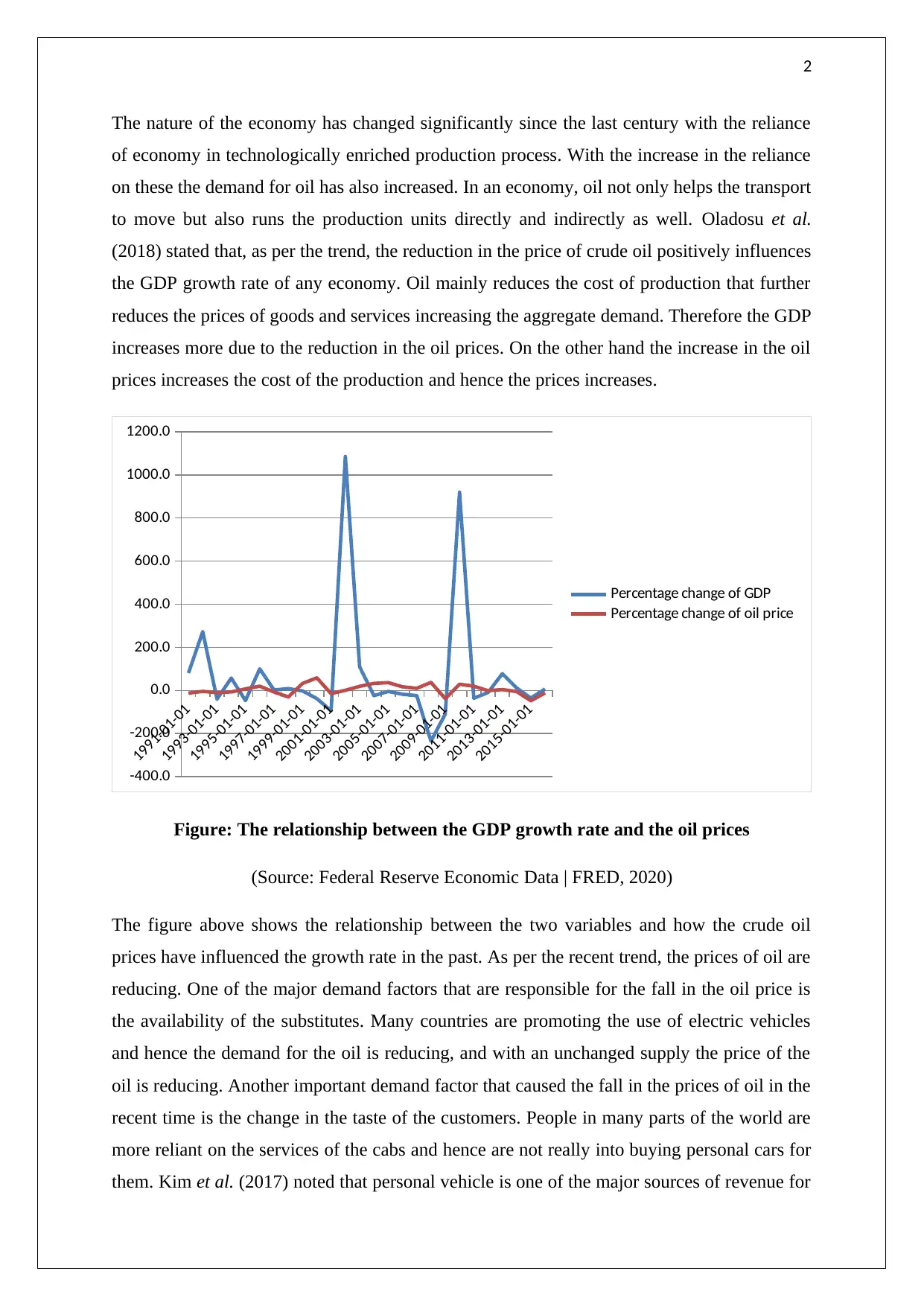
Figure: The relationship between the GDP growth rate and the oil prices
(Source: Federal Reserve Economic Data | FRED, 2020)
The figure above shows the relationship between the two variables and how the crude oil
prices have influenced the growth rate in the past. As per the recent trend, the prices of oil are
reducing. One of the major demand factors that are responsible for the fall in the oil price is
the availability of the substitutes. Many countries are promoting the use of electric vehicles
and hence the demand for the oil is reducing, and with an unchanged supply the price of the
oil is reducing. Another important demand factor that caused the fall in the prices of oil in the
recent time is the change in the taste of the customers. People in many parts of the world are
more reliant on the services of the cabs and hence are not really into buying personal cars for
them. Kim et al. (2017) noted that personal vehicle is one of the major sources of revenue for
Document Page
3
the oil distributors. Among the supply factors that are responsible for the fall in the price of
oil in the recent time is the lack of cooperation among the oil producing countries.
Consequently the world has witnessed a huge increase in the supply of oil world market.
Thus, it has pushed the supply curve to the right leading to a decrease in the price of oil.
Given the situation in the world oil prices and the recent development in the energy use, the
demand for oil in the future may reduce. One of the biggest factors that may become crucial
is the stand of the governments of many countries of the world. Green transportation is a
mission for most of the countries of the world and enhancement of oil industry is not in line
with the aim of green transportation Lorusso & Pieroni, 2018). Other than that, the lack of
cooperation may also increase among the oil producing nations of the world in the future as
each of the countries will be trying to increase their sales in the midst of problems that are
going through right now. Therefore the supply of oil is expected to increase in the future and
along with reduction in the demand, the price of oil in the future may go down sharply.
Document Page
4
Reference
Federal Reserve Economic Data | FRED | St. Louis Fed. (2020). Retrieved 28 February 2020,
from https://fred.stlouisfed.org/
Kim, W. J., Hammoudeh, S., Hyun, J. S., & Gupta, R. (2017). Oil price shocks and China's
economy: Reactions of the monetary policy to oil price shocks. Energy
Economics, 62, 61-69.
Lorusso, M., & Pieroni, L. (2018). Causes and consequences of oil price shocks on the UK
economy. Economic Modelling, 72, 223-236.
Oladosu, G. A., Leiby, P. N., Bowman, D. C., Uría-Martínez, R., & Johnson, M. M. (2018).
Impacts of oil price shocks on the United States economy: A meta-analysis of the oil
price elasticity of GDP for net oil-importing economies. Energy Policy, 115, 523-544.
Oladosu, G., Leiby, P., Bowman, D., Uría-Martínez, R., & Johnson, M. (2017, November).
Impacts of Oil Price Shocks on the US Economy: a Meta-Analysis of Oil Price
Elasticity of GDP for Net Oil-Importing Economies. In Riding the Energy Cycles,
35th USAEE/IAEE North American Conference, Nov 12-15, 2017. International
Association for Energy Economics.
chevron_up_icon
1 out of 4
circle_padding
hide_on_mobile
zoom_out_icon
[object Object]