49003 Economic Evaluation Assignment #1 (Autumn 2017) Analysis
VerifiedAdded on 2023/06/08
|6
|903
|163
Homework Assignment
AI Summary
This economics assignment analyzes the economic performance of Country X from 2007 to 2022, evaluating nominal and real GDP with and without government investment. The solution includes calculations of the investment multiplier, marginal propensity to consume (MPC), and GDP deflator. It explores the impact of investment proposals on GDP, considering scenarios with and without hyperinflation. The assignment also addresses the Keynesian economics, marginal propensity to save and provides recommendations based on the economic data and principles. References to relevant macroeconomic literature are provided.
1
49003ECONOMIC EVALUATION
Assignment #1 (autumn 2017)
Student’s Name
Student’s Number
Institution Affiliated
49003ECONOMIC EVALUATION
Assignment #1 (autumn 2017)
Student’s Name
Student’s Number
Institution Affiliated
Paraphrase This Document
Need a fresh take? Get an instant paraphrase of this document with our AI Paraphraser

2
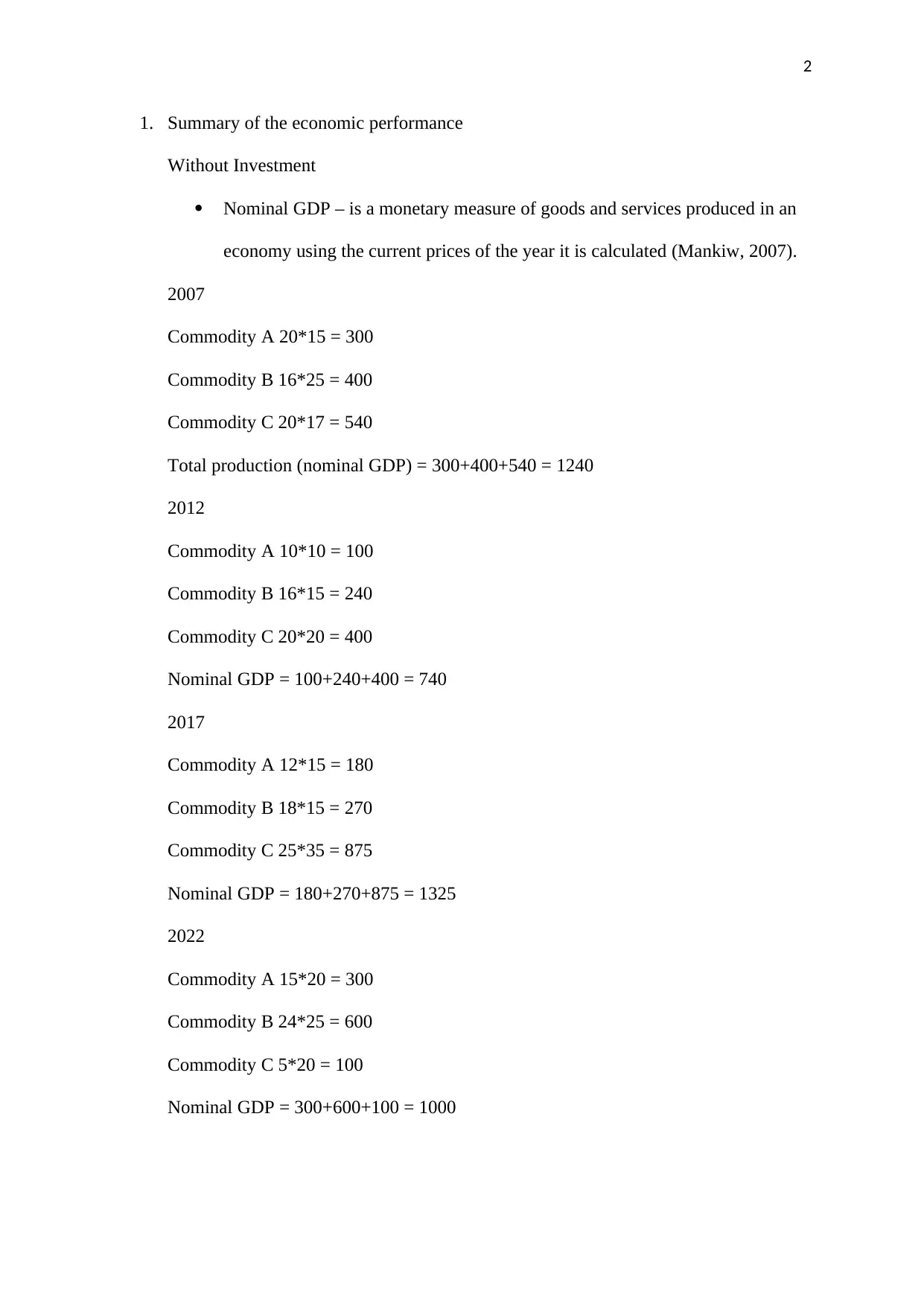
1. Summary of the economic performance
Without Investment
Nominal GDP – is a monetary measure of goods and services produced in an
economy using the current prices of the year it is calculated (Mankiw, 2007).
2007
Commodity A 20*15 = 300
Commodity B 16*25 = 400
Commodity C 20*17 = 540
Total production (nominal GDP) = 300+400+540 = 1240
2012
Commodity A 10*10 = 100
Commodity B 16*15 = 240
Commodity C 20*20 = 400
Nominal GDP = 100+240+400 = 740
2017
Commodity A 12*15 = 180
Commodity B 18*15 = 270
Commodity C 25*35 = 875
Nominal GDP = 180+270+875 = 1325
2022
Commodity A 15*20 = 300
Commodity B 24*25 = 600
Commodity C 5*20 = 100
Nominal GDP = 300+600+100 = 1000
1. Summary of the economic performance
Without Investment
Nominal GDP – is a monetary measure of goods and services produced in an
economy using the current prices of the year it is calculated (Mankiw, 2007).
2007
Commodity A 20*15 = 300
Commodity B 16*25 = 400
Commodity C 20*17 = 540
Total production (nominal GDP) = 300+400+540 = 1240
2012
Commodity A 10*10 = 100
Commodity B 16*15 = 240
Commodity C 20*20 = 400
Nominal GDP = 100+240+400 = 740
2017
Commodity A 12*15 = 180
Commodity B 18*15 = 270
Commodity C 25*35 = 875
Nominal GDP = 180+270+875 = 1325
2022
Commodity A 15*20 = 300
Commodity B 24*25 = 600
Commodity C 5*20 = 100
Nominal GDP = 300+600+100 = 1000

3
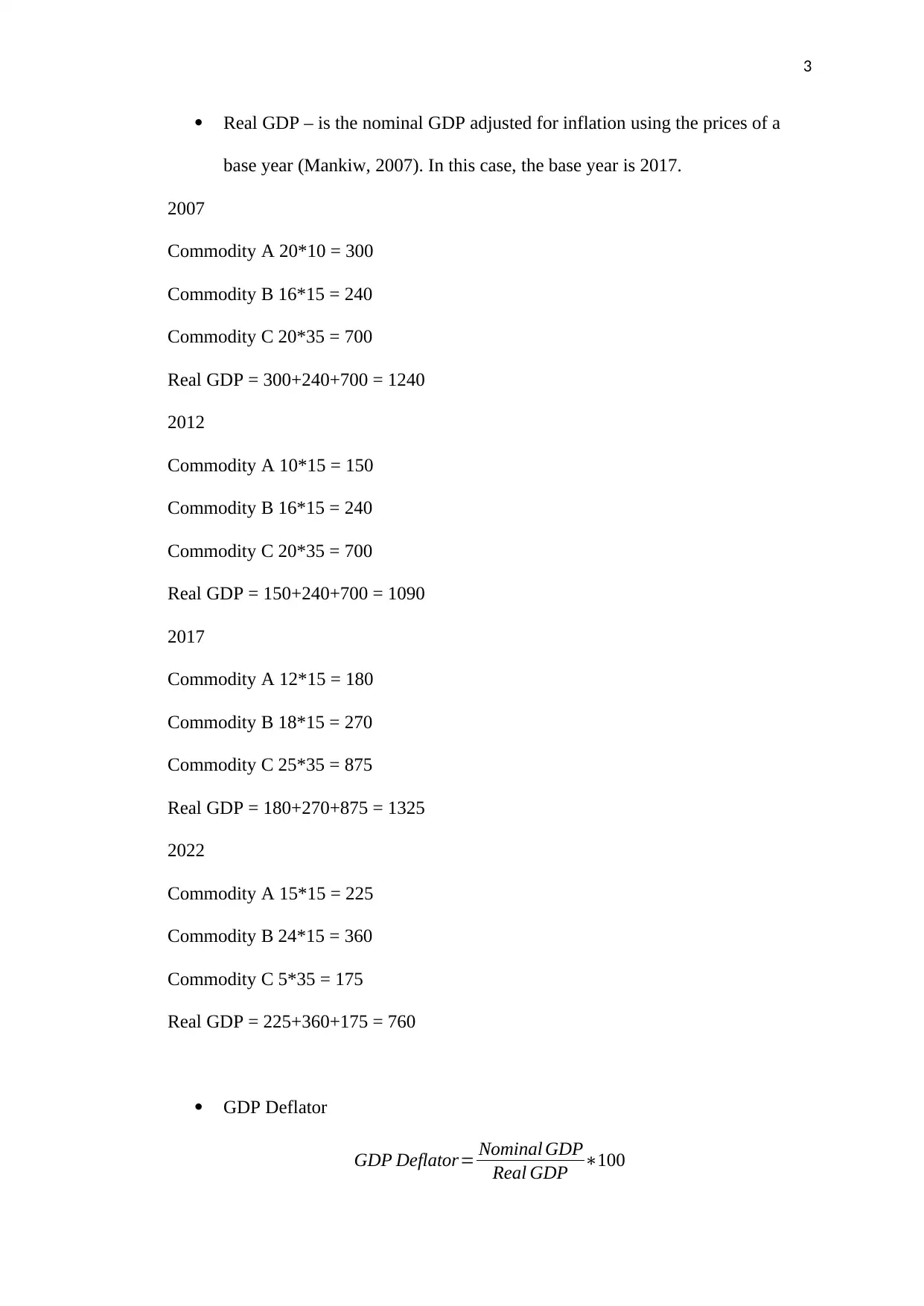
Real GDP – is the nominal GDP adjusted for inflation using the prices of a
base year (Mankiw, 2007). In this case, the base year is 2017.
2007
Commodity A 20*10 = 300
Commodity B 16*15 = 240
Commodity C 20*35 = 700
Real GDP = 300+240+700 = 1240
2012
Commodity A 10*15 = 150
Commodity B 16*15 = 240
Commodity C 20*35 = 700
Real GDP = 150+240+700 = 1090
2017
Commodity A 12*15 = 180
Commodity B 18*15 = 270
Commodity C 25*35 = 875
Real GDP = 180+270+875 = 1325
2022
Commodity A 15*15 = 225
Commodity B 24*15 = 360
Commodity C 5*35 = 175
Real GDP = 225+360+175 = 760
GDP Deflator
GDP Deflator= Nominal GDP
Real GDP ∗100
Real GDP – is the nominal GDP adjusted for inflation using the prices of a
base year (Mankiw, 2007). In this case, the base year is 2017.
2007
Commodity A 20*10 = 300
Commodity B 16*15 = 240
Commodity C 20*35 = 700
Real GDP = 300+240+700 = 1240
2012
Commodity A 10*15 = 150
Commodity B 16*15 = 240
Commodity C 20*35 = 700
Real GDP = 150+240+700 = 1090
2017
Commodity A 12*15 = 180
Commodity B 18*15 = 270
Commodity C 25*35 = 875
Real GDP = 180+270+875 = 1325
2022
Commodity A 15*15 = 225
Commodity B 24*15 = 360
Commodity C 5*35 = 175
Real GDP = 225+360+175 = 760
GDP Deflator
GDP Deflator= Nominal GDP
Real GDP ∗100
⊘ This is a preview!⊘
Do you want full access?
Subscribe today to unlock all pages.

Trusted by 1+ million students worldwide

4
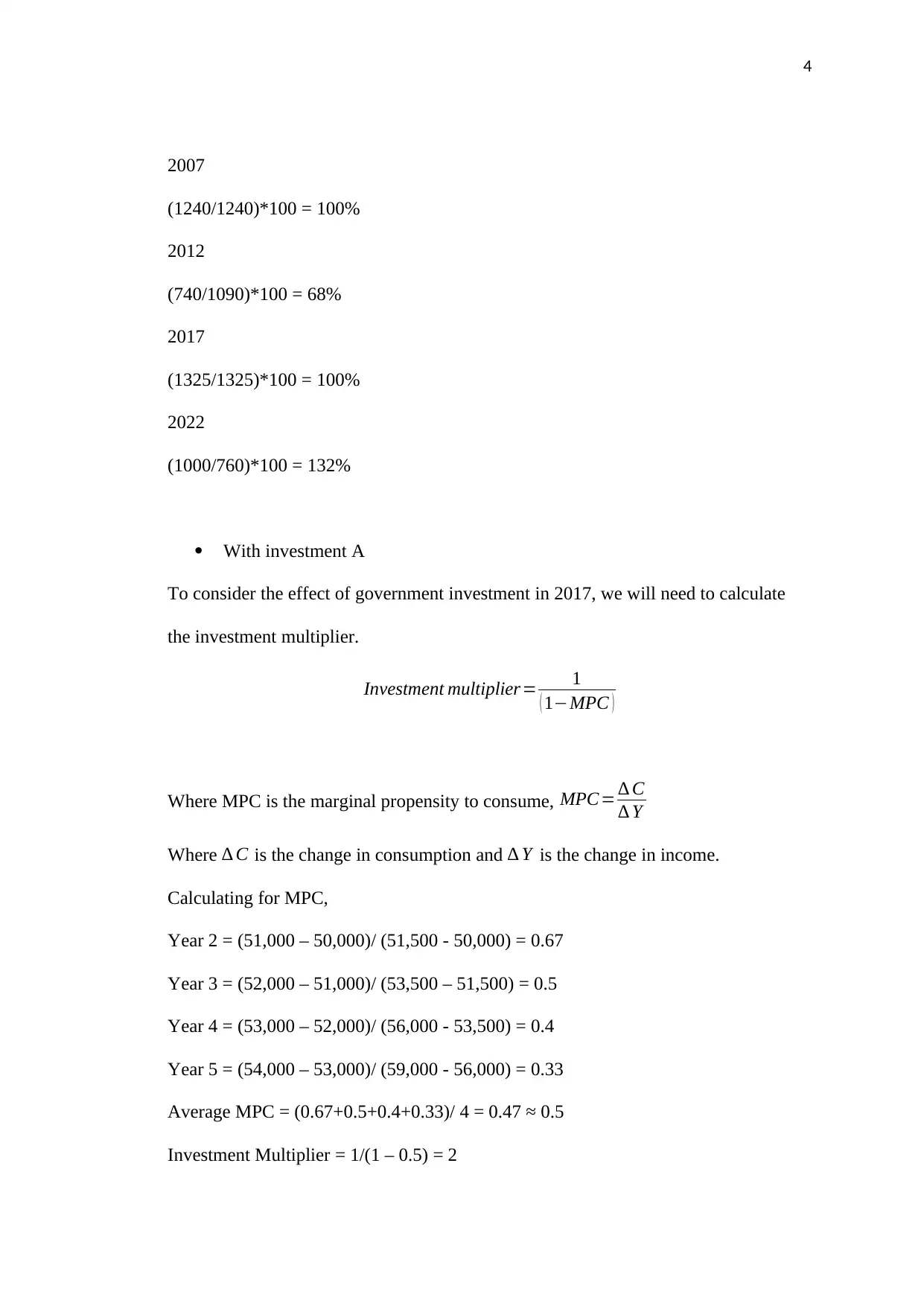
2007
(1240/1240)*100 = 100%
2012
(740/1090)*100 = 68%
2017
(1325/1325)*100 = 100%
2022
(1000/760)*100 = 132%
With investment A
To consider the effect of government investment in 2017, we will need to calculate
the investment multiplier.
Investment multiplier= 1
( 1−MPC )
Where MPC is the marginal propensity to consume, MPC= ∆ C
∆ Y
Where ∆ C is the change in consumption and ∆ Y is the change in income.
Calculating for MPC,
Year 2 = (51,000 – 50,000)/ (51,500 - 50,000) = 0.67
Year 3 = (52,000 – 51,000)/ (53,500 – 51,500) = 0.5
Year 4 = (53,000 – 52,000)/ (56,000 - 53,500) = 0.4
Year 5 = (54,000 – 53,000)/ (59,000 - 56,000) = 0.33
Average MPC = (0.67+0.5+0.4+0.33)/ 4 = 0.47 ≈ 0.5
Investment Multiplier = 1/(1 – 0.5) = 2
2007
(1240/1240)*100 = 100%
2012
(740/1090)*100 = 68%
2017
(1325/1325)*100 = 100%
2022
(1000/760)*100 = 132%
With investment A
To consider the effect of government investment in 2017, we will need to calculate
the investment multiplier.
Investment multiplier= 1
( 1−MPC )
Where MPC is the marginal propensity to consume, MPC= ∆ C
∆ Y
Where ∆ C is the change in consumption and ∆ Y is the change in income.
Calculating for MPC,
Year 2 = (51,000 – 50,000)/ (51,500 - 50,000) = 0.67
Year 3 = (52,000 – 51,000)/ (53,500 – 51,500) = 0.5
Year 4 = (53,000 – 52,000)/ (56,000 - 53,500) = 0.4
Year 5 = (54,000 – 53,000)/ (59,000 - 56,000) = 0.33
Average MPC = (0.67+0.5+0.4+0.33)/ 4 = 0.47 ≈ 0.5
Investment Multiplier = 1/(1 – 0.5) = 2
Paraphrase This Document
Need a fresh take? Get an instant paraphrase of this document with our AI Paraphraser

5
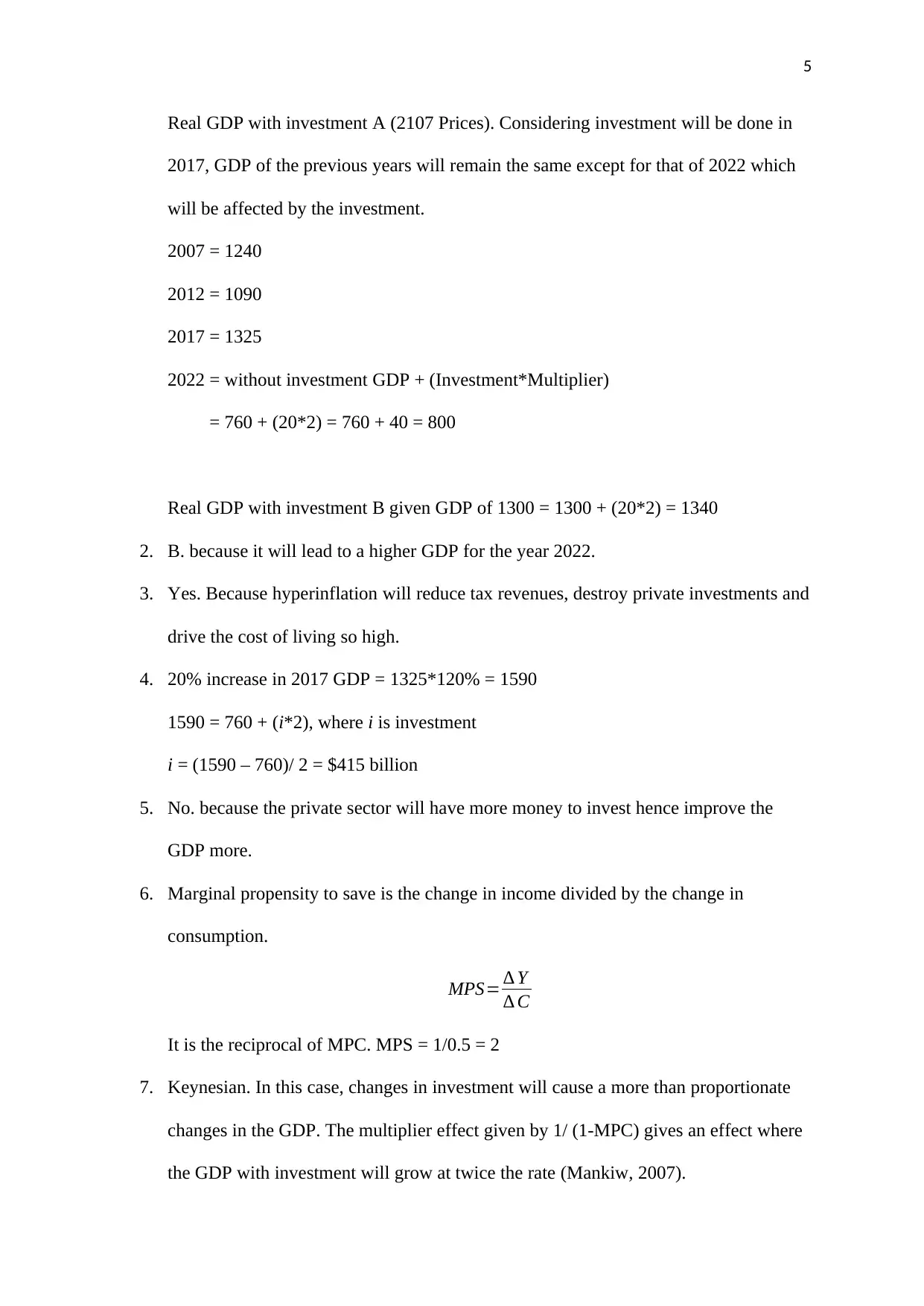
Real GDP with investment A (2107 Prices). Considering investment will be done in
2017, GDP of the previous years will remain the same except for that of 2022 which
will be affected by the investment.
2007 = 1240
2012 = 1090
2017 = 1325
2022 = without investment GDP + (Investment*Multiplier)
= 760 + (20*2) = 760 + 40 = 800
Real GDP with investment B given GDP of 1300 = 1300 + (20*2) = 1340
2. B. because it will lead to a higher GDP for the year 2022.
3. Yes. Because hyperinflation will reduce tax revenues, destroy private investments and
drive the cost of living so high.
4. 20% increase in 2017 GDP = 1325*120% = 1590
1590 = 760 + (i*2), where i is investment
i = (1590 – 760)/ 2 = $415 billion
5. No. because the private sector will have more money to invest hence improve the
GDP more.
6. Marginal propensity to save is the change in income divided by the change in
consumption.
MPS= ∆ Y
∆ C
It is the reciprocal of MPC. MPS = 1/0.5 = 2
7. Keynesian. In this case, changes in investment will cause a more than proportionate
changes in the GDP. The multiplier effect given by 1/ (1-MPC) gives an effect where
the GDP with investment will grow at twice the rate (Mankiw, 2007).
Real GDP with investment A (2107 Prices). Considering investment will be done in
2017, GDP of the previous years will remain the same except for that of 2022 which
will be affected by the investment.
2007 = 1240
2012 = 1090
2017 = 1325
2022 = without investment GDP + (Investment*Multiplier)
= 760 + (20*2) = 760 + 40 = 800
Real GDP with investment B given GDP of 1300 = 1300 + (20*2) = 1340
2. B. because it will lead to a higher GDP for the year 2022.
3. Yes. Because hyperinflation will reduce tax revenues, destroy private investments and
drive the cost of living so high.
4. 20% increase in 2017 GDP = 1325*120% = 1590
1590 = 760 + (i*2), where i is investment
i = (1590 – 760)/ 2 = $415 billion
5. No. because the private sector will have more money to invest hence improve the
GDP more.
6. Marginal propensity to save is the change in income divided by the change in
consumption.
MPS= ∆ Y
∆ C
It is the reciprocal of MPC. MPS = 1/0.5 = 2
7. Keynesian. In this case, changes in investment will cause a more than proportionate
changes in the GDP. The multiplier effect given by 1/ (1-MPC) gives an effect where
the GDP with investment will grow at twice the rate (Mankiw, 2007).

6
8. No. because the people will save but will not invest on the GDP growth.
References
ABEL, A. B., BERNANKE, B., & CROUSHORE, D. D. (2017). Macroeconomics.
CATE, T. (2013). An encyclopedia of Keynesian economics.
DORNBUSCH, R., FISCHER, S., & STARTZ, R. (2014). Macroeconomics.
MANKIW, N. G. (2997). Macroeconomics. New York, Worth Publishers.
TIMLIN, M. F. (2014). Keynesian economics. http://www.deslibris.ca/ID/448174.
8. No. because the people will save but will not invest on the GDP growth.
References
ABEL, A. B., BERNANKE, B., & CROUSHORE, D. D. (2017). Macroeconomics.
CATE, T. (2013). An encyclopedia of Keynesian economics.
DORNBUSCH, R., FISCHER, S., & STARTZ, R. (2014). Macroeconomics.
MANKIW, N. G. (2997). Macroeconomics. New York, Worth Publishers.
TIMLIN, M. F. (2014). Keynesian economics. http://www.deslibris.ca/ID/448174.
⊘ This is a preview!⊘
Do you want full access?
Subscribe today to unlock all pages.

Trusted by 1+ million students worldwide
1 out of 6
Your All-in-One AI-Powered Toolkit for Academic Success.
+13062052269
info@desklib.com
Available 24*7 on WhatsApp / Email
Unlock your academic potential
Copyright © 2020–2026 A2Z Services. All Rights Reserved. Developed and managed by ZUCOL.