Analyzing the Impact of Economic Reforms (1991) on the Indian Economy
VerifiedAdded on  2022/08/31
|8
|2057
|17
Essay
AI Summary
This essay provides a comprehensive analysis of the economic reforms implemented in India in 1991, aiming to transition the country towards a market and service-oriented economy. It begins by outlining the pre-reform era, characterized by socialist policies, public sector dominance, and protectionist measures. The essay then details the objectives of the 1991 reforms, which were driven by a high fiscal deficit and the need for economic liberalization. Key changes introduced include deregulation, reduced government spending, tax reforms, changes in monetary and fiscal policies, and the promotion of private and foreign investment. The essay further explores the effects of these reforms, highlighting the significant economic growth experienced in the following decade, but also acknowledging the rise in income inequality, decline in employment generation, and challenges faced by the domestic corporate sector. The analysis concludes that while the reforms were necessary to correct the economic situation, a more balanced approach focusing on employment and domestic industries could have yielded even better results. The essay provides a critical assessment of the reforms' overall impact, emphasizing both the positive and negative consequences for the Indian economy.
Running head: IMPACT OF ECONOMIC REFORM ONN INDIAN ECONOMY
Impact of Economic Reform on Indian Economy
Name of the Student
Name of the University
Student ID
Impact of Economic Reform on Indian Economy
Name of the Student
Name of the University
Student ID
Paraphrase This Document
Need a fresh take? Get an instant paraphrase of this document with our AI Paraphraser

1IMPACT OF ECONOMIC REFORM ONN INDIAN ECONOMY
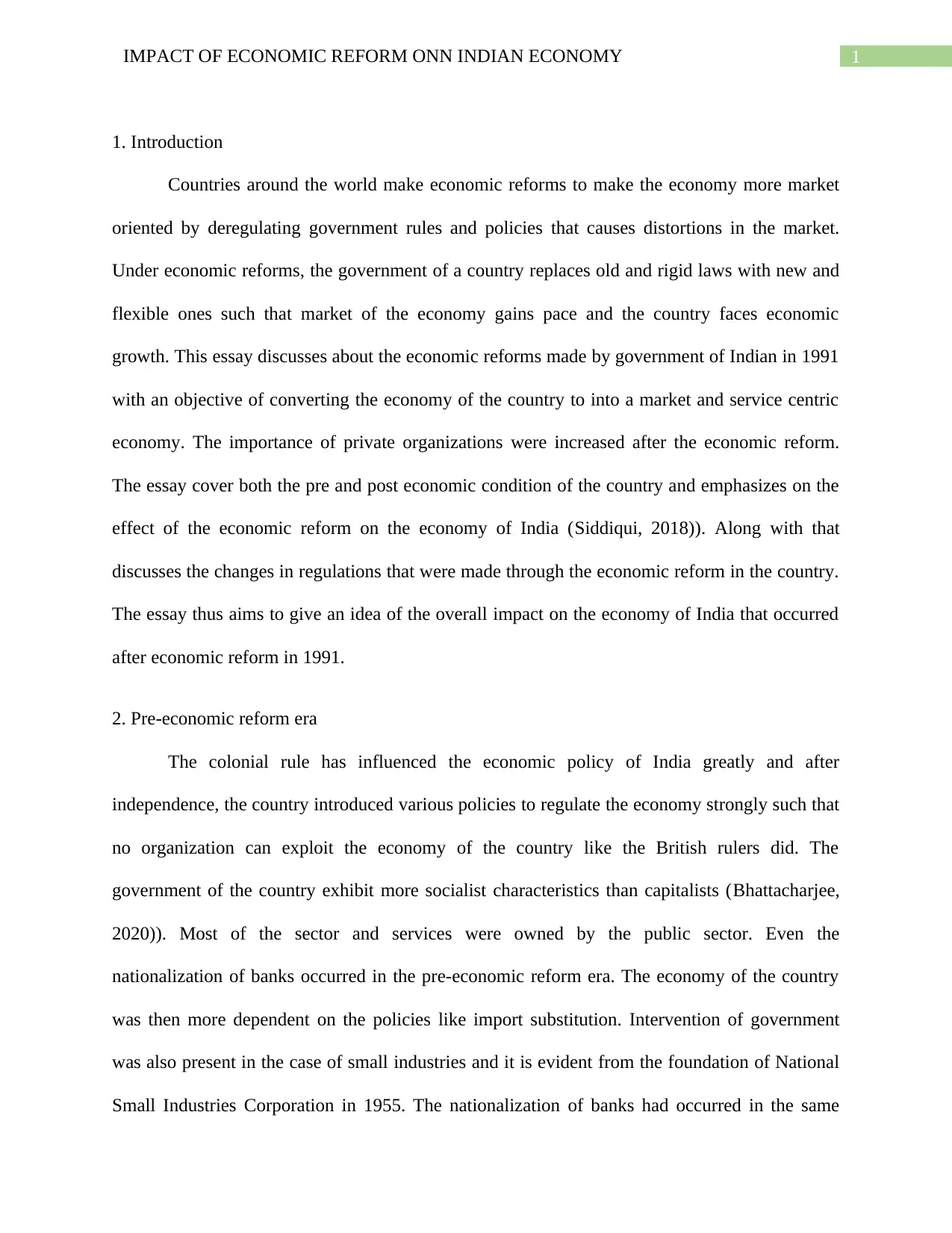
1. Introduction
Countries around the world make economic reforms to make the economy more market
oriented by deregulating government rules and policies that causes distortions in the market.
Under economic reforms, the government of a country replaces old and rigid laws with new and
flexible ones such that market of the economy gains pace and the country faces economic
growth. This essay discusses about the economic reforms made by government of Indian in 1991
with an objective of converting the economy of the country to into a market and service centric
economy. The importance of private organizations were increased after the economic reform.
The essay cover both the pre and post economic condition of the country and emphasizes on the
effect of the economic reform on the economy of India (Siddiqui, 2018)). Along with that
discusses the changes in regulations that were made through the economic reform in the country.
The essay thus aims to give an idea of the overall impact on the economy of India that occurred
after economic reform in 1991.
2. Pre-economic reform era
The colonial rule has influenced the economic policy of India greatly and after
independence, the country introduced various policies to regulate the economy strongly such that
no organization can exploit the economy of the country like the British rulers did. The
government of the country exhibit more socialist characteristics than capitalists (Bhattacharjee,
2020)). Most of the sector and services were owned by the public sector. Even the
nationalization of banks occurred in the pre-economic reform era. The economy of the country
was then more dependent on the policies like import substitution. Intervention of government
was also present in the case of small industries and it is evident from the foundation of National
Small Industries Corporation in 1955. The nationalization of banks had occurred in the same
1. Introduction
Countries around the world make economic reforms to make the economy more market
oriented by deregulating government rules and policies that causes distortions in the market.
Under economic reforms, the government of a country replaces old and rigid laws with new and
flexible ones such that market of the economy gains pace and the country faces economic
growth. This essay discusses about the economic reforms made by government of Indian in 1991
with an objective of converting the economy of the country to into a market and service centric
economy. The importance of private organizations were increased after the economic reform.
The essay cover both the pre and post economic condition of the country and emphasizes on the
effect of the economic reform on the economy of India (Siddiqui, 2018)). Along with that
discusses the changes in regulations that were made through the economic reform in the country.
The essay thus aims to give an idea of the overall impact on the economy of India that occurred
after economic reform in 1991.
2. Pre-economic reform era
The colonial rule has influenced the economic policy of India greatly and after
independence, the country introduced various policies to regulate the economy strongly such that
no organization can exploit the economy of the country like the British rulers did. The
government of the country exhibit more socialist characteristics than capitalists (Bhattacharjee,
2020)). Most of the sector and services were owned by the public sector. Even the
nationalization of banks occurred in the pre-economic reform era. The economy of the country
was then more dependent on the policies like import substitution. Intervention of government
was also present in the case of small industries and it is evident from the foundation of National
Small Industries Corporation in 1955. The nationalization of banks had occurred in the same

2IMPACT OF ECONOMIC REFORM ONN INDIAN ECONOMY
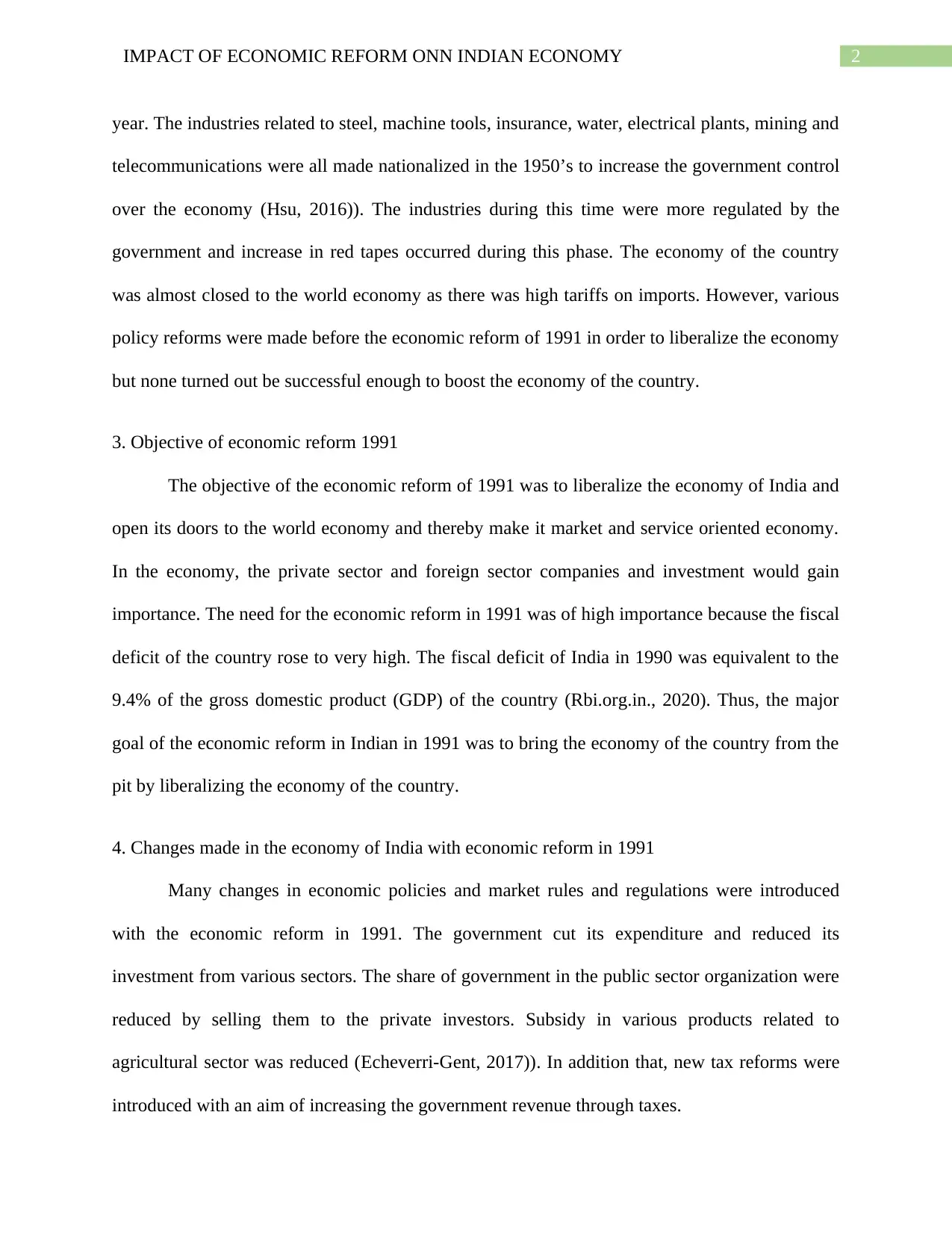
year. The industries related to steel, machine tools, insurance, water, electrical plants, mining and
telecommunications were all made nationalized in the 1950’s to increase the government control
over the economy (Hsu, 2016)). The industries during this time were more regulated by the
government and increase in red tapes occurred during this phase. The economy of the country
was almost closed to the world economy as there was high tariffs on imports. However, various
policy reforms were made before the economic reform of 1991 in order to liberalize the economy
but none turned out be successful enough to boost the economy of the country.
3. Objective of economic reform 1991
The objective of the economic reform of 1991 was to liberalize the economy of India and
open its doors to the world economy and thereby make it market and service oriented economy.
In the economy, the private sector and foreign sector companies and investment would gain
importance. The need for the economic reform in 1991 was of high importance because the fiscal
deficit of the country rose to very high. The fiscal deficit of India in 1990 was equivalent to the
9.4% of the gross domestic product (GDP) of the country (Rbi.org.in., 2020). Thus, the major
goal of the economic reform in Indian in 1991 was to bring the economy of the country from the
pit by liberalizing the economy of the country.
4. Changes made in the economy of India with economic reform in 1991
Many changes in economic policies and market rules and regulations were introduced
with the economic reform in 1991. The government cut its expenditure and reduced its
investment from various sectors. The share of government in the public sector organization were
reduced by selling them to the private investors. Subsidy in various products related to
agricultural sector was reduced (Echeverri-Gent, 2017)). In addition that, new tax reforms were
introduced with an aim of increasing the government revenue through taxes.
year. The industries related to steel, machine tools, insurance, water, electrical plants, mining and
telecommunications were all made nationalized in the 1950’s to increase the government control
over the economy (Hsu, 2016)). The industries during this time were more regulated by the
government and increase in red tapes occurred during this phase. The economy of the country
was almost closed to the world economy as there was high tariffs on imports. However, various
policy reforms were made before the economic reform of 1991 in order to liberalize the economy
but none turned out be successful enough to boost the economy of the country.
3. Objective of economic reform 1991
The objective of the economic reform of 1991 was to liberalize the economy of India and
open its doors to the world economy and thereby make it market and service oriented economy.
In the economy, the private sector and foreign sector companies and investment would gain
importance. The need for the economic reform in 1991 was of high importance because the fiscal
deficit of the country rose to very high. The fiscal deficit of India in 1990 was equivalent to the
9.4% of the gross domestic product (GDP) of the country (Rbi.org.in., 2020). Thus, the major
goal of the economic reform in Indian in 1991 was to bring the economy of the country from the
pit by liberalizing the economy of the country.
4. Changes made in the economy of India with economic reform in 1991
Many changes in economic policies and market rules and regulations were introduced
with the economic reform in 1991. The government cut its expenditure and reduced its
investment from various sectors. The share of government in the public sector organization were
reduced by selling them to the private investors. Subsidy in various products related to
agricultural sector was reduced (Echeverri-Gent, 2017)). In addition that, new tax reforms were
introduced with an aim of increasing the government revenue through taxes.
⊘ This is a preview!⊘
Do you want full access?
Subscribe today to unlock all pages.

Trusted by 1+ million students worldwide

3IMPACT OF ECONOMIC REFORM ONN INDIAN ECONOMY
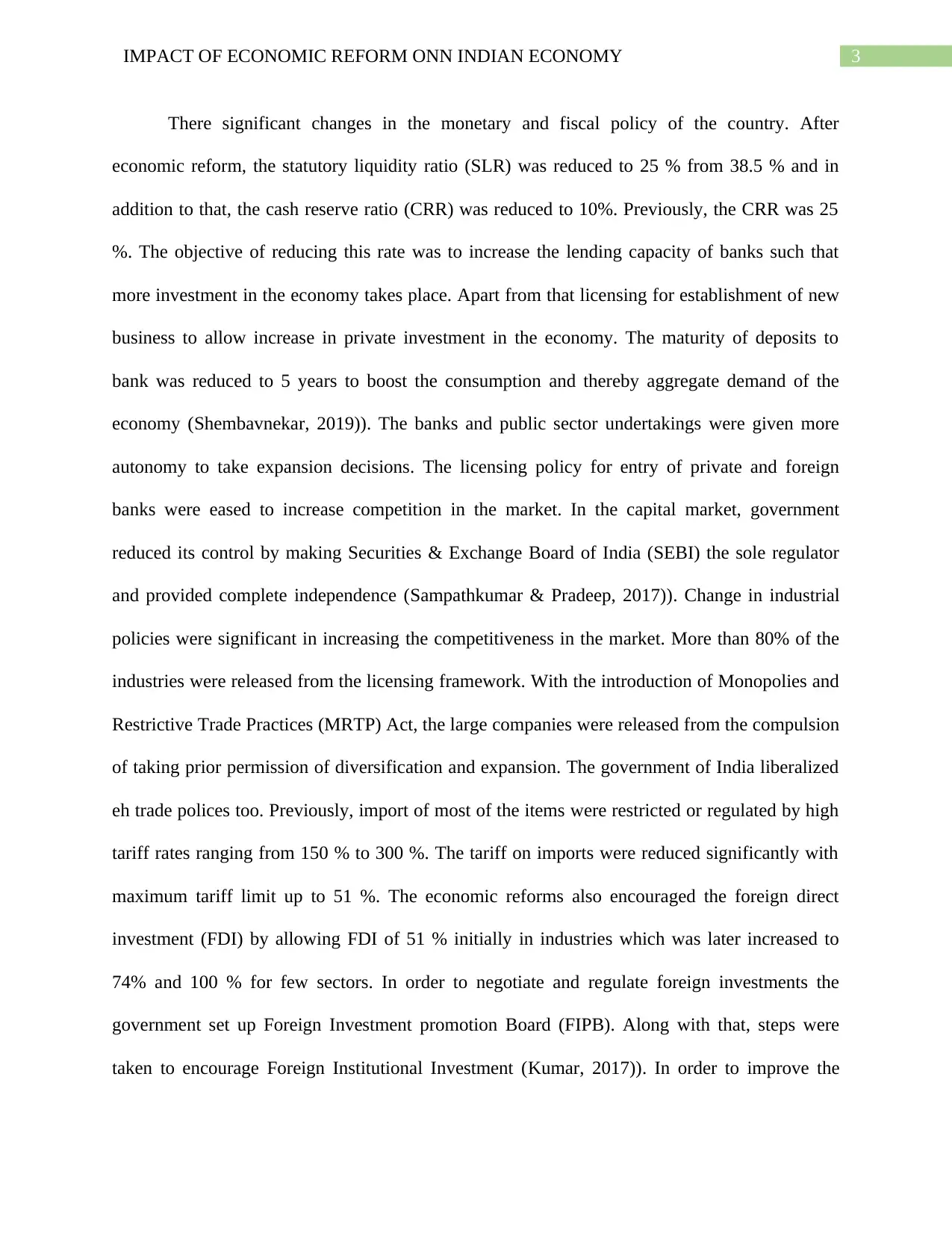
There significant changes in the monetary and fiscal policy of the country. After
economic reform, the statutory liquidity ratio (SLR) was reduced to 25 % from 38.5 % and in
addition to that, the cash reserve ratio (CRR) was reduced to 10%. Previously, the CRR was 25
%. The objective of reducing this rate was to increase the lending capacity of banks such that
more investment in the economy takes place. Apart from that licensing for establishment of new
business to allow increase in private investment in the economy. The maturity of deposits to
bank was reduced to 5 years to boost the consumption and thereby aggregate demand of the
economy (Shembavnekar, 2019)). The banks and public sector undertakings were given more
autonomy to take expansion decisions. The licensing policy for entry of private and foreign
banks were eased to increase competition in the market. In the capital market, government
reduced its control by making Securities & Exchange Board of India (SEBI) the sole regulator
and provided complete independence (Sampathkumar & Pradeep, 2017)). Change in industrial
policies were significant in increasing the competitiveness in the market. More than 80% of the
industries were released from the licensing framework. With the introduction of Monopolies and
Restrictive Trade Practices (MRTP) Act, the large companies were released from the compulsion
of taking prior permission of diversification and expansion. The government of India liberalized
eh trade polices too. Previously, import of most of the items were restricted or regulated by high
tariff rates ranging from 150 % to 300 %. The tariff on imports were reduced significantly with
maximum tariff limit up to 51 %. The economic reforms also encouraged the foreign direct
investment (FDI) by allowing FDI of 51 % initially in industries which was later increased to
74% and 100 % for few sectors. In order to negotiate and regulate foreign investments the
government set up Foreign Investment promotion Board (FIPB). Along with that, steps were
taken to encourage Foreign Institutional Investment (Kumar, 2017)). In order to improve the
There significant changes in the monetary and fiscal policy of the country. After
economic reform, the statutory liquidity ratio (SLR) was reduced to 25 % from 38.5 % and in
addition to that, the cash reserve ratio (CRR) was reduced to 10%. Previously, the CRR was 25
%. The objective of reducing this rate was to increase the lending capacity of banks such that
more investment in the economy takes place. Apart from that licensing for establishment of new
business to allow increase in private investment in the economy. The maturity of deposits to
bank was reduced to 5 years to boost the consumption and thereby aggregate demand of the
economy (Shembavnekar, 2019)). The banks and public sector undertakings were given more
autonomy to take expansion decisions. The licensing policy for entry of private and foreign
banks were eased to increase competition in the market. In the capital market, government
reduced its control by making Securities & Exchange Board of India (SEBI) the sole regulator
and provided complete independence (Sampathkumar & Pradeep, 2017)). Change in industrial
policies were significant in increasing the competitiveness in the market. More than 80% of the
industries were released from the licensing framework. With the introduction of Monopolies and
Restrictive Trade Practices (MRTP) Act, the large companies were released from the compulsion
of taking prior permission of diversification and expansion. The government of India liberalized
eh trade polices too. Previously, import of most of the items were restricted or regulated by high
tariff rates ranging from 150 % to 300 %. The tariff on imports were reduced significantly with
maximum tariff limit up to 51 %. The economic reforms also encouraged the foreign direct
investment (FDI) by allowing FDI of 51 % initially in industries which was later increased to
74% and 100 % for few sectors. In order to negotiate and regulate foreign investments the
government set up Foreign Investment promotion Board (FIPB). Along with that, steps were
taken to encourage Foreign Institutional Investment (Kumar, 2017)). In order to improve the
Paraphrase This Document
Need a fresh take? Get an instant paraphrase of this document with our AI Paraphraser

4IMPACT OF ECONOMIC REFORM ONN INDIAN ECONOMY
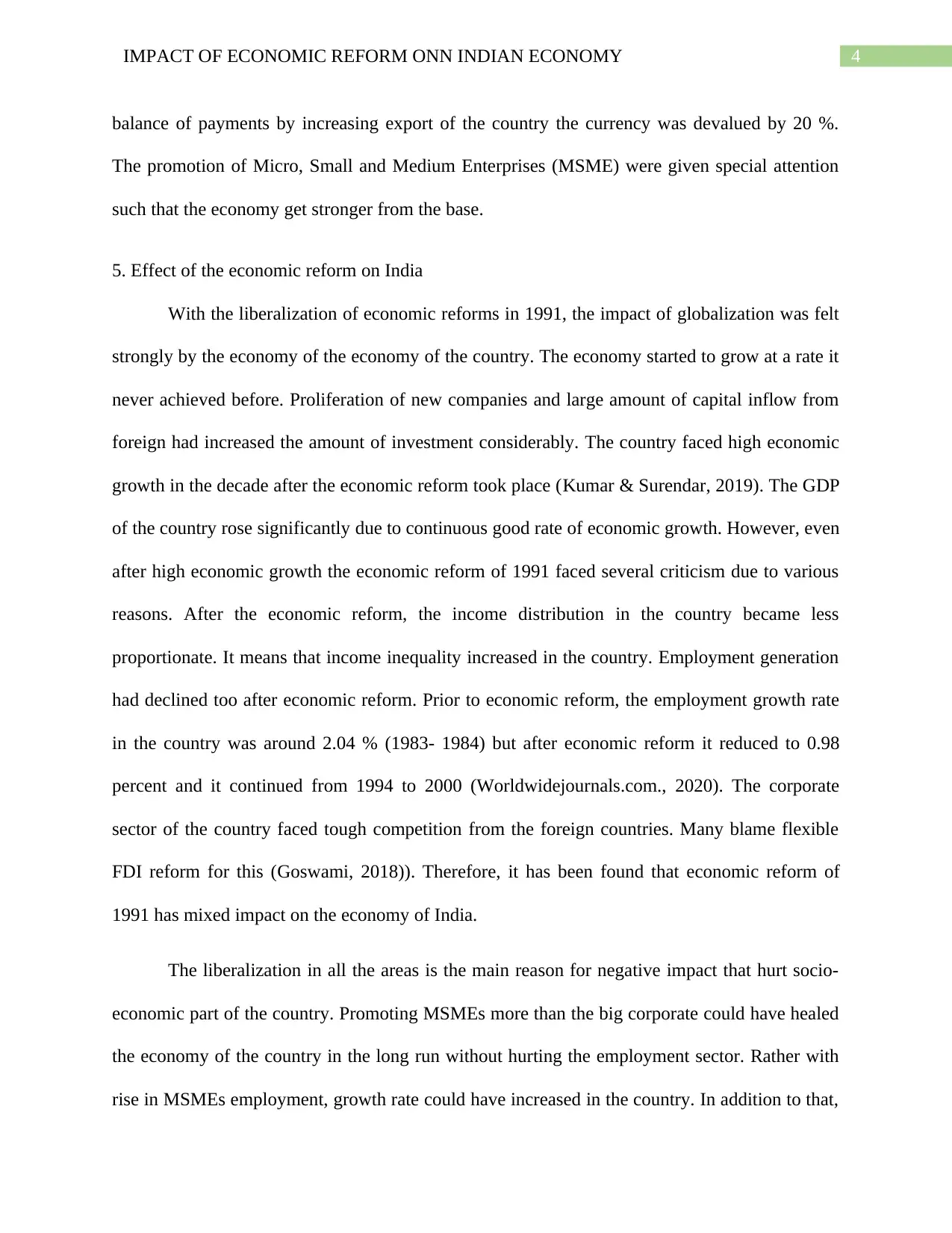
balance of payments by increasing export of the country the currency was devalued by 20 %.
The promotion of Micro, Small and Medium Enterprises (MSME) were given special attention
such that the economy get stronger from the base.
5. Effect of the economic reform on India
With the liberalization of economic reforms in 1991, the impact of globalization was felt
strongly by the economy of the economy of the country. The economy started to grow at a rate it
never achieved before. Proliferation of new companies and large amount of capital inflow from
foreign had increased the amount of investment considerably. The country faced high economic
growth in the decade after the economic reform took place (Kumar & Surendar, 2019). The GDP
of the country rose significantly due to continuous good rate of economic growth. However, even
after high economic growth the economic reform of 1991 faced several criticism due to various
reasons. After the economic reform, the income distribution in the country became less
proportionate. It means that income inequality increased in the country. Employment generation
had declined too after economic reform. Prior to economic reform, the employment growth rate
in the country was around 2.04 % (1983- 1984) but after economic reform it reduced to 0.98
percent and it continued from 1994 to 2000 (Worldwidejournals.com., 2020). The corporate
sector of the country faced tough competition from the foreign countries. Many blame flexible
FDI reform for this (Goswami, 2018)). Therefore, it has been found that economic reform of
1991 has mixed impact on the economy of India.
The liberalization in all the areas is the main reason for negative impact that hurt socio-
economic part of the country. Promoting MSMEs more than the big corporate could have healed
the economy of the country in the long run without hurting the employment sector. Rather with
rise in MSMEs employment, growth rate could have increased in the country. In addition to that,
balance of payments by increasing export of the country the currency was devalued by 20 %.
The promotion of Micro, Small and Medium Enterprises (MSME) were given special attention
such that the economy get stronger from the base.
5. Effect of the economic reform on India
With the liberalization of economic reforms in 1991, the impact of globalization was felt
strongly by the economy of the economy of the country. The economy started to grow at a rate it
never achieved before. Proliferation of new companies and large amount of capital inflow from
foreign had increased the amount of investment considerably. The country faced high economic
growth in the decade after the economic reform took place (Kumar & Surendar, 2019). The GDP
of the country rose significantly due to continuous good rate of economic growth. However, even
after high economic growth the economic reform of 1991 faced several criticism due to various
reasons. After the economic reform, the income distribution in the country became less
proportionate. It means that income inequality increased in the country. Employment generation
had declined too after economic reform. Prior to economic reform, the employment growth rate
in the country was around 2.04 % (1983- 1984) but after economic reform it reduced to 0.98
percent and it continued from 1994 to 2000 (Worldwidejournals.com., 2020). The corporate
sector of the country faced tough competition from the foreign countries. Many blame flexible
FDI reform for this (Goswami, 2018)). Therefore, it has been found that economic reform of
1991 has mixed impact on the economy of India.
The liberalization in all the areas is the main reason for negative impact that hurt socio-
economic part of the country. Promoting MSMEs more than the big corporate could have healed
the economy of the country in the long run without hurting the employment sector. Rather with
rise in MSMEs employment, growth rate could have increased in the country. In addition to that,

5IMPACT OF ECONOMIC REFORM ONN INDIAN ECONOMY
trade liberalization was a good policy but allowing high foreign investment was not necessary
then as it has impacted the native corporate houses badly.
6. Conclusion
The above discussion on the impact of the economic reform of 1991 on the economy of
India leads to the conclusion that the introduction of economic reform was necessary for the
country to correct the economic situation of the country that it was going through till 1990. The
stringent economic policies especially in the areas of industry and trade had impacted the
economy of the country adversely. It is evident from the rising fiscal deficit in the 1990. The
fiscal deficit rose around 10 % of the GDP of the country at that time. The economic reform
changed the economy of the country in many ways. The GDP of the country grew significantly
arguably the best growth phase in the history of economy of Indian. However, there were
adverse impact on the economy as well. The employment condition of the country worsened and
along with that, the domestic corporate houses faced severe competition from foreign
multinational corporations. Hence, it can be said that the economic reform could have been better
if the policies addressed the employment sector and restricted foreign corporations from gaining
power over domestic ones.
trade liberalization was a good policy but allowing high foreign investment was not necessary
then as it has impacted the native corporate houses badly.
6. Conclusion
The above discussion on the impact of the economic reform of 1991 on the economy of
India leads to the conclusion that the introduction of economic reform was necessary for the
country to correct the economic situation of the country that it was going through till 1990. The
stringent economic policies especially in the areas of industry and trade had impacted the
economy of the country adversely. It is evident from the rising fiscal deficit in the 1990. The
fiscal deficit rose around 10 % of the GDP of the country at that time. The economic reform
changed the economy of the country in many ways. The GDP of the country grew significantly
arguably the best growth phase in the history of economy of Indian. However, there were
adverse impact on the economy as well. The employment condition of the country worsened and
along with that, the domestic corporate houses faced severe competition from foreign
multinational corporations. Hence, it can be said that the economic reform could have been better
if the policies addressed the employment sector and restricted foreign corporations from gaining
power over domestic ones.
⊘ This is a preview!⊘
Do you want full access?
Subscribe today to unlock all pages.

Trusted by 1+ million students worldwide

6IMPACT OF ECONOMIC REFORM ONN INDIAN ECONOMY
Reference
Bhattacharjee, M. R. (2020). Development and internal outmigration in India in post-economic
reform era. Asia-Pacific Journal of Regional Science, 1-23.
Echeverri-Gent, J. (2017). Economic Reform in India: A Long and Winding Road. In United
States Foreign Policy and Economic Reform in Three Giants (pp. 103-134). Routledge.
Goswami, O. (2018). Changes and Challenges: Corporate India since 1991. India Transformed:
Twenty-Five Years of Economic Reforms, 463.
Hsu, S. (2016). Economic Reform in Asia: China, India, and Japan. Edward Elgar Publishing.
Kumar, D. (2017). FDI in India: A Review. FDI in India: A Review (February 2, 2017).
Kumar, V. S., & Surendar, M. (2019). Foreign Direct Investment Trends during the Last Decade
and its Effect on Various Sectors in India. ECONOMIC REFORMS IN INDIA:
ACHIEVEMENTS AND CHALLENGES, 203.
Rbi.org.in. (2020). Reserve Bank of India - Reports. (2020). Retrieved from
https://www.rbi.org.in/scripts/PublicationReportDetails.aspx?ID=270
Sampathkumar, T., & Pradeep, V. (2017). Economic reforms and employment growth in India:
An empirical analysis. Arthshastra Indian Journal of Economics & Research, 6(1), 35-45.
Shembavnekar, N. (2019). Economic Reform, Labour Markets and Informal Sector
Employment: Evidence from India. Economies, 7(2), 55.
Siddiqui, K. (2018). The Political Economy of India's Postplanning Economic Reform: A
Critical Review. World Review of Political Economy, 9(2), 235-264.
Reference
Bhattacharjee, M. R. (2020). Development and internal outmigration in India in post-economic
reform era. Asia-Pacific Journal of Regional Science, 1-23.
Echeverri-Gent, J. (2017). Economic Reform in India: A Long and Winding Road. In United
States Foreign Policy and Economic Reform in Three Giants (pp. 103-134). Routledge.
Goswami, O. (2018). Changes and Challenges: Corporate India since 1991. India Transformed:
Twenty-Five Years of Economic Reforms, 463.
Hsu, S. (2016). Economic Reform in Asia: China, India, and Japan. Edward Elgar Publishing.
Kumar, D. (2017). FDI in India: A Review. FDI in India: A Review (February 2, 2017).
Kumar, V. S., & Surendar, M. (2019). Foreign Direct Investment Trends during the Last Decade
and its Effect on Various Sectors in India. ECONOMIC REFORMS IN INDIA:
ACHIEVEMENTS AND CHALLENGES, 203.
Rbi.org.in. (2020). Reserve Bank of India - Reports. (2020). Retrieved from
https://www.rbi.org.in/scripts/PublicationReportDetails.aspx?ID=270
Sampathkumar, T., & Pradeep, V. (2017). Economic reforms and employment growth in India:
An empirical analysis. Arthshastra Indian Journal of Economics & Research, 6(1), 35-45.
Shembavnekar, N. (2019). Economic Reform, Labour Markets and Informal Sector
Employment: Evidence from India. Economies, 7(2), 55.
Siddiqui, K. (2018). The Political Economy of India's Postplanning Economic Reform: A
Critical Review. World Review of Political Economy, 9(2), 235-264.
Paraphrase This Document
Need a fresh take? Get an instant paraphrase of this document with our AI Paraphraser

7IMPACT OF ECONOMIC REFORM ONN INDIAN ECONOMY
Worldwidejournals.com. (2020). IMPACT OF ECONOMIC REFORMS ON INDIAN
ECONOMY - IJAR - Indian Journal of Applied Research. Retrieved from
https://www.worldwidejournals.com/indian-journal-of-applied-research-(IJAR)/
fileview/September_2016_1492161274__175.pdf
Worldwidejournals.com. (2020). IMPACT OF ECONOMIC REFORMS ON INDIAN
ECONOMY - IJAR - Indian Journal of Applied Research. Retrieved from
https://www.worldwidejournals.com/indian-journal-of-applied-research-(IJAR)/
fileview/September_2016_1492161274__175.pdf
1 out of 8
Related Documents
Your All-in-One AI-Powered Toolkit for Academic Success.
 +13062052269
info@desklib.com
Available 24*7 on WhatsApp / Email
Unlock your academic potential
Copyright © 2020–2025 A2Z Services. All Rights Reserved. Developed and managed by ZUCOL.