Comprehensive Economic, Social, and Environmental Analysis Report
VerifiedAdded on 2023/06/04
|6
|1455
|212
Report
AI Summary
This report provides an in-depth analysis of economic, social, and environmental factors crucial for business success. It begins by emphasizing the importance of profit maximization and the use of investment tools such as Net Present Value (NPV) to assess project feasibility. The report explores the significance of understanding the business environment, including customer expectations and the need for businesses to adapt to meet customer needs effectively. It delves into economic analysis, focusing on factors like cash flows, project life, and the discounting factor, with a detailed explanation of NPV and its application in evaluating investment opportunities. The report also addresses enterprise risk management, defining risk and risk appetite, and emphasizing the importance of balancing risk and reward within acceptable tolerance levels. The conclusion reiterates the need for businesses to maximize profits within legal and customer-focused boundaries.

ECONOMIC, SOCIAL AND ENVIRONMENTAL ANALYSIS 1
Economic, social and environmental analysis
By (Name)
Course
Instructor’s Name
Institutional Affiliation
The City and State
The Date
Economic, social and environmental analysis
By (Name)
Course
Instructor’s Name
Institutional Affiliation
The City and State
The Date
Paraphrase This Document
Need a fresh take? Get an instant paraphrase of this document with our AI Paraphraser

ECONOMIC, SOCIAL AND ENVIRONMENTAL ANALYSIS 2
Introduction
The primary reason any rational and prudent investment is to make profits after meeting all the
expenses. Therefore, investors tend to channel their resources into the most profitable ventures.
To identify the most profitable undertakings, rational investors utilize a number of investment
tools, techniques and strategies (Žižlavský 2014). For there to be sustainability of any
investment, a strong understanding of the internal and external business environment is
important. This helps in indentifying risks, competitors and other factors which may affect the
investment. Therefore, the entrepreneur faces the challenge of balancing to meet the
requirements of the business environment and to make a good return on the investment. Some
business are setup without a clear analysis and much as they may make profit, it is at the expense
of the environment. Thus it is important to study the environmental variables in order to gain a
strong competitive advantage, attract and retain customers and at the same time gain a larger
market share(Žižlavský 2014).
Meeting customer’s expectation
In order for a business to sustain a good customer base, they should lay strategies to that meet the
customer expectation. In this way, they should provide a good customers service, understanding
customers and what they want is the first step towards meeting the customer’s needs(Gresty
2008, pp.11–24).
However, the business fails to meet the expectations of the customer, they shift business
elsewhere. Good business owners usually learn to listen and address consumer complaints.
Introduction
The primary reason any rational and prudent investment is to make profits after meeting all the
expenses. Therefore, investors tend to channel their resources into the most profitable ventures.
To identify the most profitable undertakings, rational investors utilize a number of investment
tools, techniques and strategies (Žižlavský 2014). For there to be sustainability of any
investment, a strong understanding of the internal and external business environment is
important. This helps in indentifying risks, competitors and other factors which may affect the
investment. Therefore, the entrepreneur faces the challenge of balancing to meet the
requirements of the business environment and to make a good return on the investment. Some
business are setup without a clear analysis and much as they may make profit, it is at the expense
of the environment. Thus it is important to study the environmental variables in order to gain a
strong competitive advantage, attract and retain customers and at the same time gain a larger
market share(Žižlavský 2014).
Meeting customer’s expectation
In order for a business to sustain a good customer base, they should lay strategies to that meet the
customer expectation. In this way, they should provide a good customers service, understanding
customers and what they want is the first step towards meeting the customer’s needs(Gresty
2008, pp.11–24).
However, the business fails to meet the expectations of the customer, they shift business
elsewhere. Good business owners usually learn to listen and address consumer complaints.

ECONOMIC, SOCIAL AND ENVIRONMENTAL ANALYSIS 3
Despite the fact that addressing customer needs improves business performance, some customer
complaints require solutions that are not economically viable and may not meet the legal
requirements for operation of the business.
Economic Analysis.
Any investment decision bases on a decision rule which subjected to circumstances. However,
making this decision should be based on the following input; cash flows, project life and the
discounting factor. How effective the decision make is, depends entirely on how the above
factors have been critically analyzed and assessed (Kelly 2010). A clear understanding of the
business before implementation is required to produce a reliable estimation of the cash flow. The
duration of the business also called project life is very vital. The cost of capital is considered as a
discounting factor and therefore subjected to change over the year.
Capital budgeting is very important for any new business and it is grouped into two main
categories: capital budgeting under certainty and capital budgeting under uncertainty. Capital
budgeting (also known as investment appraisal criteria) under certainty is also broken down to
two groups; non-discounted and discounted cash flow methods(Mcafee et al. 2007). The former
capital discountingapproaches do not put into account the value of money over time and are
therefore only appropriate for short term businesses that do not last for more than a year. They
include Pay Back Period (PBP) and also Accounting Rate of Return (ARR). The discounted
methods are regarded as the modern technics since they put into consideration the value of
money over time. These methods are; Net Present Value (NPV), Profitability Index (PI)and
Internal Rate of Return (IRR). For the purpose of this paper, special emphasis
will be put on discounted cash flow methods specifically Net Present Value.
Despite the fact that addressing customer needs improves business performance, some customer
complaints require solutions that are not economically viable and may not meet the legal
requirements for operation of the business.
Economic Analysis.
Any investment decision bases on a decision rule which subjected to circumstances. However,
making this decision should be based on the following input; cash flows, project life and the
discounting factor. How effective the decision make is, depends entirely on how the above
factors have been critically analyzed and assessed (Kelly 2010). A clear understanding of the
business before implementation is required to produce a reliable estimation of the cash flow. The
duration of the business also called project life is very vital. The cost of capital is considered as a
discounting factor and therefore subjected to change over the year.
Capital budgeting is very important for any new business and it is grouped into two main
categories: capital budgeting under certainty and capital budgeting under uncertainty. Capital
budgeting (also known as investment appraisal criteria) under certainty is also broken down to
two groups; non-discounted and discounted cash flow methods(Mcafee et al. 2007). The former
capital discountingapproaches do not put into account the value of money over time and are
therefore only appropriate for short term businesses that do not last for more than a year. They
include Pay Back Period (PBP) and also Accounting Rate of Return (ARR). The discounted
methods are regarded as the modern technics since they put into consideration the value of
money over time. These methods are; Net Present Value (NPV), Profitability Index (PI)and
Internal Rate of Return (IRR). For the purpose of this paper, special emphasis
will be put on discounted cash flow methods specifically Net Present Value.
⊘ This is a preview!⊘
Do you want full access?
Subscribe today to unlock all pages.

Trusted by 1+ million students worldwide

ECONOMIC, SOCIAL AND ENVIRONMENTAL ANALYSIS 4
Net present value (NPV)
This technic takes into account the fact that cash flows at different periods of time carry different
value and therefore its computation is expressed with present value as the common denominator.
Net present value gives the current value of the upcoming cash inflows discounted using the rate
of capital cost for the firm. Getting the Net Present Value involves getting the appropriate
discount rate and converting the cash flow streams into the present value(Žižlavský 2014). The
Net Present Value is obtained after a subtraction of the present cash outflow values and the
present value of the cash inflows. NPV is employed to assess the feasibility of the project or
business. When NPV is positive, the project is worthwhile, otherwise not (that is to say NPV
should be greater than zero NPV > 0)
Therefore; NPV = PV (present value) of cash inflows – Initial investment
For the negative NPV, a sensitivity should be carried out further analysis whether adjustment in
the factors like price and time would make the business feasible(Juhász 2011, pp.46–53).
Generally increasing the prices of the products holding others factors constant, increases the
sales of the business, thereby increasing the present value of the inflows. There a significant
modification of the prices mechanism can shift the NPV from negative to positive and thus
making the business profitable (Kelly 2010).
Enterprise Risk Management and corporate’s risk appetite
Net present value (NPV)
This technic takes into account the fact that cash flows at different periods of time carry different
value and therefore its computation is expressed with present value as the common denominator.
Net present value gives the current value of the upcoming cash inflows discounted using the rate
of capital cost for the firm. Getting the Net Present Value involves getting the appropriate
discount rate and converting the cash flow streams into the present value(Žižlavský 2014). The
Net Present Value is obtained after a subtraction of the present cash outflow values and the
present value of the cash inflows. NPV is employed to assess the feasibility of the project or
business. When NPV is positive, the project is worthwhile, otherwise not (that is to say NPV
should be greater than zero NPV > 0)
Therefore; NPV = PV (present value) of cash inflows – Initial investment
For the negative NPV, a sensitivity should be carried out further analysis whether adjustment in
the factors like price and time would make the business feasible(Juhász 2011, pp.46–53).
Generally increasing the prices of the products holding others factors constant, increases the
sales of the business, thereby increasing the present value of the inflows. There a significant
modification of the prices mechanism can shift the NPV from negative to positive and thus
making the business profitable (Kelly 2010).
Enterprise Risk Management and corporate’s risk appetite
Paraphrase This Document
Need a fresh take? Get an instant paraphrase of this document with our AI Paraphraser

ECONOMIC, SOCIAL AND ENVIRONMENTAL ANALYSIS 5
Risk is defined as an amalgamation of the possibility of an event and its consequences. Risk
management is a focal point for any business organization. It is a method through organization
address the risks associated with activities that are geared towards attaining the goals of the
business(The Institute of Risk Management 2012). Risk management should be carried out and
developed continuously for running the business throughout implementation of its strategies.
Risk appetite is defined as the amount of the uncertainty that an investment is able to incur so as
to pursue their values(Rittenberg & Martens 2012). The management of risks cannot be isolated
from strategic plans and daily decision making. Entrepreneurs should put into account of how
much risk is acceptable in business as they pursue the goals of their investments (Kelly 2010).
A business with a low risk appetite may decide to forego an opportunity that has a big risk that
may even have better returns. As the business strategizes the goals to pursue, special
consideration should be made of their risk appetite.
However, as the saying goes “the higher the risk, the higher the profit”, some businesses with a
high risk appetite may invest in risky ventures but with high returns. The extent of the risk taken
should not exceed the risk tolerance. Operating within the bounds of risk tolerance ensures that
the business rests within the risk appetite and therefore can achieve the set objectives.
There are three steps in determining the risk appetite; developing the risk appetite,
communicating the risk appetite, and monitoring and updating the risk appetite.
Conclusion
For smooth running of a business and to successfully achieve the business set goals, the business
should invest to maximize profits but within its tolerance limit. The business should as much as
possible work within the legal limits as it tries to meet the customer expectation.
Risk is defined as an amalgamation of the possibility of an event and its consequences. Risk
management is a focal point for any business organization. It is a method through organization
address the risks associated with activities that are geared towards attaining the goals of the
business(The Institute of Risk Management 2012). Risk management should be carried out and
developed continuously for running the business throughout implementation of its strategies.
Risk appetite is defined as the amount of the uncertainty that an investment is able to incur so as
to pursue their values(Rittenberg & Martens 2012). The management of risks cannot be isolated
from strategic plans and daily decision making. Entrepreneurs should put into account of how
much risk is acceptable in business as they pursue the goals of their investments (Kelly 2010).
A business with a low risk appetite may decide to forego an opportunity that has a big risk that
may even have better returns. As the business strategizes the goals to pursue, special
consideration should be made of their risk appetite.
However, as the saying goes “the higher the risk, the higher the profit”, some businesses with a
high risk appetite may invest in risky ventures but with high returns. The extent of the risk taken
should not exceed the risk tolerance. Operating within the bounds of risk tolerance ensures that
the business rests within the risk appetite and therefore can achieve the set objectives.
There are three steps in determining the risk appetite; developing the risk appetite,
communicating the risk appetite, and monitoring and updating the risk appetite.
Conclusion
For smooth running of a business and to successfully achieve the business set goals, the business
should invest to maximize profits but within its tolerance limit. The business should as much as
possible work within the legal limits as it tries to meet the customer expectation.

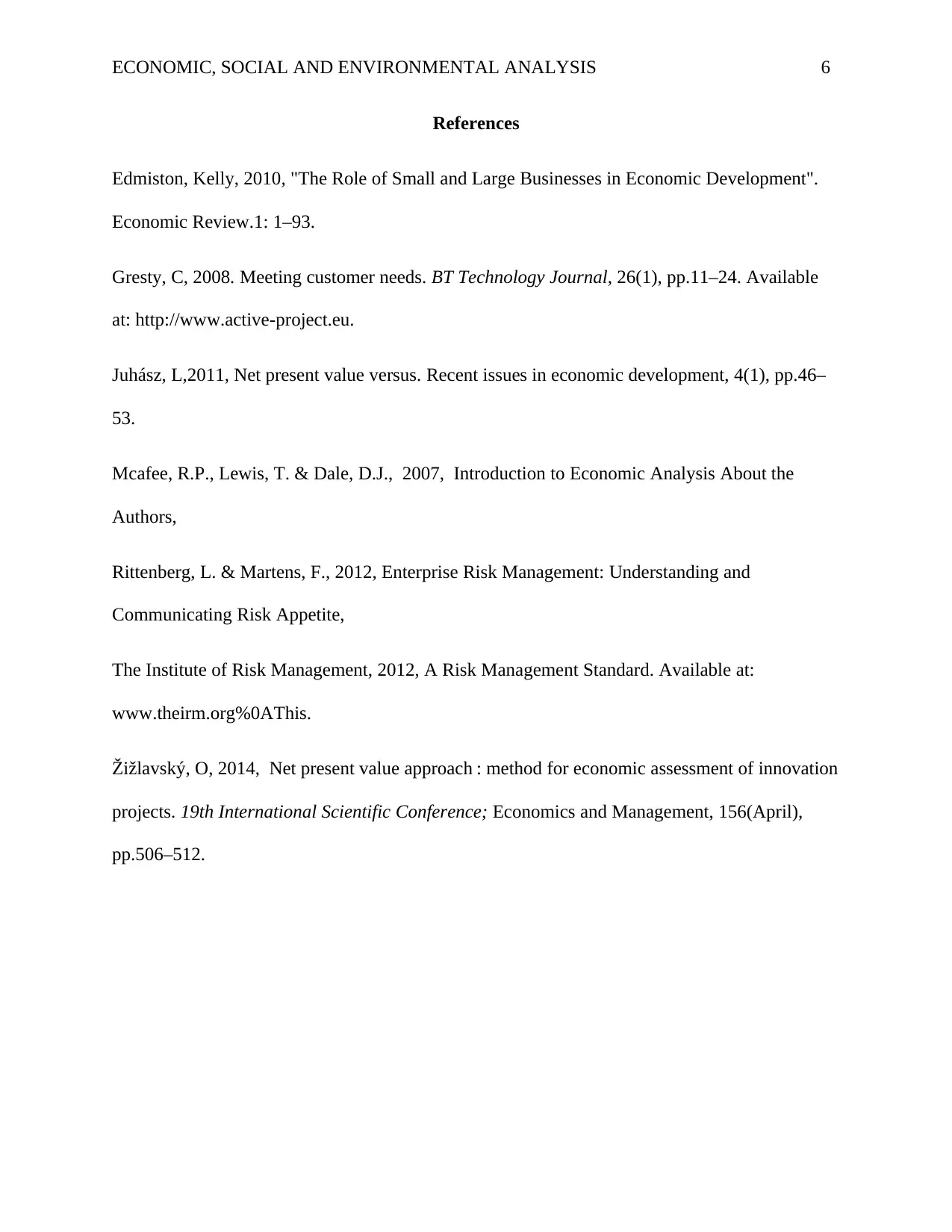
ECONOMIC, SOCIAL AND ENVIRONMENTAL ANALYSIS 6
References
Edmiston, Kelly, 2010, "The Role of Small and Large Businesses in Economic Development".
Economic Review.1: 1–93.
Gresty, C, 2008. Meeting customer needs. BT Technology Journal, 26(1), pp.11–24. Available
at: http://www.active-project.eu.
Juhász, L,2011, Net present value versus. Recent issues in economic development, 4(1), pp.46–
53.
Mcafee, R.P., Lewis, T. & Dale, D.J., 2007, Introduction to Economic Analysis About the
Authors,
Rittenberg, L. & Martens, F., 2012, Enterprise Risk Management: Understanding and
Communicating Risk Appetite,
The Institute of Risk Management, 2012, A Risk Management Standard. Available at:
www.theirm.org%0AThis.
Žižlavský, O, 2014, Net present value approach : method for economic assessment of innovation
projects. 19th International Scientific Conference; Economics and Management, 156(April),
pp.506–512.
References
Edmiston, Kelly, 2010, "The Role of Small and Large Businesses in Economic Development".
Economic Review.1: 1–93.
Gresty, C, 2008. Meeting customer needs. BT Technology Journal, 26(1), pp.11–24. Available
at: http://www.active-project.eu.
Juhász, L,2011, Net present value versus. Recent issues in economic development, 4(1), pp.46–
53.
Mcafee, R.P., Lewis, T. & Dale, D.J., 2007, Introduction to Economic Analysis About the
Authors,
Rittenberg, L. & Martens, F., 2012, Enterprise Risk Management: Understanding and
Communicating Risk Appetite,
The Institute of Risk Management, 2012, A Risk Management Standard. Available at:
www.theirm.org%0AThis.
Žižlavský, O, 2014, Net present value approach : method for economic assessment of innovation
projects. 19th International Scientific Conference; Economics and Management, 156(April),
pp.506–512.
⊘ This is a preview!⊘
Do you want full access?
Subscribe today to unlock all pages.

Trusted by 1+ million students worldwide
1 out of 6
Related Documents
Your All-in-One AI-Powered Toolkit for Academic Success.
+13062052269
info@desklib.com
Available 24*7 on WhatsApp / Email
Unlock your academic potential
Copyright © 2020–2026 A2Z Services. All Rights Reserved. Developed and managed by ZUCOL.