Principles of Economics for Accountants: Homework Assignment Solution
VerifiedAdded on  2023/03/30
|6
|832
|424
Homework Assignment
AI Summary
This economics assignment solution analyzes the impact of fuel prices on the fresh food market, illustrating shifts in supply and demand curves due to increased transportation costs. It also explores how changes in consumer tastes and preferences influence the demand for different food products. Furthermore, the assignment explains the concept of 'price takers' in a perfectly competitive market and examines cross-elasticity of demand, demonstrating how consumers may substitute goods like sausages for t-bone steak when prices rise. The solution incorporates diagrams and references to support the analysis of market equilibrium and consumer behavior.
Principles of economics for accountants 1
Principles of economics for accountants
By
Name
Course
Instructor’s Name
Institutional Affiliation
The City and State
The Date
Principles of economics for accountants
By
Name
Course
Instructor’s Name
Institutional Affiliation
The City and State
The Date
Paraphrase This Document
Need a fresh take? Get an instant paraphrase of this document with our AI Paraphraser

Principles of economics for accountants 2
Question 1a
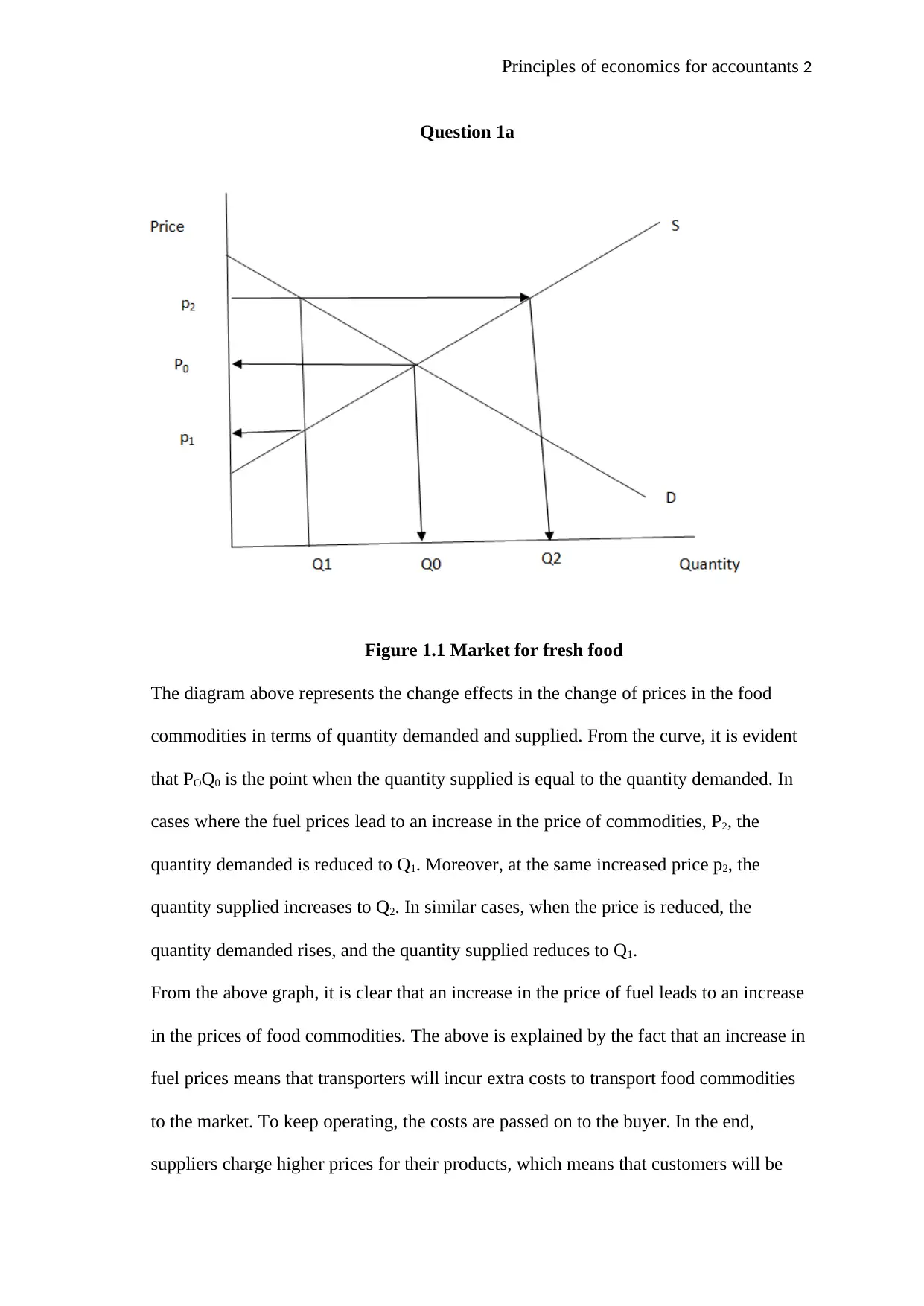
Figure 1.1 Market for fresh food
The diagram above represents the change effects in the change of prices in the food
commodities in terms of quantity demanded and supplied. From the curve, it is evident
that POQ0 is the point when the quantity supplied is equal to the quantity demanded. In
cases where the fuel prices lead to an increase in the price of commodities, P2, the
quantity demanded is reduced to Q1. Moreover, at the same increased price p2, the
quantity supplied increases to Q2. In similar cases, when the price is reduced, the
quantity demanded rises, and the quantity supplied reduces to Q1.
From the above graph, it is clear that an increase in the price of fuel leads to an increase
in the prices of food commodities. The above is explained by the fact that an increase in
fuel prices means that transporters will incur extra costs to transport food commodities
to the market. To keep operating, the costs are passed on to the buyer. In the end,
suppliers charge higher prices for their products, which means that customers will be
Question 1a
Figure 1.1 Market for fresh food
The diagram above represents the change effects in the change of prices in the food
commodities in terms of quantity demanded and supplied. From the curve, it is evident
that POQ0 is the point when the quantity supplied is equal to the quantity demanded. In
cases where the fuel prices lead to an increase in the price of commodities, P2, the
quantity demanded is reduced to Q1. Moreover, at the same increased price p2, the
quantity supplied increases to Q2. In similar cases, when the price is reduced, the
quantity demanded rises, and the quantity supplied reduces to Q1.
From the above graph, it is clear that an increase in the price of fuel leads to an increase
in the prices of food commodities. The above is explained by the fact that an increase in
fuel prices means that transporters will incur extra costs to transport food commodities
to the market. To keep operating, the costs are passed on to the buyer. In the end,
suppliers charge higher prices for their products, which means that customers will be

Principles of economics for accountants 3
charged highly for the different goods supplied at a higher price. In summary, an
increase in the prices of fuel leads to expensive supply chain, which translates into an
increase in prices of the different goods. The above is explained by the fact that all fresh
foods are transported daily from gardens to the market place. Therefore, an increase in
fuel prices means an increase in the cost of transport.
Question 1b
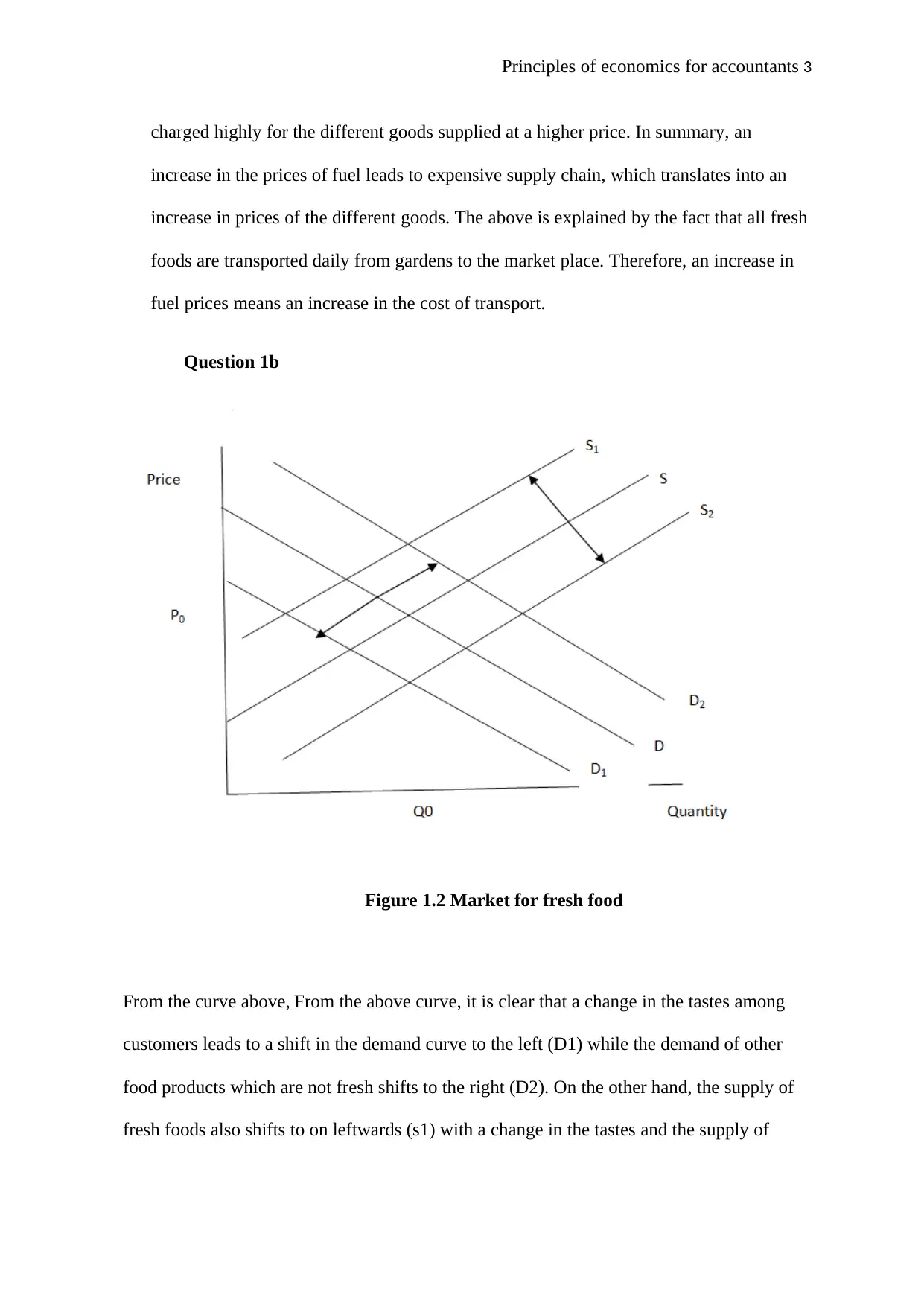
Figure 1.2 Market for fresh food
From the curve above, From the above curve, it is clear that a change in the tastes among
customers leads to a shift in the demand curve to the left (D1) while the demand of other
food products which are not fresh shifts to the right (D2). On the other hand, the supply of
fresh foods also shifts to on leftwards (s1) with a change in the tastes and the supply of
charged highly for the different goods supplied at a higher price. In summary, an
increase in the prices of fuel leads to expensive supply chain, which translates into an
increase in prices of the different goods. The above is explained by the fact that all fresh
foods are transported daily from gardens to the market place. Therefore, an increase in
fuel prices means an increase in the cost of transport.
Question 1b
Figure 1.2 Market for fresh food
From the curve above, From the above curve, it is clear that a change in the tastes among
customers leads to a shift in the demand curve to the left (D1) while the demand of other
food products which are not fresh shifts to the right (D2). On the other hand, the supply of
fresh foods also shifts to on leftwards (s1) with a change in the tastes and the supply of
⊘ This is a preview!⊘
Do you want full access?
Subscribe today to unlock all pages.

Trusted by 1+ million students worldwide

Principles of economics for accountants 4
other commodities shifts to the right (s2). The shifts in the demand and supply curves
represent the effects if tastes and preferences among customers in the market.
About the above curve, changes in the tastes and preferences among consumers affects the
consumption trends of specific products. In this case, because of high prices, consumers'
tastes and preferences are forced to change as they look out for other alternative foods that
may not be affected (Beilharz, 2018). The demand curve for fresh foods, in this case, shifts
leftward while the different foods that are not fresh; there demand curve shifts rightward.
On the other hand, the supply curve for fresh foods shifts to the left while the other
alternatives it shifts to the right.
Question 2
About the above, being "price takers" it means that farmers often accept the prevailing or
ruling price in the market and always sell each of their produced units at a similar rate
(Beilharz, 2018). The above means that they do not have a market share to be able to
influence the prices in the market. Prices for farmer's products are therefore set by other
market players and cannot control their change. Moreover, the above is prevalent in a
perfect competition kind of market.
Some of the characteristics of such type of a market are there is there free exit and entry into
the market, sellers and buyers have unlimited access to the needed information regarding
the price. Additionally, there are as manner buyers as are the sellers. The above are some of
the characteristics of such a market.
Question 3
About the article, it is clear that consumers, instead of being able to buy a "t-bone steak,"
they may opt for buying sausages(Beilharz, 2018). Understanding the concept of "cross-
other commodities shifts to the right (s2). The shifts in the demand and supply curves
represent the effects if tastes and preferences among customers in the market.
About the above curve, changes in the tastes and preferences among consumers affects the
consumption trends of specific products. In this case, because of high prices, consumers'
tastes and preferences are forced to change as they look out for other alternative foods that
may not be affected (Beilharz, 2018). The demand curve for fresh foods, in this case, shifts
leftward while the different foods that are not fresh; there demand curve shifts rightward.
On the other hand, the supply curve for fresh foods shifts to the left while the other
alternatives it shifts to the right.
Question 2
About the above, being "price takers" it means that farmers often accept the prevailing or
ruling price in the market and always sell each of their produced units at a similar rate
(Beilharz, 2018). The above means that they do not have a market share to be able to
influence the prices in the market. Prices for farmer's products are therefore set by other
market players and cannot control their change. Moreover, the above is prevalent in a
perfect competition kind of market.
Some of the characteristics of such type of a market are there is there free exit and entry into
the market, sellers and buyers have unlimited access to the needed information regarding
the price. Additionally, there are as manner buyers as are the sellers. The above are some of
the characteristics of such a market.
Question 3
About the article, it is clear that consumers, instead of being able to buy a "t-bone steak,"
they may opt for buying sausages(Beilharz, 2018). Understanding the concept of "cross-
Paraphrase This Document
Need a fresh take? Get an instant paraphrase of this document with our AI Paraphraser

Principles of economics for accountants 5
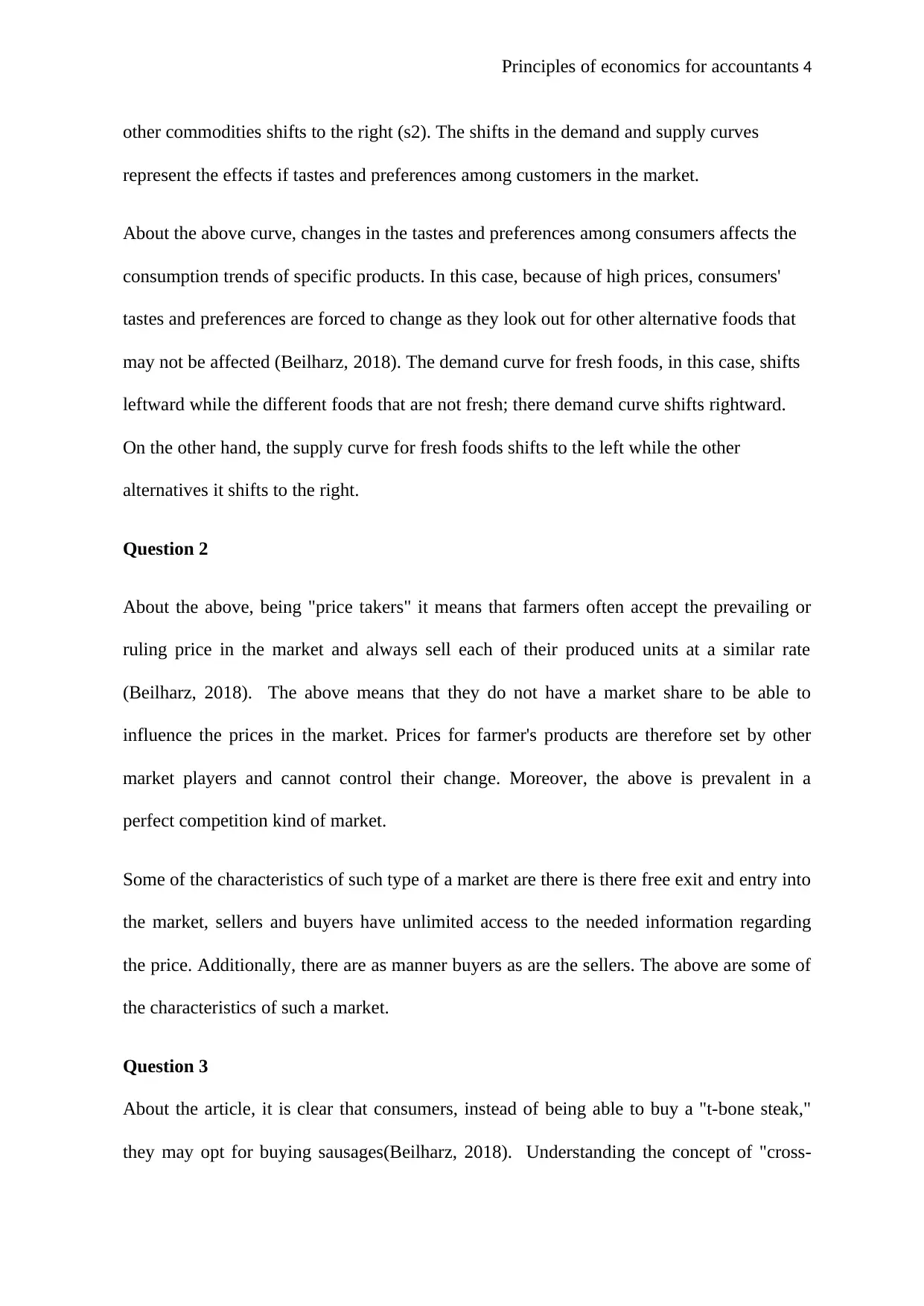
elasticity of demand," it is defined as an economic phenomenon, which measures the market
responsiveness in terms of quantity demanded of a specific good in the case of changes in
the price of another good. The above is estimated from the formula below.
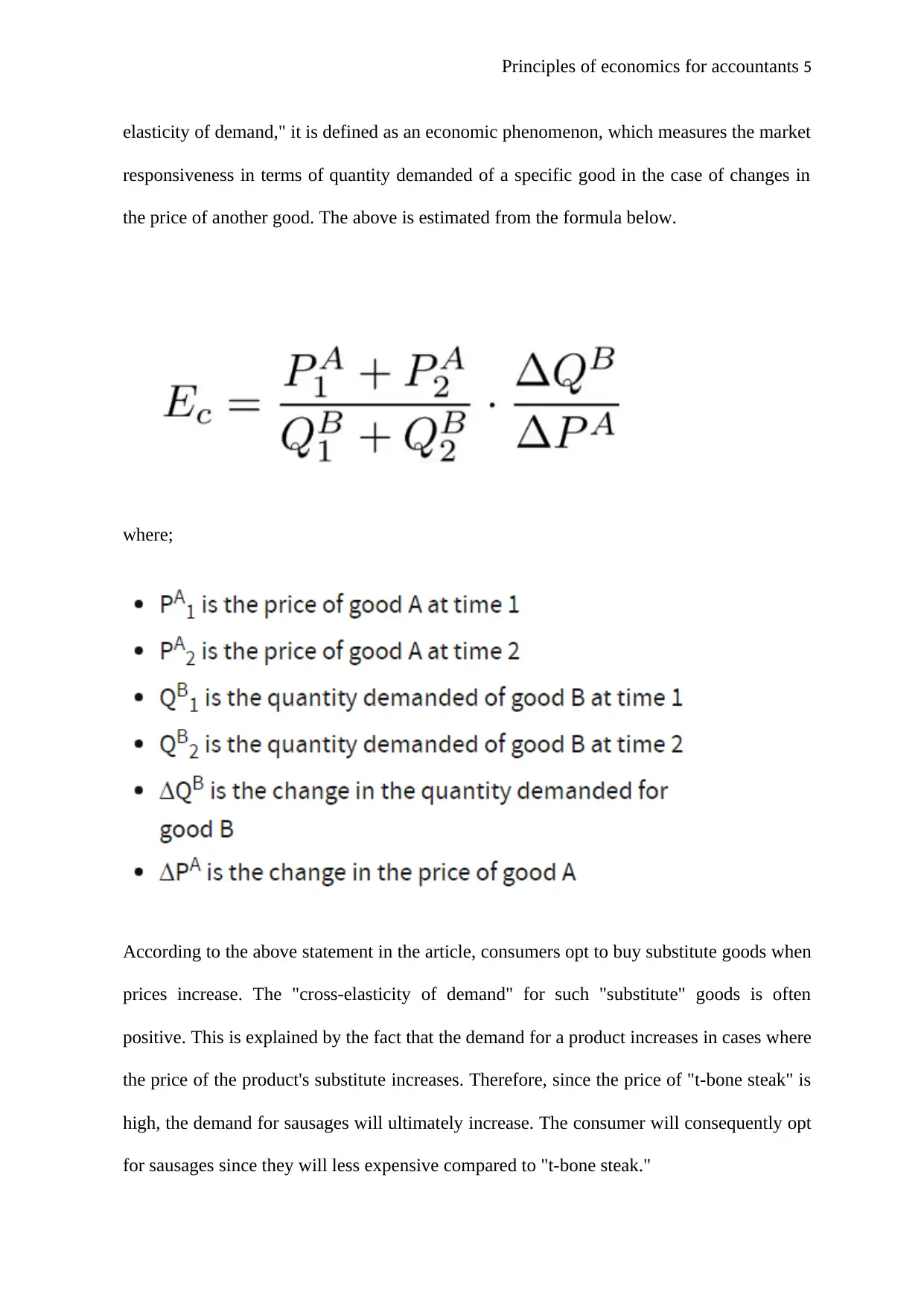
where;
According to the above statement in the article, consumers opt to buy substitute goods when
prices increase. The "cross-elasticity of demand" for such "substitute" goods is often
positive. This is explained by the fact that the demand for a product increases in cases where
the price of the product's substitute increases. Therefore, since the price of "t-bone steak" is
high, the demand for sausages will ultimately increase. The consumer will consequently opt
for sausages since they will less expensive compared to "t-bone steak."
elasticity of demand," it is defined as an economic phenomenon, which measures the market
responsiveness in terms of quantity demanded of a specific good in the case of changes in
the price of another good. The above is estimated from the formula below.
where;
According to the above statement in the article, consumers opt to buy substitute goods when
prices increase. The "cross-elasticity of demand" for such "substitute" goods is often
positive. This is explained by the fact that the demand for a product increases in cases where
the price of the product's substitute increases. Therefore, since the price of "t-bone steak" is
high, the demand for sausages will ultimately increase. The consumer will consequently opt
for sausages since they will less expensive compared to "t-bone steak."

Principles of economics for accountants 6
Reference
Beilharz, N., 2018. High petrol prices may push up the cost of fresh food for consumers,
ABC News. Retrieved from:https://www.abc.net.au/news/rural/2018-10-18/rising-petrol-
prices-may-push-up-the-cost-of-fresh-food/10390286
Reference
Beilharz, N., 2018. High petrol prices may push up the cost of fresh food for consumers,
ABC News. Retrieved from:https://www.abc.net.au/news/rural/2018-10-18/rising-petrol-
prices-may-push-up-the-cost-of-fresh-food/10390286
⊘ This is a preview!⊘
Do you want full access?
Subscribe today to unlock all pages.

Trusted by 1+ million students worldwide
1 out of 6
Related Documents
Your All-in-One AI-Powered Toolkit for Academic Success.
 +13062052269
info@desklib.com
Available 24*7 on WhatsApp / Email
Unlock your academic potential
Copyright © 2020–2026 A2Z Services. All Rights Reserved. Developed and managed by ZUCOL.