UGB 109 Economics Alternative Assessment 2020: Elasticity and Banks
VerifiedAdded on 2023/01/11
|11
|3157
|77
Report
AI Summary
This economics report, submitted as an alternative assessment for the UGB 109 module, delves into core economic concepts. The report addresses two key questions: the first explores three types of elasticity (price elasticity of demand, price elasticity of supply, and income elasticity of demand), providing calculations and examples to illustrate each. The second question examines how commercial banks generate money, detailing the role of deposits, reserves, and lending in the money creation process. The report aims to enhance understanding of these critical economic principles, demonstrating the relationships between economic factors and financial markets.

Project Alternative
Exam
Exam

Paraphrase This Document
Need a fresh take? Get an instant paraphrase of this document with our AI Paraphraser
INTRODUCTION...........................................................................................................................1
MAIN BODY..................................................................................................................................1
Question 1........................................................................................................................................1
1. Explain three different types of elasticity in the economy and how it should be calculated...1
Question 3........................................................................................................................................5
1. Explain that how commercial banks generate money.............................................................5
CONCLUSION................................................................................................................................8
REFERENCES................................................................................................................................9
MAIN BODY..................................................................................................................................1
Question 1........................................................................................................................................1
1. Explain three different types of elasticity in the economy and how it should be calculated...1
Question 3........................................................................................................................................5
1. Explain that how commercial banks generate money.............................................................5
CONCLUSION................................................................................................................................8
REFERENCES................................................................................................................................9
INTRODUCTION
Economic theories is the easiest and concise description of how social hierarchy the scarce
resources. It is a social science associated with products and services being generated, circulated,
and consumed. Macroeconomics is the field of sociology researching a national economy's
overall working (Ibanez And et.al., 2018). In particular, economies can be subdivided into
macroeconomics that focuses on world economy behaviour and microeconomics focuses on
individual customers and enterprises. This assessment is based on two questions which help the
students to improve their learning and knowledge. A first question is based on different type of
elasticity that is based on the change of demanded quantity over change in price. There are major
four types but this report discussed about major three such as price elasticity of demand (PES),
price elasticity of supply (PES) and at the end, income elasticity of demand (YED). In addition,
second question is based on how commercial banks generate money.
MAIN BODY
Question 1
1. Explain three different types of elasticity in the economy and how it should be calculated
Elasticity is a core economic principle and it applicable in many cases. Simple analysis of
demand and supply describes why economic factors, such as size, income and productions are
consistently related. Elasticity may provide valuable knowledge about the power of these
partnerships or their vulnerability. It refers with one sensitivity economic factor such as the
required quantity to a transition in some other variable such as price.
Economic experts use price elasticity to explain how supply or demand adjusts and
understand the complexities of the financial market, despite price changes. For example, certain
goods are rather inelastic, because their prices don't change at all with increases in supply or
demand (Liu and Yu, 2018). People want to buy fuel to get to work or fly across the world, and
even if oil prices increase, people are going to purchase exactly the same amount of petrol again.
Similarly, other commodities are very dynamic, creating significant changes in their demand or
availability due to their price fluctuations.
There are majorly four types of elasticity but this report discussed about only three type of
elasticity which helps in measuring relationship between two factors and it’s discussed below:
1
Economic theories is the easiest and concise description of how social hierarchy the scarce
resources. It is a social science associated with products and services being generated, circulated,
and consumed. Macroeconomics is the field of sociology researching a national economy's
overall working (Ibanez And et.al., 2018). In particular, economies can be subdivided into
macroeconomics that focuses on world economy behaviour and microeconomics focuses on
individual customers and enterprises. This assessment is based on two questions which help the
students to improve their learning and knowledge. A first question is based on different type of
elasticity that is based on the change of demanded quantity over change in price. There are major
four types but this report discussed about major three such as price elasticity of demand (PES),
price elasticity of supply (PES) and at the end, income elasticity of demand (YED). In addition,
second question is based on how commercial banks generate money.
MAIN BODY
Question 1
1. Explain three different types of elasticity in the economy and how it should be calculated
Elasticity is a core economic principle and it applicable in many cases. Simple analysis of
demand and supply describes why economic factors, such as size, income and productions are
consistently related. Elasticity may provide valuable knowledge about the power of these
partnerships or their vulnerability. It refers with one sensitivity economic factor such as the
required quantity to a transition in some other variable such as price.
Economic experts use price elasticity to explain how supply or demand adjusts and
understand the complexities of the financial market, despite price changes. For example, certain
goods are rather inelastic, because their prices don't change at all with increases in supply or
demand (Liu and Yu, 2018). People want to buy fuel to get to work or fly across the world, and
even if oil prices increase, people are going to purchase exactly the same amount of petrol again.
Similarly, other commodities are very dynamic, creating significant changes in their demand or
availability due to their price fluctuations.
There are majorly four types of elasticity but this report discussed about only three type of
elasticity which helps in measuring relationship between two factors and it’s discussed below:
1
⊘ This is a preview!⊘
Do you want full access?
Subscribe today to unlock all pages.

Trusted by 1+ million students worldwide
Price elasticity of Demand (PED): Price elasticity is an indicator of economic to the
increase in the amount a commodity demands or consumes in response to the increase in price. It
is a means of working out market sensitivity to demand variations. If a good's price elasticity is
less than 1 it is termed as inelastic (Sevilla and Huerta, 2018). That indicates a price increase of
one unit resulting in a demand decline of less than one unit. Similarly, if there is more than one
coefficient (the absolute value) the goods are elastic. Which means a price increase unit would
trigger demand to sink even further. In this concept, profits is greatly increased if the price
elasticity of a product is equal to 1, or, in other words, if demand is elastic unit.
Formula:
PED = % change in demanded quantity / % change in price
Calculation:
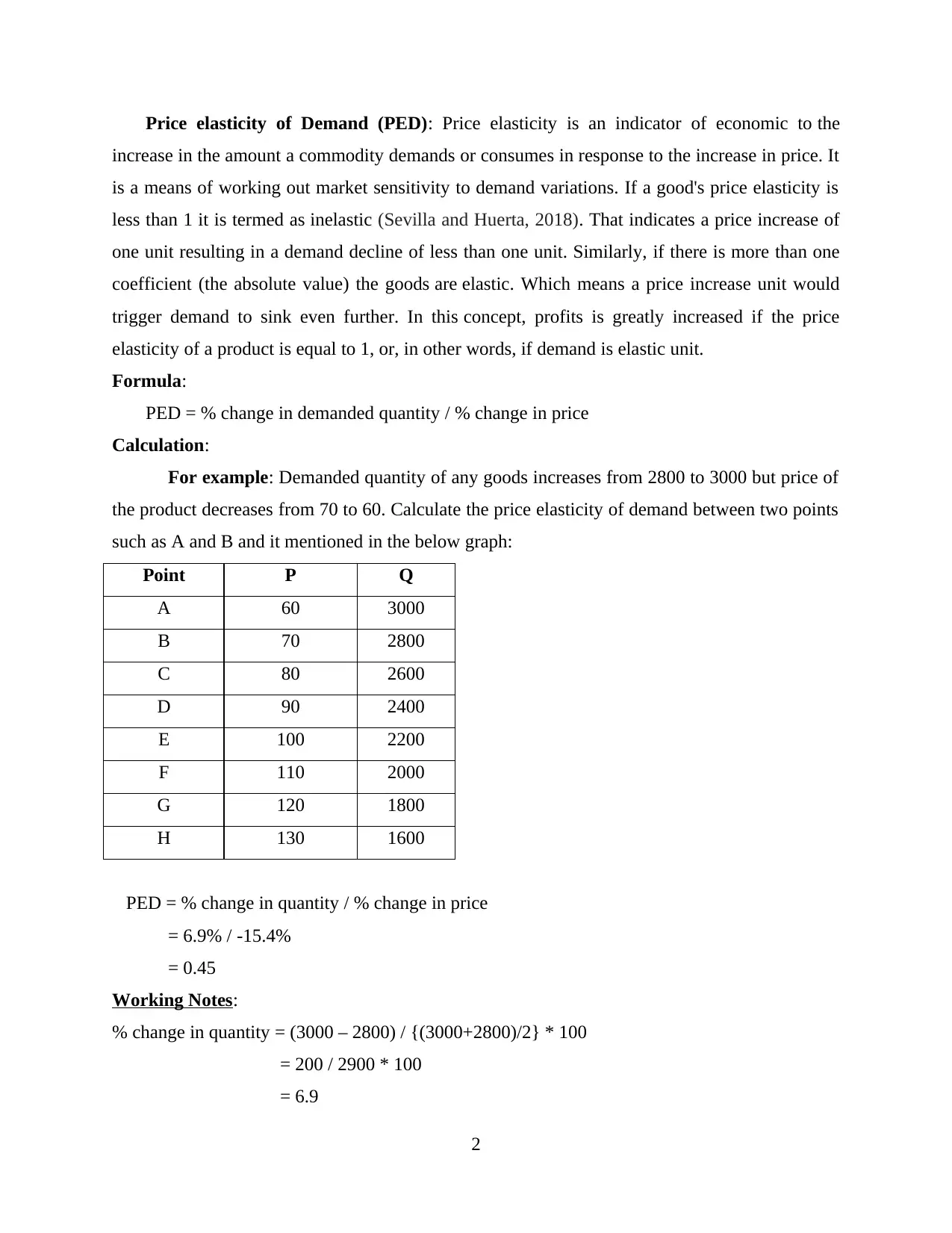
For example: Demanded quantity of any goods increases from 2800 to 3000 but price of
the product decreases from 70 to 60. Calculate the price elasticity of demand between two points
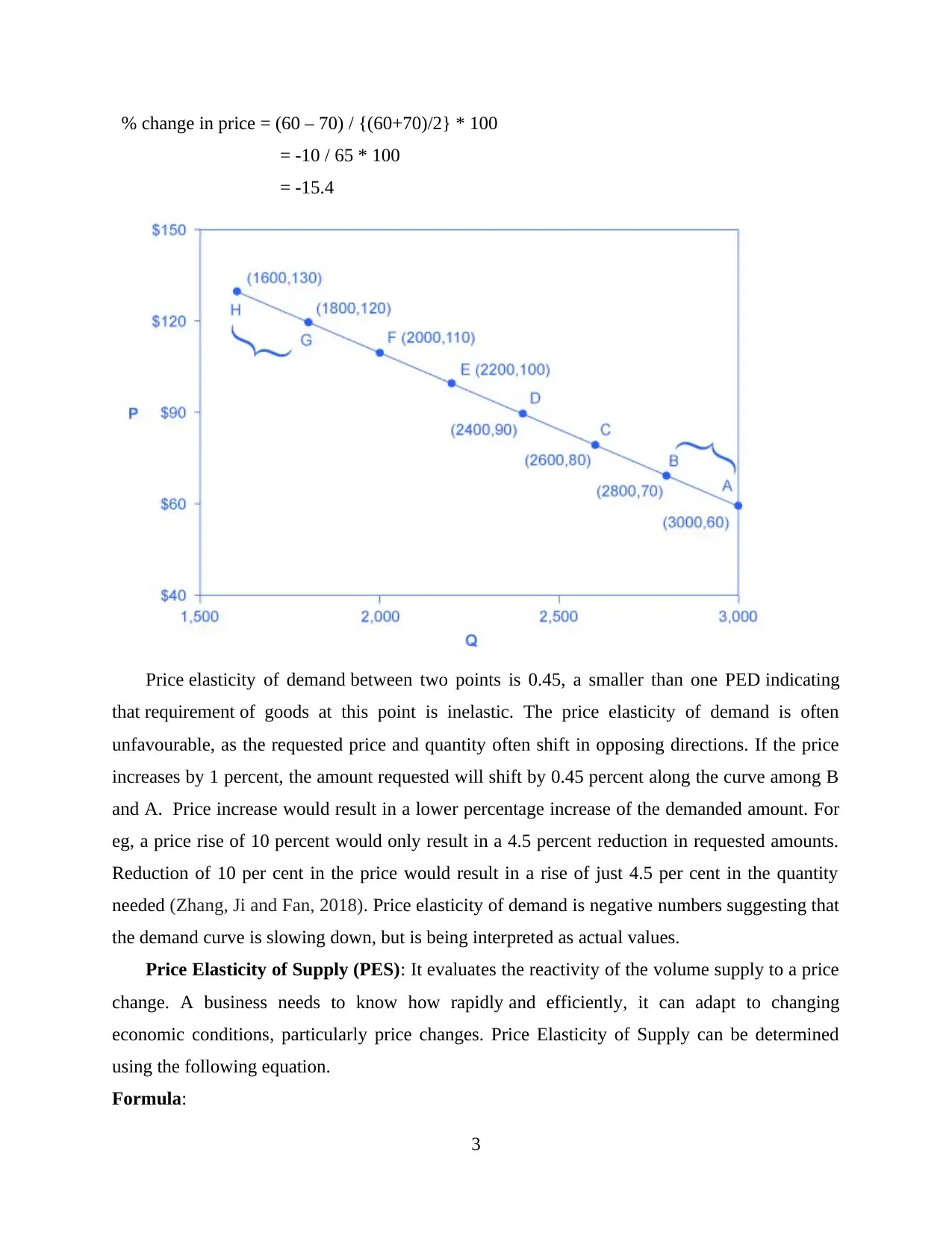
such as A and B and it mentioned in the below graph:
Point P Q
A 60 3000
B 70 2800
C 80 2600
D 90 2400
E 100 2200
F 110 2000
G 120 1800
H 130 1600
PED = % change in quantity / % change in price
= 6.9% / -15.4%
= 0.45
Working Notes:
% change in quantity = (3000 – 2800) / {(3000+2800)/2} * 100
= 200 / 2900 * 100
= 6.9
2
increase in the amount a commodity demands or consumes in response to the increase in price. It
is a means of working out market sensitivity to demand variations. If a good's price elasticity is
less than 1 it is termed as inelastic (Sevilla and Huerta, 2018). That indicates a price increase of
one unit resulting in a demand decline of less than one unit. Similarly, if there is more than one
coefficient (the absolute value) the goods are elastic. Which means a price increase unit would
trigger demand to sink even further. In this concept, profits is greatly increased if the price
elasticity of a product is equal to 1, or, in other words, if demand is elastic unit.
Formula:
PED = % change in demanded quantity / % change in price
Calculation:
For example: Demanded quantity of any goods increases from 2800 to 3000 but price of
the product decreases from 70 to 60. Calculate the price elasticity of demand between two points
such as A and B and it mentioned in the below graph:
Point P Q
A 60 3000
B 70 2800
C 80 2600
D 90 2400
E 100 2200
F 110 2000
G 120 1800
H 130 1600
PED = % change in quantity / % change in price
= 6.9% / -15.4%
= 0.45
Working Notes:
% change in quantity = (3000 – 2800) / {(3000+2800)/2} * 100
= 200 / 2900 * 100
= 6.9
2
Paraphrase This Document
Need a fresh take? Get an instant paraphrase of this document with our AI Paraphraser
% change in price = (60 – 70) / {(60+70)/2} * 100
= -10 / 65 * 100
= -15.4
Price elasticity of demand between two points is 0.45, a smaller than one PED indicating
that requirement of goods at this point is inelastic. The price elasticity of demand is often
unfavourable, as the requested price and quantity often shift in opposing directions. If the price
increases by 1 percent, the amount requested will shift by 0.45 percent along the curve among B
and A. Price increase would result in a lower percentage increase of the demanded amount. For
eg, a price rise of 10 percent would only result in a 4.5 percent reduction in requested amounts.
Reduction of 10 per cent in the price would result in a rise of just 4.5 per cent in the quantity
needed (Zhang, Ji and Fan, 2018). Price elasticity of demand is negative numbers suggesting that
the demand curve is slowing down, but is being interpreted as actual values.
Price Elasticity of Supply (PES): It evaluates the reactivity of the volume supply to a price
change. A business needs to know how rapidly and efficiently, it can adapt to changing
economic conditions, particularly price changes. Price Elasticity of Supply can be determined
using the following equation.
Formula:
3
= -10 / 65 * 100
= -15.4
Price elasticity of demand between two points is 0.45, a smaller than one PED indicating
that requirement of goods at this point is inelastic. The price elasticity of demand is often
unfavourable, as the requested price and quantity often shift in opposing directions. If the price
increases by 1 percent, the amount requested will shift by 0.45 percent along the curve among B
and A. Price increase would result in a lower percentage increase of the demanded amount. For
eg, a price rise of 10 percent would only result in a 4.5 percent reduction in requested amounts.
Reduction of 10 per cent in the price would result in a rise of just 4.5 per cent in the quantity
needed (Zhang, Ji and Fan, 2018). Price elasticity of demand is negative numbers suggesting that
the demand curve is slowing down, but is being interpreted as actual values.
Price Elasticity of Supply (PES): It evaluates the reactivity of the volume supply to a price
change. A business needs to know how rapidly and efficiently, it can adapt to changing
economic conditions, particularly price changes. Price Elasticity of Supply can be determined
using the following equation.
Formula:
3
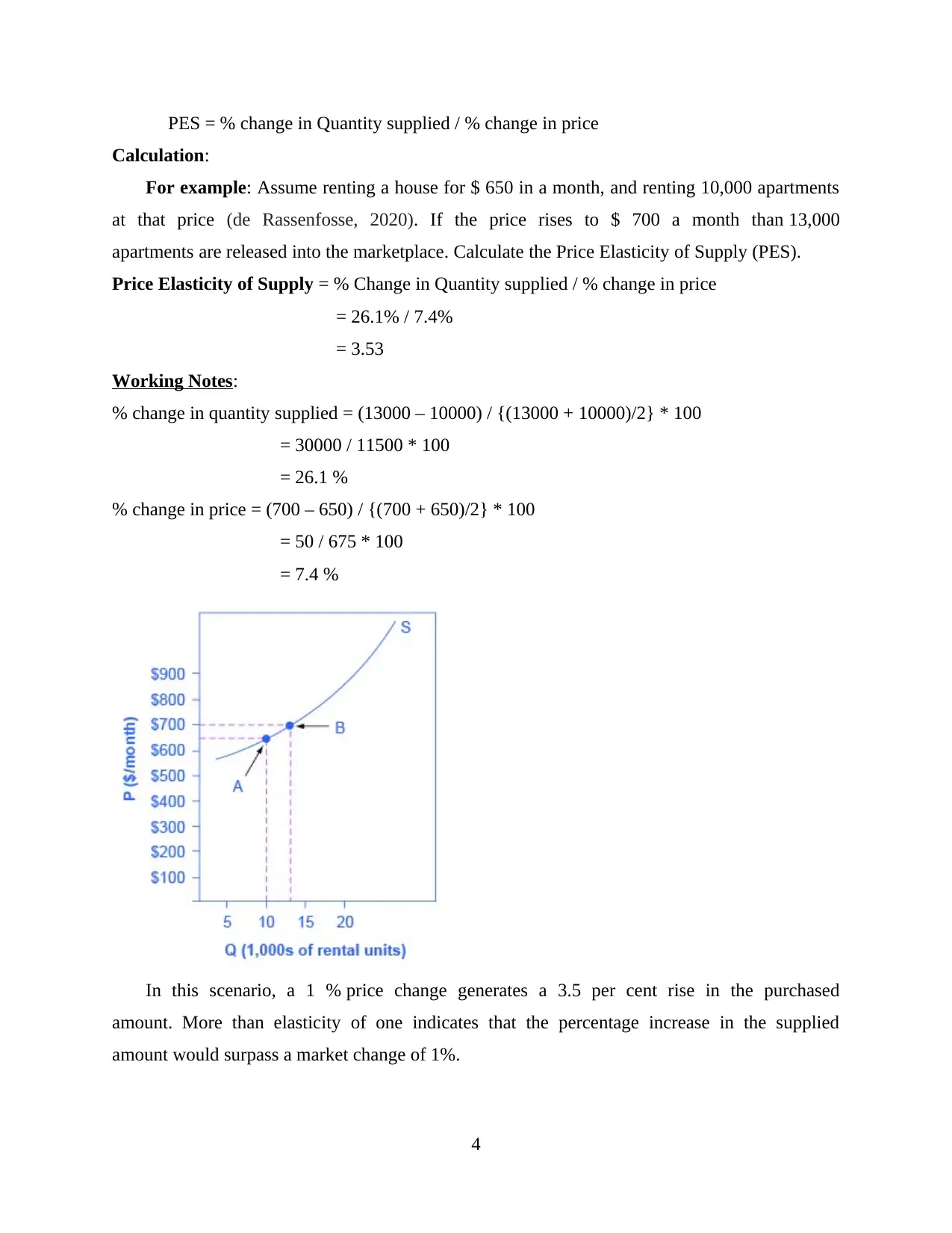
PES = % change in Quantity supplied / % change in price
Calculation:
For example: Assume renting a house for $ 650 in a month, and renting 10,000 apartments
at that price (de Rassenfosse, 2020). If the price rises to $ 700 a month than 13,000
apartments are released into the marketplace. Calculate the Price Elasticity of Supply (PES).
Price Elasticity of Supply = % Change in Quantity supplied / % change in price
= 26.1% / 7.4%
= 3.53
Working Notes:
% change in quantity supplied = (13000 – 10000) / {(13000 + 10000)/2} * 100
= 30000 / 11500 * 100
= 26.1 %
% change in price = (700 – 650) / {(700 + 650)/2} * 100
= 50 / 675 * 100
= 7.4 %
In this scenario, a 1 % price change generates a 3.5 per cent rise in the purchased
amount. More than elasticity of one indicates that the percentage increase in the supplied
amount would surpass a market change of 1%.
4
Calculation:
For example: Assume renting a house for $ 650 in a month, and renting 10,000 apartments
at that price (de Rassenfosse, 2020). If the price rises to $ 700 a month than 13,000
apartments are released into the marketplace. Calculate the Price Elasticity of Supply (PES).
Price Elasticity of Supply = % Change in Quantity supplied / % change in price
= 26.1% / 7.4%
= 3.53
Working Notes:
% change in quantity supplied = (13000 – 10000) / {(13000 + 10000)/2} * 100
= 30000 / 11500 * 100
= 26.1 %
% change in price = (700 – 650) / {(700 + 650)/2} * 100
= 50 / 675 * 100
= 7.4 %
In this scenario, a 1 % price change generates a 3.5 per cent rise in the purchased
amount. More than elasticity of one indicates that the percentage increase in the supplied
amount would surpass a market change of 1%.
4
⊘ This is a preview!⊘
Do you want full access?
Subscribe today to unlock all pages.
Trusted by 1+ million students worldwide
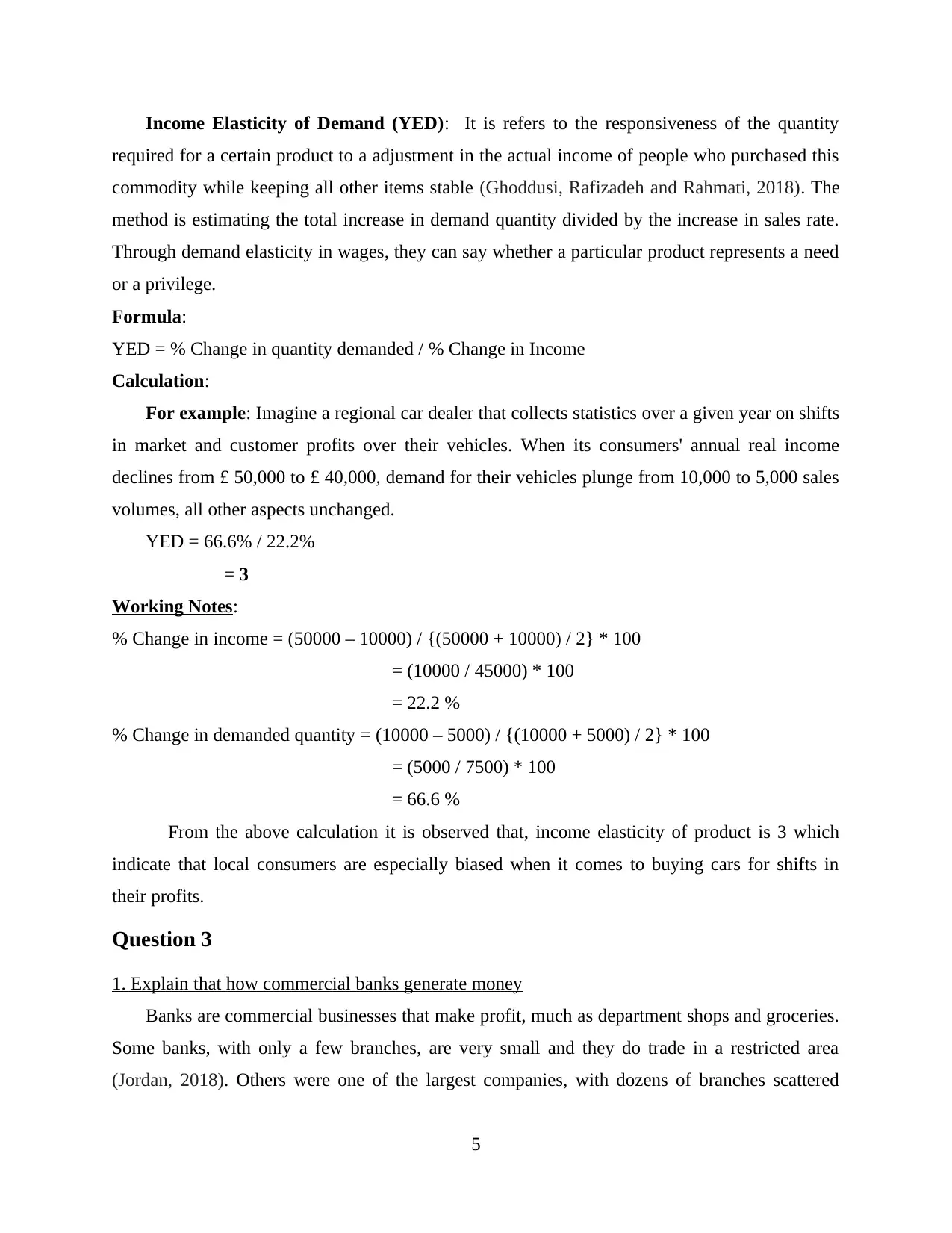
Income Elasticity of Demand (YED): It is refers to the responsiveness of the quantity
required for a certain product to a adjustment in the actual income of people who purchased this
commodity while keeping all other items stable (Ghoddusi, Rafizadeh and Rahmati, 2018). The
method is estimating the total increase in demand quantity divided by the increase in sales rate.
Through demand elasticity in wages, they can say whether a particular product represents a need
or a privilege.
Formula:
YED = % Change in quantity demanded / % Change in Income
Calculation:
For example: Imagine a regional car dealer that collects statistics over a given year on shifts
in market and customer profits over their vehicles. When its consumers' annual real income
declines from £ 50,000 to £ 40,000, demand for their vehicles plunge from 10,000 to 5,000 sales
volumes, all other aspects unchanged.
YED = 66.6% / 22.2%
= 3
Working Notes:
% Change in income = (50000 – 10000) / {(50000 + 10000) / 2} * 100
= (10000 / 45000) * 100
= 22.2 %
% Change in demanded quantity = (10000 – 5000) / {(10000 + 5000) / 2} * 100
= (5000 / 7500) * 100
= 66.6 %
From the above calculation it is observed that, income elasticity of product is 3 which
indicate that local consumers are especially biased when it comes to buying cars for shifts in
their profits.
Question 3
1. Explain that how commercial banks generate money
Banks are commercial businesses that make profit, much as department shops and groceries.
Some banks, with only a few branches, are very small and they do trade in a restricted area
(Jordan, 2018). Others were one of the largest companies, with dozens of branches scattered
5
required for a certain product to a adjustment in the actual income of people who purchased this
commodity while keeping all other items stable (Ghoddusi, Rafizadeh and Rahmati, 2018). The
method is estimating the total increase in demand quantity divided by the increase in sales rate.
Through demand elasticity in wages, they can say whether a particular product represents a need
or a privilege.
Formula:
YED = % Change in quantity demanded / % Change in Income
Calculation:
For example: Imagine a regional car dealer that collects statistics over a given year on shifts
in market and customer profits over their vehicles. When its consumers' annual real income
declines from £ 50,000 to £ 40,000, demand for their vehicles plunge from 10,000 to 5,000 sales
volumes, all other aspects unchanged.
YED = 66.6% / 22.2%
= 3
Working Notes:
% Change in income = (50000 – 10000) / {(50000 + 10000) / 2} * 100
= (10000 / 45000) * 100
= 22.2 %
% Change in demanded quantity = (10000 – 5000) / {(10000 + 5000) / 2} * 100
= (5000 / 7500) * 100
= 66.6 %
From the above calculation it is observed that, income elasticity of product is 3 which
indicate that local consumers are especially biased when it comes to buying cars for shifts in
their profits.
Question 3
1. Explain that how commercial banks generate money
Banks are commercial businesses that make profit, much as department shops and groceries.
Some banks, with only a few branches, are very small and they do trade in a restricted area
(Jordan, 2018). Others were one of the largest companies, with dozens of branches scattered
5
Paraphrase This Document
Need a fresh take? Get an instant paraphrase of this document with our AI Paraphraser
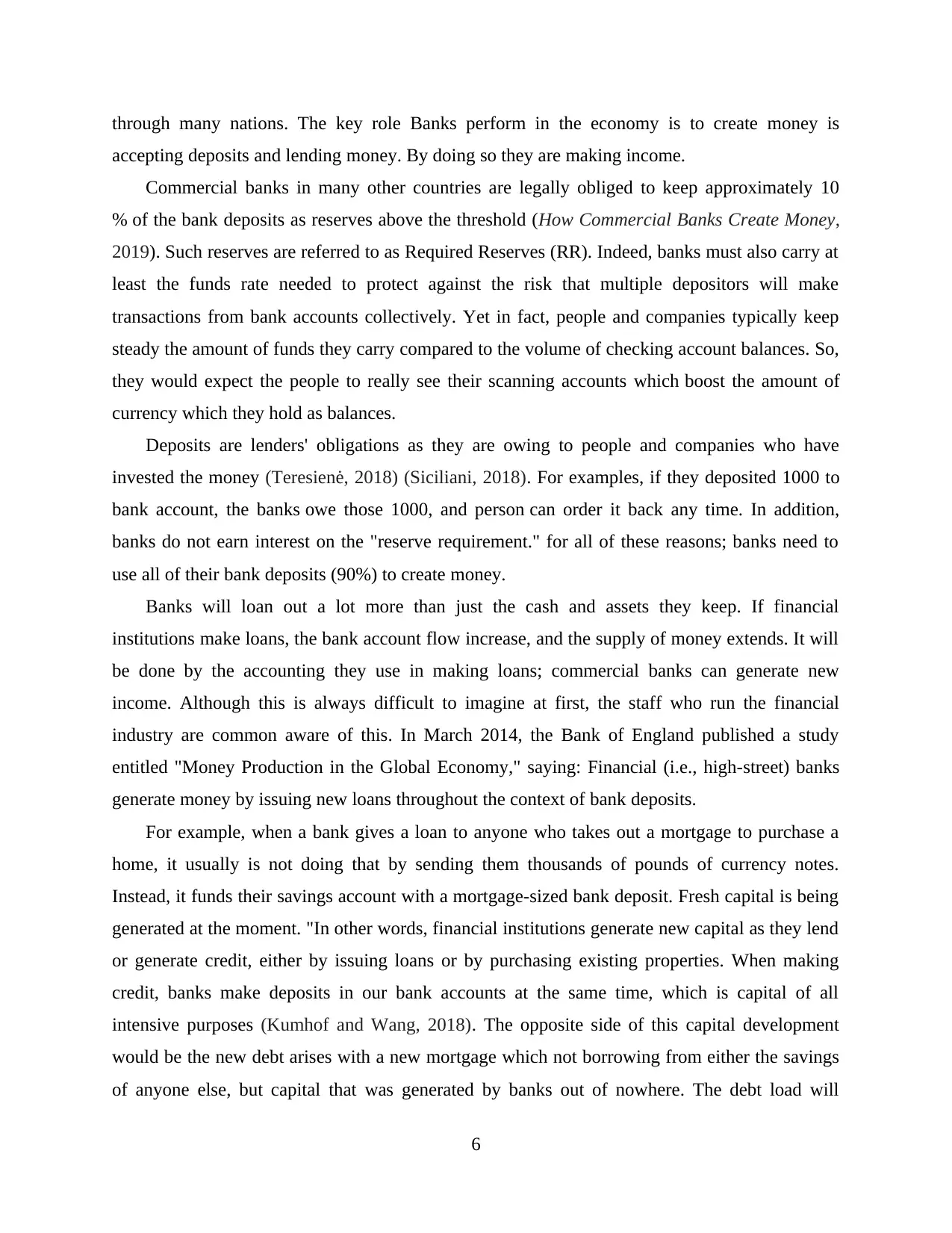
through many nations. The key role Banks perform in the economy is to create money is
accepting deposits and lending money. By doing so they are making income.
Commercial banks in many other countries are legally obliged to keep approximately 10
% of the bank deposits as reserves above the threshold (How Commercial Banks Create Money,
2019). Such reserves are referred to as Required Reserves (RR). Indeed, banks must also carry at
least the funds rate needed to protect against the risk that multiple depositors will make
transactions from bank accounts collectively. Yet in fact, people and companies typically keep
steady the amount of funds they carry compared to the volume of checking account balances. So,
they would expect the people to really see their scanning accounts which boost the amount of
currency which they hold as balances.
Deposits are lenders' obligations as they are owing to people and companies who have
invested the money (Teresienė, 2018) (Siciliani, 2018). For examples, if they deposited 1000 to
bank account, the banks owe those 1000, and person can order it back any time. In addition,
banks do not earn interest on the "reserve requirement." for all of these reasons; banks need to
use all of their bank deposits (90%) to create money.
Banks will loan out a lot more than just the cash and assets they keep. If financial
institutions make loans, the bank account flow increase, and the supply of money extends. It will
be done by the accounting they use in making loans; commercial banks can generate new
income. Although this is always difficult to imagine at first, the staff who run the financial
industry are common aware of this. In March 2014, the Bank of England published a study
entitled "Money Production in the Global Economy," saying: Financial (i.e., high-street) banks
generate money by issuing new loans throughout the context of bank deposits.
For example, when a bank gives a loan to anyone who takes out a mortgage to purchase a
home, it usually is not doing that by sending them thousands of pounds of currency notes.
Instead, it funds their savings account with a mortgage-sized bank deposit. Fresh capital is being
generated at the moment. "In other words, financial institutions generate new capital as they lend
or generate credit, either by issuing loans or by purchasing existing properties. When making
credit, banks make deposits in our bank accounts at the same time, which is capital of all
intensive purposes (Kumhof and Wang, 2018). The opposite side of this capital development
would be the new debt arises with a new mortgage which not borrowing from either the savings
of anyone else, but capital that was generated by banks out of nowhere. The debt load will
6
accepting deposits and lending money. By doing so they are making income.
Commercial banks in many other countries are legally obliged to keep approximately 10
% of the bank deposits as reserves above the threshold (How Commercial Banks Create Money,
2019). Such reserves are referred to as Required Reserves (RR). Indeed, banks must also carry at
least the funds rate needed to protect against the risk that multiple depositors will make
transactions from bank accounts collectively. Yet in fact, people and companies typically keep
steady the amount of funds they carry compared to the volume of checking account balances. So,
they would expect the people to really see their scanning accounts which boost the amount of
currency which they hold as balances.
Deposits are lenders' obligations as they are owing to people and companies who have
invested the money (Teresienė, 2018) (Siciliani, 2018). For examples, if they deposited 1000 to
bank account, the banks owe those 1000, and person can order it back any time. In addition,
banks do not earn interest on the "reserve requirement." for all of these reasons; banks need to
use all of their bank deposits (90%) to create money.
Banks will loan out a lot more than just the cash and assets they keep. If financial
institutions make loans, the bank account flow increase, and the supply of money extends. It will
be done by the accounting they use in making loans; commercial banks can generate new
income. Although this is always difficult to imagine at first, the staff who run the financial
industry are common aware of this. In March 2014, the Bank of England published a study
entitled "Money Production in the Global Economy," saying: Financial (i.e., high-street) banks
generate money by issuing new loans throughout the context of bank deposits.
For example, when a bank gives a loan to anyone who takes out a mortgage to purchase a
home, it usually is not doing that by sending them thousands of pounds of currency notes.
Instead, it funds their savings account with a mortgage-sized bank deposit. Fresh capital is being
generated at the moment. "In other words, financial institutions generate new capital as they lend
or generate credit, either by issuing loans or by purchasing existing properties. When making
credit, banks make deposits in our bank accounts at the same time, which is capital of all
intensive purposes (Kumhof and Wang, 2018). The opposite side of this capital development
would be the new debt arises with a new mortgage which not borrowing from either the savings
of anyone else, but capital that was generated by banks out of nowhere. The debt load will
6
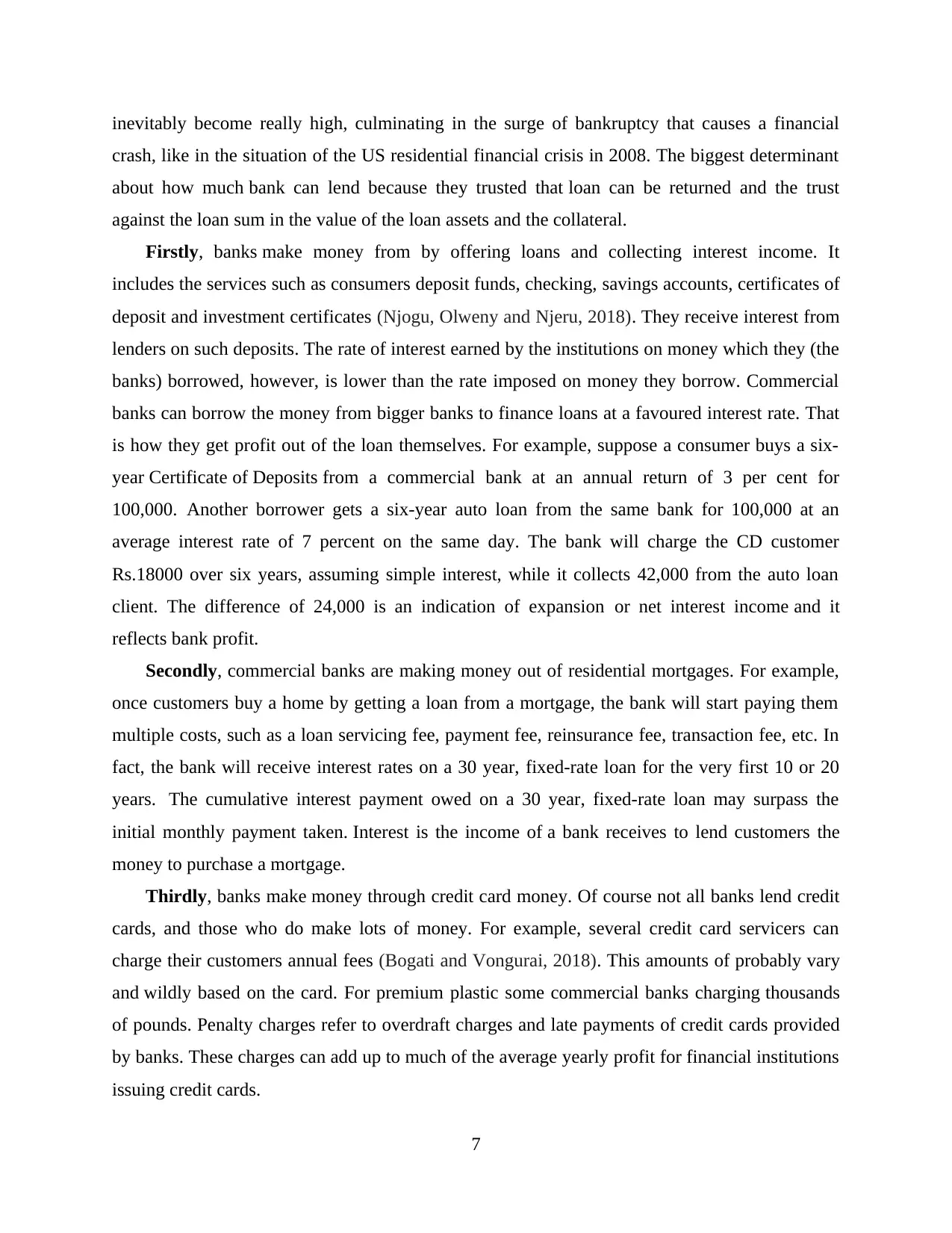
inevitably become really high, culminating in the surge of bankruptcy that causes a financial
crash, like in the situation of the US residential financial crisis in 2008. The biggest determinant
about how much bank can lend because they trusted that loan can be returned and the trust
against the loan sum in the value of the loan assets and the collateral.
Firstly, banks make money from by offering loans and collecting interest income. It
includes the services such as consumers deposit funds, checking, savings accounts, certificates of
deposit and investment certificates (Njogu, Olweny and Njeru, 2018). They receive interest from
lenders on such deposits. The rate of interest earned by the institutions on money which they (the
banks) borrowed, however, is lower than the rate imposed on money they borrow. Commercial
banks can borrow the money from bigger banks to finance loans at a favoured interest rate. That
is how they get profit out of the loan themselves. For example, suppose a consumer buys a six-
year Certificate of Deposits from a commercial bank at an annual return of 3 per cent for
100,000. Another borrower gets a six-year auto loan from the same bank for 100,000 at an
average interest rate of 7 percent on the same day. The bank will charge the CD customer
Rs.18000 over six years, assuming simple interest, while it collects 42,000 from the auto loan
client. The difference of 24,000 is an indication of expansion or net interest income and it
reflects bank profit.
Secondly, commercial banks are making money out of residential mortgages. For example,
once customers buy a home by getting a loan from a mortgage, the bank will start paying them
multiple costs, such as a loan servicing fee, payment fee, reinsurance fee, transaction fee, etc. In
fact, the bank will receive interest rates on a 30 year, fixed-rate loan for the very first 10 or 20
years. The cumulative interest payment owed on a 30 year, fixed-rate loan may surpass the
initial monthly payment taken. Interest is the income of a bank receives to lend customers the
money to purchase a mortgage.
Thirdly, banks make money through credit card money. Of course not all banks lend credit
cards, and those who do make lots of money. For example, several credit card servicers can
charge their customers annual fees (Bogati and Vongurai, 2018). This amounts of probably vary
and wildly based on the card. For premium plastic some commercial banks charging thousands
of pounds. Penalty charges refer to overdraft charges and late payments of credit cards provided
by banks. These charges can add up to much of the average yearly profit for financial institutions
issuing credit cards.
7
crash, like in the situation of the US residential financial crisis in 2008. The biggest determinant
about how much bank can lend because they trusted that loan can be returned and the trust
against the loan sum in the value of the loan assets and the collateral.
Firstly, banks make money from by offering loans and collecting interest income. It
includes the services such as consumers deposit funds, checking, savings accounts, certificates of
deposit and investment certificates (Njogu, Olweny and Njeru, 2018). They receive interest from
lenders on such deposits. The rate of interest earned by the institutions on money which they (the
banks) borrowed, however, is lower than the rate imposed on money they borrow. Commercial
banks can borrow the money from bigger banks to finance loans at a favoured interest rate. That
is how they get profit out of the loan themselves. For example, suppose a consumer buys a six-
year Certificate of Deposits from a commercial bank at an annual return of 3 per cent for
100,000. Another borrower gets a six-year auto loan from the same bank for 100,000 at an
average interest rate of 7 percent on the same day. The bank will charge the CD customer
Rs.18000 over six years, assuming simple interest, while it collects 42,000 from the auto loan
client. The difference of 24,000 is an indication of expansion or net interest income and it
reflects bank profit.
Secondly, commercial banks are making money out of residential mortgages. For example,
once customers buy a home by getting a loan from a mortgage, the bank will start paying them
multiple costs, such as a loan servicing fee, payment fee, reinsurance fee, transaction fee, etc. In
fact, the bank will receive interest rates on a 30 year, fixed-rate loan for the very first 10 or 20
years. The cumulative interest payment owed on a 30 year, fixed-rate loan may surpass the
initial monthly payment taken. Interest is the income of a bank receives to lend customers the
money to purchase a mortgage.
Thirdly, banks make money through credit card money. Of course not all banks lend credit
cards, and those who do make lots of money. For example, several credit card servicers can
charge their customers annual fees (Bogati and Vongurai, 2018). This amounts of probably vary
and wildly based on the card. For premium plastic some commercial banks charging thousands
of pounds. Penalty charges refer to overdraft charges and late payments of credit cards provided
by banks. These charges can add up to much of the average yearly profit for financial institutions
issuing credit cards.
7
⊘ This is a preview!⊘
Do you want full access?
Subscribe today to unlock all pages.
Trusted by 1+ million students worldwide
Overall discussion help in evaluating that, banks generate money through accepting
customer’s deposits, lending mortgage loan, several investment functions etc. These are the main
source of earning of commercial banks.
CONCLUSION
From the above discussion it has been observed that in the economy there are various factors
which required evaluating in order to understand the elasticity of demand and supply. Multiple
type of elasticity indicates the different perspective. Such as price elasticity of demand indicate
that how elastic is demand for particular product and it is similar to the price elasticity of supply
as well. On the other side, in context of financial institutions such as commercial banks, the
biggest source of income for banks is lending mortgage loan where they charge interest rate as
per the amount demanded by consumers. Customer deposits and credit card facilities also helps
in creating revenue for commercial banks.
8
customer’s deposits, lending mortgage loan, several investment functions etc. These are the main
source of earning of commercial banks.
CONCLUSION
From the above discussion it has been observed that in the economy there are various factors
which required evaluating in order to understand the elasticity of demand and supply. Multiple
type of elasticity indicates the different perspective. Such as price elasticity of demand indicate
that how elastic is demand for particular product and it is similar to the price elasticity of supply
as well. On the other side, in context of financial institutions such as commercial banks, the
biggest source of income for banks is lending mortgage loan where they charge interest rate as
per the amount demanded by consumers. Customer deposits and credit card facilities also helps
in creating revenue for commercial banks.
8
Paraphrase This Document
Need a fresh take? Get an instant paraphrase of this document with our AI Paraphraser
REFERENCES
Books & Journals
Ibanez, R. And et.al., 2018. A manifold learning approach to data-driven computational elasticity
and inelasticity. Archives of Computational Methods in Engineering. 25(1). pp.47-57.
Sevilla, R., Giacomini, M., Karkoulias, A. and Huerta, A., 2018. A superconvergent hybridisable
discontinuous Galerkin method for linear elasticity. International Journal for Numerical
Methods in Engineering. 116(2). pp.91-116.
Zhang, Y., Ji, Q. and Fan, Y., 2018. The price and income elasticity of China's natural gas
demand: A multi-sectoral perspective. Energy Policy. 113. pp.332-341.
de Rassenfosse, G., 2020. On the price elasticity of demand for trademarks. Industry and
Innovation. 27(1-2), pp.11-24.
Ghoddusi, H., Rafizadeh, N. and Rahmati, M. H., 2018. Price elasticity of gasoline smuggling: A
semi-structural estimation approach. Energy Economics. 71. pp.171-185.
Kumhof, M. and Wang, X., 2018. Banks, Money and the Zero Lower Bound. Saïd Business
School WP, 16.
Jordan, T. J., 2018. How money is created by the central bank and the banking system. Zurich:
Swiss National Bank, 16.
Teresienė, D., 2018. Performance measurement issues in central banks.
Siciliani, P., 2018. Competition for retail deposits between commercial banks and non-bank
operators: a two-sided platform analysis.
Njogu, G. K., Olweny, T. and Njeru, A., 2018. Relationship between farm production capacity
and agricultural credit access from commercial banks.
Bogati, D. and Vongurai, R., 2018. Determinants Of Customer Satisfaction And Customer
Loyalty In E-Banking: A Case Study of Thailand’s Selected Commercial Banks in
Bangkok’s Central Business Area. International Research E-Journal on Business and
Economics. 2(2). p.32.
Liu, Q. and Yu, Z., 2018, October. The elasticity and plasticity in semi-containerized co-locating
cloud workload: A view from Alibaba trace. In Proceedings of the ACM Symposium on
Cloud Computing (pp. 347-360).
Online
How Commercial Banks Create Money. 2019. [Online]. Available Through:
<https://morungexpress.com/how-do-commercial-banks-create-money>
9
Books & Journals
Ibanez, R. And et.al., 2018. A manifold learning approach to data-driven computational elasticity
and inelasticity. Archives of Computational Methods in Engineering. 25(1). pp.47-57.
Sevilla, R., Giacomini, M., Karkoulias, A. and Huerta, A., 2018. A superconvergent hybridisable
discontinuous Galerkin method for linear elasticity. International Journal for Numerical
Methods in Engineering. 116(2). pp.91-116.
Zhang, Y., Ji, Q. and Fan, Y., 2018. The price and income elasticity of China's natural gas
demand: A multi-sectoral perspective. Energy Policy. 113. pp.332-341.
de Rassenfosse, G., 2020. On the price elasticity of demand for trademarks. Industry and
Innovation. 27(1-2), pp.11-24.
Ghoddusi, H., Rafizadeh, N. and Rahmati, M. H., 2018. Price elasticity of gasoline smuggling: A
semi-structural estimation approach. Energy Economics. 71. pp.171-185.
Kumhof, M. and Wang, X., 2018. Banks, Money and the Zero Lower Bound. Saïd Business
School WP, 16.
Jordan, T. J., 2018. How money is created by the central bank and the banking system. Zurich:
Swiss National Bank, 16.
Teresienė, D., 2018. Performance measurement issues in central banks.
Siciliani, P., 2018. Competition for retail deposits between commercial banks and non-bank
operators: a two-sided platform analysis.
Njogu, G. K., Olweny, T. and Njeru, A., 2018. Relationship between farm production capacity
and agricultural credit access from commercial banks.
Bogati, D. and Vongurai, R., 2018. Determinants Of Customer Satisfaction And Customer
Loyalty In E-Banking: A Case Study of Thailand’s Selected Commercial Banks in
Bangkok’s Central Business Area. International Research E-Journal on Business and
Economics. 2(2). p.32.
Liu, Q. and Yu, Z., 2018, October. The elasticity and plasticity in semi-containerized co-locating
cloud workload: A view from Alibaba trace. In Proceedings of the ACM Symposium on
Cloud Computing (pp. 347-360).
Online
How Commercial Banks Create Money. 2019. [Online]. Available Through:
<https://morungexpress.com/how-do-commercial-banks-create-money>
9

1 out of 11


Related Documents


Your All-in-One AI-Powered Toolkit for Academic Success.
+13062052269
info@desklib.com
Available 24*7 on WhatsApp / Email
![[object Object]](/_next/static/media/star-bottom.7253800d.svg)
Unlock your academic potential
Copyright © 2020–2026 A2Z Services. All Rights Reserved. Developed and managed by ZUCOL.