Economics Assignment: Analyzing Market Structures and Strategies

Verified

Added on  2023/04/10

|5
|590
|484
Homework Assignment
AI Summary
This economics assignment analyzes various market structures, including Cournot and Bertrand models, to determine equilibrium quantities, prices, and profit levels. The solution begins by calculating output levels and equilibrium in a Cournot duopoly, considering response functions and marginal costs. It then explores a scenario where two firms operate in the same market, calculating profits under different assumptions. The assignment further investigates Bertrand competition, determining equilibrium prices and profits when firms compete on price. Finally, it examines a scenario involving quantity competition, calculating profits and analyzing how a variable affects market outcomes. The solution provides detailed calculations and explanations for each model, providing a comprehensive understanding of market dynamics and strategic decision-making in economics.
Document Page
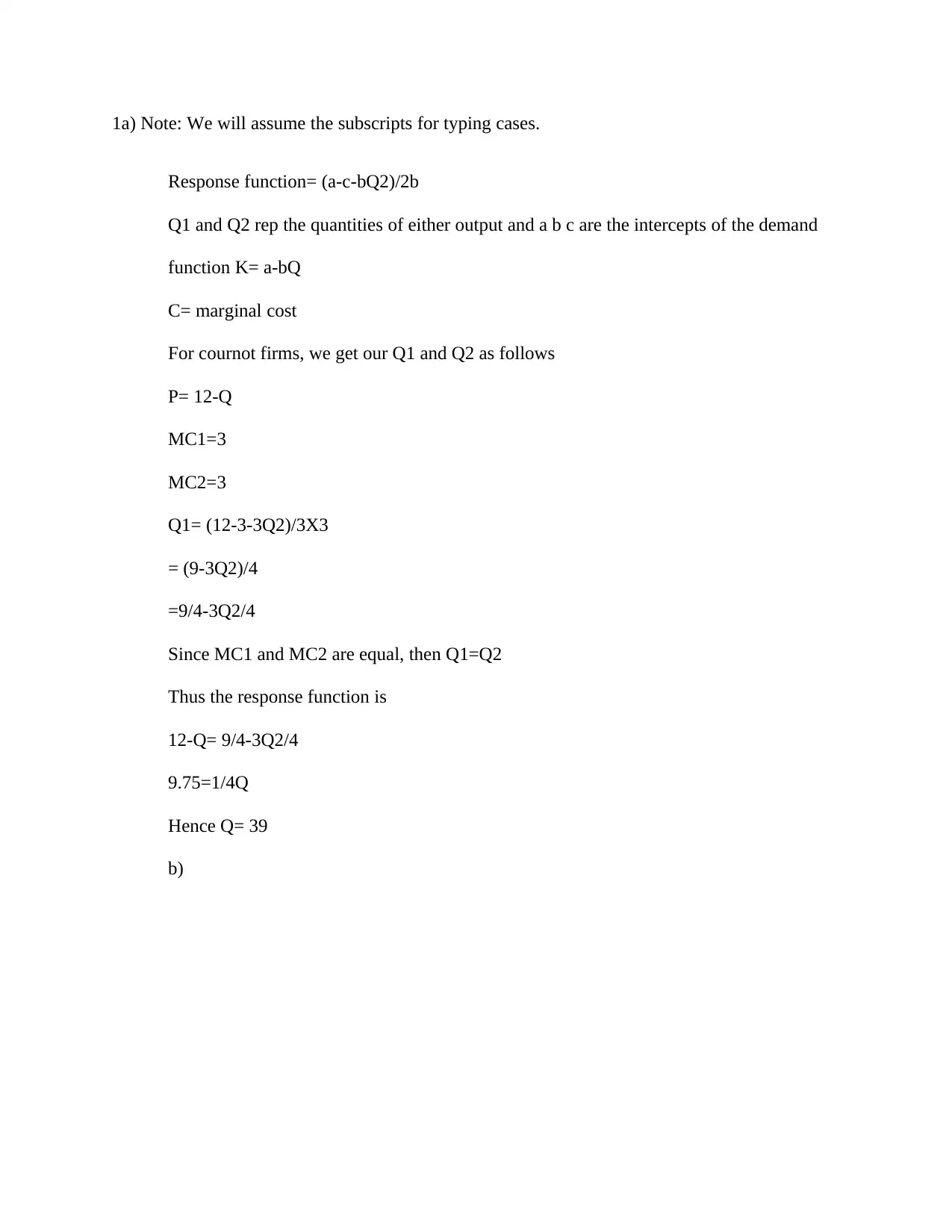
1a) Note: We will assume the subscripts for typing cases.
Response function= (a-c-bQ2)/2b
Q1 and Q2 rep the quantities of either output and a b c are the intercepts of the demand
function K= a-bQ
C= marginal cost
For cournot firms, we get our Q1 and Q2 as follows
P= 12-Q
MC1=3
MC2=3
Q1= (12-3-3Q2)/3X3
= (9-3Q2)/4
=9/4-3Q2/4
Since MC1 and MC2 are equal, then Q1=Q2
Thus the response function is
12-Q= 9/4-3Q2/4
9.75=1/4Q
Hence Q= 39
b)
tabler-icon-diamond-filled.svg

Paraphrase This Document

Need a fresh take? Get an instant paraphrase of this document with our AI Paraphraser
Document Page
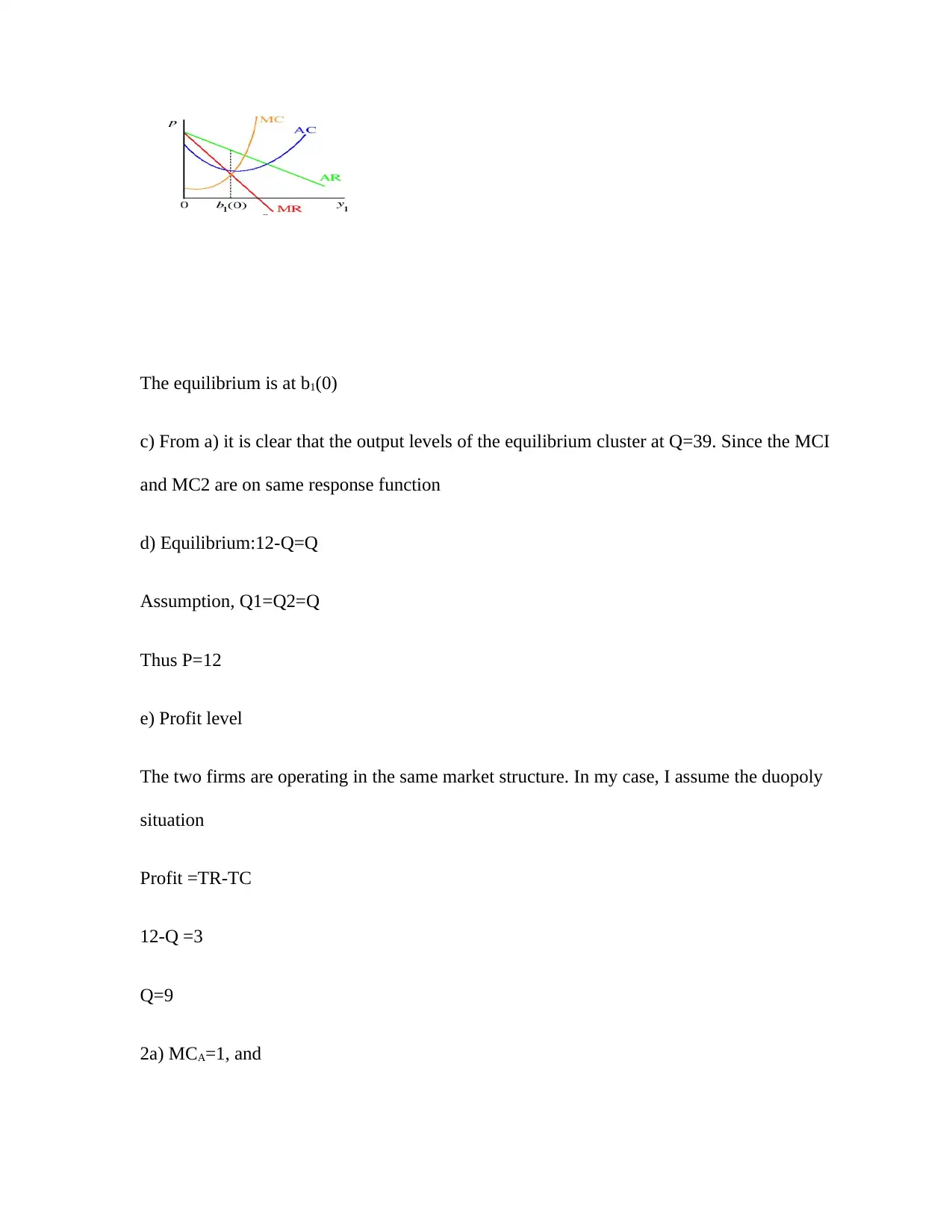
The equilibrium is at b1(0)
c) From a) it is clear that the output levels of the equilibrium cluster at Q=39. Since the MCI
and MC2 are on same response function
d) Equilibrium:12-Q=Q
Assumption, Q1=Q2=Q
Thus P=12
e) Profit level
The two firms are operating in the same market structure. In my case, I assume the duopoly
situation
Profit =TR-TC
12-Q =3
Q=9
2a) MCA=1, and
Document Page
MCB= 2
Q1= (12-Q-Q2)/1X1
= (9-Q2)
Q2= (12-Q-3Q2)/4
=3-Q2
b) For the leader firm A, we use: Q1= (9-Q2)
And for follower=3-Q2,
For A and B, it follows that:
(9-Q2)+ (3-Q2) =12-Q, But Q=9, Thus,
(9-Q2)+ (3-Q2) =12-9
(9-Q2)+ (3-Q2) =3
C) Profit level:
Profit =TR-TC
For firm A: 12-Q =1
Q=13
For firm B: 12-Q =2
Q=14
Document Page
d)ATC = qs + 3 + 36/qs = 2qs + 3 = MC
36/qs = qs
36 = qs, on square root, 6 = qs
3a) let aggregate market demand for boxes p = 12 − Q/2, p=price per box and Q=number of
boxes sold.
Case1: A undercuts B on setting pA = cB −= 8 −, is a small number.
Firm B sets pB = cB = $8.
Consumers purchase brandA only,
Thus, solving 8 = 12 − qA/2 givesqA = 8 and qB = 0.
ProfitsπA = (8 − 6)8 = $16,πB = 0.
Case2: A sets a monopoly price.
MR = 12 − qA = cA = 6 yields qA = 6.
p = 12 − 6/2 = $8 > $8 = pB.
Firm A would not charge its monopoly price.
Hence Nash-Bertrand equilibrium: p b A = $8 − and p b B = $8.
Equilibrium profits: π b A = (8 − 6)8 = $16, π b B = 0.
b) We check where A undercuts B on setting pA = cB − = 8 −, is small number. B sets pB =
cB = $8. Consumers, buy brand A only, solving
tabler-icon-diamond-filled.svg

Paraphrase This Document

Need a fresh take? Get an instant paraphrase of this document with our AI Paraphraser
Document Page
8 = 12 − qA/2 gives qA = 8 and qB = 0.
Profits πA = (8 − 2)8 = $48 and πB = 0.
Case 2 to be checked when A has monopoly price.
MR = 12 − qA = cA = 2 results to qA = 10.
p = 12 − 10/2 = $7 < $8 = pB.
πA = (7 − 2)10 = $50 > $48.
c) The Nash-Bertrand equilibrium is p b A = $7 and p b B = $8,
Equilibrium profit π b A = (7 − 2)10 = $50 and π b B = 0.
4a) q b A = 100 − 2 · 56 = 44 = 112 and
q bB = 180 − 2 · 44 + 56 = 88.
Thus, π b A = 56 · 112 = $6272 and
π b B = 44 · 88 = $3872. Finally, aggregate industry profit is: Πb = π b A + π b B = $10, 144.
b) 100-4t=Q, so Q=20, P=20,
1-t, P=MC, so 20=4+4q, so q=4
T is a variable to be depended on since it marks the VHS extinct
chevron_up_icon
1 out of 5
circle_padding
hide_on_mobile
zoom_out_icon
[object Object]