Economics Assignment: Analyzing Economic Policies and Market Dynamics

Verified

Added on  2020/05/04

|4
|704
|61
Homework Assignment
AI Summary
This economics assignment explores several key economic concepts and policies. It begins by analyzing the arguments for and against a sugar tax, examining its potential impact on consumer behavior and market dynamics. The assignment then delves into Keynesian economics, discussing its relevance during economic downturns and the role of government spending. It further addresses the use of fiscal policy, including automatic stabilizers and discretionary changes, and how they influence macroeconomic performance. Additionally, the assignment examines the effectiveness of monetary policy in stimulating economic growth and compares it to fiscal policy. The solution demonstrates a clear understanding of these economic principles, offering insightful analysis and well-supported arguments.
Document Page
Questions
Name
Institution
Page 1 of 4
tabler-icon-diamond-filled.svg

Paraphrase This Document

Need a fresh take? Get an instant paraphrase of this document with our AI Paraphraser
Document Page
Part 1:
Arguing For: The government must impose a tax on sugar to shift the consumption
towards a healthier diet. Tax will decrease demand thereby making “alternatives” more
appealing and higher price will change individuals spending and eating habits over time.
Sugar soft drinks create externality as it contributes to obesity. Because obesity is external
cost, tax makes people pay full social cost.
Arguing Against: The government should never interfere with the consumers’
choices by imposing the tax on sugar. Since sugar is a basic commodity, imposing tax will
increase the price yet consumer will still buy. This will harm the consumers as the budget
will be restrained due to the extra costs. The government should know that sugar has a fairly
inelastic demand. Therefore, taxing sugar will only lead to increased consumer burden. The
producers will pass the cost or shift the burden to final users of the product.
Page 2 of 4
Document Page
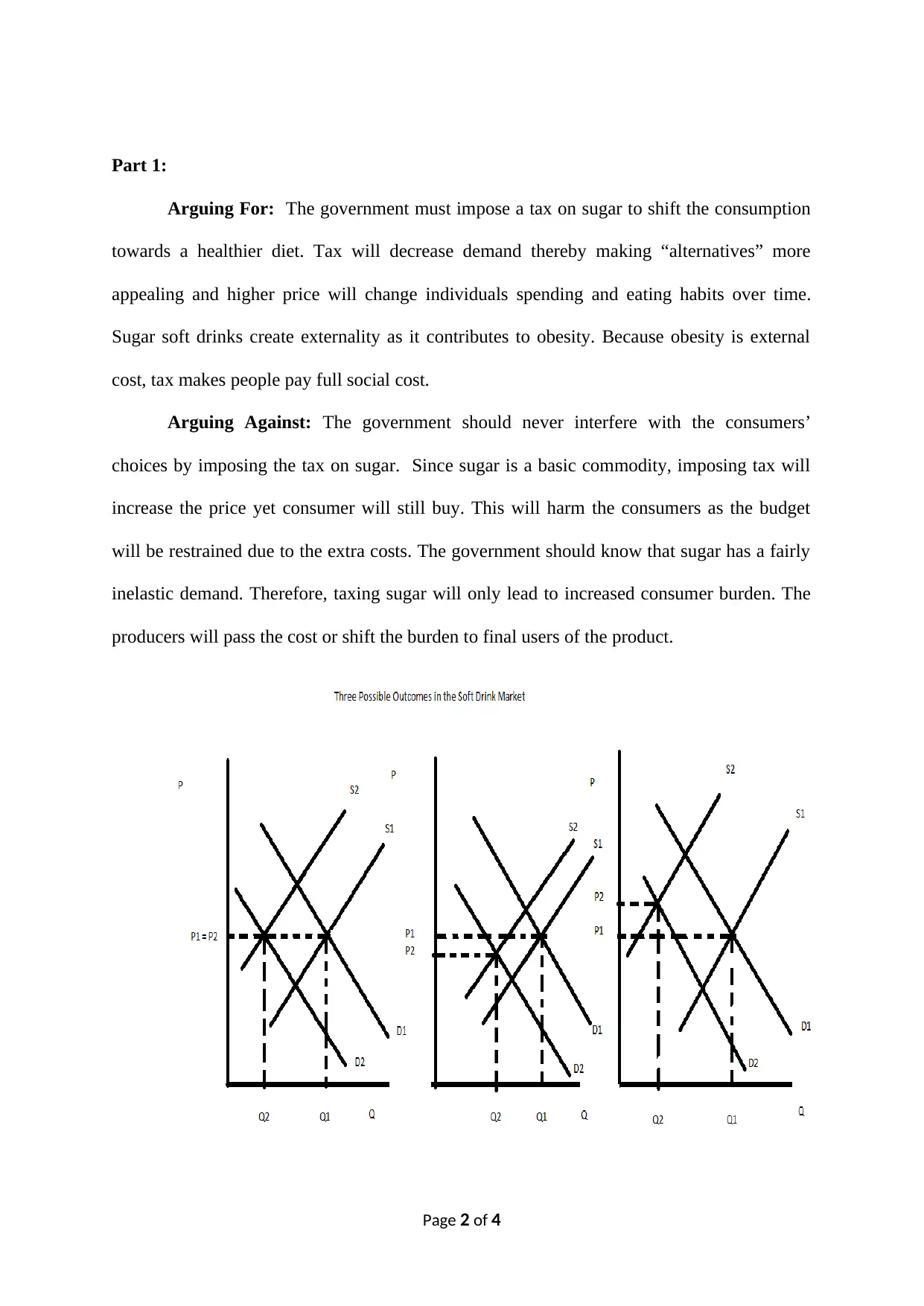
The above diagram shows three possible ways in which sugar tax will affect the soft
drink market. The market demand curvature will shift to the left and the supply curvature will
shift to leftwards too; the equilibrium quantity will drop and equilibrium price could increase;
fall or stay unchanged as seen above.
Part II:
Question (a)
The idea is based effective demand failure whereby the private is not spending
adequate money. Thus Keynes postulated the simple idea that where people are not spending,
there is no way for the economy to adjust automatically. And during great depression, no
person had figured out how to get individuals spending again. The Keynesian prescription is
that where all else fails, the government can spend money. Thus the idea is that if private
sector will not do it, then the public sector can as a fill-in stopgap.
Question (b)
This is because of the automatic stabilizers which increase budget deficits during the
recessions without new legislation by enacting countercyclical policy without the lags linked
with legislative policy changes. Such stabilizer as corporate profits tax will decline during
recessions. Progress income tax-many people fall into lower tax bracket during recession or
have no tax liability which increases the government budget deficit size and lowers surplus.
An example of discretionary changes include government military expenditure which leads to
increase in budget deficits. A government can pass a novel spending bill which promotes
some cause like green technology which increases budget deficit.
Question (c)
The fiscal contractions will improve the macroeconomic performance through
minimization of wasteful government programs. The saved spending that would otherwise be
wasted can be used in development of other sectors hence a boost in the macroeconomic
Page 3 of 4
Document Page
performance. The government will the contractionary fiscal policy to reduce inflation which
would have been otherwise hiked by the wasteful government spending. In this case, there
will be decrease in government spending on the wasteful spending thus reducing the inflation.
The indirect effect resulting from reduced inflation is the creation of conducive environment
to do business which then translates to improved macroeconomic performance.
Question (d)
Monetary policy can be used to create economic stimulus in a more effective manner
than fiscal policy where the government stimulates the economy financially. The government
uses the monetary changes to kick-start economic growth. Lower interest rates and
quantitative easing policies lead to stimulus package (economic measures intended to
stimulate the struggling economy). The main objective of the resulting stimulus package is
the reinvigoration of economy as well as the prevention or reversal of the recession by
increasing spending and employment. The monetary policy is effective than the fiscal
policies. The risk of fiscal policy stimulus spending is that consumers will internalize the
government expenditure decisions in a manner which counterbalance the present stimulus
measures. The consumers might end up spending less today where they believe they would
be paying higher taxes to cover the deficits of the government.
Page 4 of 4
chevron_up_icon
1 out of 4
circle_padding
hide_on_mobile
zoom_out_icon
[object Object]