Economics for Managers Assignment: Goods, Taxes, and Subsidies
VerifiedAdded on 2022/12/23
|13
|2587
|81
Homework Assignment
AI Summary
This economics assignment delves into the core concepts of microeconomics, exploring the distinction between luxury and necessity goods, the impact of taxation and subsidies on market behavior, and the implications of government interventions. The assignment begins by differentiating between luxury and necessity goods, analyzing their income elasticity of demand, and discussing the tax revenue implications of each. It then examines Adam Smith's preferences for taxing luxury goods and objects of universal consumption. A significant portion of the assignment focuses on the effects of a sugar tax, including potential impacts on consumer behavior (such as increased consumption of salt and decreased consumption of fruits and vegetables), the costs involved, and the concept of deadweight loss. The assignment also explores the economic effects of subsidies, specifically on salads, and analyzes the short-run and long-run impacts of a sugar tax on both the market and individual firms in a perfectly competitive environment. The student provides graphs and figures to illustrate the concepts.

ECONOMICS 1
Economics for Manager
By (Name)
Course
Instructor’s Name
Institutional Affiliation
The City and State
The Date
Economics for Manager
By (Name)
Course
Instructor’s Name
Institutional Affiliation
The City and State
The Date
Paraphrase This Document
Need a fresh take? Get an instant paraphrase of this document with our AI Paraphraser

ECONOMICS 2
Question one
Difference between a necessity and a luxury good
Luxury goods
Considering the consumer theory, a luxury good is known as a product whose demand
increases more than an increase in income such that its cost is greater than the entire spending.
Luxury goods are different from necessity goods, in that demand rises proportionally not like the
level of income. The income elasticity of demand for luxury goods is higher as compared to
necessity goods. In this case, the accumulation people’s wealth leads to an increase in the
purchase of luxury goods. For many years, the market for luxury goods has been increasing apart
from some setbacks that lead to crisis. Luxury products perform well by contributing high
revenue to the country. In 2000, the market for luxury goods across the world such as fashions,
fragrances, luggage, habits such as tobacco, alcohol, daily essentials that is to say; water and
electricity, and important medication was over one hundred seventy million dollars which rise to
7.9% (Fletcher et al 2010).
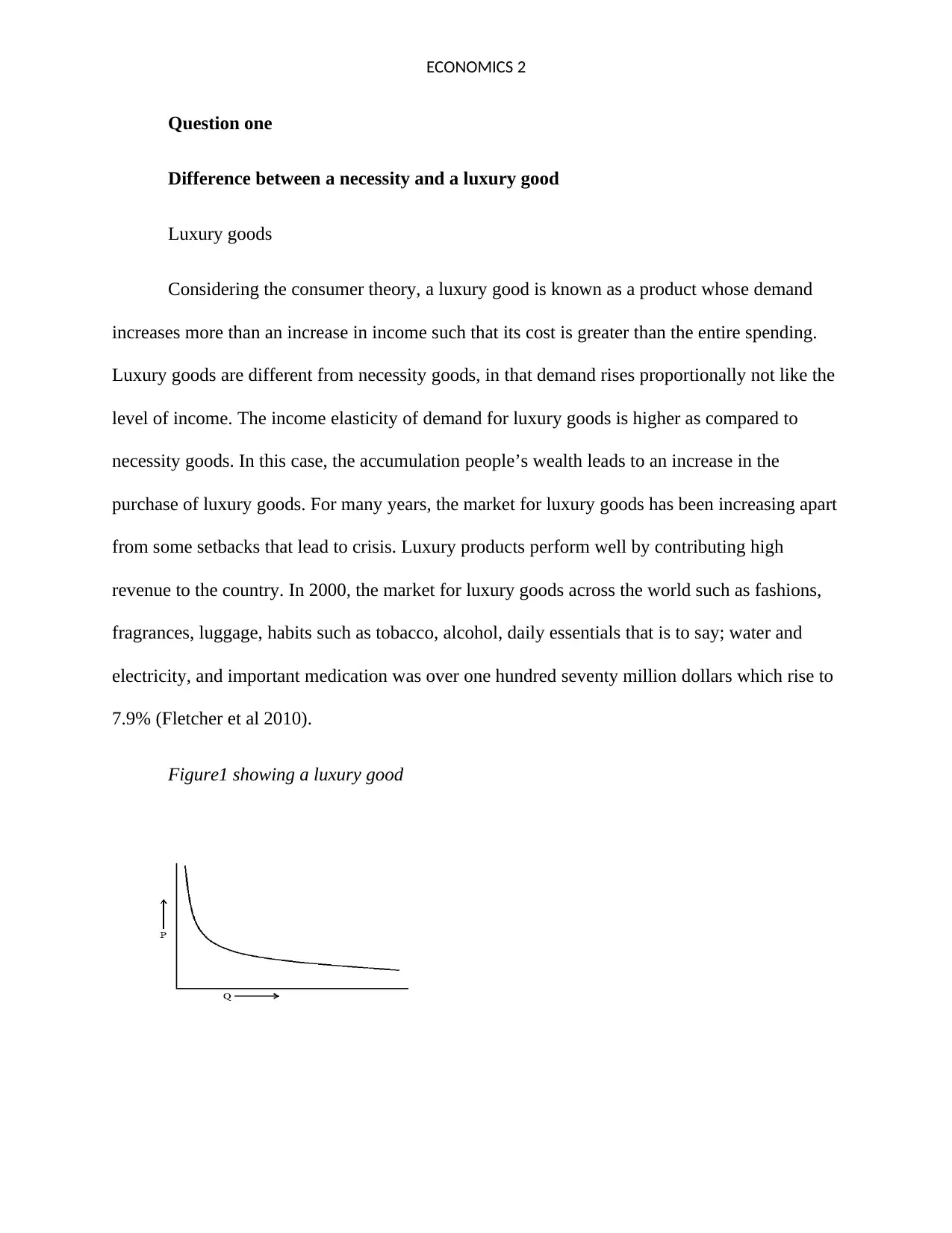
Figure1 showing a luxury good
Question one
Difference between a necessity and a luxury good
Luxury goods
Considering the consumer theory, a luxury good is known as a product whose demand
increases more than an increase in income such that its cost is greater than the entire spending.
Luxury goods are different from necessity goods, in that demand rises proportionally not like the
level of income. The income elasticity of demand for luxury goods is higher as compared to
necessity goods. In this case, the accumulation people’s wealth leads to an increase in the
purchase of luxury goods. For many years, the market for luxury goods has been increasing apart
from some setbacks that lead to crisis. Luxury products perform well by contributing high
revenue to the country. In 2000, the market for luxury goods across the world such as fashions,
fragrances, luggage, habits such as tobacco, alcohol, daily essentials that is to say; water and
electricity, and important medication was over one hundred seventy million dollars which rise to
7.9% (Fletcher et al 2010).
Figure1 showing a luxury good

ECONOMICS 3
https://www.economicshelp.org/blog/790/economics/different-types-of-goods-inferior-
normal-luxury/
Necessity goods
Necessary goods are services and products that the consumers purchase despite the
changes in the people's level of income. Therefore, necessity products are made less sensitive to
the change in income. Examples of necessity goods include, food, utilities, communication,
housing, transport, medicine, education, and many others. For normal goods, the rise in the
income greatly leads to the rise in the demand, but an increase in necessity goods is not directly
proportional to an increase in income. Therefore, the proportional expenditure on necessity
goods declines as the income rises. During a recession, necessity goods do not decline much in
their demand as compared to luxury goods. The economic theory explains that necessity goods
can be demanded more during a recession as most of the customers drop the purchase of luxuries
so as to acquire more basic substitutes. In many nations, necessity goods are not taxed
(Chaloupka et al 2015).
Figure 2: showing necessity goods
https://www.economicshelp.org/blog/790/economics/different-types-of-goods-inferior-
normal-luxury/
Necessity goods
Necessary goods are services and products that the consumers purchase despite the
changes in the people's level of income. Therefore, necessity products are made less sensitive to
the change in income. Examples of necessity goods include, food, utilities, communication,
housing, transport, medicine, education, and many others. For normal goods, the rise in the
income greatly leads to the rise in the demand, but an increase in necessity goods is not directly
proportional to an increase in income. Therefore, the proportional expenditure on necessity
goods declines as the income rises. During a recession, necessity goods do not decline much in
their demand as compared to luxury goods. The economic theory explains that necessity goods
can be demanded more during a recession as most of the customers drop the purchase of luxuries
so as to acquire more basic substitutes. In many nations, necessity goods are not taxed
(Chaloupka et al 2015).
Figure 2: showing necessity goods
⊘ This is a preview!⊘
Do you want full access?
Subscribe today to unlock all pages.

Trusted by 1+ million students worldwide

ECONOMICS 4
http://www.writeopinions.com/necessity-good
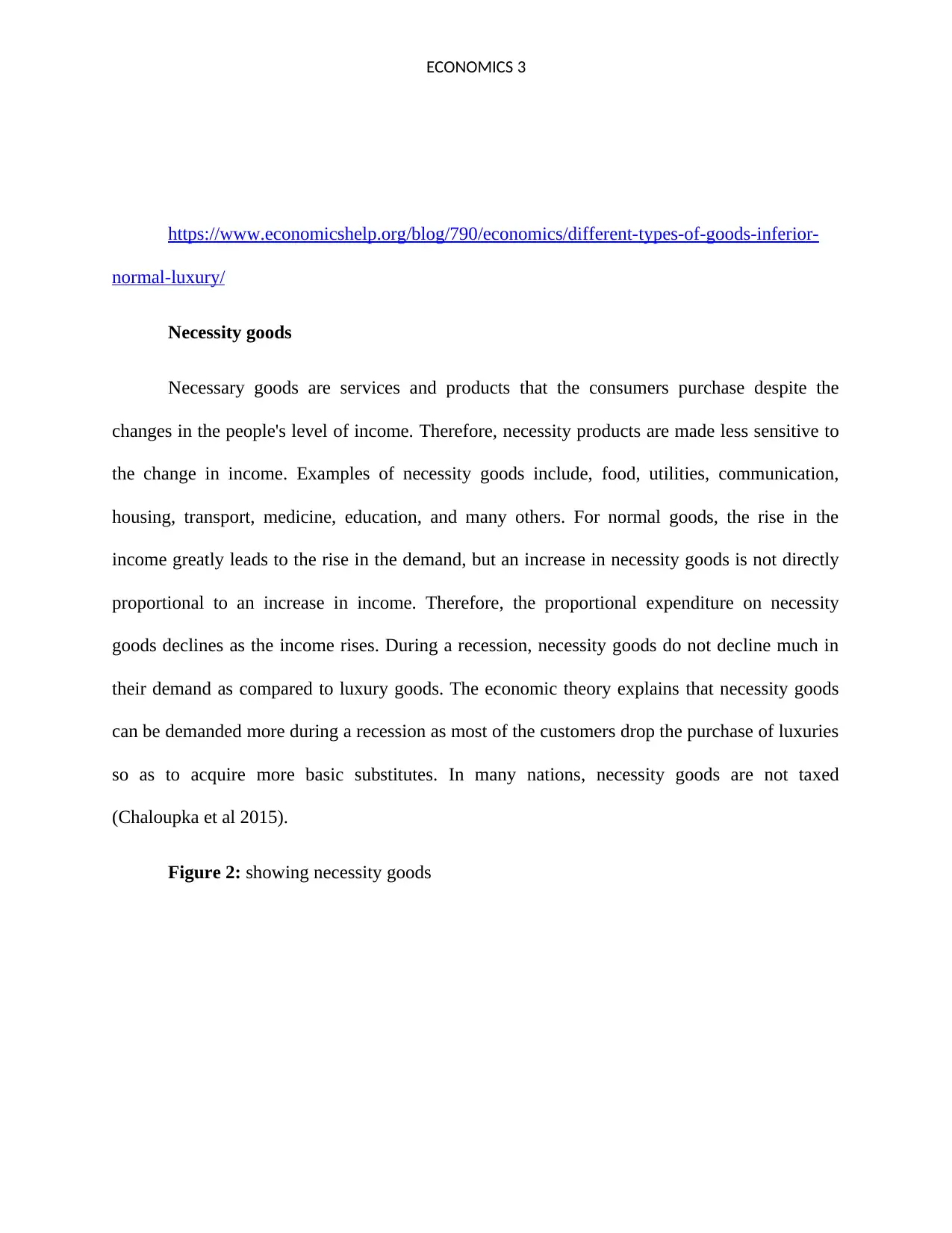
As the income increases, the demand for the commodity also increases
The difference in the tax revenue obtained from a tax imposed on necessity versus a
luxury good
In most cases, tax revenue obtained from luxury goods is less compared to that of
necessity goods. In this case, when the government imposes a tax on luxury goods, most people
tend to stop consuming the goods because they are always expensive and intend to go for the
most required goods. However, for necessity goods, people will never stop purchasing them
despite the imposition of the tax because they need them. Therefore, if the goods used by all
people are taxed, much revenue is obtained. For luxury goods, they are purchased by a few rich
people which fetches considerable a low revenue to the government. Considering the "income
elasticity of demand", it illustrates the shift in the demand curve in the response of income
changes (World Health Organ 2016).
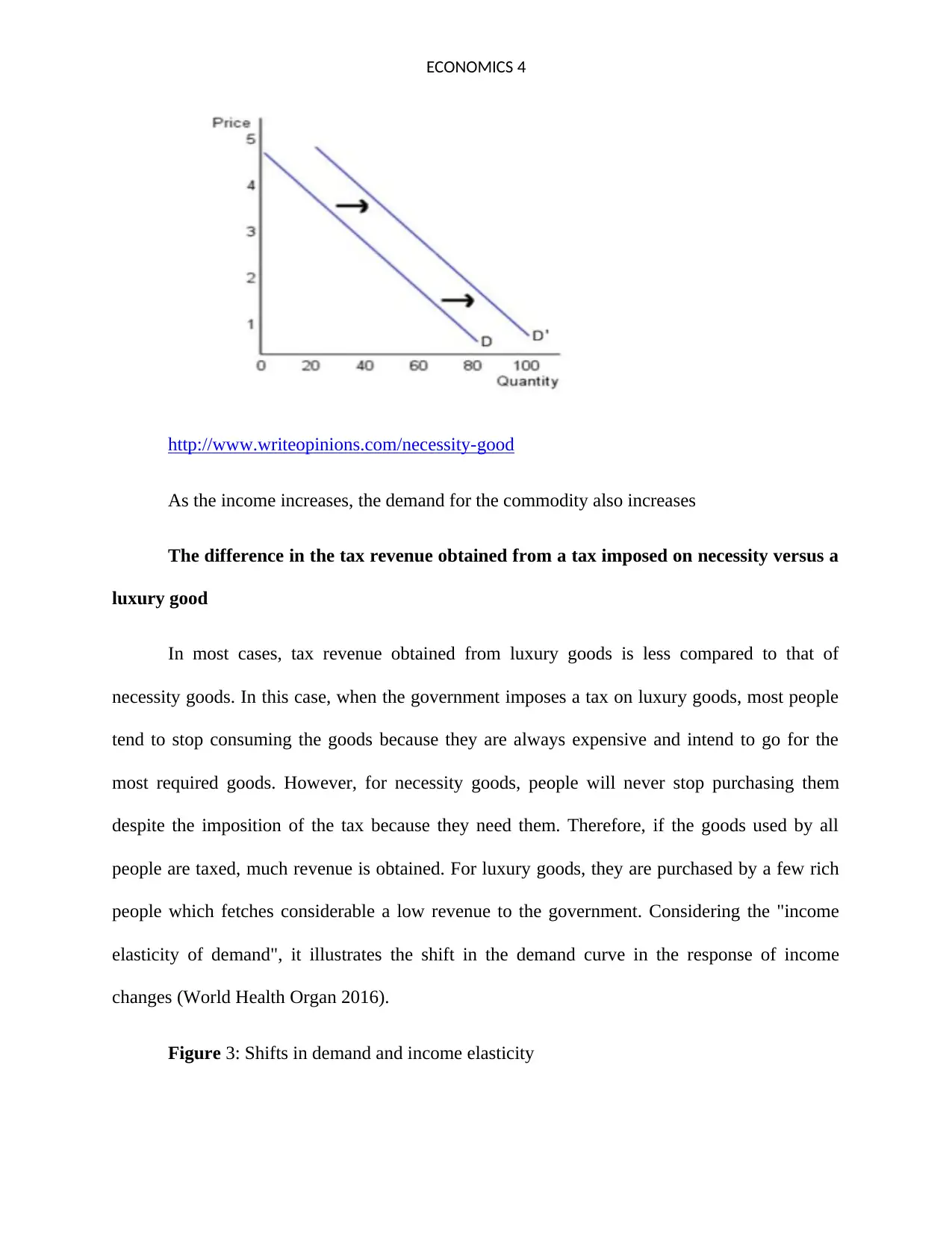
Figure 3: Shifts in demand and income elasticity
http://www.writeopinions.com/necessity-good
As the income increases, the demand for the commodity also increases
The difference in the tax revenue obtained from a tax imposed on necessity versus a
luxury good
In most cases, tax revenue obtained from luxury goods is less compared to that of
necessity goods. In this case, when the government imposes a tax on luxury goods, most people
tend to stop consuming the goods because they are always expensive and intend to go for the
most required goods. However, for necessity goods, people will never stop purchasing them
despite the imposition of the tax because they need them. Therefore, if the goods used by all
people are taxed, much revenue is obtained. For luxury goods, they are purchased by a few rich
people which fetches considerable a low revenue to the government. Considering the "income
elasticity of demand", it illustrates the shift in the demand curve in the response of income
changes (World Health Organ 2016).
Figure 3: Shifts in demand and income elasticity
Paraphrase This Document
Need a fresh take? Get an instant paraphrase of this document with our AI Paraphraser

ECONOMICS 5
Source: http://www.opentextbooks.org.hk/ditatopic/38813
At point P0, income elasticity is measured horizontally to the shift in the demand as a
result of an increase in income. A shift from B illustrates a low income as compared to C. For a
luxury good, its income exceeds the unity, whereas the income elasticity of necessity goods is
below the unit. This implies that the budget for luxury products is high compared to that of
necessity goods because its level of income elasticity is higher than the unit. Therefore, luxury
goods will be purchased by few people because their prices are high hence contributing less tax
revenue to the government whereas necessity goods will contribute high tax revenue because
their prices are low and consumption is high (Fletcher et al 2010).
Question two
Why Adam Smith preferred to impose a tax on luxury goods?
I think Adam Smith preferred to impose a tax on luxury goods with the following
intention or reasons, first reducing the rate of income inequality among the people in the area.
Smith might have thought out that it was the right solution of reducing income inequality in the
short run. So, he might have wanted to break down the level of monopolies on various luxuries.
Source: http://www.opentextbooks.org.hk/ditatopic/38813
At point P0, income elasticity is measured horizontally to the shift in the demand as a
result of an increase in income. A shift from B illustrates a low income as compared to C. For a
luxury good, its income exceeds the unity, whereas the income elasticity of necessity goods is
below the unit. This implies that the budget for luxury products is high compared to that of
necessity goods because its level of income elasticity is higher than the unit. Therefore, luxury
goods will be purchased by few people because their prices are high hence contributing less tax
revenue to the government whereas necessity goods will contribute high tax revenue because
their prices are low and consumption is high (Fletcher et al 2010).
Question two
Why Adam Smith preferred to impose a tax on luxury goods?
I think Adam Smith preferred to impose a tax on luxury goods with the following
intention or reasons, first reducing the rate of income inequality among the people in the area.
Smith might have thought out that it was the right solution of reducing income inequality in the
short run. So, he might have wanted to break down the level of monopolies on various luxuries.

ECONOMICS 6
Second, Adam Smith might have wanted to discourage the people from buying the products.
This was though imposing the high tax which in turn increases the cost of the luxury product
which is already expensive. Meaning that the products could only be affordable by a few richer
people (Fletcher et al 2010)
Why Adam Smith preferred a tax on ‘objects of almost universal consumption’?
I think Adam Smith preferred to impose a tax on "object of almost universal
consumption" so as to reduce the demand for such products. In this case, Adam Smith might
have believed that higher prices on such luxury products would prevent the consumer from
purchasing them. In addition, he might have thought that the imposition of the tax could curb
down relapse among people with quit and also reduce their consumption among daily users
(Long et al, 2015).
Question three
Why a tax on sugary drinks ‘lead to people eating fewer fruit and vegetables and
more salt’
A tax on sugary drinks such as vegetable and fruits will lead to the rise in the prices of
goods. As the prices increase people will find it very difficult to consume expensive products
then opt for cheap products that is to say salt. Moreso, the salt will act as a substitute for
vegetables and fruits. Therefore, the cross elasticity of demand for the substitute is positive. This
can be explained by "cross-elasticity of demand" which measures the quantity of demand of a
given good in the relation to price changes of another commodity caused by various factors such
as taxation (Long et al, 2015).
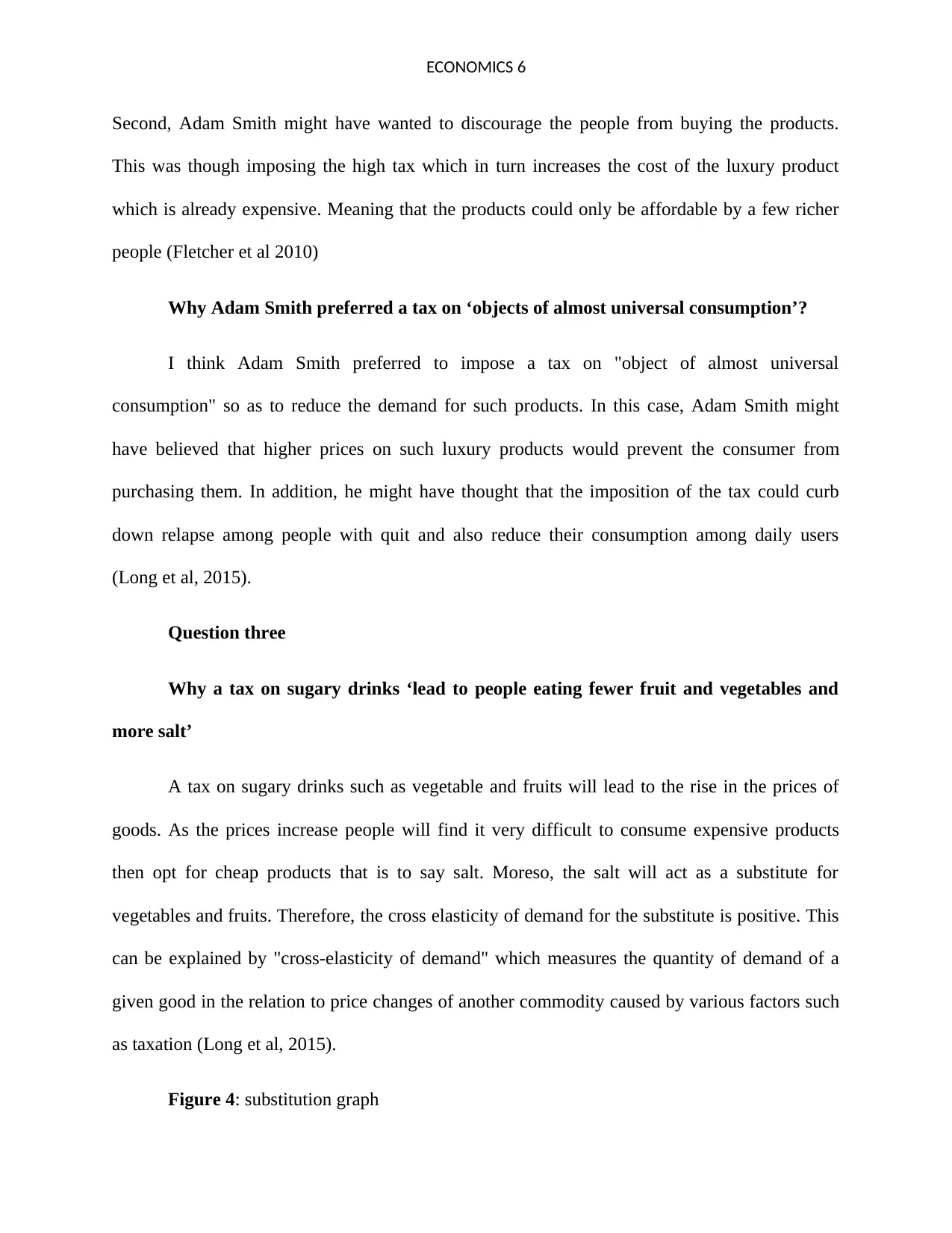
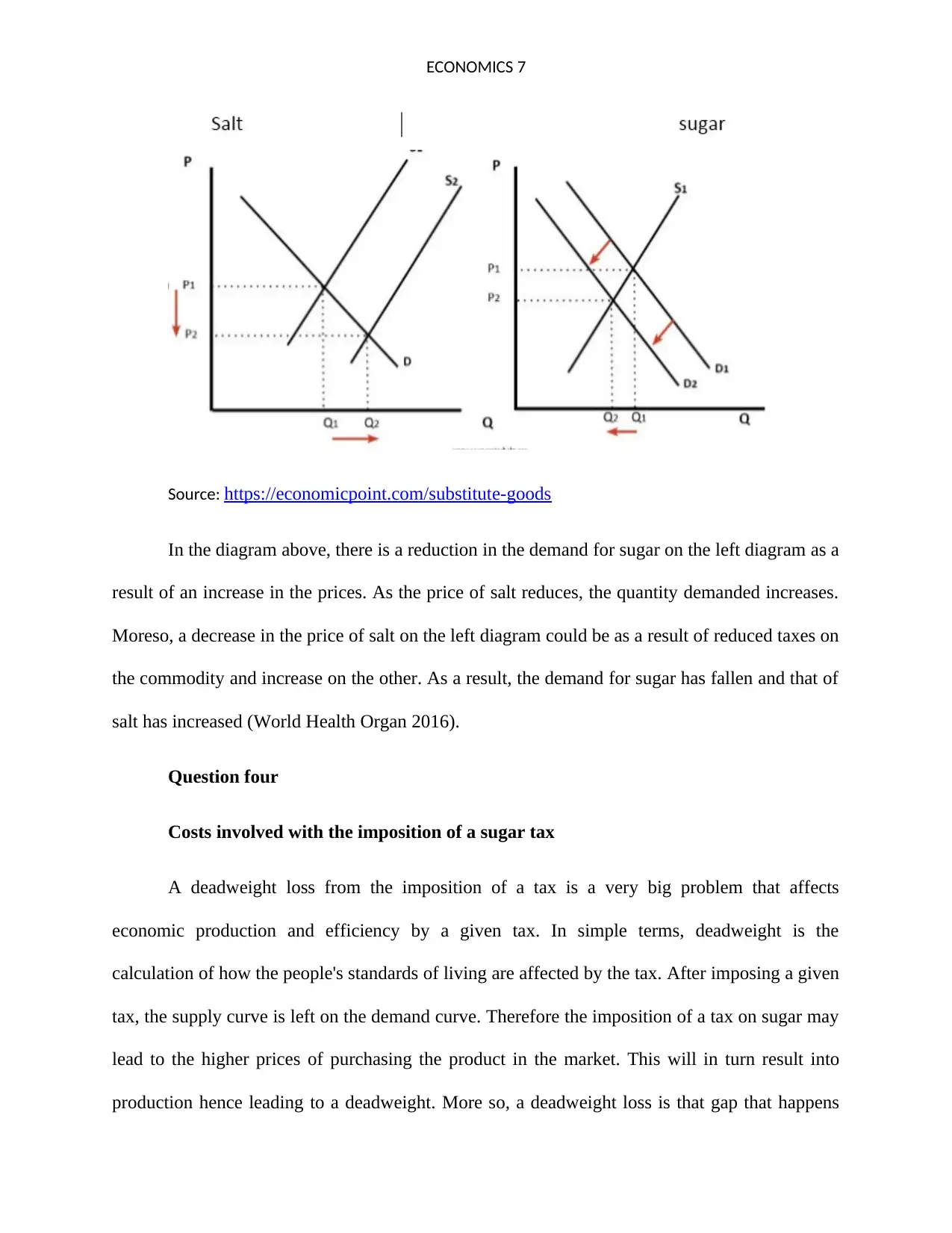
Figure 4: substitution graph
Second, Adam Smith might have wanted to discourage the people from buying the products.
This was though imposing the high tax which in turn increases the cost of the luxury product
which is already expensive. Meaning that the products could only be affordable by a few richer
people (Fletcher et al 2010)
Why Adam Smith preferred a tax on ‘objects of almost universal consumption’?
I think Adam Smith preferred to impose a tax on "object of almost universal
consumption" so as to reduce the demand for such products. In this case, Adam Smith might
have believed that higher prices on such luxury products would prevent the consumer from
purchasing them. In addition, he might have thought that the imposition of the tax could curb
down relapse among people with quit and also reduce their consumption among daily users
(Long et al, 2015).
Question three
Why a tax on sugary drinks ‘lead to people eating fewer fruit and vegetables and
more salt’
A tax on sugary drinks such as vegetable and fruits will lead to the rise in the prices of
goods. As the prices increase people will find it very difficult to consume expensive products
then opt for cheap products that is to say salt. Moreso, the salt will act as a substitute for
vegetables and fruits. Therefore, the cross elasticity of demand for the substitute is positive. This
can be explained by "cross-elasticity of demand" which measures the quantity of demand of a
given good in the relation to price changes of another commodity caused by various factors such
as taxation (Long et al, 2015).
Figure 4: substitution graph
⊘ This is a preview!⊘
Do you want full access?
Subscribe today to unlock all pages.

Trusted by 1+ million students worldwide

ECONOMICS 7
Source: https://economicpoint.com/substitute-goods
In the diagram above, there is a reduction in the demand for sugar on the left diagram as a
result of an increase in the prices. As the price of salt reduces, the quantity demanded increases.
Moreso, a decrease in the price of salt on the left diagram could be as a result of reduced taxes on
the commodity and increase on the other. As a result, the demand for sugar has fallen and that of
salt has increased (World Health Organ 2016).
Question four
Costs involved with the imposition of a sugar tax
A deadweight loss from the imposition of a tax is a very big problem that affects
economic production and efficiency by a given tax. In simple terms, deadweight is the
calculation of how the people's standards of living are affected by the tax. After imposing a given
tax, the supply curve is left on the demand curve. Therefore the imposition of a tax on sugar may
lead to the higher prices of purchasing the product in the market. This will in turn result into
production hence leading to a deadweight. More so, a deadweight loss is that gap that happens
Source: https://economicpoint.com/substitute-goods
In the diagram above, there is a reduction in the demand for sugar on the left diagram as a
result of an increase in the prices. As the price of salt reduces, the quantity demanded increases.
Moreso, a decrease in the price of salt on the left diagram could be as a result of reduced taxes on
the commodity and increase on the other. As a result, the demand for sugar has fallen and that of
salt has increased (World Health Organ 2016).
Question four
Costs involved with the imposition of a sugar tax
A deadweight loss from the imposition of a tax is a very big problem that affects
economic production and efficiency by a given tax. In simple terms, deadweight is the
calculation of how the people's standards of living are affected by the tax. After imposing a given
tax, the supply curve is left on the demand curve. Therefore the imposition of a tax on sugar may
lead to the higher prices of purchasing the product in the market. This will in turn result into
production hence leading to a deadweight. More so, a deadweight loss is that gap that happens
Paraphrase This Document
Need a fresh take? Get an instant paraphrase of this document with our AI Paraphraser

ECONOMICS 8
between tax-free production and taxed production volumes. The government imposition of a tax
on sugar products will lead to the distortion of the current market and the distribution of
resources. This may lead to the shifting of the limited resources from optimal use as a result of
high taxation to light taxed activities which are at times disadvantageous (World Health Organ
2016).
If the sugar tax is levied on the buyers, the demand curve will move downwards in
regards to the tax. Also, if the sugar tax is levied on the suppliers, the supply curve will have to
move upwards depending on the amount of a tax imposed. In this case, if the tax will be
imposed, the buyers will pay much for sugar and the sellers will receive fewer prices. Therefore,
the sellers and buyers of sugar products will face the loss irrespective of the mode of imposition.
But the producer will be affected more as their sales will reduce. In simple terms, the imposition
of the tax on sugar products will lead to a reduction or decrease in the market capacity (World
Health Organ 2016).
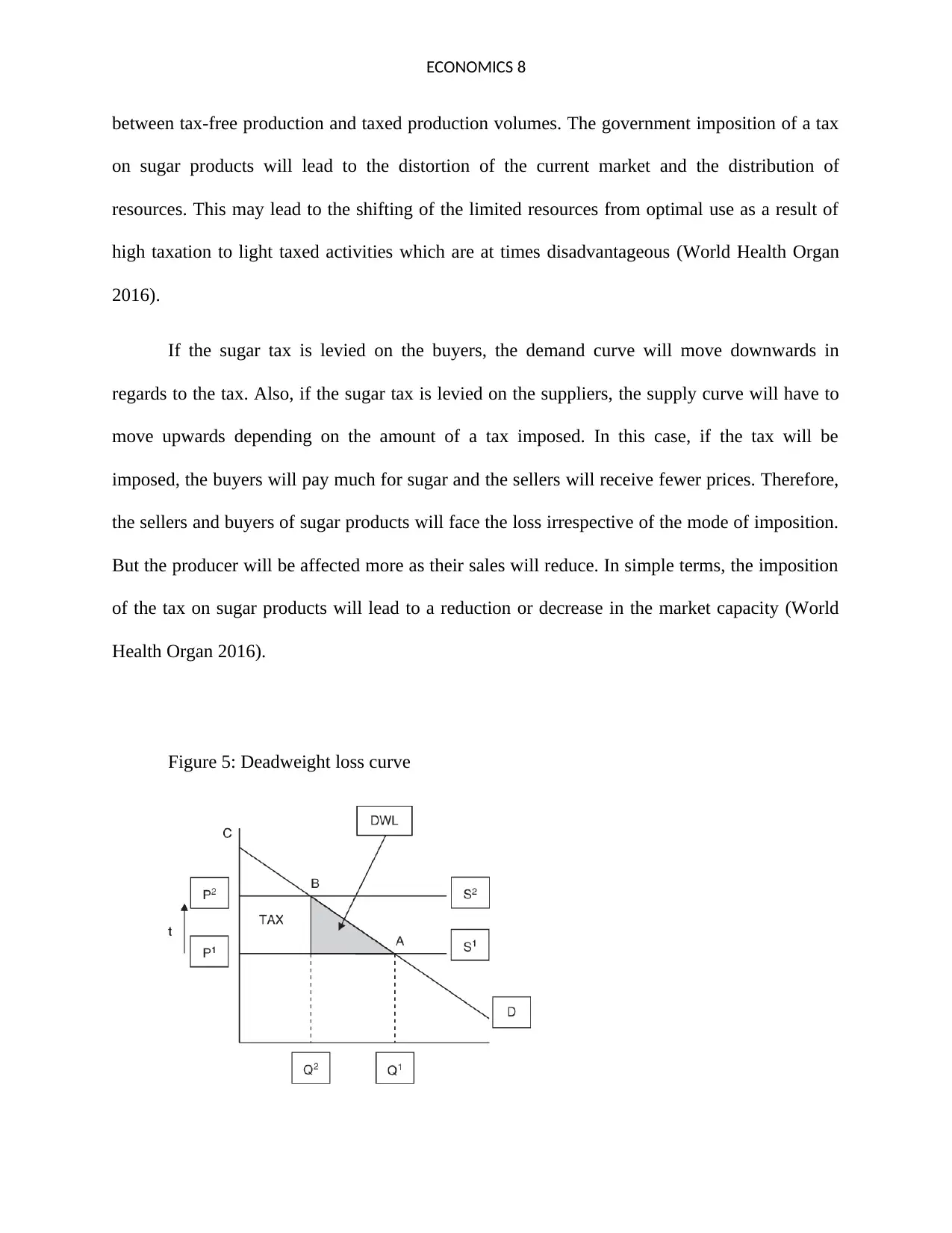
Figure 5: Deadweight loss curve
between tax-free production and taxed production volumes. The government imposition of a tax
on sugar products will lead to the distortion of the current market and the distribution of
resources. This may lead to the shifting of the limited resources from optimal use as a result of
high taxation to light taxed activities which are at times disadvantageous (World Health Organ
2016).
If the sugar tax is levied on the buyers, the demand curve will move downwards in
regards to the tax. Also, if the sugar tax is levied on the suppliers, the supply curve will have to
move upwards depending on the amount of a tax imposed. In this case, if the tax will be
imposed, the buyers will pay much for sugar and the sellers will receive fewer prices. Therefore,
the sellers and buyers of sugar products will face the loss irrespective of the mode of imposition.
But the producer will be affected more as their sales will reduce. In simple terms, the imposition
of the tax on sugar products will lead to a reduction or decrease in the market capacity (World
Health Organ 2016).
Figure 5: Deadweight loss curve

ECONOMICS 9
https://www.intelligenteconomist.com/deadweight-loss/
Explanation: the deadweight loss of imposing of a tax on sugar; there will be an increase
in the amount paid by the consumer to purchase the product p2 and the prices received by the
suppliers will decrease to p1 and the quantity supplied will decline from Q1 to Q2 (Long et al,
2015).
Question five
A subsidy is in terms of financial support or aid that is extended to a given economic
sector by the government with the intention of promoting social and economic policy. In this
case, the government should impose a subsidy on salads so as to reduce their prices. Further, the
implementation of a subsidy on salads will encourage the suppliers to supply more of the product
to the market as the losses or costs of production are reduced. The imposition of the subsidy will
expand the production of salads and the market will be promoted without prices affecting the
final consumer (Andreyeva, Long, &Brownell, 2010).
However, the imposition of a subsidy on salads will lead to a number of problems to the
market of the product that is to say; it will to depressing global market prices and leads to
overproduction of salads leading to high supply hence reduced prices in the market. Therefore, if
the government imposes a subsidy on salads, more will be produced leading to overhead
expenses to the producers as a result of storing the extra salads (Lind and Granqvist, 2010).
Figure 6: A graph of subsidy
https://www.intelligenteconomist.com/deadweight-loss/
Explanation: the deadweight loss of imposing of a tax on sugar; there will be an increase
in the amount paid by the consumer to purchase the product p2 and the prices received by the
suppliers will decrease to p1 and the quantity supplied will decline from Q1 to Q2 (Long et al,
2015).
Question five
A subsidy is in terms of financial support or aid that is extended to a given economic
sector by the government with the intention of promoting social and economic policy. In this
case, the government should impose a subsidy on salads so as to reduce their prices. Further, the
implementation of a subsidy on salads will encourage the suppliers to supply more of the product
to the market as the losses or costs of production are reduced. The imposition of the subsidy will
expand the production of salads and the market will be promoted without prices affecting the
final consumer (Andreyeva, Long, &Brownell, 2010).
However, the imposition of a subsidy on salads will lead to a number of problems to the
market of the product that is to say; it will to depressing global market prices and leads to
overproduction of salads leading to high supply hence reduced prices in the market. Therefore, if
the government imposes a subsidy on salads, more will be produced leading to overhead
expenses to the producers as a result of storing the extra salads (Lind and Granqvist, 2010).
Figure 6: A graph of subsidy
⊘ This is a preview!⊘
Do you want full access?
Subscribe today to unlock all pages.

Trusted by 1+ million students worldwide

ECONOMICS 10
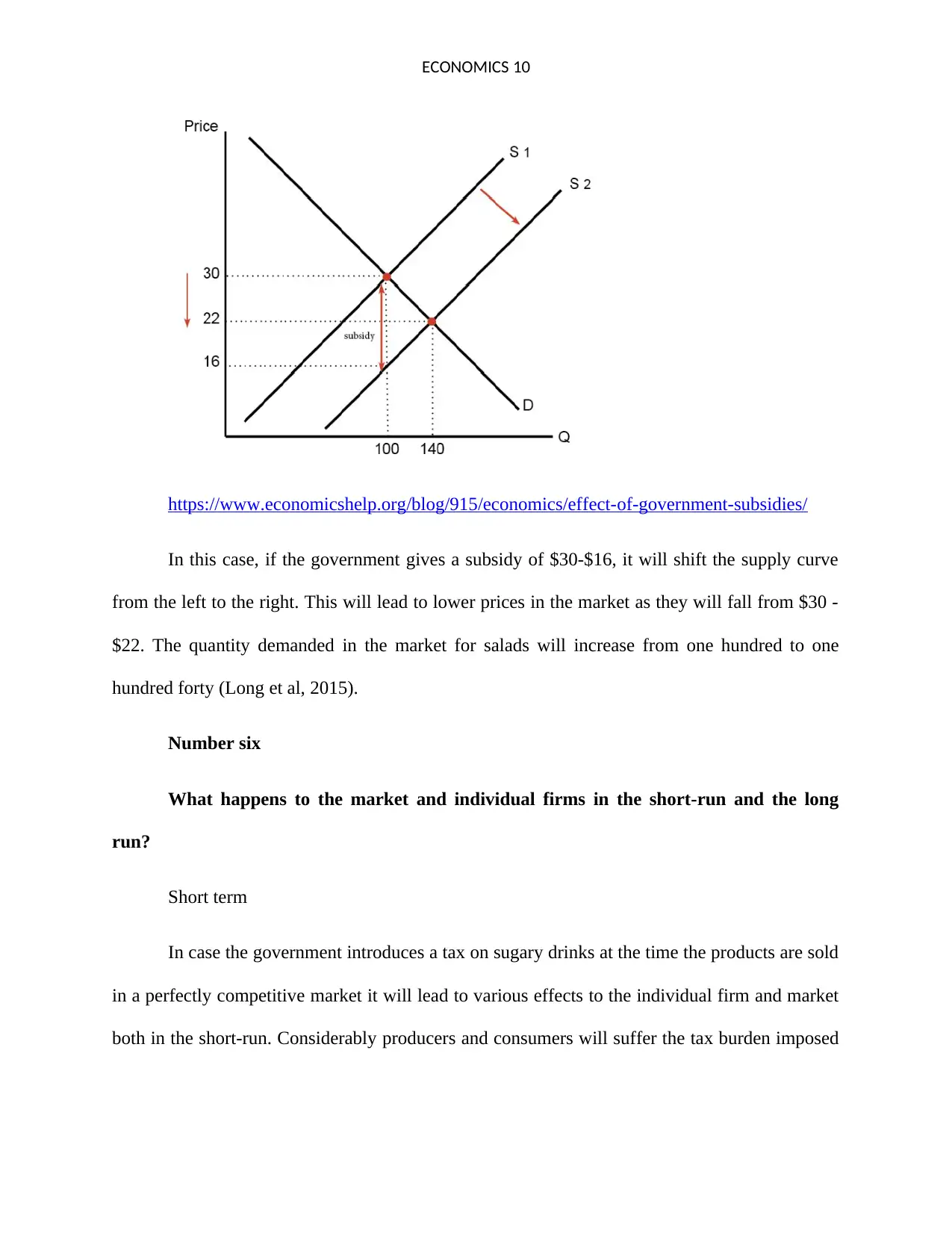
https://www.economicshelp.org/blog/915/economics/effect-of-government-subsidies/
In this case, if the government gives a subsidy of $30-$16, it will shift the supply curve
from the left to the right. This will lead to lower prices in the market as they will fall from $30 -
$22. The quantity demanded in the market for salads will increase from one hundred to one
hundred forty (Long et al, 2015).
Number six
What happens to the market and individual firms in the short-run and the long
run?
Short term
In case the government introduces a tax on sugary drinks at the time the products are sold
in a perfectly competitive market it will lead to various effects to the individual firm and market
both in the short-run. Considerably producers and consumers will suffer the tax burden imposed
https://www.economicshelp.org/blog/915/economics/effect-of-government-subsidies/
In this case, if the government gives a subsidy of $30-$16, it will shift the supply curve
from the left to the right. This will lead to lower prices in the market as they will fall from $30 -
$22. The quantity demanded in the market for salads will increase from one hundred to one
hundred forty (Long et al, 2015).
Number six
What happens to the market and individual firms in the short-run and the long
run?
Short term
In case the government introduces a tax on sugary drinks at the time the products are sold
in a perfectly competitive market it will lead to various effects to the individual firm and market
both in the short-run. Considerably producers and consumers will suffer the tax burden imposed
Paraphrase This Document
Need a fresh take? Get an instant paraphrase of this document with our AI Paraphraser

ECONOMICS 11
on sugary drinks in the short run. Notably, the introduction of a sugar tax will lead to the
increased prices of the products (Bellmann et al 2012).
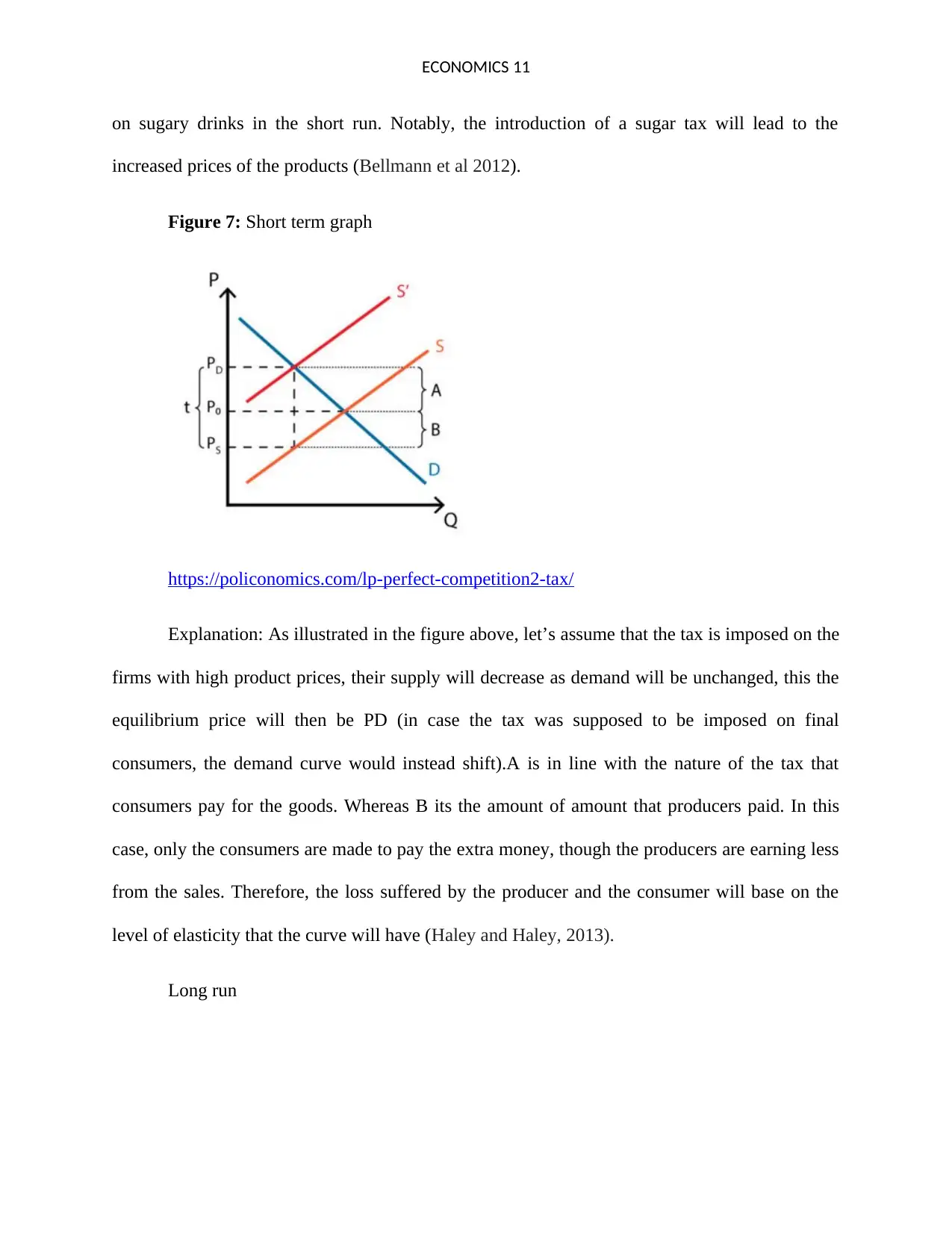
Figure 7: Short term graph
https://policonomics.com/lp-perfect-competition2-tax/
Explanation: As illustrated in the figure above, let’s assume that the tax is imposed on the
firms with high product prices, their supply will decrease as demand will be unchanged, this the
equilibrium price will then be PD (in case the tax was supposed to be imposed on final
consumers, the demand curve would instead shift).A is in line with the nature of the tax that
consumers pay for the goods. Whereas B its the amount of amount that producers paid. In this
case, only the consumers are made to pay the extra money, though the producers are earning less
from the sales. Therefore, the loss suffered by the producer and the consumer will base on the
level of elasticity that the curve will have (Haley and Haley, 2013).
Long run
on sugary drinks in the short run. Notably, the introduction of a sugar tax will lead to the
increased prices of the products (Bellmann et al 2012).
Figure 7: Short term graph
https://policonomics.com/lp-perfect-competition2-tax/
Explanation: As illustrated in the figure above, let’s assume that the tax is imposed on the
firms with high product prices, their supply will decrease as demand will be unchanged, this the
equilibrium price will then be PD (in case the tax was supposed to be imposed on final
consumers, the demand curve would instead shift).A is in line with the nature of the tax that
consumers pay for the goods. Whereas B its the amount of amount that producers paid. In this
case, only the consumers are made to pay the extra money, though the producers are earning less
from the sales. Therefore, the loss suffered by the producer and the consumer will base on the
level of elasticity that the curve will have (Haley and Haley, 2013).
Long run

ECONOMICS 12
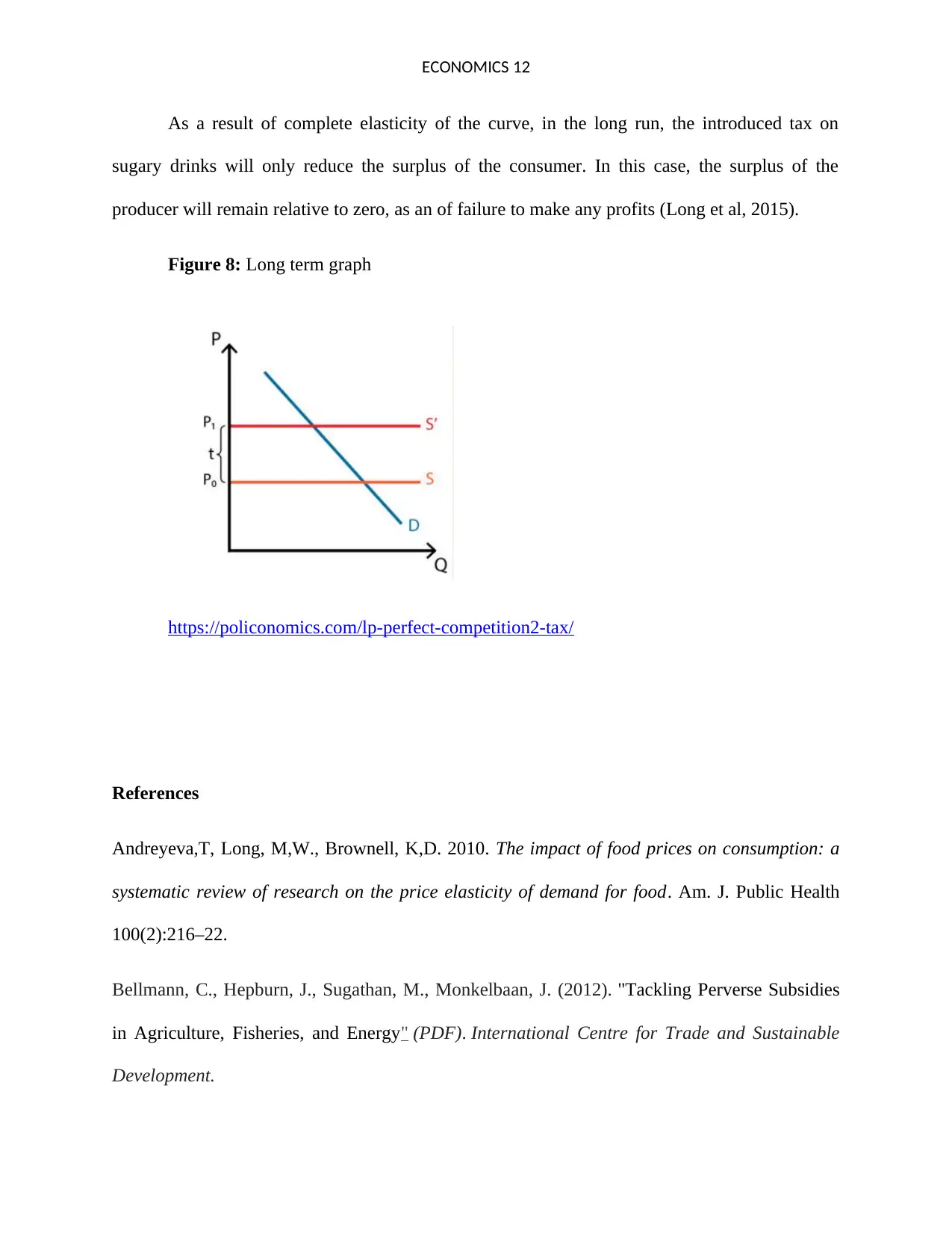
As a result of complete elasticity of the curve, in the long run, the introduced tax on
sugary drinks will only reduce the surplus of the consumer. In this case, the surplus of the
producer will remain relative to zero, as an of failure to make any profits (Long et al, 2015).
Figure 8: Long term graph
https://policonomics.com/lp-perfect-competition2-tax/
References
Andreyeva,T, Long, M,W., Brownell, K,D. 2010. The impact of food prices on consumption: a
systematic review of research on the price elasticity of demand for food. Am. J. Public Health
100(2):216–22.
Bellmann, C., Hepburn, J., Sugathan, M., Monkelbaan, J. (2012). "Tackling Perverse Subsidies
in Agriculture, Fisheries, and Energy" (PDF). International Centre for Trade and Sustainable
Development.
As a result of complete elasticity of the curve, in the long run, the introduced tax on
sugary drinks will only reduce the surplus of the consumer. In this case, the surplus of the
producer will remain relative to zero, as an of failure to make any profits (Long et al, 2015).
Figure 8: Long term graph
https://policonomics.com/lp-perfect-competition2-tax/
References
Andreyeva,T, Long, M,W., Brownell, K,D. 2010. The impact of food prices on consumption: a
systematic review of research on the price elasticity of demand for food. Am. J. Public Health
100(2):216–22.
Bellmann, C., Hepburn, J., Sugathan, M., Monkelbaan, J. (2012). "Tackling Perverse Subsidies
in Agriculture, Fisheries, and Energy" (PDF). International Centre for Trade and Sustainable
Development.
⊘ This is a preview!⊘
Do you want full access?
Subscribe today to unlock all pages.

Trusted by 1+ million students worldwide
1 out of 13
Related Documents
Your All-in-One AI-Powered Toolkit for Academic Success.
+13062052269
info@desklib.com
Available 24*7 on WhatsApp / Email
Unlock your academic potential
Copyright © 2020–2026 A2Z Services. All Rights Reserved. Developed and managed by ZUCOL.