Economics for Business: Record Growth in Australian Agriculture

Verified

Added on  2023/06/13

|7
|1292
|239
Report
AI Summary
This report analyzes the record-breaking growth of the Australian agricultural sector, leveraging a newspaper article and economic theories like supply and demand. The analysis highlights details from the selected article, addresses stakeholder issues, and offers recommendations for the Australian agricultural sector. It notes Australia's consistent economic growth, driven by service, construction, and mining, with agriculture contributing significantly to GDP. The report forecasts an 8.3% growth rate for the agricultural sector, projecting a total value of $68.3 billion, with nut production and export playing a key role. It also anticipates the creation of 325,300 jobs and a substantial boost to the economy through net farm exports. The report uses a supply and demand model to illustrate the impact of increased agricultural output on price and quantity demanded and recommends diversifying markets, improving seed yields, and enhancing labor skills to ensure sustainable growth.
Document Page
Running head: ECONOMICS FOR BUSINESS
Economics for business
Name of the Student:
Name of the University:
Author note
tabler-icon-diamond-filled.svg

Paraphrase This Document

Need a fresh take? Get an instant paraphrase of this document with our AI Paraphraser
Document Page
1ECONOMICS FOR BUSINESS
Table of Contents
Introduction:...............................................................................................................................2
Review of the article:.................................................................................................................2
The economic interpretation of the selected article:..................................................................3
Recommendation to gauge the situation:...................................................................................4
Conclusion:................................................................................................................................4
References:.................................................................................................................................6
Document Page
2ECONOMICS FOR BUSINESS
Introduction:
Australia is one of the developing nation that has been going through its 27th
consecutive growth year (Inklaar & Rao, 2017). Though the economy is largely dependable
upon the service, construction and the mining industry; however, agriculture provides
substantial amount of share to country’s Gross Domestic Product (GDP) (Sheng et al., 2015).
This report is meant to analyse the present record tumbling growth of the Australian
agricultural sector utilising a selected newspaper report through the help of the economic
theory like supply and demand. Through this analysis, this report will highlight the details
mentioned in the selected article, points the stakeholders’ issue and next to this before
concluding the report with summarised overview of the same, it will provide
recommendations for the Australian agricultural sector.
Review of the article:
Chosen article was published in the Sydney Morning Herald with the headline “World
goes nuts for Australian agriculture as records tumble” that depicts the epic growth of the
Australian agricultural output during the last year (Gray, 2017). According the same source,
Australian agricultural sector has been forecasted to grow at 8.3% rate and the total value of
the industry is expected to be as high as 68.3 billion $. The report also showcase that though
the country produce variety agricultural products, however during the last year different type
of nut production has been highest during the recent decades that has made the economy the
second largest nut exporter in the world. Nut export value will be 760 million $ business in
the recent years and the economy is expected to gain it from too (Hyde, 2015). According to
statistics, the agricultural production rise will produce additional 325,300 jobs and it the share
to the country’s GDP of the agriculture will be as high as 12% compared to the present
situation (Worsley, Wang & Ridley, 2015). The report expect that that the net farm export in
the coming years will be as high as 47.7 billion $, which will provide the economy much
Document Page
3ECONOMICS FOR BUSINESS
Q3
D
S1
S2 S3
E3
E2
E1
P3
P2
P1
P
Q
Q1 Q2
amount of boost (Sippel, 2015). Agriculture output being the essential comity, rise in the
production will enhance the economic growth as well as provide the economy ability to move
forward with higher sustainability.
The economic interpretation of the selected article:
Supply and demand is one of the simplest economic model that determines the price
and quantity of a good or service. Utilising this model, one can determine the factors that
influence the equilibrium condition and make policies depending on the same (Grumdy et al.,
2016).
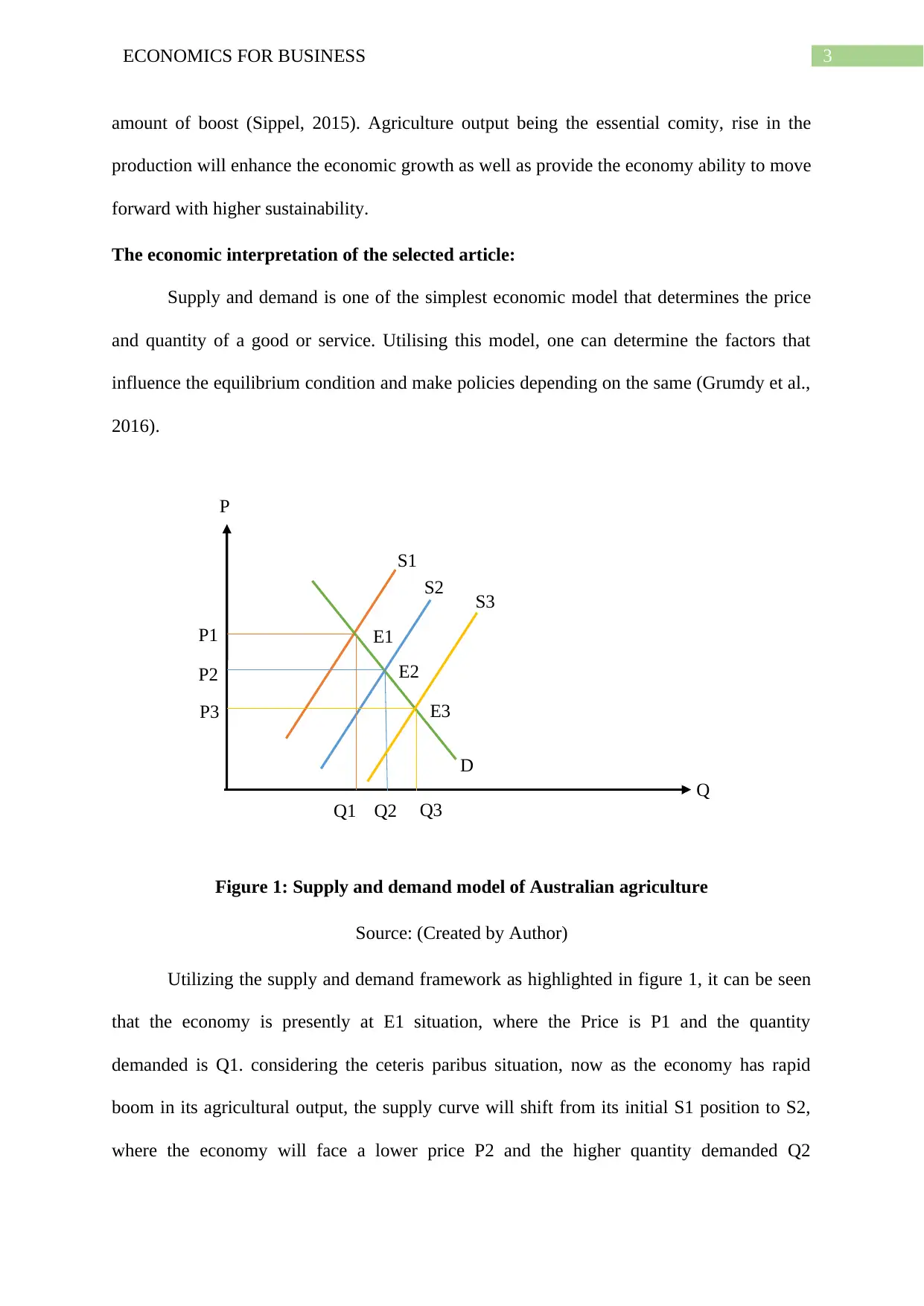
Figure 1: Supply and demand model of Australian agriculture
Source: (Created by Author)
Utilizing the supply and demand framework as highlighted in figure 1, it can be seen
that the economy is presently at E1 situation, where the Price is P1 and the quantity
demanded is Q1. considering the ceteris paribus situation, now as the economy has rapid
boom in its agricultural output, the supply curve will shift from its initial S1 position to S2,
where the economy will face a lower price P2 and the higher quantity demanded Q2
tabler-icon-diamond-filled.svg

Paraphrase This Document

Need a fresh take? Get an instant paraphrase of this document with our AI Paraphraser
Document Page
4ECONOMICS FOR BUSINESS
(Johnson, 2017). now, if the economy moves forward again depending upon the successive
rapid boom in the agricultural output, the supply curve will shift further to S3 position, where
the economy will face further deterioration in price, which then will be P3 and the quantity
demanded will be Q3.
Recommendation to gauge the situation:
Analysing the selected newspaper article following recommendations can be
mentioned towards the Australian agricultural sector:
Australian agriculture is highly dependable upon the favourable weather condition. It
need to reduce the constraints that holds the growth path aback through producing
high yielding seeds
Australian agricultural export is mainly diverted towards the Asian economies that
make the trading highly elastic to demand side shock. Australian agricultural sector
need to diversify its market for sustainability
Agricultural sector of the Australia need skilled labour so as to ensure future growth;
otherwise, developing nations like China, India will surpass the agricultural growth of
the country.
Conclusion:
From the above analysis it can be seen that the Australian economy has performed
really well during the last year with the help of the favourable weather condition. The report
has highlighted that the rise in the agricultural output has aided the economy to have better
trading prospect and it has provided substantial amount of growth to the various
macroeconomic parameters of the state. With the help of the supply and demand analysis, the
report has explained the effect of the rise in record tumbling production from the Australian
agriculture and it has found that economic growth has enhanced, whereas the unemployment
Document Page
5ECONOMICS FOR BUSINESS
rate has fell substantially. To conclude it can be said that the Australian economy has high
potential to become the food bowl of the world, however, in order to fulfil the aim, it needs to
enhance its capabilities.
Document Page
6ECONOMICS FOR BUSINESS
References:
Gray, D. (2017). World goes nuts for Australian agriculture as records tumble. The Sydney
Morning Herald. Retrieved 23 April 2018, from
https://www.smh.com.au/national/world-goes-nuts-for-australian-agriculture-as-
records-tumble-20170306-guruhc.html
Grundy, M. J., Bryan, B. A., Nolan, M., Battaglia, M., Hatfield-Dodds, S., Connor, J. D., &
Keating, B. A. (2016). Scenarios for Australian agricultural production and land use
to 2050. Agricultural systems, 142, 70-83.
Hyde, M. (2015). Key agricultural outcomes of recent free trade agreements. Agricultural
Commodities, 5(1), 23.
Inklaar, R., & Rao, D. S. (2017). Cross-country income levels over time: did the developing
world suddenly become much richer?. American Economic Journal:
Macroeconomics, 9(1), 265-90.
Johnson, H. G. (2017). Macroeconomics and monetary theory. Routledge.
Sheng, Y., Zhao, S., Nossal, K., & Zhang, D. (2015). Productivity and farm size in Australian
agriculture: reinvestigating the returns to scale. Australian Journal of Agricultural and
Resource Economics, 59(1), 16-38.
Sippel, S. R. (2015). Food security or commercial business? Gulf State investments in
Australian agriculture. The Journal of Peasant Studies, 42(5), 981-1001.
Worsley, A., Wang, W., & Ridley, S. (2015). Australian adults’ knowledge of Australian
agriculture. British Food Journal, 117(1), 400-411.
chevron_up_icon
1 out of 7
circle_padding
hide_on_mobile
zoom_out_icon
[object Object]