Economics for Business: Analysis of Supply Side and Fiscal Policies
VerifiedAdded on 2019/12/28
|13
|3928
|130
Report
AI Summary
This report provides an in-depth analysis of economic policies, focusing on how governments utilize supply-side, fiscal, and monetary strategies to influence economic growth. It begins by exploring the advantages of supply-side policies, such as reducing inflation, enhancing employment, and fostering trade, with discussions on privatization, deregulation, tax reduction, education, and trade union powers. The report then delves into fiscal and monetary policies, explaining their roles in managing aggregate demand and supply, and the tools used to stimulate or slow down economic growth, with a focus on the AS-AD model. The report also touches upon the fiscal policies like neutral, expansionary, contractionary and Tobynomics. The report highlights the importance of these policies in maintaining economic stability, reducing unemployment, and addressing inflation, all of which are critical for a nation's financial health and global competitiveness.
Economics for Business

Paraphrase This Document
Need a fresh take? Get an instant paraphrase of this document with our AI Paraphraser
TABLE OF CONTENTS
INTRODUCTION...........................................................................................................................1
(i) Use of supply side policies by government............................................................................1
(ii) Use of fiscal and monetary policy for slowing economic growth.........................................4
CONCLUSION................................................................................................................................8
REFERECES.................................................................................................................................10
INTRODUCTION...........................................................................................................................1
(i) Use of supply side policies by government............................................................................1
(ii) Use of fiscal and monetary policy for slowing economic growth.........................................4
CONCLUSION................................................................................................................................8
REFERECES.................................................................................................................................10
INTRODUCTION
Use of quantitative methods for developing a business is enterprise economics. Strategies
and practises are based on all policies and reforms that define economic structure of an
organisation. A country develops when collective growth is initiated. Private and public sector
has to adopt those plans which will help in contributing massively to economic welfare of the
nation and its citizens. Notions must be based on managing aggregate supply and aggregate
demand of products and services. Stabilised or developed country is one which has lowest
unemployment rates and more income opportunities. Limiting agents of progress are negligible
here. Hence, economics for businesses are developed for achieving a developed nation status in
global markets. This report aims to give a broader perspective on steps and measures a
government has to take for speeding up growth and for temporarily slowing down the same.
These facts are elaborated with help of AS and AD analysis.
(i) Use of supply side policies by government
Economic growth is essential for financial strengthening of country. Supply side policies
can be used by governments for enhancing this growth. Gross domestic product is a component
or measure of economic growth. Basically, improvements in productivity and core competencies
of firms can be increased by these supply side policies (Buckley, 2016). Aggregate supply is
shifted correctly with supply side policies. Following advantages are gained by use of such
policies by government.
1. Reduction in inflation: Total amount of goods and services that are supplied and sold
during a particular time span is aggregate supply. Domestic economic plans must be
focused on utilising maximum exports and minimum imports. Inflation is sudden rise in
prices of commodities and services that are utilised by citizens of a country. It is moral
responsibility of government to reduce inflation (Koo, 2013). Tools like supply side
policies are helpful in fighting recession and inflation. Aggregate supply is shifted to
right when these policies are implemented.
2. Enrichment of employment scales: Unemployment is a basic problem after poverty in
many developing countries. Supply side policies are oriented with an objective to reduce
structural frictions that cause unemployment. Investments in education and training
1
Use of quantitative methods for developing a business is enterprise economics. Strategies
and practises are based on all policies and reforms that define economic structure of an
organisation. A country develops when collective growth is initiated. Private and public sector
has to adopt those plans which will help in contributing massively to economic welfare of the
nation and its citizens. Notions must be based on managing aggregate supply and aggregate
demand of products and services. Stabilised or developed country is one which has lowest
unemployment rates and more income opportunities. Limiting agents of progress are negligible
here. Hence, economics for businesses are developed for achieving a developed nation status in
global markets. This report aims to give a broader perspective on steps and measures a
government has to take for speeding up growth and for temporarily slowing down the same.
These facts are elaborated with help of AS and AD analysis.
(i) Use of supply side policies by government
Economic growth is essential for financial strengthening of country. Supply side policies
can be used by governments for enhancing this growth. Gross domestic product is a component
or measure of economic growth. Basically, improvements in productivity and core competencies
of firms can be increased by these supply side policies (Buckley, 2016). Aggregate supply is
shifted correctly with supply side policies. Following advantages are gained by use of such
policies by government.
1. Reduction in inflation: Total amount of goods and services that are supplied and sold
during a particular time span is aggregate supply. Domestic economic plans must be
focused on utilising maximum exports and minimum imports. Inflation is sudden rise in
prices of commodities and services that are utilised by citizens of a country. It is moral
responsibility of government to reduce inflation (Koo, 2013). Tools like supply side
policies are helpful in fighting recession and inflation. Aggregate supply is shifted to
right when these policies are implemented.
2. Enrichment of employment scales: Unemployment is a basic problem after poverty in
many developing countries. Supply side policies are oriented with an objective to reduce
structural frictions that cause unemployment. Investments in education and training
1
⊘ This is a preview!⊘
Do you want full access?
Subscribe today to unlock all pages.

Trusted by 1+ million students worldwide
improve competency levels of individuals. This reduces lack of skills and people will
explore employment opportunities.
3. Improved economic growth: Incentives are improved with application of supply side
policies. Investments are increased and researches are conducted by government. Rates
for sustainable development increase with help of government. Major component of this
progress is aggregate supply (AS). Economic growth as a whole is balance between
exports and imports or demand and supply of products and services. If supplies are less
and demands are more, then companies can face debts and loans in markets (Granger,
2014). On the contrary balance situation gives equal opportunity for organisation and
market to progress together.
4. Betterment of trade: Supply side polices help in increasing productivity. Competition is
healthy and motivating. Payments are made in an orderly manner. Companies can feel a
balance in incoming and outgoing of capitals. During inflation periods, these policies are
less effective or need more time for creating an impact whereas during free periods they
act for rapid economic developments.
Government when feels that economic growth is hindered or slow then below mentioned
steps can be taken with help of supply side policies for maintaining feasible economic growth.
Privatisation: It is believed that private sector undertakings have much better grasp of
business than public sector. Perseverance for private sector is based on positivity, growth and
maximum profits (Leigh and Blakely, 2013). For example, TESCO is a private sector
organisation known for its super markets and exemplary departmental services. It has about 800
stores solely in UK. No public sector organisation has reached such a limit. Privatisation helps in
earning more and efficient businesses can be produced. Their main motive is to earn more profits
with least production costs. Aggregates demands increases with private sector products and
services.
Deregulation: Supply side policies can be used to reduce barriers that are held for
discouraging new entries to markets. Deregulation will help in reducing such situations.
Competition gets refreshed when new comers with vibrant ideas start functioning (Treyz, 2013).
Moreover, it also helps in development of existing companies. Lethargy for innovation is
vanished when a threat from new entries is felt. This perspective helps safeguarding consumers
2
explore employment opportunities.
3. Improved economic growth: Incentives are improved with application of supply side
policies. Investments are increased and researches are conducted by government. Rates
for sustainable development increase with help of government. Major component of this
progress is aggregate supply (AS). Economic growth as a whole is balance between
exports and imports or demand and supply of products and services. If supplies are less
and demands are more, then companies can face debts and loans in markets (Granger,
2014). On the contrary balance situation gives equal opportunity for organisation and
market to progress together.
4. Betterment of trade: Supply side polices help in increasing productivity. Competition is
healthy and motivating. Payments are made in an orderly manner. Companies can feel a
balance in incoming and outgoing of capitals. During inflation periods, these policies are
less effective or need more time for creating an impact whereas during free periods they
act for rapid economic developments.
Government when feels that economic growth is hindered or slow then below mentioned
steps can be taken with help of supply side policies for maintaining feasible economic growth.
Privatisation: It is believed that private sector undertakings have much better grasp of
business than public sector. Perseverance for private sector is based on positivity, growth and
maximum profits (Leigh and Blakely, 2013). For example, TESCO is a private sector
organisation known for its super markets and exemplary departmental services. It has about 800
stores solely in UK. No public sector organisation has reached such a limit. Privatisation helps in
earning more and efficient businesses can be produced. Their main motive is to earn more profits
with least production costs. Aggregates demands increases with private sector products and
services.
Deregulation: Supply side policies can be used to reduce barriers that are held for
discouraging new entries to markets. Deregulation will help in reducing such situations.
Competition gets refreshed when new comers with vibrant ideas start functioning (Treyz, 2013).
Moreover, it also helps in development of existing companies. Lethargy for innovation is
vanished when a threat from new entries is felt. This perspective helps safeguarding consumers
2
Paraphrase This Document
Need a fresh take? Get an instant paraphrase of this document with our AI Paraphraser
up to a great extent. People have their own choices and monopoly is curbed. It also intends
towards lowering of prices and increasing of standards.
Reduction of taxes: Taxes are most dreadful elements of an economy. When government
introduces high tax policies on every basic necessity then, consumers automatically reduce their
extra expenditure on luxuries. This causes high pricing. To curb all such factors, government
must reduce taxes Companies will save more and utilise in improving its human resource (Borrás
and Edquist, 2013). They will work on giving more incentives to their employees so that better
quality of output will be generated. This will also increase expenditure on leisure activities and
products. This whole concept of lowered taxes will work only if companies work ethically.
When not handled correctly, people can take advantage of this situation.
Increasing education and training facilities: Education can never be a depleting agent of
growth. Only when correct education and practises are given to children and working force of
country, people will develop their skills. Irrespective of functioning sector and industry, trainings
are an integral part of an organisation (Mason and Brown, 2013). Information and updating of
skills is important for continuous growth of an institution or enterprise. As education and training
is imparted, productivity of labours increases which in turn increases the aggregated supply.
Market failure of product can be due to lack of proper education. Government when invests its
capital in education and training programs, then overall progress is assured.
Reducing trade union powers: Trade unions often get influenced by personal benefits
and give birth to protests and riots which are irrelevant. These activities can only be controlled
when government doesn’t give much power to trade unions (Lavoie and Stockhammer, 2013).
The objective of a trade union is to work for increasing efficiency and productivity of workers
functioning for a company. For example, if BT – the leading telecommunications brand faces a
rebellion from its workers. This revolt is organised by trade union. Their motive behind protest is
to pressurise the firm for giving more incentives than is deserved. It becomes really difficult to
tackle such situations when they are backed by government declared rights and powers.
Company won’t function and brand reputation will be disturbed. Reduction of such practises
with irrelevant powers will increase employment opportunities and efficiency of company
(Checherita-Westphal and Rother, 2012).
3
towards lowering of prices and increasing of standards.
Reduction of taxes: Taxes are most dreadful elements of an economy. When government
introduces high tax policies on every basic necessity then, consumers automatically reduce their
extra expenditure on luxuries. This causes high pricing. To curb all such factors, government
must reduce taxes Companies will save more and utilise in improving its human resource (Borrás
and Edquist, 2013). They will work on giving more incentives to their employees so that better
quality of output will be generated. This will also increase expenditure on leisure activities and
products. This whole concept of lowered taxes will work only if companies work ethically.
When not handled correctly, people can take advantage of this situation.
Increasing education and training facilities: Education can never be a depleting agent of
growth. Only when correct education and practises are given to children and working force of
country, people will develop their skills. Irrespective of functioning sector and industry, trainings
are an integral part of an organisation (Mason and Brown, 2013). Information and updating of
skills is important for continuous growth of an institution or enterprise. As education and training
is imparted, productivity of labours increases which in turn increases the aggregated supply.
Market failure of product can be due to lack of proper education. Government when invests its
capital in education and training programs, then overall progress is assured.
Reducing trade union powers: Trade unions often get influenced by personal benefits
and give birth to protests and riots which are irrelevant. These activities can only be controlled
when government doesn’t give much power to trade unions (Lavoie and Stockhammer, 2013).
The objective of a trade union is to work for increasing efficiency and productivity of workers
functioning for a company. For example, if BT – the leading telecommunications brand faces a
rebellion from its workers. This revolt is organised by trade union. Their motive behind protest is
to pressurise the firm for giving more incentives than is deserved. It becomes really difficult to
tackle such situations when they are backed by government declared rights and powers.
Company won’t function and brand reputation will be disturbed. Reduction of such practises
with irrelevant powers will increase employment opportunities and efficiency of company
(Checherita-Westphal and Rother, 2012).
3
Supply sided policies can be implemented by government of UK to enhance growth of
economy in above declared ways. There are few more options which can be considered
according to convenience and current market situations (Hansen, 2013). Bureaucracy can reduce
state welfare benefits which will help reduce individualism in functioning of country. It can also
lessen tariff barriers and regulation of financial markets so that competition can be enhanced. In
all cases, a better competition always helps in increasing efficiency of companies. Supplies in all
sectors get a new edge and standard every time a new comer comes up with a better version of
same product. Consumers are least affected by competition but rather more safeguarded from
monopoly (Gemmell, Kneller and Sanz, 2013).
(ii) Use of fiscal and monetary policy for slowing economic growth
Before understanding the uses of fiscal and monetary policy by government it is essential
to know about basics of these policies. Major macro-economic variables of a country are
aggregate demand (AD), savings, investments, income distribution, unemployment, inflation,
globalisation, etc. All these factors are controlled and varied according to needs and demands of
economic status of a country. Industries are major drivers of economy (Lin, 2012). Any sort of
changes in economic policies are felt by both private and public sector companies adversely.
Fiscal and monetary policies are formulated for increasing competitive performance of an
organisation. The better and fierce competition is, demands for goods and products from UK will
increase worldwide.
Fiscal Policy: Economy is formed by revenues and taxes that are collected by
government through business activities. Fiscal policy is this use of economy for welfare of
companies and citizens. Taxation policies changes when budget gets disturbed. Major sufferers
of these reforms are middle income people and organisations (Ahmed and Zlate, 2014). Fiscal
policy can sometimes be beneficial for all related people and sometimes be less effective.
Business cycles get affected by slightest changes in these policies. Central banks are not
involved in designing procedure of this policy. There four major types of fiscal policies in
economics of businesses:
Neutral: Policies that are used for maintaining an obtained equilibrium position are
neutral fiscal policy. It also means that taxes and investments are in balance and people
don’t suffer price rise or any sort of degradation of their incomes.
4
economy in above declared ways. There are few more options which can be considered
according to convenience and current market situations (Hansen, 2013). Bureaucracy can reduce
state welfare benefits which will help reduce individualism in functioning of country. It can also
lessen tariff barriers and regulation of financial markets so that competition can be enhanced. In
all cases, a better competition always helps in increasing efficiency of companies. Supplies in all
sectors get a new edge and standard every time a new comer comes up with a better version of
same product. Consumers are least affected by competition but rather more safeguarded from
monopoly (Gemmell, Kneller and Sanz, 2013).
(ii) Use of fiscal and monetary policy for slowing economic growth
Before understanding the uses of fiscal and monetary policy by government it is essential
to know about basics of these policies. Major macro-economic variables of a country are
aggregate demand (AD), savings, investments, income distribution, unemployment, inflation,
globalisation, etc. All these factors are controlled and varied according to needs and demands of
economic status of a country. Industries are major drivers of economy (Lin, 2012). Any sort of
changes in economic policies are felt by both private and public sector companies adversely.
Fiscal and monetary policies are formulated for increasing competitive performance of an
organisation. The better and fierce competition is, demands for goods and products from UK will
increase worldwide.
Fiscal Policy: Economy is formed by revenues and taxes that are collected by
government through business activities. Fiscal policy is this use of economy for welfare of
companies and citizens. Taxation policies changes when budget gets disturbed. Major sufferers
of these reforms are middle income people and organisations (Ahmed and Zlate, 2014). Fiscal
policy can sometimes be beneficial for all related people and sometimes be less effective.
Business cycles get affected by slightest changes in these policies. Central banks are not
involved in designing procedure of this policy. There four major types of fiscal policies in
economics of businesses:
Neutral: Policies that are used for maintaining an obtained equilibrium position are
neutral fiscal policy. It also means that taxes and investments are in balance and people
don’t suffer price rise or any sort of degradation of their incomes.
4
⊘ This is a preview!⊘
Do you want full access?
Subscribe today to unlock all pages.
Trusted by 1+ million students worldwide
Expansionary: When spending by government exceeds the revenue taxes then
equilibrium gets disturbed. In order to gather more money so that a balance is achieved
prices on supplies and goods are increased. Indirect rise of inflation is obtained.
Contractionary: Tax values and revenues are income source of bureaucracy. If this value
is greater than the expenditure of government then, a Contractionary fiscal policy is
needed to be formulated. This reduces flow of taxes and aids government funding. It is
also helpful in paying huge amounts of debts and loans undertaken by country.
Tobynomics: When authorities think of increasing o maximising taxes and revenues but
without supporting or increasing investments then, Tobynomics fiscal policy is initiated.
Monetary Policy: Targeting on price stability and management of monetary supply,
central banks of a country devise monetary policy. They are aimed at controlling economic
growth of the nation. Money is important aspect of day to day routine of every person be it a
small daily wager or the highest official of a nation (Jaramillo and Cottarelli, 2012). Economic
status of country becomes a basis for design of monetary policy. Bank of England is the decision
maker of monetary policy. Currency is deciding factor of monetary reforms Exchange of
currencies must be stable so that powerful world economies cannot dominate activities in UK.
There are two types of this policy:
Expansionary: Devised for stimulating or increasing economic growth. When
unemployment rates and recession increases this policy is used. Development of more
opportunities helps in inviting investments from foreign countries and multinationals
which definitely helps in earning more economical advantages.
Contractionary: Designed for decreasing speed of growth. Basically, this is more like
controlling agent. Sometimes, there are chances that county can face inflation if growth is
not controlled. For preventing such adverse consequences, authorities in power of
economic welfare have to come up with this Contractionary policy so that slower
progress is initiated. It helps in keeping balance on economy.
AS and AD analysis:
This analysis of aggregate supply and demand is helpful in getting knowledge regarding
economic situation of a company and country. Aggregate Supply is total products and services
that are present in an economy while Aggregate Demand is total amount of goods and services
5
equilibrium gets disturbed. In order to gather more money so that a balance is achieved
prices on supplies and goods are increased. Indirect rise of inflation is obtained.
Contractionary: Tax values and revenues are income source of bureaucracy. If this value
is greater than the expenditure of government then, a Contractionary fiscal policy is
needed to be formulated. This reduces flow of taxes and aids government funding. It is
also helpful in paying huge amounts of debts and loans undertaken by country.
Tobynomics: When authorities think of increasing o maximising taxes and revenues but
without supporting or increasing investments then, Tobynomics fiscal policy is initiated.
Monetary Policy: Targeting on price stability and management of monetary supply,
central banks of a country devise monetary policy. They are aimed at controlling economic
growth of the nation. Money is important aspect of day to day routine of every person be it a
small daily wager or the highest official of a nation (Jaramillo and Cottarelli, 2012). Economic
status of country becomes a basis for design of monetary policy. Bank of England is the decision
maker of monetary policy. Currency is deciding factor of monetary reforms Exchange of
currencies must be stable so that powerful world economies cannot dominate activities in UK.
There are two types of this policy:
Expansionary: Devised for stimulating or increasing economic growth. When
unemployment rates and recession increases this policy is used. Development of more
opportunities helps in inviting investments from foreign countries and multinationals
which definitely helps in earning more economical advantages.
Contractionary: Designed for decreasing speed of growth. Basically, this is more like
controlling agent. Sometimes, there are chances that county can face inflation if growth is
not controlled. For preventing such adverse consequences, authorities in power of
economic welfare have to come up with this Contractionary policy so that slower
progress is initiated. It helps in keeping balance on economy.
AS and AD analysis:
This analysis of aggregate supply and demand is helpful in getting knowledge regarding
economic situation of a company and country. Aggregate Supply is total products and services
that are present in an economy while Aggregate Demand is total amount of goods and services
5
Paraphrase This Document
Need a fresh take? Get an instant paraphrase of this document with our AI Paraphraser
that are purchased and consumed at all possible prices. Fluctuations are present in market. It can
face sudden boom or sudden declination at any instance. Hence, for stabilising economic
conditions of a country, government has to come up with policies like supply side, fiscal and
monetary for stabilising these changes (Dosi and et. al., 2015). Any sort of hardships that are
faced by citizens and people working for UK are a result of un-strategic decisions on these
policies.
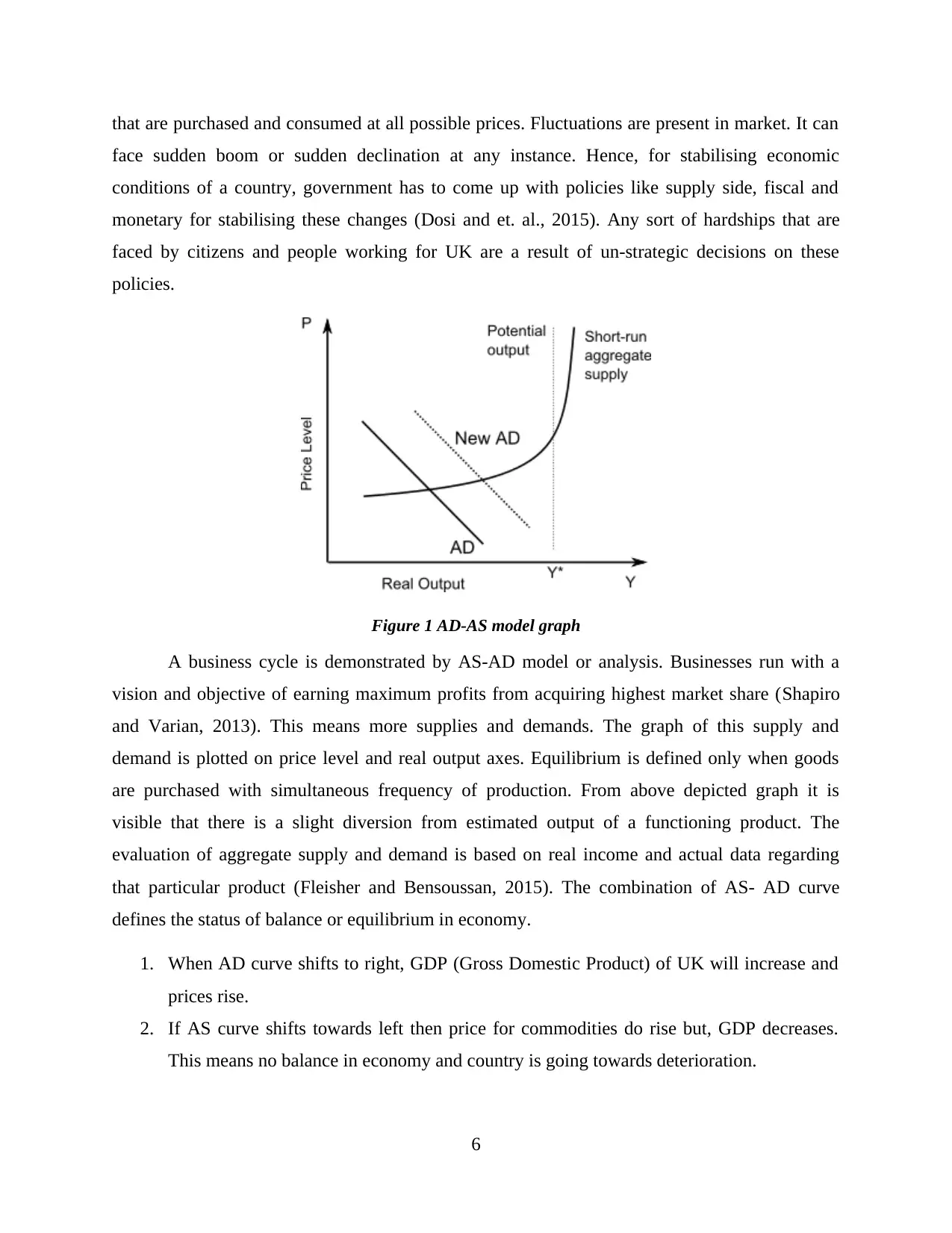
Figure 1 AD-AS model graph
A business cycle is demonstrated by AS-AD model or analysis. Businesses run with a
vision and objective of earning maximum profits from acquiring highest market share (Shapiro
and Varian, 2013). This means more supplies and demands. The graph of this supply and
demand is plotted on price level and real output axes. Equilibrium is defined only when goods
are purchased with simultaneous frequency of production. From above depicted graph it is
visible that there is a slight diversion from estimated output of a functioning product. The
evaluation of aggregate supply and demand is based on real income and actual data regarding
that particular product (Fleisher and Bensoussan, 2015). The combination of AS- AD curve
defines the status of balance or equilibrium in economy.
1. When AD curve shifts to right, GDP (Gross Domestic Product) of UK will increase and
prices rise.
2. If AS curve shifts towards left then price for commodities do rise but, GDP decreases.
This means no balance in economy and country is going towards deterioration.
6
face sudden boom or sudden declination at any instance. Hence, for stabilising economic
conditions of a country, government has to come up with policies like supply side, fiscal and
monetary for stabilising these changes (Dosi and et. al., 2015). Any sort of hardships that are
faced by citizens and people working for UK are a result of un-strategic decisions on these
policies.
Figure 1 AD-AS model graph
A business cycle is demonstrated by AS-AD model or analysis. Businesses run with a
vision and objective of earning maximum profits from acquiring highest market share (Shapiro
and Varian, 2013). This means more supplies and demands. The graph of this supply and
demand is plotted on price level and real output axes. Equilibrium is defined only when goods
are purchased with simultaneous frequency of production. From above depicted graph it is
visible that there is a slight diversion from estimated output of a functioning product. The
evaluation of aggregate supply and demand is based on real income and actual data regarding
that particular product (Fleisher and Bensoussan, 2015). The combination of AS- AD curve
defines the status of balance or equilibrium in economy.
1. When AD curve shifts to right, GDP (Gross Domestic Product) of UK will increase and
prices rise.
2. If AS curve shifts towards left then price for commodities do rise but, GDP decreases.
This means no balance in economy and country is going towards deterioration.
6
Advantages that come with use of this model for deciding measures and steps to control
economic growth of a country are that it is simplicity and flexibility. No special skills or
techniques are required for applying this tool. Data interpretation with help of this model is very
easy and smooth.
From above gathered information it is clear that when government has surplus funds or
demands are exceeding limited supply then, economic growth has to be controlled or temporarily
slowed down so that stability can be achieved (Lewis, 2013). When driving financial resources
of a country these two tools that is fiscal and monetary policies are to be implemented in a
strategic way so that better directional flow of income can be targeted. Expansion and
contraction of GDP often affects functioning of corporate governances. Everyone wants to earn
maximum and spend minimum. In this process of business cycle it is important that ethical
practises are turned on.
Combination of these two important economic policies is cent per cent beneficial for all
components that are involved in the functioning. UK government regulates such laws that will
increase taxes and revenue generations on all luxurious goods and services. The reason behind
such a step is that people will spend more on taxes which will be helpful in developing a repo
with growth (Bryan, 2016). It is already known that contractual policies are only used for
reducing economic growth and reason is also clarified. Industries hence must develop their
strategies and action plans with complete external and internal analysis.
Major tool for keeping a track on economical factors of business environment is PEST or
PESTEL. Its economical factor evaluation helps in recording country’s economics and also its
impact on functioning of private and public sectors. The influence of AD-AS is also felt in this
section (AD-AS model, 2016). Central Bank of UK is the Bank of England. It looks after
implementation and changes in monetary policy. When money is to be pumped from domestic
markets then import duties are increased and foreign investments become costlier. This means
multinationals that want to function in UK have to analyse their financial strategies. Domestic
companies have to pay more taxes and charges for utilising national resources. If income levels
of employees are not increased at this point then, outrage can be felt amongst common people.
Inflation can occur due to two conditions that is excess demands and low supply or
excess supply and little or no demands. Fiscal policy is used for controlling excess demands and
7
economic growth of a country are that it is simplicity and flexibility. No special skills or
techniques are required for applying this tool. Data interpretation with help of this model is very
easy and smooth.
From above gathered information it is clear that when government has surplus funds or
demands are exceeding limited supply then, economic growth has to be controlled or temporarily
slowed down so that stability can be achieved (Lewis, 2013). When driving financial resources
of a country these two tools that is fiscal and monetary policies are to be implemented in a
strategic way so that better directional flow of income can be targeted. Expansion and
contraction of GDP often affects functioning of corporate governances. Everyone wants to earn
maximum and spend minimum. In this process of business cycle it is important that ethical
practises are turned on.
Combination of these two important economic policies is cent per cent beneficial for all
components that are involved in the functioning. UK government regulates such laws that will
increase taxes and revenue generations on all luxurious goods and services. The reason behind
such a step is that people will spend more on taxes which will be helpful in developing a repo
with growth (Bryan, 2016). It is already known that contractual policies are only used for
reducing economic growth and reason is also clarified. Industries hence must develop their
strategies and action plans with complete external and internal analysis.
Major tool for keeping a track on economical factors of business environment is PEST or
PESTEL. Its economical factor evaluation helps in recording country’s economics and also its
impact on functioning of private and public sectors. The influence of AD-AS is also felt in this
section (AD-AS model, 2016). Central Bank of UK is the Bank of England. It looks after
implementation and changes in monetary policy. When money is to be pumped from domestic
markets then import duties are increased and foreign investments become costlier. This means
multinationals that want to function in UK have to analyse their financial strategies. Domestic
companies have to pay more taxes and charges for utilising national resources. If income levels
of employees are not increased at this point then, outrage can be felt amongst common people.
Inflation can occur due to two conditions that is excess demands and low supply or
excess supply and little or no demands. Fiscal policy is used for controlling excess demands and
7
⊘ This is a preview!⊘
Do you want full access?
Subscribe today to unlock all pages.
Trusted by 1+ million students worldwide
low supply condition. Although this condition is definitely favouring development of a nation
but with a long term perspective, it invites demand pull inflation. It is not a threatening condition
but care can be taken so that GDP doesn’t get affected. AD curve when shifted to left then
Contractionary fiscal policy is initiated in this context. Excess of taxes have to use somewhere so
that funds are not wasted.
Every developing and developed nation has to take proper analytical measures for
prohibiting external agents in draining resources from country. Brain drain happens when human
resources investment of country goes in vain. People get high quality education and training in
their native nation but move towards better opportunities in different countries (Koo, 2013). This
causes brain drain. When financial resources are exploited by external agents like multinationals
based in other countries then money drain happens. It is ethical responsibility of government to
develop certain barriers that will restrict such happenings.
Effective use of monetary and fiscal policies helps in controlling economic growth. The
process after implementation of respective policies in required manner can be depicted using AS-
AD model which is based on plotting of curve between aggregate supply and aggregate demand.
Combination of all three components drives the economy of UK. It is legitimate authorities that
handle these driving agents. Choice of contractionary or expansionary policies is totally
dependent on current situation (Treyz, 2013). Whether there is inflation or rapid growth, control
is essential. Customers are safeguarded when control is assured. A permanent result of all these
methodologies and comprehensive steps is competition. Monopoly cannot survive in any
conditions favouring these policies. This means consumers are provided with diverse and
versatile choices which can be enhanced for earning more profits. It is also realised that private
sector investments and support definitely help in contributing an controlling economic growth of
a country.
CONCLUSION
Economic crisis can occur at any point in time when a government or ruling body
becomes incapable of maintaining stability between its supply ad demands. Formulation of
policies and structural rules help in managing all trade related transactions. Taxation and supply-
demands are two important parts of economic growth of a country. Both are interrelated in such
a manner that imbalance severely affects major part of businesses. Through this report, it is
8
but with a long term perspective, it invites demand pull inflation. It is not a threatening condition
but care can be taken so that GDP doesn’t get affected. AD curve when shifted to left then
Contractionary fiscal policy is initiated in this context. Excess of taxes have to use somewhere so
that funds are not wasted.
Every developing and developed nation has to take proper analytical measures for
prohibiting external agents in draining resources from country. Brain drain happens when human
resources investment of country goes in vain. People get high quality education and training in
their native nation but move towards better opportunities in different countries (Koo, 2013). This
causes brain drain. When financial resources are exploited by external agents like multinationals
based in other countries then money drain happens. It is ethical responsibility of government to
develop certain barriers that will restrict such happenings.
Effective use of monetary and fiscal policies helps in controlling economic growth. The
process after implementation of respective policies in required manner can be depicted using AS-
AD model which is based on plotting of curve between aggregate supply and aggregate demand.
Combination of all three components drives the economy of UK. It is legitimate authorities that
handle these driving agents. Choice of contractionary or expansionary policies is totally
dependent on current situation (Treyz, 2013). Whether there is inflation or rapid growth, control
is essential. Customers are safeguarded when control is assured. A permanent result of all these
methodologies and comprehensive steps is competition. Monopoly cannot survive in any
conditions favouring these policies. This means consumers are provided with diverse and
versatile choices which can be enhanced for earning more profits. It is also realised that private
sector investments and support definitely help in contributing an controlling economic growth of
a country.
CONCLUSION
Economic crisis can occur at any point in time when a government or ruling body
becomes incapable of maintaining stability between its supply ad demands. Formulation of
policies and structural rules help in managing all trade related transactions. Taxation and supply-
demands are two important parts of economic growth of a country. Both are interrelated in such
a manner that imbalance severely affects major part of businesses. Through this report, it is
8
Paraphrase This Document
Need a fresh take? Get an instant paraphrase of this document with our AI Paraphraser
visualised that growth enhancement can be achieved by utilising supply sided policies. It not
only helps in curbing barriers to progress but also supports businesses to a great extent with
maximum possible freedom. While fiscal and monetary policies are two different economic
agendas, they have certain role in balancing financial status of country. In final section of the
report, this criterion was discussed. It was realised that government at some point has to
implement strategies which limit economic growth so that adverse effects can be overcome.
9
only helps in curbing barriers to progress but also supports businesses to a great extent with
maximum possible freedom. While fiscal and monetary policies are two different economic
agendas, they have certain role in balancing financial status of country. In final section of the
report, this criterion was discussed. It was realised that government at some point has to
implement strategies which limit economic growth so that adverse effects can be overcome.
9
REFERECES
Books and Journals
Ahmed, S. and Zlate, A., 2014. Capital flows to emerging market economies: a brave new
world?. Journal of International Money and Finance. 48. pp.221-248.
Borrás, S. and Edquist, C., 2013. The choice of innovation policy instruments. Technological
forecasting and social change. 80(8). pp.1513-1522.
Buckley, P. J., 2016. International business: economics and anthropology, theory and method.
Springer.
Checherita-Westphal, C. and Rother, P., 2012. The impact of high government debt on economic
growth and its channels: An empirical investigation for the euro area. European Economic
Review. 56(7). pp.1392-1405.
Dosi, G. and et. al., 2015. Fiscal and monetary policies in complex evolving economies. Journal
of Economic Dynamics and Control. 52. pp.166-189.
Fleisher, C. S. and Bensoussan, B. E., 2015. Business and competitive analysis: effective
application of new and classic methods. FT Press.
Gemmell, N., Kneller, R. and Sanz, I., 2013. Fiscal decentralization and economic growth:
spending versus revenue decentralization. Economic Inquiry. 51(4). pp.1915-1931.
Granger, C. W. J., 2014. Forecasting in business and economics. Academic Press.
Hansen, A. H., 2013. Fiscal policy & business cycles. Routledge.
Jaramillo, L. and Cottarelli, M.C., 2012. Walking hand in hand: fiscal policy and growth in
advanced economies (No. 12-137). International Monetary Fund.
Koo, D., 2013. Elements of optimization: with applications in economics and business. Springer
Science & Business Media.
Lavoie, M. and Stockhammer, E., 2013. Wage-led growth: Concept, theories and policies.
In Wage-led Growth Palgrave Macmillan UK. pp. 13-39.
Leigh, N. G. and Blakely, E. J., 2013. Planning local economic development: Theory and
practice. SAGE Publications, Incorporated.
Lewis, W. A., 2013. Theory of economic growth (Vol. 7). Routledge.
Lin, J. Y., 2012. New structural economics: A framework for rethinking development and policy.
World Bank Publications.
Mason, C. and Brown, R., 2013. Creating good public policy to support high-growth
firms. Small Business Economics. 40(2). pp.211-225.
Shapiro, C. and Varian, H. R., 2013. Information rules: a strategic guide to the network
economy. Harvard Business Press.
10
Books and Journals
Ahmed, S. and Zlate, A., 2014. Capital flows to emerging market economies: a brave new
world?. Journal of International Money and Finance. 48. pp.221-248.
Borrás, S. and Edquist, C., 2013. The choice of innovation policy instruments. Technological
forecasting and social change. 80(8). pp.1513-1522.
Buckley, P. J., 2016. International business: economics and anthropology, theory and method.
Springer.
Checherita-Westphal, C. and Rother, P., 2012. The impact of high government debt on economic
growth and its channels: An empirical investigation for the euro area. European Economic
Review. 56(7). pp.1392-1405.
Dosi, G. and et. al., 2015. Fiscal and monetary policies in complex evolving economies. Journal
of Economic Dynamics and Control. 52. pp.166-189.
Fleisher, C. S. and Bensoussan, B. E., 2015. Business and competitive analysis: effective
application of new and classic methods. FT Press.
Gemmell, N., Kneller, R. and Sanz, I., 2013. Fiscal decentralization and economic growth:
spending versus revenue decentralization. Economic Inquiry. 51(4). pp.1915-1931.
Granger, C. W. J., 2014. Forecasting in business and economics. Academic Press.
Hansen, A. H., 2013. Fiscal policy & business cycles. Routledge.
Jaramillo, L. and Cottarelli, M.C., 2012. Walking hand in hand: fiscal policy and growth in
advanced economies (No. 12-137). International Monetary Fund.
Koo, D., 2013. Elements of optimization: with applications in economics and business. Springer
Science & Business Media.
Lavoie, M. and Stockhammer, E., 2013. Wage-led growth: Concept, theories and policies.
In Wage-led Growth Palgrave Macmillan UK. pp. 13-39.
Leigh, N. G. and Blakely, E. J., 2013. Planning local economic development: Theory and
practice. SAGE Publications, Incorporated.
Lewis, W. A., 2013. Theory of economic growth (Vol. 7). Routledge.
Lin, J. Y., 2012. New structural economics: A framework for rethinking development and policy.
World Bank Publications.
Mason, C. and Brown, R., 2013. Creating good public policy to support high-growth
firms. Small Business Economics. 40(2). pp.211-225.
Shapiro, C. and Varian, H. R., 2013. Information rules: a strategic guide to the network
economy. Harvard Business Press.
10
⊘ This is a preview!⊘
Do you want full access?
Subscribe today to unlock all pages.
Trusted by 1+ million students worldwide

1 out of 13


Related Documents


Your All-in-One AI-Powered Toolkit for Academic Success.
+13062052269
info@desklib.com
Available 24*7 on WhatsApp / Email
![[object Object]](/_next/static/media/star-bottom.7253800d.svg)
Unlock your academic potential
Copyright © 2020–2026 A2Z Services. All Rights Reserved. Developed and managed by ZUCOL.