Principles of Macroeconomics: Economics Assignment Module 2

Verified

Added on  2022/09/09

|6
|764
|18
Homework Assignment
AI Summary
This economics assignment addresses key microeconomic concepts through the analysis of several scenarios. The first question explores the concept of opportunity cost, using the example of a high school senior deciding between college and a professional golf career. The second question applies marginal analysis and sunk cost to a student's career decision. The third question discusses the inverse relationship between price and demand, analyzing how hotel prices in New Orleans affect demand. Finally, the assignment considers the economic implications of price ceilings, using the example of Super Bowl tickets. The assignment demonstrates an understanding of supply and demand, market equilibrium, and decision-making under scarcity, drawing on concepts presented in Modules 1 and 2 of an introductory macroeconomics course. The document is structured to provide clear explanations and graphical representations of economic principles.
Document Page
Running head: ECONOMICS ASSIGNMENT
Economics Assignment
Name of the Student
Name of the University
Author Note
tabler-icon-diamond-filled.svg

Paraphrase This Document

Need a fresh take? Get an instant paraphrase of this document with our AI Paraphraser
Document Page
1ECONOMICS ASSIGNMENT
Table of Contents
Answer to question 1.......................................................................................................................2
Answer to question 2.......................................................................................................................2
Answer to question 3.......................................................................................................................2
Reference list...................................................................................................................................2
Document Page
2ECONOMICS ASSIGNMENT
Answer to question 1
According to the statement, there are two feasible options for J.C. who is a high school
senior. With an average of 4.0, she scored a 32 on ACT. On the other hand, she could earn more
than $500,000 in her first year of the LPG professional golf tour. Now, it is important to judge
which feasible option is the best option for her. Using the concept of opportunity cost, the best
options can be identified for her. Opportunity cost explains what an individual should give up
consumption of goods in order to consume another desired good (Polley). It has been observed
that monetary value may not measure the true opportunity cost. For instance, her score on ACT
is impossible to get measured. In this case, the utility driven from the score will be compared
with the utility derived from the earnings of $500,000 from the professional golf tour.
Answer to question 2
In the view of the statement, Buck decided to complete his accounting course after
learning the concepts of marginal analysis and sunk cost (Augenblick). Marginal analysis
explains how much utility can be achieved by consuming one extra unit of goods or services. It
examines both cost and benefit aspects in relation to marginal changes in the consumption level
(Carroll). Buck observes that cost of the police professional is greater than cost of the accounting
professional. However, sunk cost being a result of the past activity, is impossible to be changed.
Sunk cost assists the individual to make an effective decision avoiding the past errors. Here,
Buck gave up his decision as he incurred sunk cost in accounting career.
Answer to question 3
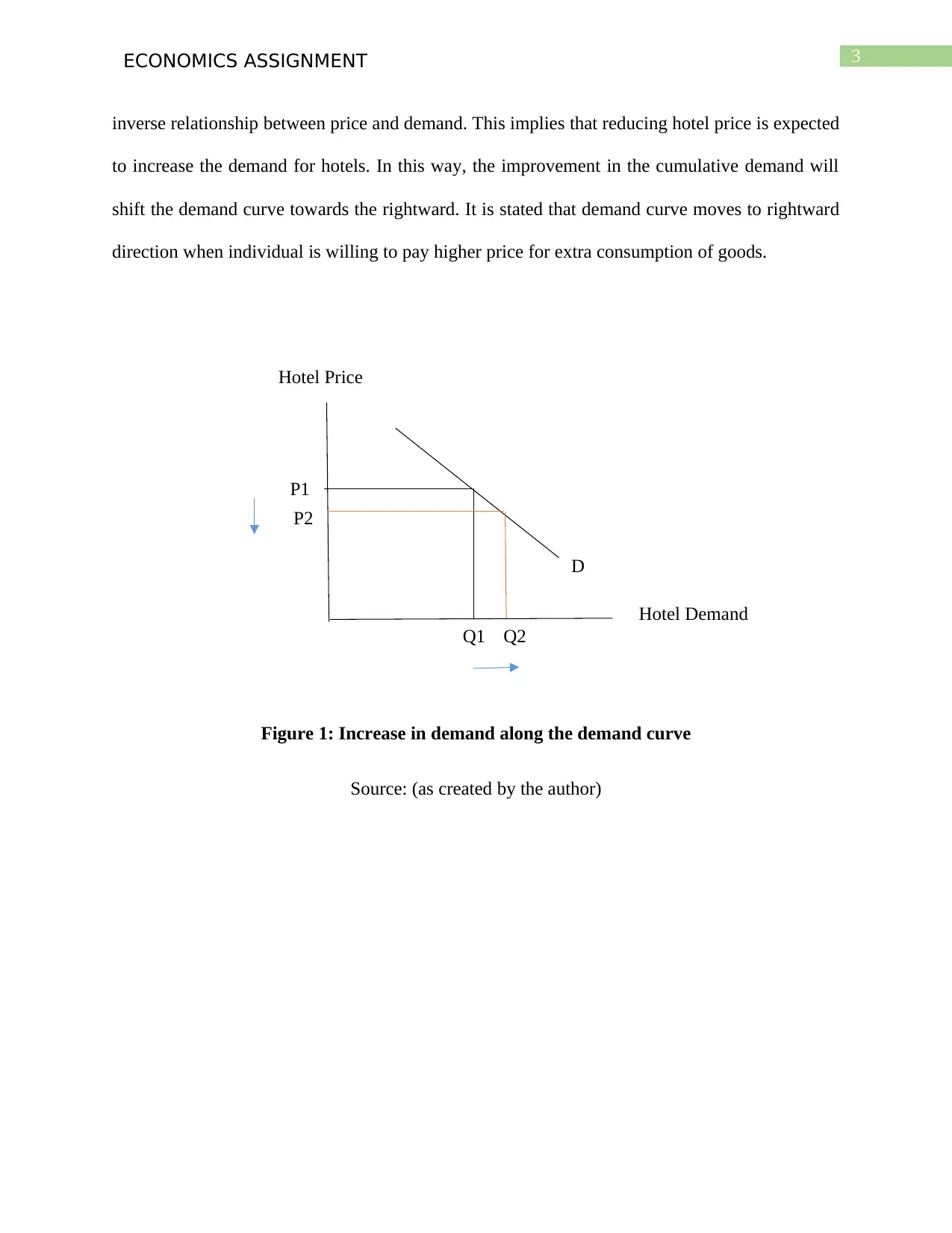
Referring to the statement, average price of a Hotel in New Oreland reduces to $145 in
summer as compared to $200 per night. In term of the microeconomics theory, there exists
Document Page
3ECONOMICS ASSIGNMENT
D
Hotel Demand
Hotel Price
Q1 Q2
P1
P2
inverse relationship between price and demand. This implies that reducing hotel price is expected
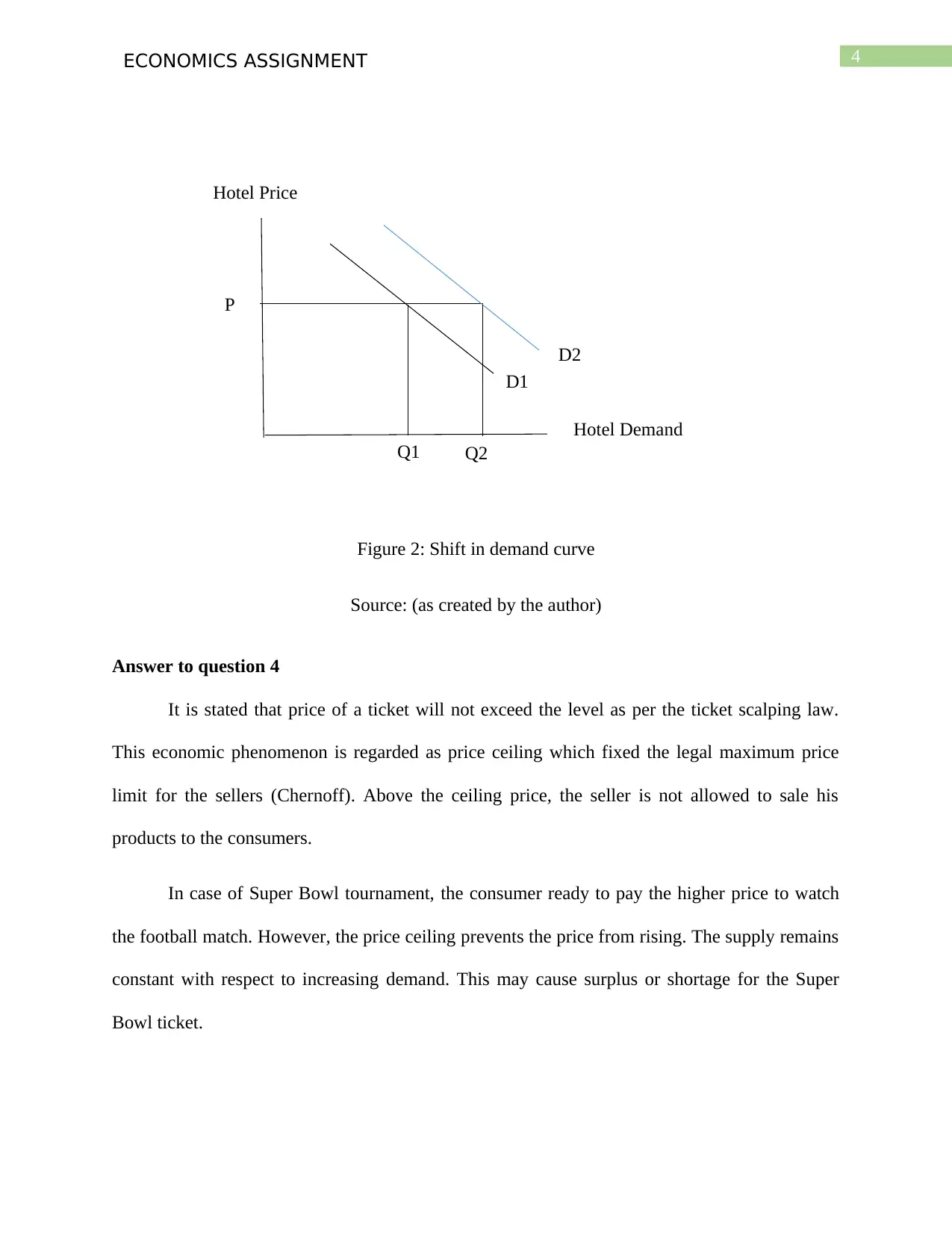
to increase the demand for hotels. In this way, the improvement in the cumulative demand will
shift the demand curve towards the rightward. It is stated that demand curve moves to rightward
direction when individual is willing to pay higher price for extra consumption of goods.
Figure 1: Increase in demand along the demand curve
Source: (as created by the author)
tabler-icon-diamond-filled.svg

Paraphrase This Document

Need a fresh take? Get an instant paraphrase of this document with our AI Paraphraser
Document Page
4ECONOMICS ASSIGNMENT
D1
Hotel Demand
Hotel Price
Q1 Q2
P
D2
Figure 2: Shift in demand curve
Source: (as created by the author)
Answer to question 4
It is stated that price of a ticket will not exceed the level as per the ticket scalping law.
This economic phenomenon is regarded as price ceiling which fixed the legal maximum price
limit for the sellers (Chernoff). Above the ceiling price, the seller is not allowed to sale his
products to the consumers.
In case of Super Bowl tournament, the consumer ready to pay the higher price to watch
the football match. However, the price ceiling prevents the price from rising. The supply remains
constant with respect to increasing demand. This may cause surplus or shortage for the Super
Bowl ticket.
Document Page
5ECONOMICS ASSIGNMENT
Reference list
Augenblick, Ned. "The sunk-cost fallacy in penny auctions." The Review of Economic Studies
83.1 (2016): 58-86.
Carroll, Christopher, et al. "The distribution of wealth and the marginal propensity to consume."
Quantitative Economics 8.3 (2017): 977-1020.
Chernoff, Alex W. "Between a cap and a higher price: Modelling the price of dairy quotas under
price ceiling legislation." Canadian Journal of Economics/Revue canadienne
d'économique 48.4 (2015): 1403-1429.
Polley, William J. "The rhetoric of opportunity cost." The American Economist 60.1 (2015): 9-
19.
chevron_up_icon
1 out of 6
circle_padding
hide_on_mobile
zoom_out_icon
[object Object]