Economics for Business 2019-20: Equilibrium, Growth, and Policy

Verified

Added on  2023/01/11

|8
|1324
|23
Homework Assignment
AI Summary
This economics assignment explores the determination of equilibrium price and quantity through the interaction of demand and supply, examining the impact of minimum price interventions and changes in raw material prices. It further analyzes short-run economic growth using the aggregate demand/supply model, considering factors like government spending and interest rates. The assignment also delves into long-run economic growth, linking it to potential output and factors such as capital investment and labor productivity. The solutions provided incorporate economic models, definitions, and examples, offering a comprehensive analysis of these key macroeconomic concepts. The assignment addresses specific questions related to equilibrium, growth, and the influence of economic policies on market dynamics and overall economic performance. Diagrams are also included to aid in explaining the concepts.
Document Page
Economics
tabler-icon-diamond-filled.svg

Paraphrase This Document

Need a fresh take? Get an instant paraphrase of this document with our AI Paraphraser
Document Page
Document Page
Question 1
(a) Explanation on how equilibrium price and quantity are determined via interaction of demand
and supply in a certain market.
Demand and supply are two main components of economics, that helps in measuring the
price and quantity (demanded or supplied) at a particular marketplace. Hereby, law of supply
states that with increase in price, quantity of supply will increase directly (Towse and Hernández,
2020). While demand law indicates reduction in demanded quantity with higher in price and vice
versa. The point at which demand and supply of a commodity intersect in known as its
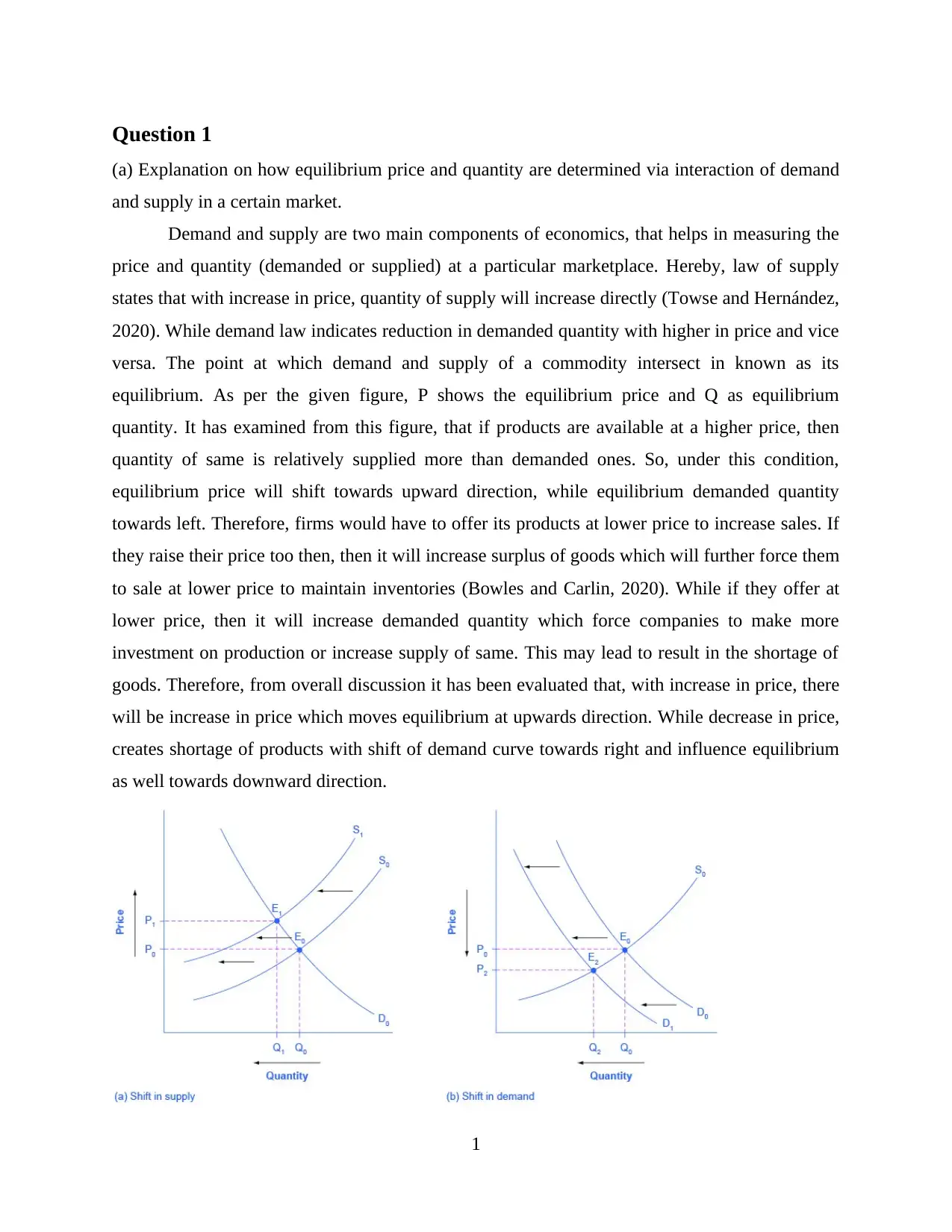
equilibrium. As per the given figure, P shows the equilibrium price and Q as equilibrium
quantity. It has examined from this figure, that if products are available at a higher price, then
quantity of same is relatively supplied more than demanded ones. So, under this condition,
equilibrium price will shift towards upward direction, while equilibrium demanded quantity
towards left. Therefore, firms would have to offer its products at lower price to increase sales. If
they raise their price too then, then it will increase surplus of goods which will further force them
to sale at lower price to maintain inventories (Bowles and Carlin, 2020). While if they offer at
lower price, then it will increase demanded quantity which force companies to make more
investment on production or increase supply of same. This may lead to result in the shortage of
goods. Therefore, from overall discussion it has been evaluated that, with increase in price, there
will be increase in price which moves equilibrium at upwards direction. While decrease in price,
creates shortage of products with shift of demand curve towards right and influence equilibrium
as well towards downward direction.
1
Document Page
(b) Effect on price and quantity by –
i). The imposition by the government of an effective minimum price.
Government interventions can be defined as regulations made on companies for setting
price of its products effectively. So, interventions on pricing policies of certain products highly
influence both price and quantity of goods. This would can be understood by concept of price
ceiling and price floor, where first one states that setting prices of particular products legally at
maximum point and price floor at minimum (Nagaraj and Stern, 2020). Therefore, if government
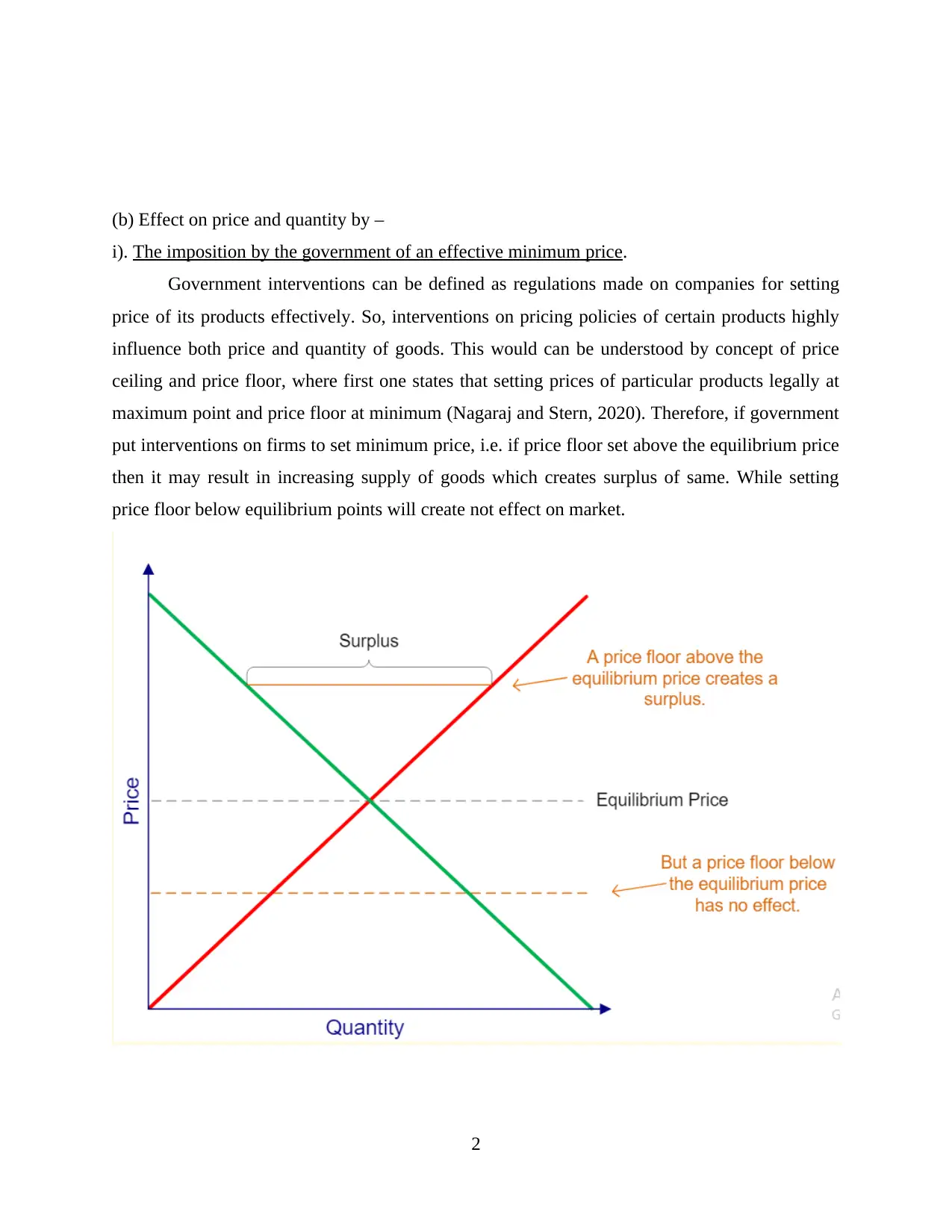
put interventions on firms to set minimum price, i.e. if price floor set above the equilibrium price
then it may result in increasing supply of goods which creates surplus of same. While setting
price floor below equilibrium points will create not effect on market.
2
tabler-icon-diamond-filled.svg

Paraphrase This Document

Need a fresh take? Get an instant paraphrase of this document with our AI Paraphraser
Document Page
ii). An increase in the price of a raw material
In the market-driven economy, it has been analysed that price of goods or input in
production, acts as a signal or surplus or shortage of same. With increase in price of raw
materials and entire input like labour costs, leads to increase production cost, which ultimate
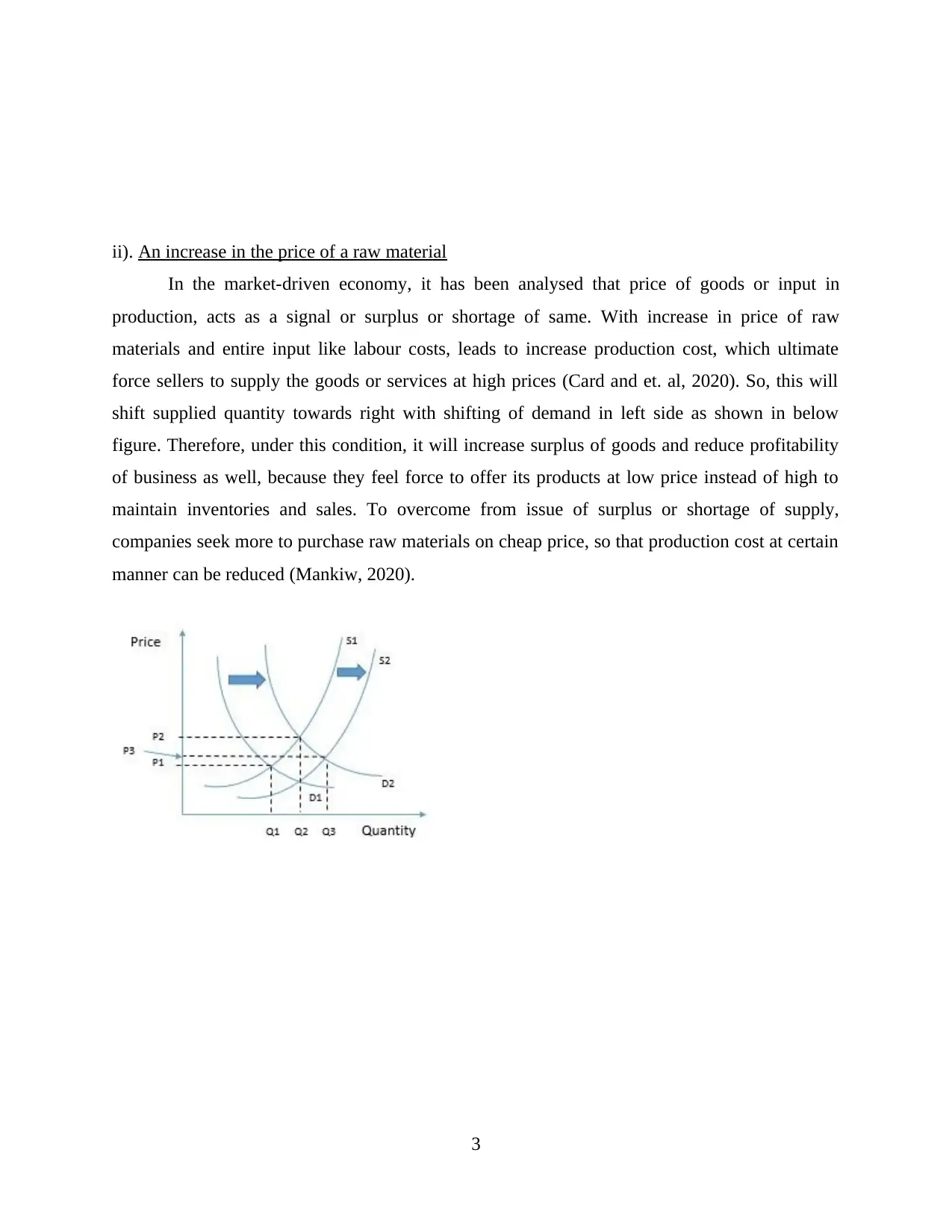
force sellers to supply the goods or services at high prices (Card and et. al, 2020). So, this will
shift supplied quantity towards right with shifting of demand in left side as shown in below
figure. Therefore, under this condition, it will increase surplus of goods and reduce profitability
of business as well, because they feel force to offer its products at low price instead of high to
maintain inventories and sales. To overcome from issue of surplus or shortage of supply,
companies seek more to purchase raw materials on cheap price, so that production cost at certain
manner can be reduced (Mankiw, 2020).
3
Document Page
Question 2
(a) Description on how economy may experience the short run growth in actual output, by using
aggregate demand/supply
The aggregate supply (AS) or aggregate demand (AD) model, is one of the most
important fundamental tool in macroeconomics, which provides overall framework of market
position (Mankiw, 2020). Aggregate demand shows total demand of products or services in a
specific market by using the below formula –
AD = C + I + G + X – M
where, C indicates consumer spending to purchase goods, I represents business investment for
increasing GDP, G refers to Government spending, and X – M shows net exports.
So, measuring all these components help economists in determining growth rate of a
country in a specified period of time (quarterly, monthly or annually). Therefore, both short-term
and long-term economic growth can be measured by using AD/AS model effectively.
In context with short-run, it has been analysed that under such condition, GDP fluctuates
in economy, especially falls at recession period (Nagaraj and Stern, 2020). Through applying the
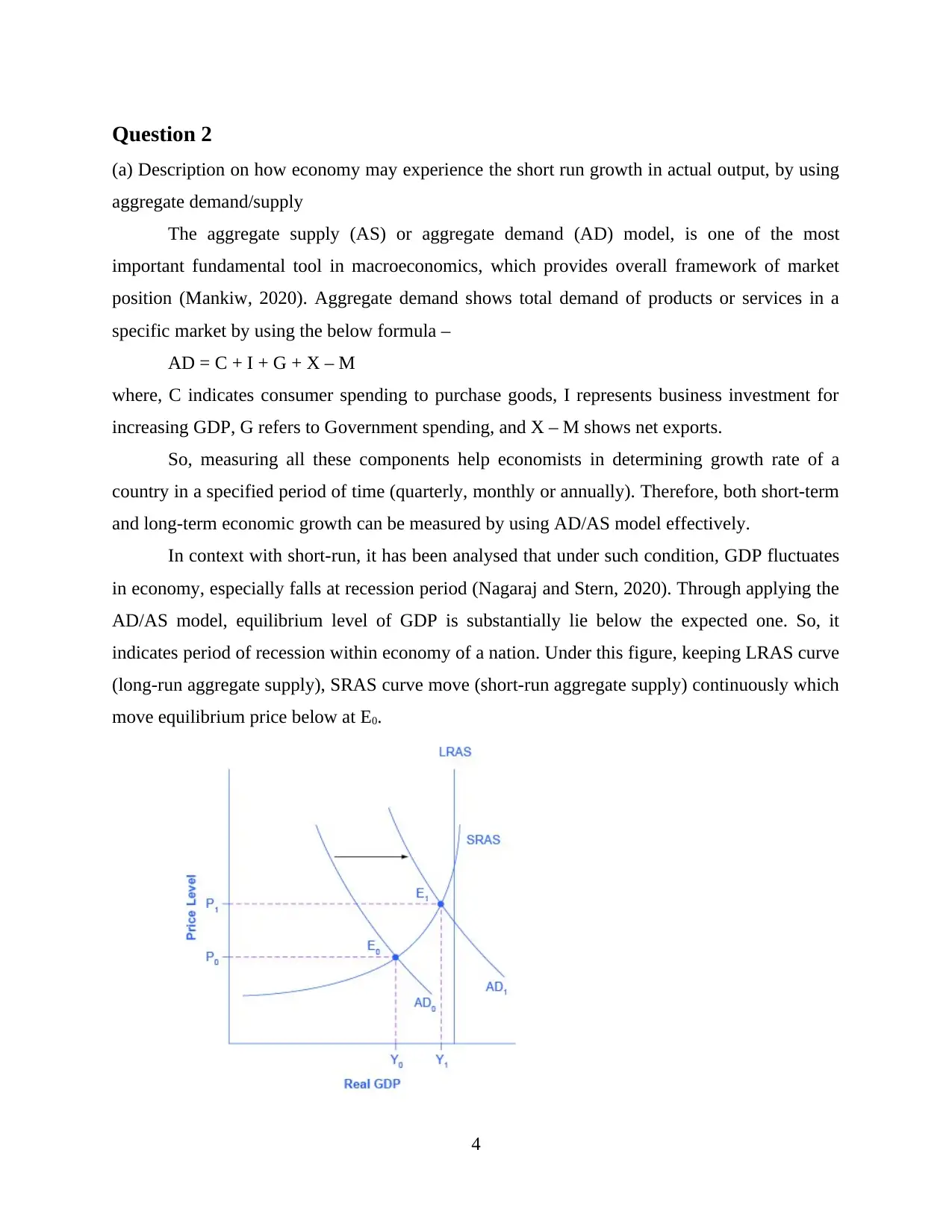
AD/AS model, equilibrium level of GDP is substantially lie below the expected one. So, it
indicates period of recession within economy of a nation. Under this figure, keeping LRAS curve
(long-run aggregate supply), SRAS curve move (short-run aggregate supply) continuously which
move equilibrium price below at E0.
4
Document Page
Economy may experience the short run growth in actual output due to various factors like
decrease in government spending and higher interest rates. With increase in rates of interest,
increases cost of borrowing, which further lead to decrease disposable income of people,
increase mortgage payments and more (Bowles and Carlin, 2020). Under this condition, both
consumer spending and investment of firms, also reduces, which results in decreasing or slow-
down the economic growth. Similarly, reduction of government spending on development of
society and infrastructure also indicates slow-down of economic growth.
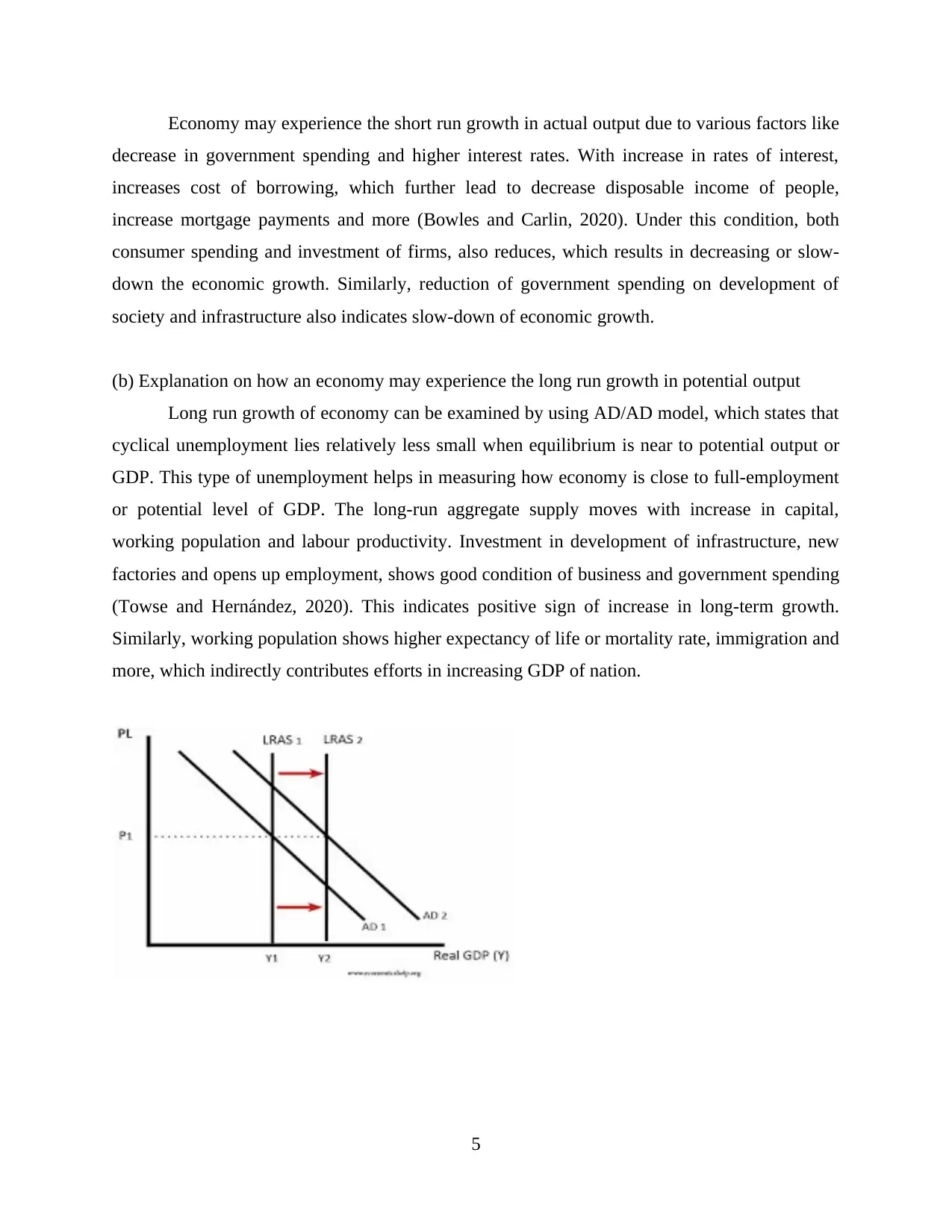
(b) Explanation on how an economy may experience the long run growth in potential output
Long run growth of economy can be examined by using AD/AD model, which states that
cyclical unemployment lies relatively less small when equilibrium is near to potential output or
GDP. This type of unemployment helps in measuring how economy is close to full-employment
or potential level of GDP. The long-run aggregate supply moves with increase in capital,
working population and labour productivity. Investment in development of infrastructure, new
factories and opens up employment, shows good condition of business and government spending
(Towse and Hernández, 2020). This indicates positive sign of increase in long-term growth.
Similarly, working population shows higher expectancy of life or mortality rate, immigration and
more, which indirectly contributes efforts in increasing GDP of nation.
5
tabler-icon-diamond-filled.svg

Paraphrase This Document

Need a fresh take? Get an instant paraphrase of this document with our AI Paraphraser
Document Page
REFERENCES
Books and Journals
Bowles, S., & Carlin, W. (2020). What Students Learn in Economics 101: Time for a
Change. Journal of Economic Literature.
Card, D., & et. al. (2020). Are referees and editors in economics gender neutral?. The Quarterly
Journal of Economics, 135(1), 269-327.
Mankiw, N. G. (2020). Principles of economics. Cengage Learning.
Nagaraj, A., & Stern, S. (2020). The Economics of Maps. Journal of Economic
Perspectives, 34(1), 196-221.
Towse, R., & Hernández, T. N. (Eds.). (2020). Handbook of cultural economics. Edward Elgar
Publishing.
6
chevron_up_icon
1 out of 8
circle_padding
hide_on_mobile
zoom_out_icon
[object Object]