Economic Analysis of IBM: Macroeconomic Exposures and Strategies
VerifiedAdded on 2023/01/17
|24
|5115
|71
Report
AI Summary
This report offers a comprehensive economic analysis of International Business Machines (IBM). It begins with a historical overview of IBM, highlighting its evolution as a global technology and IT consulting firm. The analysis then delves into IBM's business portfolio, examining its Global Business Services, Linux technology center, and Business Transformation Outsourcing divisions. The core of the report focuses on various economic factors impacting IBM, including competitive forces, product differentiation, capital requirements, and cost disadvantages. It also explores macroeconomic exposures such as foreign exchange and taxation, illustrating how these factors influence IBM's revenue and profitability. The report further investigates IBM's vulnerabilities, categorizing them into Type 1 and quasi-fixed costs, and suggests strategies for mitigating business risks. The analysis incorporates relevant economic concepts such as economies of scale, elasticity of demand, and the effects of currency fluctuations. The report concludes by providing insights into IBM's strategic responses to economic challenges, including its approach to managing costs and adapting to market changes.
ECONOMICS ASSIGNMENT 1
Economics assignment
Name
Course
Tutor
University
City/State
Date
Economics assignment
Name
Course
Tutor
University
City/State
Date

Paraphrase This Document
Need a fresh take? Get an instant paraphrase of this document with our AI Paraphraser
ECONOMICS ASSIGNMENT 2
IBM Company history
International Business Machines Corporation, commonly known as IBM dupped as Big
Blue based on its official corporate color is a global computer technology and IT consulting firm
that has its headquarters situated at Armonk, in the US.IBM is one of the few information
technology firms that have a continuous history that goes back to the 19th century. IBM is a
manufacturer and seller of both the hardware and software and provides infrastructure services,
hosting platforms and also consulting services in fields spanning from the computers and
nanotechnology.
IBM is famous for its current history as the global largest computer company and systems
incorporator. Globally, IBM has over 388,000 workers globally. IBM has been ranked as the
largest and the most profitable information technology recruiter across the globe. It is also
reported that IBM has more patents compared to any other US tech company and has eight
research laboratories across the world. IBM boasts of its vast pool of scientists, engineers,
advisors and sales executives in more than 170 countries. IBM is not without three distinct Nobel
prizes and more than five medals of technology. IBM was also listed as being the global top 20
semiconductor sales giant in the past, and it is in 2007 that IBM got ranked as the second in the
list of the largest software enterprises across the globe.
IBM’s business portfolio
Global business services
The global business services division, together with the Global Technology Services that
were incorporated and named as IBM Global Services previously, had the most significant
workforce headcount and ran in a global delivery system.
Linux technology center
IBM Company history
International Business Machines Corporation, commonly known as IBM dupped as Big
Blue based on its official corporate color is a global computer technology and IT consulting firm
that has its headquarters situated at Armonk, in the US.IBM is one of the few information
technology firms that have a continuous history that goes back to the 19th century. IBM is a
manufacturer and seller of both the hardware and software and provides infrastructure services,
hosting platforms and also consulting services in fields spanning from the computers and
nanotechnology.
IBM is famous for its current history as the global largest computer company and systems
incorporator. Globally, IBM has over 388,000 workers globally. IBM has been ranked as the
largest and the most profitable information technology recruiter across the globe. It is also
reported that IBM has more patents compared to any other US tech company and has eight
research laboratories across the world. IBM boasts of its vast pool of scientists, engineers,
advisors and sales executives in more than 170 countries. IBM is not without three distinct Nobel
prizes and more than five medals of technology. IBM was also listed as being the global top 20
semiconductor sales giant in the past, and it is in 2007 that IBM got ranked as the second in the
list of the largest software enterprises across the globe.
IBM’s business portfolio
Global business services
The global business services division, together with the Global Technology Services that
were incorporated and named as IBM Global Services previously, had the most significant
workforce headcount and ran in a global delivery system.
Linux technology center
ECONOMICS ASSIGNMENT 3
IBM always invests more than 1 billion annually in its Linux endeavors globally. With such a
center in India, it has been stated that it contributes significantly to the research and development
of Linux associated IBM products.
Business Transformation Outsourcing
Following the acquisition of Daksh in 2004, it is without a doubt that IBM takes pride in
its formidable BPO service products. For instance, analysts assert that the Bangalore office plays
a crucial role in outsourcing enterprise processes of IBM customers. IBM has played a pivotal
part in sending more than 800 newly recruited workers as of 2008, and the process is still active.
Clothed exposure
A crucial competitive force to reckon with is the threat of new entrants. IBM is one of the
leading providers of IT services, has developed a robust research and development department.
IBM also enjoys the massive capital investments it has made enabling it enjoys huge profits from
its businesses. It has also enabled IBM to assist its customers to succeed by delivering business
value through being creative, efficient, and competitive by utilizing business insight and
information technology.
The level of competition and innovation in the computer market takes place not only in
segmented incorporated lines but also across vertically integrated lines where leaders arise from
different domains. A good illustration is the Intel microprocessors, Microsoft in desktop
software, with networking there is the Novell and Oracle corporation when it comes to database
software. The dominance of IBM when it comes to personal computers has been challenged by
Compaq, Dell, and HP, among others.
The economies of scale deter the entry into the industry by compelling the new entrants to
venture and penetrate the market through large scale operations or accepting the cost
IBM always invests more than 1 billion annually in its Linux endeavors globally. With such a
center in India, it has been stated that it contributes significantly to the research and development
of Linux associated IBM products.
Business Transformation Outsourcing
Following the acquisition of Daksh in 2004, it is without a doubt that IBM takes pride in
its formidable BPO service products. For instance, analysts assert that the Bangalore office plays
a crucial role in outsourcing enterprise processes of IBM customers. IBM has played a pivotal
part in sending more than 800 newly recruited workers as of 2008, and the process is still active.
Clothed exposure
A crucial competitive force to reckon with is the threat of new entrants. IBM is one of the
leading providers of IT services, has developed a robust research and development department.
IBM also enjoys the massive capital investments it has made enabling it enjoys huge profits from
its businesses. It has also enabled IBM to assist its customers to succeed by delivering business
value through being creative, efficient, and competitive by utilizing business insight and
information technology.
The level of competition and innovation in the computer market takes place not only in
segmented incorporated lines but also across vertically integrated lines where leaders arise from
different domains. A good illustration is the Intel microprocessors, Microsoft in desktop
software, with networking there is the Novell and Oracle corporation when it comes to database
software. The dominance of IBM when it comes to personal computers has been challenged by
Compaq, Dell, and HP, among others.
The economies of scale deter the entry into the industry by compelling the new entrants to
venture and penetrate the market through large scale operations or accepting the cost
⊘ This is a preview!⊘
Do you want full access?
Subscribe today to unlock all pages.

Trusted by 1+ million students worldwide
ECONOMICS ASSIGNMENT 4
disadvantage. It is thus correct that scaling economies of production, research, and development
in marketing and services are particularly the significant barriers to penetrating the market for
mainframe computers that is a product of IBM. Companies such as Xerox and GE attempted to
capture the mainframe market but ended up being unsuccessful.
Product differentiation
Product differentiation refers to the recognition of a particular brand. IBM has been in the
industry for many years, can be termed as an old player for hardware and software. IBM has
developed its special features for its products, and one of the most complicated products that
were developed by IBM used in daily life is the billing counter. The billing has a robust domain
in both software and hardware, and this makes it be one of the most efficient and durable with
one of the most prolonged lifecycles. IBM always innovates to accommodate the needs of the
user and attempts to make such products user-friendly. It is such uniqueness and innovation that
forms the product recognition component of IBM.
Capital requirement
Vast amounts of capital need with regards to financial resources needed to compete,
develop a barrier to entry specifically if the capital requirement is required to cater for
unrecoverable expenses in upfront advertising and also in operations entailing research and
development. Regarding IBM, it an old yet highly demanded brand in both the market and the
industry. In the past 29 years, IBM has served as the market leader in IT and has invested huge
capital enabling it to diversify any emerging product offerings. If IBM seeks to expand in the
sector of the database, then the colossal capital requirement for the research and development
and also an advertisement for purposes of raising awareness among the companies and even for
potential customers.
disadvantage. It is thus correct that scaling economies of production, research, and development
in marketing and services are particularly the significant barriers to penetrating the market for
mainframe computers that is a product of IBM. Companies such as Xerox and GE attempted to
capture the mainframe market but ended up being unsuccessful.
Product differentiation
Product differentiation refers to the recognition of a particular brand. IBM has been in the
industry for many years, can be termed as an old player for hardware and software. IBM has
developed its special features for its products, and one of the most complicated products that
were developed by IBM used in daily life is the billing counter. The billing has a robust domain
in both software and hardware, and this makes it be one of the most efficient and durable with
one of the most prolonged lifecycles. IBM always innovates to accommodate the needs of the
user and attempts to make such products user-friendly. It is such uniqueness and innovation that
forms the product recognition component of IBM.
Capital requirement
Vast amounts of capital need with regards to financial resources needed to compete,
develop a barrier to entry specifically if the capital requirement is required to cater for
unrecoverable expenses in upfront advertising and also in operations entailing research and
development. Regarding IBM, it an old yet highly demanded brand in both the market and the
industry. In the past 29 years, IBM has served as the market leader in IT and has invested huge
capital enabling it to diversify any emerging product offerings. If IBM seeks to expand in the
sector of the database, then the colossal capital requirement for the research and development
and also an advertisement for purposes of raising awareness among the companies and even for
potential customers.
Paraphrase This Document
Need a fresh take? Get an instant paraphrase of this document with our AI Paraphraser
ECONOMICS ASSIGNMENT 5
Cost disadvantage
Whenever the cost of the product becomes higher compared to that of a substitute that
has additional properties then it becomes tough to survive in such a market and also the
prevailing firm will attract other firms to such a demand. With regards to IBM, they launched a
laptop characterized by high cost, and this made it hard for people to reach and access such
laptops, particularly the average individuals. This provided a platform and opportunity for other
players such as Dell, HP, and HCL among other players. Thus, IBM lost a share of its market for
its products, and this led to the company selling its laptop department to Lenovo.
Macroeconomic exposures
Foreign exchange
In 2015, IBM seemed to be falling apart, and in the third quarter of 2015, IBM reports
indicated that the company’s revenue had declined more than 14 quarters in a row.IBM’s
revenue had slumped by more than 14% year after year during the third quarter, and this led to
IBM slashing its earnings directory for the whole year.
Cost disadvantage
Whenever the cost of the product becomes higher compared to that of a substitute that
has additional properties then it becomes tough to survive in such a market and also the
prevailing firm will attract other firms to such a demand. With regards to IBM, they launched a
laptop characterized by high cost, and this made it hard for people to reach and access such
laptops, particularly the average individuals. This provided a platform and opportunity for other
players such as Dell, HP, and HCL among other players. Thus, IBM lost a share of its market for
its products, and this led to the company selling its laptop department to Lenovo.
Macroeconomic exposures
Foreign exchange
In 2015, IBM seemed to be falling apart, and in the third quarter of 2015, IBM reports
indicated that the company’s revenue had declined more than 14 quarters in a row.IBM’s
revenue had slumped by more than 14% year after year during the third quarter, and this led to
IBM slashing its earnings directory for the whole year.
ECONOMICS ASSIGNMENT 6
Source: FRED 2018
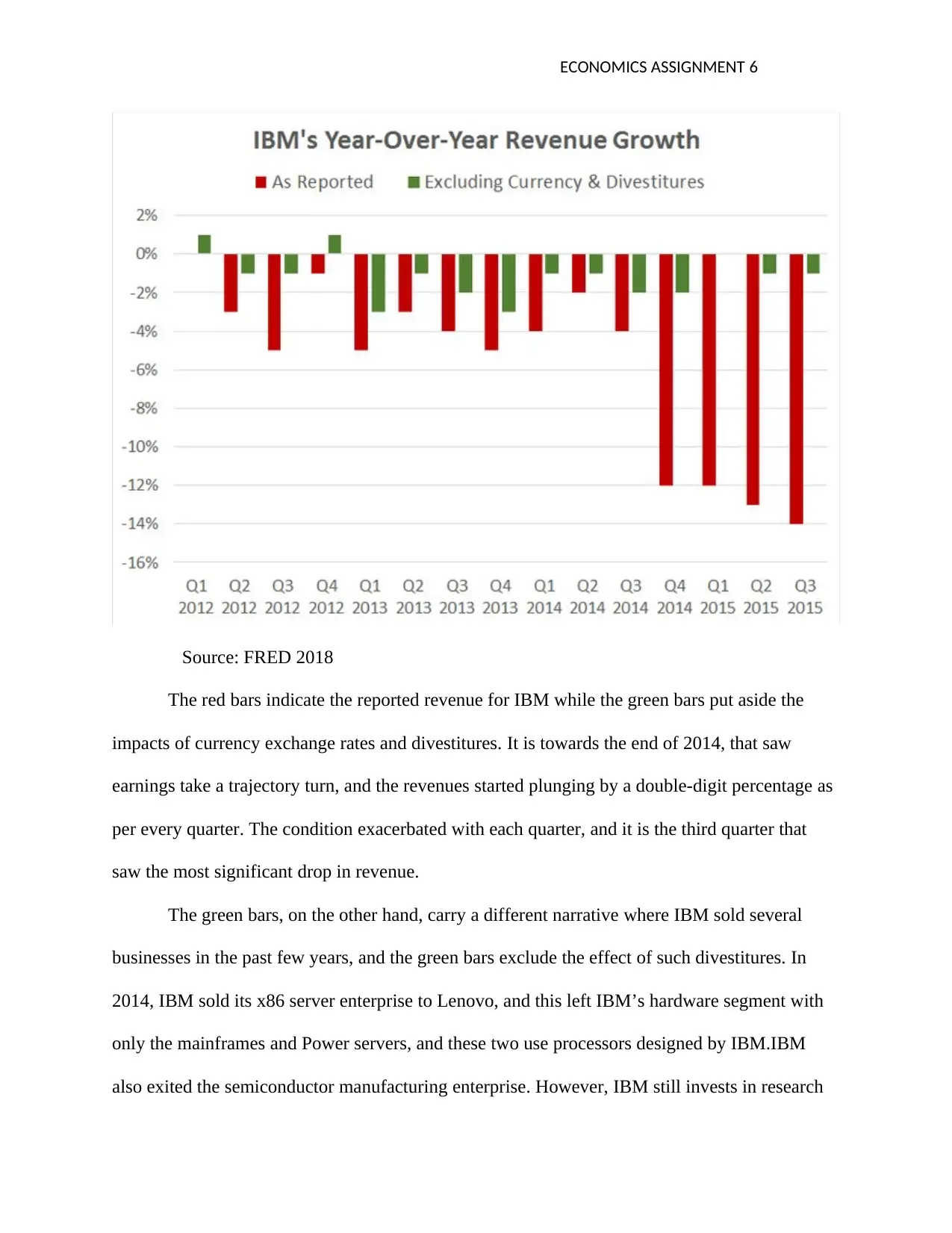
The red bars indicate the reported revenue for IBM while the green bars put aside the
impacts of currency exchange rates and divestitures. It is towards the end of 2014, that saw
earnings take a trajectory turn, and the revenues started plunging by a double-digit percentage as
per every quarter. The condition exacerbated with each quarter, and it is the third quarter that
saw the most significant drop in revenue.
The green bars, on the other hand, carry a different narrative where IBM sold several
businesses in the past few years, and the green bars exclude the effect of such divestitures. In
2014, IBM sold its x86 server enterprise to Lenovo, and this left IBM’s hardware segment with
only the mainframes and Power servers, and these two use processors designed by IBM.IBM
also exited the semiconductor manufacturing enterprise. However, IBM still invests in research
Source: FRED 2018
The red bars indicate the reported revenue for IBM while the green bars put aside the
impacts of currency exchange rates and divestitures. It is towards the end of 2014, that saw
earnings take a trajectory turn, and the revenues started plunging by a double-digit percentage as
per every quarter. The condition exacerbated with each quarter, and it is the third quarter that
saw the most significant drop in revenue.
The green bars, on the other hand, carry a different narrative where IBM sold several
businesses in the past few years, and the green bars exclude the effect of such divestitures. In
2014, IBM sold its x86 server enterprise to Lenovo, and this left IBM’s hardware segment with
only the mainframes and Power servers, and these two use processors designed by IBM.IBM
also exited the semiconductor manufacturing enterprise. However, IBM still invests in research
⊘ This is a preview!⊘
Do you want full access?
Subscribe today to unlock all pages.
Trusted by 1+ million students worldwide
ECONOMICS ASSIGNMENT 7
involving semiconductor and the firm currently outsources the manufacture of semiconductors to
GlobalFoundries.
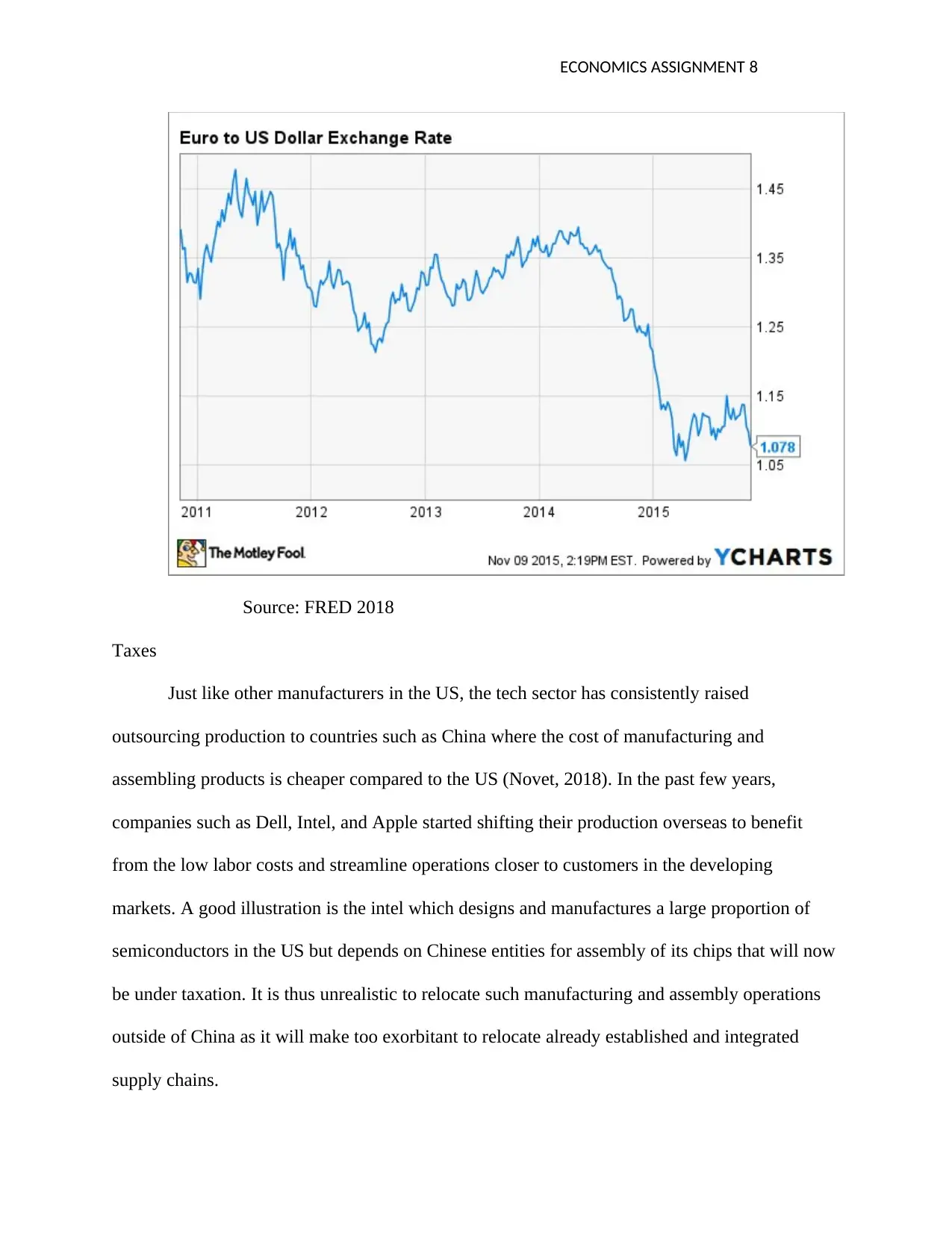
The green bars also exclude the impacts of currency. With the US dollar getting strong,
this means that the revenue earned in other countries translating to a few US dollars. A good
illustration here is how the Euro to US dollar exchange rate has evolved for several years. IBM is
a global business that impacted negatively by currency fluctuations, particularly on its reported
revenue. Below is a good illustration of how the Euro to US dollar exchange rate has evolved. It
is towards the end of 2014 that saw IBM’s revenue tank, particularly in the third quarter of 2014.
However, in 2015, the revenue situation for IBM improved compared to 2013 and 2014. During
the third quarter of 2015, the revenue from Europe, the Middle East, and Africa adjusted
accordingly due to currency and divestitures and grew by 1%.
The red bars seem to demonstrate a firm that is unraveling at the seams, though the green
bars display an accurate picture of how IBM performs. Currency fluctuations remains a
phenomenon, and as demonstrated by the above exchange rate chart, the revenue over the
coming quarters would continue being impacted negatively by currency fluctuation rates.
However, the currency is not under the control of IBM, and this results to decline in both
revenue and profit, and most cases have nothing to do with the performance of IBM functional
enterprises.
involving semiconductor and the firm currently outsources the manufacture of semiconductors to
GlobalFoundries.
The green bars also exclude the impacts of currency. With the US dollar getting strong,
this means that the revenue earned in other countries translating to a few US dollars. A good
illustration here is how the Euro to US dollar exchange rate has evolved for several years. IBM is
a global business that impacted negatively by currency fluctuations, particularly on its reported
revenue. Below is a good illustration of how the Euro to US dollar exchange rate has evolved. It
is towards the end of 2014 that saw IBM’s revenue tank, particularly in the third quarter of 2014.
However, in 2015, the revenue situation for IBM improved compared to 2013 and 2014. During
the third quarter of 2015, the revenue from Europe, the Middle East, and Africa adjusted
accordingly due to currency and divestitures and grew by 1%.
The red bars seem to demonstrate a firm that is unraveling at the seams, though the green
bars display an accurate picture of how IBM performs. Currency fluctuations remains a
phenomenon, and as demonstrated by the above exchange rate chart, the revenue over the
coming quarters would continue being impacted negatively by currency fluctuation rates.
However, the currency is not under the control of IBM, and this results to decline in both
revenue and profit, and most cases have nothing to do with the performance of IBM functional
enterprises.
Paraphrase This Document
Need a fresh take? Get an instant paraphrase of this document with our AI Paraphraser
ECONOMICS ASSIGNMENT 8
Source: FRED 2018
Taxes
Just like other manufacturers in the US, the tech sector has consistently raised
outsourcing production to countries such as China where the cost of manufacturing and
assembling products is cheaper compared to the US (Novet, 2018). In the past few years,
companies such as Dell, Intel, and Apple started shifting their production overseas to benefit
from the low labor costs and streamline operations closer to customers in the developing
markets. A good illustration is the intel which designs and manufactures a large proportion of
semiconductors in the US but depends on Chinese entities for assembly of its chips that will now
be under taxation. It is thus unrealistic to relocate such manufacturing and assembly operations
outside of China as it will make too exorbitant to relocate already established and integrated
supply chains.
Source: FRED 2018
Taxes
Just like other manufacturers in the US, the tech sector has consistently raised
outsourcing production to countries such as China where the cost of manufacturing and
assembling products is cheaper compared to the US (Novet, 2018). In the past few years,
companies such as Dell, Intel, and Apple started shifting their production overseas to benefit
from the low labor costs and streamline operations closer to customers in the developing
markets. A good illustration is the intel which designs and manufactures a large proportion of
semiconductors in the US but depends on Chinese entities for assembly of its chips that will now
be under taxation. It is thus unrealistic to relocate such manufacturing and assembly operations
outside of China as it will make too exorbitant to relocate already established and integrated
supply chains.
ECONOMICS ASSIGNMENT 9
Vulnerabilities
Type 1 Vulnerabilities
There are two primary determinants of the gradient of the SRATC curve. The most
common one is the costs linked to business activities regarding the nature of the business
operations with regards to the goods and services offered by a particular company and the market
dominated by the firm. The average total cost refers to the accumulation of fixed costs incurred
by the firm and is grounded on the amenities/machinery, the raw materials, amount of capital,
and the remuneration on the regular employees. On the other hand, the variable cost refers to
additional expenses required to produce additional units of output one the company has reached
the maximum production with regards to capacity.
The type 1 of vulnerability constitutes of the fixed cost where the larger the fixed costs,
then the more powerful is the effect of falling average costs on average total costs such that the
short-run average total cost becomes steeper making the business vulnerable to external shocks.
Quasi-fixed cost
This refers to high knowledge for its almost irreplaceable workers. IBM is made of many
business units where the costs and output are varying. According to IBM, it can differentiate its
hardware, software, and services.
The hardware brand provided new hardware to boost capacities with regards to calculus
and thermal energy release, and this was associated with increasing the needs from the
perspective of consumers. IBM’s budget for research and development have been robust year
after year as there are innovations from the hardware side of it, making the difference among
rivals commanding high skills. The variable costs for IBM are associated with supply chain
operations.
Vulnerabilities
Type 1 Vulnerabilities
There are two primary determinants of the gradient of the SRATC curve. The most
common one is the costs linked to business activities regarding the nature of the business
operations with regards to the goods and services offered by a particular company and the market
dominated by the firm. The average total cost refers to the accumulation of fixed costs incurred
by the firm and is grounded on the amenities/machinery, the raw materials, amount of capital,
and the remuneration on the regular employees. On the other hand, the variable cost refers to
additional expenses required to produce additional units of output one the company has reached
the maximum production with regards to capacity.
The type 1 of vulnerability constitutes of the fixed cost where the larger the fixed costs,
then the more powerful is the effect of falling average costs on average total costs such that the
short-run average total cost becomes steeper making the business vulnerable to external shocks.
Quasi-fixed cost
This refers to high knowledge for its almost irreplaceable workers. IBM is made of many
business units where the costs and output are varying. According to IBM, it can differentiate its
hardware, software, and services.
The hardware brand provided new hardware to boost capacities with regards to calculus
and thermal energy release, and this was associated with increasing the needs from the
perspective of consumers. IBM’s budget for research and development have been robust year
after year as there are innovations from the hardware side of it, making the difference among
rivals commanding high skills. The variable costs for IBM are associated with supply chain
operations.
⊘ This is a preview!⊘
Do you want full access?
Subscribe today to unlock all pages.
Trusted by 1+ million students worldwide
ECONOMICS ASSIGNMENT 10
The global recession led to the budget allocated for IT to decline, and this has seen the
revenue from the hardware to decline. Despite the amortization cycle is complete, it was not a
priority for the firm to renew the hardware and instead concentrated on the obsolete and end of
support hardware.
The nature of elasticity of demand associated with hardware is medium since similar
companies are in the same situation, and it is a prerequisite for some business operations. Also,
the sales are made through a business partner medium which stands for a back-end
variabilization. Thus, the SRATC falls in between the flute and the saucer where the sales are
primarily made via an enterprise partner medium.
Strategy for reducing business vulnerability
With the world growing and becoming a fast pace environment, the costs have been
associated with exposing the business to both fluctuations and events at the level of
macroeconomics and microeconomics. Based on previous observations, for an enterprise to be
pertinent, it has to manage the situation and manage its resources effectively with regards to the
fixed costs. The variabilization plays a crucial role in deciding the exposure that the business will
be ready to handle that is between the type and type 2 vulnerabilities though the company has to
determine the correct level for the balance between them. The primary purpose is to change the
SRATC curve to ‘S’ curve.
Impact on IBM of the global recession
IBM has three primary business segments which are different in investment and volume
that is revenue and cost, the gross profit margin and also in time with regards to a software
license. Thus, IBM can primarily differentiate hardware, software, and services.
The global recession led to the budget allocated for IT to decline, and this has seen the
revenue from the hardware to decline. Despite the amortization cycle is complete, it was not a
priority for the firm to renew the hardware and instead concentrated on the obsolete and end of
support hardware.
The nature of elasticity of demand associated with hardware is medium since similar
companies are in the same situation, and it is a prerequisite for some business operations. Also,
the sales are made through a business partner medium which stands for a back-end
variabilization. Thus, the SRATC falls in between the flute and the saucer where the sales are
primarily made via an enterprise partner medium.
Strategy for reducing business vulnerability
With the world growing and becoming a fast pace environment, the costs have been
associated with exposing the business to both fluctuations and events at the level of
macroeconomics and microeconomics. Based on previous observations, for an enterprise to be
pertinent, it has to manage the situation and manage its resources effectively with regards to the
fixed costs. The variabilization plays a crucial role in deciding the exposure that the business will
be ready to handle that is between the type and type 2 vulnerabilities though the company has to
determine the correct level for the balance between them. The primary purpose is to change the
SRATC curve to ‘S’ curve.
Impact on IBM of the global recession
IBM has three primary business segments which are different in investment and volume
that is revenue and cost, the gross profit margin and also in time with regards to a software
license. Thus, IBM can primarily differentiate hardware, software, and services.
Paraphrase This Document
Need a fresh take? Get an instant paraphrase of this document with our AI Paraphraser
ECONOMICS ASSIGNMENT 11
IBM is an internationally integrated firm and has a presence across the world and runs a global
delivery across the globe. Due to the existing park, the SRATC curve for hardware is less steep
compared to SRATC Service Build due to the obsolescence of hardware.
The curves for the Software and Services run are the same, for different motives. The
software brand developed software, and once the commodities are available, there are no more
costs associated with regards to fixed and variable costs as the sales channel are based on a
business partner. With regards to the SRATC run services, and there are two primary activities
outsourcing and maintenance. Thus, in the short run, it is true that the customers have made the
variabilization of their fixed cost regarding outsourcing their IT production. This is usually a
long-term contract that spans several years. It is also vital to understand that all inputs of IBM
are mutualized and thus at the start of a new contract, the fixed costs decrease faster compared to
the variable costs.
With regards to maintenance, it is identical where companies know the potential revenue
and cost on an annual basis as the inputs are mutualized also. The SRATC for build services got
impacted robustly; however, due to some delay arising from the robust backlog, the impact of the
recession was only felt towards the end of 2009. It is during this period that several decisions
were assumed to reduce the cost minimally. However, there were few constraints on fixed costs
such vehicles with regards to modification of the types, premises where IBM was no longer the
owner of such buildings and on variable costs regarding cloud computing strategy aimed at
preserving gross profit by minimizing the cost (Asay, 2009). As for the maintenance services, it
was crucial to increase its revenue as there was a decrease in demand for the hardware,
particularly towards the end of the warranty period. This also provided the platform to support
IBM is an internationally integrated firm and has a presence across the world and runs a global
delivery across the globe. Due to the existing park, the SRATC curve for hardware is less steep
compared to SRATC Service Build due to the obsolescence of hardware.
The curves for the Software and Services run are the same, for different motives. The
software brand developed software, and once the commodities are available, there are no more
costs associated with regards to fixed and variable costs as the sales channel are based on a
business partner. With regards to the SRATC run services, and there are two primary activities
outsourcing and maintenance. Thus, in the short run, it is true that the customers have made the
variabilization of their fixed cost regarding outsourcing their IT production. This is usually a
long-term contract that spans several years. It is also vital to understand that all inputs of IBM
are mutualized and thus at the start of a new contract, the fixed costs decrease faster compared to
the variable costs.
With regards to maintenance, it is identical where companies know the potential revenue
and cost on an annual basis as the inputs are mutualized also. The SRATC for build services got
impacted robustly; however, due to some delay arising from the robust backlog, the impact of the
recession was only felt towards the end of 2009. It is during this period that several decisions
were assumed to reduce the cost minimally. However, there were few constraints on fixed costs
such vehicles with regards to modification of the types, premises where IBM was no longer the
owner of such buildings and on variable costs regarding cloud computing strategy aimed at
preserving gross profit by minimizing the cost (Asay, 2009). As for the maintenance services, it
was crucial to increase its revenue as there was a decrease in demand for the hardware,
particularly towards the end of the warranty period. This also provided the platform to support
ECONOMICS ASSIGNMENT 12
the SWG strategy that entailed acquiring of software from other software companies that
impacted the value of software as it depreciated.
However, it is the use of different kind of activities that have led to varying needs of the
market being addressed that is through hefty investment by IBM in emerging markets compared
to mature markets where there is less investment, and this has assisted IBM in sailing through the
global recession.
Market structure
The change experienced by IBM is pivotal as by 2015 IBM product portfolio, which was
more than 50% was slated to be software, and this was a significant transformation. IBM was
famous for computer hardware, specifically the mainframe computers and has now changed to
become the service provider. With regards to the mainframe computers, they exhibited a market
structure that is oligopoly though the market for commodities where IBM is currently competing
can be classified as monopolistic competition.
The monopolistic competition is characterized by increased competitiveness arising from
a large number of sellers. The other feature is that many producers sell commodities that are
differentiated from those of their rivals. The products are also not perfect substitutes, and in the
short run, IBM can operate as a monopoly and enjoy supernormal profits. However, in the long
term, other firms will venture and penetrate the market and the advantages associated with
differentiation decrease.
When many businesses experienced a decline that was conditional to adjustments in
currency fluctuations, IBM got saved through its software enterprise and the reports by
Bloomberg as it grew by 9% when currency adjustments were incorporated. This was a
testament arising from IBM’s forward innovation that led to the purchasing of a variety of high-
the SWG strategy that entailed acquiring of software from other software companies that
impacted the value of software as it depreciated.
However, it is the use of different kind of activities that have led to varying needs of the
market being addressed that is through hefty investment by IBM in emerging markets compared
to mature markets where there is less investment, and this has assisted IBM in sailing through the
global recession.
Market structure
The change experienced by IBM is pivotal as by 2015 IBM product portfolio, which was
more than 50% was slated to be software, and this was a significant transformation. IBM was
famous for computer hardware, specifically the mainframe computers and has now changed to
become the service provider. With regards to the mainframe computers, they exhibited a market
structure that is oligopoly though the market for commodities where IBM is currently competing
can be classified as monopolistic competition.
The monopolistic competition is characterized by increased competitiveness arising from
a large number of sellers. The other feature is that many producers sell commodities that are
differentiated from those of their rivals. The products are also not perfect substitutes, and in the
short run, IBM can operate as a monopoly and enjoy supernormal profits. However, in the long
term, other firms will venture and penetrate the market and the advantages associated with
differentiation decrease.
When many businesses experienced a decline that was conditional to adjustments in
currency fluctuations, IBM got saved through its software enterprise and the reports by
Bloomberg as it grew by 9% when currency adjustments were incorporated. This was a
testament arising from IBM’s forward innovation that led to the purchasing of a variety of high-
⊘ This is a preview!⊘
Do you want full access?
Subscribe today to unlock all pages.
Trusted by 1+ million students worldwide

1 out of 24


Related Documents


Your All-in-One AI-Powered Toolkit for Academic Success.
+13062052269
info@desklib.com
Available 24*7 on WhatsApp / Email
![[object Object]](/_next/static/media/star-bottom.7253800d.svg)
Unlock your academic potential
Copyright © 2020–2026 A2Z Services. All Rights Reserved. Developed and managed by ZUCOL.