Microeconomics Final Exam: Analysis of Economic Principles
VerifiedAdded on 2019/09/16
|5
|1929
|402
Quiz and Exam
AI Summary
This document presents a comprehensive microeconomics exam designed to assess understanding of core economic principles. The exam includes seven questions covering a range of topics, including market power, game theory (Cournot and Prisoners' Dilemma), cost analysis, and market structures (monopoly, duopoly, and cartels). Students are expected to analyze true/false/uncertain statements, solve problems related to consumer and producer surplus, and evaluate the impact of government subsidies and taxes. Furthermore, the exam delves into decision-making under uncertainty, such as auction bidding, and explores production allocation strategies for a monopolist across multiple facilities. Finally, the exam addresses pricing strategies and output allocation in segmented markets, considering scenarios with and without arbitrage opportunities.

Directions:
Download the examination between 12:01 am on Tuesday, December 16, 2014 and 8:30 pm
December 31, 2014. This is an open book exam with hand calculator allowed. Please print your
name clearly below and on each page of your answer sheets. Once downloaded, you are
allowed to complete the examination in three and one-half hours -- three hours in total to focus
on the examination, and one-half hour to allow for downloading/uploading technology-related
logistical snafus. It would be best if you take the examination all in one setting. However, since
some of you may be temporarily interrupted by work or family while taking the exam, the
maximum time we will allow for you to upload the completed exam back is 3 hours after you
initially downloaded the exam (download and upload times will be time stamped). No
examinations will be accepted after midnight, December 31, 2014.
Answer all questions as clearly and legibly as possible. The exam has a total of 180 points. The
number of points and a suggested amount of time is indicated for each question. For those
questions having multiple component parts, we have indicated the point allocation to each
component part. In order to obtain full credit for your answers, you need to show your work.
Download the examination between 12:01 am on Tuesday, December 16, 2014 and 8:30 pm
December 31, 2014. This is an open book exam with hand calculator allowed. Please print your
name clearly below and on each page of your answer sheets. Once downloaded, you are
allowed to complete the examination in three and one-half hours -- three hours in total to focus
on the examination, and one-half hour to allow for downloading/uploading technology-related
logistical snafus. It would be best if you take the examination all in one setting. However, since
some of you may be temporarily interrupted by work or family while taking the exam, the
maximum time we will allow for you to upload the completed exam back is 3 hours after you
initially downloaded the exam (download and upload times will be time stamped). No
examinations will be accepted after midnight, December 31, 2014.
Answer all questions as clearly and legibly as possible. The exam has a total of 180 points. The
number of points and a suggested amount of time is indicated for each question. For those
questions having multiple component parts, we have indicated the point allocation to each
component part. In order to obtain full credit for your answers, you need to show your work.
Paraphrase This Document
Need a fresh take? Get an instant paraphrase of this document with our AI Paraphraser

1. (40 total points, 40 minutes, 5 points for each question) Decide whether each of the
following statements is True, False or Uncertain, and give a brief but clear explanation
supporting your answer. Most of the credit will be given for your explanation.
A. If a firm having market power charges a price for its output that is less than its
marginal cost, it should shut down and cease production.
B. Dominique is planning to bid on an antique piece of fine jewelry in a second price
sealed bid auction. Dominique’s private value for the antique jewelry is $10,000.
Dominique should bid no more than $10,000 for the antique jewelry.
C. Greater diversity among suppliers makes collusion more likely to emerge, since
there is more likely to be something for everyone in the market.
D. A monopolist’s long-run supply curve is that portion of its long-run marginal cost
curve above its long-run average total cost curve.
E. The demand for refrigerators is characterized by a partial adjustment process
(inertia). Suppose a $250 tax is imposed on new refrigerators. The share of the
burden of this tax borne by consumers (as opposed to producers) will rise.
F. Deductibles and cost sharing copayments are tools used by insurers to mitigate or
counter the effects of consumers’ adverse selection into health care insurance plans.
G. Consider a Cournot game in which a Prisoners’ Dilemma-like payoff matrix is
repeated a known finite number of times. In such a case, a tit-for-tat strategy is
optimal.
H. Whenever a firm has market power and can set its own output prices, deadweight
loss will occur. Therefore, any firm having market power reduces economic
efficiency compared to a perfectly competitive market outcome.
2. (30 total points, 30 minutes) Workers must travel from Residentsville to the Workplace
copper mine and return every day. On a monthly basis, the inverse demand for bus rides is
given by
P = 300 – 4Q
where P is in cents per ride and Q is in thousands of rides. The marginal cost of each ride is 50
cents (there are no economies of scale and no fixed costs).
following statements is True, False or Uncertain, and give a brief but clear explanation
supporting your answer. Most of the credit will be given for your explanation.
A. If a firm having market power charges a price for its output that is less than its
marginal cost, it should shut down and cease production.
B. Dominique is planning to bid on an antique piece of fine jewelry in a second price
sealed bid auction. Dominique’s private value for the antique jewelry is $10,000.
Dominique should bid no more than $10,000 for the antique jewelry.
C. Greater diversity among suppliers makes collusion more likely to emerge, since
there is more likely to be something for everyone in the market.
D. A monopolist’s long-run supply curve is that portion of its long-run marginal cost
curve above its long-run average total cost curve.
E. The demand for refrigerators is characterized by a partial adjustment process
(inertia). Suppose a $250 tax is imposed on new refrigerators. The share of the
burden of this tax borne by consumers (as opposed to producers) will rise.
F. Deductibles and cost sharing copayments are tools used by insurers to mitigate or
counter the effects of consumers’ adverse selection into health care insurance plans.
G. Consider a Cournot game in which a Prisoners’ Dilemma-like payoff matrix is
repeated a known finite number of times. In such a case, a tit-for-tat strategy is
optimal.
H. Whenever a firm has market power and can set its own output prices, deadweight
loss will occur. Therefore, any firm having market power reduces economic
efficiency compared to a perfectly competitive market outcome.
2. (30 total points, 30 minutes) Workers must travel from Residentsville to the Workplace
copper mine and return every day. On a monthly basis, the inverse demand for bus rides is
given by
P = 300 – 4Q
where P is in cents per ride and Q is in thousands of rides. The marginal cost of each ride is 50
cents (there are no economies of scale and no fixed costs).

a. (8 points) Suppose that the transit business is perfectly competitive, and there are no
barriers to entry or exit. How many bus rides are sold, at what price are they sold, and
what are the values of consumer and producer surplus?
b. (10 points) Suppose that an exclusive license is obtained by Trailaway to provide transit
services between Residentsville and Workplace, so that Trailaway is a monopoly
provider of these bus rides. How many bus rides are sold, and at what price are they
sold? What are Trailaway’s profits, and what is the deadweight loss relative to (a)
above?
c. (12 points) Suppose that a government subsidy of 40 cents per ride is paid to the
Trailaway monopoly. How many bus rides are sold, and at what price are they sold?
What are Trailaway’s profits, what is the cost of the government subsidy program, and
what is the dead weight loss relative to (a) above?
3. (20 points total, 20 minutes) Bob is deeply in debt, with over $60,000 owed on credit cards
at an annual rate of 20%, and $80,000 owed on student loans at an annual interest rate of 5%.
Yet to maintain appearances, Bob must arrive at work in style. His only options are: (i) to
continue to drive his fancy BMW to work; or (ii) to sell his BMW and hire the Lightning
Limousine Service to chauffer him to work. (Assume Bob gets the same value from either
alternative, and never has any reason to use his car other than to go to work.) Lightning
Limousine charges $18,000 per year (with payment for the full year due at the end of the year).
Bob’s BMW can be sold now for $50,000, whereas a year from now its resale price will only be
$40,000.
a. (10 points) What is the user cost of capital associated with owning the BMW for the
next year?
b. (10 points) Should Bob sell his car and employ Lightning Limousine, or not? Why?
4. (30 total points, 30 minutes) Suppose that two identical firms produce widgets and that they
are the only firms in the market. Their total costs are given by C1 = 30Q1 and C2 = 30Q2, where
Q1 is the output of Firm 1 and Q2 is the output of Firm 2. Price is determined by the following
inverse demand curve:
P = 150 – Q, where Q ≡ Q1 + Q2.
a. (8 points) Find the Cournot-Nash equilibrium. Calculate the profits of each firm at this
equilibrium.
barriers to entry or exit. How many bus rides are sold, at what price are they sold, and
what are the values of consumer and producer surplus?
b. (10 points) Suppose that an exclusive license is obtained by Trailaway to provide transit
services between Residentsville and Workplace, so that Trailaway is a monopoly
provider of these bus rides. How many bus rides are sold, and at what price are they
sold? What are Trailaway’s profits, and what is the deadweight loss relative to (a)
above?
c. (12 points) Suppose that a government subsidy of 40 cents per ride is paid to the
Trailaway monopoly. How many bus rides are sold, and at what price are they sold?
What are Trailaway’s profits, what is the cost of the government subsidy program, and
what is the dead weight loss relative to (a) above?
3. (20 points total, 20 minutes) Bob is deeply in debt, with over $60,000 owed on credit cards
at an annual rate of 20%, and $80,000 owed on student loans at an annual interest rate of 5%.
Yet to maintain appearances, Bob must arrive at work in style. His only options are: (i) to
continue to drive his fancy BMW to work; or (ii) to sell his BMW and hire the Lightning
Limousine Service to chauffer him to work. (Assume Bob gets the same value from either
alternative, and never has any reason to use his car other than to go to work.) Lightning
Limousine charges $18,000 per year (with payment for the full year due at the end of the year).
Bob’s BMW can be sold now for $50,000, whereas a year from now its resale price will only be
$40,000.
a. (10 points) What is the user cost of capital associated with owning the BMW for the
next year?
b. (10 points) Should Bob sell his car and employ Lightning Limousine, or not? Why?
4. (30 total points, 30 minutes) Suppose that two identical firms produce widgets and that they
are the only firms in the market. Their total costs are given by C1 = 30Q1 and C2 = 30Q2, where
Q1 is the output of Firm 1 and Q2 is the output of Firm 2. Price is determined by the following
inverse demand curve:
P = 150 – Q, where Q ≡ Q1 + Q2.
a. (8 points) Find the Cournot-Nash equilibrium. Calculate the profits of each firm at this
equilibrium.
⊘ This is a preview!⊘
Do you want full access?
Subscribe today to unlock all pages.

Trusted by 1+ million students worldwide

b. (8 points) Suppose the two firms form a cartel to maximize joint profits, which they
agree to share equally. How many widgets will each firm produce? Calculate each
firm’s profits.
c. (6 points) Suppose Firm 1 were the only firm in the industry. How would the market
output and Firm 1’s profits differ from that found in part (b) above? Why?
d. (8 points) Returning to the duopoly of part (b), Firm 2 knows that Firm 1 will abide by
the agreement, but Firm 2 decides to take advantage of Firm 1’s credible faithful
commitment by increasing Firm 2’s production. How many widgets will Firm 2 produce?
What will be each firm’s profits?
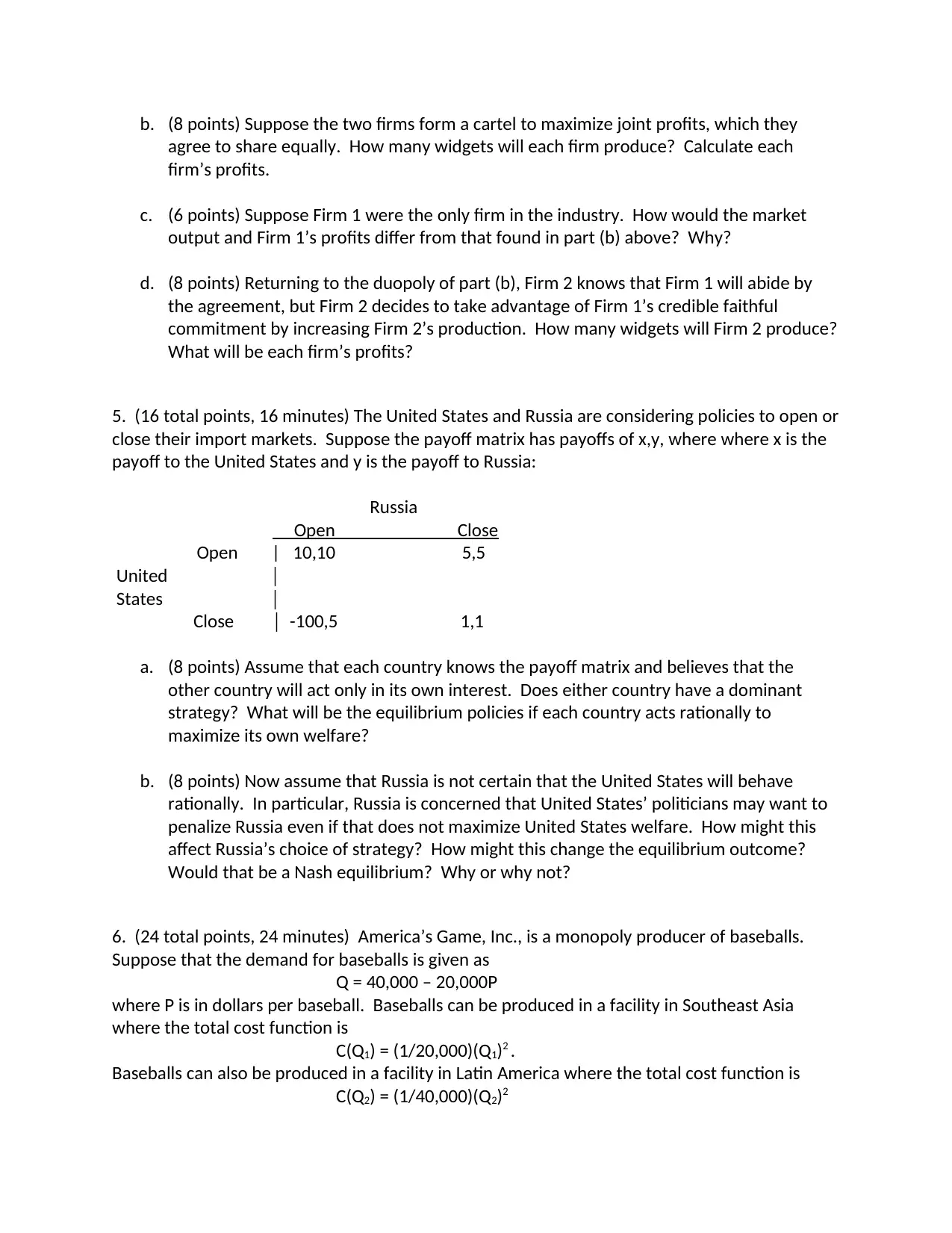
5. (16 total points, 16 minutes) The United States and Russia are considering policies to open or
close their import markets. Suppose the payoff matrix has payoffs of x,y, where where x is the
payoff to the United States and y is the payoff to Russia:
Russia
Open Close
Open | 10,10 5,5
United │
States │
Close │ -100,5 1,1
a. (8 points) Assume that each country knows the payoff matrix and believes that the
other country will act only in its own interest. Does either country have a dominant
strategy? What will be the equilibrium policies if each country acts rationally to
maximize its own welfare?
b. (8 points) Now assume that Russia is not certain that the United States will behave
rationally. In particular, Russia is concerned that United States’ politicians may want to
penalize Russia even if that does not maximize United States welfare. How might this
affect Russia’s choice of strategy? How might this change the equilibrium outcome?
Would that be a Nash equilibrium? Why or why not?
6. (24 total points, 24 minutes) America’s Game, Inc., is a monopoly producer of baseballs.
Suppose that the demand for baseballs is given as
Q = 40,000 – 20,000P
where P is in dollars per baseball. Baseballs can be produced in a facility in Southeast Asia
where the total cost function is
C(Q1) = (1/20,000)(Q1)2 .
Baseballs can also be produced in a facility in Latin America where the total cost function is
C(Q2) = (1/40,000)(Q2)2
agree to share equally. How many widgets will each firm produce? Calculate each
firm’s profits.
c. (6 points) Suppose Firm 1 were the only firm in the industry. How would the market
output and Firm 1’s profits differ from that found in part (b) above? Why?
d. (8 points) Returning to the duopoly of part (b), Firm 2 knows that Firm 1 will abide by
the agreement, but Firm 2 decides to take advantage of Firm 1’s credible faithful
commitment by increasing Firm 2’s production. How many widgets will Firm 2 produce?
What will be each firm’s profits?
5. (16 total points, 16 minutes) The United States and Russia are considering policies to open or
close their import markets. Suppose the payoff matrix has payoffs of x,y, where where x is the
payoff to the United States and y is the payoff to Russia:
Russia
Open Close
Open | 10,10 5,5
United │
States │
Close │ -100,5 1,1
a. (8 points) Assume that each country knows the payoff matrix and believes that the
other country will act only in its own interest. Does either country have a dominant
strategy? What will be the equilibrium policies if each country acts rationally to
maximize its own welfare?
b. (8 points) Now assume that Russia is not certain that the United States will behave
rationally. In particular, Russia is concerned that United States’ politicians may want to
penalize Russia even if that does not maximize United States welfare. How might this
affect Russia’s choice of strategy? How might this change the equilibrium outcome?
Would that be a Nash equilibrium? Why or why not?
6. (24 total points, 24 minutes) America’s Game, Inc., is a monopoly producer of baseballs.
Suppose that the demand for baseballs is given as
Q = 40,000 – 20,000P
where P is in dollars per baseball. Baseballs can be produced in a facility in Southeast Asia
where the total cost function is
C(Q1) = (1/20,000)(Q1)2 .
Baseballs can also be produced in a facility in Latin America where the total cost function is
C(Q2) = (1/40,000)(Q2)2
Paraphrase This Document
Need a fresh take? Get an instant paraphrase of this document with our AI Paraphraser

a. (6 points) What principles and insights from microeconomic theory guide the profit-
maximizing monopolist when allocating the firm’s total production of baseballs into the
two geographically distinct plant facilities?
b. (12 points) Illustrate graphically the monopolist’s problem. What is the monopolist’s
optimal total production level over both production facilities, and what is the optimal
production allocation for baseballs in the two distinct production facilities? Is any
output produced in the Southeast Asia production facility, given that its cost curve is
higher than that for Latin America, at all common output levels? Why or why not?
a. (6 points) What is the optimal price of baseballs (show all calculations)? How many are
produced in Southeast Asia? How many are produced in Latin America? What are total
profits to America’s Game, Inc.?
7. (20 total points, 20 minutes) A monopolist must decide how to price in two markets and
allocate product output between them. The markets are separated geographically (being either
side of a national border). Demands in the two markets are as follows:
Q1 = 30 – 2P1 and Q2 = 24 – P2.
The monopolists total cost are C = 5 + 2(Q1 + Q2).
What are the prices charged, total product shipped to each market, and total profits to the
monopolist under the following two conditions?
a. (12 points) The markets are separated, and no arbitrage is possible (the firm can ship to
both markets, but there is no other trade in the particular product)?
b. (8 points) The border is opened to free trade and possible arbitrage.
maximizing monopolist when allocating the firm’s total production of baseballs into the
two geographically distinct plant facilities?
b. (12 points) Illustrate graphically the monopolist’s problem. What is the monopolist’s
optimal total production level over both production facilities, and what is the optimal
production allocation for baseballs in the two distinct production facilities? Is any
output produced in the Southeast Asia production facility, given that its cost curve is
higher than that for Latin America, at all common output levels? Why or why not?
a. (6 points) What is the optimal price of baseballs (show all calculations)? How many are
produced in Southeast Asia? How many are produced in Latin America? What are total
profits to America’s Game, Inc.?
7. (20 total points, 20 minutes) A monopolist must decide how to price in two markets and
allocate product output between them. The markets are separated geographically (being either
side of a national border). Demands in the two markets are as follows:
Q1 = 30 – 2P1 and Q2 = 24 – P2.
The monopolists total cost are C = 5 + 2(Q1 + Q2).
What are the prices charged, total product shipped to each market, and total profits to the
monopolist under the following two conditions?
a. (12 points) The markets are separated, and no arbitrage is possible (the firm can ship to
both markets, but there is no other trade in the particular product)?
b. (8 points) The border is opened to free trade and possible arbitrage.
1 out of 5
Related Documents
Your All-in-One AI-Powered Toolkit for Academic Success.
+13062052269
info@desklib.com
Available 24*7 on WhatsApp / Email
Unlock your academic potential
Copyright © 2020–2026 A2Z Services. All Rights Reserved. Developed and managed by ZUCOL.