Scarcity and Opportunity Cost: An Economics Assignment

Verified

Added on  2022/11/25

|4
|332
|96
Homework Assignment
AI Summary
This economics assignment explores the concepts of scarcity and opportunity cost. It defines scarcity as the limited availability of resources and opportunity cost as the value of the next best alternative forgone when making a choice. The assignment provides examples, such as outsourcing services to developing countries and Saudi Arabia's chemical production, to illustrate these concepts. It differentiates between explicit costs (direct monetary payments) and implicit costs (opportunity costs not involving direct payment). The solution references relevant economic literature, including Buchanan (2017) and Dudley (2017), to support its analysis of scarcity and opportunity cost in various economic scenarios.
Document Page
Running head: SCARCITY AND OPPORTUNITY COST
Scarcity and Opportunity Cost
Name of the Student
Name of the University
Author note
tabler-icon-diamond-filled.svg

Paraphrase This Document

Need a fresh take? Get an instant paraphrase of this document with our AI Paraphraser
Document Page
1SCARCITY AND OPPORTUNITY COST
Table of Contents
Answer to Question.........................................................................................................................2
Reference.........................................................................................................................................3
Document Page
2SCARCITY AND OPPORTUNITY COST
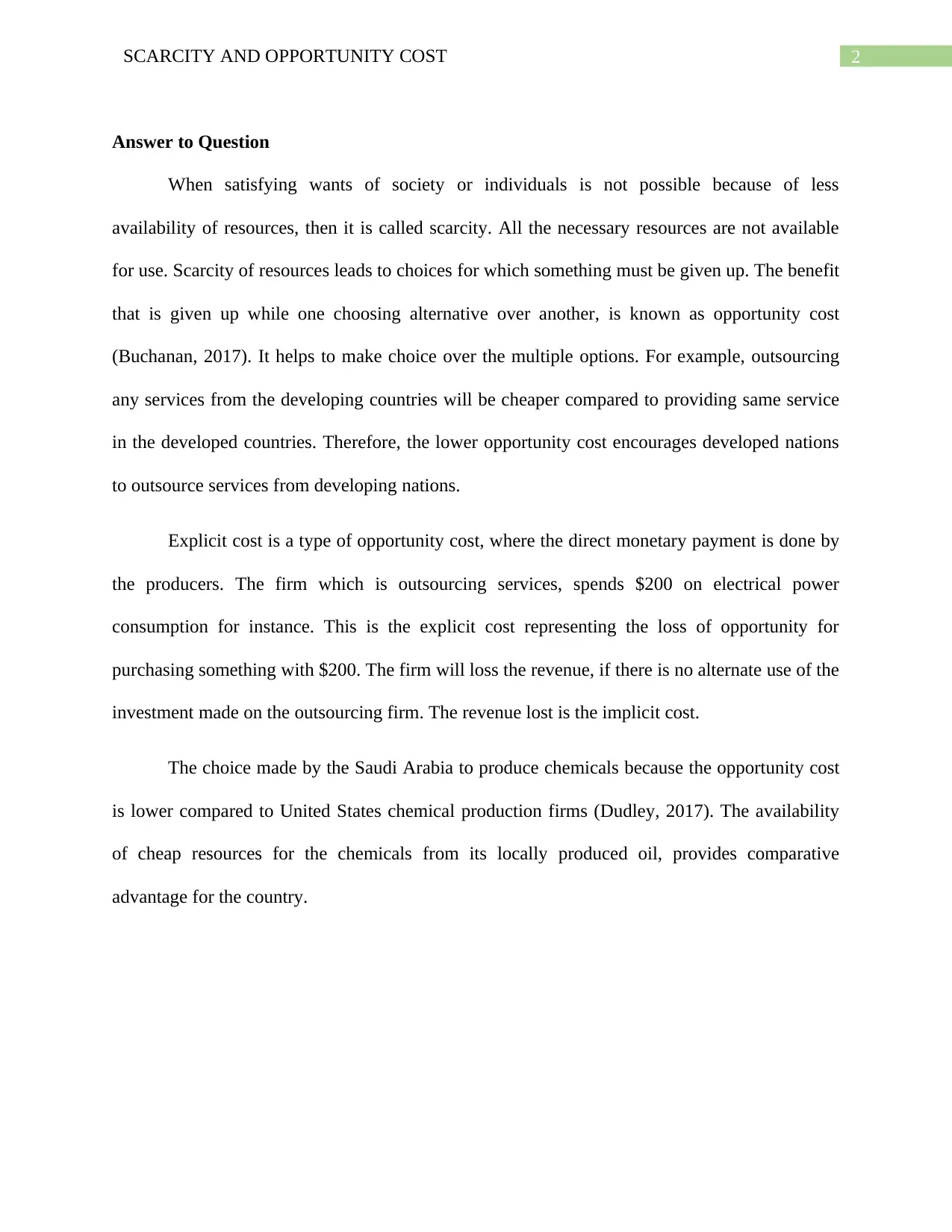
Answer to Question
When satisfying wants of society or individuals is not possible because of less
availability of resources, then it is called scarcity. All the necessary resources are not available
for use. Scarcity of resources leads to choices for which something must be given up. The benefit
that is given up while one choosing alternative over another, is known as opportunity cost
(Buchanan, 2017). It helps to make choice over the multiple options. For example, outsourcing
any services from the developing countries will be cheaper compared to providing same service
in the developed countries. Therefore, the lower opportunity cost encourages developed nations
to outsource services from developing nations.
Explicit cost is a type of opportunity cost, where the direct monetary payment is done by
the producers. The firm which is outsourcing services, spends $200 on electrical power
consumption for instance. This is the explicit cost representing the loss of opportunity for
purchasing something with $200. The firm will loss the revenue, if there is no alternate use of the
investment made on the outsourcing firm. The revenue lost is the implicit cost.
The choice made by the Saudi Arabia to produce chemicals because the opportunity cost
is lower compared to United States chemical production firms (Dudley, 2017). The availability
of cheap resources for the chemicals from its locally produced oil, provides comparative
advantage for the country.
Document Page
3SCARCITY AND OPPORTUNITY COST
Reference
Buchanan, J. M. (2017). Opportunity cost. The new Palgrave dictionary of economics, 1-5.
Dudley, S. E. (2017). Retrospective evaluation of chemical regulations.
chevron_up_icon
1 out of 4
circle_padding
hide_on_mobile
zoom_out_icon
[object Object]