Case Study: Copyright Infringement of Economics Textbook (IRAC)

Verified

Added on  2022/08/09

|3
|386
|17
Case Study
AI Summary
This case study examines a copyright infringement issue involving Hanna, an economics textbook author. The assignment explores whether Hanna can successfully sue Anne, Blake, and David for copyright violations. Anne copied a chapter for her class, Blake used Hanna's textbook knowledge, and David's textbook mirrored Hanna's work. The analysis follows the IRAC method (Issue, Rule, Application, Conclusion), focusing on copyright law and its application to each situation. The solution concludes that Hanna can likely sue Anne and David for infringement but not Blake. The assignment highlights the importance of copyright registration and the legal recourse available to copyright holders against infringers. The solution references relevant legal concepts and case precedents to support its conclusions, providing a comprehensive understanding of copyright protection in the context of intellectual property law and economics.
Document Page
Running head: INFRINGING COPYRIGHT 1
Infringing Copyright
Name
Institutional Affiliation
tabler-icon-diamond-filled.svg

Paraphrase This Document

Need a fresh take? Get an instant paraphrase of this document with our AI Paraphraser
Document Page
INFRINGING COPYRIGHT 3
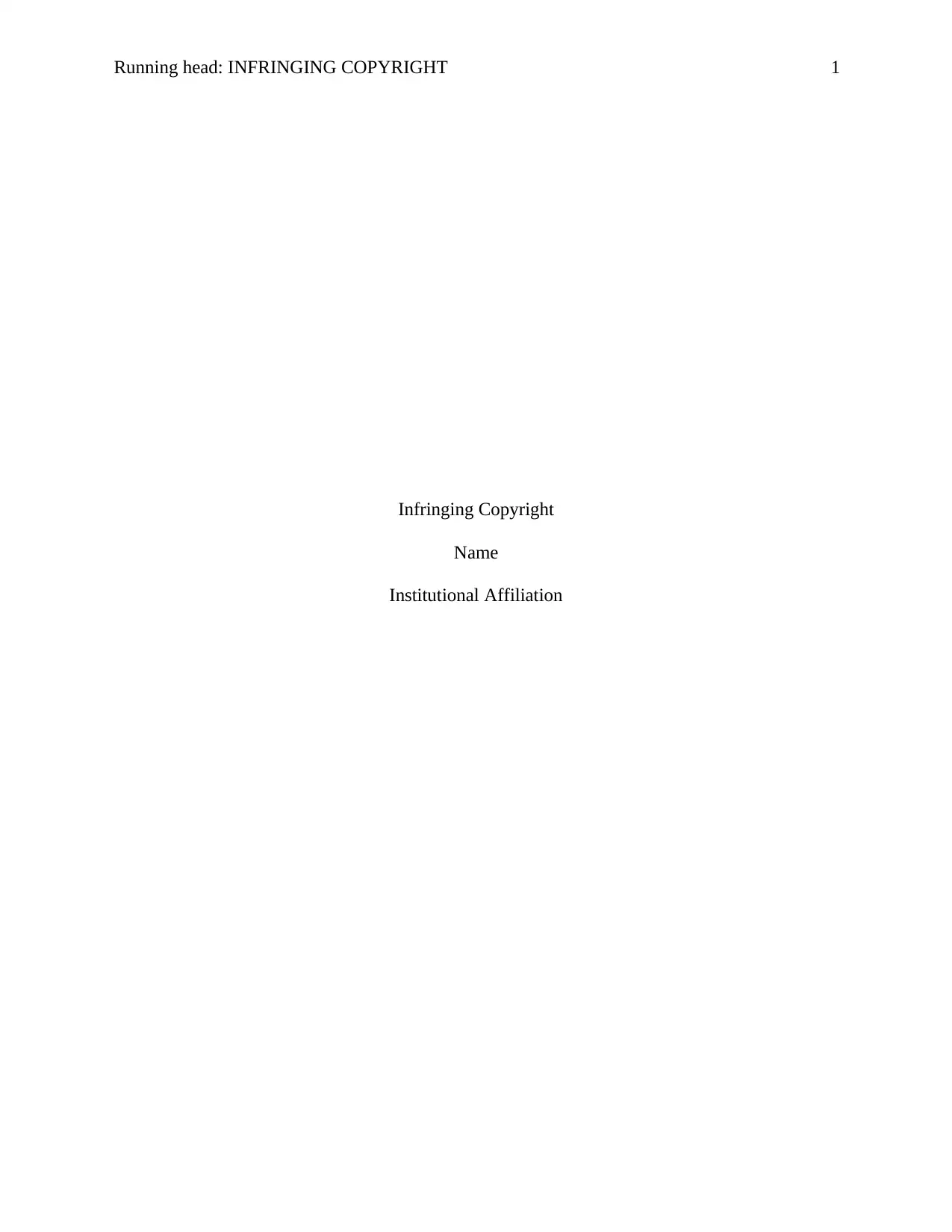
INFRINGING COPYRIGHT
Issue
The main issue in this instance is whether Hanna can successfully sue either Anne, David
or Blake for infringing her copyright.
Rule
The rule which applies to this case is the Copyright laws. Copyright law confers the
exclusive right on the copyright owner (Hanna) to reproduce or authorize work reproduction in
any material from including storage of it in any medium through electronic means.
Analysis
Hanna can successfully sue Anne for duplication of her original work by copying her
book and disseminating it to her students to read against the copyright laws. Hanna’s work is
infringed by Anne’s actions when Anne reproduces many photocopies of Hanna’s original book.
Anne never asked for permission from Hanna before duplicating her work hence copyright Act
gives Hanna a legal recourse (Jamali, 2017). Hanna solely needs to prove that she sent a warning
letter known as cease and desist so to Anne, however, she ignored it went ahead with her acts of
infringement. Hanna also needs to prove that she had registered her copyright with copyright
office prior to defendant infringing it. If Hanna had never registered, she can still file
infringement lawsuit demanding compensation for her damaged work (Walker, 2019). Hanna
can successfully sue David for infringing her copyright by reproducing her book chapters and
arranging them similar to Hanna’s original book. David duplicated Hanna’s original textbook
and solely paraphrased the 2nd name of title to “Lucid Thinking” from “Lucid Reasoning” and
making it appear like his independent work.
Conclusion
Document Page
INFRINGING COPYRIGHT 3
Hanna can successfully manage to sue both David and Anne, but not Blake provided she
had registered her copyright and provided substantial proof that her work stood infringed.
References
Jamali, H. R. (2017). Copyright compliance and infringement in ResearchGate full-text journal
articles. Scientometrics, 112(1), 241-254.
Walker, A. (2019). True gold: damages for infringement of copyright in music. Journal of
Intellectual Property Law & Practice.
chevron_up_icon
1 out of 3
circle_padding
hide_on_mobile
zoom_out_icon
[object Object]