Report on Uranium Demand and Supply: Economic Factors and Outlook

Verified

Added on  2020/03/01

|5
|1349
|49
Report
AI Summary
This economics report analyzes the recent decline in uranium prices, attributing it to factors like the Fukushima disaster and shifting global energy policies. It examines the interplay of demand and supply, illustrating how decreased demand from developed nations, particularly after the Fukushima incident and the subsequent move towards renewable energy sources, has led to price drops. The report discusses the impact on the uranium mining industry, including project postponements and bankruptcies, while also considering potential future demand from developing countries like China and India. It concludes that while the short-term outlook remains soft, medium to long-term demand, particularly driven by developing nations and technological advancements, could lead to price recovery. The report references key economic theories and provides a comprehensive overview of the uranium market's current state and future prospects.
Document Page
Economics For Business
Demand and Supply for Uranium
Student Id:
8/3/2016
tabler-icon-diamond-filled.svg

Paraphrase This Document

Need a fresh take? Get an instant paraphrase of this document with our AI Paraphraser
Document Page
ECONOMICS FOR BUSINESS
Introduction
Currently, there is an immense amount of hue and cry with regards to global warming and
hence the global focus is on generation of clean energy which would not only fuel the future
economic growth but would also address the issue of environmental pollution. One of the
solutions in this regard relates to the use of uranium for generating nuclear energy which does
not result in greenhouse emissions. Considering Australian exports of uranium, it is one of
the critical resources that the nation has. However, in the last two to three years, the price of
uranium has plummeted which has caused havoc for the uranium mining industry (Green,
2016). The objective of the given report is to analyse the recent fall in uranium prices with
reference to economic theory and the potential outlook for future in uranium prices.
Discussion
In accordance with the theory of demand and supply, the equilibrium price of an underlying
product or commodity is determined by the relative demand supply forces and the demand
supply gap that tends to exist. These forces are particularly critical for commodities as there
are market driven prices for various grades of the underlying mineral. Considering the
demand supply situation, the price of these commodities tends to vary in real time and thus
impacts the dynamics of the mining industry (Mankiw, 2014).
There has been a severe fall in the uranium prices which have reached a 13 year low in 2014.
The key factor responsible for the same is the Fukushima disaster which raised question
marks over the underlying safety of nuclear energy. The sentiments were severely dampened
when one of the technologically advanced nations such as Japan had to suffer a meltdown. As
a result, a negative propaganda has begun which has led to the termination of existing nuclear
plants and delay with regards to construction of new ones. A case in point is Japan which
after this indicated closed down all the 48 operational nuclear reactors (FOE, 2013).
The developed countries were quick to take a decision in regards to nuclear plants phase out
in the favour of renewable sources of energy which is particularly true for European countries
particularly Netherlands and Germany. Prior to this incident, these nations had sizable
generation of electricity in the form of nuclear power, but migration from nuclear energy
meant fall in demand of uranium by these nations. In the developing world, there are safety
concerns which has given rise to protests which has stalled the construction of new nuclear
plants which would adversely impact future demand (Green, 2014).
1
Document Page
ECONOMICS FOR BUSINESS
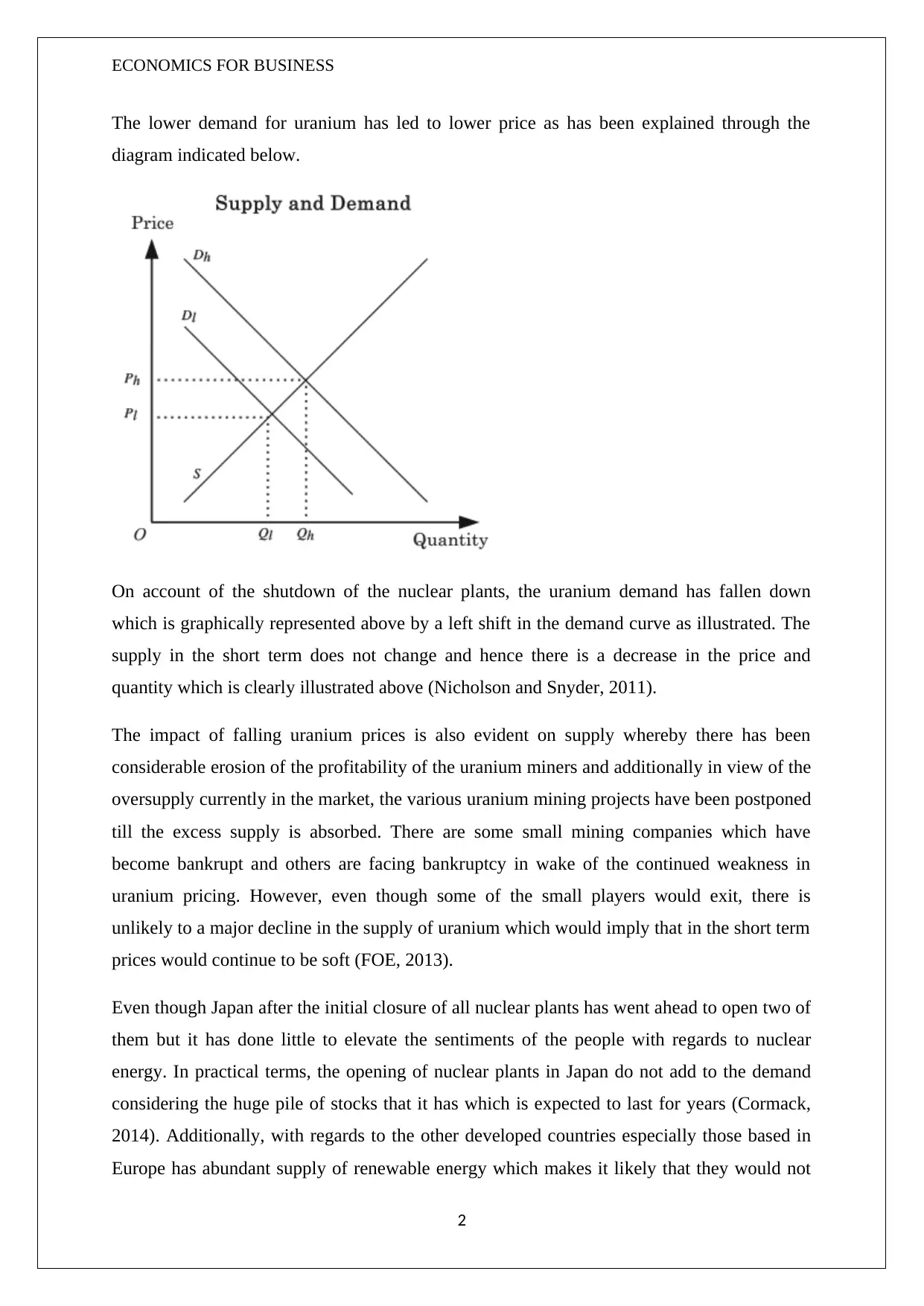
The lower demand for uranium has led to lower price as has been explained through the
diagram indicated below.
On account of the shutdown of the nuclear plants, the uranium demand has fallen down
which is graphically represented above by a left shift in the demand curve as illustrated. The
supply in the short term does not change and hence there is a decrease in the price and
quantity which is clearly illustrated above (Nicholson and Snyder, 2011).
The impact of falling uranium prices is also evident on supply whereby there has been
considerable erosion of the profitability of the uranium miners and additionally in view of the
oversupply currently in the market, the various uranium mining projects have been postponed
till the excess supply is absorbed. There are some small mining companies which have
become bankrupt and others are facing bankruptcy in wake of the continued weakness in
uranium pricing. However, even though some of the small players would exit, there is
unlikely to a major decline in the supply of uranium which would imply that in the short term
prices would continue to be soft (FOE, 2013).
Even though Japan after the initial closure of all nuclear plants has went ahead to open two of
them but it has done little to elevate the sentiments of the people with regards to nuclear
energy. In practical terms, the opening of nuclear plants in Japan do not add to the demand
considering the huge pile of stocks that it has which is expected to last for years (Cormack,
2014). Additionally, with regards to the other developed countries especially those based in
Europe has abundant supply of renewable energy which makes it likely that they would not
2
Document Page
ECONOMICS FOR BUSINESS
shift to nuclear energy in the future. Also, the humungous nuclear liability is also a concern
for western nations due to which there is a tepid response to nuclear plants in the west. Thus,
it is quite apparent that with regards to uranium demand the picture seems quite bad with
regards to developed nations and potentially only the developing world could prove to e
beacon of hope for the uranium miners (McHugh, 2016).
The developing nations such as China and India have severe power shortages and hence are
actively looking at nuclear power to serve the ever growing energy needs. Considering China
and the mode of operations, it is highly likely that state owned Chinese mining companies
may buyout uranium mines abroad preferably in Africa so as to ensure energy security.
However, some demand would still be continued to be met by imports where Australian
manufacturers could pinch in (Green, 2014). India on the other hand is likely to depend more
on imports and hence provide a medium to long term opportunity for the Australian uranium
miners (McHugh, 2016). However, the technological advancements particularly in the form
of breeder reactors also need to be considered which tend to be highly fuel efficient and
hence acts as a dampener for future uranium demand. Thus, it is likely in view of the above
factors that uranium demand would pick up only in the medium to long term (Levit, 2016).
Conclusion
It is apparent that the demand for uranium has plummeted on account of safety concerns. The
developed world seems to have permanently migrated from nuclear plants and it is likely that
the future demand would come primarily from developing countries. However, considering
the gestation period in construction, negative public opinion and the technological
advancements going forward, it is highly likely that the price of uranium would improve only
in the medium to long term.
3
tabler-icon-diamond-filled.svg

Paraphrase This Document

Need a fresh take? Get an instant paraphrase of this document with our AI Paraphraser
Document Page
ECONOMICS FOR BUSINESS
References
Cormack. L. (2014), Uranium jumps as Japan reopens reactors, Retrieved on August 22,
2017 from http://www.afr.com/markets/commodities/uranium-jumps-as-japan-
reopens-reactors-20141112-11l8li
FOE (2013), Uranium price slumps, Paladin Energy in trouble, Retrieved on August 22,
2017 from http://www.foe.org.au/uranium-price-slumps-paladin-energy-trouble
Green, J. (2014), Uranium − how low can it go?, Retrieved on August 22, 2017 from
http://www.businessspectator.com.au/article/2014/5/29/energy-markets/uranium-
%E2%88%92-how-low-can-it-go
Green, J. (2016), Australia’s uranium industry foundering – ?nearly dead, i Retrieved on
August 22, 2017 from
https://nuclearinformation.wordpress.com/2016/06/12/australias-uranium-industry-
foundering-nearly-dead/comment-page-1/
Levit, D. (2016), Uranium Prices Recovery Could Take 10 Years, Retrieved on August 22,
2017 from http://www.economiccalendar.com/2016/05/13/uranium-prices-recovery-
could-take-10-years/
Mankiw, G. (2014), Microeconomics (6th edition), London: Worth Publishers
McHugh, B. (2016), Uranium price increase around corner as China and India look to
nuclear to reduce carbon emissions, Retrieved on August 22, 2017 from
http://www.abc.net.au/news/2016-03-09/uranium-future-price-set-to-improve-as-new-
plants-built/7232944
Nicholson, W. and Snyder, C. (2011), Fundamentals of Microeconomics (11th ed.), New
York: Cengage Learning
4
chevron_up_icon
1 out of 5
circle_padding
hide_on_mobile
zoom_out_icon
[object Object]