Evaluating Customer Response to Discount Offers on Magazine Sales
VerifiedAdded on 2023/04/21
|11
|3138
|357
Case Study
AI Summary
This case study research proposal aims to evaluate customer response to discount offers on magazine sales, specifically focusing on The Economist. The study will employ a descriptive design and inductive approach, gathering data from both primary (questionnaires from marketing managers) and secondary sources (books, journals, and online articles). The research seeks to identify the effectiveness of discount offers in attracting customers, understand their impact on Economist magazine sales, assess factors influencing purchase behavior, and recommend effective ways for The Economist to enhance customer response. The expected outcomes include insights into how discount offers influence customer behavior, enhance magazine sales, and contribute to customer retention and improved market performance for The Economist. Ethical considerations and limitations of the study are also addressed, along with a proposed timeframe for completion.

RESEARCH PROPOSAL

Paraphrase This Document
Need a fresh take? Get an instant paraphrase of this document with our AI Paraphraser
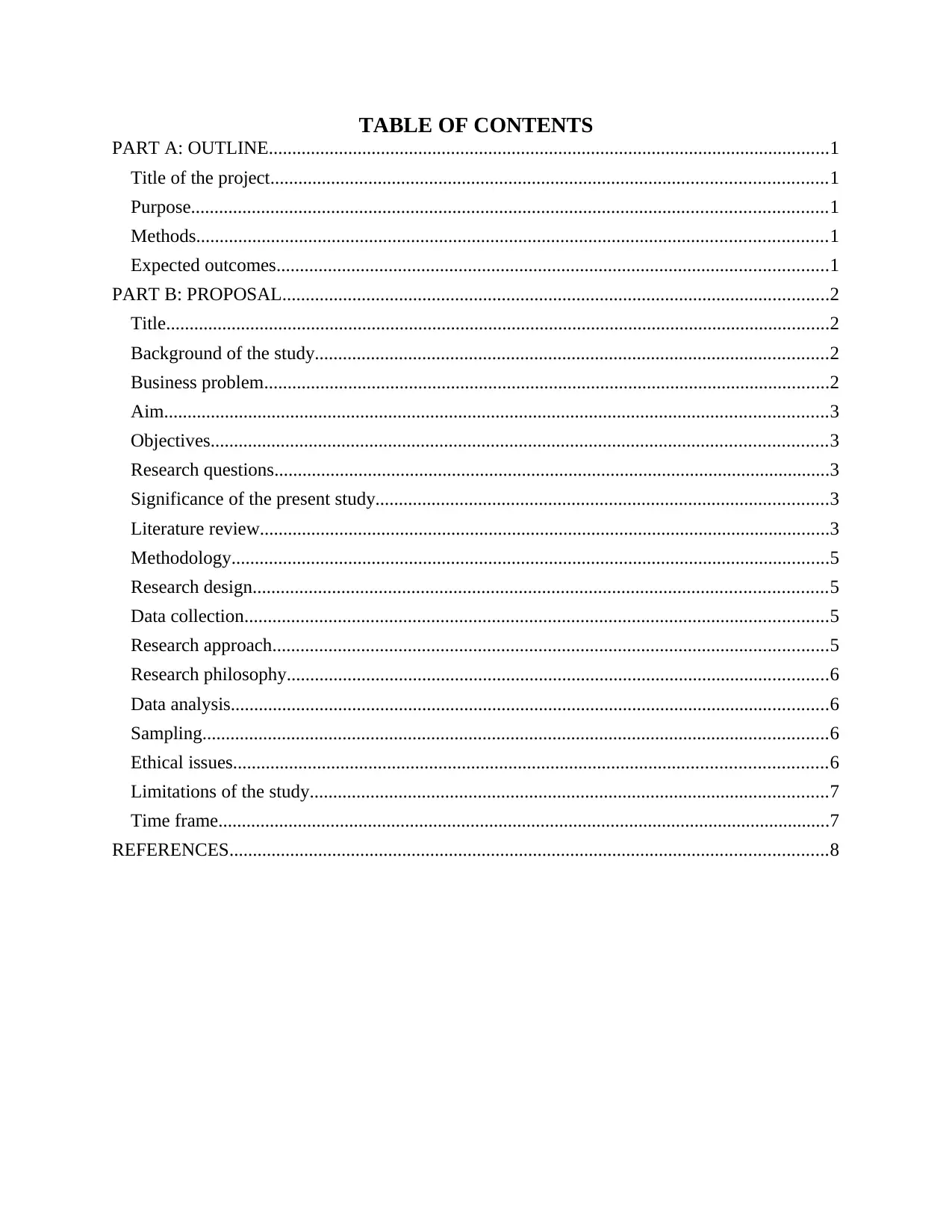
TABLE OF CONTENTS
PART A: OUTLINE........................................................................................................................1
Title of the project.......................................................................................................................1
Purpose........................................................................................................................................1
Methods.......................................................................................................................................1
Expected outcomes......................................................................................................................1
PART B: PROPOSAL.....................................................................................................................2
Title..............................................................................................................................................2
Background of the study..............................................................................................................2
Business problem.........................................................................................................................2
Aim..............................................................................................................................................3
Objectives....................................................................................................................................3
Research questions.......................................................................................................................3
Significance of the present study.................................................................................................3
Literature review..........................................................................................................................3
Methodology................................................................................................................................5
Research design...........................................................................................................................5
Data collection.............................................................................................................................5
Research approach.......................................................................................................................5
Research philosophy....................................................................................................................6
Data analysis................................................................................................................................6
Sampling......................................................................................................................................6
Ethical issues...............................................................................................................................6
Limitations of the study...............................................................................................................7
Time frame...................................................................................................................................7
REFERENCES................................................................................................................................8
PART A: OUTLINE........................................................................................................................1
Title of the project.......................................................................................................................1
Purpose........................................................................................................................................1
Methods.......................................................................................................................................1
Expected outcomes......................................................................................................................1
PART B: PROPOSAL.....................................................................................................................2
Title..............................................................................................................................................2
Background of the study..............................................................................................................2
Business problem.........................................................................................................................2
Aim..............................................................................................................................................3
Objectives....................................................................................................................................3
Research questions.......................................................................................................................3
Significance of the present study.................................................................................................3
Literature review..........................................................................................................................3
Methodology................................................................................................................................5
Research design...........................................................................................................................5
Data collection.............................................................................................................................5
Research approach.......................................................................................................................5
Research philosophy....................................................................................................................6
Data analysis................................................................................................................................6
Sampling......................................................................................................................................6
Ethical issues...............................................................................................................................6
Limitations of the study...............................................................................................................7
Time frame...................................................................................................................................7
REFERENCES................................................................................................................................8
PART A: OUTLINE
Title of the project
To evaluate the customer response to discount offer on magazine sales: A case study of
the Economist.
Purpose
The main purpose behind conducting the present study will be to assess the response of
customers in favour of discount offers and its overall impact on sales of magazine. Further, in the
modern era with the motive to boost sales of the product, discounts are provided by the company
and this has favourable impact on the overall performance. Apart from this, providing discount to
customers on continuous basis acts as source of attraction where target market can be easily
influenced to purchase products offered by the business (Payne and Frow, 2013). Therefore, it is
also considered to be beneficial for business in the market and in turn allows dealing with
challenges present in the business environment. Generally, magazines are read with the motive to
gain different types of information and for satisfying need of information, various companies are
offering magazines in the market. Therefore, providing discount and other types of attractive
offers on the product is considered to be effective and in turn; this saves money which is being
spent by customers in purchasing any specific commodity in the market.
Methods
For conducting the present study in effective manner, different methods will be
employed. Descriptive design will be undertaken along with inductive approach. Data will be
gathered from both sources namely primary and secondary. Primary information will be
collected with the help of questionnaire and secondary through books, journals and online
articles. Sample size of 5 marketing managers working in Economist will be undertaken through
purposive sampling technique. Further, for analysing information, qualitative technique will be
adopted where different themes will be formed. So, these are some of the methods which will be
undertaken for conducting present research.
Expected outcomes
From the entire research, it will be expected that discount offers and other types of
schemes provided on the magazines influences customer response. Further, it allows in
1
Title of the project
To evaluate the customer response to discount offer on magazine sales: A case study of
the Economist.
Purpose
The main purpose behind conducting the present study will be to assess the response of
customers in favour of discount offers and its overall impact on sales of magazine. Further, in the
modern era with the motive to boost sales of the product, discounts are provided by the company
and this has favourable impact on the overall performance. Apart from this, providing discount to
customers on continuous basis acts as source of attraction where target market can be easily
influenced to purchase products offered by the business (Payne and Frow, 2013). Therefore, it is
also considered to be beneficial for business in the market and in turn allows dealing with
challenges present in the business environment. Generally, magazines are read with the motive to
gain different types of information and for satisfying need of information, various companies are
offering magazines in the market. Therefore, providing discount and other types of attractive
offers on the product is considered to be effective and in turn; this saves money which is being
spent by customers in purchasing any specific commodity in the market.
Methods
For conducting the present study in effective manner, different methods will be
employed. Descriptive design will be undertaken along with inductive approach. Data will be
gathered from both sources namely primary and secondary. Primary information will be
collected with the help of questionnaire and secondary through books, journals and online
articles. Sample size of 5 marketing managers working in Economist will be undertaken through
purposive sampling technique. Further, for analysing information, qualitative technique will be
adopted where different themes will be formed. So, these are some of the methods which will be
undertaken for conducting present research.
Expected outcomes
From the entire research, it will be expected that discount offers and other types of
schemes provided on the magazines influences customer response. Further, it allows in
1
⊘ This is a preview!⊘
Do you want full access?
Subscribe today to unlock all pages.

Trusted by 1+ million students worldwide
enhancing sales of the magazine. Moreover, providing discount will be beneficial for Economist
Company also where it is possible for business to retain its customers for longer period of time
and will enhance market performance which is one of the main motives of organisation. So,
these will be some of the expected outcomes of the present research.
PART B: PROPOSAL
Title
To evaluate the customer response to discount offer on magazine sales: A case study of
the Economist.
Background of the study
The present study will be based on assessing the response of customers in relation with
the discount offers on magazine sales. Further, for conducting the entire study, Economist
magazine will be chosen which is considered as one of the leading magazine by Economist
group. With the motive to enhance sales volume of the magazine, discount and other type of
offers are continuously launched by business and this allows in attracting large number of
customers (Schultz and Block, 2014). Moreover, it is well known fact that for sustaining in the
market for longer period of time, it is required for businesses to introduce some additional offers
and this directly supports in influencing purchase decision of the target market. Apart from this,
it has direct impact on sales volume of the product where due to presence of discount; more
products are purchased which proves to be profitable for business in the market.
Economist group is considered as the leading source analysis in international business
along with major affairs in the world. Further, large amount of information is delivered to the
people living in the society through newspapers, magazines etc (About us, 2016). The kind of
data being shared by business is reliable and trusted too. Company is famous worldwide and is
headquartered in the city of Westminster, London. Principal activities of the business involve
conferences, magazines and market intelligence.
Business problem
The problem associated with the present study will be to assess the customer response to
discount offers on magazine sales. Further, majority of the businesses operating in the market are
dealing with the issue to offer products in the market due to rise in competition level. Apart from
2
Company also where it is possible for business to retain its customers for longer period of time
and will enhance market performance which is one of the main motives of organisation. So,
these will be some of the expected outcomes of the present research.
PART B: PROPOSAL
Title
To evaluate the customer response to discount offer on magazine sales: A case study of
the Economist.
Background of the study
The present study will be based on assessing the response of customers in relation with
the discount offers on magazine sales. Further, for conducting the entire study, Economist
magazine will be chosen which is considered as one of the leading magazine by Economist
group. With the motive to enhance sales volume of the magazine, discount and other type of
offers are continuously launched by business and this allows in attracting large number of
customers (Schultz and Block, 2014). Moreover, it is well known fact that for sustaining in the
market for longer period of time, it is required for businesses to introduce some additional offers
and this directly supports in influencing purchase decision of the target market. Apart from this,
it has direct impact on sales volume of the product where due to presence of discount; more
products are purchased which proves to be profitable for business in the market.
Economist group is considered as the leading source analysis in international business
along with major affairs in the world. Further, large amount of information is delivered to the
people living in the society through newspapers, magazines etc (About us, 2016). The kind of
data being shared by business is reliable and trusted too. Company is famous worldwide and is
headquartered in the city of Westminster, London. Principal activities of the business involve
conferences, magazines and market intelligence.
Business problem
The problem associated with the present study will be to assess the customer response to
discount offers on magazine sales. Further, majority of the businesses operating in the market are
dealing with the issue to offer products in the market due to rise in competition level. Apart from
2
Paraphrase This Document
Need a fresh take? Get an instant paraphrase of this document with our AI Paraphraser
this, offering discount and delivering other types of benefit is the best way adopted by companies
to attract customers. But in case of magazines, firm has to identify the effective ways through
which sales can be maximised easily and in turn, it proves to be beneficial for the company.
Therefore, these will be the major problems linked with the study.
Aim
The main aim behind carrying out the present study will be; “To evaluate the customer
response to discount offer on magazine sales: A case study of the Economist”.
Objectives
Following objectives will be developed for the research which is as follows:
To identify the effectiveness of discount offers in attracting customers.
To understand the impact of discount offers on sales of Economist magazines.
To assess the factors influencing purchase behaviour of customers.
To recommend the effective ways through which Economist can better influence its
customer response.
Research questions
How effective are the discount offers in attracting customers?
What is the impact of discount offers on sales of Economist magazines?
What are the factors influencing purchase behaviour of customers?
Significance of the present study
The entire study carried out will be beneficial at both corporate and academic level.
Further, at corporate level, findings will be useful for various businesses where it is possible to
develop more effective discount offers and other forms of schemes. Apart from this, companies
can know whether providing monetary benefits to the customers can enhance sales volume or
not. On the other hand, study is also beneficial for academic level where students and other types
of learners will know the significance of discount offers and how its acts as source of attraction
in case of customers. Providing monetary benefits is a kind of promotion through which it is easy
for businesses to enhance their sales volume in the market and can support to deal with the range
of challenges present in the business environment.
3
to attract customers. But in case of magazines, firm has to identify the effective ways through
which sales can be maximised easily and in turn, it proves to be beneficial for the company.
Therefore, these will be the major problems linked with the study.
Aim
The main aim behind carrying out the present study will be; “To evaluate the customer
response to discount offer on magazine sales: A case study of the Economist”.
Objectives
Following objectives will be developed for the research which is as follows:
To identify the effectiveness of discount offers in attracting customers.
To understand the impact of discount offers on sales of Economist magazines.
To assess the factors influencing purchase behaviour of customers.
To recommend the effective ways through which Economist can better influence its
customer response.
Research questions
How effective are the discount offers in attracting customers?
What is the impact of discount offers on sales of Economist magazines?
What are the factors influencing purchase behaviour of customers?
Significance of the present study
The entire study carried out will be beneficial at both corporate and academic level.
Further, at corporate level, findings will be useful for various businesses where it is possible to
develop more effective discount offers and other forms of schemes. Apart from this, companies
can know whether providing monetary benefits to the customers can enhance sales volume or
not. On the other hand, study is also beneficial for academic level where students and other types
of learners will know the significance of discount offers and how its acts as source of attraction
in case of customers. Providing monetary benefits is a kind of promotion through which it is easy
for businesses to enhance their sales volume in the market and can support to deal with the range
of challenges present in the business environment.
3
Literature review
As per view of Bourassa, Cunningham and Handelman (2013), in the modern era every
organisation operates in the market where competition level is quite high and with the motive to
attract customers various effective ways are undertaken by businesses. Further, it is well known
fact that buyer decision is influenced by large number of factors and they are price, quality,
monetary benefits etc (Bourassa, Cunningham and Handelman, 2013). Apart from this, when
additional benefits are provided to the customers with the help of discount then, they prefer to
buy commodities on continuous basis and in turn sales volume of the business enhances.
Moreover, in case of magazines and other types of commodities, introducing discount scheme is
much more effective through which purchase decision of the customers can be easily enhanced.
In short, it acts as source of competitive advantage for the business and in turn allows dealing
with the challenges present in the business environment. However, Ndubisi and Moi (2005)
argued that, in various situations customers behave positively when monetary benefits are
provided to them by organisation and this supports in building strength of the business. Apart
from this, it also provides base in dealing with large number of issues in the market such as
competition and other form of barriers (Ndubisi and Moi, 2005).
On the other hand, it is well known fact that to maximise sales volume is one of the main
motives of every organisation and this can be only accomplished if company applies efforts in
satisfying needs of its target market. Businesses who are indulged into practices of delivering
market intelligence services and conferences totally rely on the type of information being shared
by them with their customers (Payne and Frow, 2013). Therefore, sometime it becomes difficult
to sustain in the market due to presence of different challenges. Further, promotion is essential
for every type of business and when discount and other schemes are introduced then, it directly
attracts customers towards product in the market. Moreover, without providing monetary
benefits, it is not possible for any company to sustain in the market for longer period of time and
sometime it may have negative impact on the brand image of business.
As per view of Murthy (2009), providing discount on the products helps to boost sales of
the enterprise where business can easily sell large number of products in specific period of time.
In short, retaining customers becomes easier where monetary benefits are delivered to them and
in turn; it has positive impact on brand image also (Murthy, 2009). Further, every individual
living in the society has some sort of expectation from company and when promotional tools are
4
As per view of Bourassa, Cunningham and Handelman (2013), in the modern era every
organisation operates in the market where competition level is quite high and with the motive to
attract customers various effective ways are undertaken by businesses. Further, it is well known
fact that buyer decision is influenced by large number of factors and they are price, quality,
monetary benefits etc (Bourassa, Cunningham and Handelman, 2013). Apart from this, when
additional benefits are provided to the customers with the help of discount then, they prefer to
buy commodities on continuous basis and in turn sales volume of the business enhances.
Moreover, in case of magazines and other types of commodities, introducing discount scheme is
much more effective through which purchase decision of the customers can be easily enhanced.
In short, it acts as source of competitive advantage for the business and in turn allows dealing
with the challenges present in the business environment. However, Ndubisi and Moi (2005)
argued that, in various situations customers behave positively when monetary benefits are
provided to them by organisation and this supports in building strength of the business. Apart
from this, it also provides base in dealing with large number of issues in the market such as
competition and other form of barriers (Ndubisi and Moi, 2005).
On the other hand, it is well known fact that to maximise sales volume is one of the main
motives of every organisation and this can be only accomplished if company applies efforts in
satisfying needs of its target market. Businesses who are indulged into practices of delivering
market intelligence services and conferences totally rely on the type of information being shared
by them with their customers (Payne and Frow, 2013). Therefore, sometime it becomes difficult
to sustain in the market due to presence of different challenges. Further, promotion is essential
for every type of business and when discount and other schemes are introduced then, it directly
attracts customers towards product in the market. Moreover, without providing monetary
benefits, it is not possible for any company to sustain in the market for longer period of time and
sometime it may have negative impact on the brand image of business.
As per view of Murthy (2009), providing discount on the products helps to boost sales of
the enterprise where business can easily sell large number of products in specific period of time.
In short, retaining customers becomes easier where monetary benefits are delivered to them and
in turn; it has positive impact on brand image also (Murthy, 2009). Further, every individual
living in the society has some sort of expectation from company and when promotional tools are
4
⊘ This is a preview!⊘
Do you want full access?
Subscribe today to unlock all pages.
Trusted by 1+ million students worldwide
employed by management then, customers perceive organisation positively. Apart from this, to
deal with the situation of rise in competition level in the market delivering monetary benefit to
the customer is the best way and it can assist in enhancing satisfaction level of target market.
However, Tian and Keep (2002) argued that to retain customers for longer period of time is
considered as one of the most difficult tasks for business and to accomplish this aim, some
additional benefits have to be given. Positive response of customers when discount is offered
enhances business performance in the form of high market share and profitability (Tian
and Keep, 2002).
Moreover, it assists company to sustain in the market for longer period of time and has
positive impact on the brand image also. Further, the decision making process of consumer is
complex in nature and is influenced by large number of factors. Therefore, it is must for business
to consider all the factors so that level of customer satisfaction can be enhanced easily. No doubt
price, quality matters but providing monetary benefit is also must so that target market may
respond positively.
Methodology
Research design
It is regarded as the blueprint of the study and supports in knowing the type of research
being carried out (Flick, 2011). Different types of designs are present which are employed in the
research such as exploratory, descriptive, explanatory etc. Considering the nature of present
research, descriptive design will be undertaken where main stress will be on providing
description of the topic being selected. Further, this will support in knowing the response of
customers when discounts are provided and how it maximises sales of the business in the market.
Due to this reason, stated design will be selected.
Data collection
Data collection is one of the most important parts of the study where two sources are
present with the motive to acquire accurate information (Sreedharan, 2007). Two sources present
are primary and secondary. In the present research, both sources will be undertaken where
primary information will be gathered with the help of questionnaire from marketing managers
working in the Economist. Further, secondary information will be obtained with the help of
books, journals and online articles. Therefore, in this way, different types of information will be
gathered which will support in accomplishing aim and objectives of the study.
5
deal with the situation of rise in competition level in the market delivering monetary benefit to
the customer is the best way and it can assist in enhancing satisfaction level of target market.
However, Tian and Keep (2002) argued that to retain customers for longer period of time is
considered as one of the most difficult tasks for business and to accomplish this aim, some
additional benefits have to be given. Positive response of customers when discount is offered
enhances business performance in the form of high market share and profitability (Tian
and Keep, 2002).
Moreover, it assists company to sustain in the market for longer period of time and has
positive impact on the brand image also. Further, the decision making process of consumer is
complex in nature and is influenced by large number of factors. Therefore, it is must for business
to consider all the factors so that level of customer satisfaction can be enhanced easily. No doubt
price, quality matters but providing monetary benefit is also must so that target market may
respond positively.
Methodology
Research design
It is regarded as the blueprint of the study and supports in knowing the type of research
being carried out (Flick, 2011). Different types of designs are present which are employed in the
research such as exploratory, descriptive, explanatory etc. Considering the nature of present
research, descriptive design will be undertaken where main stress will be on providing
description of the topic being selected. Further, this will support in knowing the response of
customers when discounts are provided and how it maximises sales of the business in the market.
Due to this reason, stated design will be selected.
Data collection
Data collection is one of the most important parts of the study where two sources are
present with the motive to acquire accurate information (Sreedharan, 2007). Two sources present
are primary and secondary. In the present research, both sources will be undertaken where
primary information will be gathered with the help of questionnaire from marketing managers
working in the Economist. Further, secondary information will be obtained with the help of
books, journals and online articles. Therefore, in this way, different types of information will be
gathered which will support in accomplishing aim and objectives of the study.
5
Paraphrase This Document
Need a fresh take? Get an instant paraphrase of this document with our AI Paraphraser
Research approach
It is associated with the plan and procedure linked with the research. Two types of
approaches are present which are inductive and deductive (Saunders, 2003). In inductive
approach, results move from specific to general and vice versa in case of deductive approach. In
the present study, inductive approach will be undertaken where entire research will be carried out
from view point of Economist magazines and on the basis of same, recommendations will be
provided to other firms providing information with the help of magazines etc. The main reason
due to which deductive approach will not be selected is that study will not be carried out in
general form.
Research philosophy
It is regarded as the belief where data in relation with phenomenon can be gathered,
analyzed and used (Christopher, 2014). Two type of philosophies are present namely positivism
and interpretivism. In positivism philosophy, world is perceived as external and in
interpretivism, main focus is on interpreting results. In the present study, interpretivism
philosophy will be used where research will focus on interpreting the results so-as-to accomplish
expected findings with the help of this. Therefore, this will also support in accomplishing aim of
the research in every possible manner.
Data analysis
It is also considered as one of the most important part of the study where data is analysed
through qualitative and quantitative tools (Flick, 2011). In the present study, data will be
analysed through qualitative tools where different themes will be formed on the basis of primary
data. This will support in knowing the overall response of the respondents. On the other hand,
quantitative tools will not be considered as data is present in non numeric form.
Sampling
Before conducting any study, it is necessary to adopt appropriate sample size. In the
present study, sample size of 5 marketing managers of Economist group will be undertaken and
technique of purposive sampling will be employed for the same. Through this sample size, it will
become easy to gather adequate amount of information from the respondents and this will assist
in answering all the research questions.
6
It is associated with the plan and procedure linked with the research. Two types of
approaches are present which are inductive and deductive (Saunders, 2003). In inductive
approach, results move from specific to general and vice versa in case of deductive approach. In
the present study, inductive approach will be undertaken where entire research will be carried out
from view point of Economist magazines and on the basis of same, recommendations will be
provided to other firms providing information with the help of magazines etc. The main reason
due to which deductive approach will not be selected is that study will not be carried out in
general form.
Research philosophy
It is regarded as the belief where data in relation with phenomenon can be gathered,
analyzed and used (Christopher, 2014). Two type of philosophies are present namely positivism
and interpretivism. In positivism philosophy, world is perceived as external and in
interpretivism, main focus is on interpreting results. In the present study, interpretivism
philosophy will be used where research will focus on interpreting the results so-as-to accomplish
expected findings with the help of this. Therefore, this will also support in accomplishing aim of
the research in every possible manner.
Data analysis
It is also considered as one of the most important part of the study where data is analysed
through qualitative and quantitative tools (Flick, 2011). In the present study, data will be
analysed through qualitative tools where different themes will be formed on the basis of primary
data. This will support in knowing the overall response of the respondents. On the other hand,
quantitative tools will not be considered as data is present in non numeric form.
Sampling
Before conducting any study, it is necessary to adopt appropriate sample size. In the
present study, sample size of 5 marketing managers of Economist group will be undertaken and
technique of purposive sampling will be employed for the same. Through this sample size, it will
become easy to gather adequate amount of information from the respondents and this will assist
in answering all the research questions.
6
Ethical issues
Ethics are the moral principles and they play significant role in the entire study
(Saunders, 2003). In the present study, various ethical issues will be faced as information will be
obtained from marketing managers of Economist group and it will be possible that they may not
prefer to share information. Generally, from the internal sources of company, it is difficult to
obtain information as it is confidential. Therefore, this ethical issue will be faced due to which
managers of company may not prefer to share confidential information. Further, to deal with
issue, confidential information will be stored in secured place and this will assist in dealing with
this challenge.
Limitations of the study
In the present study, various limitations will be present where time will be one of them.
Researcher will gather information from 5 marketing managers of Economist and it will
consume time. Apart from this, it will enhance overall cost associated with the study. Apart from
this, the entire study will only be restricted to economist group which is also a limitation.
Therefore, these will be some of the major limitations in the research.
Time frame
Activity/Week 1 2 3 4 5 6 7 8 9 10 11 12
Formulating research proposal
Assessment of primary and secondary data
Developing research objectives
Determination of research approach
Drafting the research methodology
Development of the questionnaire
Collecting the primary data
7
Ethics are the moral principles and they play significant role in the entire study
(Saunders, 2003). In the present study, various ethical issues will be faced as information will be
obtained from marketing managers of Economist group and it will be possible that they may not
prefer to share information. Generally, from the internal sources of company, it is difficult to
obtain information as it is confidential. Therefore, this ethical issue will be faced due to which
managers of company may not prefer to share confidential information. Further, to deal with
issue, confidential information will be stored in secured place and this will assist in dealing with
this challenge.
Limitations of the study
In the present study, various limitations will be present where time will be one of them.
Researcher will gather information from 5 marketing managers of Economist and it will
consume time. Apart from this, it will enhance overall cost associated with the study. Apart from
this, the entire study will only be restricted to economist group which is also a limitation.
Therefore, these will be some of the major limitations in the research.
Time frame
Activity/Week 1 2 3 4 5 6 7 8 9 10 11 12
Formulating research proposal
Assessment of primary and secondary data
Developing research objectives
Determination of research approach
Drafting the research methodology
Development of the questionnaire
Collecting the primary data
7
⊘ This is a preview!⊘
Do you want full access?
Subscribe today to unlock all pages.
Trusted by 1+ million students worldwide
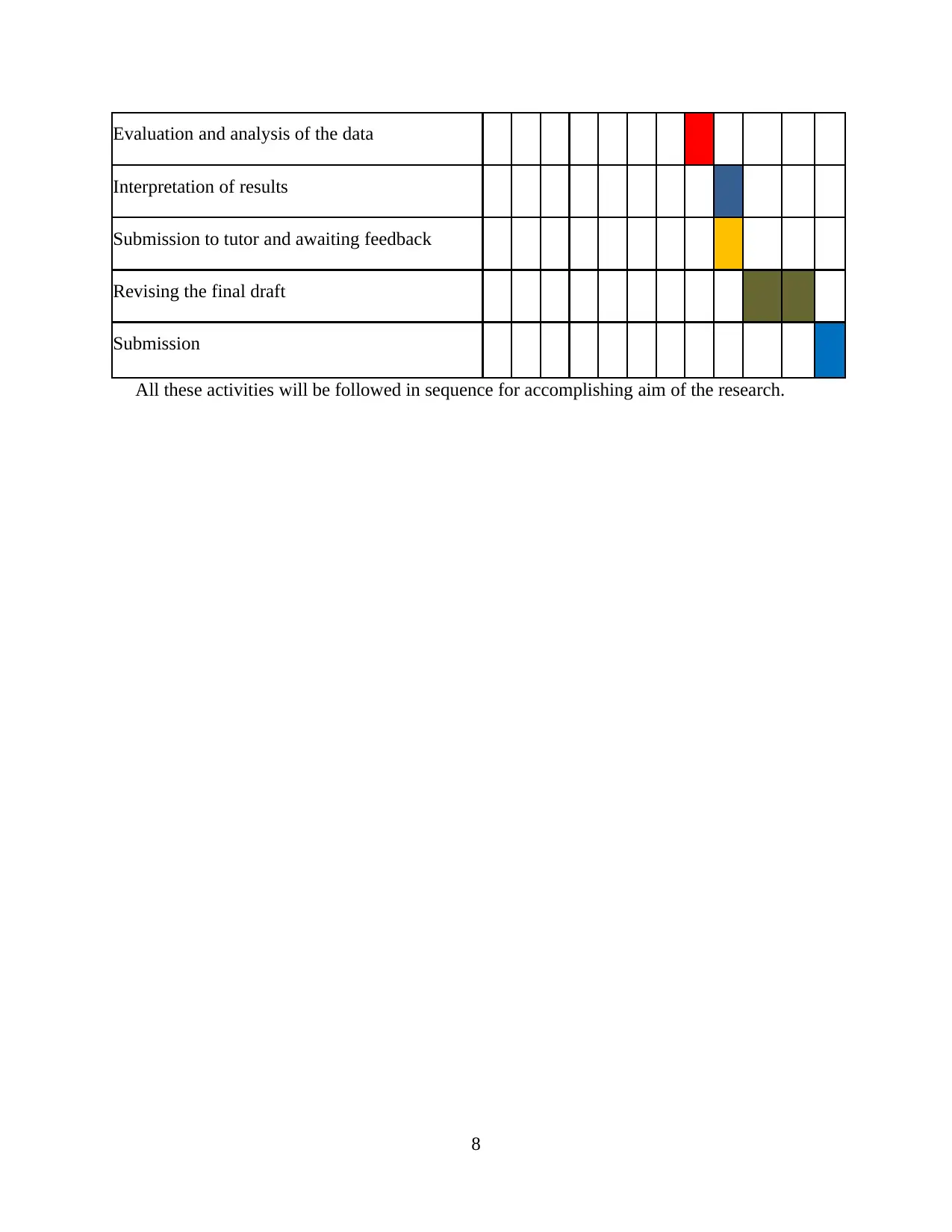
Evaluation and analysis of the data
Interpretation of results
Submission to tutor and awaiting feedback
Revising the final draft
Submission
All these activities will be followed in sequence for accomplishing aim of the research.
8
Interpretation of results
Submission to tutor and awaiting feedback
Revising the final draft
Submission
All these activities will be followed in sequence for accomplishing aim of the research.
8
Paraphrase This Document
Need a fresh take? Get an instant paraphrase of this document with our AI Paraphraser
REFERENCES
Books and Journals
Bourassa, A. M. Cunningham, H H. P. and Handelmanand Handelman, M. J., 2013. Marketing
as a response to paradox and norms in the 1960s and 1970s. Journal of Historical Research
in Marketing. 5(1). pp.47 – 70.
Christopher, H., 2014. Qualitative research – mixed emotions. Qualitative Research in
Accounting & Management. 11(1). pp.51–70.
Flick, U., 2011. Introducing Research Methodology: A Beginner's Guide to Doing a Research
Project. SAGE.
Murthy, 2009. Advertising. Excel Books India.
Ndubisi, N. and Moi, C., 2005. Customers behaviourial responses to sales promotion: the role of
fear of losing face. Asia Pacific Journal of Marketing and Logistics. 17(1). pp.32 – 49.
Payne, A. and Frow, P., 2013. Strategic Customer Management: Integrating Relationship
Marketing and CRM. Cambridge University Press.
Saunders, M., 2003. Research Methods for Business Students. Pearson Education India.
Schultz , E. D. and Block, P. M., 2014. Sales promotion influencing consumer brand
preferences/purchases. Journal of Consumer Marketing. 31(3). pp.212 – 217.
Sreedharan, 2007. A Manual of Historical Research Methodology. South Indian Studies.
Tian, K. and Keep, B., 2002. Customer Fraud and Business Responses: Let the Marketer
Beware. Greenwood Publishing Group.
Online
About us. 2016. [Online]. Accessed through < http://www.economist.com/help/about-us>.
[Accessed on 7th April, 2016].
9
Books and Journals
Bourassa, A. M. Cunningham, H H. P. and Handelmanand Handelman, M. J., 2013. Marketing
as a response to paradox and norms in the 1960s and 1970s. Journal of Historical Research
in Marketing. 5(1). pp.47 – 70.
Christopher, H., 2014. Qualitative research – mixed emotions. Qualitative Research in
Accounting & Management. 11(1). pp.51–70.
Flick, U., 2011. Introducing Research Methodology: A Beginner's Guide to Doing a Research
Project. SAGE.
Murthy, 2009. Advertising. Excel Books India.
Ndubisi, N. and Moi, C., 2005. Customers behaviourial responses to sales promotion: the role of
fear of losing face. Asia Pacific Journal of Marketing and Logistics. 17(1). pp.32 – 49.
Payne, A. and Frow, P., 2013. Strategic Customer Management: Integrating Relationship
Marketing and CRM. Cambridge University Press.
Saunders, M., 2003. Research Methods for Business Students. Pearson Education India.
Schultz , E. D. and Block, P. M., 2014. Sales promotion influencing consumer brand
preferences/purchases. Journal of Consumer Marketing. 31(3). pp.212 – 217.
Sreedharan, 2007. A Manual of Historical Research Methodology. South Indian Studies.
Tian, K. and Keep, B., 2002. Customer Fraud and Business Responses: Let the Marketer
Beware. Greenwood Publishing Group.
Online
About us. 2016. [Online]. Accessed through < http://www.economist.com/help/about-us>.
[Accessed on 7th April, 2016].
9

1 out of 11


Related Documents


Your All-in-One AI-Powered Toolkit for Academic Success.
+13062052269
info@desklib.com
Available 24*7 on WhatsApp / Email
![[object Object]](/_next/static/media/star-bottom.7253800d.svg)
Unlock your academic potential
Copyright © 2020–2026 A2Z Services. All Rights Reserved. Developed and managed by ZUCOL.