Water Security and Ecosystem Services: Nitrogen Cycle Analysis
VerifiedAdded on 2020/06/05
|9
|3024
|33
Report
AI Summary
This report provides a comprehensive overview of the nitrogen cycle, detailing its various processes including nitrogen fixation, nitrification, assimilation, ammonification, and denitrification. It explores the transmission of nitrogen between different mediums and analyzes the impact of human activities on the cycle. The report specifically examines the consequences of burning fossil fuels, deforestation, the use of nitrogen-based fertilizers, and sewage and waste issues. It highlights how these activities lead to imbalances in the nitrogen cycle, affecting soil fertility, air and water quality, and ultimately, ecosystem services and water security. The report emphasizes the importance of understanding these impacts to implement effective measures for controlling the flow of nitrogen and mitigating environmental consequences.
Water Security and Ecosystem
Services
Services

Paraphrase This Document
Need a fresh take? Get an instant paraphrase of this document with our AI Paraphraser
TABLE OF CONTENTS
INTRODUCTION...........................................................................................................................1
1. Nitrogen cycle and its transmission from medium to another............................................1
2. Consequences of human modifications on the nitrogen cycle...........................................2
Implications ...........................................................................................................................5
CONCLUSION................................................................................................................................6
REFERENCES................................................................................................................................7
INTRODUCTION...........................................................................................................................1
1. Nitrogen cycle and its transmission from medium to another............................................1
2. Consequences of human modifications on the nitrogen cycle...........................................2
Implications ...........................................................................................................................5
CONCLUSION................................................................................................................................6
REFERENCES................................................................................................................................7
INTRODUCTION
Nitrogen cycle can be classified as a series of processes in which the procedure of inter
conversion of nitrogen and its compounds takes place. Also, there are various human activities
responsible that has some influence on the flow of nitrogen in the nitrogen cycle and these
factors can involve deforestation, erosion, excess use of nitrogen based fertilizers etc. So, proper
measures can be taken in order to control the flow of nitrogen in the nitrogen cycle. The report is
about understanding the flow of nitrogen in the nitrogen cycle. Also, it includes various
consequences of basic human activities that also has some influence on the flow of nitrogen in
nitrogen cycle.
1. Nitrogen cycle and its transmission from medium to another
Nitrogen cycle is considered as a biogeochemical cycle which helps in an efficient
conversion of nitrogen into different chemical forms as it undergoes various changes. There are
various process involved in the formation of nitrogen cycle and these involve nitrification,
denitrification, fixation etc. In actual, the composition of nitrogen involves nucleic acids and
proteins. There can be enormous number of examples concluded on the behalf of flow of
nitrogen in the nitrogen cycle from medium to another. A very common example of this can be
termed as the fact that when micro-organisms die, the process of decomposition takes place,
which results in the presence of nitrogen in soil or in water. There are bacteria's also present in
the soil, so these bacteria's changes the nitrogen in a form that can seem usable by the plants.
Bacteria's here play a quite important role. The amount of nitrogen that is being placed in the
water bodies is being changed in a form that it becomes capable enough to return to the
atmosphere (Galloway and et.al, 2013).
The flow of nitrogen can be described easily by focusing on the stages of the nitrogen
cycle more deeply. The whole cycle is composed of five process and these are fixation of
nitrogen, assimilation, ammonification, nitrification and denitrification. In nitrogen fixation, the
nitrogen is being converted from atmospheric form to the biological one. By this way, it can be
well prepared for the plants. The procedure is also classified as anaerobic that also helps in
making the reduction process of nitrogen in ammonia faster. A very common example of this
fixation can be considered as the Rhizobium bacteria that is available inside the roots of peas,
soya beans etc. In Nitrification, the ions of ammonia are being converted in form of nitrides and
after that the same is being converted into nitrates. All this is being achieved by the help of
1
Nitrogen cycle can be classified as a series of processes in which the procedure of inter
conversion of nitrogen and its compounds takes place. Also, there are various human activities
responsible that has some influence on the flow of nitrogen in the nitrogen cycle and these
factors can involve deforestation, erosion, excess use of nitrogen based fertilizers etc. So, proper
measures can be taken in order to control the flow of nitrogen in the nitrogen cycle. The report is
about understanding the flow of nitrogen in the nitrogen cycle. Also, it includes various
consequences of basic human activities that also has some influence on the flow of nitrogen in
nitrogen cycle.
1. Nitrogen cycle and its transmission from medium to another
Nitrogen cycle is considered as a biogeochemical cycle which helps in an efficient
conversion of nitrogen into different chemical forms as it undergoes various changes. There are
various process involved in the formation of nitrogen cycle and these involve nitrification,
denitrification, fixation etc. In actual, the composition of nitrogen involves nucleic acids and
proteins. There can be enormous number of examples concluded on the behalf of flow of
nitrogen in the nitrogen cycle from medium to another. A very common example of this can be
termed as the fact that when micro-organisms die, the process of decomposition takes place,
which results in the presence of nitrogen in soil or in water. There are bacteria's also present in
the soil, so these bacteria's changes the nitrogen in a form that can seem usable by the plants.
Bacteria's here play a quite important role. The amount of nitrogen that is being placed in the
water bodies is being changed in a form that it becomes capable enough to return to the
atmosphere (Galloway and et.al, 2013).
The flow of nitrogen can be described easily by focusing on the stages of the nitrogen
cycle more deeply. The whole cycle is composed of five process and these are fixation of
nitrogen, assimilation, ammonification, nitrification and denitrification. In nitrogen fixation, the
nitrogen is being converted from atmospheric form to the biological one. By this way, it can be
well prepared for the plants. The procedure is also classified as anaerobic that also helps in
making the reduction process of nitrogen in ammonia faster. A very common example of this
fixation can be considered as the Rhizobium bacteria that is available inside the roots of peas,
soya beans etc. In Nitrification, the ions of ammonia are being converted in form of nitrides and
after that the same is being converted into nitrates. All this is being achieved by the help of
1
⊘ This is a preview!⊘
Do you want full access?
Subscribe today to unlock all pages.

Trusted by 1+ million students worldwide
nitrogen fixation bacteria. In Assimilation, it considers the fact of the ways by which nitrogen is
being obtained by the plants and animals. That nitrates are used for the synthesis of nucleic acids
by the plants and in case of animals, they eat the plant and obtain the amount of nitrogen
thoroughly. In case of Ammonification, it mainly focuses on the decaying procedure. When any
plant, animal or organism dies, then bacteria's along with fungi etc. decomposes it and
transforms the decomposed ones into ammonia. Denitrification is classified as the process of
transforming the nitrates into nitrogen gas.
2. Consequences of human modifications on the nitrogen cycle
There are various activities done by humans that are responsible for some sort of
modifications in the nitrogen cycle. Also, these activities has some consequences which are
discussed as following :
Burning of fossil fuels
Fossil fuels can be considered as coal, natural gas, fuel oil etc. and usually these fossil
fuels are being burned by the human population in a huge quantity as it is termed as one of the
biggest source of emission of the carbon dioxide present. While the burning of these fossil fuels,
some gases are emitted in large quantities and that has a very bad influence on the nature and its
surroundings. These emitted gases in the atmosphere can be sulphur, nitrogen etc. So, these
activities that are done by the human population has somewhere created a sort of alteration in the
amount of nitrogen available in the environment (Fowler and et.al, 2013). Although there are
other various activities as well such as basic activities and factors of human population, various
types of nitrogen based fertilizers etc. that has some influence on the flow of nitrogen but out of
all, burning of fossil fuels can be considered as one of the major reason that is affecting the flow
of nitrogen in the nitrogen cycle. When these fossil fuels are being burnt, various types of nitric
oxides are being evolved in the surroundings and in the atmosphere, it gets mixed with other
variants as well, which can result in a few complications such as after mixing with other
pollutants in the atmosphere, it can also cause acid rain and it can have a negative effect on
various environmental factors as well. There are various green house gases as well that gives rise
to various emissions. When the gas is being flared, the conversion takes place from methane to
carbon dioxide.
Also, it contributes to global warming. Burning of fossil fuels is an unavoidable process,
so it cannot be stopped as well as it contributes to functioning of various operations. There is a
2
being obtained by the plants and animals. That nitrates are used for the synthesis of nucleic acids
by the plants and in case of animals, they eat the plant and obtain the amount of nitrogen
thoroughly. In case of Ammonification, it mainly focuses on the decaying procedure. When any
plant, animal or organism dies, then bacteria's along with fungi etc. decomposes it and
transforms the decomposed ones into ammonia. Denitrification is classified as the process of
transforming the nitrates into nitrogen gas.
2. Consequences of human modifications on the nitrogen cycle
There are various activities done by humans that are responsible for some sort of
modifications in the nitrogen cycle. Also, these activities has some consequences which are
discussed as following :
Burning of fossil fuels
Fossil fuels can be considered as coal, natural gas, fuel oil etc. and usually these fossil
fuels are being burned by the human population in a huge quantity as it is termed as one of the
biggest source of emission of the carbon dioxide present. While the burning of these fossil fuels,
some gases are emitted in large quantities and that has a very bad influence on the nature and its
surroundings. These emitted gases in the atmosphere can be sulphur, nitrogen etc. So, these
activities that are done by the human population has somewhere created a sort of alteration in the
amount of nitrogen available in the environment (Fowler and et.al, 2013). Although there are
other various activities as well such as basic activities and factors of human population, various
types of nitrogen based fertilizers etc. that has some influence on the flow of nitrogen but out of
all, burning of fossil fuels can be considered as one of the major reason that is affecting the flow
of nitrogen in the nitrogen cycle. When these fossil fuels are being burnt, various types of nitric
oxides are being evolved in the surroundings and in the atmosphere, it gets mixed with other
variants as well, which can result in a few complications such as after mixing with other
pollutants in the atmosphere, it can also cause acid rain and it can have a negative effect on
various environmental factors as well. There are various green house gases as well that gives rise
to various emissions. When the gas is being flared, the conversion takes place from methane to
carbon dioxide.
Also, it contributes to global warming. Burning of fossil fuels is an unavoidable process,
so it cannot be stopped as well as it contributes to functioning of various operations. There is a
2
Paraphrase This Document
Need a fresh take? Get an instant paraphrase of this document with our AI Paraphraser
way by the help of which an efficient amount of nitrogen can be provided to both the plants and
animals and it is called as nitrogen fixation. There are some nutrients which are considered
important for maintaining and handling a proper balance in the environment and these nutrients
are calcium and potassium. Because of some processes that are also implemented by the humans
for their own purposes, there comes a loss in the overall rate of these nutrients, which further
results in minimization of the fertility of the soil. Cattle grazing is another factor that is being
implemented by a huge number of people which also results in infertility of soil. So, these factors
can be concluded as the reasons for affecting the flow of nitrogen in the nitrogen cycle.
Deforestation
Deforestation is considered as a process of removal of trees for the purpose of completing
self motives. The deforested land can be used for any commercial, non commercial purpose.
Also, the process of deforestation has a huge influence on the flow of nitrogen in the nitrogen
cycle. Lack of tress results in maximizing amounts of carbon dioxide in the environment which
further results to issues like global warming (Canfield, Glazer and Falkowski, 2010).
Deforestation leads to decrease in the rate of nitrogen as well. When there will be lesser tress
available on the land, the chances for soil pollution and erosion will increase to a huge extent.
Because of the less amount of organic nitrogen is present in the atmosphere, it can further lead to
erosion and leaching as well. It is because after leaching or erosion, the production of nitrates
will become slower and also can influence any further plant growth. The tress can be excluded
by various means such as by burning etc. and when they are being burned, it will make the
production of nitrogen oxides that are in actual, the greenhouse gases. Also, after leaching, all
the nitrates can actually influence negative on the quality of water and land. Also, it can affect
the species that live inside these water bodies. It can affect the health of those water bodies as
well because inside the water, it may result into lower level of oxygen and that can become the
reason for the water mammals to breathe and live.
Fertilizers that are nitrogen based
Although there are various types of fertilizers available in the environment but the
nitrogen based fertilizers acquires a different influence. The composition in the nitrogen based
fertilizers is of ammonia. The overall growth of the plants depends on the amount of nitrogen
available in the plant. So, the practice of using nitrogen for making various nitrogen fertilizers so
that they can be used in order to increase the growth rate of the plants. As it is obvious that when
3
animals and it is called as nitrogen fixation. There are some nutrients which are considered
important for maintaining and handling a proper balance in the environment and these nutrients
are calcium and potassium. Because of some processes that are also implemented by the humans
for their own purposes, there comes a loss in the overall rate of these nutrients, which further
results in minimization of the fertility of the soil. Cattle grazing is another factor that is being
implemented by a huge number of people which also results in infertility of soil. So, these factors
can be concluded as the reasons for affecting the flow of nitrogen in the nitrogen cycle.
Deforestation
Deforestation is considered as a process of removal of trees for the purpose of completing
self motives. The deforested land can be used for any commercial, non commercial purpose.
Also, the process of deforestation has a huge influence on the flow of nitrogen in the nitrogen
cycle. Lack of tress results in maximizing amounts of carbon dioxide in the environment which
further results to issues like global warming (Canfield, Glazer and Falkowski, 2010).
Deforestation leads to decrease in the rate of nitrogen as well. When there will be lesser tress
available on the land, the chances for soil pollution and erosion will increase to a huge extent.
Because of the less amount of organic nitrogen is present in the atmosphere, it can further lead to
erosion and leaching as well. It is because after leaching or erosion, the production of nitrates
will become slower and also can influence any further plant growth. The tress can be excluded
by various means such as by burning etc. and when they are being burned, it will make the
production of nitrogen oxides that are in actual, the greenhouse gases. Also, after leaching, all
the nitrates can actually influence negative on the quality of water and land. Also, it can affect
the species that live inside these water bodies. It can affect the health of those water bodies as
well because inside the water, it may result into lower level of oxygen and that can become the
reason for the water mammals to breathe and live.
Fertilizers that are nitrogen based
Although there are various types of fertilizers available in the environment but the
nitrogen based fertilizers acquires a different influence. The composition in the nitrogen based
fertilizers is of ammonia. The overall growth of the plants depends on the amount of nitrogen
available in the plant. So, the practice of using nitrogen for making various nitrogen fertilizers so
that they can be used in order to increase the growth rate of the plants. As it is obvious that when
3
something has some positive influence, then the same has some negative as well. Thus, the use
of nitrogen based fertilizers can also result in some negative changes because it leads to various
changes such as soil imbalance, nitrogen polluted atmosphere etc. It is because in various cases,
it has been observed that people for increasing the rate of production of plants, makes use of the
nitrogen based fertilizers in excess amounts. Rather than understanding its impact on the soil and
quality of land, they make use of it in excess just to maximize the rate of development but it
throws a negative influence on various factors (Mosier, Syers and Freney, 2013). A very
common example of this can be considered as the fact that it leads to the soil imbalance. It is
because when nitrogen based fertilizers are being provided in a huge amount to the soil, various
other important nutrients are being excluded from the soil such as magnesium, calcium and
phosphorous.
Also, it results in nitrogen polluted air because by means of auto mobiles and industries,
it pollutes the air which further results in soil acidification at the time when these pollutants gets
mixed with other pollutants and causes processes like acid rain etc. There are various toxic
elements as well such as aluminium etc. that can actually influence negative on plants. Also, it
influences the quality of water, thus decreasing the rate of oxygen inside the water, making it
hard for the water animals to survive inside (Hietz and et.al, 2011). Thus, it also causes death of
these organisms and mammals. Along with the imbalance in soil, it also results in more algae
growth because when the excess amount of nitrogen will be deployed in water, it causes a rapid
growth of algae. After a few times, the algae gets decomposed thus maximizing the amount of
organic matter more inside the water body. This decreases the amount of oxygen in the water
thus making it difficult for the water animals to survive inside. Also, it can lead to death of these
living organisms.
Sewage and waste issues
There are various cases in which it is observed that there is a large amount of wastes
being produced by the industries and from household chores as well. This amount of wastes can
lead to blockage of the sewage and that can actually prove very harmful for causing various
issues. It gives rise to various diseases and bacteria's that can actually prove very harmful for the
health of the individuals (Bernal and et.al, 2012). A very common example of problem that can
be caused by it is considered as eutrophication. Also, it can be classified as a very common cause
of water pollution. Also, this polluted water can become responsible for various types of
4
of nitrogen based fertilizers can also result in some negative changes because it leads to various
changes such as soil imbalance, nitrogen polluted atmosphere etc. It is because in various cases,
it has been observed that people for increasing the rate of production of plants, makes use of the
nitrogen based fertilizers in excess amounts. Rather than understanding its impact on the soil and
quality of land, they make use of it in excess just to maximize the rate of development but it
throws a negative influence on various factors (Mosier, Syers and Freney, 2013). A very
common example of this can be considered as the fact that it leads to the soil imbalance. It is
because when nitrogen based fertilizers are being provided in a huge amount to the soil, various
other important nutrients are being excluded from the soil such as magnesium, calcium and
phosphorous.
Also, it results in nitrogen polluted air because by means of auto mobiles and industries,
it pollutes the air which further results in soil acidification at the time when these pollutants gets
mixed with other pollutants and causes processes like acid rain etc. There are various toxic
elements as well such as aluminium etc. that can actually influence negative on plants. Also, it
influences the quality of water, thus decreasing the rate of oxygen inside the water, making it
hard for the water animals to survive inside (Hietz and et.al, 2011). Thus, it also causes death of
these organisms and mammals. Along with the imbalance in soil, it also results in more algae
growth because when the excess amount of nitrogen will be deployed in water, it causes a rapid
growth of algae. After a few times, the algae gets decomposed thus maximizing the amount of
organic matter more inside the water body. This decreases the amount of oxygen in the water
thus making it difficult for the water animals to survive inside. Also, it can lead to death of these
living organisms.
Sewage and waste issues
There are various cases in which it is observed that there is a large amount of wastes
being produced by the industries and from household chores as well. This amount of wastes can
lead to blockage of the sewage and that can actually prove very harmful for causing various
issues. It gives rise to various diseases and bacteria's that can actually prove very harmful for the
health of the individuals (Bernal and et.al, 2012). A very common example of problem that can
be caused by it is considered as eutrophication. Also, it can be classified as a very common cause
of water pollution. Also, this polluted water can become responsible for various types of
4
⊘ This is a preview!⊘
Do you want full access?
Subscribe today to unlock all pages.
Trusted by 1+ million students worldwide
infections as well such as respiratory infections etc. It is because these wastes from household
chores and industries however depletes the quality of water to much extent. There is an efficient
amount of nitrogen present in the septic systems as well. The basic use of septic systems is to
minimize the amount of pollution by preventing the pathogens, ammonium etc. Although there
are various ways by which the overall rate of nitrogen can be removed but it relies on the
concentration and type of the waste present in it. It has been observed that in domestic water that
is considered as waste, the nitrogen is present for about 50 – 60% mg/L (Rütting and et.al, 2011).
There are various sources of nitrogen and some very common examples can be considered as
urine, rubbish disposals, feces etc. So, the amount of nitrogen that is available in the sceptic
system can actually prove very harmful for depleting the quality of water. There are various
procedures such as denitrification etc. that can be used for treatment of a successful removal of
the nitrogen present so that it cannot deplete the quality of water, thus preserving it so that it
cannot be termed responsible for creating problems like infections etc.
Implications
It can be implicated that if some human activities can be managed and controlled in an
efficient way, it can help in maintaining the flow of nitrogen in the nitrogen cycle. There are
various factors that can be controlled in a limit such as deforestation. If deforestation will be
controlled, the possibility of soil erosion and other factors will reduce to a huge extent. But there
are some factors that cannot be controlled and a very common and well known example of it can
be concluded as the burning of fossil fuels (Erisman and et.al, 2013). It cannot be stopped
because it helps in performing various functions but in such cases, one can involve some ways or
modifications such as making involvement of fuels that can produce less smoke as it will help in
reducing the rate of pollution in the environment, thus maintaining the flow of nitrogen in the
nitrogen cycle. Another activity, that is cattle grazing can also be controlled as the people can
make use of other products etc. for feeding their cattle's. Thus, it will help in preserving the
quality of land. Along with this, if the industries and people will take an initiative that the wastes
can be stored in rubbish pits only rather than throwing them out on the roadsides because it
causes pollution and other various infections. Also, the wastes will not be disposed in the water,
it will help in maintaining the quality of water, thus helping people to stay away from various
types of infections. Thus, they can make involvement of these pits where the wastes and rubbish
can be stored so that it may not lead to any further issue or problem. Thus, if some basic human
5
chores and industries however depletes the quality of water to much extent. There is an efficient
amount of nitrogen present in the septic systems as well. The basic use of septic systems is to
minimize the amount of pollution by preventing the pathogens, ammonium etc. Although there
are various ways by which the overall rate of nitrogen can be removed but it relies on the
concentration and type of the waste present in it. It has been observed that in domestic water that
is considered as waste, the nitrogen is present for about 50 – 60% mg/L (Rütting and et.al, 2011).
There are various sources of nitrogen and some very common examples can be considered as
urine, rubbish disposals, feces etc. So, the amount of nitrogen that is available in the sceptic
system can actually prove very harmful for depleting the quality of water. There are various
procedures such as denitrification etc. that can be used for treatment of a successful removal of
the nitrogen present so that it cannot deplete the quality of water, thus preserving it so that it
cannot be termed responsible for creating problems like infections etc.
Implications
It can be implicated that if some human activities can be managed and controlled in an
efficient way, it can help in maintaining the flow of nitrogen in the nitrogen cycle. There are
various factors that can be controlled in a limit such as deforestation. If deforestation will be
controlled, the possibility of soil erosion and other factors will reduce to a huge extent. But there
are some factors that cannot be controlled and a very common and well known example of it can
be concluded as the burning of fossil fuels (Erisman and et.al, 2013). It cannot be stopped
because it helps in performing various functions but in such cases, one can involve some ways or
modifications such as making involvement of fuels that can produce less smoke as it will help in
reducing the rate of pollution in the environment, thus maintaining the flow of nitrogen in the
nitrogen cycle. Another activity, that is cattle grazing can also be controlled as the people can
make use of other products etc. for feeding their cattle's. Thus, it will help in preserving the
quality of land. Along with this, if the industries and people will take an initiative that the wastes
can be stored in rubbish pits only rather than throwing them out on the roadsides because it
causes pollution and other various infections. Also, the wastes will not be disposed in the water,
it will help in maintaining the quality of water, thus helping people to stay away from various
types of infections. Thus, they can make involvement of these pits where the wastes and rubbish
can be stored so that it may not lead to any further issue or problem. Thus, if some basic human
5
Paraphrase This Document
Need a fresh take? Get an instant paraphrase of this document with our AI Paraphraser
activities and processes are managed to an extent, it can actually help in maintaining the rate of
nitrogen in the nitrogen cycle.
CONCLUSION
It can be concluded from the report that it is very important to manage the flow of
nitrogen in the nitrogen cycle. Although there are various factors that leads to the decrease or
increase in the overall rate but some activities can be controlled to an extent that can help in
maintaining the amount of nitrogen in the nitrogen cycle. Various number of human activities
have an influence on the flow of nitrogen. Some very common examples of it can be considered
as deforestation, using nitrogen based fertilizers in excess amount, cattle grazing etc. So
preventive measures can be taken in order to control the issue. Also, it includes various
implications and if that included can actually help in making a change.
6
nitrogen in the nitrogen cycle.
CONCLUSION
It can be concluded from the report that it is very important to manage the flow of
nitrogen in the nitrogen cycle. Although there are various factors that leads to the decrease or
increase in the overall rate but some activities can be controlled to an extent that can help in
maintaining the amount of nitrogen in the nitrogen cycle. Various number of human activities
have an influence on the flow of nitrogen. Some very common examples of it can be considered
as deforestation, using nitrogen based fertilizers in excess amount, cattle grazing etc. So
preventive measures can be taken in order to control the issue. Also, it includes various
implications and if that included can actually help in making a change.
6
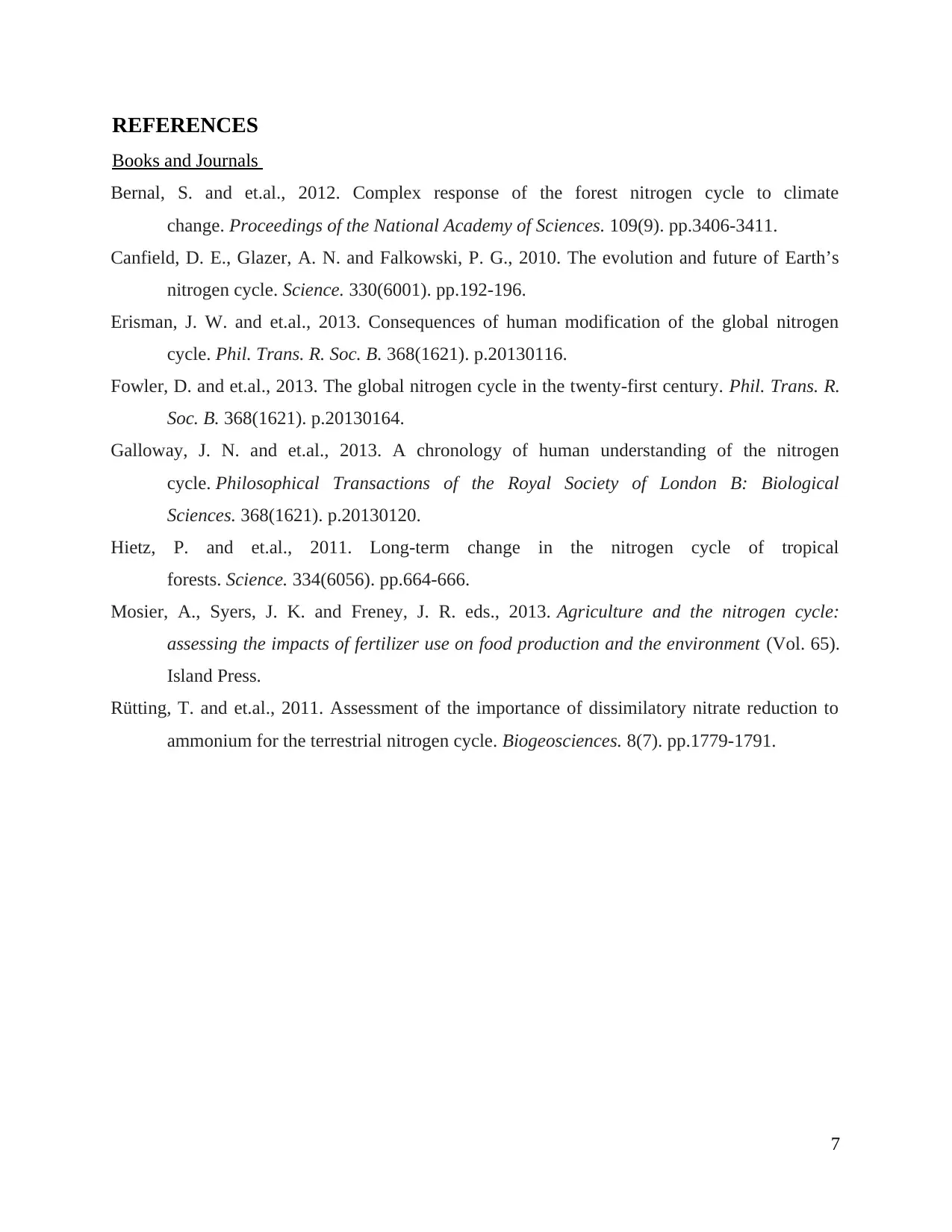
REFERENCES
Books and Journals
Bernal, S. and et.al., 2012. Complex response of the forest nitrogen cycle to climate
change. Proceedings of the National Academy of Sciences. 109(9). pp.3406-3411.
Canfield, D. E., Glazer, A. N. and Falkowski, P. G., 2010. The evolution and future of Earth’s
nitrogen cycle. Science. 330(6001). pp.192-196.
Erisman, J. W. and et.al., 2013. Consequences of human modification of the global nitrogen
cycle. Phil. Trans. R. Soc. B. 368(1621). p.20130116.
Fowler, D. and et.al., 2013. The global nitrogen cycle in the twenty-first century. Phil. Trans. R.
Soc. B. 368(1621). p.20130164.
Galloway, J. N. and et.al., 2013. A chronology of human understanding of the nitrogen
cycle. Philosophical Transactions of the Royal Society of London B: Biological
Sciences. 368(1621). p.20130120.
Hietz, P. and et.al., 2011. Long-term change in the nitrogen cycle of tropical
forests. Science. 334(6056). pp.664-666.
Mosier, A., Syers, J. K. and Freney, J. R. eds., 2013. Agriculture and the nitrogen cycle:
assessing the impacts of fertilizer use on food production and the environment (Vol. 65).
Island Press.
Rütting, T. and et.al., 2011. Assessment of the importance of dissimilatory nitrate reduction to
ammonium for the terrestrial nitrogen cycle. Biogeosciences. 8(7). pp.1779-1791.
7
Books and Journals
Bernal, S. and et.al., 2012. Complex response of the forest nitrogen cycle to climate
change. Proceedings of the National Academy of Sciences. 109(9). pp.3406-3411.
Canfield, D. E., Glazer, A. N. and Falkowski, P. G., 2010. The evolution and future of Earth’s
nitrogen cycle. Science. 330(6001). pp.192-196.
Erisman, J. W. and et.al., 2013. Consequences of human modification of the global nitrogen
cycle. Phil. Trans. R. Soc. B. 368(1621). p.20130116.
Fowler, D. and et.al., 2013. The global nitrogen cycle in the twenty-first century. Phil. Trans. R.
Soc. B. 368(1621). p.20130164.
Galloway, J. N. and et.al., 2013. A chronology of human understanding of the nitrogen
cycle. Philosophical Transactions of the Royal Society of London B: Biological
Sciences. 368(1621). p.20130120.
Hietz, P. and et.al., 2011. Long-term change in the nitrogen cycle of tropical
forests. Science. 334(6056). pp.664-666.
Mosier, A., Syers, J. K. and Freney, J. R. eds., 2013. Agriculture and the nitrogen cycle:
assessing the impacts of fertilizer use on food production and the environment (Vol. 65).
Island Press.
Rütting, T. and et.al., 2011. Assessment of the importance of dissimilatory nitrate reduction to
ammonium for the terrestrial nitrogen cycle. Biogeosciences. 8(7). pp.1779-1791.
7
⊘ This is a preview!⊘
Do you want full access?
Subscribe today to unlock all pages.
Trusted by 1+ million students worldwide

1 out of 9


Related Documents


Your All-in-One AI-Powered Toolkit for Academic Success.
+13062052269
info@desklib.com
Available 24*7 on WhatsApp / Email
![[object Object]](/_next/static/media/star-bottom.7253800d.svg)
Unlock your academic potential
Copyright © 2020–2026 A2Z Services. All Rights Reserved. Developed and managed by ZUCOL.