EDEC101: Designing Stimulating Early Learning Environments Essay

Verified

Added on  2023/03/30

|9
|1846
|345
Essay
AI Summary
This essay explores the foundations of teaching and learning, emphasizing the importance of creating stimulating and caring classroom environments for early learners. It highlights the critical developmental stage of early learners and the impact of the learning environment on their social, physical, and psychological development. The essay discusses the necessary resources and design considerations for an optimal learning environment, including hands-on learning, fair play, and whole child development. It emphasizes the significance of meeting the needs of young learners, particularly the need for attachment, drawing on Bowlby's Attachment Theory and Ainsworth's research. The role of teachers and caregivers in fostering attachment, promoting a sense of connectedness, and providing a rich and varied learning experience is examined. The essay also addresses the importance of physical activities, concrete actions, and sensory stimulation in supporting cognitive, social, physical, and spiritual development. It concludes by highlighting the need for teachers to create a favorable environment that caters to the diverse needs of young children, ensuring their holistic development and well-being.
Document Page
Running head: FOUNDATIONS OF TEACHING AND LEARNING 1
Foundations of Teaching and Learning
Names
Institution Affiliation
tabler-icon-diamond-filled.svg

Paraphrase This Document

Need a fresh take? Get an instant paraphrase of this document with our AI Paraphraser
Document Page
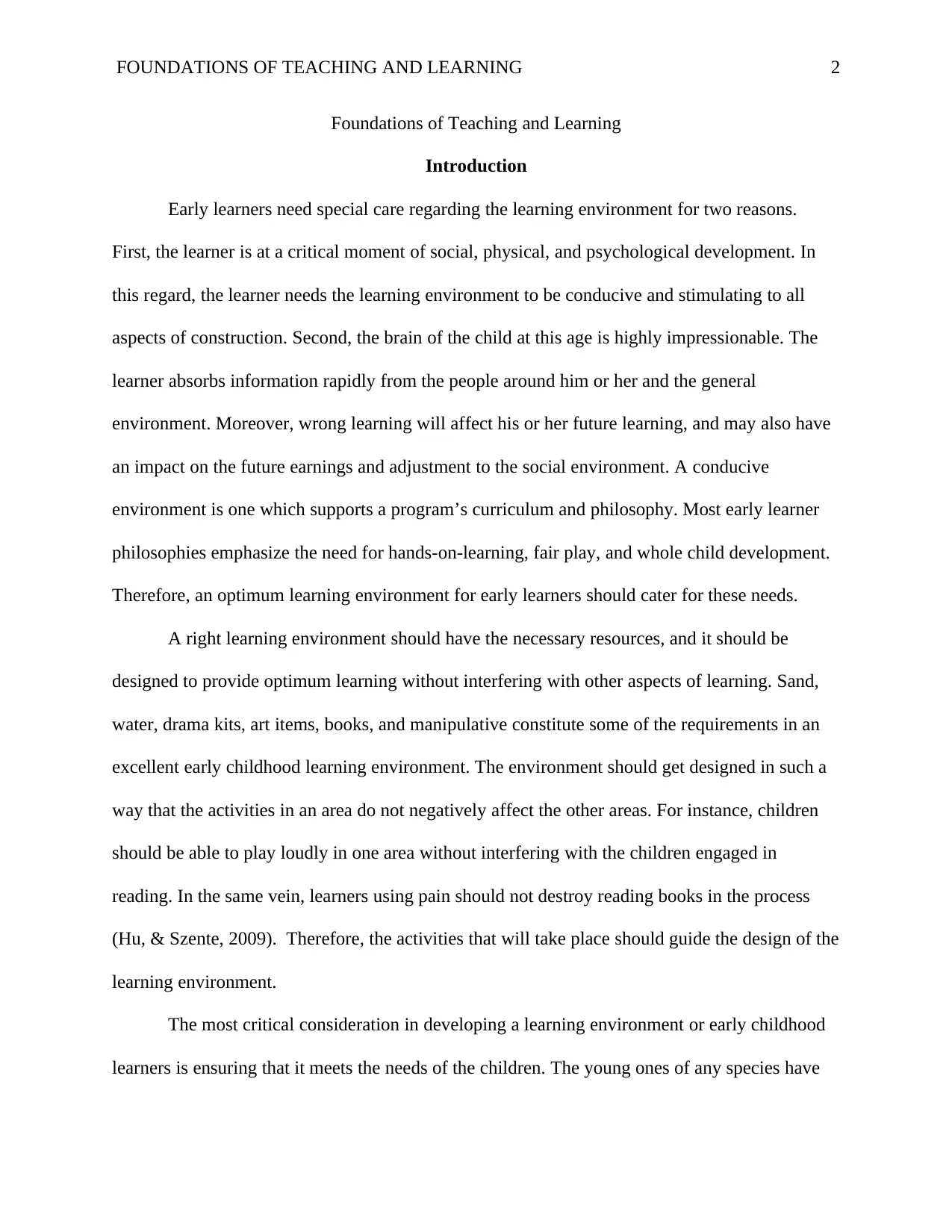
FOUNDATIONS OF TEACHING AND LEARNING 2
Foundations of Teaching and Learning
Introduction
Early learners need special care regarding the learning environment for two reasons.
First, the learner is at a critical moment of social, physical, and psychological development. In
this regard, the learner needs the learning environment to be conducive and stimulating to all
aspects of construction. Second, the brain of the child at this age is highly impressionable. The
learner absorbs information rapidly from the people around him or her and the general
environment. Moreover, wrong learning will affect his or her future learning, and may also have
an impact on the future earnings and adjustment to the social environment. A conducive
environment is one which supports a program’s curriculum and philosophy. Most early learner
philosophies emphasize the need for hands-on-learning, fair play, and whole child development.
Therefore, an optimum learning environment for early learners should cater for these needs.
A right learning environment should have the necessary resources, and it should be
designed to provide optimum learning without interfering with other aspects of learning. Sand,
water, drama kits, art items, books, and manipulative constitute some of the requirements in an
excellent early childhood learning environment. The environment should get designed in such a
way that the activities in an area do not negatively affect the other areas. For instance, children
should be able to play loudly in one area without interfering with the children engaged in
reading. In the same vein, learners using pain should not destroy reading books in the process
(Hu, & Szente, 2009). Therefore, the activities that will take place should guide the design of the
learning environment.
The most critical consideration in developing a learning environment or early childhood
learners is ensuring that it meets the needs of the children. The young ones of any species have
Document Page
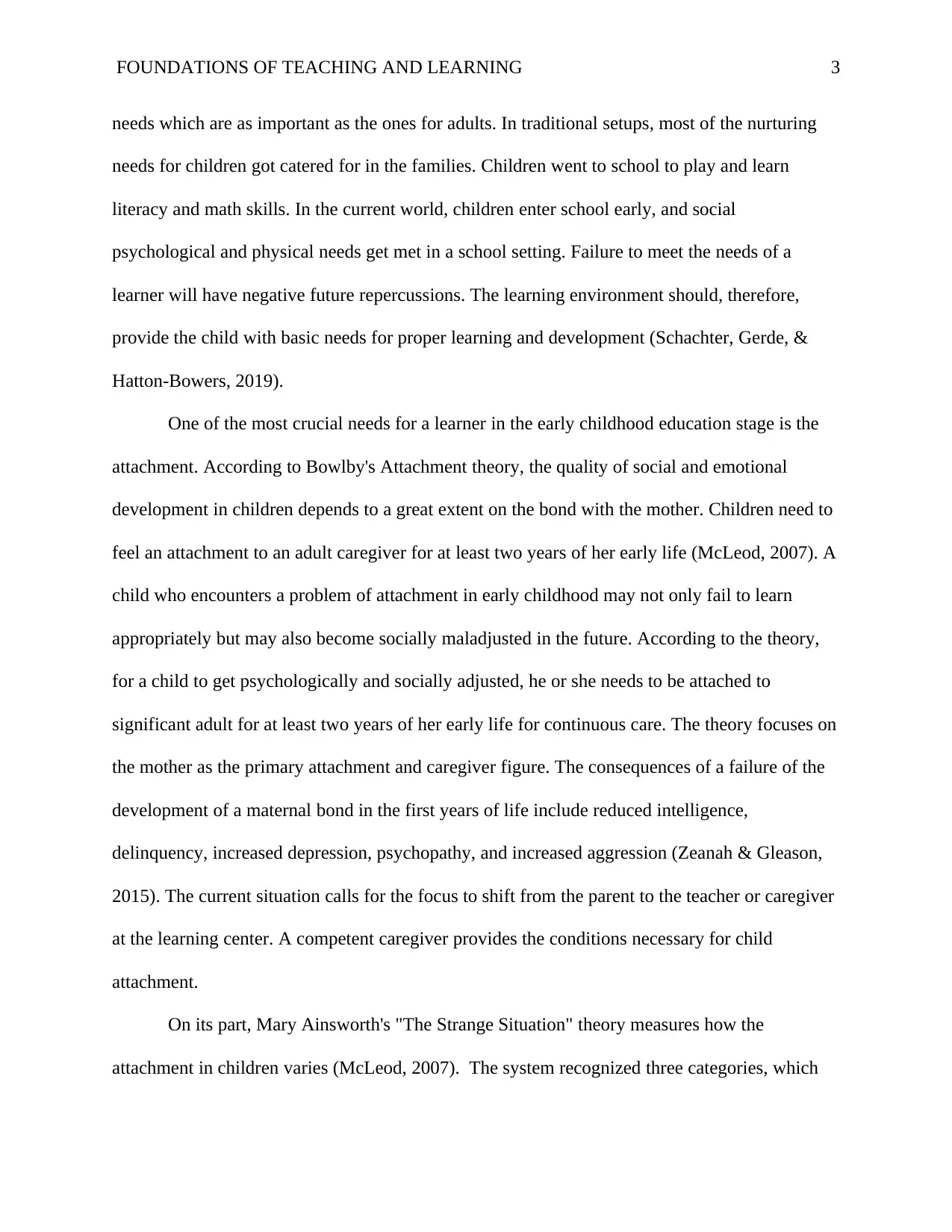
FOUNDATIONS OF TEACHING AND LEARNING 3
needs which are as important as the ones for adults. In traditional setups, most of the nurturing
needs for children got catered for in the families. Children went to school to play and learn
literacy and math skills. In the current world, children enter school early, and social
psychological and physical needs get met in a school setting. Failure to meet the needs of a
learner will have negative future repercussions. The learning environment should, therefore,
provide the child with basic needs for proper learning and development (Schachter, Gerde, &
Hatton-Bowers, 2019).
One of the most crucial needs for a learner in the early childhood education stage is the
attachment. According to Bowlby's Attachment theory, the quality of social and emotional
development in children depends to a great extent on the bond with the mother. Children need to
feel an attachment to an adult caregiver for at least two years of her early life (McLeod, 2007). A
child who encounters a problem of attachment in early childhood may not only fail to learn
appropriately but may also become socially maladjusted in the future. According to the theory,
for a child to get psychologically and socially adjusted, he or she needs to be attached to
significant adult for at least two years of her early life for continuous care. The theory focuses on
the mother as the primary attachment and caregiver figure. The consequences of a failure of the
development of a maternal bond in the first years of life include reduced intelligence,
delinquency, increased depression, psychopathy, and increased aggression (Zeanah & Gleason,
2015). The current situation calls for the focus to shift from the parent to the teacher or caregiver
at the learning center. A competent caregiver provides the conditions necessary for child
attachment.
On its part, Mary Ainsworth's "The Strange Situation" theory measures how the
attachment in children varies (McLeod, 2007). The system recognized three categories, which
Document Page
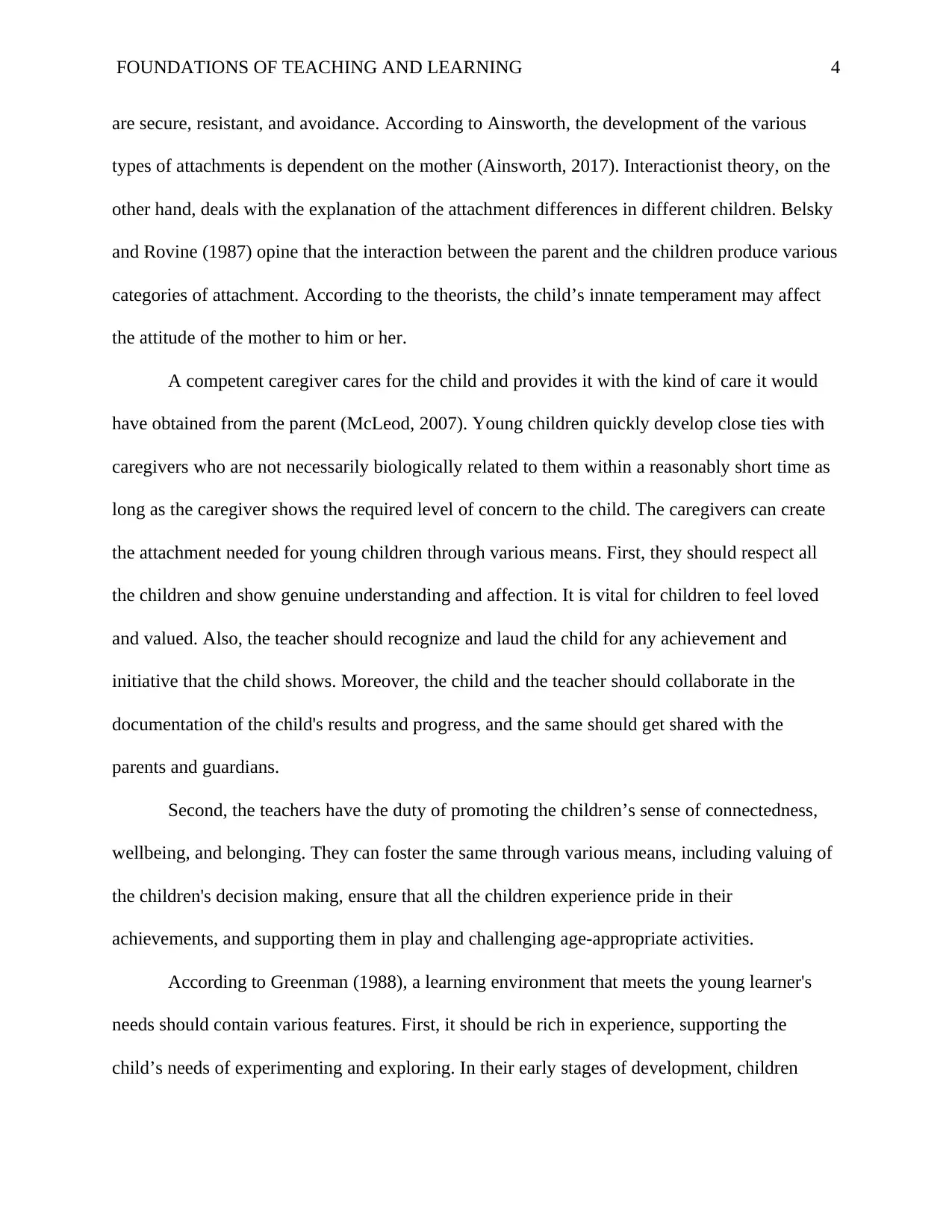
FOUNDATIONS OF TEACHING AND LEARNING 4
are secure, resistant, and avoidance. According to Ainsworth, the development of the various
types of attachments is dependent on the mother (Ainsworth, 2017). Interactionist theory, on the
other hand, deals with the explanation of the attachment differences in different children. Belsky
and Rovine (1987) opine that the interaction between the parent and the children produce various
categories of attachment. According to the theorists, the child’s innate temperament may affect
the attitude of the mother to him or her.
A competent caregiver cares for the child and provides it with the kind of care it would
have obtained from the parent (McLeod, 2007). Young children quickly develop close ties with
caregivers who are not necessarily biologically related to them within a reasonably short time as
long as the caregiver shows the required level of concern to the child. The caregivers can create
the attachment needed for young children through various means. First, they should respect all
the children and show genuine understanding and affection. It is vital for children to feel loved
and valued. Also, the teacher should recognize and laud the child for any achievement and
initiative that the child shows. Moreover, the child and the teacher should collaborate in the
documentation of the child's results and progress, and the same should get shared with the
parents and guardians.
Second, the teachers have the duty of promoting the children’s sense of connectedness,
wellbeing, and belonging. They can foster the same through various means, including valuing of
the children's decision making, ensure that all the children experience pride in their
achievements, and supporting them in play and challenging age-appropriate activities.
According to Greenman (1988), a learning environment that meets the young learner's
needs should contain various features. First, it should be rich in experience, supporting the
child’s needs of experimenting and exploring. In their early stages of development, children
tabler-icon-diamond-filled.svg

Paraphrase This Document

Need a fresh take? Get an instant paraphrase of this document with our AI Paraphraser
Document Page
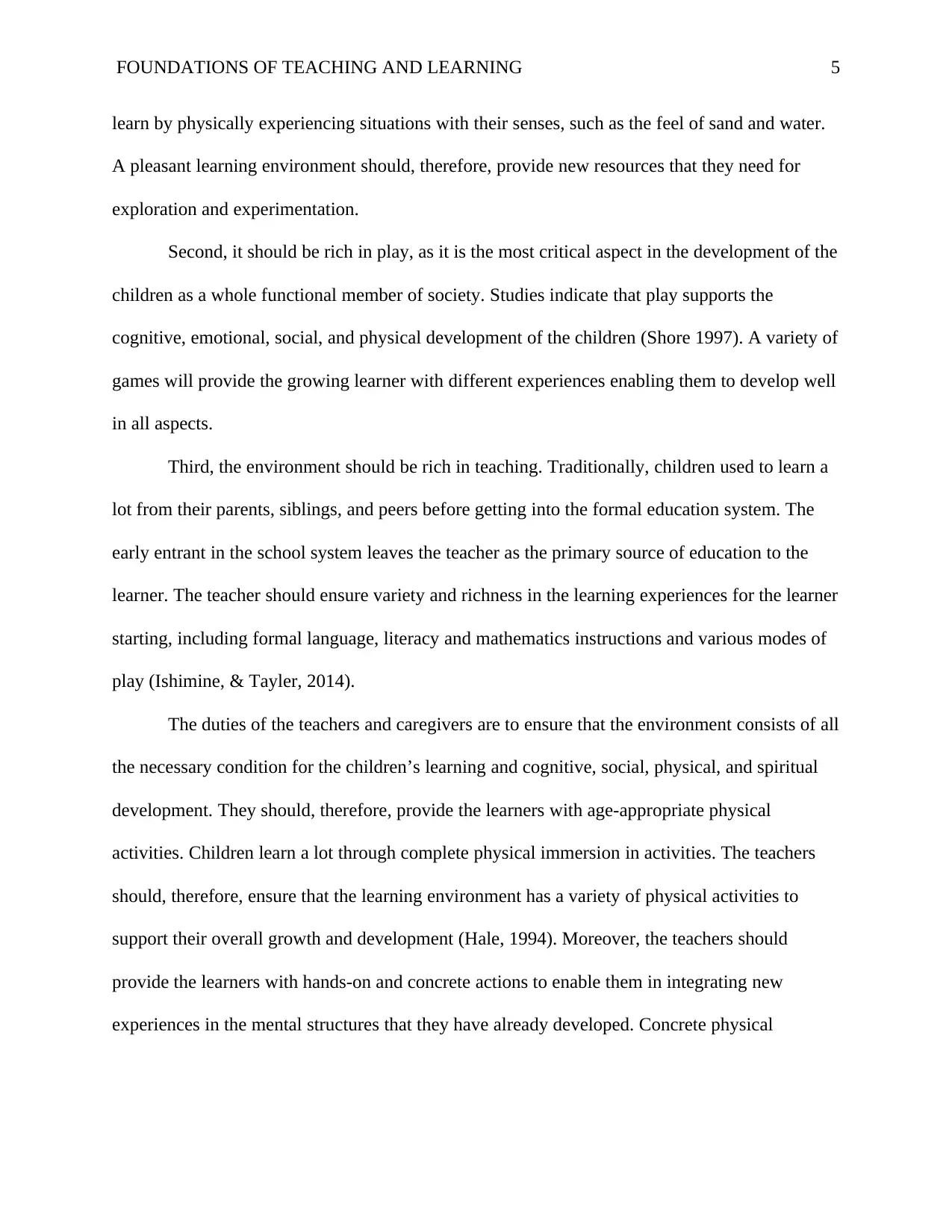
FOUNDATIONS OF TEACHING AND LEARNING 5
learn by physically experiencing situations with their senses, such as the feel of sand and water.
A pleasant learning environment should, therefore, provide new resources that they need for
exploration and experimentation.
Second, it should be rich in play, as it is the most critical aspect in the development of the
children as a whole functional member of society. Studies indicate that play supports the
cognitive, emotional, social, and physical development of the children (Shore 1997). A variety of
games will provide the growing learner with different experiences enabling them to develop well
in all aspects.
Third, the environment should be rich in teaching. Traditionally, children used to learn a
lot from their parents, siblings, and peers before getting into the formal education system. The
early entrant in the school system leaves the teacher as the primary source of education to the
learner. The teacher should ensure variety and richness in the learning experiences for the learner
starting, including formal language, literacy and mathematics instructions and various modes of
play (Ishimine, & Tayler, 2014).
The duties of the teachers and caregivers are to ensure that the environment consists of all
the necessary condition for the children’s learning and cognitive, social, physical, and spiritual
development. They should, therefore, provide the learners with age-appropriate physical
activities. Children learn a lot through complete physical immersion in activities. The teachers
should, therefore, ensure that the learning environment has a variety of physical activities to
support their overall growth and development (Hale, 1994). Moreover, the teachers should
provide the learners with hands-on and concrete actions to enable them in integrating new
experiences in the mental structures that they have already developed. Concrete physical
Document Page
FOUNDATIONS OF TEACHING AND LEARNING 6
activities include allowing the children to play with water, build castles using wooden blocks,
taking a doll to bed, drawing, and even taking photographs.
Monotony is the enemy of development in children as it makes the children bored and
also restricts learning. The early childhood learning environment should be characterized by
variety. Variety stimulates and expands a child's brain creating room for new neural connections,
thus increasing the brains capacity for logical thinking (Olds, 1982). They, therefore, need a
variety of content, colors, textures, sceneries, sounds, and smells.
Color is one of the most significant considerations in young learners' environment as they
affect their moods. The choice of colors for the various areas of study and play is substantial as it
might determine the extent of learning that takes place. Different color combinations need to be
explored to ensure that the correct color and decorations get applied at the right place to enhance
learning. For instance, in areas that require intense concentration and light, white and light colors
are appropriate, while gentles hues and pastels are appropriate for reading areas.
Conclusion
Young children are highly sensitive to the components of the learning environment, and
they tend to experience long-term adverse effects if the conditions are not appropriate.
Traditionally, the first two years of a child's socialization was under the protective and loving
care of a mother or close relatives. The child entered formal schooling system while much older.
However, current trends include children attending formal schooling earlier. Thus, the teachers
replace the primary caregivers, and with it comes added responsibilities and expectations. The
teacher needs to provide a conducive learning environment for young learners. The learning
environment should cater to the needs of the young learners, including the need for attachment,
sense of belonging, play, and recognition, to support cognitive, physical, and social development.
Document Page
FOUNDATIONS OF TEACHING AND LEARNING 7
The teacher has the responsibility of creating a favorable environment for young children to
experience adequate learning. The instructors should ensure that the learning environment has a
variety of physical activities, is not monotonous, and has beautiful colors and decorations.
tabler-icon-diamond-filled.svg

Paraphrase This Document

Need a fresh take? Get an instant paraphrase of this document with our AI Paraphraser
Document Page
FOUNDATIONS OF TEACHING AND LEARNING 8
References
Ainsworth, M. (2017). The Strange Situation. Retrieved from https://www.youtube.com/watch?
v=m_6rQk7jlrc
Belsky, J., & Rovine, M. (1987). Temperament and Attachment Security in the Strange
Situation: An Empirical Rapprochement. Child Development, 58, 3, 787–795.
https://doi.org/10.2307/1130215 https://www.jstor.org/stable/1130215.
Greenman, J. (1988). Caring spaces, learning places: Children's environments that work.
Redmond, WA: Exchange Press.
Hale, J. E. (1994). Unbank the fire. Baltimore, MD: The Johns Hopkins University Press.
Hu, B. Y., & Szente, J. (August 14, 2009). Exploring the Quality of Early Childhood Education
in China: Implications for Early Childhood Teacher Education. Journal of Early
Childhood Teacher Education, 30, 3, 247-262.
Ishimine, K., & Tayler, C. (2014). Assessing Quality in Early Childhood Education and
Care. European Journal of Education. 49, 272-290.
McLeod, S. (2007). Bowlby’s attachment theory. Retrieved 30 April 2019, from
https://www.simplypsychology.org/bowlby.html.
Olds, A. (1982). Planning a developmentally optimal day care center. Day Care and Early
Education. Summer.
Prescott, E. (1994). The physical environment—a powerful regulator of experience. Child Care
Information Exchange, 100, Nov/Dec. 9-15
Schachter, R. E., Gerde, H. K., & Hatton-Bowers, H. (July 01, 2019). Guidelines for Selecting
Professional Development for Early Childhood Teachers. Early Childhood Education
Journal, 47, 4, 395-408.
Document Page
FOUNDATIONS OF TEACHING AND LEARNING 9
Shore, R. (1997). Rethinking the brain. New York, NY: Families and Work Institute.
Zeanah, C. H., & Gleason, M. M. (March 01, 2015). Annual Research Review: Attachment
disorders in early childhood - clinical presentation, causes, correlates, and
treatment. Journal of Child Psychology and Psychiatry, 56, 3, 207-222.
chevron_up_icon
1 out of 9
circle_padding
hide_on_mobile
zoom_out_icon
[object Object]