Analyzing Digital Technology's Impact on EDF Energy's Activities
VerifiedAdded on 2024/05/20
|30
|4920
|453
Project
AI Summary
This research project critically analyzes the impact of digital technology on EDF Energy's business activities, exploring the stages of digital transformation, challenges faced in integrating emerging technologies, implications on business services, and stakeholder engagement. The study uses a mixed-methods approach, incorporating a literature review and a survey of 100 EDF Energy employees, guided by a pragmatism research philosophy and a case study strategy. Findings from the survey and literature are presented and discussed, covering awareness of digital technology, its impact on various business systems (production, administration, storage, communication, and distribution), and the perceived benefits of digital transformation. The project concludes with recommendations for EDF Energy and suggests areas for further research, while also acknowledging ethical considerations and research limitations such as sample size and time constraints. Desklib provides access to this and similar solved assignments to aid students in their studies.
RESEARCH PROJECT
EDF ENERGY
EDF ENERGY

Paraphrase This Document
Need a fresh take? Get an instant paraphrase of this document with our AI Paraphraser
Table of Contents
CHAPTER 1.......................................................................................................................1
INTRODUCTION............................................................................................................1
CHAPTER 2.......................................................................................................................3
LITERATURE REVIEW..................................................................................................3
CHAPTER 3.......................................................................................................................6
METHODOLOGY...........................................................................................................6
CHAPTER 4.......................................................................................................................8
FINDINGS (DATA ANALYSIS AND PRESENTATION)................................................8
CHAPTER 5.....................................................................................................................20
DISCUSSION (DATA INTERPRETATION).................................................................20
CHAPTER 6.....................................................................................................................22
CONCLUSION.............................................................................................................22
RECOMMENDATION..................................................................................................22
IMPLICATIONS FOR FURTHER RESEARCH............................................................23
REFERENCES................................................................................................................24
APPENDIX.......................................................................................................................26
1
CHAPTER 1.......................................................................................................................1
INTRODUCTION............................................................................................................1
CHAPTER 2.......................................................................................................................3
LITERATURE REVIEW..................................................................................................3
CHAPTER 3.......................................................................................................................6
METHODOLOGY...........................................................................................................6
CHAPTER 4.......................................................................................................................8
FINDINGS (DATA ANALYSIS AND PRESENTATION)................................................8
CHAPTER 5.....................................................................................................................20
DISCUSSION (DATA INTERPRETATION).................................................................20
CHAPTER 6.....................................................................................................................22
CONCLUSION.............................................................................................................22
RECOMMENDATION..................................................................................................22
IMPLICATIONS FOR FURTHER RESEARCH............................................................23
REFERENCES................................................................................................................24
APPENDIX.......................................................................................................................26
1
CHAPTER 1
INTRODUCTION
Title- The impact of digital technology on activities of EDF energy
Research aim and rationale
Aim -To critically analyze the impact of digital technology on the business activities of
the firm, EDF Energy.
The purpose behind the selection of this topic of research lies in the fact that EDF
energy being an energy industry conducting the operations of electricity generation and
selling gas and electricity to business and households throughout the UK has
undergone major digital changes in its method of operations and selling of its products.
The firm has its headquarters in the UK, founded in the year 2002 providing its services
to around 5.7 million customers (EDF Energy, 2018). Therefore, it is essential to
analyze the impact of the changes in digital technology on the firm so as to cope up with
the challenges faced by the firm of change management, planning for investment in new
technology and also respond in a positive manner to the competitive environment.
Objectives
To determine the stages that EDF energy has to undergo for achieving digital
transformation
To identify the challenges faced in the process of integration of emerging
technologies within EDF energy
To understand the implications of digital technology on various business services
of EDF energy
To analyze the engagement of stakeholders with the digital technology
Significance
The importance of the research can be understood as the study will help in the
examination of the effect of digital technology on the way organizations conduct their
business with the help of the aforementioned business objectives. This examination will
include the scrutinizing of the impact on a number of business systems such as the
2
INTRODUCTION
Title- The impact of digital technology on activities of EDF energy
Research aim and rationale
Aim -To critically analyze the impact of digital technology on the business activities of
the firm, EDF Energy.
The purpose behind the selection of this topic of research lies in the fact that EDF
energy being an energy industry conducting the operations of electricity generation and
selling gas and electricity to business and households throughout the UK has
undergone major digital changes in its method of operations and selling of its products.
The firm has its headquarters in the UK, founded in the year 2002 providing its services
to around 5.7 million customers (EDF Energy, 2018). Therefore, it is essential to
analyze the impact of the changes in digital technology on the firm so as to cope up with
the challenges faced by the firm of change management, planning for investment in new
technology and also respond in a positive manner to the competitive environment.
Objectives
To determine the stages that EDF energy has to undergo for achieving digital
transformation
To identify the challenges faced in the process of integration of emerging
technologies within EDF energy
To understand the implications of digital technology on various business services
of EDF energy
To analyze the engagement of stakeholders with the digital technology
Significance
The importance of the research can be understood as the study will help in the
examination of the effect of digital technology on the way organizations conduct their
business with the help of the aforementioned business objectives. This examination will
include the scrutinizing of the impact on a number of business systems such as the
2
⊘ This is a preview!⊘
Do you want full access?
Subscribe today to unlock all pages.

Trusted by 1+ million students worldwide
administration, storage and the distribution systems, the communication systems and
the production. It will provide the prospect to contextualize the implications of digital
technology in EDF Energy the manner in which it is shaping the future personnel
(Westerman, et al. 2014). The examination of the effect of digital technology and
changes will also aid in exploring the challenges as well as the opportunities that the
rapidly evolving technological advancements represent the business.
3
the production. It will provide the prospect to contextualize the implications of digital
technology in EDF Energy the manner in which it is shaping the future personnel
(Westerman, et al. 2014). The examination of the effect of digital technology and
changes will also aid in exploring the challenges as well as the opportunities that the
rapidly evolving technological advancements represent the business.
3
Paraphrase This Document
Need a fresh take? Get an instant paraphrase of this document with our AI Paraphraser
CHAPTER 2
LITERATURE REVIEW
Kane, et al. (2015) states that digital transformation is an amendment correlated with
the application of the digital technology in all areas and aspects of the society. The
process of digitalizing every aspect of the organizations has led to abrupt changes in
the manner firms executes their operations and change in their business models, socio-
economic structures, the business patterns, consumption patterns and legal and policy
measures etc (Kiron, et al. 2016). According to Hess, et al. (2016), there are 6 stages
that firms undergo for digital transformation in which the first one is the organizations
operate with an acquainted legacy perception of the stakeholders, the processes and
business models considering that it remains the result to digital relevance. The 2nd stage
is testing and learning where the firms experiment for driving digital transformation and
learn from past failures or success. The 3rd Stage is systemize and strategize where the
firm gets smarter and work formally towards the bigger picture that they see as a result
of the changes. The next step is adapt or die where the firms become resilient and
adopt the digital transformation and change by forming the short and long-term goals.
The next stage is transformed and transforming where the digital transformation
becomes the essence of the firm leading to consistency in the business operations and
systems. The last stage is innovated or die where innovation is prevalent and new
models and roles move towards innovation so as to accelerate transformation and look
for new growth opportunities (Solis, 2016). These stages of digital transformation
provide benefit help in setting new vision and platform of leadership along with the
development of the new process, model and motive for the technology and future
workforce.
In the process of integration of digital technology into the businesses, the firms
encounter many challenges that hinder them from adapting to the digital changes in an
abrupt manner. According to Matt, et al. (2015), the major change that digital
transformation has introduced is the socio-economic changes as the employees and
leaders of the firms take time in adjusting to the unfamiliar technologies and relying
upon them. The receptiveness from top management to the bottom is important for
4
LITERATURE REVIEW
Kane, et al. (2015) states that digital transformation is an amendment correlated with
the application of the digital technology in all areas and aspects of the society. The
process of digitalizing every aspect of the organizations has led to abrupt changes in
the manner firms executes their operations and change in their business models, socio-
economic structures, the business patterns, consumption patterns and legal and policy
measures etc (Kiron, et al. 2016). According to Hess, et al. (2016), there are 6 stages
that firms undergo for digital transformation in which the first one is the organizations
operate with an acquainted legacy perception of the stakeholders, the processes and
business models considering that it remains the result to digital relevance. The 2nd stage
is testing and learning where the firms experiment for driving digital transformation and
learn from past failures or success. The 3rd Stage is systemize and strategize where the
firm gets smarter and work formally towards the bigger picture that they see as a result
of the changes. The next step is adapt or die where the firms become resilient and
adopt the digital transformation and change by forming the short and long-term goals.
The next stage is transformed and transforming where the digital transformation
becomes the essence of the firm leading to consistency in the business operations and
systems. The last stage is innovated or die where innovation is prevalent and new
models and roles move towards innovation so as to accelerate transformation and look
for new growth opportunities (Solis, 2016). These stages of digital transformation
provide benefit help in setting new vision and platform of leadership along with the
development of the new process, model and motive for the technology and future
workforce.
In the process of integration of digital technology into the businesses, the firms
encounter many challenges that hinder them from adapting to the digital changes in an
abrupt manner. According to Matt, et al. (2015), the major change that digital
transformation has introduced is the socio-economic changes as the employees and
leaders of the firms take time in adjusting to the unfamiliar technologies and relying
upon them. The receptiveness from top management to the bottom is important for
4
developing a shift in culture. According to Greenberg (2017), every executive of the firm
must adopt the culture of change that allows efficiently adopting of digital technology in
the operations such as sales, Human resources, marketing etc. Additionally, Colbert, et
al. (2016) states that the advent of digital technology has created a competitive
marketplace full of challenges and opportunities where the businesses must compete
with agile competitors who have the benefit of low barrier to entry with the help of
advanced technology. The general buy-in is also one of the challenges for digital
transformation where the proactive leadership is neglected and therefore they are not
able to administer the initiatives for long-term survival of the business (Greenberg,
2017). Another challenge is the challenge of upskilling traditional executives within a
short time span. The accomplishment of full competence across all the channels of the
firms is not feasible as the employees are not able to grasp the digital changes in a
short time period.
According to Fitzgerald, et al. (2014), the digital technology in organizations is being
incorporated in a number of business systems such as communication, the
administration systems, production systems and storage and distribution. The cloud
technology helps in storage and filing along with the distribution of the information in the
administrative systems (Scheck, 2016). In a similar manner, the mobile technology with
social media aids the businesses to communicate, associate and collaborate on an
international scale. The Internet of Things (IoT) in storage and distribution integrates
the systems and connect them through the business structures. Along with this, the big
data analytics and the use of artificial intelligence are fostering innovating and the
growth of products in the production business systems (Scheck, 2016).
Janowski, (2015) states that with the help of utilization of the new technology and digital
changes, the client engagement can be increased to a great extent. The collaborations
with the stakeholders’ increases that enable the decrease in amendments and
stakeholders to change down the line. The introduction of new technologies in the firm
attracts the clients to be a part of the firm or get services from it in an active or passive
manner. The customers get to know the difference between the traditional method of
5
must adopt the culture of change that allows efficiently adopting of digital technology in
the operations such as sales, Human resources, marketing etc. Additionally, Colbert, et
al. (2016) states that the advent of digital technology has created a competitive
marketplace full of challenges and opportunities where the businesses must compete
with agile competitors who have the benefit of low barrier to entry with the help of
advanced technology. The general buy-in is also one of the challenges for digital
transformation where the proactive leadership is neglected and therefore they are not
able to administer the initiatives for long-term survival of the business (Greenberg,
2017). Another challenge is the challenge of upskilling traditional executives within a
short time span. The accomplishment of full competence across all the channels of the
firms is not feasible as the employees are not able to grasp the digital changes in a
short time period.
According to Fitzgerald, et al. (2014), the digital technology in organizations is being
incorporated in a number of business systems such as communication, the
administration systems, production systems and storage and distribution. The cloud
technology helps in storage and filing along with the distribution of the information in the
administrative systems (Scheck, 2016). In a similar manner, the mobile technology with
social media aids the businesses to communicate, associate and collaborate on an
international scale. The Internet of Things (IoT) in storage and distribution integrates
the systems and connect them through the business structures. Along with this, the big
data analytics and the use of artificial intelligence are fostering innovating and the
growth of products in the production business systems (Scheck, 2016).
Janowski, (2015) states that with the help of utilization of the new technology and digital
changes, the client engagement can be increased to a great extent. The collaborations
with the stakeholders’ increases that enable the decrease in amendments and
stakeholders to change down the line. The introduction of new technologies in the firm
attracts the clients to be a part of the firm or get services from it in an active or passive
manner. The customers get to know the difference between the traditional method of
5
⊘ This is a preview!⊘
Do you want full access?
Subscribe today to unlock all pages.
Trusted by 1+ million students worldwide
carrying out the operations and the improved digital methods and thus build a sense of
engagement with the firm (Barrett, et al. 2016).
The influence of digital technology on the activities of the business provides a range of
opportunities and complex challenges that need to be overcome. These opportunities if
utilized in an appropriate manner can help in the accomplishment of various objectives
and the goals of the firm. The challenges help the firms to get a chance to overcome its
weaknesses and improve in order to provide benefits to the firm and grow and develop
as a digitally efficient firm.
6
engagement with the firm (Barrett, et al. 2016).
The influence of digital technology on the activities of the business provides a range of
opportunities and complex challenges that need to be overcome. These opportunities if
utilized in an appropriate manner can help in the accomplishment of various objectives
and the goals of the firm. The challenges help the firms to get a chance to overcome its
weaknesses and improve in order to provide benefits to the firm and grow and develop
as a digitally efficient firm.
6
Paraphrase This Document
Need a fresh take? Get an instant paraphrase of this document with our AI Paraphraser
CHAPTER 3
METHODOLOGY
A research philosophy is a belief about the manner in which information and relevant
data about a study must be gathered, conducted an analysis of and used. The
identification of the research philosophy is placed at the outer layer of the model known
as Research Onion. The research philosophy used here is Pragmatism where the data
will be collected by mixed or the multiple method designs consisting of qualitative as
well as qualitative data collection methods (Research Methodology, 2017). The
pragmatic approach to research that is used here uses those methods of research that
are best suitable for the research problem that may be qualitative or quantitative. This is
done because each research method has some limitations. The method of mixing the
two approaches enables triangulation that allows the use of different data sources,
different researchers, multiple perspectives to interpret the results and multiple
methodologies for studying a research problem (Sekaran and Bougie, 2016).
The research strategy used for the topic of research is ‘Case Study’ where the empirical
investigation of the contemporary phenomenon of digital technology and its impact on
business is done through multiple sources answering the why, what and how of the
research. A number of strategies will be used that include conducting surveys and
documentary analysis along with studying the academic sources and other journals and
scholarly works by dignified and verified authors (Saunders and Lewis, 2012). This
research strategy comprises of the investigation for examining various sources of
evidence. This type of research strategy is best suitable for conducting an in-depth
research involving the analysis of the first-hand data as well as the data and information
researched by someone else.
The research methodology used is the mixed method of research that includes the
collection of data by following the pragmatic research philosophy with the help of a
questionnaire and the secondary research conducted in the form of a literature review.
The tool used for the research for conducting the survey is the questionnaire that is
asked to the employees of EDF Energy for examining and critically evaluating the
impact of digital technology on a number of business activities of the firm.
7
METHODOLOGY
A research philosophy is a belief about the manner in which information and relevant
data about a study must be gathered, conducted an analysis of and used. The
identification of the research philosophy is placed at the outer layer of the model known
as Research Onion. The research philosophy used here is Pragmatism where the data
will be collected by mixed or the multiple method designs consisting of qualitative as
well as qualitative data collection methods (Research Methodology, 2017). The
pragmatic approach to research that is used here uses those methods of research that
are best suitable for the research problem that may be qualitative or quantitative. This is
done because each research method has some limitations. The method of mixing the
two approaches enables triangulation that allows the use of different data sources,
different researchers, multiple perspectives to interpret the results and multiple
methodologies for studying a research problem (Sekaran and Bougie, 2016).
The research strategy used for the topic of research is ‘Case Study’ where the empirical
investigation of the contemporary phenomenon of digital technology and its impact on
business is done through multiple sources answering the why, what and how of the
research. A number of strategies will be used that include conducting surveys and
documentary analysis along with studying the academic sources and other journals and
scholarly works by dignified and verified authors (Saunders and Lewis, 2012). This
research strategy comprises of the investigation for examining various sources of
evidence. This type of research strategy is best suitable for conducting an in-depth
research involving the analysis of the first-hand data as well as the data and information
researched by someone else.
The research methodology used is the mixed method of research that includes the
collection of data by following the pragmatic research philosophy with the help of a
questionnaire and the secondary research conducted in the form of a literature review.
The tool used for the research for conducting the survey is the questionnaire that is
asked to the employees of EDF Energy for examining and critically evaluating the
impact of digital technology on a number of business activities of the firm.
7
The process of sampling that is used in statistical analysis involves a fixed number of
observations taken from a large population. The type of sampling used here is
probability sampling of which systematic sampling is one of the categories (Research
Methodology, 2017). The systematic sampling involves selection of a sample of
employees and other stakeholders of the EDF Energy from as per a fixed start point and
a sampling interval. The population is identified on the basis of the number of
employees of the firm and other stakeholders and 100 employees are selected
according to the sampling interval. This type of strategy for sampling is chosen so as to
ensure that all the groups of employees of the form are fairly represented in the sample
taken of 100 people.
Ethical implications
The ethical implication that may occur is the confidentiality and legality constraints. The
guidelines for the protection of the confidential and secret data and information of the
employees must be followed. For example, the personal information of the participant of
the survey in EDF Energy must be kept secret from the other departments of the firm.
The legal constraints must be kept in mind by following the rules and regulations set by
the firm. The survey must not overpower the legalities of the firm (Neuman and Robson,
2014).
Research limitations
The limitations of research are-
The sample size for conducting a survey for the research is small which in some
cases may pose difficulty in determining significant relationships from the data.
The time may impose limitation as the time limit given for conducting the
research is less and may have an impact on the results of the research
8
observations taken from a large population. The type of sampling used here is
probability sampling of which systematic sampling is one of the categories (Research
Methodology, 2017). The systematic sampling involves selection of a sample of
employees and other stakeholders of the EDF Energy from as per a fixed start point and
a sampling interval. The population is identified on the basis of the number of
employees of the firm and other stakeholders and 100 employees are selected
according to the sampling interval. This type of strategy for sampling is chosen so as to
ensure that all the groups of employees of the form are fairly represented in the sample
taken of 100 people.
Ethical implications
The ethical implication that may occur is the confidentiality and legality constraints. The
guidelines for the protection of the confidential and secret data and information of the
employees must be followed. For example, the personal information of the participant of
the survey in EDF Energy must be kept secret from the other departments of the firm.
The legal constraints must be kept in mind by following the rules and regulations set by
the firm. The survey must not overpower the legalities of the firm (Neuman and Robson,
2014).
Research limitations
The limitations of research are-
The sample size for conducting a survey for the research is small which in some
cases may pose difficulty in determining significant relationships from the data.
The time may impose limitation as the time limit given for conducting the
research is less and may have an impact on the results of the research
8
⊘ This is a preview!⊘
Do you want full access?
Subscribe today to unlock all pages.
Trusted by 1+ million students worldwide
CHAPTER 4
FINDINGS (DATA ANALYSIS AND PRESENTATION)
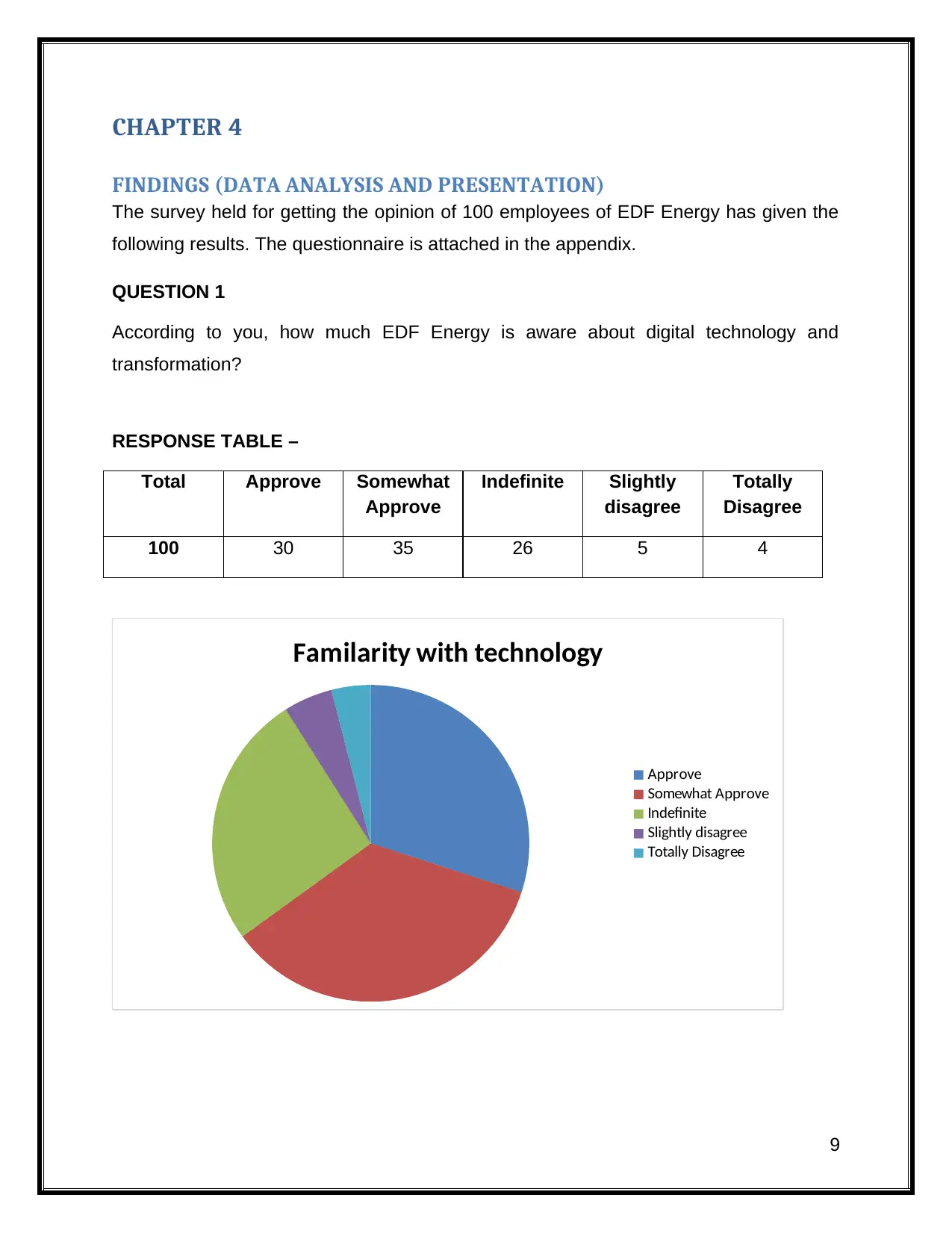
The survey held for getting the opinion of 100 employees of EDF Energy has given the
following results. The questionnaire is attached in the appendix.
QUESTION 1
According to you, how much EDF Energy is aware about digital technology and
transformation?
RESPONSE TABLE –
Total Approve Somewhat
Approve
Indefinite Slightly
disagree
Totally
Disagree
100 30 35 26 5 4
Familarity with technology
Approve
Somewhat Approve
Indefinite
Slightly disagree
Totally Disagree
9
FINDINGS (DATA ANALYSIS AND PRESENTATION)
The survey held for getting the opinion of 100 employees of EDF Energy has given the
following results. The questionnaire is attached in the appendix.
QUESTION 1
According to you, how much EDF Energy is aware about digital technology and
transformation?
RESPONSE TABLE –
Total Approve Somewhat
Approve
Indefinite Slightly
disagree
Totally
Disagree
100 30 35 26 5 4
Familarity with technology
Approve
Somewhat Approve
Indefinite
Slightly disagree
Totally Disagree
9
Paraphrase This Document
Need a fresh take? Get an instant paraphrase of this document with our AI Paraphraser
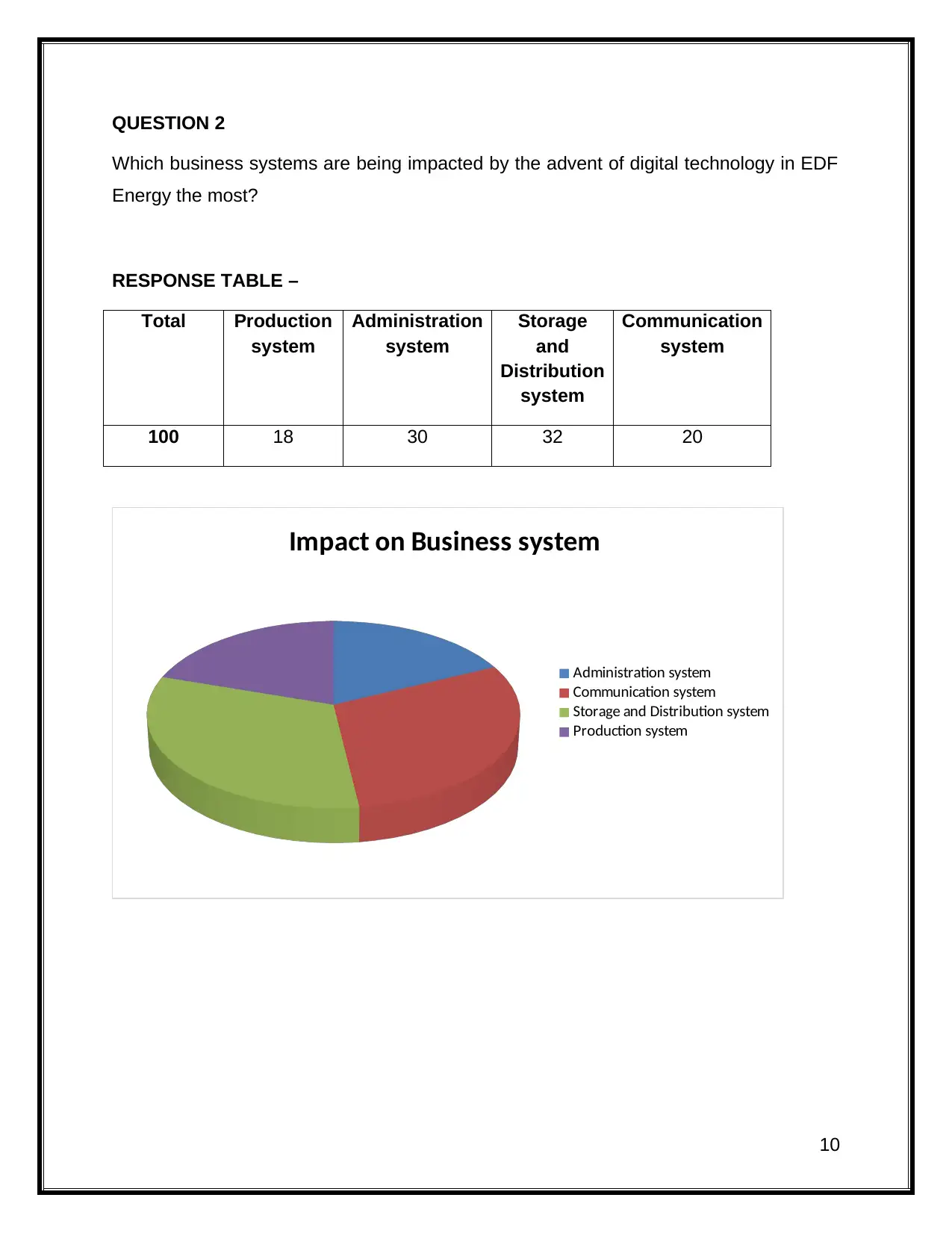
QUESTION 2
Which business systems are being impacted by the advent of digital technology in EDF
Energy the most?
RESPONSE TABLE –
Total Production
system
Administration
system
Storage
and
Distribution
system
Communication
system
100 18 30 32 20
Impact on Business system
Administration system
Communication system
Storage and Distribution system
Production system
10
Which business systems are being impacted by the advent of digital technology in EDF
Energy the most?
RESPONSE TABLE –
Total Production
system
Administration
system
Storage
and
Distribution
system
Communication
system
100 18 30 32 20
Impact on Business system
Administration system
Communication system
Storage and Distribution system
Production system
10
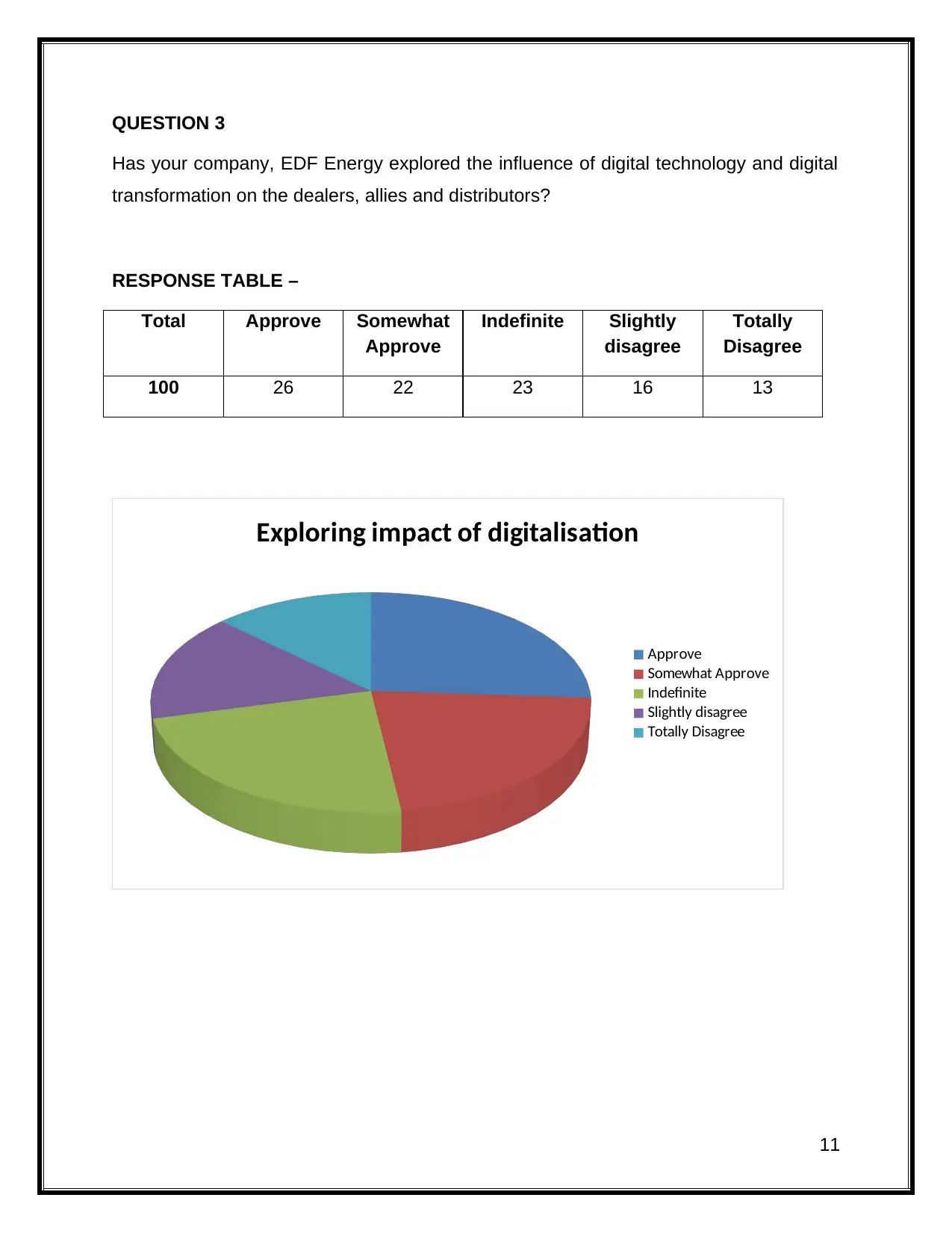
QUESTION 3
Has your company, EDF Energy explored the influence of digital technology and digital
transformation on the dealers, allies and distributors?
RESPONSE TABLE –
Total Approve Somewhat
Approve
Indefinite Slightly
disagree
Totally
Disagree
100 26 22 23 16 13
Exploring impact of digitalisation
Approve
Somewhat Approve
Indefinite
Slightly disagree
Totally Disagree
11
Has your company, EDF Energy explored the influence of digital technology and digital
transformation on the dealers, allies and distributors?
RESPONSE TABLE –
Total Approve Somewhat
Approve
Indefinite Slightly
disagree
Totally
Disagree
100 26 22 23 16 13
Exploring impact of digitalisation
Approve
Somewhat Approve
Indefinite
Slightly disagree
Totally Disagree
11
⊘ This is a preview!⊘
Do you want full access?
Subscribe today to unlock all pages.
Trusted by 1+ million students worldwide

1 out of 30


Related Documents


Your All-in-One AI-Powered Toolkit for Academic Success.
+13062052269
info@desklib.com
Available 24*7 on WhatsApp / Email
![[object Object]](/_next/static/media/star-bottom.7253800d.svg)
Unlock your academic potential
Copyright © 2020–2026 A2Z Services. All Rights Reserved. Developed and managed by ZUCOL.