Economic and Social Impacts of the Edinburgh Tram Extension Report
VerifiedAdded on 2020/04/15
|12
|3374
|36
Report
AI Summary
This report provides an in-depth analysis of the Edinburgh Tram Extension, examining its economic and social impacts on the city of Edinburgh. It begins with an executive summary highlighting the need for the extension due to increasing traffic congestion and population growth. The introduction emphasizes the project's importance for economic development and improved transportation. A literature review explores the effects of the extension, including job creation, business opportunities, and reduced travel times. The report includes a cost-benefit analysis, discussing the financial aspects of the project and its benefits, such as reduced congestion and pollution. The discussion and analysis section further explores the positive and negative impacts on businesses, employment, and car ownership. Overall, the report provides a comprehensive overview of the Edinburgh Tram Extension's influence on the local economy and urban development.

Edinburgh Tram Extension 1
EDINBURGH TRAM EXTENSION
By Name
Course
Instructor
Institution
Location
Date
EDINBURGH TRAM EXTENSION
By Name
Course
Instructor
Institution
Location
Date

Paraphrase This Document
Need a fresh take? Get an instant paraphrase of this document with our AI Paraphraser
Edinburgh Tram Extension 2
Executive summary
Traffic jam in the roads is growing substantially in the area of Edinburgh leading to
the realization of the increased population and the growth in the employment. With this
increase in population, there will be an increase in the congestion of the traffic thus leading to
the demand increment towards the transportation sector. For the local economy to be
supported, there should be the construction of the tram that would increase the quality of the
transportation hence leading to the development sustainability (Andrews, 2012).
This will lead to the increase in the development and provides a key value to the
transportation sector. Since there is higher and stronger economic growth in Edinburgh as
suggested by the recent research, there will be increase in the population growth hence
increase in the migration and movement of people from one area to the other, thus economic
growth is directly proportional to the growth of the population. This, in turn, leads to the
development and construction of the Edinburgh tram extension.
Introduction
The construction of the Edinburgh tram extension is a key factor to the development
of the area of the target. With the less population in the Edinburgh, it produces about 15%
GDP of the country of the Scotland. This implies that, the rate of the population growth in
this area is high calling for the contraction of the tram to improve the transportation and thus
Executive summary
Traffic jam in the roads is growing substantially in the area of Edinburgh leading to
the realization of the increased population and the growth in the employment. With this
increase in population, there will be an increase in the congestion of the traffic thus leading to
the demand increment towards the transportation sector. For the local economy to be
supported, there should be the construction of the tram that would increase the quality of the
transportation hence leading to the development sustainability (Andrews, 2012).
This will lead to the increase in the development and provides a key value to the
transportation sector. Since there is higher and stronger economic growth in Edinburgh as
suggested by the recent research, there will be increase in the population growth hence
increase in the migration and movement of people from one area to the other, thus economic
growth is directly proportional to the growth of the population. This, in turn, leads to the
development and construction of the Edinburgh tram extension.
Introduction
The construction of the Edinburgh tram extension is a key factor to the development
of the area of the target. With the less population in the Edinburgh, it produces about 15%
GDP of the country of the Scotland. This implies that, the rate of the population growth in
this area is high calling for the contraction of the tram to improve the transportation and thus
Edinburgh Tram Extension 3
increase in the economic growth in this area. The construction of this tram extension will
increase the ability to deal with the significant rise in the population hence creating easy
transportation of the people. This tram will also improve quick movement of people within
smaller range of time, due to their smooth, quick and the accessibility nature of the trams.
The construction aimed at a number of impacts ranging from employment, schemes of
operation, and the accessibility of the benefits by the residents in this particular areas and the
long-term results after the opening of the tram extension. The determination of the benefits
obtained by the residents has its roots in the local economy. This is also detected by the value
of the public transportation thus there is a need to construct tram extension in this areas. The
current traffic jam situation in the urban centres affected the transport sectors thus
undermining the movement by cars due to the pollution and accidents that are experienced.
This is a greater factor that led to the extension of the tram to Newhaven (Efford, 2010).
There has been the significant increase in motorist in the urban centres that has led to
the creation of the congestion in this urban area. This situation has greatly affected the
operation in this area hence flexible mode of transportation has to the constructed.
Literature review
The construction of the Edinburgh Tram extension has led to a number of impacts on the
economy locally after its opening. They include;
The rapid growth of the population and growth in the economy after several decades,
the surrounding area of the Edinburgh between York place and the Newhaven an
increased population was expected at a faster rate. Between the estimated periods, the
increased population that was seen was by approximately 20% of the population in
that particular area. Households increased in number by 2032 this is realized to be
increase in the economic growth in this area. The construction of this tram extension will
increase the ability to deal with the significant rise in the population hence creating easy
transportation of the people. This tram will also improve quick movement of people within
smaller range of time, due to their smooth, quick and the accessibility nature of the trams.
The construction aimed at a number of impacts ranging from employment, schemes of
operation, and the accessibility of the benefits by the residents in this particular areas and the
long-term results after the opening of the tram extension. The determination of the benefits
obtained by the residents has its roots in the local economy. This is also detected by the value
of the public transportation thus there is a need to construct tram extension in this areas. The
current traffic jam situation in the urban centres affected the transport sectors thus
undermining the movement by cars due to the pollution and accidents that are experienced.
This is a greater factor that led to the extension of the tram to Newhaven (Efford, 2010).
There has been the significant increase in motorist in the urban centres that has led to
the creation of the congestion in this urban area. This situation has greatly affected the
operation in this area hence flexible mode of transportation has to the constructed.
Literature review
The construction of the Edinburgh Tram extension has led to a number of impacts on the
economy locally after its opening. They include;
The rapid growth of the population and growth in the economy after several decades,
the surrounding area of the Edinburgh between York place and the Newhaven an
increased population was expected at a faster rate. Between the estimated periods, the
increased population that was seen was by approximately 20% of the population in
that particular area. Households increased in number by 2032 this is realized to be
⊘ This is a preview!⊘
Do you want full access?
Subscribe today to unlock all pages.

Trusted by 1+ million students worldwide
Edinburgh Tram Extension 4
16% of the population in this area. Currently, the rate of the employees also increased
between the stipulated period and this is seen to be about 7.5% of the population.
For the easy movement in these areas, there is a provision of the new and attractive
choices for the motorist by the tram. This can create an impression on the can owners
thus taking them out of their car to use the tram. This will intern lower the congestion
of the traffic hence improve the development of the city (Hodgson, 2012).
Some of the economic benefits that were experienced after the opening are the
increment in the jobs allocation, both the construction jobs and the maintenance jobs.
This increment led to the growth and sustainability of the development of the local
economy of this area.
The development of the areas of the coverage by this tram is also seen. The area
experienced increment in the business opportunities along this routes thus leading to increase
in the local economic development. This tram extension will reduce the time taken for the
journey from one place to the other hence improving the economy of that particular area as
much time is not wasted on the roads during transportation. Since the tram extension will be
as part of the transportation within this cities with the normal transportation systems being
there like the buses and cars, the integration of the tram will be done in such a way that the
tickets are interchanged with the buses. The connection of the transportation is done to the
rail network thus improving the number of people commuting by rail thus supporting the
economy of the city.
Cost-benefit Analysis
The construction of the tram extension has provided transit transportation in the pubic
region. There has been increasing use of the tram as compared to the use of the car and the
bases.
The cost of providing Edinburgh tram extension
16% of the population in this area. Currently, the rate of the employees also increased
between the stipulated period and this is seen to be about 7.5% of the population.
For the easy movement in these areas, there is a provision of the new and attractive
choices for the motorist by the tram. This can create an impression on the can owners
thus taking them out of their car to use the tram. This will intern lower the congestion
of the traffic hence improve the development of the city (Hodgson, 2012).
Some of the economic benefits that were experienced after the opening are the
increment in the jobs allocation, both the construction jobs and the maintenance jobs.
This increment led to the growth and sustainability of the development of the local
economy of this area.
The development of the areas of the coverage by this tram is also seen. The area
experienced increment in the business opportunities along this routes thus leading to increase
in the local economic development. This tram extension will reduce the time taken for the
journey from one place to the other hence improving the economy of that particular area as
much time is not wasted on the roads during transportation. Since the tram extension will be
as part of the transportation within this cities with the normal transportation systems being
there like the buses and cars, the integration of the tram will be done in such a way that the
tickets are interchanged with the buses. The connection of the transportation is done to the
rail network thus improving the number of people commuting by rail thus supporting the
economy of the city.
Cost-benefit Analysis
The construction of the tram extension has provided transit transportation in the pubic
region. There has been increasing use of the tram as compared to the use of the car and the
bases.
The cost of providing Edinburgh tram extension
Paraphrase This Document
Need a fresh take? Get an instant paraphrase of this document with our AI Paraphraser
Edinburgh Tram Extension 5
The construction of the tram extension received subsidies from the federals that aided
in the construction of the most part of the development. The expenditure of the remaining
part of the construction was majorly done by the revenue from the taxes paid by the citizens
and the grant which was obtained by the government that was to be paid by the future tax.
The fare revenue can only be used to operate a smaller part of the system, that is, about 30%
of its operation. Hence most of the operation would need a larger amount of capital that runs
into millions thus this capital must be obtained from collected revenue from the tax
(Hodgson, 2013).
Benefits of the construction of the Edinburgh tram extension
The main benefits of the tram extension are the provision of the solution to the traffic
congestion and pollution. The congestion brought about by the traffic jam in this cities are
majorly by the automobiles along the streets city. Even though there is some pay when
acquiring cars, during insurance and car maintenance, the owner of the cars don't normally
pay for the congestion and the pollution they come along with hence affecting other road
users. This implies that the government has to enact some laws governing the traffic and
encouraging the use of the tram to reduce the congestion and lower the pollution. The
construction of the tram has reduced the congestion on the roads during the peak hours hence
a significant factor to the transportation sector.
From the high property value perspective, the residential properties near the tram extension
are of high values. Hence there is an economic development that comes as result of this since
many tend to build residential near the area covered by the tram. Thus for one to obtain
economic development brought about by the construction of the tram extension, there has to
be a subtraction of the cost of the tax from the development value. The construction of the
tram might be expensive but these cities are not recommended to the abandon this kind of
transportation since its benefits overcome the amount that was used to build it. The
The construction of the tram extension received subsidies from the federals that aided
in the construction of the most part of the development. The expenditure of the remaining
part of the construction was majorly done by the revenue from the taxes paid by the citizens
and the grant which was obtained by the government that was to be paid by the future tax.
The fare revenue can only be used to operate a smaller part of the system, that is, about 30%
of its operation. Hence most of the operation would need a larger amount of capital that runs
into millions thus this capital must be obtained from collected revenue from the tax
(Hodgson, 2013).
Benefits of the construction of the Edinburgh tram extension
The main benefits of the tram extension are the provision of the solution to the traffic
congestion and pollution. The congestion brought about by the traffic jam in this cities are
majorly by the automobiles along the streets city. Even though there is some pay when
acquiring cars, during insurance and car maintenance, the owner of the cars don't normally
pay for the congestion and the pollution they come along with hence affecting other road
users. This implies that the government has to enact some laws governing the traffic and
encouraging the use of the tram to reduce the congestion and lower the pollution. The
construction of the tram has reduced the congestion on the roads during the peak hours hence
a significant factor to the transportation sector.
From the high property value perspective, the residential properties near the tram extension
are of high values. Hence there is an economic development that comes as result of this since
many tend to build residential near the area covered by the tram. Thus for one to obtain
economic development brought about by the construction of the tram extension, there has to
be a subtraction of the cost of the tax from the development value. The construction of the
tram might be expensive but these cities are not recommended to the abandon this kind of
transportation since its benefits overcome the amount that was used to build it. The
Edinburgh Tram Extension 6
consideration should be taken into count since it will deal with the congestion and reduction
of the pollution (Hodgson, 2013).
Discussion and analysis
In the business, there are several impacts that were experienced after the opening of
the Edinburgh tram extension. These impacts were positive while others were negatively
experienced. Positive results were seen when there was an access to the labour that was
provided especially in the health sectors and the services provided financially with the job
vacancies of up to about 30% every year. This number of employees cannot be experienced
in the current businesses industries but this is largely created by the tram hence a greater
development of the business industries. But on the other hand, a negative impact comes a
result of the parking of the customer's car right in front of the business hence creating
interruption.
Increase in the accessibility of employment: Before the construction of the Edinburgh
tram extension, the level of the unemployment was somehow higher. This construction of
tram has led to the creation of new jobs hence providing employment to most people in the
city. The unemployment level in the Newhaven ranged on about 1 to 5%. The rates of the
activities that were taking place in this area was below average and the people employed in
this area is underpaid. For the fulfilment of the rate of the employment in this area, a labour
resource existed. But in the site of development of the tram, the total employment that was
experienced ranged from about 14,000 to 20,000.Since the level of the skill of employment is
mixed then it can be assumed that say 5% were unskilled personnel, this implies that of about
700 to 1020 jobs were created in this particular area.
With the approximation and the ability of one to move from one area to their place of
work for the skilled people, the prediction can be of about 8 to 22% jobs were created. This
implies that of about 70 to 200 jobs were created that were too occupied by the residents
consideration should be taken into count since it will deal with the congestion and reduction
of the pollution (Hodgson, 2013).
Discussion and analysis
In the business, there are several impacts that were experienced after the opening of
the Edinburgh tram extension. These impacts were positive while others were negatively
experienced. Positive results were seen when there was an access to the labour that was
provided especially in the health sectors and the services provided financially with the job
vacancies of up to about 30% every year. This number of employees cannot be experienced
in the current businesses industries but this is largely created by the tram hence a greater
development of the business industries. But on the other hand, a negative impact comes a
result of the parking of the customer's car right in front of the business hence creating
interruption.
Increase in the accessibility of employment: Before the construction of the Edinburgh
tram extension, the level of the unemployment was somehow higher. This construction of
tram has led to the creation of new jobs hence providing employment to most people in the
city. The unemployment level in the Newhaven ranged on about 1 to 5%. The rates of the
activities that were taking place in this area was below average and the people employed in
this area is underpaid. For the fulfilment of the rate of the employment in this area, a labour
resource existed. But in the site of development of the tram, the total employment that was
experienced ranged from about 14,000 to 20,000.Since the level of the skill of employment is
mixed then it can be assumed that say 5% were unskilled personnel, this implies that of about
700 to 1020 jobs were created in this particular area.
With the approximation and the ability of one to move from one area to their place of
work for the skilled people, the prediction can be of about 8 to 22% jobs were created. This
implies that of about 70 to 200 jobs were created that were too occupied by the residents
⊘ This is a preview!⊘
Do you want full access?
Subscribe today to unlock all pages.
Trusted by 1+ million students worldwide
Edinburgh Tram Extension 7
around the area of construction. Some jobs would be created as a result of the relocation of
the sites. This leads to the increment of the allowances due to the displacement of the
employees. This allowance is made up to about 50%.The total result, therefore, can be
predicted to be about 35 to 250 jobs created that reflects about 5 to 15% of the total people
that are no employed in this areas (Hodgson, 2013).
Impact on the ownership of a car: From the research that was done during the census,
it has indicated that of about 35% of the household do not have cars. This research also
indicated that this person that do not own more cars also comes from densely populated areas.
This, therefore, led to the construction of the tram to ease the mode of transportation in this
particular area. This system of transportation was connected to the bus system. This also
lowers the attraction of the ownership of a car in this area as compared to other areas
(Erjavec, 2003).
The construction leads to the direct opportunity to the residents in terms of the job
creation that took place in about three years. This employment depended on the scale of
construction and the expenditure of the construction. The employment of the workers was
based on the three factors below.
The cost of the construction in terms of the capital used. This was estimated to be 185
million pounds. This estimation excluded the cost of the property, the cost of the
vehicle etc.
No existence in the fluctuation in the cost of capital.
The time targeted for the construction to be completed.
There was also an estimated assumption of about 50,000 pounds of the construction
capital expenditure supporting at least a person during that year when the employment is
done. With this estimation of 185 million pounds of the expenditure capital, of about 3200
people were to be employed within a span of three years. But with approximation based on
around the area of construction. Some jobs would be created as a result of the relocation of
the sites. This leads to the increment of the allowances due to the displacement of the
employees. This allowance is made up to about 50%.The total result, therefore, can be
predicted to be about 35 to 250 jobs created that reflects about 5 to 15% of the total people
that are no employed in this areas (Hodgson, 2013).
Impact on the ownership of a car: From the research that was done during the census,
it has indicated that of about 35% of the household do not have cars. This research also
indicated that this person that do not own more cars also comes from densely populated areas.
This, therefore, led to the construction of the tram to ease the mode of transportation in this
particular area. This system of transportation was connected to the bus system. This also
lowers the attraction of the ownership of a car in this area as compared to other areas
(Erjavec, 2003).
The construction leads to the direct opportunity to the residents in terms of the job
creation that took place in about three years. This employment depended on the scale of
construction and the expenditure of the construction. The employment of the workers was
based on the three factors below.
The cost of the construction in terms of the capital used. This was estimated to be 185
million pounds. This estimation excluded the cost of the property, the cost of the
vehicle etc.
No existence in the fluctuation in the cost of capital.
The time targeted for the construction to be completed.
There was also an estimated assumption of about 50,000 pounds of the construction
capital expenditure supporting at least a person during that year when the employment is
done. With this estimation of 185 million pounds of the expenditure capital, of about 3200
people were to be employed within a span of three years. But with approximation based on
Paraphrase This Document
Need a fresh take? Get an instant paraphrase of this document with our AI Paraphraser
Edinburgh Tram Extension 8
the standard ratio that when 10 people are employed then this reflects one person is
permanently employed in the economy, this implies that about over 200 people are being
permanently employed. Since there can be a requirement of the skilled to be imported outside
then this cost can be up to about 70% of the total cost of the expenditure.
Therefore, about 65% of the employed will be permanently employed in this area’s
leading to a progressive reduction of the unemployment situation in this particular areas to
about 1% that reflects about 9500 according to the statistics that was done in 2002, within
that period when the construction was done. The jobs that were permanently provided
included, divers, the people that aided in the maintenance and the administration.
The construction of the tram has also lead to an indirect impact on the people in this
areas. This is seen when the constructor's purchases goods from the locals and also get some
service for the locals too. These good and services included materials for construction, sub
constructors and supply of the temporary buildings. This impact will be felt due to the
spending in the area and this income will majorly be received by the local residents and the
local economy intern leading to the generation of the employment within that area. This
impact will be greatly felt depending on several factors ranging from the amount used in the
purchase of the equipment to be used during construction, the services that were to be
obtained from the local residents and the technically equipped component like the tram
vehicle to be used.
The expenditure will not be amongst the local economy hence an exclusion from the
analysis obtained by allowances. This will lead to the creation of additional 10% jobs
(Knowles, 2016).
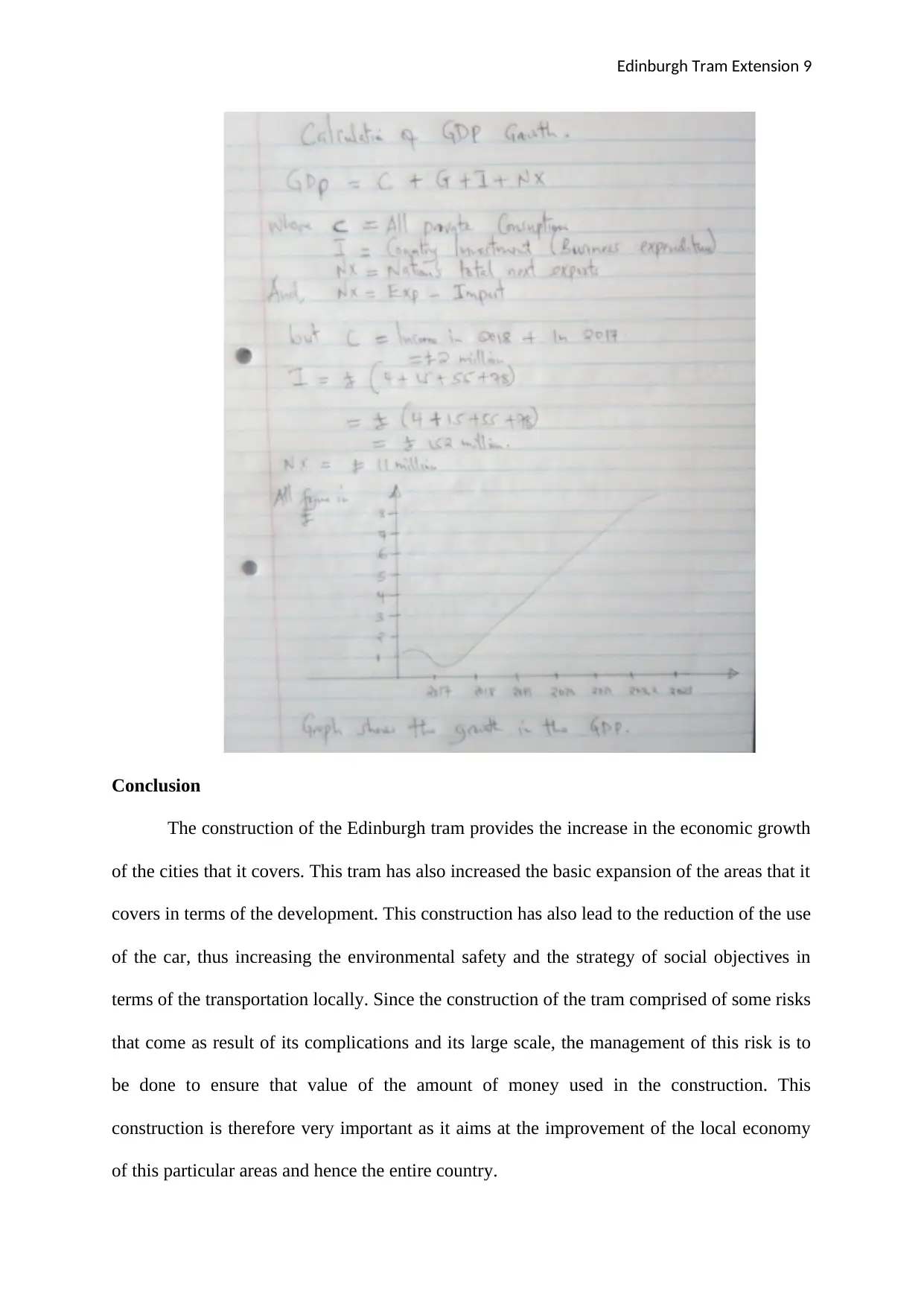
Impact of the Tram Extension on the GDP
The calculation below shows the impact of the tram extension on the gross domestic
product of Edinburgh
the standard ratio that when 10 people are employed then this reflects one person is
permanently employed in the economy, this implies that about over 200 people are being
permanently employed. Since there can be a requirement of the skilled to be imported outside
then this cost can be up to about 70% of the total cost of the expenditure.
Therefore, about 65% of the employed will be permanently employed in this area’s
leading to a progressive reduction of the unemployment situation in this particular areas to
about 1% that reflects about 9500 according to the statistics that was done in 2002, within
that period when the construction was done. The jobs that were permanently provided
included, divers, the people that aided in the maintenance and the administration.
The construction of the tram has also lead to an indirect impact on the people in this
areas. This is seen when the constructor's purchases goods from the locals and also get some
service for the locals too. These good and services included materials for construction, sub
constructors and supply of the temporary buildings. This impact will be felt due to the
spending in the area and this income will majorly be received by the local residents and the
local economy intern leading to the generation of the employment within that area. This
impact will be greatly felt depending on several factors ranging from the amount used in the
purchase of the equipment to be used during construction, the services that were to be
obtained from the local residents and the technically equipped component like the tram
vehicle to be used.
The expenditure will not be amongst the local economy hence an exclusion from the
analysis obtained by allowances. This will lead to the creation of additional 10% jobs
(Knowles, 2016).
Impact of the Tram Extension on the GDP
The calculation below shows the impact of the tram extension on the gross domestic
product of Edinburgh
Edinburgh Tram Extension 9
Conclusion
The construction of the Edinburgh tram provides the increase in the economic growth
of the cities that it covers. This tram has also increased the basic expansion of the areas that it
covers in terms of the development. This construction has also lead to the reduction of the use
of the car, thus increasing the environmental safety and the strategy of social objectives in
terms of the transportation locally. Since the construction of the tram comprised of some risks
that come as result of its complications and its large scale, the management of this risk is to
be done to ensure that value of the amount of money used in the construction. This
construction is therefore very important as it aims at the improvement of the local economy
of this particular areas and hence the entire country.
Conclusion
The construction of the Edinburgh tram provides the increase in the economic growth
of the cities that it covers. This tram has also increased the basic expansion of the areas that it
covers in terms of the development. This construction has also lead to the reduction of the use
of the car, thus increasing the environmental safety and the strategy of social objectives in
terms of the transportation locally. Since the construction of the tram comprised of some risks
that come as result of its complications and its large scale, the management of this risk is to
be done to ensure that value of the amount of money used in the construction. This
construction is therefore very important as it aims at the improvement of the local economy
of this particular areas and hence the entire country.
⊘ This is a preview!⊘
Do you want full access?
Subscribe today to unlock all pages.
Trusted by 1+ million students worldwide
Edinburgh Tram Extension 10
The mobilization of other resource was as a result of the implementation of the project
of construction within this areas. This has, in turn, led to the increase in the economic
benefits. Generally, the construction of the tram mostly depended on the amount of the
capital invested in the construction hence the benefits were also determined by this fact (Lee,
2013).
Reference
Andrews, G.P., 2012. JUST THE TICKET? EXPLORING THE CONTRIBUTION OF FREE
BUS FARES POLICY TO QUALITY OF LATER LIFE (Doctoral dissertation, Faculty of
Environment & Technology, the University of the West of England, Bristol).
Efford, B. and Agent, N.Z., 2010, Shanghai lines up new tram system.
Hodgson, P., Potter, S., Warren, J. and Gillingwater, D., 2012. Can bus really be the new
tram?.
The mobilization of other resource was as a result of the implementation of the project
of construction within this areas. This has, in turn, led to the increase in the economic
benefits. Generally, the construction of the tram mostly depended on the amount of the
capital invested in the construction hence the benefits were also determined by this fact (Lee,
2013).
Reference
Andrews, G.P., 2012. JUST THE TICKET? EXPLORING THE CONTRIBUTION OF FREE
BUS FARES POLICY TO QUALITY OF LATER LIFE (Doctoral dissertation, Faculty of
Environment & Technology, the University of the West of England, Bristol).
Efford, B. and Agent, N.Z., 2010, Shanghai lines up new tram system.
Hodgson, P., Potter, S., Warren, J. and Gillingwater, D., 2012. Can bus really be the new
tram?.
Paraphrase This Document
Need a fresh take? Get an instant paraphrase of this document with our AI Paraphraser
Edinburgh Tram Extension 11
Hodgson, P., Potter, S., Warren, J. and Gillingwater, D., 2013. Can bus really be the new
tram?. Research in Transportation Economics, 39(1), pp.158-166.
Hodgson, P., Potter, S., Warren, J. and Gillingwater, D., 2013. Can bus really be the new
tram?. Research in Transportation Economics, 39(1), pp.158-166.
Hodgson, P., Potter, S., Warren, J. and Gillingwater, D., 2013. Can bus really be the new
tram?. Research in Transportation Economics, 39(1), pp.158-166.
Knowles, R.D., and Abrantes, P., 2008. Buses and light rail: stalled en route?. Traffic Jam:
Ten Years of Sustainable 'Transport in the UK Eds I Docherty, J Shaw (Policy Press, Bristol)
pp, pp.97-116.
Knowles, R.D. and Ferbrache, F., 2016. Evaluation of wider economic impacts of light rail
investment on cities. Journal of Transport Geography, 54, pp.430-439.
Knowles, R.D., 2007. What future for light rail in the UK after Ten Year Transport Plan
targets are scrapped. Transport policy, 14(1), pp.81-93.
Knowles, R.D., 2007. What future for light rail in the UK after Ten Year Transport Plan
targets are scrapped?. Transport Policy, 1(14), pp.81-93.
Knowles, R.D., 2007. What future for light rail in the UK after Ten Year Transport Plan
targets are scrapped?. Transport Policy, 1(14), pp.81-93.
Knowles, R.D., 2007. What future for light rail in the UK after Ten Year Transport Plan
targets are scrapped?. Transport Policy, 14(1), pp.81-93.
Knowles, R.D., 2007. What Future for Light Rail in the UK after Ten Year Transport Plan
Targets is Scrapped?.
Knowles, R.D., 2007. What future for light rail in the UK after Ten Year Transport Plan
targets are scrapped?. Transport Policy, 14(1), pp.81-93.
Hodgson, P., Potter, S., Warren, J. and Gillingwater, D., 2013. Can bus really be the new
tram?. Research in Transportation Economics, 39(1), pp.158-166.
Hodgson, P., Potter, S., Warren, J. and Gillingwater, D., 2013. Can bus really be the new
tram?. Research in Transportation Economics, 39(1), pp.158-166.
Hodgson, P., Potter, S., Warren, J. and Gillingwater, D., 2013. Can bus really be the new
tram?. Research in Transportation Economics, 39(1), pp.158-166.
Knowles, R.D., and Abrantes, P., 2008. Buses and light rail: stalled en route?. Traffic Jam:
Ten Years of Sustainable 'Transport in the UK Eds I Docherty, J Shaw (Policy Press, Bristol)
pp, pp.97-116.
Knowles, R.D. and Ferbrache, F., 2016. Evaluation of wider economic impacts of light rail
investment on cities. Journal of Transport Geography, 54, pp.430-439.
Knowles, R.D., 2007. What future for light rail in the UK after Ten Year Transport Plan
targets are scrapped. Transport policy, 14(1), pp.81-93.
Knowles, R.D., 2007. What future for light rail in the UK after Ten Year Transport Plan
targets are scrapped?. Transport Policy, 1(14), pp.81-93.
Knowles, R.D., 2007. What future for light rail in the UK after Ten Year Transport Plan
targets are scrapped?. Transport Policy, 1(14), pp.81-93.
Knowles, R.D., 2007. What future for light rail in the UK after Ten Year Transport Plan
targets are scrapped?. Transport Policy, 14(1), pp.81-93.
Knowles, R.D., 2007. What Future for Light Rail in the UK after Ten Year Transport Plan
Targets is Scrapped?.
Knowles, R.D., 2007. What future for light rail in the UK after Ten Year Transport Plan
targets are scrapped?. Transport Policy, 14(1), pp.81-93.
Edinburgh Tram Extension 12
Lee, S.S., and Senior, M.L., 2013. Do light rail services discourage car ownership and use?
Evidence from Census data for four English cities. Journal of Transport Geography, 29,
pp.11-23.
Lowe, J., 2011, September. Dispute resolution on the Edinburgh Tram project. In RICS
Construction and Property Conference (p. 1439).
Senior, M.L., 2009. Impacts on the travel behavior of Greater Manchester's light rail
investment (Metrolink Phase 1): evidence from household surveys and Census data. Journal
of Transport Geography, 17(3), pp.187-197.
Shaw, J., MacKinnon, D., and Docherty, I., 2009. Divergence or convergence? Devolution
and transport policy in the United Kingdom. Environment and Planning C: Government and
Policy, 27(3), pp.546-567.
Simmonds, D.C., 2005. Using a Land-use/Transport/Economic Model in Edinburgh. In
European Transport Conference, 2005.
Simmonds, D.C., Leitham, S., White, V. and Williamson, S., 2005, October. Using a land
use/transport/economic model in Edinburgh. In Proceedings of the European transport
conference.
Simmonds, D.C., Leitham, S., White, V. and Williamson, S., 2005, October. Using a land
use/transport/economic model in Edinburgh. In Proceedings of the European transport
conference.
Lee, S.S., and Senior, M.L., 2013. Do light rail services discourage car ownership and use?
Evidence from Census data for four English cities. Journal of Transport Geography, 29,
pp.11-23.
Lowe, J., 2011, September. Dispute resolution on the Edinburgh Tram project. In RICS
Construction and Property Conference (p. 1439).
Senior, M.L., 2009. Impacts on the travel behavior of Greater Manchester's light rail
investment (Metrolink Phase 1): evidence from household surveys and Census data. Journal
of Transport Geography, 17(3), pp.187-197.
Shaw, J., MacKinnon, D., and Docherty, I., 2009. Divergence or convergence? Devolution
and transport policy in the United Kingdom. Environment and Planning C: Government and
Policy, 27(3), pp.546-567.
Simmonds, D.C., 2005. Using a Land-use/Transport/Economic Model in Edinburgh. In
European Transport Conference, 2005.
Simmonds, D.C., Leitham, S., White, V. and Williamson, S., 2005, October. Using a land
use/transport/economic model in Edinburgh. In Proceedings of the European transport
conference.
Simmonds, D.C., Leitham, S., White, V. and Williamson, S., 2005, October. Using a land
use/transport/economic model in Edinburgh. In Proceedings of the European transport
conference.
⊘ This is a preview!⊘
Do you want full access?
Subscribe today to unlock all pages.
Trusted by 1+ million students worldwide

1 out of 12


Related Documents


Your All-in-One AI-Powered Toolkit for Academic Success.
+13062052269
info@desklib.com
Available 24*7 on WhatsApp / Email
![[object Object]](/_next/static/media/star-bottom.7253800d.svg)
Unlock your academic potential
Copyright © 2020–2026 A2Z Services. All Rights Reserved. Developed and managed by ZUCOL.