Edinburgh Zoo: Data Communications Network Design and Implementation
VerifiedAdded on 2021/11/10
|22
|4290
|27
Report
AI Summary
This report provides a comprehensive analysis of a data communications network design for the Edinburgh Zoo. It begins by outlining the benefits of networking, emphasizing centralized IT administration, enhanced data access, improved customer service, and increased revenue. The report then delves into the network design, detailing infrastructure devices such as routers, switches, and wireless access points, including specific product recommendations with pricing. The design considers cabling requirements, including Ethernet and fiber optic cables, to ensure high-speed data transportation across the zoo's extensive area. IPv4 addressing is thoroughly examined, including the allocation of a classless IP addressing space and subnetting for different departments, ensuring efficient use of IP addresses and future scalability. The report also covers network services, differentiating between background and foreground services, and discusses network monitoring tools like SolarWinds. Finally, it addresses network security, including password protection, virus and spyware prevention, and physical network security measures. The report aims to provide a robust and secure network infrastructure for the Edinburgh Zoo, supporting its operational and customer service needs.
Anglia Ruskin University
BSc (HONs) Computing (Information Management)
Data communications
Edinburgh Zoo
STU50613
Adrian Pullin
Running head: DATA COMMUNICATIONS – EDINBURGH ZOO
BSc (HONs) Computing (Information Management)
Data communications
Edinburgh Zoo
STU50613
Adrian Pullin
Running head: DATA COMMUNICATIONS – EDINBURGH ZOO

Paraphrase This Document
Need a fresh take? Get an instant paraphrase of this document with our AI Paraphraser
DATA COMMUNICATIONS – EDINBURGH ZOO
3053
Submission deadline:
15 April 2019
DATA COMMUNICATIONS
ASSIGNMENT:
EDINBURGH ZOO
1
3053
Submission deadline:
15 April 2019
DATA COMMUNICATIONS
ASSIGNMENT:
EDINBURGH ZOO
1
DATA COMMUNICATIONS – EDINBURGH ZOO
TABLE OF CONTENTS
Task 1: Benefits of networking..................................................................................................3
Task 2: Network design.............................................................................................................5
2.1 Infrastructure Devices:.................................................................................................................7
2.1.1 Router:........................................................................................................................7
2.1.2 Switch:........................................................................................................................8
2.1.3 Wireless AP:...............................................................................................................8
Task 3: IPv4 Addressing............................................................................................................9
Task 3.1 Devices acquisition of IP addresses...................................................................................11
Task 4- Network services.........................................................................................................12
4.1 Background services..................................................................................................................12
4.2 Foreground services...................................................................................................................13
Task 5- Network monitoring....................................................................................................13
5.1 SolarWinds network performance monitor................................................................................13
Task 6- Security.......................................................................................................................14
6.1 Password protection...................................................................................................................14
6.2 Viruses and Spyware..................................................................................................................15
6.3 Physical network security...........................................................................................................15
Bibliography:............................................................................................................................16
2
TABLE OF CONTENTS
Task 1: Benefits of networking..................................................................................................3
Task 2: Network design.............................................................................................................5
2.1 Infrastructure Devices:.................................................................................................................7
2.1.1 Router:........................................................................................................................7
2.1.2 Switch:........................................................................................................................8
2.1.3 Wireless AP:...............................................................................................................8
Task 3: IPv4 Addressing............................................................................................................9
Task 3.1 Devices acquisition of IP addresses...................................................................................11
Task 4- Network services.........................................................................................................12
4.1 Background services..................................................................................................................12
4.2 Foreground services...................................................................................................................13
Task 5- Network monitoring....................................................................................................13
5.1 SolarWinds network performance monitor................................................................................13
Task 6- Security.......................................................................................................................14
6.1 Password protection...................................................................................................................14
6.2 Viruses and Spyware..................................................................................................................15
6.3 Physical network security...........................................................................................................15
Bibliography:............................................................................................................................16
2
⊘ This is a preview!⊘
Do you want full access?
Subscribe today to unlock all pages.

Trusted by 1+ million students worldwide
DATA COMMUNICATIONS – EDINBURGH ZOO
TASK 1: BENEFITS OF NETWORKING
Data communication may be described as the process by which information is
transferred from one source to another through either analogue or digital signal. In the
modern era of new technology, networking is widely used by many organisations due to its
benefits. It is appropriate for the Edinburgh Zoo to update the local area network (LAN) as a
way of reducing the many limitations amidst the continued development of the
communication system (Wang et al. 2017). It is imperative for the management to install new
computers and network facilities to allow access to their internal systems from the many
offices around the park, make use of the modern technologies and enable their visitors to
access the Zoo’s information and the internet.
One of the benefits of networking in Edinburgh Zoo is that it enhances centralised IT
administration by improving the efficient management of many computers from a single
platform. The IT administrator can easily troubleshoot a problem arising in the organisation’s
computers without going personally to all the different offices within the Zoo. Networking is
important because it protects the IT devices of the organisation from the interference by the
Zoo visitors. Some of the Zoo visitors may have malicious intentions, and therefore a good
networking system protects the organisation’s private information from intruders. Another
benefit networking in Zoo is that it enhances in better performance of the organisation
because the clients can get more access to data. Networking ensures there are centralised
data backups in case of a disaster in the Zoo offices and this makes networking more reliable
to both the management and the clients.
3
TASK 1: BENEFITS OF NETWORKING
Data communication may be described as the process by which information is
transferred from one source to another through either analogue or digital signal. In the
modern era of new technology, networking is widely used by many organisations due to its
benefits. It is appropriate for the Edinburgh Zoo to update the local area network (LAN) as a
way of reducing the many limitations amidst the continued development of the
communication system (Wang et al. 2017). It is imperative for the management to install new
computers and network facilities to allow access to their internal systems from the many
offices around the park, make use of the modern technologies and enable their visitors to
access the Zoo’s information and the internet.
One of the benefits of networking in Edinburgh Zoo is that it enhances centralised IT
administration by improving the efficient management of many computers from a single
platform. The IT administrator can easily troubleshoot a problem arising in the organisation’s
computers without going personally to all the different offices within the Zoo. Networking is
important because it protects the IT devices of the organisation from the interference by the
Zoo visitors. Some of the Zoo visitors may have malicious intentions, and therefore a good
networking system protects the organisation’s private information from intruders. Another
benefit networking in Zoo is that it enhances in better performance of the organisation
because the clients can get more access to data. Networking ensures there are centralised
data backups in case of a disaster in the Zoo offices and this makes networking more reliable
to both the management and the clients.
3
Paraphrase This Document
Need a fresh take? Get an instant paraphrase of this document with our AI Paraphraser
DATA COMMUNICATIONS – EDINBURGH ZOO
There are many employees in the Zoo, and each of them uses things such as printers
and storage devices among others. A modern shared internet allows the employees to work
efficiently and it also reduces the operating cost of the organisation. The primary goal of any
business is to gain more profit and Edinburgh Zoo is not an exception. Thus a good
networking system would help the organisation increase its revenue as well as run smoothly
(Xia et al. 2015). Networking is vital in Zoo operations because it ensures better customer
service. The Zoo customers can interact with the customer representative in the organisation
via modern platforms of technology such as mobile apps and emails. The customers care
service may respond to all the queries of the visitors within the shortest time possible and in a
practical way. Networking enhances universal access to Edinburgh business applications
whereby all the users can easily book the visits among other things. Networking improves
real-time insight on the daily progress on the business operations in an organisation. The data
regarding the income figures of the Zoo can be easily retrieved by the management when it is
stored in a Local Area Network (LAN) (Waliullah, Moniruzzaman and Rahman 2015). It is
imperative for Zoo to adopt effective networking strategies that would enhance more
informed decision making. Another benefit of networking is that it enhances the
manageability of the Zoo because the hierarchical model allows the addition of new switches
in the different offices.
4
There are many employees in the Zoo, and each of them uses things such as printers
and storage devices among others. A modern shared internet allows the employees to work
efficiently and it also reduces the operating cost of the organisation. The primary goal of any
business is to gain more profit and Edinburgh Zoo is not an exception. Thus a good
networking system would help the organisation increase its revenue as well as run smoothly
(Xia et al. 2015). Networking is vital in Zoo operations because it ensures better customer
service. The Zoo customers can interact with the customer representative in the organisation
via modern platforms of technology such as mobile apps and emails. The customers care
service may respond to all the queries of the visitors within the shortest time possible and in a
practical way. Networking enhances universal access to Edinburgh business applications
whereby all the users can easily book the visits among other things. Networking improves
real-time insight on the daily progress on the business operations in an organisation. The data
regarding the income figures of the Zoo can be easily retrieved by the management when it is
stored in a Local Area Network (LAN) (Waliullah, Moniruzzaman and Rahman 2015). It is
imperative for Zoo to adopt effective networking strategies that would enhance more
informed decision making. Another benefit of networking is that it enhances the
manageability of the Zoo because the hierarchical model allows the addition of new switches
in the different offices.
4
DATA COMMUNICATIONS – EDINBURGH ZOO
TASK 2: NETWORK DESIGN
In networking, there are requirements for cabling and failure to adhere to specific
guidelines that may lead to the improper alignment of cables. Due to the significance of
networking in Edinburgh Zoo as indicated in the discussion above, it is imperative for the
management to ensure that the wires used will meet the appropriate standards (Al Mamun et
al. 2016). The installer of the cables in Edinburgh Zoo should ensure that all the steps are
followed to enhance the effectiveness of the networking system in the area and this would
help the Zoo to achieve its goals. The Zoo covers an area of over 80 acres of wooded hillside.
This implies that the contractor should have the drawing of the total area covered by the Zoo
to avoid problems that may be caused by improper cabling. Some cables are connected
underground while others are connected above the ground, say, via poles between the
different offices and he suggests that the installer should have prior knowledge of the entire
site.
Most of the cables used are made of copper wires, and they should meet certain
standards to avoid unprecedented surprises in the future that may subject the Zoo to loss of
visitors and decline to profitability (Wang et al. 2017). It is therefore essential for the Zoo
management to ensure that all the cables have gone through the necessary stages such as
testing and certification. All the copper cables intended for use in the networking of the Zoo
should undergo full tests as well as termination in case of either pass or fail results. When all
the specification of the cables is done, the next step is to install the network accessories in all
the designated points in the Zoo without interfering with the daily operations of the Zoo
because this may subject the organisation to some delays. Any delay in the course of service
5
TASK 2: NETWORK DESIGN
In networking, there are requirements for cabling and failure to adhere to specific
guidelines that may lead to the improper alignment of cables. Due to the significance of
networking in Edinburgh Zoo as indicated in the discussion above, it is imperative for the
management to ensure that the wires used will meet the appropriate standards (Al Mamun et
al. 2016). The installer of the cables in Edinburgh Zoo should ensure that all the steps are
followed to enhance the effectiveness of the networking system in the area and this would
help the Zoo to achieve its goals. The Zoo covers an area of over 80 acres of wooded hillside.
This implies that the contractor should have the drawing of the total area covered by the Zoo
to avoid problems that may be caused by improper cabling. Some cables are connected
underground while others are connected above the ground, say, via poles between the
different offices and he suggests that the installer should have prior knowledge of the entire
site.
Most of the cables used are made of copper wires, and they should meet certain
standards to avoid unprecedented surprises in the future that may subject the Zoo to loss of
visitors and decline to profitability (Wang et al. 2017). It is therefore essential for the Zoo
management to ensure that all the cables have gone through the necessary stages such as
testing and certification. All the copper cables intended for use in the networking of the Zoo
should undergo full tests as well as termination in case of either pass or fail results. When all
the specification of the cables is done, the next step is to install the network accessories in all
the designated points in the Zoo without interfering with the daily operations of the Zoo
because this may subject the organisation to some delays. Any delay in the course of service
5
⊘ This is a preview!⊘
Do you want full access?
Subscribe today to unlock all pages.
Trusted by 1+ million students worldwide
DATA COMMUNICATIONS – EDINBURGH ZOO
delivery may taint the image of the organisation in the eyes of the visitors, and this should be
avoided.
6
delivery may taint the image of the organisation in the eyes of the visitors, and this should be
avoided.
6
Paraphrase This Document
Need a fresh take? Get an instant paraphrase of this document with our AI Paraphraser
DATA COMMUNICATIONS – EDINBURGH ZOO
Figure1: High Level Network Diagram – Edinburgh Zoo
(Source: Created by Author)
Edinburgh Zoo is a tourist attraction site that is visited by many tourists, and this
requires a good networking system that provides data transportation among the different
offices at high speed to avoid long queues. When data transportation between the systems is
at a low speed, this may cause long delays in service delivery thus reducing the number of
visitors attended per day, and this would eventually lead to low profitability (Ibe, 2017).
Different types of cables would fit the network design of Edinburgh Zoo; this includes;
Ethernet Cables and Fiber Optics Cable (Barz & Bassett, 2016). The network design of the
Zoo comprises of various infrastructure components such as a Routers, Firewalls, Switches,
Network Attached Storages, Wireless access point, Workstations, Servers which mostly will
be interconnected by using cables. We will also consider eliminating any single point of
failures by implementing high-availability and redundancy for each link or device in our
design (Kennedy & Bedford, 2014). In cases of a wireless connection, cables are not used,
and the access points are used instead to deliver 5Ghz and 2.4Ghz bands connections. one of
the common types of cables that we will use in the Zoo is Ethernet unshielded twisted-pair
cables (UTP) Category 6A which can deliver up to 10-Gbps over to 100 Meters distance
(Yang et al. 2018). These cables provide compatibility especially in cases of supporting older
and newer network adapter cards.
Fibre optic cables will also be used to connect between buildings and provide more
bandwidth where more distance and speed are required (Oliviero & Woodward, 2014). They
will be used as the central core of our network infrastructure and will connect all of the
subnets through trunk ports (Lammle, 2011) located in our main switches. Additionally, all
7
Figure1: High Level Network Diagram – Edinburgh Zoo
(Source: Created by Author)
Edinburgh Zoo is a tourist attraction site that is visited by many tourists, and this
requires a good networking system that provides data transportation among the different
offices at high speed to avoid long queues. When data transportation between the systems is
at a low speed, this may cause long delays in service delivery thus reducing the number of
visitors attended per day, and this would eventually lead to low profitability (Ibe, 2017).
Different types of cables would fit the network design of Edinburgh Zoo; this includes;
Ethernet Cables and Fiber Optics Cable (Barz & Bassett, 2016). The network design of the
Zoo comprises of various infrastructure components such as a Routers, Firewalls, Switches,
Network Attached Storages, Wireless access point, Workstations, Servers which mostly will
be interconnected by using cables. We will also consider eliminating any single point of
failures by implementing high-availability and redundancy for each link or device in our
design (Kennedy & Bedford, 2014). In cases of a wireless connection, cables are not used,
and the access points are used instead to deliver 5Ghz and 2.4Ghz bands connections. one of
the common types of cables that we will use in the Zoo is Ethernet unshielded twisted-pair
cables (UTP) Category 6A which can deliver up to 10-Gbps over to 100 Meters distance
(Yang et al. 2018). These cables provide compatibility especially in cases of supporting older
and newer network adapter cards.
Fibre optic cables will also be used to connect between buildings and provide more
bandwidth where more distance and speed are required (Oliviero & Woodward, 2014). They
will be used as the central core of our network infrastructure and will connect all of the
subnets through trunk ports (Lammle, 2011) located in our main switches. Additionally, all
7
DATA COMMUNICATIONS – EDINBURGH ZOO
network attached storages and other servers that will require high bandwidth will also use
fibre optic cables within the DMZ (Jousset et al. 2018).
2.1 INFRASTRUCTURE DEVICES:
2.1.1 ROUTER:
In the domain of networking data packets are transmitted within a network or comes
from another network. The router can be referred to a networking device which is used for
examining data packet contents. The router checks the data packet and decides the destination
and source of the network. Router is a network layer device and it can read the IP addresses
unlike the switches that can read the mac address only. For our routers and firewalls we will
use the Fortinet FG-501E-BDL-950-36 which costs £8,499.99 (Protection, 2019).
2.1.2 SWITCH:
The other significant device within the infrastructure is the switch, and its primary
function is to access specific information within the system and send it to the designated
endpoint (Benvenuto & Zorzi, 2008). At the designated point, the end user may be an
employee of the Zoo sitting behind a computer in one of the offices. The other device in the
design is the server, and it is one of the most critical components in networking because of its
stores, receives, and sends data files to other computers on the same network. The access
point allows the wireless devices within the Zoo to connect with the internet and this may
also benefit the visitors whenever they want to use free Wi-Fi in the course of their visit. For
the offices and other areas (especially with CCTV), we will use Cisco SG250-50P-K9-EU
(Amazon UK, n.d) switch series with POE and SFP+ in the price of £759.08
8
network attached storages and other servers that will require high bandwidth will also use
fibre optic cables within the DMZ (Jousset et al. 2018).
2.1 INFRASTRUCTURE DEVICES:
2.1.1 ROUTER:
In the domain of networking data packets are transmitted within a network or comes
from another network. The router can be referred to a networking device which is used for
examining data packet contents. The router checks the data packet and decides the destination
and source of the network. Router is a network layer device and it can read the IP addresses
unlike the switches that can read the mac address only. For our routers and firewalls we will
use the Fortinet FG-501E-BDL-950-36 which costs £8,499.99 (Protection, 2019).
2.1.2 SWITCH:
The other significant device within the infrastructure is the switch, and its primary
function is to access specific information within the system and send it to the designated
endpoint (Benvenuto & Zorzi, 2008). At the designated point, the end user may be an
employee of the Zoo sitting behind a computer in one of the offices. The other device in the
design is the server, and it is one of the most critical components in networking because of its
stores, receives, and sends data files to other computers on the same network. The access
point allows the wireless devices within the Zoo to connect with the internet and this may
also benefit the visitors whenever they want to use free Wi-Fi in the course of their visit. For
the offices and other areas (especially with CCTV), we will use Cisco SG250-50P-K9-EU
(Amazon UK, n.d) switch series with POE and SFP+ in the price of £759.08
8
⊘ This is a preview!⊘
Do you want full access?
Subscribe today to unlock all pages.
Trusted by 1+ million students worldwide
DATA COMMUNICATIONS – EDINBURGH ZOO
Additionally, we would recommend buying a Cat6A UTP Reel (100m) at an average
price of £69.98 (Amazon UK, n.d) with UTP RJ-45 and a termination kit that could be for
buying for the price of £38.97.
2.1.3 WIRELESS AP:
For the wireless access point, we would recommend the Cisco Aironet 4800 AP
which provides high-performance for the Zoo clients (Services and Points, 2019). This part
can be identifiable by the manufacturer part number AIR-AP4800-E-K9C with a price tag of
£1,347.68 (Amazon UK, n.d). we would also suggest Cisco Nexus 93128TX switch part
number N3 K-C3064TQ-10GT for the price of £12,296.67 along with QSFP cables such as
10Gtek QSFP+ (for the trunk ports) that costs £55.99 for the backbone.
Optic cables LC single-mode are better for long distances, and a reek can be found in
Amazon for the price of 2,999.00 (Amazon UK, n.d), For the DMZ we will use fibre optics
multimode LC cables with an estimated price of 26.15 which are better for use within
datacentres as they are less sensitive for physical changes that could affect the light signalling
that could occur unexpectedly by employees.
TASK 3: IPV4 ADDRESSING
The zoo is assigned the following classless IP Addressing space (aka CIDR) (Blank,
2002): 172.16.0.0/23 (172.16.0.1 - 172.16.1.254). The zoo has different departments that will
isolated into different broadcast domains which will require about 45 different assignable
addresses and extra assignable addresses to allow for future expansion of the network
(Siddika, Hossen and Saha 2017).
9
Additionally, we would recommend buying a Cat6A UTP Reel (100m) at an average
price of £69.98 (Amazon UK, n.d) with UTP RJ-45 and a termination kit that could be for
buying for the price of £38.97.
2.1.3 WIRELESS AP:
For the wireless access point, we would recommend the Cisco Aironet 4800 AP
which provides high-performance for the Zoo clients (Services and Points, 2019). This part
can be identifiable by the manufacturer part number AIR-AP4800-E-K9C with a price tag of
£1,347.68 (Amazon UK, n.d). we would also suggest Cisco Nexus 93128TX switch part
number N3 K-C3064TQ-10GT for the price of £12,296.67 along with QSFP cables such as
10Gtek QSFP+ (for the trunk ports) that costs £55.99 for the backbone.
Optic cables LC single-mode are better for long distances, and a reek can be found in
Amazon for the price of 2,999.00 (Amazon UK, n.d), For the DMZ we will use fibre optics
multimode LC cables with an estimated price of 26.15 which are better for use within
datacentres as they are less sensitive for physical changes that could affect the light signalling
that could occur unexpectedly by employees.
TASK 3: IPV4 ADDRESSING
The zoo is assigned the following classless IP Addressing space (aka CIDR) (Blank,
2002): 172.16.0.0/23 (172.16.0.1 - 172.16.1.254). The zoo has different departments that will
isolated into different broadcast domains which will require about 45 different assignable
addresses and extra assignable addresses to allow for future expansion of the network
(Siddika, Hossen and Saha 2017).
9
Paraphrase This Document
Need a fresh take? Get an instant paraphrase of this document with our AI Paraphraser
DATA COMMUNICATIONS – EDINBURGH ZOO
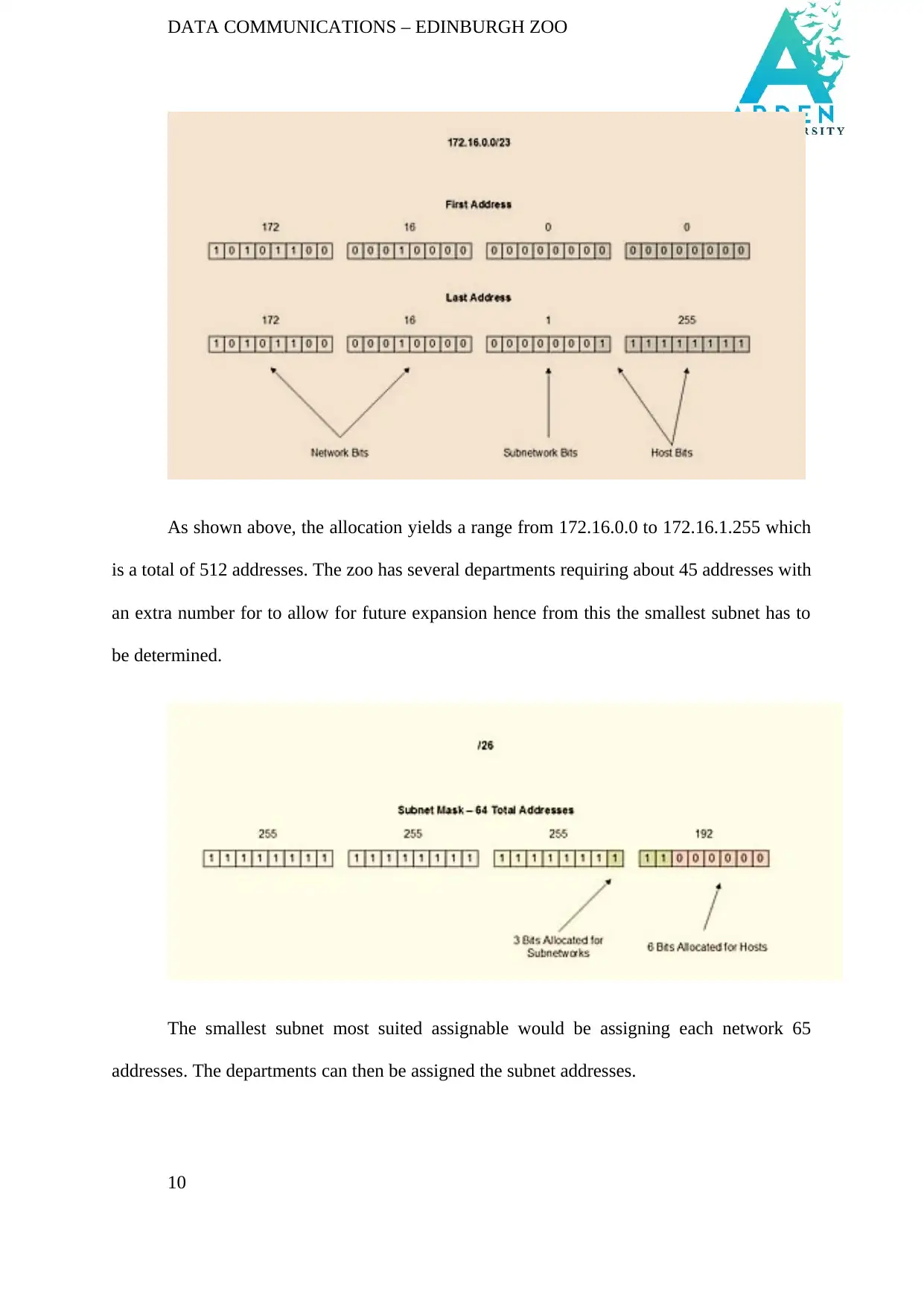
As shown above, the allocation yields a range from 172.16.0.0 to 172.16.1.255 which
is a total of 512 addresses. The zoo has several departments requiring about 45 addresses with
an extra number for to allow for future expansion hence from this the smallest subnet has to
be determined.
The smallest subnet most suited assignable would be assigning each network 65
addresses. The departments can then be assigned the subnet addresses.
10
As shown above, the allocation yields a range from 172.16.0.0 to 172.16.1.255 which
is a total of 512 addresses. The zoo has several departments requiring about 45 addresses with
an extra number for to allow for future expansion hence from this the smallest subnet has to
be determined.
The smallest subnet most suited assignable would be assigning each network 65
addresses. The departments can then be assigned the subnet addresses.
10
DATA COMMUNICATIONS – EDINBURGH ZOO
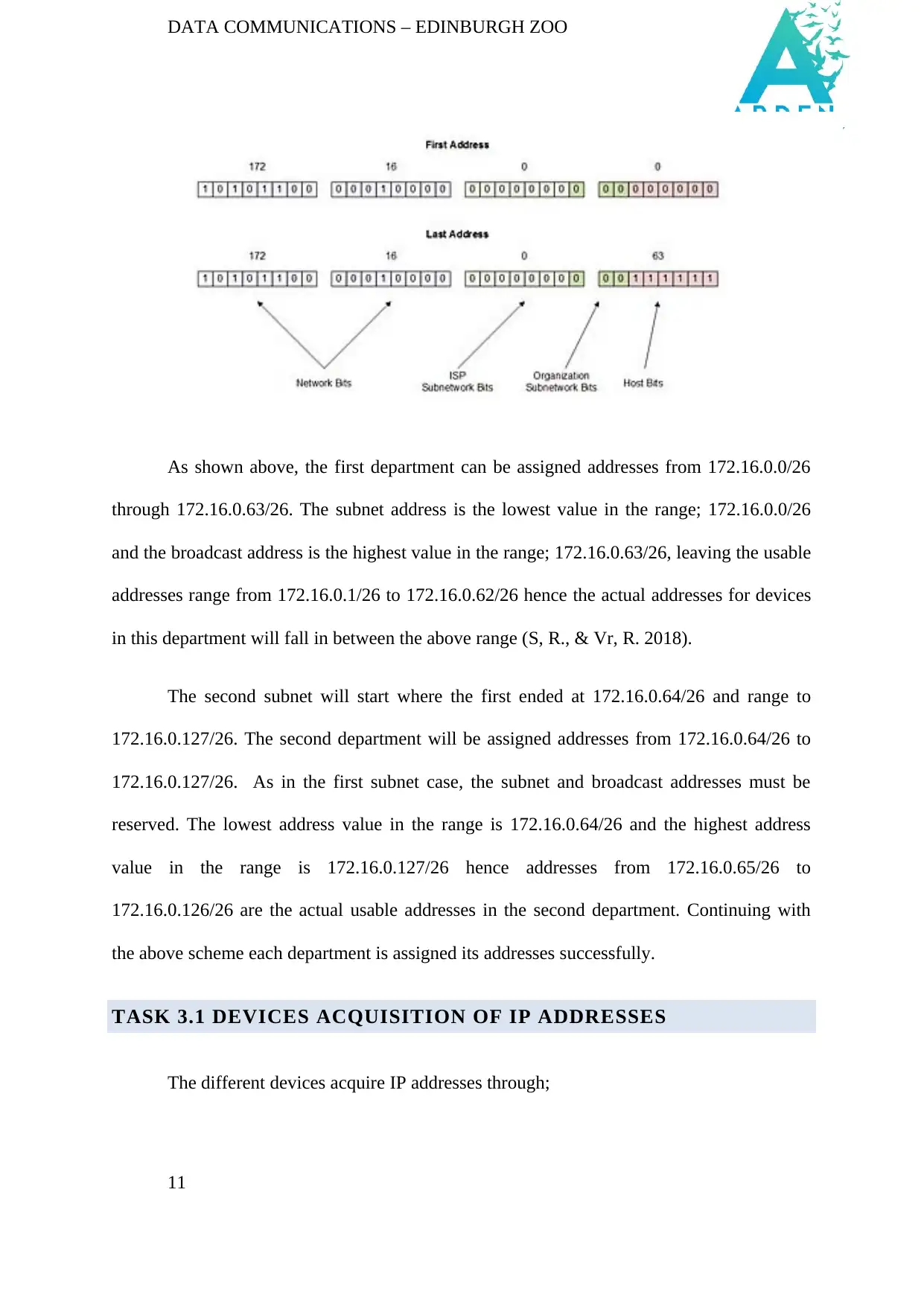
As shown above, the first department can be assigned addresses from 172.16.0.0/26
through 172.16.0.63/26. The subnet address is the lowest value in the range; 172.16.0.0/26
and the broadcast address is the highest value in the range; 172.16.0.63/26, leaving the usable
addresses range from 172.16.0.1/26 to 172.16.0.62/26 hence the actual addresses for devices
in this department will fall in between the above range (S, R., & Vr, R. 2018).
The second subnet will start where the first ended at 172.16.0.64/26 and range to
172.16.0.127/26. The second department will be assigned addresses from 172.16.0.64/26 to
172.16.0.127/26. As in the first subnet case, the subnet and broadcast addresses must be
reserved. The lowest address value in the range is 172.16.0.64/26 and the highest address
value in the range is 172.16.0.127/26 hence addresses from 172.16.0.65/26 to
172.16.0.126/26 are the actual usable addresses in the second department. Continuing with
the above scheme each department is assigned its addresses successfully.
TASK 3.1 DEVICES ACQUISITION OF IP ADDRESSES
The different devices acquire IP addresses through;
11
As shown above, the first department can be assigned addresses from 172.16.0.0/26
through 172.16.0.63/26. The subnet address is the lowest value in the range; 172.16.0.0/26
and the broadcast address is the highest value in the range; 172.16.0.63/26, leaving the usable
addresses range from 172.16.0.1/26 to 172.16.0.62/26 hence the actual addresses for devices
in this department will fall in between the above range (S, R., & Vr, R. 2018).
The second subnet will start where the first ended at 172.16.0.64/26 and range to
172.16.0.127/26. The second department will be assigned addresses from 172.16.0.64/26 to
172.16.0.127/26. As in the first subnet case, the subnet and broadcast addresses must be
reserved. The lowest address value in the range is 172.16.0.64/26 and the highest address
value in the range is 172.16.0.127/26 hence addresses from 172.16.0.65/26 to
172.16.0.126/26 are the actual usable addresses in the second department. Continuing with
the above scheme each department is assigned its addresses successfully.
TASK 3.1 DEVICES ACQUISITION OF IP ADDRESSES
The different devices acquire IP addresses through;
11
⊘ This is a preview!⊘
Do you want full access?
Subscribe today to unlock all pages.
Trusted by 1+ million students worldwide

1 out of 22


Related Documents


Your All-in-One AI-Powered Toolkit for Academic Success.
+13062052269
info@desklib.com
Available 24*7 on WhatsApp / Email
![[object Object]](/_next/static/media/star-bottom.7253800d.svg)
Unlock your academic potential
Copyright © 2020–2026 A2Z Services. All Rights Reserved. Developed and managed by ZUCOL.