Education Ethics and Theories: Case Studies in Teaching Practice
VerifiedAdded on 2021/06/17
|9
|3007
|20
Essay
AI Summary
This essay presents two case studies focusing on ethical decision-making and the duty of care within the teaching profession. The first case examines a teacher's ethical dilemma when faced with a parent's complaint about student grouping, analyzing the importance of defending pedagogical best practices and student's best interests while adhering to professional codes of conduct and standards. The second case explores a scenario involving student fighting and the teacher's potential negligence, analyzing the elements of duty of care, breach of duty, harm, and causation to determine the teacher's responsibility. The essay utilizes professional resources, curriculum, and legislation to analyze the scenarios and provide arguments. The essay highlights the importance of teachers understanding their professional responsibilities in relation to the law, and the importance of adhering to the highest ethical standards.

UNIT:
NAME:
DATE:
NAME:
DATE:

Paraphrase This Document
Need a fresh take? Get an instant paraphrase of this document with our AI Paraphraser
Education Ethics and Theories Case
Studies
Introduction
Education ethics and theories inform teachers’ decisions and actions in their professional
practice. Education ethics and theories refer to professional guidelines that govern a teacher’s
actions and decisions and set standards between right and wrong (Winch, Oancea, & Orchard,
2015). Ethics seeks to standardize actions and rationalize decisions taken in a professional
practice. Teachers have an obligation to create conducive learning environment that nature
learners’ and enable them achieve their full potential. Ethical standards are a significant resource
that provides guidelines to teaching practice. Teachers require exemplary values and morals to
engage with students and other stakeholders and meet educational objectives (Strike, & Soltis,
2015). Teachers are responsible for what happens around the learning environment and are
charged for any offence that occurs within their span of duty (Falkiner, Thomson, & Day, 2017).
This outlines the importance of teachers understanding the teaching professional in relation to
law. The teachers are then able to rationally defend themselves from criminal charges when
levied against them (Crigger, & Godfrey, 2014). The teacher is therefore required to a bid to
highest ethical standards and assumes responsibility and accountability when practicing teaching.
The following essay discusses two case studies relating to theoretically informed ethical decision
making and duty of care and negligence in the teaching profession practice. The essay will use
professional resources relating to ethics, curriculum and legislation and review scholarly sources
to analyze and put forward arguments.
Case 1: Theoretical informed ethical decision making
The first case study present a scenario where I have to decide between a student’s father
escalation and my original decisions to group his daughter who is a high achiever with a boy
who is a low achiever. The class group had been designed consistent with pedagogical best
practices to ensure effective and all round learning experiences to all students. The groups’
results were impressive as students were engaging and becoming more accommodating. A father
of high achieving student complains that his daughter should not mingle with a low achieving
Studies
Introduction
Education ethics and theories inform teachers’ decisions and actions in their professional
practice. Education ethics and theories refer to professional guidelines that govern a teacher’s
actions and decisions and set standards between right and wrong (Winch, Oancea, & Orchard,
2015). Ethics seeks to standardize actions and rationalize decisions taken in a professional
practice. Teachers have an obligation to create conducive learning environment that nature
learners’ and enable them achieve their full potential. Ethical standards are a significant resource
that provides guidelines to teaching practice. Teachers require exemplary values and morals to
engage with students and other stakeholders and meet educational objectives (Strike, & Soltis,
2015). Teachers are responsible for what happens around the learning environment and are
charged for any offence that occurs within their span of duty (Falkiner, Thomson, & Day, 2017).
This outlines the importance of teachers understanding the teaching professional in relation to
law. The teachers are then able to rationally defend themselves from criminal charges when
levied against them (Crigger, & Godfrey, 2014). The teacher is therefore required to a bid to
highest ethical standards and assumes responsibility and accountability when practicing teaching.
The following essay discusses two case studies relating to theoretically informed ethical decision
making and duty of care and negligence in the teaching profession practice. The essay will use
professional resources relating to ethics, curriculum and legislation and review scholarly sources
to analyze and put forward arguments.
Case 1: Theoretical informed ethical decision making
The first case study present a scenario where I have to decide between a student’s father
escalation and my original decisions to group his daughter who is a high achiever with a boy
who is a low achiever. The class group had been designed consistent with pedagogical best
practices to ensure effective and all round learning experiences to all students. The groups’
results were impressive as students were engaging and becoming more accommodating. A father
of high achieving student complains that his daughter should not mingle with a low achieving
student in fear that the daughter’s performance is likely to be negatively impacted. The following
is my rational defensive argument to a theoretically informed ethical decision.
First, I will settle down the parent for a discussion to explain the whole issue. The discussing will
involve explaining the objectives of the group work, how they are designed, and the benefits that
students get from the class groups. This will allow me time to let the parent understand my
decision is right and of best interest to all students including his daughter. This means that I will
not change the student group membership but proceed to defend by decision. The case has
ethical significance that I have to decide what is right or wrong to do (Davson-Galle, 2009). This
entails that I have to decide and defend by decision or accept I was wrong to have taken the
decisions when designing class group. The parent feels and thinks that I am wrong to allow his
daughter who is a high achiever to interact and work in the same group with a low performing
student. This view is different to my opinion and professional practice and I have to defend my
ethically informed decision. The situation therefore presents a dilemma. I am faced with two
situations that I have to decide on. On one side, am faced with a situation to go ahead and
explain my decision or give in to parent’s argument and change his daughter group membership.
This situation has two sides, explaining and making parent understand my decision or accepting I
made a wrong decision and agree to change the student from the current group and follow the
parent’s wish. I have to choose between defending professional practice and student’s best
interests and parent’s rights over their students. The father of the student feels that he has right to
who his daughter interact with and that the daughter is too young to know that people that one
surround themselves with have great impact to their success. Therefore the parent feels he has a
duty to protect his student from low performing student who can lower his daughter
performance. This is different to classroom setting and the objective of the school system. The
Australian education system seeks to promote equity and excellence and provide students with
best learning environment (Leibowitz, & Hlengwa, 2017). Therefore, the father’s argument
doesn’t prompt me to change by original position but create a need to consider parents’ rights to
their children in the scenario. Instead of altering my position I will opt to explain and convince
the parent that my decision is right and of best interests to the students.
My decision to group a high performing student and a low achieving student is right. In
accordance to Common Wealth Guidelines, I have a responsibility to make decisions that
is my rational defensive argument to a theoretically informed ethical decision.
First, I will settle down the parent for a discussion to explain the whole issue. The discussing will
involve explaining the objectives of the group work, how they are designed, and the benefits that
students get from the class groups. This will allow me time to let the parent understand my
decision is right and of best interest to all students including his daughter. This means that I will
not change the student group membership but proceed to defend by decision. The case has
ethical significance that I have to decide what is right or wrong to do (Davson-Galle, 2009). This
entails that I have to decide and defend by decision or accept I was wrong to have taken the
decisions when designing class group. The parent feels and thinks that I am wrong to allow his
daughter who is a high achiever to interact and work in the same group with a low performing
student. This view is different to my opinion and professional practice and I have to defend my
ethically informed decision. The situation therefore presents a dilemma. I am faced with two
situations that I have to decide on. On one side, am faced with a situation to go ahead and
explain my decision or give in to parent’s argument and change his daughter group membership.
This situation has two sides, explaining and making parent understand my decision or accepting I
made a wrong decision and agree to change the student from the current group and follow the
parent’s wish. I have to choose between defending professional practice and student’s best
interests and parent’s rights over their students. The father of the student feels that he has right to
who his daughter interact with and that the daughter is too young to know that people that one
surround themselves with have great impact to their success. Therefore the parent feels he has a
duty to protect his student from low performing student who can lower his daughter
performance. This is different to classroom setting and the objective of the school system. The
Australian education system seeks to promote equity and excellence and provide students with
best learning environment (Leibowitz, & Hlengwa, 2017). Therefore, the father’s argument
doesn’t prompt me to change by original position but create a need to consider parents’ rights to
their children in the scenario. Instead of altering my position I will opt to explain and convince
the parent that my decision is right and of best interests to the students.
My decision to group a high performing student and a low achieving student is right. In
accordance to Common Wealth Guidelines, I have a responsibility to make decisions that
⊘ This is a preview!⊘
Do you want full access?
Subscribe today to unlock all pages.

Trusted by 1+ million students worldwide
promote learning to all students. The decision to allocate a high achiever student and low
achiever was deliberately and rationally made. The class group is designed to specific learning
objectives and is consistent with professional teaching practice. The design used meets and is
consistent to pedagogical best practices. I have an obligation to protect students’ rights in ensure
there is equity and excellence in learning. First I have to protect learners’ dignity and promote
mutual respect. This means that I cannot engage in practices that interferes with learners self
worth or intimidates or humiliates them in the process of learning (Maxwell, & Schwimmer,
2016). This ensures that all learners are treated with dignity and courtesy despite of their abilities
and backgrounds. Secondly, I have to interact with students without displaying preference or any
form of biasness. According to Common Wealth Guidelines, I also have to make decisions that
are in best interests of the students’. This enables to maintain objectivity when relating with
students. I appreciate the parent’s efforts to protect their children’s rights. However, parent’s
right does not collide with professional practices that aim to improve learners’ ability to learn.
The parents have rights to assess their children’s learning conditions, learner’s performance
information, and safety of the environment. Therefore the parent’s rights are not supposed to
interfere with the learners’ best interest and professional practice.
My defense is much influenced by contemporary models of thinking around indoctrination and
inclusivity. I strive to defend provision and access of high quality education that is free from any
form of discrimination. I tend to reason and put forward arguments that endorse support and
engagement between school members and build communities that are respectful to one another.
This entails advocating for inclusive education every-day, every classroom, and students are
learning to achieve supportive, inclusive, safe, and disciplined schooling environment (Maxwell
et al., 2016). In order to ensure my argument is rationally defensible, I cited government policies
on education, professional codes of conducts, scholarly evidence, and Australian Professional
Standards for education. These sources enhance credibility of my evidence of argument and offer
a convincing rational argument that I made informed ethical decisions. The decision to defend
my original position is relevant to Professional Code of Conduct and Australian Professional
Standards for Education. They inform my decision to defend professional practices and
engagement. The professional Code of Conduct ad Australian Professional Standards for
Teachers provide guidelines to defend and make decisions in ethical dilemmas. Therefore, my
understanding on Professional Codes of Conduct and Professional Standards of teaching practice
achiever was deliberately and rationally made. The class group is designed to specific learning
objectives and is consistent with professional teaching practice. The design used meets and is
consistent to pedagogical best practices. I have an obligation to protect students’ rights in ensure
there is equity and excellence in learning. First I have to protect learners’ dignity and promote
mutual respect. This means that I cannot engage in practices that interferes with learners self
worth or intimidates or humiliates them in the process of learning (Maxwell, & Schwimmer,
2016). This ensures that all learners are treated with dignity and courtesy despite of their abilities
and backgrounds. Secondly, I have to interact with students without displaying preference or any
form of biasness. According to Common Wealth Guidelines, I also have to make decisions that
are in best interests of the students’. This enables to maintain objectivity when relating with
students. I appreciate the parent’s efforts to protect their children’s rights. However, parent’s
right does not collide with professional practices that aim to improve learners’ ability to learn.
The parents have rights to assess their children’s learning conditions, learner’s performance
information, and safety of the environment. Therefore the parent’s rights are not supposed to
interfere with the learners’ best interest and professional practice.
My defense is much influenced by contemporary models of thinking around indoctrination and
inclusivity. I strive to defend provision and access of high quality education that is free from any
form of discrimination. I tend to reason and put forward arguments that endorse support and
engagement between school members and build communities that are respectful to one another.
This entails advocating for inclusive education every-day, every classroom, and students are
learning to achieve supportive, inclusive, safe, and disciplined schooling environment (Maxwell
et al., 2016). In order to ensure my argument is rationally defensible, I cited government policies
on education, professional codes of conducts, scholarly evidence, and Australian Professional
Standards for education. These sources enhance credibility of my evidence of argument and offer
a convincing rational argument that I made informed ethical decisions. The decision to defend
my original position is relevant to Professional Code of Conduct and Australian Professional
Standards for Education. They inform my decision to defend professional practices and
engagement. The professional Code of Conduct ad Australian Professional Standards for
Teachers provide guidelines to defend and make decisions in ethical dilemmas. Therefore, my
understanding on Professional Codes of Conduct and Professional Standards of teaching practice
Paraphrase This Document
Need a fresh take? Get an instant paraphrase of this document with our AI Paraphraser
informed by decision on the situation. The Melbourne Declaration was useful in shaping my
argument toward inclusivity and indoctrination. The foundation documents provide inclusive
education policy statement that enhances inclusivity in learning institutions (“Melbourne
Declaration on Educational Goals for Young” n.d.).
From the discussion, I will defend my original stand and explain to the parent the rationality
behind my decisions using code of conducts, professional standards, and foundation document.
This will enable the parent understand and appreciate the school learning process that will
effective and enhance student success.
Case 2: Duty of Due Diligence
In the following case study, Phillip, a first year teacher is involved in a situation where students
fight while he is on duty for supervision. The students fight ends up with one student being badly
injured and taken to hospital. Duty of care is defined as legal obligation that one party has of
safety to another party ("Duty of Care", 2018). It is a legal responsibility for an action or
omission of an action that is reasonably foreseeable that cause damage or harm to others
(Lucadou-Wells, & Bourke, 2015). Negligence is breach of duty of care that leads to damage.
Negligence is proven when an entity fails to take proper action of what is within their
responsibility to take care and avoid harm or damage. Negligence has to be failure of taking
reasonable care where damages are incurred by the other party ("Mandatory reporting of child
abuse and neglect,” 2018). In accordance to Common Wealth Guidelines, teachers and the school
authority have duty of care to ensure no reasonable foreseeable injuries or damages happen to
learners (Sugrue, & Solbrekke, 2014). They have to take responsibility and ensure reasonable
care is taken or no omission leads to injuries. The following discussing analyses if Phillip has a
duty of care and negligence to the fight damages. This will involve 4 steps to prove if Philip is
guilty or not. They include duty of care, breach of duty of care, harm, and causation.
1. Was there a professional duty of care
Yes. Phillip has a teacher had a duty of care to the injured boy. The teacher has a professional
duty of care to ensure not injury or harm come to students. Teachers are supposed to make
through arrangements and ensure students are free from foreseeable harm (Sugrue, & Solbrekke,
2014). This entails that teachers should take responsibility to foreseeable and proximity harm
argument toward inclusivity and indoctrination. The foundation documents provide inclusive
education policy statement that enhances inclusivity in learning institutions (“Melbourne
Declaration on Educational Goals for Young” n.d.).
From the discussion, I will defend my original stand and explain to the parent the rationality
behind my decisions using code of conducts, professional standards, and foundation document.
This will enable the parent understand and appreciate the school learning process that will
effective and enhance student success.
Case 2: Duty of Due Diligence
In the following case study, Phillip, a first year teacher is involved in a situation where students
fight while he is on duty for supervision. The students fight ends up with one student being badly
injured and taken to hospital. Duty of care is defined as legal obligation that one party has of
safety to another party ("Duty of Care", 2018). It is a legal responsibility for an action or
omission of an action that is reasonably foreseeable that cause damage or harm to others
(Lucadou-Wells, & Bourke, 2015). Negligence is breach of duty of care that leads to damage.
Negligence is proven when an entity fails to take proper action of what is within their
responsibility to take care and avoid harm or damage. Negligence has to be failure of taking
reasonable care where damages are incurred by the other party ("Mandatory reporting of child
abuse and neglect,” 2018). In accordance to Common Wealth Guidelines, teachers and the school
authority have duty of care to ensure no reasonable foreseeable injuries or damages happen to
learners (Sugrue, & Solbrekke, 2014). They have to take responsibility and ensure reasonable
care is taken or no omission leads to injuries. The following discussing analyses if Phillip has a
duty of care and negligence to the fight damages. This will involve 4 steps to prove if Philip is
guilty or not. They include duty of care, breach of duty of care, harm, and causation.
1. Was there a professional duty of care
Yes. Phillip has a teacher had a duty of care to the injured boy. The teacher has a professional
duty of care to ensure not injury or harm come to students. Teachers are supposed to make
through arrangements and ensure students are free from foreseeable harm (Sugrue, & Solbrekke,
2014). This entails that teachers should take responsibility to foreseeable and proximity harm
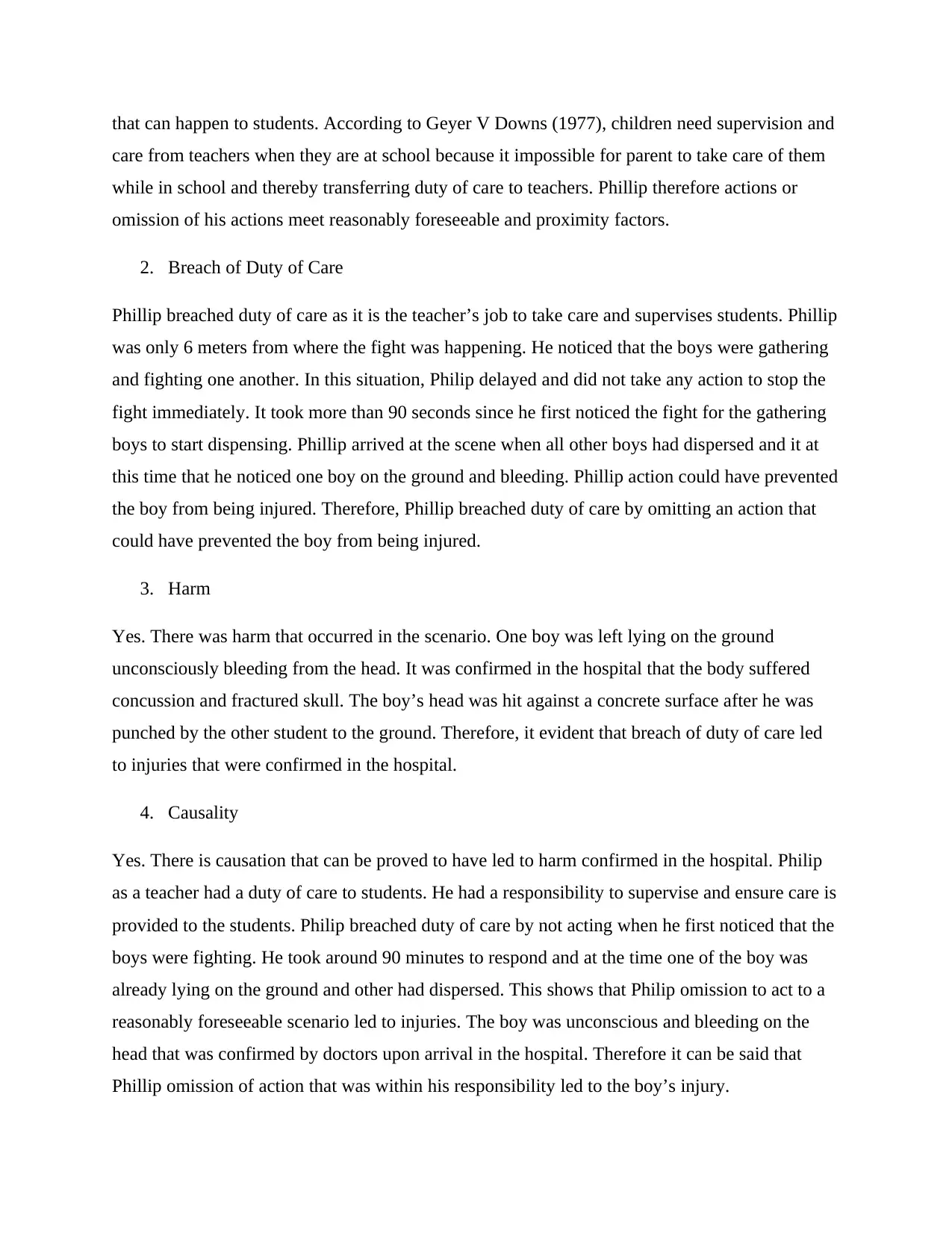
that can happen to students. According to Geyer V Downs (1977), children need supervision and
care from teachers when they are at school because it impossible for parent to take care of them
while in school and thereby transferring duty of care to teachers. Phillip therefore actions or
omission of his actions meet reasonably foreseeable and proximity factors.
2. Breach of Duty of Care
Phillip breached duty of care as it is the teacher’s job to take care and supervises students. Phillip
was only 6 meters from where the fight was happening. He noticed that the boys were gathering
and fighting one another. In this situation, Philip delayed and did not take any action to stop the
fight immediately. It took more than 90 seconds since he first noticed the fight for the gathering
boys to start dispensing. Phillip arrived at the scene when all other boys had dispersed and it at
this time that he noticed one boy on the ground and bleeding. Phillip action could have prevented
the boy from being injured. Therefore, Phillip breached duty of care by omitting an action that
could have prevented the boy from being injured.
3. Harm
Yes. There was harm that occurred in the scenario. One boy was left lying on the ground
unconsciously bleeding from the head. It was confirmed in the hospital that the body suffered
concussion and fractured skull. The boy’s head was hit against a concrete surface after he was
punched by the other student to the ground. Therefore, it evident that breach of duty of care led
to injuries that were confirmed in the hospital.
4. Causality
Yes. There is causation that can be proved to have led to harm confirmed in the hospital. Philip
as a teacher had a duty of care to students. He had a responsibility to supervise and ensure care is
provided to the students. Philip breached duty of care by not acting when he first noticed that the
boys were fighting. He took around 90 minutes to respond and at the time one of the boy was
already lying on the ground and other had dispersed. This shows that Philip omission to act to a
reasonably foreseeable scenario led to injuries. The boy was unconscious and bleeding on the
head that was confirmed by doctors upon arrival in the hospital. Therefore it can be said that
Phillip omission of action that was within his responsibility led to the boy’s injury.
care from teachers when they are at school because it impossible for parent to take care of them
while in school and thereby transferring duty of care to teachers. Phillip therefore actions or
omission of his actions meet reasonably foreseeable and proximity factors.
2. Breach of Duty of Care
Phillip breached duty of care as it is the teacher’s job to take care and supervises students. Phillip
was only 6 meters from where the fight was happening. He noticed that the boys were gathering
and fighting one another. In this situation, Philip delayed and did not take any action to stop the
fight immediately. It took more than 90 seconds since he first noticed the fight for the gathering
boys to start dispensing. Phillip arrived at the scene when all other boys had dispersed and it at
this time that he noticed one boy on the ground and bleeding. Phillip action could have prevented
the boy from being injured. Therefore, Phillip breached duty of care by omitting an action that
could have prevented the boy from being injured.
3. Harm
Yes. There was harm that occurred in the scenario. One boy was left lying on the ground
unconsciously bleeding from the head. It was confirmed in the hospital that the body suffered
concussion and fractured skull. The boy’s head was hit against a concrete surface after he was
punched by the other student to the ground. Therefore, it evident that breach of duty of care led
to injuries that were confirmed in the hospital.
4. Causality
Yes. There is causation that can be proved to have led to harm confirmed in the hospital. Philip
as a teacher had a duty of care to students. He had a responsibility to supervise and ensure care is
provided to the students. Philip breached duty of care by not acting when he first noticed that the
boys were fighting. He took around 90 minutes to respond and at the time one of the boy was
already lying on the ground and other had dispersed. This shows that Philip omission to act to a
reasonably foreseeable scenario led to injuries. The boy was unconscious and bleeding on the
head that was confirmed by doctors upon arrival in the hospital. Therefore it can be said that
Phillip omission of action that was within his responsibility led to the boy’s injury.
⊘ This is a preview!⊘
Do you want full access?
Subscribe today to unlock all pages.
Trusted by 1+ million students worldwide
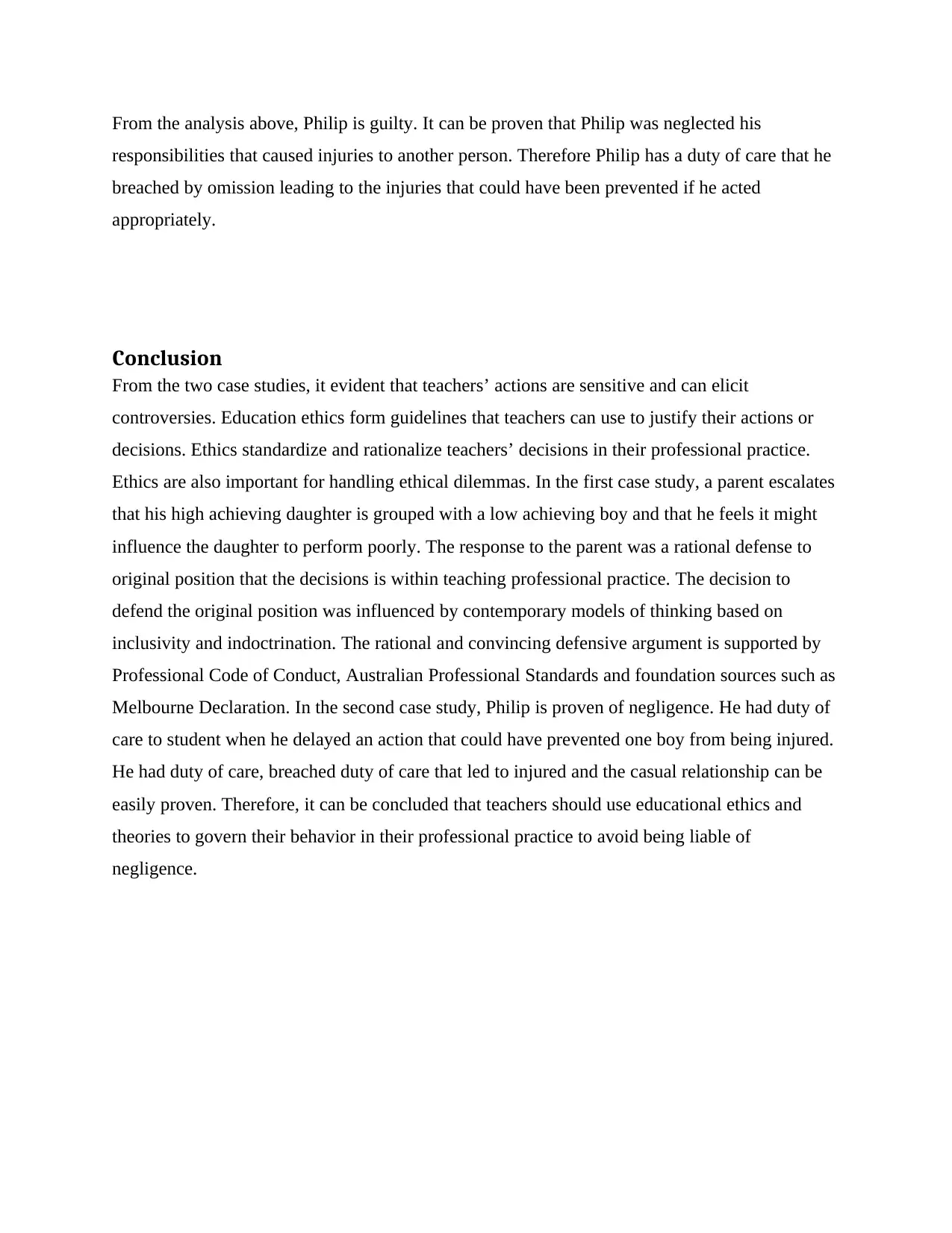
From the analysis above, Philip is guilty. It can be proven that Philip was neglected his
responsibilities that caused injuries to another person. Therefore Philip has a duty of care that he
breached by omission leading to the injuries that could have been prevented if he acted
appropriately.
Conclusion
From the two case studies, it evident that teachers’ actions are sensitive and can elicit
controversies. Education ethics form guidelines that teachers can use to justify their actions or
decisions. Ethics standardize and rationalize teachers’ decisions in their professional practice.
Ethics are also important for handling ethical dilemmas. In the first case study, a parent escalates
that his high achieving daughter is grouped with a low achieving boy and that he feels it might
influence the daughter to perform poorly. The response to the parent was a rational defense to
original position that the decisions is within teaching professional practice. The decision to
defend the original position was influenced by contemporary models of thinking based on
inclusivity and indoctrination. The rational and convincing defensive argument is supported by
Professional Code of Conduct, Australian Professional Standards and foundation sources such as
Melbourne Declaration. In the second case study, Philip is proven of negligence. He had duty of
care to student when he delayed an action that could have prevented one boy from being injured.
He had duty of care, breached duty of care that led to injured and the casual relationship can be
easily proven. Therefore, it can be concluded that teachers should use educational ethics and
theories to govern their behavior in their professional practice to avoid being liable of
negligence.
responsibilities that caused injuries to another person. Therefore Philip has a duty of care that he
breached by omission leading to the injuries that could have been prevented if he acted
appropriately.
Conclusion
From the two case studies, it evident that teachers’ actions are sensitive and can elicit
controversies. Education ethics form guidelines that teachers can use to justify their actions or
decisions. Ethics standardize and rationalize teachers’ decisions in their professional practice.
Ethics are also important for handling ethical dilemmas. In the first case study, a parent escalates
that his high achieving daughter is grouped with a low achieving boy and that he feels it might
influence the daughter to perform poorly. The response to the parent was a rational defense to
original position that the decisions is within teaching professional practice. The decision to
defend the original position was influenced by contemporary models of thinking based on
inclusivity and indoctrination. The rational and convincing defensive argument is supported by
Professional Code of Conduct, Australian Professional Standards and foundation sources such as
Melbourne Declaration. In the second case study, Philip is proven of negligence. He had duty of
care to student when he delayed an action that could have prevented one boy from being injured.
He had duty of care, breached duty of care that led to injured and the casual relationship can be
easily proven. Therefore, it can be concluded that teachers should use educational ethics and
theories to govern their behavior in their professional practice to avoid being liable of
negligence.
Paraphrase This Document
Need a fresh take? Get an instant paraphrase of this document with our AI Paraphraser
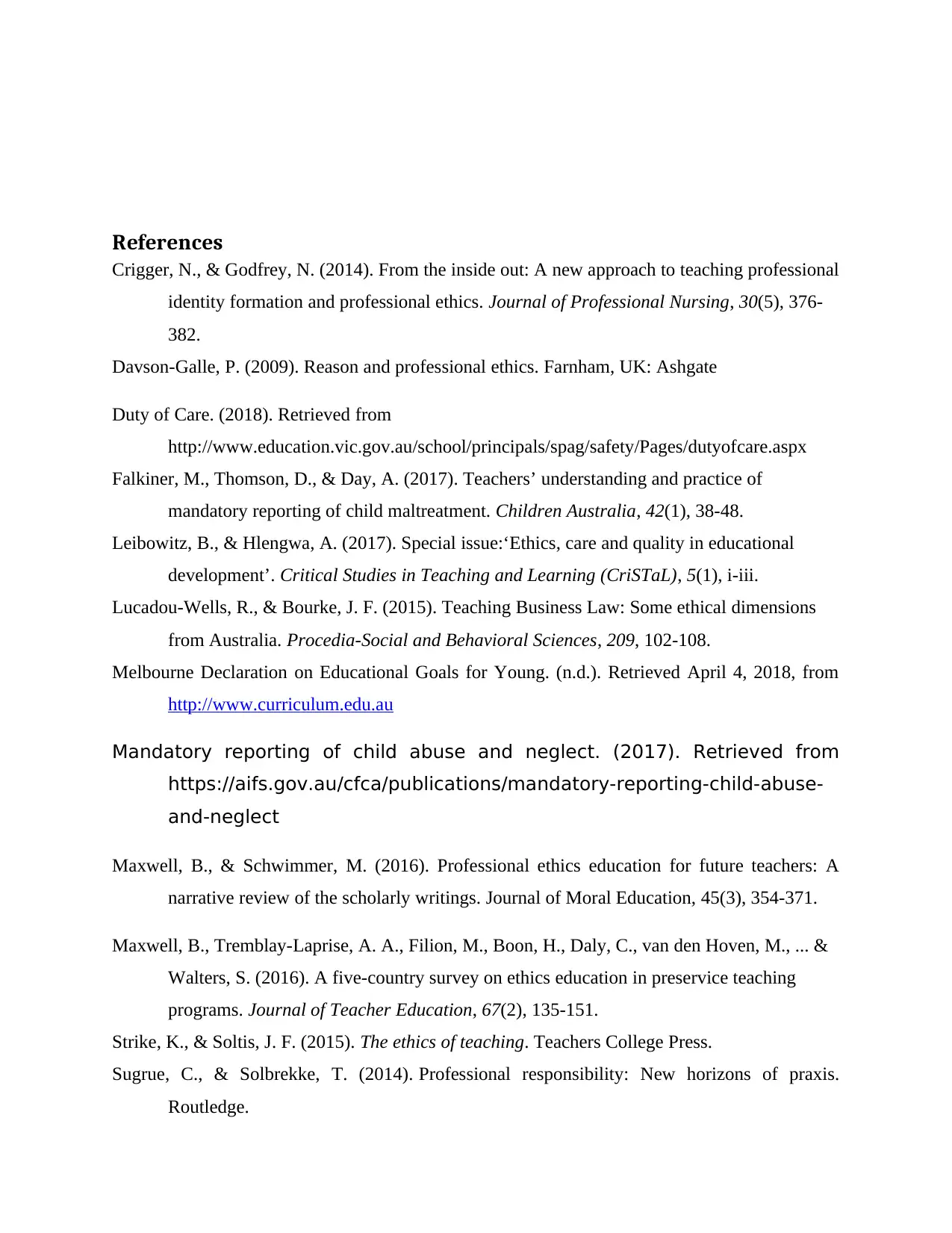
References
Crigger, N., & Godfrey, N. (2014). From the inside out: A new approach to teaching professional
identity formation and professional ethics. Journal of Professional Nursing, 30(5), 376-
382.
Davson-Galle, P. (2009). Reason and professional ethics. Farnham, UK: Ashgate
Duty of Care. (2018). Retrieved from
http://www.education.vic.gov.au/school/principals/spag/safety/Pages/dutyofcare.aspx
Falkiner, M., Thomson, D., & Day, A. (2017). Teachers’ understanding and practice of
mandatory reporting of child maltreatment. Children Australia, 42(1), 38-48.
Leibowitz, B., & Hlengwa, A. (2017). Special issue:‘Ethics, care and quality in educational
development’. Critical Studies in Teaching and Learning (CriSTaL), 5(1), i-iii.
Lucadou-Wells, R., & Bourke, J. F. (2015). Teaching Business Law: Some ethical dimensions
from Australia. Procedia-Social and Behavioral Sciences, 209, 102-108.
Melbourne Declaration on Educational Goals for Young. (n.d.). Retrieved April 4, 2018, from
http://www.curriculum.edu.au
Mandatory reporting of child abuse and neglect. (2017). Retrieved from
https://aifs.gov.au/cfca/publications/mandatory-reporting-child-abuse-
and-neglect
Maxwell, B., & Schwimmer, M. (2016). Professional ethics education for future teachers: A
narrative review of the scholarly writings. Journal of Moral Education, 45(3), 354-371.
Maxwell, B., Tremblay-Laprise, A. A., Filion, M., Boon, H., Daly, C., van den Hoven, M., ... &
Walters, S. (2016). A five-country survey on ethics education in preservice teaching
programs. Journal of Teacher Education, 67(2), 135-151.
Strike, K., & Soltis, J. F. (2015). The ethics of teaching. Teachers College Press.
Sugrue, C., & Solbrekke, T. (2014). Professional responsibility: New horizons of praxis.
Routledge.
Crigger, N., & Godfrey, N. (2014). From the inside out: A new approach to teaching professional
identity formation and professional ethics. Journal of Professional Nursing, 30(5), 376-
382.
Davson-Galle, P. (2009). Reason and professional ethics. Farnham, UK: Ashgate
Duty of Care. (2018). Retrieved from
http://www.education.vic.gov.au/school/principals/spag/safety/Pages/dutyofcare.aspx
Falkiner, M., Thomson, D., & Day, A. (2017). Teachers’ understanding and practice of
mandatory reporting of child maltreatment. Children Australia, 42(1), 38-48.
Leibowitz, B., & Hlengwa, A. (2017). Special issue:‘Ethics, care and quality in educational
development’. Critical Studies in Teaching and Learning (CriSTaL), 5(1), i-iii.
Lucadou-Wells, R., & Bourke, J. F. (2015). Teaching Business Law: Some ethical dimensions
from Australia. Procedia-Social and Behavioral Sciences, 209, 102-108.
Melbourne Declaration on Educational Goals for Young. (n.d.). Retrieved April 4, 2018, from
http://www.curriculum.edu.au
Mandatory reporting of child abuse and neglect. (2017). Retrieved from
https://aifs.gov.au/cfca/publications/mandatory-reporting-child-abuse-
and-neglect
Maxwell, B., & Schwimmer, M. (2016). Professional ethics education for future teachers: A
narrative review of the scholarly writings. Journal of Moral Education, 45(3), 354-371.
Maxwell, B., Tremblay-Laprise, A. A., Filion, M., Boon, H., Daly, C., van den Hoven, M., ... &
Walters, S. (2016). A five-country survey on ethics education in preservice teaching
programs. Journal of Teacher Education, 67(2), 135-151.
Strike, K., & Soltis, J. F. (2015). The ethics of teaching. Teachers College Press.
Sugrue, C., & Solbrekke, T. (2014). Professional responsibility: New horizons of praxis.
Routledge.
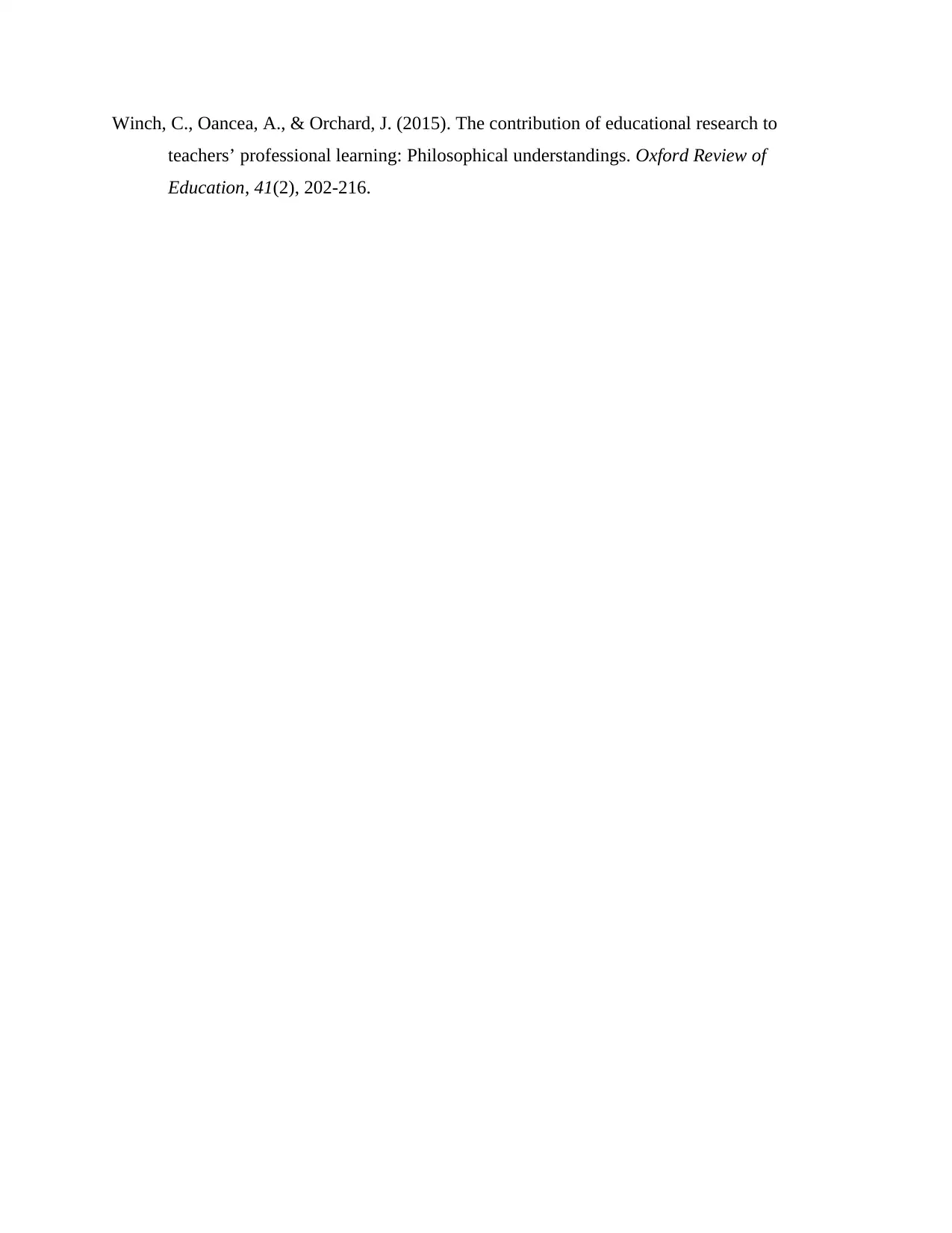
Winch, C., Oancea, A., & Orchard, J. (2015). The contribution of educational research to
teachers’ professional learning: Philosophical understandings. Oxford Review of
Education, 41(2), 202-216.
teachers’ professional learning: Philosophical understandings. Oxford Review of
Education, 41(2), 202-216.
⊘ This is a preview!⊘
Do you want full access?
Subscribe today to unlock all pages.
Trusted by 1+ million students worldwide

1 out of 9


Related Documents


Your All-in-One AI-Powered Toolkit for Academic Success.
+13062052269
info@desklib.com
Available 24*7 on WhatsApp / Email
![[object Object]](/_next/static/media/star-bottom.7253800d.svg)
Unlock your academic potential
Copyright © 2020–2026 A2Z Services. All Rights Reserved. Developed and managed by ZUCOL.