ITC571 Project Proposal: Cloud Computing in Education

Verified

Added on  2024/05/16

|4
|1362
|379
Project
AI Summary
This project proposal for ITC571 explores the potential of cloud computing to improve the educational environment in developing countries. It identifies issues with traditional learning methods, such as limited access to data and cost-ineffectiveness, and proposes cloud computing as a solution to enhance interactivity, flexibility, and portability in education. The research questions address the need for cloud computing, its impact on flexibility and innovation, and its ability to overcome memory and security limitations. The methodology involves gathering data from secondary sources, analyzing existing approaches, proposing a new solution, and assessing its strengths and weaknesses. The expected outcomes include improved learning capabilities, skill development, and advanced portable learning methods, ultimately contributing to the development of the education system in developing nations. The proposal also addresses ethical considerations and outlines the research process.
Document Page
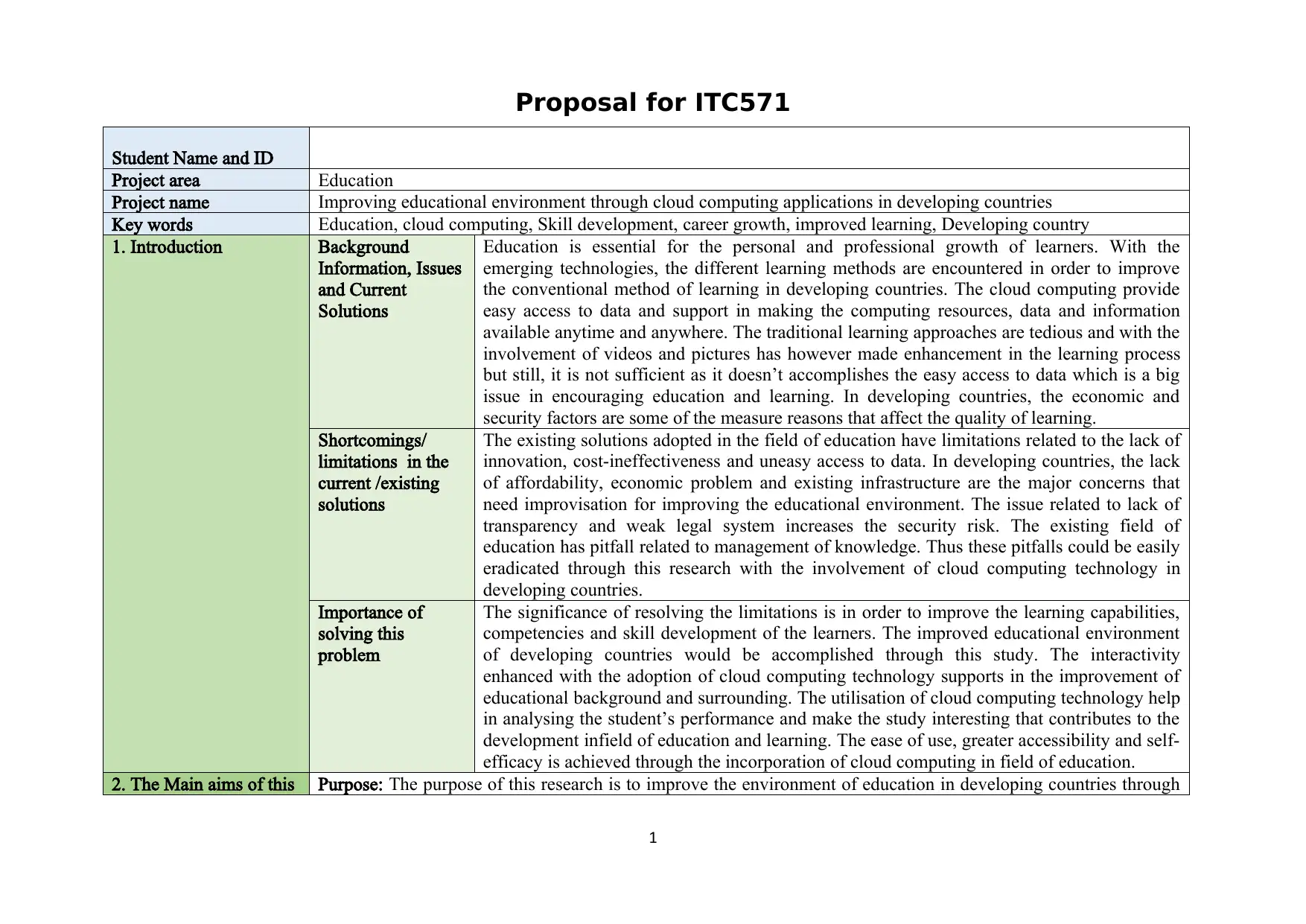
Proposal for ITC571
Student Name and ID
Project area Education
Project name Improving educational environment through cloud computing applications in developing countries
Key words Education, cloud computing, Skill development, career growth, improved learning, Developing country
1. Introduction Background
Information, Issues
and Current
Solutions
Education is essential for the personal and professional growth of learners. With the
emerging technologies, the different learning methods are encountered in order to improve
the conventional method of learning in developing countries. The cloud computing provide
easy access to data and support in making the computing resources, data and information
available anytime and anywhere. The traditional learning approaches are tedious and with the
involvement of videos and pictures has however made enhancement in the learning process
but still, it is not sufficient as it doesn’t accomplishes the easy access to data which is a big
issue in encouraging education and learning. In developing countries, the economic and
security factors are some of the measure reasons that affect the quality of learning.
Shortcomings/
limitations in the
current /existing
solutions
The existing solutions adopted in the field of education have limitations related to the lack of
innovation, cost-ineffectiveness and uneasy access to data. In developing countries, the lack
of affordability, economic problem and existing infrastructure are the major concerns that
need improvisation for improving the educational environment. The issue related to lack of
transparency and weak legal system increases the security risk. The existing field of
education has pitfall related to management of knowledge. Thus these pitfalls could be easily
eradicated through this research with the involvement of cloud computing technology in
developing countries.
Importance of
solving this
problem
The significance of resolving the limitations is in order to improve the learning capabilities,
competencies and skill development of the learners. The improved educational environment
of developing countries would be accomplished through this study. The interactivity
enhanced with the adoption of cloud computing technology supports in the improvement of
educational background and surrounding. The utilisation of cloud computing technology help
in analysing the student’s performance and make the study interesting that contributes to the
development infield of education and learning. The ease of use, greater accessibility and self-
efficacy is achieved through the incorporation of cloud computing in field of education.
2. The Main aims of this Purpose: The purpose of this research is to improve the environment of education in developing countries through
1
tabler-icon-diamond-filled.svg

Paraphrase This Document

Need a fresh take? Get an instant paraphrase of this document with our AI Paraphraser
Document Page
research the effective utilisation of cloud computing methods that possess more accessibility and usability.
Specific aims: The particular objective of the research is to make the learning approaches more cost-effective,
interactive and less tedious. Another objective is to eliminate the difficulty in accessing the information and
provide flexibility in learning and enhances innovation aspects with the use of cloud computing technology. The
focus is on making advancement in learning environment of developing countries with the involvement of cloud
technology.
3. The questions which
need to be addressed in
this research
Questions that need to be tackled through this research are as follows:
RQ 1. What is the need of incorporating cloud computing methods in improving education of developing
countries?
RQ 2. How can cloud computing technology increase the flexibility and portability in field of education?
RQ 3. Illustrate the way through which the interactivity and innovation aspects are enhanced with the cloud
computing technology?
RQ 4.How the cloud computing applications overcome the limitation related to the memory and security of
information?
4. A Brief Description of
Your Proposal
The limitations of the existing solution involve the ineffectiveness in cost utilisation and issues related to the
accessibility of data. The incorporation of cloud computing technology supports in enhancing the interactivity,
portability and flexibility of the learners. It solves the limitations of existing solutions related to time consumption,
cost utilisation and accessibility. The memory problems also resolved and it will allow the learners to get an easy
access to data through light-weighted mobile devices. The use of cloud computing technology in education of
developing countries results in improvement of the educational surrounding as it increases self-learning efficacy of
learners and makes the learning method more interesting and exciting through enhancing efficiency and innovation
aspects of the learning methods. The efficient management of knowledge and information sources will also be
achieved in education sector of developing nations through this study. This research will focus on the transparency,
security and efficacy of learning material in order to boosts effectiveness of the education system of developing
nations.
5. Factors affecting the
research and ethical
considerations (if
This research concentrates on making improvement in aneducational surrounding with the utilisation of cloud
computing approaches. It is therefore significant to compute the interactivity and utility of the learning approaches
and assess its influence on the learning capability of the students. The principles outlined in this research will be
2
Document Page
needed) true and based on honesty. There will not be any discrimination or unethical activities and confidentiality of the
information will be considered during the research.
6. The Process or
Methodology of Your
Project
The process steps involved for conducting this research are as follows:
Gathering of information and data from the secondary sources that involve CSU library, literature reviews
or journals.
Analysing the existing approaches and assesses its limitations.
Determining the current best solution and evaluate its strength and weaknesses
Proposing a new solution that could be an enhancement or modification of the existing best solution.
Assessing its strengths and weaknesses and providing recommendations with the intention to offer more
opportunities to developing nations through making improvement in the learning environment with the use
of cloud computing method.
7. Expected Outcomes The students are going to get benefits from this research as it will improve their competency through making
enhancement in the educational background and environment. It will resolve the issues prevailed in the existing
learning approaches and amplify the interactivity and innovation in learning method. It will offer more
opportunities to the education system of developing countries. The possible outcome is related to the skill
development of the students and advanced portable learning method for developing nations. Expected outcomes of
this research achieved with the use of cloud computing are the scalability, flexibility, portability and cost reduction
of learning systems. In developing nation, the easier, quick and processor independent education with the efficient
management of data and effective storage is also going to be achieved through this study.
Reference list Amron, M. T., Ibrahim, R., & Chuprat, S. (2017). A Review on Cloud Computing Acceptance Factors.
Procedia
Computer
Science,
124, 639-646. Retrieved from:
https://www-sciencedirect-com.ezproxy.csu.edu.au/science/article/pii/S187705091732968X.
Arpaci, I. (2017). Antecedents and consequences of cloud computing adoption in education to achieve knowledge
management.
Computers in Human Behavior,
70, 382-390. Retrieved from: https://www-sciencedirect-
com.ezproxy.csu.edu.au/science/article/pii/S0747563217300249.
Ashtari, S., & Eydgahi, A. (2017). Student perceptions of cloud applications effectiveness in higher
education.
Journal of Computational Science,
23, 173-180. Retrieved from: https://www-sciencedirect-
3
Document Page
com.ezproxy.csu.edu.au/science/article/pii/S1877750316304975.
Baldassarre, M. T., Caivano, D., Dimauro, G., Gentile, E., & Visaggio, G. (2018). Cloud Computing for Education:
A Systematic Mapping Study.
IEEE Transactions on Education.
El Mhouti, A., Erradi, M., & Nasseh, A. (2016). Using cloud computing services in e-learning process: Benefits
and challenges.
Education and Information Technologies, 1-17. Retrieved from: https://link-springer-
com.ezproxy.csu.edu.au/article/10.1007/s10639-017-9642-x.
© Dr Abeer Alsadoon 2018_CSU Sydney Study Centre
4
chevron_up_icon
1 out of 4
circle_padding
hide_on_mobile
zoom_out_icon
[object Object]