Sociology Report: The Education of Disabled Children in Ireland

Verified

Added on  2021/04/21

|7
|1410
|61
Report
AI Summary
This sociology report examines the critical issue of education for disabled children, with a specific focus on the context of Ireland. It begins by highlighting the global inequality in educational opportunities for differently-abled children and emphasizes the importance of special care and provisions. The report then delves into the social issue, the sociological perspective, and the legal framework surrounding disability and education in Ireland, referencing key legislation like the Disability Discrimination Act 1995 and the UNCRPD. It analyzes how societal attitudes, discrimination, and the absence of inclusive practices affect disabled children. The report concludes with recommendations for fostering a more inclusive and equitable educational environment, emphasizing the roles of society, government, and educational institutions. The report underscores the importance of collective action and the need to ensure that disabled children have the same access to education as their able-bodied peers, thereby preventing them from falling into poverty and promoting their future well-being.
Document Page
Running head: SOCIOLOGY
Sociology
Name of the Student
Name of the University
Author note
tabler-icon-diamond-filled.svg

Paraphrase This Document

Need a fresh take? Get an instant paraphrase of this document with our AI Paraphraser
Document Page
1SOCIOLOGY
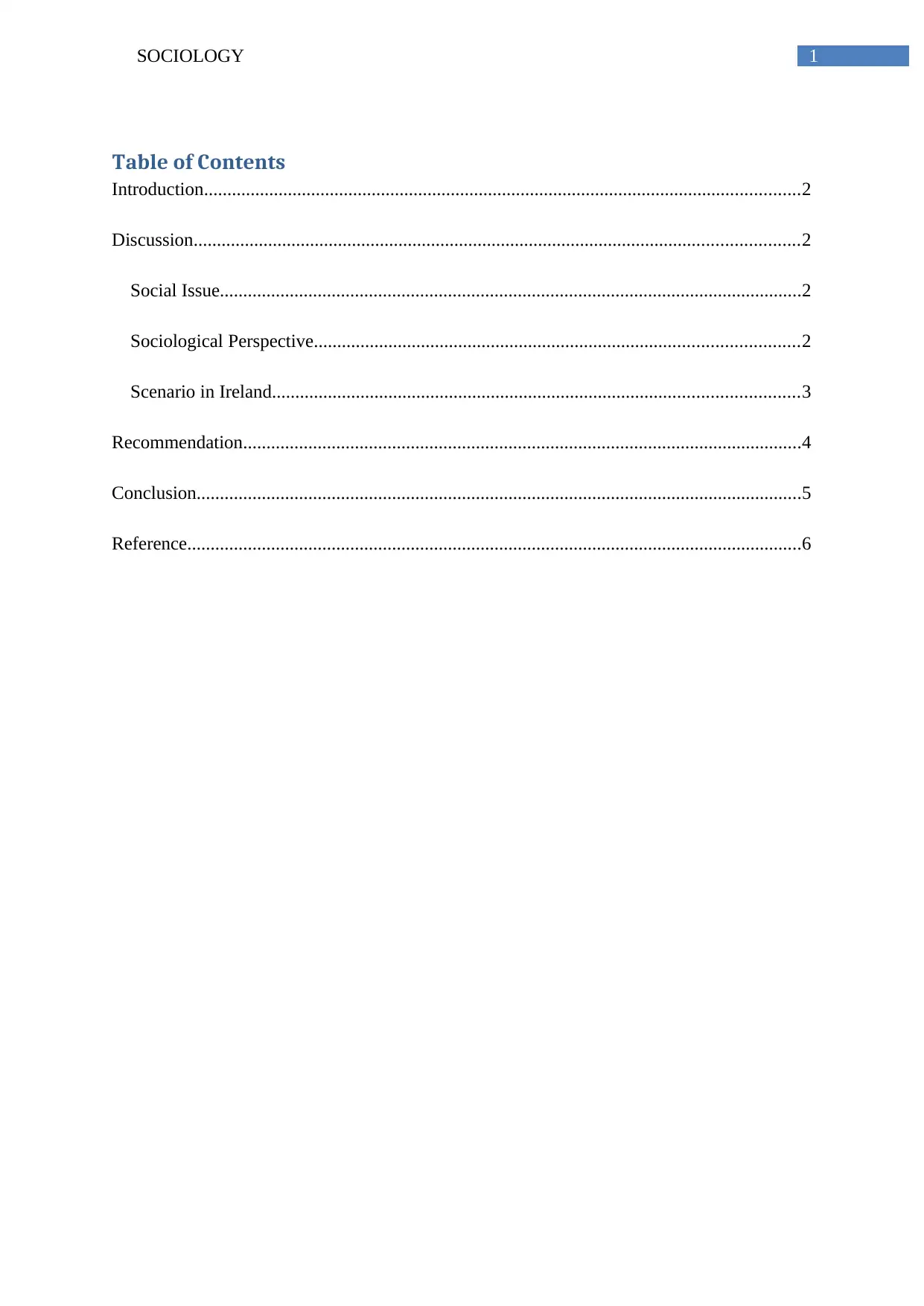
Table of Contents
Introduction................................................................................................................................2
Discussion..................................................................................................................................2
Social Issue.............................................................................................................................2
Sociological Perspective........................................................................................................2
Scenario in Ireland.................................................................................................................3
Recommendation........................................................................................................................4
Conclusion..................................................................................................................................5
Reference....................................................................................................................................6
Document Page
2SOCIOLOGY
Introduction
The education sector for the disabled children is a major issue of concern in the entire
world. In every corner of the world there exists certain inequality when it comes to imparting
education for the differently able children (Peters 2013). Special care and provision is
required for such children and there is a dearth of any such support system for these children.
Education is not imparted to them due to lack of advanced facilities and this prevents them
from prospering in life and stay poor. The country that will be studied in this report is Ireland.
Education is directly related to economy and as there is lack of education, chances are high
that such children end up being poor and incapable of earning a living for themselves.
Discussion
Social Issue
The constitution of Ireland assures that any child who is physically or mentally
disabled has the right to special education and the state will provide support to them. The
issue remains in the society that there are hardly any takers who support such a cause and
though there will be people who support the cause from outset, it is very hard to find people
who actually come forwards for the cause. The responsibility of coming together for such a
cause stands with the society and it is essential that people understand the necessity to
empower the disabled population (Chang 2014). It is a must that education reaches out to
these sectors of the society so that the idea of inequality in society reduces substantially.
Sociological Perspective
The sociological perspective of the topic is broad and it reflects the status of the
society. If the interest of the group is not served then it will show that the people in the
society are least bothered about others in the same society. The condition of the society has to
Document Page
3SOCIOLOGY
be very poor if such a situation arises in it and the people dwelling in it are the only ones to
be blamed. The most important need is to make sure that the disabled children should not be
made to feel that they are socially excluded and out casted by the society. The segmentation
in the society should never be based on the lines of the mental and physical disability (Picot
2013). If they are out casted by the people and are provided with no service then it will be
impossible for them to grow. The practice of sustainability has to be done in the society so
that every class, caste and differently able groups gets hands to their deserving share in the
society (Moscardo 2013).
Scenario in Ireland
The Disability Discrimination Act 1995 of Northern Ireland makes sure that any
individual with any form of physical or mental disability shall not be a subject to
discrimination in schools, colleges, teachers or any other educational section. No one can
discriminate with them based on their disability and it is a foremost declaration by the
authorities that disability is not a point for discrimination (Shakespeare 2013). Any person or
authority found violating the practice shall be guilty and can be severely penalized. The
practices that are disallowed by the constitution are listed below-
The admission to schools and colleges should be regulated and any unfair practice
should be checked.
Refusing to admit such pupil into schools and institutions is unlawful.
Deliberately rejecting the application citing the reason of disability.
Harassment of a student or pupil in any situation is a violation of law and constitution.
The Section 75 of Northern Ireland Act 1998 further states that it is the responsibility of
all the government authorities and the educational authorities to make sure that the need for
education to the disabled in promoted (O'Leary and McGarry 2016). People have to be made
tabler-icon-diamond-filled.svg

Paraphrase This Document

Need a fresh take? Get an instant paraphrase of this document with our AI Paraphraser
Document Page
4SOCIOLOGY
aware of these programs so that none of the disabled student is barred from the right to
education (Cole 2017). The UN Convention on the Rights of Persons With Disabilities
(UNCRPD) gives an worldwide standard for debilitated individuals' human rights. Article 24:
A Right to Inclusive Instruction in the UNCRPD ensures every single crippled student a
privilege to take an interest in all types of standard training with fitting help. Ireland is a pace
that assures that the disabled children are looked after and they have several constitutional
bills for the same. It is to be noted that even in Northern Ireland there are laws that assist in
education of both able and disable children. The Special Educational Needs and Disability
Order act takes into consideration both the aspects. For the disabled it is the SENDO act that
makes sure that they are given out the best of the services and support in the educational
sector. Whereas for the children who seem to have difficulty in understanding and getting a
grip on education despite being physically fit they are assisted with care and special support
is provided to them under SEN (Special Educational Needs) (Robertson 2014.). These
divisions make Ireland a place to count on in terms of education for the disabled and removal
of the inequality that exist.
Recommendation
Society is a place that needs collective action from all those who live in it. In order to
make a proposal successful it is essential that everyone unites and fights for a cause.
Humanity needs to be brought out within the players in the society so that every person in
need gets a hand for support. Countries like Ireland should monitor the laws that they have
and check that they are being applied to action. The authorities must clearly identify those
who truly need the help from the government and the acts that are mentioned in the
constitution. No undue advantage should be taken and it should be maintained that anyone
found misusing the power shall be severely punished. The enforcement department must be
Document Page
5SOCIOLOGY
made more powerful so that every educational institute abides by the laws. Private and public
both sectors must consider the case of an disabled child and their education must be treated
responsibly.
Conclusion
The ultimate success of a society is when it is well developed and free from any kind
of unfair practice towards its subjects. The disabled children are as much entitled to education
as the able children. Education and poverty are part of a cycle and it is the responsibility of
the society that the disabled population should not fall into poverty. With lack of education, it
is obvious that the people will have no source of earning money and hence fall into poverty.
Such a situation should be avoided and proper assistance should be provided to the disabled
children because they too are part of the future that is impending for the country.
Document Page
6SOCIOLOGY
Reference
Chang, H.H., 2014. Social change and the disability rights movement in Taiwan 1981-
2002. Review of Disability Studies: An International Journal, 3(1 & 2).
Cole, M. ed., 2017. Education, equality and human rights: issues of gender,'race', sexuality,
disability and social class. Routledge.
Moscardo, G., 2013. Sustainability, economy and society. Wiley-Blackwell.
O'Leary, B. and McGarry, J., 2016. The politics of antagonism: understanding Northern
Ireland. Bloomsbury Publishing.
Peters, S.J. ed., 2013. Education and disability in cross-cultural perspective. Routledge.
Picot, G., 2013. Politics of segmentation: party competition and social protection in
Europe (Vol. 15). Routledge.
Robertson, C., 2014. Providing for inclusion. Angela McLachlan, University of Manchester,
UK, p.341.
Shakespeare, T., 2013. Disability rights and wrongs revisited. Routledge.
chevron_up_icon
1 out of 7
circle_padding
hide_on_mobile
zoom_out_icon
[object Object]