Historical Analysis: Education Act 1877 and its Societal Impact

Verified

Added on  2022/11/28

|3
|377
|98
Report
AI Summary
This report delves into the historical context and societal impact of the Education Act 1877 in New Zealand. Prior to its implementation, education was fragmented, with provincial, church, and private schools offering varying standards. The Act aimed to standardize education and address inequalities, particularly among social classes and the Maori population. Before the act, access to education was limited, often based on wealth, with the upper classes and the wealthy able to afford tutors while the poor were denied education. The Act's introduction of free, secular, and compulsory education aimed to eliminate gender disparities and improve educational opportunities for all, including the Maori lower classes. The analysis considers the shift from a system that favored the wealthy to one that promoted equal access, discussing the Act's role in shaping a more equitable educational landscape. The report also references the historical perspective on schooling and other related literature.
Document Page
Running Head: SOCIOLOGY 0
EDUCATION
tabler-icon-diamond-filled.svg

Paraphrase This Document

Need a fresh take? Get an instant paraphrase of this document with our AI Paraphraser
Document Page
SOCIOLOGY 2
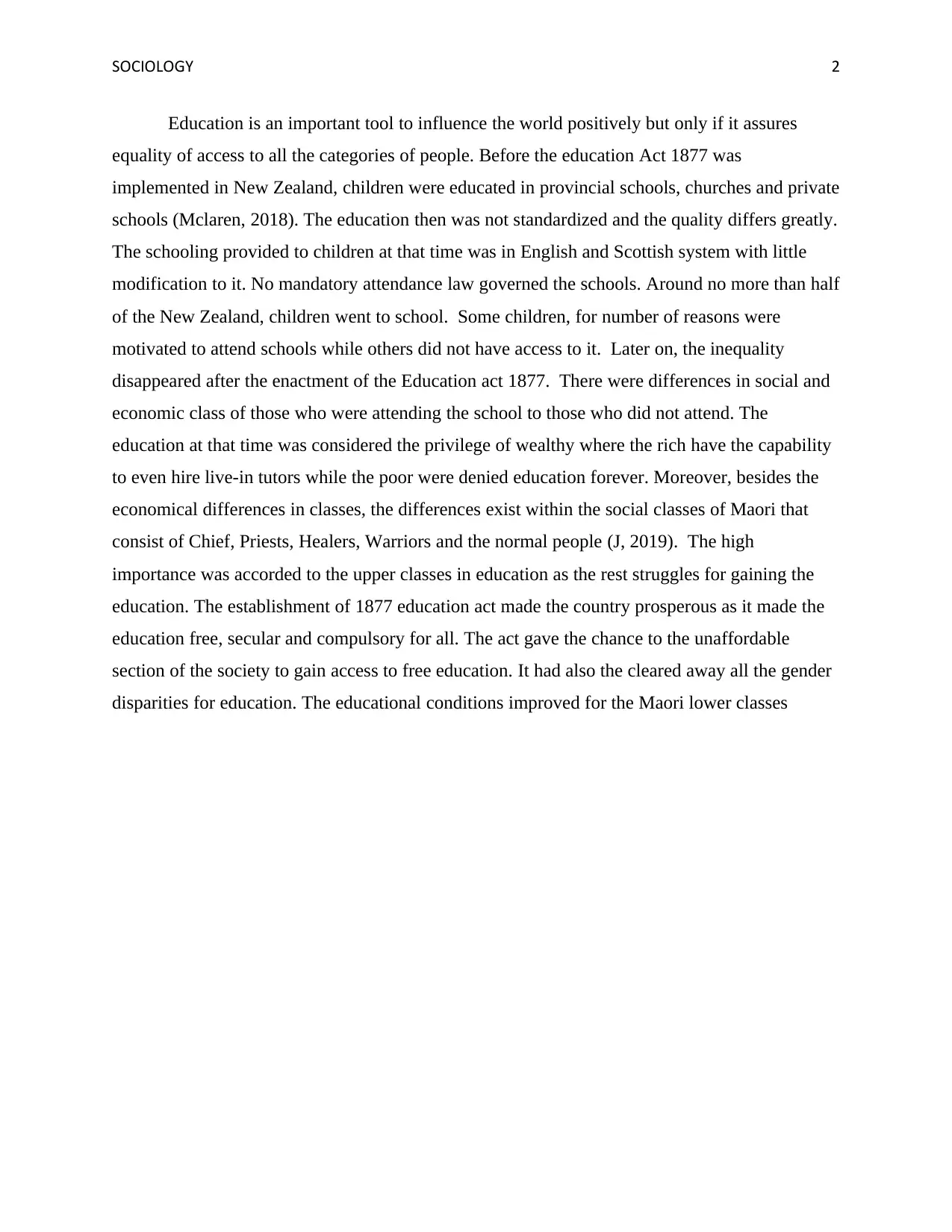
Education is an important tool to influence the world positively but only if it assures
equality of access to all the categories of people. Before the education Act 1877 was
implemented in New Zealand, children were educated in provincial schools, churches and private
schools (Mclaren, 2018). The education then was not standardized and the quality differs greatly.
The schooling provided to children at that time was in English and Scottish system with little
modification to it. No mandatory attendance law governed the schools. Around no more than half
of the New Zealand, children went to school. Some children, for number of reasons were
motivated to attend schools while others did not have access to it. Later on, the inequality
disappeared after the enactment of the Education act 1877. There were differences in social and
economic class of those who were attending the school to those who did not attend. The
education at that time was considered the privilege of wealthy where the rich have the capability
to even hire live-in tutors while the poor were denied education forever. Moreover, besides the
economical differences in classes, the differences exist within the social classes of Maori that
consist of Chief, Priests, Healers, Warriors and the normal people (J, 2019). The high
importance was accorded to the upper classes in education as the rest struggles for gaining the
education. The establishment of 1877 education act made the country prosperous as it made the
education free, secular and compulsory for all. The act gave the chance to the unaffordable
section of the society to gain access to free education. It had also the cleared away all the gender
disparities for education. The educational conditions improved for the Maori lower classes
Document Page
SOCIOLOGY 3
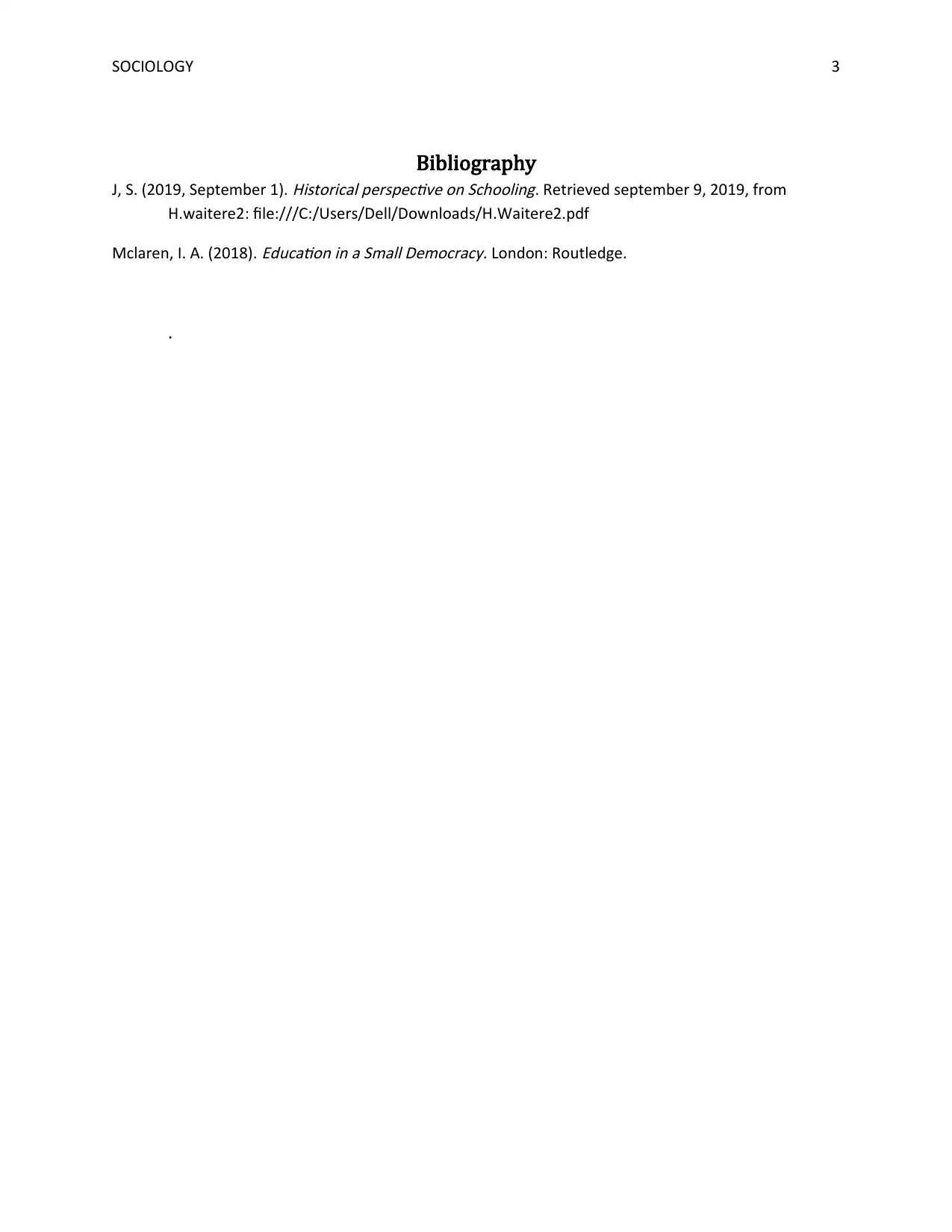
Bibliography
J, S. (2019, September 1).
Historical perspective on Schooling. Retrieved september 9, 2019, from
H.waitere2: file:///C:/Users/Dell/Downloads/H.Waitere2.pdf
Mclaren, I. A. (2018).
Education in a Small Democracy. London: Routledge.
.
chevron_up_icon
1 out of 3
circle_padding
hide_on_mobile
zoom_out_icon
[object Object]