Education Psychology, Views & Practices in Iranian ELT Classes
VerifiedAdded on 2023/06/11
|13
|3054
|286
Report
AI Summary
This research proposal investigates the psychological influences of education on Iranian English Language Teaching (ELT) teachers' views and practices. It addresses the background and rationale for the research, highlighting the importance of understanding teachers' beliefs and knowledge in shaping classroom dynamics. The proposal poses research questions concerning the relationship between education, teacher psychology, and classroom outcomes. It outlines a methodological approach involving qualitative data collection through interviews, questionnaires, observations, and surveys with 30 Iranian teachers from various educational levels. The proposal details the stages of data collection, including preparation, input, processing, output, interpretation, and storage, and defines key terms related to the research. Furthermore, it includes an application for research ethics approval, addressing beneficence, informed consent, non-malfeasance, and confidentiality. The document concludes with arrangements for sampling and contacting participants, potential benefits and consequences of the research, and institutional arrangements.

Running head: RESEARCH PROPOSAL
Research Proposal
Name:
Institution:
Date:
Research Proposal
Name:
Institution:
Date:

Paraphrase This Document
Need a fresh take? Get an instant paraphrase of this document with our AI Paraphraser
RESEARCH PROPOSAL
Part 1 – The Research Proposal
1) 1- Provisional Title For Dissertation
The psychological influence of Teachers due to Education, their views and practices in
Iranian English Language Teaching (ELT) classes.
Background and Rationale of the Research
Analysis is of interest in psychology as an important quality inherent in human
consciousness. Psychological analysis is the main method of studying the surrounding world,
based on a variety of units, differing in size and quality. For example, the analysis of the
course of mental reactions to a specific life situation. For unit of analysis take, for example,
the formation of the character of a person from infancy and until death. In this case, the most
important psychological components of the personality and the peculiarities of their changes
are distinguished under the influence of internal and external factors. The problem of analysis
as a method of comprehension is of fundamental importance. Methods of analysis have
become so common in psychology and in scientific circles that the term "analysis" has been
used as a synonym for research as a whole. (Beccaria, L., Beccaria, G., & McCosker, C.
2018).. The teacher’s knowledge and belief can be classified as content and the teacher’s
insight as the practice. They can be differentiated as matched knowledge for educators and
practical knowledge for teachers. The educational literature is focused on a lot due to the
critical role it plays in helping the Iranian teachers to understand the logic and intricate
multidimensional classroom nature. Among the factors that affect learning in classrooms are;
The basic idea of a qualitative approach as a phenomenology is the idea expressed by M. M.
Bakhtin that the essence of an individual, estimated through an act, can be adequately
identified only through the specifics of that personality. Misunderstanding of it appears due to
the evaluation of the latter from the outside, abstractly and generalized. "Everything taken
Part 1 – The Research Proposal
1) 1- Provisional Title For Dissertation
The psychological influence of Teachers due to Education, their views and practices in
Iranian English Language Teaching (ELT) classes.
Background and Rationale of the Research
Analysis is of interest in psychology as an important quality inherent in human
consciousness. Psychological analysis is the main method of studying the surrounding world,
based on a variety of units, differing in size and quality. For example, the analysis of the
course of mental reactions to a specific life situation. For unit of analysis take, for example,
the formation of the character of a person from infancy and until death. In this case, the most
important psychological components of the personality and the peculiarities of their changes
are distinguished under the influence of internal and external factors. The problem of analysis
as a method of comprehension is of fundamental importance. Methods of analysis have
become so common in psychology and in scientific circles that the term "analysis" has been
used as a synonym for research as a whole. (Beccaria, L., Beccaria, G., & McCosker, C.
2018).. The teacher’s knowledge and belief can be classified as content and the teacher’s
insight as the practice. They can be differentiated as matched knowledge for educators and
practical knowledge for teachers. The educational literature is focused on a lot due to the
critical role it plays in helping the Iranian teachers to understand the logic and intricate
multidimensional classroom nature. Among the factors that affect learning in classrooms are;
The basic idea of a qualitative approach as a phenomenology is the idea expressed by M. M.
Bakhtin that the essence of an individual, estimated through an act, can be adequately
identified only through the specifics of that personality. Misunderstanding of it appears due to
the evaluation of the latter from the outside, abstractly and generalized. "Everything taken
RESEARCH PROPOSAL
independently, regardless of the single value center of the outgoing responsibility of the deed,
is deconcrete and deregulated, loses its value weight, emotionally-volitional vigilance,
becomes an empty abstract-general possibility. Developed a whole complex of categories-
principles, which are the basis of the phenomenological method
Environment: Refers to the environment surrounding the person trying to learn, includes
available tools such as technology or material available to perform the research. Although it
does not have a direct impact, it influences the habits of the people (Brinkmann, S. (2014).
The presence in psychology of two tendencies - descriptive and explanatory, leads internal
psychological disputes to a dead end. Emphasies on this confrontation and suggested that the
development of psychology is associated, first of all, with the withering away of one of them.
This "useless" from the point of view of practice psychological paradigm is phenomenology,
descriptive and subjective psychology (Lewis, 2015).
A personal factor that affects learning is motivation, which is the will to make an effort, to
reach the goals proposed by oneself, conditioned by the capacity of the effort to satisfy some
personal need. The greater the motivation of the person to learn, the more easily he will learn
if he has motivation (Heimberg, R. G., & Butler, R. M. (2018).
Research question or research questions
There are various research questions that will be discussed in the research, these are;
Influence their process of teaching. Various multidimensional variables and aspects are
utilized in the research. The study investigates the effects of psychological education in
Iranian teachers and ELT classes. The following questions must be presented inorder to
achieve the objectives of the contemporary survey (Hox, J. J., Moerbeek, M., & van de
Schoot, R. (2017)
independently, regardless of the single value center of the outgoing responsibility of the deed,
is deconcrete and deregulated, loses its value weight, emotionally-volitional vigilance,
becomes an empty abstract-general possibility. Developed a whole complex of categories-
principles, which are the basis of the phenomenological method
Environment: Refers to the environment surrounding the person trying to learn, includes
available tools such as technology or material available to perform the research. Although it
does not have a direct impact, it influences the habits of the people (Brinkmann, S. (2014).
The presence in psychology of two tendencies - descriptive and explanatory, leads internal
psychological disputes to a dead end. Emphasies on this confrontation and suggested that the
development of psychology is associated, first of all, with the withering away of one of them.
This "useless" from the point of view of practice psychological paradigm is phenomenology,
descriptive and subjective psychology (Lewis, 2015).
A personal factor that affects learning is motivation, which is the will to make an effort, to
reach the goals proposed by oneself, conditioned by the capacity of the effort to satisfy some
personal need. The greater the motivation of the person to learn, the more easily he will learn
if he has motivation (Heimberg, R. G., & Butler, R. M. (2018).
Research question or research questions
There are various research questions that will be discussed in the research, these are;
Influence their process of teaching. Various multidimensional variables and aspects are
utilized in the research. The study investigates the effects of psychological education in
Iranian teachers and ELT classes. The following questions must be presented inorder to
achieve the objectives of the contemporary survey (Hox, J. J., Moerbeek, M., & van de
Schoot, R. (2017)
⊘ This is a preview!⊘
Do you want full access?
Subscribe today to unlock all pages.

Trusted by 1+ million students worldwide
RESEARCH PROPOSAL
1) Does education influence psychology of teachers in relation to the outcome in classes
and with regard to views and practices among various teachers?
2) Are there any relationships between Iranian teacher’s views &practices and the
educational psychology?
3) How does the educational psychology influence and affect the practices and views or
Iranian teachers?
These research question will lead to conclusively and comprehensive research study on the
effects of education psychology on practises and views of Iranian teachers.
Methodological approach to be adopted
Due to the complexity of the research, the researcher’s asked 30 Iranian teachers to
participate in the research on the influence of education psychology on views and practices of
teachers. Data collection was mainly done through the online platform from different schools
in Iran. Some of the teachers were from universities while others were from colleges,
elementary school and even lower grade schools (Okonedo & Bamigboye, 2015)..
Qualitative, descriptively-interpretative forms are actively used by domestic psychologists.
Qualitative analysis of empirical data is an integral part of any pilot study, although the
principles and procedures are not clearly defined. At present, the qualitative approach is more
like a generation of psychological knowledge at the level of a special phenomenon that
requires further structuring, study and refinement. Qualitative research today includes all
sorts of phenomenological, narrative procedures, discourse analysis and other "soft"
strategies for studying psychological phenomena that have relatively recently appeared in the
social sciences.
There are different methods of collecting data. The first is interviews, these is one of the most
reliable method of data collection and will be relevant when collecting first-hand information
1) Does education influence psychology of teachers in relation to the outcome in classes
and with regard to views and practices among various teachers?
2) Are there any relationships between Iranian teacher’s views &practices and the
educational psychology?
3) How does the educational psychology influence and affect the practices and views or
Iranian teachers?
These research question will lead to conclusively and comprehensive research study on the
effects of education psychology on practises and views of Iranian teachers.
Methodological approach to be adopted
Due to the complexity of the research, the researcher’s asked 30 Iranian teachers to
participate in the research on the influence of education psychology on views and practices of
teachers. Data collection was mainly done through the online platform from different schools
in Iran. Some of the teachers were from universities while others were from colleges,
elementary school and even lower grade schools (Okonedo & Bamigboye, 2015)..
Qualitative, descriptively-interpretative forms are actively used by domestic psychologists.
Qualitative analysis of empirical data is an integral part of any pilot study, although the
principles and procedures are not clearly defined. At present, the qualitative approach is more
like a generation of psychological knowledge at the level of a special phenomenon that
requires further structuring, study and refinement. Qualitative research today includes all
sorts of phenomenological, narrative procedures, discourse analysis and other "soft"
strategies for studying psychological phenomena that have relatively recently appeared in the
social sciences.
There are different methods of collecting data. The first is interviews, these is one of the most
reliable method of data collection and will be relevant when collecting first-hand information
Paraphrase This Document
Need a fresh take? Get an instant paraphrase of this document with our AI Paraphraser
RESEARCH PROPOSAL
from the teachers. The second method is the questionnaires. Open ended and closed
questionnaires are the best if there are specific questions to be asked regarding the language
education. It is important to note that questionnaires give some of the most accurate results in
any survey. Observation is also a key item in the research. Through observation of learning
activities, the researcher will draw conclusions. Survey is the last method that is also
necessary in the research.
Sample identity and size
The teachers taking part in the research are from different schools. They are both male and
female to be gender balanced. They are 30 teachers from all over the country of Iran with the
youngest being 30 years and the oldest being 60 years. They range from ordinary level
teacher to a professor of a University specializing in literature and linguistics. The data is
both qualitative and quantitative. Another factor that is already common is called Learning
Problems in sample size (Revelle, W. R. (2017).. Learning problems are defined as disorders
that may affect a person's ability to acquire, understand, store or use oral and non-oral
information. They affect both children and adults and, more frequently, boys. A teacher with
specific teaching problems cannot do the same as others with the same level of intelligence.
Detecting if the child has problems is not a difficult task, if the parents and also the teachers
are attentive. There are frequent signs that indicate the existence of learning problems.
The main stages of your data collection, including the data collection methods that you
intend to use and your intended approach to data analysis
Data collection is about extracting useful information to be used in data processing. There is a
widespread range of approaches, techniques and tools that are important in data processing.
from the teachers. The second method is the questionnaires. Open ended and closed
questionnaires are the best if there are specific questions to be asked regarding the language
education. It is important to note that questionnaires give some of the most accurate results in
any survey. Observation is also a key item in the research. Through observation of learning
activities, the researcher will draw conclusions. Survey is the last method that is also
necessary in the research.
Sample identity and size
The teachers taking part in the research are from different schools. They are both male and
female to be gender balanced. They are 30 teachers from all over the country of Iran with the
youngest being 30 years and the oldest being 60 years. They range from ordinary level
teacher to a professor of a University specializing in literature and linguistics. The data is
both qualitative and quantitative. Another factor that is already common is called Learning
Problems in sample size (Revelle, W. R. (2017).. Learning problems are defined as disorders
that may affect a person's ability to acquire, understand, store or use oral and non-oral
information. They affect both children and adults and, more frequently, boys. A teacher with
specific teaching problems cannot do the same as others with the same level of intelligence.
Detecting if the child has problems is not a difficult task, if the parents and also the teachers
are attentive. There are frequent signs that indicate the existence of learning problems.
The main stages of your data collection, including the data collection methods that you
intend to use and your intended approach to data analysis
Data collection is about extracting useful information to be used in data processing. There is a
widespread range of approaches, techniques and tools that are important in data processing.
RESEARCH PROPOSAL
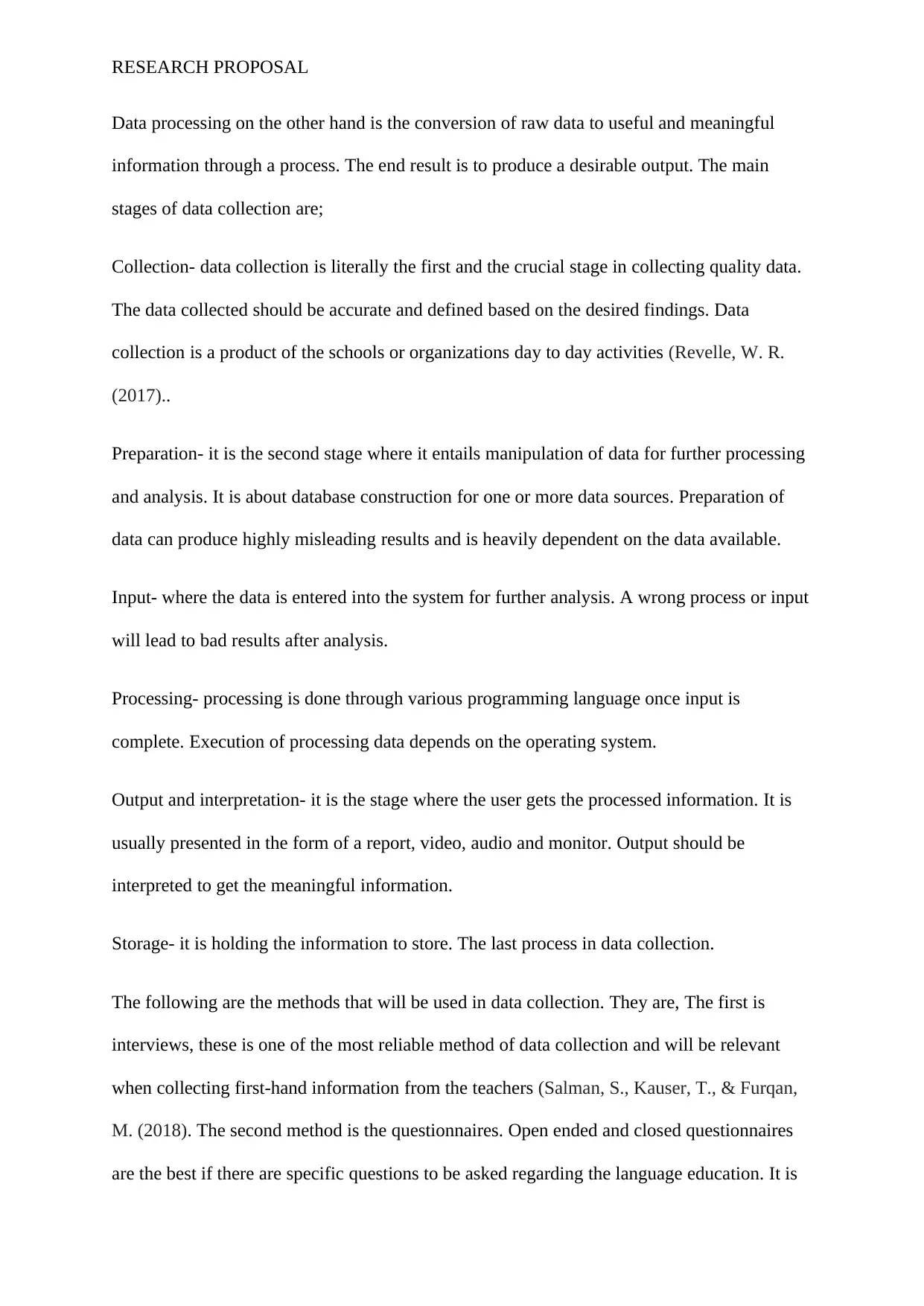
Data processing on the other hand is the conversion of raw data to useful and meaningful
information through a process. The end result is to produce a desirable output. The main
stages of data collection are;
Collection- data collection is literally the first and the crucial stage in collecting quality data.
The data collected should be accurate and defined based on the desired findings. Data
collection is a product of the schools or organizations day to day activities (Revelle, W. R.
(2017)..
Preparation- it is the second stage where it entails manipulation of data for further processing
and analysis. It is about database construction for one or more data sources. Preparation of
data can produce highly misleading results and is heavily dependent on the data available.
Input- where the data is entered into the system for further analysis. A wrong process or input
will lead to bad results after analysis.
Processing- processing is done through various programming language once input is
complete. Execution of processing data depends on the operating system.
Output and interpretation- it is the stage where the user gets the processed information. It is
usually presented in the form of a report, video, audio and monitor. Output should be
interpreted to get the meaningful information.
Storage- it is holding the information to store. The last process in data collection.
The following are the methods that will be used in data collection. They are, The first is
interviews, these is one of the most reliable method of data collection and will be relevant
when collecting first-hand information from the teachers (Salman, S., Kauser, T., & Furqan,
M. (2018). The second method is the questionnaires. Open ended and closed questionnaires
are the best if there are specific questions to be asked regarding the language education. It is
Data processing on the other hand is the conversion of raw data to useful and meaningful
information through a process. The end result is to produce a desirable output. The main
stages of data collection are;
Collection- data collection is literally the first and the crucial stage in collecting quality data.
The data collected should be accurate and defined based on the desired findings. Data
collection is a product of the schools or organizations day to day activities (Revelle, W. R.
(2017)..
Preparation- it is the second stage where it entails manipulation of data for further processing
and analysis. It is about database construction for one or more data sources. Preparation of
data can produce highly misleading results and is heavily dependent on the data available.
Input- where the data is entered into the system for further analysis. A wrong process or input
will lead to bad results after analysis.
Processing- processing is done through various programming language once input is
complete. Execution of processing data depends on the operating system.
Output and interpretation- it is the stage where the user gets the processed information. It is
usually presented in the form of a report, video, audio and monitor. Output should be
interpreted to get the meaningful information.
Storage- it is holding the information to store. The last process in data collection.
The following are the methods that will be used in data collection. They are, The first is
interviews, these is one of the most reliable method of data collection and will be relevant
when collecting first-hand information from the teachers (Salman, S., Kauser, T., & Furqan,
M. (2018). The second method is the questionnaires. Open ended and closed questionnaires
are the best if there are specific questions to be asked regarding the language education. It is
⊘ This is a preview!⊘
Do you want full access?
Subscribe today to unlock all pages.
Trusted by 1+ million students worldwide
RESEARCH PROPOSAL
important to note that questionnaires give some of the most accurate results in any survey.
Observation is also a key item in the research. Through observation of learning activities, the
researcher will draw conclusions. Survey is the last method that is also necessary in the
research.
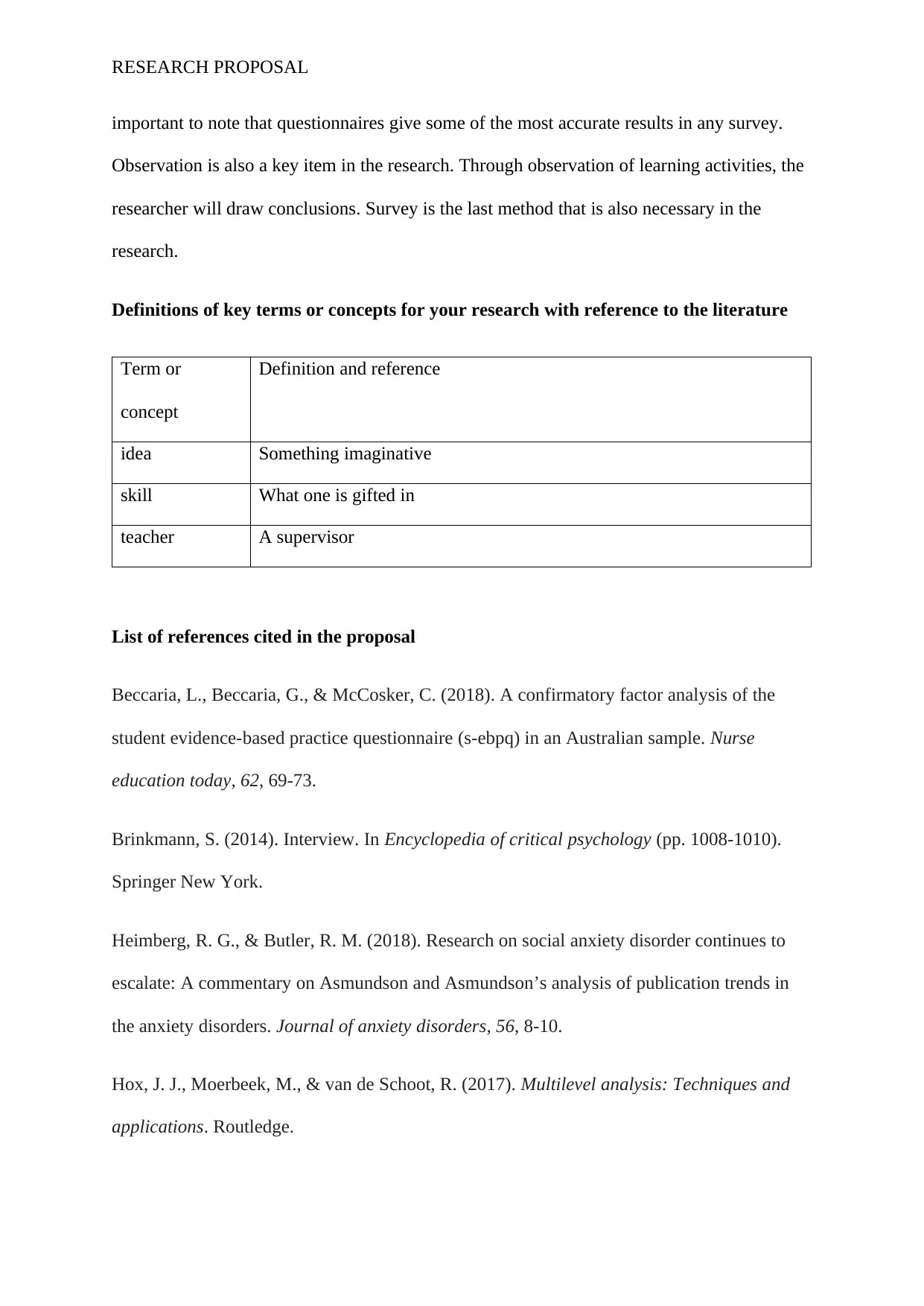
Definitions of key terms or concepts for your research with reference to the literature
Term or
concept
Definition and reference
idea Something imaginative
skill What one is gifted in
teacher A supervisor
List of references cited in the proposal
Beccaria, L., Beccaria, G., & McCosker, C. (2018). A confirmatory factor analysis of the
student evidence-based practice questionnaire (s-ebpq) in an Australian sample. Nurse
education today, 62, 69-73.
Brinkmann, S. (2014). Interview. In Encyclopedia of critical psychology (pp. 1008-1010).
Springer New York.
Heimberg, R. G., & Butler, R. M. (2018). Research on social anxiety disorder continues to
escalate: A commentary on Asmundson and Asmundson’s analysis of publication trends in
the anxiety disorders. Journal of anxiety disorders, 56, 8-10.
Hox, J. J., Moerbeek, M., & van de Schoot, R. (2017). Multilevel analysis: Techniques and
applications. Routledge.
important to note that questionnaires give some of the most accurate results in any survey.
Observation is also a key item in the research. Through observation of learning activities, the
researcher will draw conclusions. Survey is the last method that is also necessary in the
research.
Definitions of key terms or concepts for your research with reference to the literature
Term or
concept
Definition and reference
idea Something imaginative
skill What one is gifted in
teacher A supervisor
List of references cited in the proposal
Beccaria, L., Beccaria, G., & McCosker, C. (2018). A confirmatory factor analysis of the
student evidence-based practice questionnaire (s-ebpq) in an Australian sample. Nurse
education today, 62, 69-73.
Brinkmann, S. (2014). Interview. In Encyclopedia of critical psychology (pp. 1008-1010).
Springer New York.
Heimberg, R. G., & Butler, R. M. (2018). Research on social anxiety disorder continues to
escalate: A commentary on Asmundson and Asmundson’s analysis of publication trends in
the anxiety disorders. Journal of anxiety disorders, 56, 8-10.
Hox, J. J., Moerbeek, M., & van de Schoot, R. (2017). Multilevel analysis: Techniques and
applications. Routledge.
Paraphrase This Document
Need a fresh take? Get an instant paraphrase of this document with our AI Paraphraser

RESEARCH PROPOSAL
Lewis, S. (2015). Qualitative inquiry and research design: Choosing among five
approaches. Health promotion practice, 16(4), 473-475.
Part 2 - application for research ethics approval
Are you aware of the four principles of ethical research – Yes
Beneficence- do positive good
Informed consent
Non-malfeasance- do no harm
Confidentiality –anonimity
Describe the arrangements for sampling potential participants
1) The teachers taking part in the research are from different schools. They are both male and
female to be gender balanced. There are 30 teachers from all over the country of Iran with the
youngest being 30 years and the oldest being 60 years. They range from ordinary level
teacher to a professor of a University specializing in literature and linguistics. The data is
both qualitative and quantitative.
2) Describe arrangement for contacting and briefing potential participants
Lewis, S. (2015). Qualitative inquiry and research design: Choosing among five
approaches. Health promotion practice, 16(4), 473-475.
Part 2 - application for research ethics approval
Are you aware of the four principles of ethical research – Yes
Beneficence- do positive good
Informed consent
Non-malfeasance- do no harm
Confidentiality –anonimity
Describe the arrangements for sampling potential participants
1) The teachers taking part in the research are from different schools. They are both male and
female to be gender balanced. There are 30 teachers from all over the country of Iran with the
youngest being 30 years and the oldest being 60 years. They range from ordinary level
teacher to a professor of a University specializing in literature and linguistics. The data is
both qualitative and quantitative.
2) Describe arrangement for contacting and briefing potential participants
RESEARCH PROPOSAL
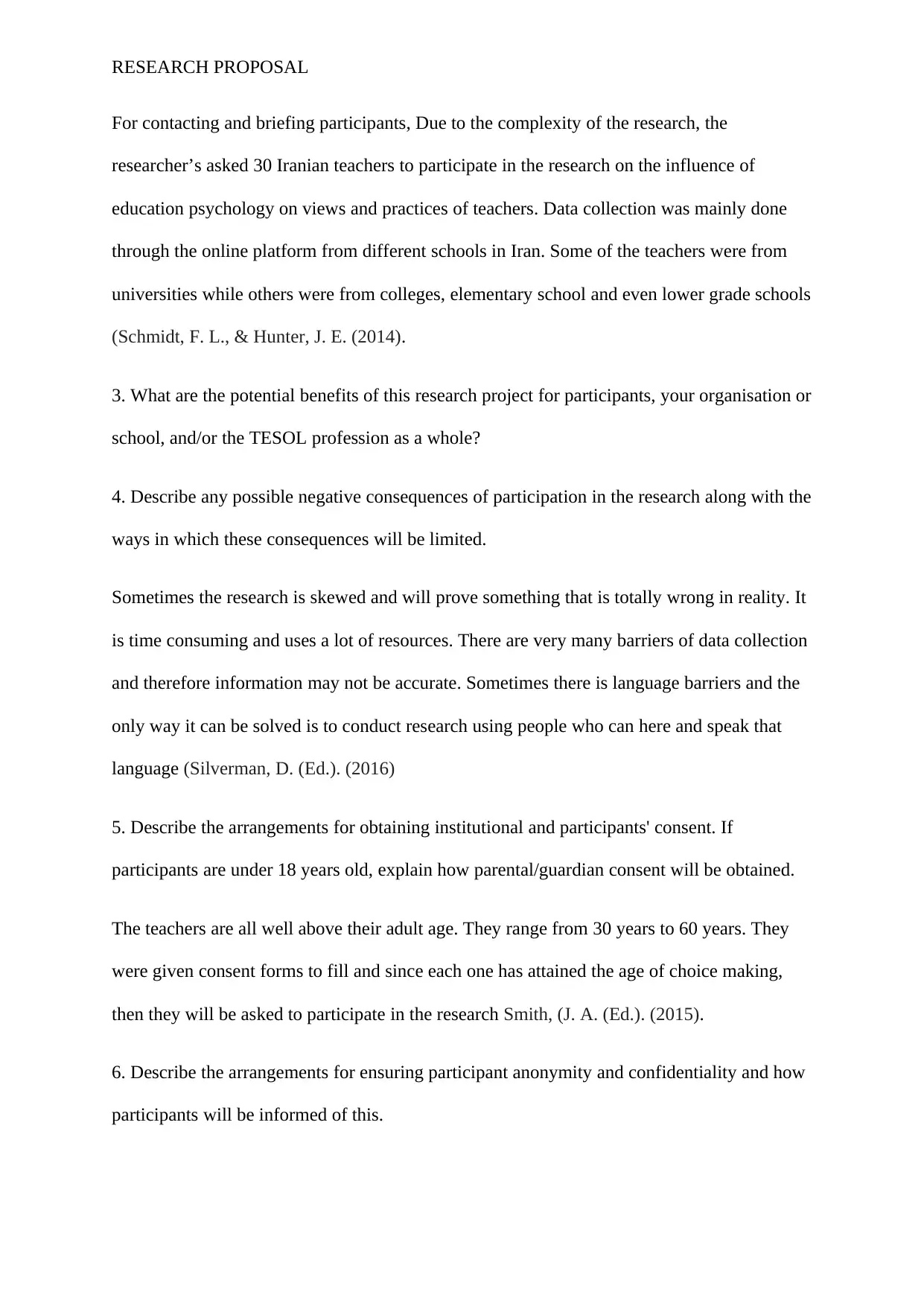
For contacting and briefing participants, Due to the complexity of the research, the
researcher’s asked 30 Iranian teachers to participate in the research on the influence of
education psychology on views and practices of teachers. Data collection was mainly done
through the online platform from different schools in Iran. Some of the teachers were from
universities while others were from colleges, elementary school and even lower grade schools
(Schmidt, F. L., & Hunter, J. E. (2014).
3. What are the potential benefits of this research project for participants, your organisation or
school, and/or the TESOL profession as a whole?
4. Describe any possible negative consequences of participation in the research along with the
ways in which these consequences will be limited.
Sometimes the research is skewed and will prove something that is totally wrong in reality. It
is time consuming and uses a lot of resources. There are very many barriers of data collection
and therefore information may not be accurate. Sometimes there is language barriers and the
only way it can be solved is to conduct research using people who can here and speak that
language (Silverman, D. (Ed.). (2016)
5. Describe the arrangements for obtaining institutional and participants' consent. If
participants are under 18 years old, explain how parental/guardian consent will be obtained.
The teachers are all well above their adult age. They range from 30 years to 60 years. They
were given consent forms to fill and since each one has attained the age of choice making,
then they will be asked to participate in the research Smith, (J. A. (Ed.). (2015).
6. Describe the arrangements for ensuring participant anonymity and confidentiality and how
participants will be informed of this.
For contacting and briefing participants, Due to the complexity of the research, the
researcher’s asked 30 Iranian teachers to participate in the research on the influence of
education psychology on views and practices of teachers. Data collection was mainly done
through the online platform from different schools in Iran. Some of the teachers were from
universities while others were from colleges, elementary school and even lower grade schools
(Schmidt, F. L., & Hunter, J. E. (2014).
3. What are the potential benefits of this research project for participants, your organisation or
school, and/or the TESOL profession as a whole?
4. Describe any possible negative consequences of participation in the research along with the
ways in which these consequences will be limited.
Sometimes the research is skewed and will prove something that is totally wrong in reality. It
is time consuming and uses a lot of resources. There are very many barriers of data collection
and therefore information may not be accurate. Sometimes there is language barriers and the
only way it can be solved is to conduct research using people who can here and speak that
language (Silverman, D. (Ed.). (2016)
5. Describe the arrangements for obtaining institutional and participants' consent. If
participants are under 18 years old, explain how parental/guardian consent will be obtained.
The teachers are all well above their adult age. They range from 30 years to 60 years. They
were given consent forms to fill and since each one has attained the age of choice making,
then they will be asked to participate in the research Smith, (J. A. (Ed.). (2015).
6. Describe the arrangements for ensuring participant anonymity and confidentiality and how
participants will be informed of this.
⊘ This is a preview!⊘
Do you want full access?
Subscribe today to unlock all pages.
Trusted by 1+ million students worldwide

RESEARCH PROPOSAL
The following are the methods that will be used in data collection. They are, The first is
interviews, these is one of the most reliable method of data collection and will be relevant
when collecting first-hand information from the teachers. The second method is the
questionnaires. The information should be stored in computer hardware’s and hard disks for
traceability
7. Describe how participants will be made aware of their right to withdraw from the research.
The participants can fill a withdrawal form requesting termination of work given by the
researcher.
8. Describe the arrangements for sharing findings with the participants and/or explain how
you will offer to share your findings.
Share through online platforms
9. Are there any conflicts of interest in you undertaking this research? (E.g. Are you
undertaking research on work colleagues?) How will you deal with these? Please supply
details.
Yes. By being involved in the research. (Taylor, S. J., Bogdan, R., & DeVault, M. (2015).
I confirm that this application is accurate to the best of my knowledge.
Student's signature
(or typed name)
21-6-2018
The following are the methods that will be used in data collection. They are, The first is
interviews, these is one of the most reliable method of data collection and will be relevant
when collecting first-hand information from the teachers. The second method is the
questionnaires. The information should be stored in computer hardware’s and hard disks for
traceability
7. Describe how participants will be made aware of their right to withdraw from the research.
The participants can fill a withdrawal form requesting termination of work given by the
researcher.
8. Describe the arrangements for sharing findings with the participants and/or explain how
you will offer to share your findings.
Share through online platforms
9. Are there any conflicts of interest in you undertaking this research? (E.g. Are you
undertaking research on work colleagues?) How will you deal with these? Please supply
details.
Yes. By being involved in the research. (Taylor, S. J., Bogdan, R., & DeVault, M. (2015).
I confirm that this application is accurate to the best of my knowledge.
Student's signature
(or typed name)
21-6-2018
Paraphrase This Document
Need a fresh take? Get an instant paraphrase of this document with our AI Paraphraser

RESEARCH PROPOSAL
Date
Email this form to your supervisor along with accompanying ethics paperwork (and
remember to keep a copy for yourself.)
Thank you!
Date
Email this form to your supervisor along with accompanying ethics paperwork (and
remember to keep a copy for yourself.)
Thank you!
RESEARCH PROPOSAL
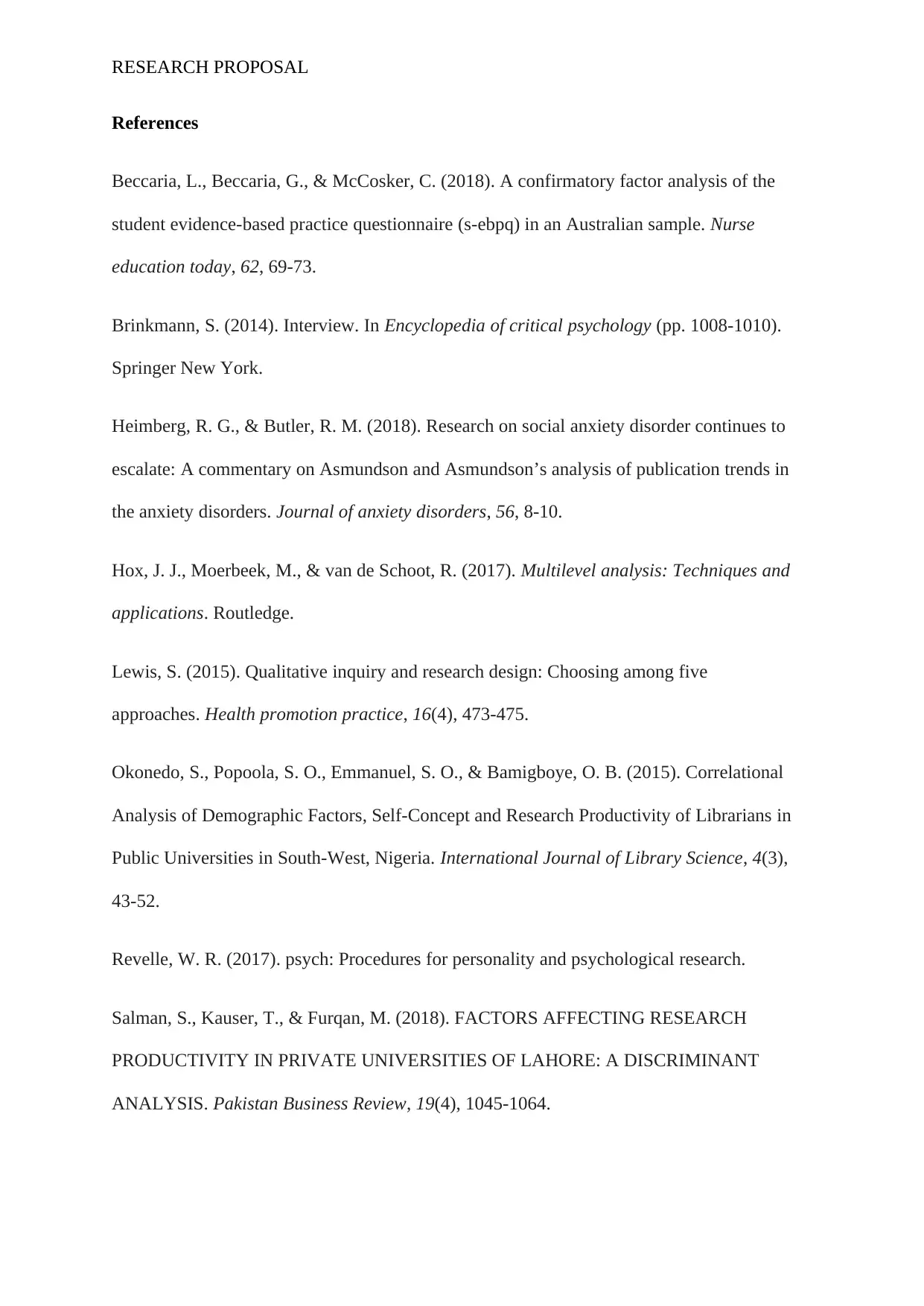
References
Beccaria, L., Beccaria, G., & McCosker, C. (2018). A confirmatory factor analysis of the
student evidence-based practice questionnaire (s-ebpq) in an Australian sample. Nurse
education today, 62, 69-73.
Brinkmann, S. (2014). Interview. In Encyclopedia of critical psychology (pp. 1008-1010).
Springer New York.
Heimberg, R. G., & Butler, R. M. (2018). Research on social anxiety disorder continues to
escalate: A commentary on Asmundson and Asmundson’s analysis of publication trends in
the anxiety disorders. Journal of anxiety disorders, 56, 8-10.
Hox, J. J., Moerbeek, M., & van de Schoot, R. (2017). Multilevel analysis: Techniques and
applications. Routledge.
Lewis, S. (2015). Qualitative inquiry and research design: Choosing among five
approaches. Health promotion practice, 16(4), 473-475.
Okonedo, S., Popoola, S. O., Emmanuel, S. O., & Bamigboye, O. B. (2015). Correlational
Analysis of Demographic Factors, Self-Concept and Research Productivity of Librarians in
Public Universities in South-West, Nigeria. International Journal of Library Science, 4(3),
43-52.
Revelle, W. R. (2017). psych: Procedures for personality and psychological research.
Salman, S., Kauser, T., & Furqan, M. (2018). FACTORS AFFECTING RESEARCH
PRODUCTIVITY IN PRIVATE UNIVERSITIES OF LAHORE: A DISCRIMINANT
ANALYSIS. Pakistan Business Review, 19(4), 1045-1064.
References
Beccaria, L., Beccaria, G., & McCosker, C. (2018). A confirmatory factor analysis of the
student evidence-based practice questionnaire (s-ebpq) in an Australian sample. Nurse
education today, 62, 69-73.
Brinkmann, S. (2014). Interview. In Encyclopedia of critical psychology (pp. 1008-1010).
Springer New York.
Heimberg, R. G., & Butler, R. M. (2018). Research on social anxiety disorder continues to
escalate: A commentary on Asmundson and Asmundson’s analysis of publication trends in
the anxiety disorders. Journal of anxiety disorders, 56, 8-10.
Hox, J. J., Moerbeek, M., & van de Schoot, R. (2017). Multilevel analysis: Techniques and
applications. Routledge.
Lewis, S. (2015). Qualitative inquiry and research design: Choosing among five
approaches. Health promotion practice, 16(4), 473-475.
Okonedo, S., Popoola, S. O., Emmanuel, S. O., & Bamigboye, O. B. (2015). Correlational
Analysis of Demographic Factors, Self-Concept and Research Productivity of Librarians in
Public Universities in South-West, Nigeria. International Journal of Library Science, 4(3),
43-52.
Revelle, W. R. (2017). psych: Procedures for personality and psychological research.
Salman, S., Kauser, T., & Furqan, M. (2018). FACTORS AFFECTING RESEARCH
PRODUCTIVITY IN PRIVATE UNIVERSITIES OF LAHORE: A DISCRIMINANT
ANALYSIS. Pakistan Business Review, 19(4), 1045-1064.
⊘ This is a preview!⊘
Do you want full access?
Subscribe today to unlock all pages.
Trusted by 1+ million students worldwide

1 out of 13


Related Documents


Your All-in-One AI-Powered Toolkit for Academic Success.
+13062052269
info@desklib.com
Available 24*7 on WhatsApp / Email
![[object Object]](/_next/static/media/star-bottom.7253800d.svg)
Unlock your academic potential
Copyright © 2020–2025 A2Z Services. All Rights Reserved. Developed and managed by ZUCOL.