Curriculum Development: Theories and Models in Education & Training

Verified

Added on  2023/06/12

|10
|1013
|199
Essay
AI Summary
This essay explores various theories, principles, and models in education and training, focusing on their application in teaching, learning, and assessment, particularly for children with disabilities. It discusses Jean Piaget's and Vygotsky's theories of communication, highlighting their relevance in language development and socialisation. The essay also examines assessment theories such as procedural and declarative knowledge, initial and diagnostic assessment, and training and learning need analysis, emphasizing their role in evaluating the learning progress of children with autism and dyslexia. Furthermore, it delves into curriculum development models like the behaviourist approach and Skilbeck model, illustrating how these can be applied to create positive incentives and culturally relevant learning experiences for students with disabilities, ultimately enhancing their educational outcomes. Desklib provides access to more solved assignments.
Document Page
Theories, Principles and
Models in Education and
Training
tabler-icon-diamond-filled.svg

Paraphrase This Document

Need a fresh take? Get an instant paraphrase of this document with our AI Paraphraser
Document Page
Table of content
Task 2
Task 3
Task 4
Document Page
Task 2: Application of theories, principles and models of
communication in education and training
2.1: Theories, principles and models of communication
There are wide range of theories, principle and model are used for the communication. In addition, the children with the
disability show some effort in order to make proper communication and interaction.
The Jean Piaget theory of language development are usually suggested that the children use both assimilation and
accommodation in order to learn the language. The process of assimilation is defined as the changing environment that place
information into the already existed idea.
In addition, the children are usually requiring to develop the core which is helpful to generate the communication in the
effective by using the theory of Jean Piaget.
Document Page
Continue
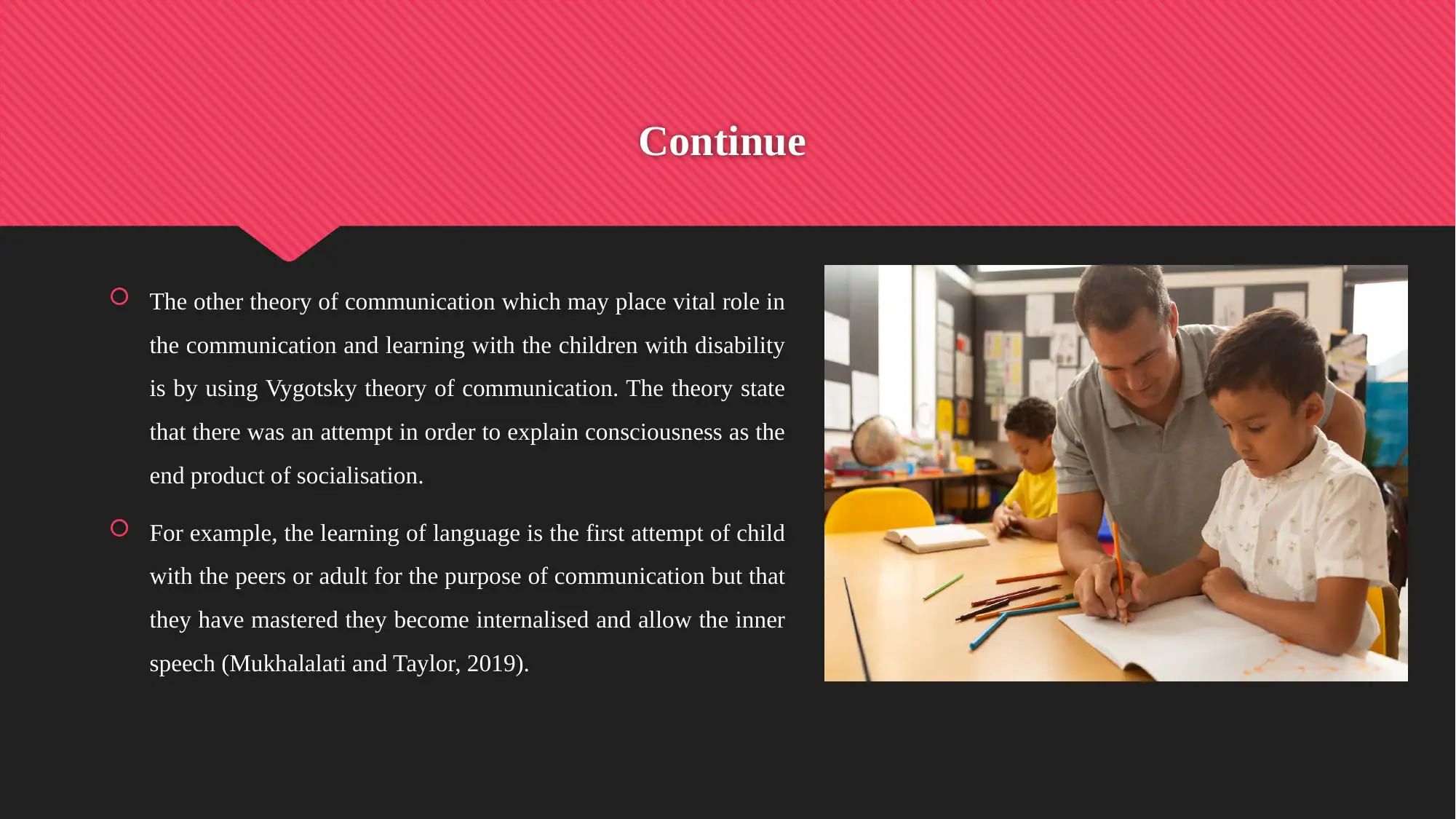
The other theory of communication which may place vital role in
the communication and learning with the children with disability
is by using Vygotsky theory of communication. The theory state
that there was an attempt in order to explain consciousness as the
end product of socialisation.
For example, the learning of language is the first attempt of child
with the peers or adult for the purpose of communication but that
they have mastered they become internalised and allow the inner
speech (Mukhalalati and Taylor, 2019).
tabler-icon-diamond-filled.svg

Paraphrase This Document

Need a fresh take? Get an instant paraphrase of this document with our AI Paraphraser
Document Page
Continue
2.2: Theories, principles and models of communication can be applied to teaching,
learning and assessment
The above discussed theory of communication such as Piaget and Vygotsky play vital role
with the developed case study that is related with children with issue of autism that is
defined learning disability. In addition, it is well analysing that the theory usually plays
their relevance in the development of communication and show the impact among the
children to learn the language.
The major strength of the Piaget theory is usually focus on the learning behaviour which is
related the concept of assimilation and accommodation of learning towards the language
that play vital role in development of positive impact of communication and group
communication.
Document Page
Task 3: Application of theories, principles and models of assessment
in education and training
3.1: Theories, principles and models of assessment
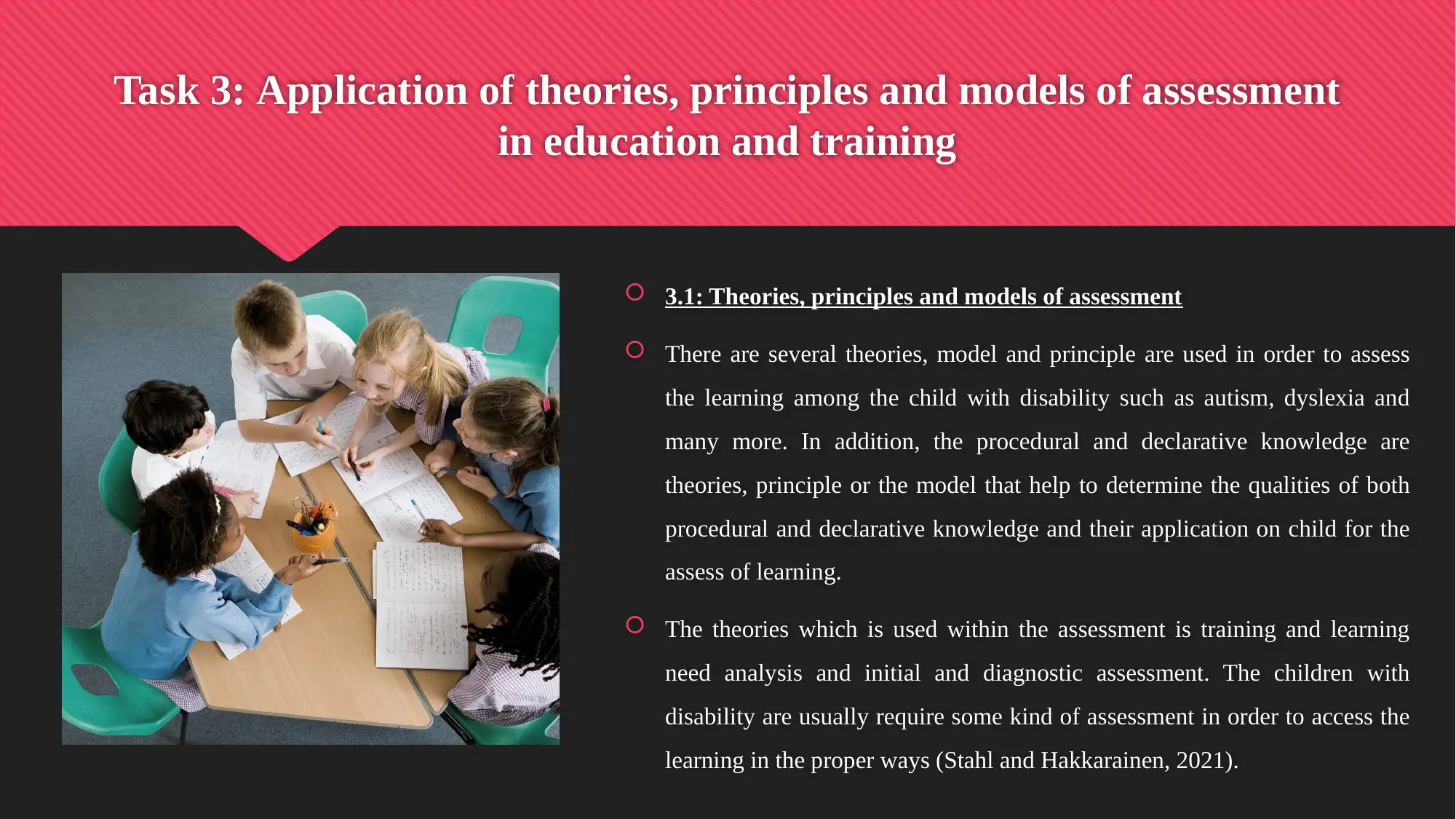
There are several theories, model and principle are used in order to assess
the learning among the child with disability such as autism, dyslexia and
many more. In addition, the procedural and declarative knowledge are
theories, principle or the model that help to determine the qualities of both
procedural and declarative knowledge and their application on child for the
assess of learning.
The theories which is used within the assessment is training and learning
need analysis and initial and diagnostic assessment. The children with
disability are usually require some kind of assessment in order to access the
learning in the proper ways (Stahl and Hakkarainen, 2021).
Document Page
Continue
Overall, with the context to children with disability, it helps to provide the
description that is follow the aspect of learning and development of child by
analysing their abilities.
Initial and diagnostic assessment is well defined as the starting of the analysis of
children and observe them in appropriate which help to configure their
capabilities and talent and diagnostic assessment usually provide the aspect
which may contributed within the children scope of development and plan the
education and training in such a way which help to provide the quality based
learning among the children with disability (Tatsis, Wagner and Maj-Tatsis,
2018).
tabler-icon-diamond-filled.svg

Paraphrase This Document

Need a fresh take? Get an instant paraphrase of this document with our AI Paraphraser
Document Page
Continue
3.2: Theories, principles and models of assessment can be applied in assessing
learning
The both the theories which is above listed such as initial and diagnostic
assessment and training and learning need analysis are usually play vital role in the
development of quality of learning among the children for the proper assess of
learning.
The theories are useful in order to determine the core value of children and their
abilities and care plan such as followed with activities or games which may
influential in order to support the children that develop quality of learning among
the children who is dealing with disabilities.
Document Page
Task 4: Application of theories and models of curriculum
development within own area of specialism.
Behaviourist (Skinner, Watson)- This is the model which has focus on the internal
emotional and psychological condition of individual which are associated with external
and outward behaviour. This may involve the laws which can cause human behaviour that
is outside the individual and are something in their environment.
This theory can be applied to students which can include positive incentives for
individual, class and group behaviour.
Here, curriculum approaches can be differing where behaviour is considered as learning
within education to get learning about changing behaviour to learn. It can create positive
incentives for individual or group.
Document Page
Continue
Through applying this behaviour can help in providing learning to children with disability
through changing in behaviour and help to learn effectively.
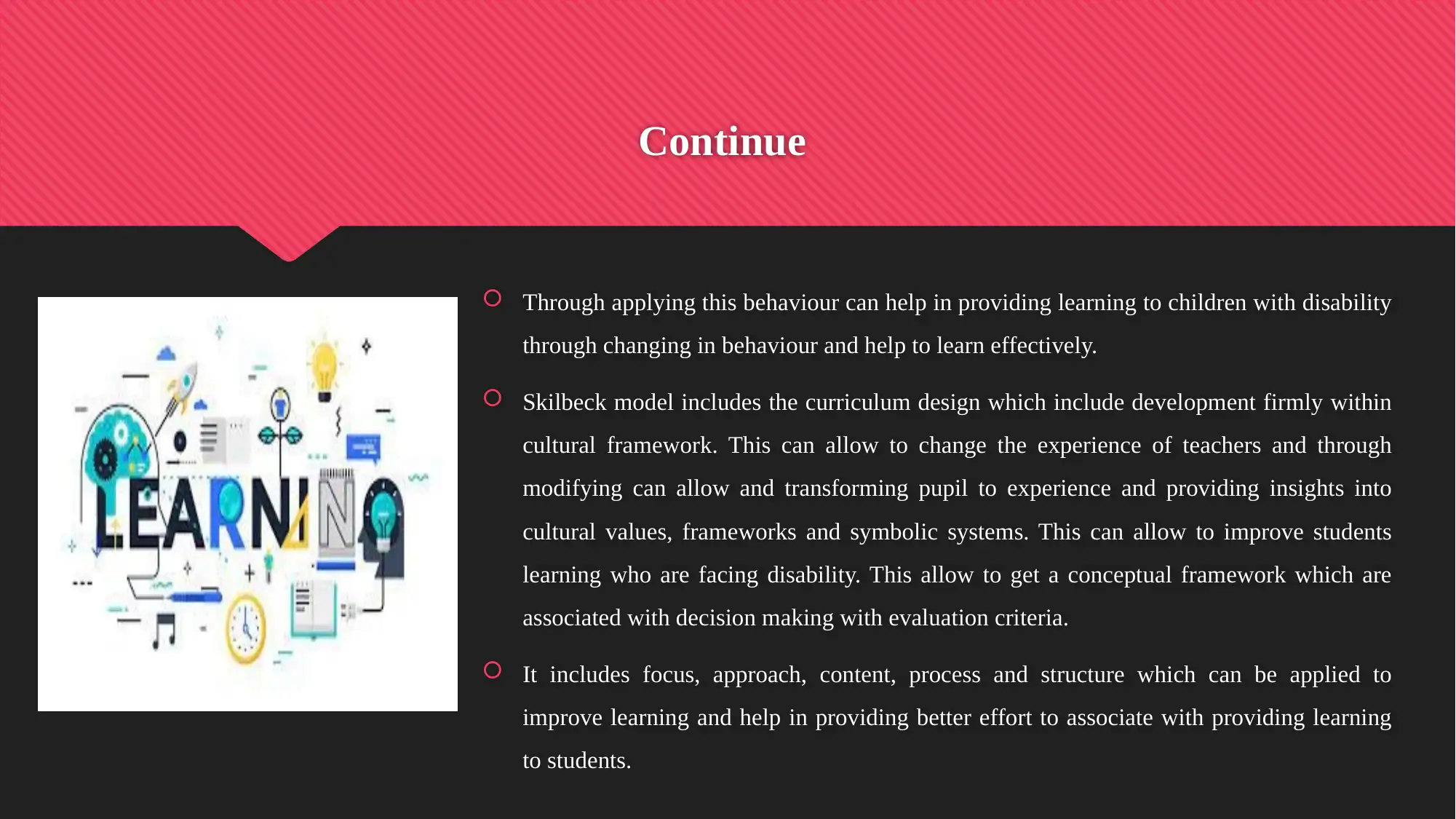
Skilbeck model includes the curriculum design which include development firmly within
cultural framework. This can allow to change the experience of teachers and through
modifying can allow and transforming pupil to experience and providing insights into
cultural values, frameworks and symbolic systems. This can allow to improve students
learning who are facing disability. This allow to get a conceptual framework which are
associated with decision making with evaluation criteria.
It includes focus, approach, content, process and structure which can be applied to
improve learning and help in providing better effort to associate with providing learning
to students.
chevron_up_icon
1 out of 10
circle_padding
hide_on_mobile
zoom_out_icon
[object Object]