Educational Plan for Improving Mental Health in the Winton Community
VerifiedAdded on 2022/09/28
|10
|3366
|32
Report
AI Summary
This report outlines an educational plan designed to address the high rate of mental illness within the Winton community in Central West Queensland, Australia, which is attributed to a lack of healthcare services. The plan proposes the introduction of telehealth to improve accessibility, especially in remote areas. The educational intervention emphasizes cultural competence, community needs assessment, and the use of local resources, including pamphlets and community nurses, to educate residents about mental health illnesses, management strategies, and available support services. The plan incorporates a community assessment phase to understand the population's needs and resources, development of educational materials, and a one-month intervention period, including ongoing evaluation. The educational materials cover epidemiological principles, definitions of mental illness, determinants, when and where to seek help, and management strategies, with a focus on empowering the community to actively participate in their mental healthcare through a telehealth app, promoting early detection, treatment, and rehabilitation. The plan also underscores the role of community nurses in connecting patients with appropriate care and providing support to families.
Running head: EDUCATIONAL PLAN
Educational Plan
Name
Institution
Educational Plan
Name
Institution

Paraphrase This Document
Need a fresh take? Get an instant paraphrase of this document with our AI Paraphraser
EDUCATIONAL PLAN
Mental health illnesses are among the main healthcare problems that pose a challenge
for Winton community, developing an effective healthcare intervention is important because
these healthcare challenges are due to lack of access to healthcare services. As a result, a new
strategy: telehealth, should be introduced in remote areas to improve accessibility. However,
it is paramount to develop an effective educational intervention to foster better adoption of
the proposed solution. The educational intervention entails developing a culturally competent
and sensitive plan to inform the community about mental illnesses and how to manage them
in reference to existing resources that can be accessed by the Winton community.
Client satisfaction is an indicator of quality healthcare; thereby, it is paramount to
ensure that clients are satisfied. The fact that patients are not fully satisfied with healthcare
services suggests the need for educating patients about conditions affecting them and how
they can be actively involved to aid in the effective management of these conditions (Ahmed,
Shehadeh, & Collins, 2013). Thereby, it is paramount to develop a plausible educational plan
that utilizes local resources whose objective is to align the educational content to these
resources.
The people at Winton community are largely poor and most of them are unemployed.
Also, there are a few early childhood and primary schools. Thereby, the community might
not be exposed to top-notch technology and the use of simple language is important. Thereby,
the proposed educational plan will be customized to meet the needs of Winton Community
while ensuring it complies with the recommendations for community nursing and care. Being
a new concept in Winton community, telehealth for this community will be discussed through
an app where patients can voluntarily get involved in different healthcare processes to
promote the attainment of optimal mental health status. The use of apps in Winton
community is more preferable as it is easy to share and easier to navigate because it
constitutes primary, secondary, and rehabilitative services for different health conditions.
Mental health illnesses are among the main healthcare problems that pose a challenge
for Winton community, developing an effective healthcare intervention is important because
these healthcare challenges are due to lack of access to healthcare services. As a result, a new
strategy: telehealth, should be introduced in remote areas to improve accessibility. However,
it is paramount to develop an effective educational intervention to foster better adoption of
the proposed solution. The educational intervention entails developing a culturally competent
and sensitive plan to inform the community about mental illnesses and how to manage them
in reference to existing resources that can be accessed by the Winton community.
Client satisfaction is an indicator of quality healthcare; thereby, it is paramount to
ensure that clients are satisfied. The fact that patients are not fully satisfied with healthcare
services suggests the need for educating patients about conditions affecting them and how
they can be actively involved to aid in the effective management of these conditions (Ahmed,
Shehadeh, & Collins, 2013). Thereby, it is paramount to develop a plausible educational plan
that utilizes local resources whose objective is to align the educational content to these
resources.
The people at Winton community are largely poor and most of them are unemployed.
Also, there are a few early childhood and primary schools. Thereby, the community might
not be exposed to top-notch technology and the use of simple language is important. Thereby,
the proposed educational plan will be customized to meet the needs of Winton Community
while ensuring it complies with the recommendations for community nursing and care. Being
a new concept in Winton community, telehealth for this community will be discussed through
an app where patients can voluntarily get involved in different healthcare processes to
promote the attainment of optimal mental health status. The use of apps in Winton
community is more preferable as it is easy to share and easier to navigate because it
constitutes primary, secondary, and rehabilitative services for different health conditions.
EDUCATIONAL PLAN
Education is considered a preventive intervention that will cut across the three levels
of care: primary, secondary, and tertiary, with the aim of preventing progression of the
ailment at the different stages. Thereby, the educational for telehealth emphasis early
detection while also emphasizing on the importance of treatment alongside rehabilitation for
effective disease management that improves an individual’s quality of life (Bhattacharya &
Bhatt, 2017). Winton community is seemingly a disadvantaged population that does not have
access to healthcare services. Thereby, the approach taken on prevention will enable it to
have a comprehensive solution in managing mental illnesses (First, 2019).
The other aspect of the Winton community is its population structure, which will
guide the educational intervention. The distribution of mental health illnesses within the
community and associated risk factors specific to Winton community will be factored in
when developing the educational plan. Whereas elderly above 70 years are deemed to be the
main affected population, it is also important to understand the conditions that are likely to
affect the young ones as they could culminate to poor mental health in old age. Such an
approach helps to understand the most occurring cases of mental health disorders. The
incidence of disease is linked to the risk factors in a particular locality. Thereby, these
epidemiological facet should be considered during community assessment as described later
in the paper.
The quality and safety framework for community nursing and care recommends that
healthcare should be consumer-centered. As a result, the educational content will factor in the
cultural needs of Winton community. The Australian Commission on Safety and Quality in
Healthcare (n. d.) discusses the importance of empowering the community on their health
conditions, possible solutions, and access to healthcare services to aid in patient-centered
decision-making processes. Thereby, the educational plan will be adequately comprehensive
to educate the community about mental health illnesses and when to seek help. In reference to
Education is considered a preventive intervention that will cut across the three levels
of care: primary, secondary, and tertiary, with the aim of preventing progression of the
ailment at the different stages. Thereby, the educational for telehealth emphasis early
detection while also emphasizing on the importance of treatment alongside rehabilitation for
effective disease management that improves an individual’s quality of life (Bhattacharya &
Bhatt, 2017). Winton community is seemingly a disadvantaged population that does not have
access to healthcare services. Thereby, the approach taken on prevention will enable it to
have a comprehensive solution in managing mental illnesses (First, 2019).
The other aspect of the Winton community is its population structure, which will
guide the educational intervention. The distribution of mental health illnesses within the
community and associated risk factors specific to Winton community will be factored in
when developing the educational plan. Whereas elderly above 70 years are deemed to be the
main affected population, it is also important to understand the conditions that are likely to
affect the young ones as they could culminate to poor mental health in old age. Such an
approach helps to understand the most occurring cases of mental health disorders. The
incidence of disease is linked to the risk factors in a particular locality. Thereby, these
epidemiological facet should be considered during community assessment as described later
in the paper.
The quality and safety framework for community nursing and care recommends that
healthcare should be consumer-centered. As a result, the educational content will factor in the
cultural needs of Winton community. The Australian Commission on Safety and Quality in
Healthcare (n. d.) discusses the importance of empowering the community on their health
conditions, possible solutions, and access to healthcare services to aid in patient-centered
decision-making processes. Thereby, the educational plan will be adequately comprehensive
to educate the community about mental health illnesses and when to seek help. In reference to
⊘ This is a preview!⊘
Do you want full access?
Subscribe today to unlock all pages.

Trusted by 1+ million students worldwide
EDUCATIONAL PLAN
the principles of epidemiology, the educational plan will highlight the causes and distribution
of mental illnesses. The determinants of mental health illnesses should be aligned to the
needs of Winton community as guided by a community needs assessment. A community need
assessment is important because it helps to understand the profile of the community in terms
of prevailing cultures, religion, and socioeconomic status as these tend to affect accessibility
to social amenities where health services are part (Centers for Disease Control and Prevention
[CDC], 2013).
Subsequently, there will be brainstorming of cultural-based interventions for the
community to use in the development of preventive strategies (State of Delaware, 2006).
Discussion of brainstormed ideas helps in the modification of the already developed content
to ensure it aligns with the community’s preferences and needs. Also, the information
obtained helps in planning for interventions to ensure that they are culture-sensitive. The
education initiative enables healthcare providers to interact with the community. Thereby,
gaining insight into the community’s cultural practices is meant to inform the community
nurse, who is main direct link between the community and other healthcare providers,
including, physicians, counselors, psychologists, and psychiatrists. Promotion of the
telehealth initiative helps to integrate the role of the community nurse, who will help the
existing primary care providers to focus on urgent and deserving cases.
Cultural competence in developing the educational plan is paramount. Thereby, the
facilitator should be aware of the cultural values and beliefs linked to mental illnesses and
causes to develop an effective approach in demystifying the prejudices and stereotypes
around mental illness and health care in the community. Thereby, attaining culturally
competent education intervention will entail developing a culturally-based didactic teaching
approach where members of the community will be involved in the delivery of information,
especially in light of simple concepts, and mainly those requiring integration of cultural
the principles of epidemiology, the educational plan will highlight the causes and distribution
of mental illnesses. The determinants of mental health illnesses should be aligned to the
needs of Winton community as guided by a community needs assessment. A community need
assessment is important because it helps to understand the profile of the community in terms
of prevailing cultures, religion, and socioeconomic status as these tend to affect accessibility
to social amenities where health services are part (Centers for Disease Control and Prevention
[CDC], 2013).
Subsequently, there will be brainstorming of cultural-based interventions for the
community to use in the development of preventive strategies (State of Delaware, 2006).
Discussion of brainstormed ideas helps in the modification of the already developed content
to ensure it aligns with the community’s preferences and needs. Also, the information
obtained helps in planning for interventions to ensure that they are culture-sensitive. The
education initiative enables healthcare providers to interact with the community. Thereby,
gaining insight into the community’s cultural practices is meant to inform the community
nurse, who is main direct link between the community and other healthcare providers,
including, physicians, counselors, psychologists, and psychiatrists. Promotion of the
telehealth initiative helps to integrate the role of the community nurse, who will help the
existing primary care providers to focus on urgent and deserving cases.
Cultural competence in developing the educational plan is paramount. Thereby, the
facilitator should be aware of the cultural values and beliefs linked to mental illnesses and
causes to develop an effective approach in demystifying the prejudices and stereotypes
around mental illness and health care in the community. Thereby, attaining culturally
competent education intervention will entail developing a culturally-based didactic teaching
approach where members of the community will be involved in the delivery of information,
especially in light of simple concepts, and mainly those requiring integration of cultural
Paraphrase This Document
Need a fresh take? Get an instant paraphrase of this document with our AI Paraphraser
EDUCATIONAL PLAN
beliefs and values. Education will be face-to-face and will integrate both audio, visual, and
hands-on media. It is important to integrate arrange of teaching methods, especially for this
community whose educational attainment levels are presumed to be low (Kurtz et al., 2018).
Thereby, using one mode of teaching might result in a loss of attention among the
participants.
The educational intervention to promote the introduction and use of telehealth in
Winton community will go on for one month. The first week will be to understand the
community better as indicated below in the community assessment section. The information
obtained will help to develop educational content that is relevant to the population. For
example, if the population mainly consists of old people, much of the focus will be on
promoting good health in old age. Thereby, strategies to support family caregivers in taking
care of this population to avoid extended mental health problems will be given priority
through a question and answer section or direct communication with a healthcare
representative. The next one-and-a-half weeks will be spent educating the community
members, a break for process evaluation will take place before proceeding for another one-
and-a-half weeks. Lastly, knowledge levels will be determined and over time, statistical
reports on mental health status in Winton community will determine the effect of the
educational initiative.
In reference to the different factors that should be considered the educational plan will
entail:
a. Community Assessment
This process will require the identification and selection of stakeholders to facilitate the needs
assessment process in the community. The needs assessment process will determine the
community’s use of online resources, current ways of accessing health-related information,
and anticipated use of the telehealth app in relation to mental health. Also, it helps to
beliefs and values. Education will be face-to-face and will integrate both audio, visual, and
hands-on media. It is important to integrate arrange of teaching methods, especially for this
community whose educational attainment levels are presumed to be low (Kurtz et al., 2018).
Thereby, using one mode of teaching might result in a loss of attention among the
participants.
The educational intervention to promote the introduction and use of telehealth in
Winton community will go on for one month. The first week will be to understand the
community better as indicated below in the community assessment section. The information
obtained will help to develop educational content that is relevant to the population. For
example, if the population mainly consists of old people, much of the focus will be on
promoting good health in old age. Thereby, strategies to support family caregivers in taking
care of this population to avoid extended mental health problems will be given priority
through a question and answer section or direct communication with a healthcare
representative. The next one-and-a-half weeks will be spent educating the community
members, a break for process evaluation will take place before proceeding for another one-
and-a-half weeks. Lastly, knowledge levels will be determined and over time, statistical
reports on mental health status in Winton community will determine the effect of the
educational initiative.
In reference to the different factors that should be considered the educational plan will
entail:
a. Community Assessment
This process will require the identification and selection of stakeholders to facilitate the needs
assessment process in the community. The needs assessment process will determine the
community’s use of online resources, current ways of accessing health-related information,
and anticipated use of the telehealth app in relation to mental health. Also, it helps to
EDUCATIONAL PLAN
understand the characteristics of the community in reference to age to determine the likely
proportion of different health problems on the basis of the affected population (CDC, 2013).
Subsequently, the educational program will assert the essence of improving the quality of life
for the elderly and demystify cultural beliefs about old age and disease. Also, infrastructure to
support the use of the app based on the socioeconomic status helps to identify or develop
social networks through which individuals can access the app and obtain the healthcare
service they want.
b. Identification of Available Resources
The educational plan and content will be tailored to the extant resources within the
community. The educational site, trainers, connectivity, and lighting are imperative in the
successful execution of the educational session. Thereby, it is paramount to ensure that all
these elements are available because they will support the use of technology and educational
equipment, such as PowerPoint projections and related videos and flip charts and related
writing boards (World Health Organization [WHO], 2005).
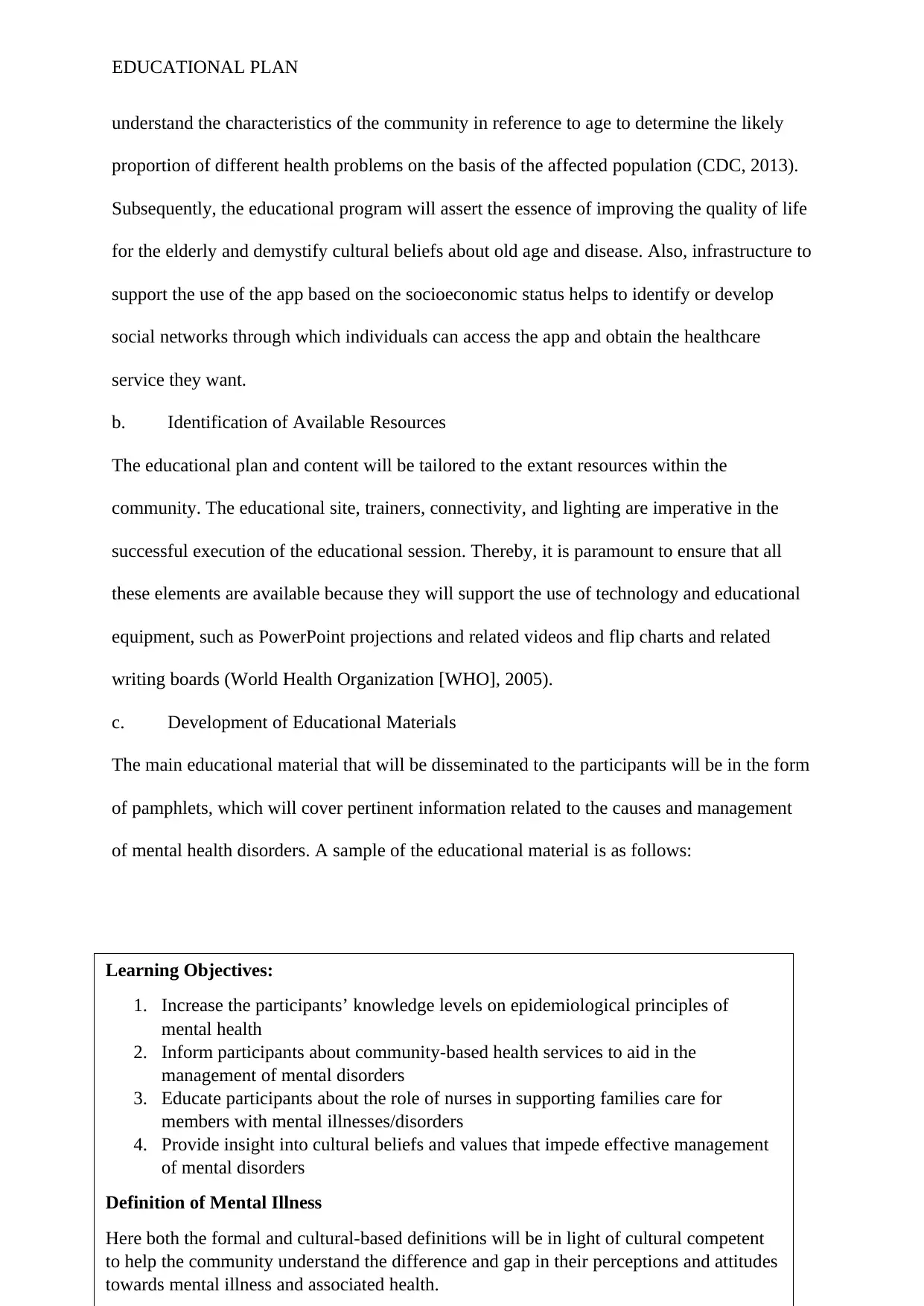
c. Development of Educational Materials
The main educational material that will be disseminated to the participants will be in the form
of pamphlets, which will cover pertinent information related to the causes and management
of mental health disorders. A sample of the educational material is as follows:
Learning Objectives:
1. Increase the participants’ knowledge levels on epidemiological principles of
mental health
2. Inform participants about community-based health services to aid in the
management of mental disorders
3. Educate participants about the role of nurses in supporting families care for
members with mental illnesses/disorders
4. Provide insight into cultural beliefs and values that impede effective management
of mental disorders
Definition of Mental Illness
Here both the formal and cultural-based definitions will be in light of cultural competent
to help the community understand the difference and gap in their perceptions and attitudes
towards mental illness and associated health.
understand the characteristics of the community in reference to age to determine the likely
proportion of different health problems on the basis of the affected population (CDC, 2013).
Subsequently, the educational program will assert the essence of improving the quality of life
for the elderly and demystify cultural beliefs about old age and disease. Also, infrastructure to
support the use of the app based on the socioeconomic status helps to identify or develop
social networks through which individuals can access the app and obtain the healthcare
service they want.
b. Identification of Available Resources
The educational plan and content will be tailored to the extant resources within the
community. The educational site, trainers, connectivity, and lighting are imperative in the
successful execution of the educational session. Thereby, it is paramount to ensure that all
these elements are available because they will support the use of technology and educational
equipment, such as PowerPoint projections and related videos and flip charts and related
writing boards (World Health Organization [WHO], 2005).
c. Development of Educational Materials
The main educational material that will be disseminated to the participants will be in the form
of pamphlets, which will cover pertinent information related to the causes and management
of mental health disorders. A sample of the educational material is as follows:
Learning Objectives:
1. Increase the participants’ knowledge levels on epidemiological principles of
mental health
2. Inform participants about community-based health services to aid in the
management of mental disorders
3. Educate participants about the role of nurses in supporting families care for
members with mental illnesses/disorders
4. Provide insight into cultural beliefs and values that impede effective management
of mental disorders
Definition of Mental Illness
Here both the formal and cultural-based definitions will be in light of cultural competent
to help the community understand the difference and gap in their perceptions and attitudes
towards mental illness and associated health.
⊘ This is a preview!⊘
Do you want full access?
Subscribe today to unlock all pages.
Trusted by 1+ million students worldwide
EDUCATIONAL PLAN
d.
Co
ver
age
The content can be delivered in on day, but in compliance with the primary health movement,
as discussed below, the community nurse alongside the involved multidisciplinary team will
visit the entire Winton community to ensure all people get the information. Initially,
individuals will assemble in a selected locality of convenience. The educational initiative will
run for a month to ensure al community members have the information.
The standards and competencies of nursing practice guide nurses in taking
stewardship roles to help vulnerable populations like the Winton community obtain the
needed healthcare services. A collaborative approach will be used by involving different
disciplines that have a role to play in the management of healthcare services, including the
primary health care providers serving the people within the locality (Kulbok, Thatcher, Park,
& Meszaros, 2012). Importantly, involving the community in the use of telehealth is
paramount because patients are pertinent in the effective management of mental health
problems. Patients understand their health better and can seek timely intervention to avoid
delay linked to the onset of advanced mental disorders that take a toll on the general
wellbeing of an individual.
The education plan will require monitoring and evaluation to ensure that all the
processes go on smoothly as per the intended objectives and activities. Thereby both
formative and summative assessments will be included to monitor attendance rates and
quality of content delivered based on the learning outcomes (University of Minnesota, 2019).
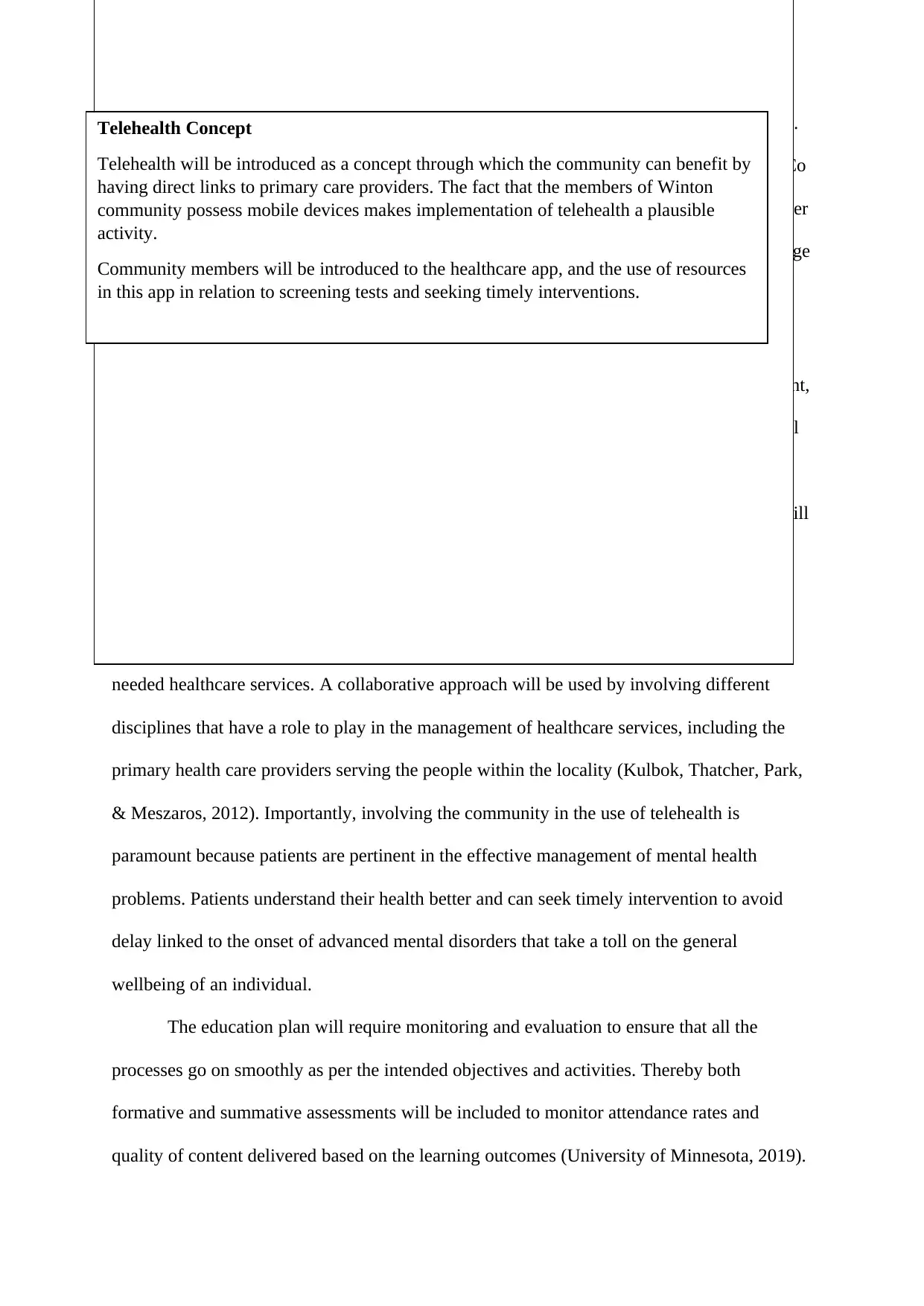
Telehealth Concept
Telehealth will be introduced as a concept through which the community can benefit by
having direct links to primary care providers. The fact that the members of Winton
community possess mobile devices makes implementation of telehealth a plausible
activity.
Community members will be introduced to the healthcare app, and the use of resources
in this app in relation to screening tests and seeking timely interventions.
d.
Co
ver
age
The content can be delivered in on day, but in compliance with the primary health movement,
as discussed below, the community nurse alongside the involved multidisciplinary team will
visit the entire Winton community to ensure all people get the information. Initially,
individuals will assemble in a selected locality of convenience. The educational initiative will
run for a month to ensure al community members have the information.
The standards and competencies of nursing practice guide nurses in taking
stewardship roles to help vulnerable populations like the Winton community obtain the
needed healthcare services. A collaborative approach will be used by involving different
disciplines that have a role to play in the management of healthcare services, including the
primary health care providers serving the people within the locality (Kulbok, Thatcher, Park,
& Meszaros, 2012). Importantly, involving the community in the use of telehealth is
paramount because patients are pertinent in the effective management of mental health
problems. Patients understand their health better and can seek timely intervention to avoid
delay linked to the onset of advanced mental disorders that take a toll on the general
wellbeing of an individual.
The education plan will require monitoring and evaluation to ensure that all the
processes go on smoothly as per the intended objectives and activities. Thereby both
formative and summative assessments will be included to monitor attendance rates and
quality of content delivered based on the learning outcomes (University of Minnesota, 2019).
Telehealth Concept
Telehealth will be introduced as a concept through which the community can benefit by
having direct links to primary care providers. The fact that the members of Winton
community possess mobile devices makes implementation of telehealth a plausible
activity.
Community members will be introduced to the healthcare app, and the use of resources
in this app in relation to screening tests and seeking timely interventions.
Paraphrase This Document
Need a fresh take? Get an instant paraphrase of this document with our AI Paraphraser
EDUCATIONAL PLAN
Summative assent will help to determine if increased knowledge levels result in positive
behavior change towards the attainment of self-care.
The educational program is a facet of the primary health movement that seeks to
ensure that all people in Winton community can access health care services. Primary health
care seeks to address the causes of health by taking a multidisciplinary approach that informs
policy. Also, it empowers individuals, families, and the larger community to become
responsible for their own health (WHO, 2019). The introduction of the concept of telehealth
helps Winton community to become autonomous in seeking intervention and taking the
initiative to be responsible for one’s health status. Orem’s self-care deficit theory advocates
for the essence of self-reliance in propagating self-care; however, she noted that knowledge
of impending health problems is the first step towards promoting self-care behaviors
(“Orem’s Self-care Deficit Nursing Theory,” 2016). Thereby, the current plan entails a
discussion of mental health problems and associated determinants before introducing
telehealth as a concept to promote self-care.
Summative assent will help to determine if increased knowledge levels result in positive
behavior change towards the attainment of self-care.
The educational program is a facet of the primary health movement that seeks to
ensure that all people in Winton community can access health care services. Primary health
care seeks to address the causes of health by taking a multidisciplinary approach that informs
policy. Also, it empowers individuals, families, and the larger community to become
responsible for their own health (WHO, 2019). The introduction of the concept of telehealth
helps Winton community to become autonomous in seeking intervention and taking the
initiative to be responsible for one’s health status. Orem’s self-care deficit theory advocates
for the essence of self-reliance in propagating self-care; however, she noted that knowledge
of impending health problems is the first step towards promoting self-care behaviors
(“Orem’s Self-care Deficit Nursing Theory,” 2016). Thereby, the current plan entails a
discussion of mental health problems and associated determinants before introducing
telehealth as a concept to promote self-care.
EDUCATIONAL PLAN
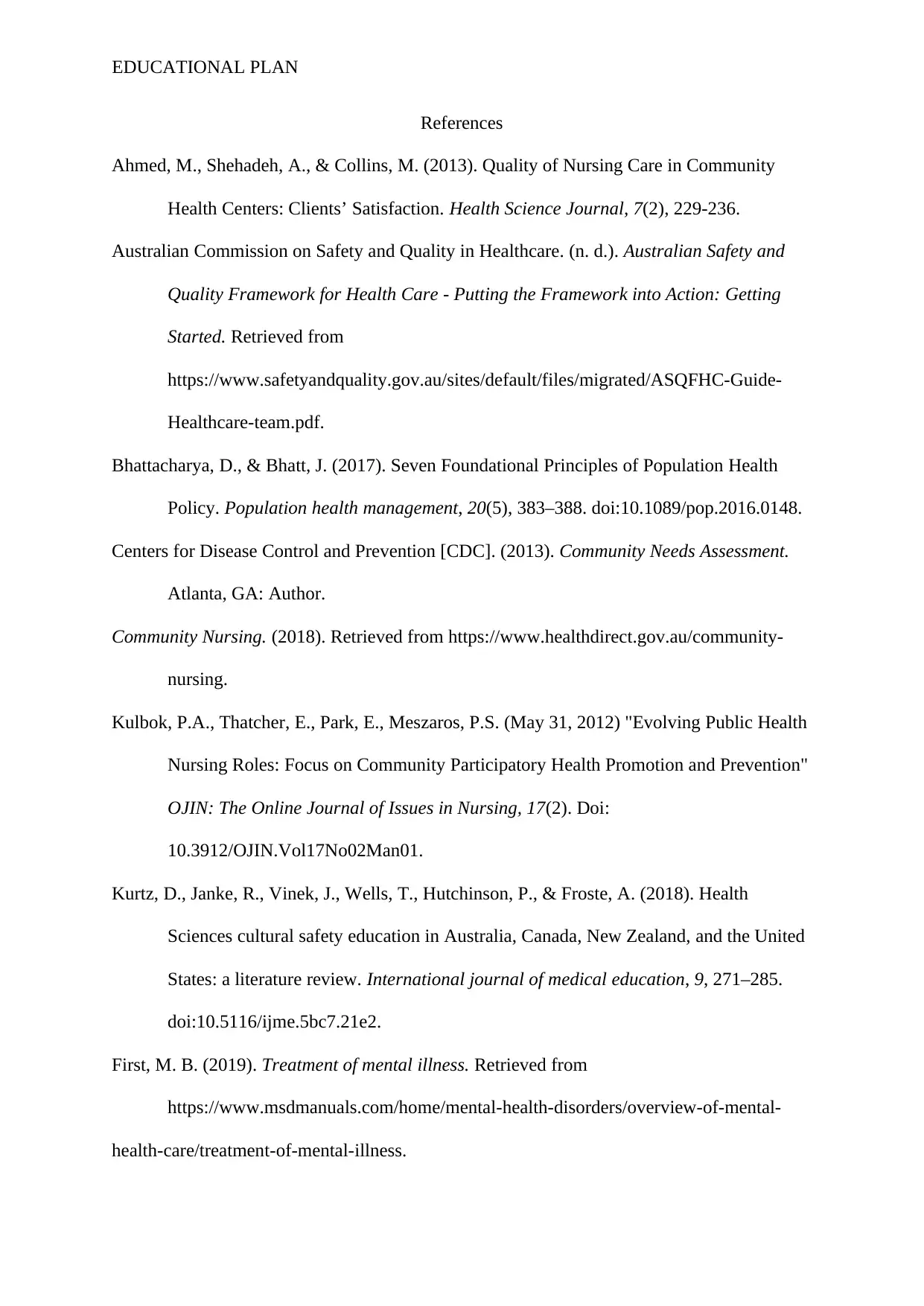
References
Ahmed, M., Shehadeh, A., & Collins, M. (2013). Quality of Nursing Care in Community
Health Centers: Clients’ Satisfaction. Health Science Journal, 7(2), 229-236.
Australian Commission on Safety and Quality in Healthcare. (n. d.). Australian Safety and
Quality Framework for Health Care - Putting the Framework into Action: Getting
Started. Retrieved from
https://www.safetyandquality.gov.au/sites/default/files/migrated/ASQFHC-Guide-
Healthcare-team.pdf.
Bhattacharya, D., & Bhatt, J. (2017). Seven Foundational Principles of Population Health
Policy. Population health management, 20(5), 383–388. doi:10.1089/pop.2016.0148.
Centers for Disease Control and Prevention [CDC]. (2013). Community Needs Assessment.
Atlanta, GA: Author.
Community Nursing. (2018). Retrieved from https://www.healthdirect.gov.au/community-
nursing.
Kulbok, P.A., Thatcher, E., Park, E., Meszaros, P.S. (May 31, 2012) "Evolving Public Health
Nursing Roles: Focus on Community Participatory Health Promotion and Prevention"
OJIN: The Online Journal of Issues in Nursing, 17(2). Doi:
10.3912/OJIN.Vol17No02Man01.
Kurtz, D., Janke, R., Vinek, J., Wells, T., Hutchinson, P., & Froste, A. (2018). Health
Sciences cultural safety education in Australia, Canada, New Zealand, and the United
States: a literature review. International journal of medical education, 9, 271–285.
doi:10.5116/ijme.5bc7.21e2.
First, M. B. (2019). Treatment of mental illness. Retrieved from
https://www.msdmanuals.com/home/mental-health-disorders/overview-of-mental-
health-care/treatment-of-mental-illness.
References
Ahmed, M., Shehadeh, A., & Collins, M. (2013). Quality of Nursing Care in Community
Health Centers: Clients’ Satisfaction. Health Science Journal, 7(2), 229-236.
Australian Commission on Safety and Quality in Healthcare. (n. d.). Australian Safety and
Quality Framework for Health Care - Putting the Framework into Action: Getting
Started. Retrieved from
https://www.safetyandquality.gov.au/sites/default/files/migrated/ASQFHC-Guide-
Healthcare-team.pdf.
Bhattacharya, D., & Bhatt, J. (2017). Seven Foundational Principles of Population Health
Policy. Population health management, 20(5), 383–388. doi:10.1089/pop.2016.0148.
Centers for Disease Control and Prevention [CDC]. (2013). Community Needs Assessment.
Atlanta, GA: Author.
Community Nursing. (2018). Retrieved from https://www.healthdirect.gov.au/community-
nursing.
Kulbok, P.A., Thatcher, E., Park, E., Meszaros, P.S. (May 31, 2012) "Evolving Public Health
Nursing Roles: Focus on Community Participatory Health Promotion and Prevention"
OJIN: The Online Journal of Issues in Nursing, 17(2). Doi:
10.3912/OJIN.Vol17No02Man01.
Kurtz, D., Janke, R., Vinek, J., Wells, T., Hutchinson, P., & Froste, A. (2018). Health
Sciences cultural safety education in Australia, Canada, New Zealand, and the United
States: a literature review. International journal of medical education, 9, 271–285.
doi:10.5116/ijme.5bc7.21e2.
First, M. B. (2019). Treatment of mental illness. Retrieved from
https://www.msdmanuals.com/home/mental-health-disorders/overview-of-mental-
health-care/treatment-of-mental-illness.
⊘ This is a preview!⊘
Do you want full access?
Subscribe today to unlock all pages.
Trusted by 1+ million students worldwide
EDUCATIONAL PLAN
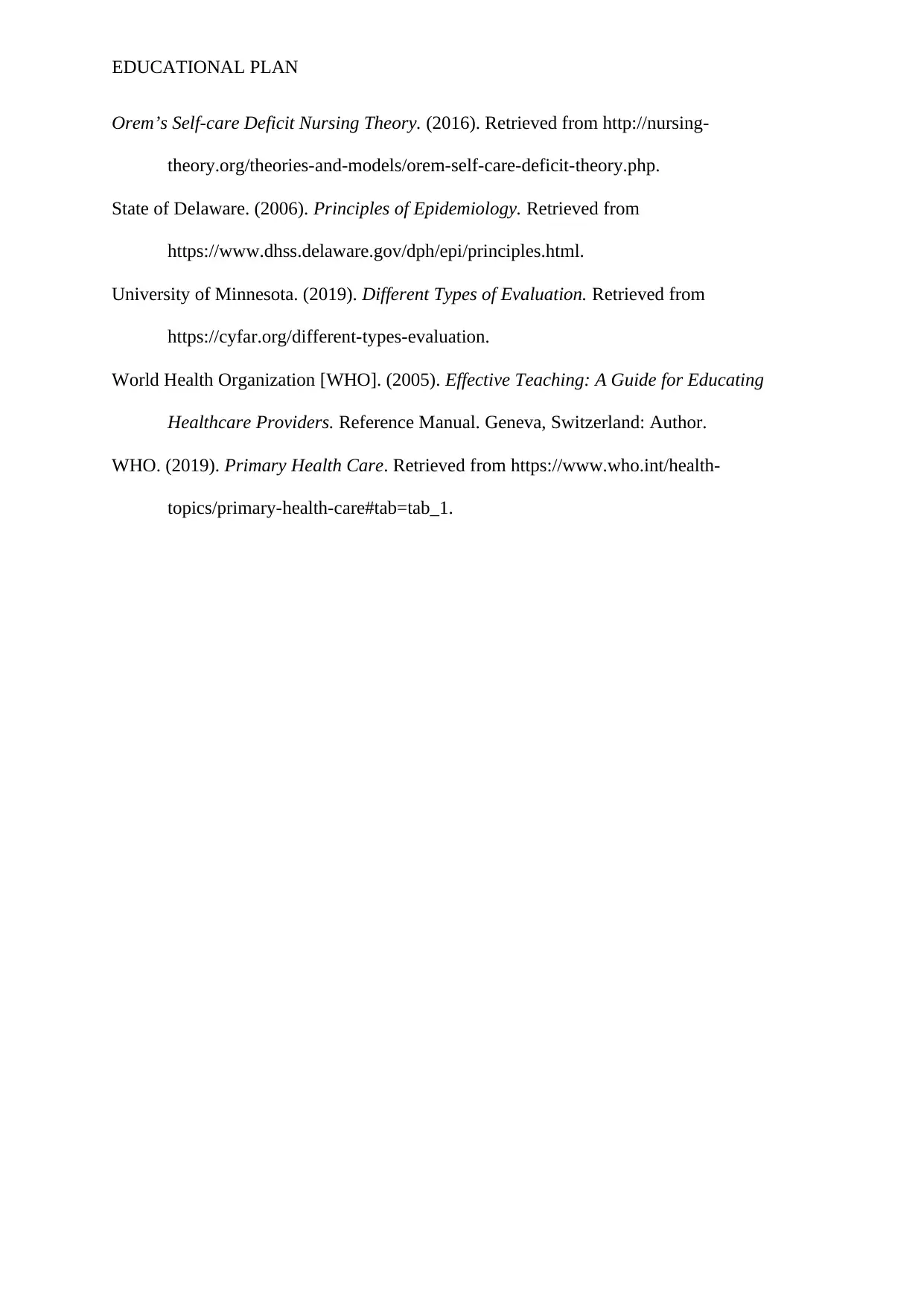
Orem’s Self-care Deficit Nursing Theory. (2016). Retrieved from http://nursing-
theory.org/theories-and-models/orem-self-care-deficit-theory.php.
State of Delaware. (2006). Principles of Epidemiology. Retrieved from
https://www.dhss.delaware.gov/dph/epi/principles.html.
University of Minnesota. (2019). Different Types of Evaluation. Retrieved from
https://cyfar.org/different-types-evaluation.
World Health Organization [WHO]. (2005). Effective Teaching: A Guide for Educating
Healthcare Providers. Reference Manual. Geneva, Switzerland: Author.
WHO. (2019). Primary Health Care. Retrieved from https://www.who.int/health-
topics/primary-health-care#tab=tab_1.
Orem’s Self-care Deficit Nursing Theory. (2016). Retrieved from http://nursing-
theory.org/theories-and-models/orem-self-care-deficit-theory.php.
State of Delaware. (2006). Principles of Epidemiology. Retrieved from
https://www.dhss.delaware.gov/dph/epi/principles.html.
University of Minnesota. (2019). Different Types of Evaluation. Retrieved from
https://cyfar.org/different-types-evaluation.
World Health Organization [WHO]. (2005). Effective Teaching: A Guide for Educating
Healthcare Providers. Reference Manual. Geneva, Switzerland: Author.
WHO. (2019). Primary Health Care. Retrieved from https://www.who.int/health-
topics/primary-health-care#tab=tab_1.

1 out of 10


Related Documents


Your All-in-One AI-Powered Toolkit for Academic Success.
+13062052269
info@desklib.com
Available 24*7 on WhatsApp / Email
![[object Object]](/_next/static/media/star-bottom.7253800d.svg)
Unlock your academic potential
Copyright © 2020–2026 A2Z Services. All Rights Reserved. Developed and managed by ZUCOL.