Educational Theory Application: Clinical Environment and Practice
VerifiedAdded on 2020/03/01
|10
|2618
|71
Essay
AI Summary
This essay delves into the application of educational theory within the clinical environment, with a specific focus on behaviorism as a learning theory. It explores the different types of behaviorism, including methodological and radical behaviorism, and how they influence learning and behavior change through respondent and operant conditioning. The paper further examines key principles of learning, such as the role of consequences, experiences, and antecedents, and how these factors impact adult learning. The essay also discusses the practical applications of behaviorism in clinical settings, including psychology guidance and interactions with patients, and outlines various methods to facilitate learning in the workplace, such as setting baseline assessments, incorporating professional self-development, and promoting learning through participation and discussion. The conclusion emphasizes the importance of educational theory in healthcare, highlighting its role in developing effective teaching and learning experiences for students and practitioners alike, ultimately contributing to improved patient care and professional development.
Facilitation and Education skills for Practice Development 1
EDUCATIONAL THEORY IN CLINICAL ENVIRONMENT
Name:
Course:
Tutor:
Institution:
City:
Date:
EDUCATIONAL THEORY IN CLINICAL ENVIRONMENT
Name:
Course:
Tutor:
Institution:
City:
Date:

Paraphrase This Document
Need a fresh take? Get an instant paraphrase of this document with our AI Paraphraser
Facilitation and Education skills for Practice Development 2
Educational Theory in Clinical Environment
Introduction
Educations which can also be called learning is described as a process where one acquires knowledge and
start having different thoughts and feeling about the new skill and develop an attitude towards it. It helps
individuals to respond well to demands in clinical environment, that is, if for the sick and their families,
they will be able to understand ways of improving their health and follow the prescriptions from a
medical practitioner. For the learning students in the field of medicine, they are able to get information
and all skills required in the medical field.
Educational theory offers a different point of view on how learning takes place and what attracts people
towards it (Emerson 2007). Learning theory is very crucial in education as it helps in creating a good
environment for learning, improving education system and harmonizing it. It is also useful in psychology
guidance. Medical professionals are therefore advised to use these theories often especially when dealing
with the sick and other clients, during trainings and during other health programs. There are different
types of learning theories which include behaviorism, cognitive, humanism, but in this paper, we will be
discussing one of the theories, how learning theories is applied to clinical sector, principles to learning
and ways that facilitate learning in clinical environment
Behaviorism
This is a type of learning is believed to be a change in behavior which is visible and this happens when
there is a communication and response (Siemens 2014). There are two types of behaviorism;
methodological which describes psychology as a science which helps predict and control one’s behavior,
(Slavin & Davis 2006) while radical behaviorism which says that behaviors are inborn and is determined
by genes of a particular organism
Educational Theory in Clinical Environment
Introduction
Educations which can also be called learning is described as a process where one acquires knowledge and
start having different thoughts and feeling about the new skill and develop an attitude towards it. It helps
individuals to respond well to demands in clinical environment, that is, if for the sick and their families,
they will be able to understand ways of improving their health and follow the prescriptions from a
medical practitioner. For the learning students in the field of medicine, they are able to get information
and all skills required in the medical field.
Educational theory offers a different point of view on how learning takes place and what attracts people
towards it (Emerson 2007). Learning theory is very crucial in education as it helps in creating a good
environment for learning, improving education system and harmonizing it. It is also useful in psychology
guidance. Medical professionals are therefore advised to use these theories often especially when dealing
with the sick and other clients, during trainings and during other health programs. There are different
types of learning theories which include behaviorism, cognitive, humanism, but in this paper, we will be
discussing one of the theories, how learning theories is applied to clinical sector, principles to learning
and ways that facilitate learning in clinical environment
Behaviorism
This is a type of learning is believed to be a change in behavior which is visible and this happens when
there is a communication and response (Siemens 2014). There are two types of behaviorism;
methodological which describes psychology as a science which helps predict and control one’s behavior,
(Slavin & Davis 2006) while radical behaviorism which says that behaviors are inborn and is determined
by genes of a particular organism
Facilitation and Education skills for Practice Development 3
This theory assumes that all change of behavior is achieved from the environment and that behavior is the
final product of event response. Learning can be simple because by not considering what is happening in
an individual’s mind, observation and responses can tell you there is behavior change and therefore the
final behavior is achieved by continuous learning (Ormrod,2011). This has a great impact on learner’s
responses which can be positive or negative. The transition of behavior is achieved through practice and
much of these are based on respondent conditioning and operant conditioning.
Respondent conditioning deals with conditions of stimuli in that when a neutral stimulus is joined with a
naturally occurring and unconditioned response, a new conditioned response occur and this happens
without the knowledge of an individual. This creates a good clinical environment and improves the
performance of the medical practitioners. This conditioning can also be used in eliminating a previously
learned behavior, for example, fear/ anxiety or any other behavior and in this case psychologists have
devised ways to help counter that by use of;
Systematic desensitization is used by psychologists to minimize fear and anxiousness in patients/clients.
This is done by teaching patients with anxiety or fear problems the need for relaxation. This technique is
used in treating patients who are addicted to drugs.
Stimulus generalization whereby first experiences are used to apply to other events, therefore mixture of
different events helps people to learn.
Spontaneous recovery is a technique used in respondent theory to help in dealing relapse cases whereby a
person can go back to past habits when the current conditions seem alike with the past experiences
Operant conditioning looks into behavior of an organism and effects that occur after response. There are
different responses in this operant conditioning; neutral which comes from the environment and does not
cause a change in behavior, rein forcers which increase the change in behavior and punishers which
decreases the chance of change of behavior. The main point of doing this is to observe individual
reactions and find ways to use to change the behavior. The methods of reinforcement used can be positive
This theory assumes that all change of behavior is achieved from the environment and that behavior is the
final product of event response. Learning can be simple because by not considering what is happening in
an individual’s mind, observation and responses can tell you there is behavior change and therefore the
final behavior is achieved by continuous learning (Ormrod,2011). This has a great impact on learner’s
responses which can be positive or negative. The transition of behavior is achieved through practice and
much of these are based on respondent conditioning and operant conditioning.
Respondent conditioning deals with conditions of stimuli in that when a neutral stimulus is joined with a
naturally occurring and unconditioned response, a new conditioned response occur and this happens
without the knowledge of an individual. This creates a good clinical environment and improves the
performance of the medical practitioners. This conditioning can also be used in eliminating a previously
learned behavior, for example, fear/ anxiety or any other behavior and in this case psychologists have
devised ways to help counter that by use of;
Systematic desensitization is used by psychologists to minimize fear and anxiousness in patients/clients.
This is done by teaching patients with anxiety or fear problems the need for relaxation. This technique is
used in treating patients who are addicted to drugs.
Stimulus generalization whereby first experiences are used to apply to other events, therefore mixture of
different events helps people to learn.
Spontaneous recovery is a technique used in respondent theory to help in dealing relapse cases whereby a
person can go back to past habits when the current conditions seem alike with the past experiences
Operant conditioning looks into behavior of an organism and effects that occur after response. There are
different responses in this operant conditioning; neutral which comes from the environment and does not
cause a change in behavior, rein forcers which increase the change in behavior and punishers which
decreases the chance of change of behavior. The main point of doing this is to observe individual
reactions and find ways to use to change the behavior. The methods of reinforcement used can be positive
⊘ This is a preview!⊘
Do you want full access?
Subscribe today to unlock all pages.

Trusted by 1+ million students worldwide
Facilitation and Education skills for Practice Development 4
or negative (Deci & Ryan 201); positive involve giving gifts to enhance action repetitions of a response.
A negative method involves removing unwanted events. Different patterns can be used to achieve these
reinforcements and they are as follows;
Continuous method happens when behaviors occur in an individual or animal, fixed ration happens after
occurrence of behavior for a specific number of times. Fixed interval happens when one thing is given
priority to achieve one response, variable pattern whereby a behavior is determined after several trials.
Variable interval pattern says that after one good behavior is achieved, the others can be tried at different
unpredictable time. This theory has some disadvantages because it does not show all kinds of learning,
does not explain some learning techniques.
Key principles of learning
Consequence role- behavior is strengthened by positive and exciting learning effects but it is weakened by
unpleasant events. The positive events are called rein forcers while the negative ones are called punishers.
Rein forcers are any events that strengthen behavior; it has two categories; primary and secondary.
Experiences –learning should acknowledge learners past events therefore educators should be able to
guide the learners come out of past experiences and gain new skills (Hirsh, et.al 2007)
Result- this is the immediate consequences after behavior change and this includes shaping which is a
new skills or behavior impacted on learners to achieve the best. Extinction is also a result of change in
behavior whereby when learning stops, behavior change declines and almost disappear.
Learning in adults needs practical performance of what is being taught so that there is good understanding
which helps in behavior change (O’Connor 2015).
Maintenance- this involves close monitoring and continuation of learning in learners especially the slow
learners and those with bad behaviors. Learning should cover every learner including the poor learners so
that no one is left behind.
or negative (Deci & Ryan 201); positive involve giving gifts to enhance action repetitions of a response.
A negative method involves removing unwanted events. Different patterns can be used to achieve these
reinforcements and they are as follows;
Continuous method happens when behaviors occur in an individual or animal, fixed ration happens after
occurrence of behavior for a specific number of times. Fixed interval happens when one thing is given
priority to achieve one response, variable pattern whereby a behavior is determined after several trials.
Variable interval pattern says that after one good behavior is achieved, the others can be tried at different
unpredictable time. This theory has some disadvantages because it does not show all kinds of learning,
does not explain some learning techniques.
Key principles of learning
Consequence role- behavior is strengthened by positive and exciting learning effects but it is weakened by
unpleasant events. The positive events are called rein forcers while the negative ones are called punishers.
Rein forcers are any events that strengthen behavior; it has two categories; primary and secondary.
Experiences –learning should acknowledge learners past events therefore educators should be able to
guide the learners come out of past experiences and gain new skills (Hirsh, et.al 2007)
Result- this is the immediate consequences after behavior change and this includes shaping which is a
new skills or behavior impacted on learners to achieve the best. Extinction is also a result of change in
behavior whereby when learning stops, behavior change declines and almost disappear.
Learning in adults needs practical performance of what is being taught so that there is good understanding
which helps in behavior change (O’Connor 2015).
Maintenance- this involves close monitoring and continuation of learning in learners especially the slow
learners and those with bad behaviors. Learning should cover every learner including the poor learners so
that no one is left behind.
Paraphrase This Document
Need a fresh take? Get an instant paraphrase of this document with our AI Paraphraser
Facilitation and Education skills for Practice Development 5
Antecedent’s role- events that follow behavior is important because they give a clear information whether
the behavior change need reinforce or punishment. Educators should be able to do follow up in their
students to allow better change.
Learning should have goals, it should be able to solve a problem; a learner should have something in
mind which he/she wants to achieve, a teacher therefore should guide them in setting the goals. Learning
is not easy for both young and adults, it needs motivation and the teacher should always guide them and
to some point giving them real life scenarios so that they can understand.
Learning should have orientation, a sense of self direction and responsibility, a teacher is the one who
understands the learners and for the concept to be understood, the teacher knows a way of passing that
information to the students, teacher can engage the students in discussion groups to perform some tasks or
discuss and share information about a certain idea and by so doing, the teacher will be able to know
where to begin in guiding the students. Some ideas can be learned well the through the process.
Learning process should be practical; the teacher should take the students through the clinical needs
through practical, visiting wards to check on patients, allowing them to do some things and not just seeing
or being told about them, this will build their confidence in the area of clinical profession. For a learner to
understand an idea there should be continuous learning and practicing (Hirsh, et.al 2007).
In learning process, there should be a show of respect to one another, learners should learn to appreciate
one another and the ideas thy bring into the learning forum, by so doing it helps someone who might be
having a problem or might have faced difficult experiences. In learning, somebody’s idea should build
someone’s life hence need for that virtue.
Applications of behaviorism theory in clinical environment
It helps in psychology guidance by providing the required infrastructure. It should also be used by health
professionals during interactions with patients/clients, in health programs. Nurses being the ones to
Antecedent’s role- events that follow behavior is important because they give a clear information whether
the behavior change need reinforce or punishment. Educators should be able to do follow up in their
students to allow better change.
Learning should have goals, it should be able to solve a problem; a learner should have something in
mind which he/she wants to achieve, a teacher therefore should guide them in setting the goals. Learning
is not easy for both young and adults, it needs motivation and the teacher should always guide them and
to some point giving them real life scenarios so that they can understand.
Learning should have orientation, a sense of self direction and responsibility, a teacher is the one who
understands the learners and for the concept to be understood, the teacher knows a way of passing that
information to the students, teacher can engage the students in discussion groups to perform some tasks or
discuss and share information about a certain idea and by so doing, the teacher will be able to know
where to begin in guiding the students. Some ideas can be learned well the through the process.
Learning process should be practical; the teacher should take the students through the clinical needs
through practical, visiting wards to check on patients, allowing them to do some things and not just seeing
or being told about them, this will build their confidence in the area of clinical profession. For a learner to
understand an idea there should be continuous learning and practicing (Hirsh, et.al 2007).
In learning process, there should be a show of respect to one another, learners should learn to appreciate
one another and the ideas thy bring into the learning forum, by so doing it helps someone who might be
having a problem or might have faced difficult experiences. In learning, somebody’s idea should build
someone’s life hence need for that virtue.
Applications of behaviorism theory in clinical environment
It helps in psychology guidance by providing the required infrastructure. It should also be used by health
professionals during interactions with patients/clients, in health programs. Nurses being the ones to
Facilitation and Education skills for Practice Development 6
launch and implement processes of training, they should embrace the approach of this learning theory for
education to the patients (Emerson 2007).
Behaviorism theory applications influence learner’s reactions in that it can be positive or negative
reaction. Bad response can lead to fear.
Can be used in treating psychology disorders, finding ways of improvement and changing behavior
conflicts. Techniques of change of behavior are used in teaching learners about education and social
behaviors in teaching environments.
Behavioral objectives are crucial in nursing especially when dealing with mental because it helps the
educators in teaching and also in analyzing the performance of the learners as it forms the basic
foundation in learning.
It has been used to find ways of dealing with chronic illnesses like diabetes, hypertension, and using
effective diet programs as per the theory and health procedures.
Following up correct diet during treatment is a hard task specially to aged adults; therefore, health
professionals should always guide the patient on this so as to comply with the required food procedures.
Ways to facilitate learning. Learning in work place help in improving the spirit of learning in clinical
environment as it offers great opportunities making learners acquire skills and knowledge in medical field
(Bastable 2014).
Nursing is one of the essential parts in clinical environment and nurses play a very crucial part in the
health sector. They are therefore required to be professionally and academically qualified to perform their
duties well.th following methods help in facilitating learning of nurses in the clinical environment;
Setting participants and baseline assessments this involve training the nurses as they come in and
depending on their qualifications and age so that they are not overtake by time.
launch and implement processes of training, they should embrace the approach of this learning theory for
education to the patients (Emerson 2007).
Behaviorism theory applications influence learner’s reactions in that it can be positive or negative
reaction. Bad response can lead to fear.
Can be used in treating psychology disorders, finding ways of improvement and changing behavior
conflicts. Techniques of change of behavior are used in teaching learners about education and social
behaviors in teaching environments.
Behavioral objectives are crucial in nursing especially when dealing with mental because it helps the
educators in teaching and also in analyzing the performance of the learners as it forms the basic
foundation in learning.
It has been used to find ways of dealing with chronic illnesses like diabetes, hypertension, and using
effective diet programs as per the theory and health procedures.
Following up correct diet during treatment is a hard task specially to aged adults; therefore, health
professionals should always guide the patient on this so as to comply with the required food procedures.
Ways to facilitate learning. Learning in work place help in improving the spirit of learning in clinical
environment as it offers great opportunities making learners acquire skills and knowledge in medical field
(Bastable 2014).
Nursing is one of the essential parts in clinical environment and nurses play a very crucial part in the
health sector. They are therefore required to be professionally and academically qualified to perform their
duties well.th following methods help in facilitating learning of nurses in the clinical environment;
Setting participants and baseline assessments this involve training the nurses as they come in and
depending on their qualifications and age so that they are not overtake by time.
⊘ This is a preview!⊘
Do you want full access?
Subscribe today to unlock all pages.
Trusted by 1+ million students worldwide
Facilitation and Education skills for Practice Development 7
Study design involves a procedure where individuals who have the same qualifications are tested on some
ideas to determine their level of knowledge and skill on the question asked, the outcome will determine
who needs further training than the other and by so doing improve learning.
Nurses need more knowledge on clinical teachings, skills about critical thinking and ways of
communicating so as to deliver their work well and pass clear and legit information to the people they are
dealing with. There is need for knowledge in communication so as to handle questions from the students
well. There is need for learning in clinical environment to allow easy coaching of learners in the field too
because they should be taught and assessed well so that they get the correct content as required in the
medical field.
Incorporation of developed ideas of professional self has also created a room for learning of nurses
(educators and learners) hence improving the relationship between others.
In as much as nurses need learning for the sake of coaching the learners, they should also get knowledge
on how to handle their own fears and anxiety and also be able to handle students while training them.
Learning by participation is a way of improving learning of nurses in a medical field, learning as
acquisition involves going back to class hence shortage of workers to attend to patients, but through
participation it opens ways to learn while working.
Learning through talking has also improved learning in clinical environment in that learners should learn
to talk for them to become experts in their field of medicine other than listening to a talk from experts.
There are ways in which learning by talking has improved learning and it includes trainee talk, self-
talking/thinking aloud, discussions.
Conclusion. In health education, research which was once done in psychology, nursing and medicine, is
used in finding learning experiences from patients, clients, families and at the same time developing
teaching and learning experiences to learning students and workers.
Study design involves a procedure where individuals who have the same qualifications are tested on some
ideas to determine their level of knowledge and skill on the question asked, the outcome will determine
who needs further training than the other and by so doing improve learning.
Nurses need more knowledge on clinical teachings, skills about critical thinking and ways of
communicating so as to deliver their work well and pass clear and legit information to the people they are
dealing with. There is need for knowledge in communication so as to handle questions from the students
well. There is need for learning in clinical environment to allow easy coaching of learners in the field too
because they should be taught and assessed well so that they get the correct content as required in the
medical field.
Incorporation of developed ideas of professional self has also created a room for learning of nurses
(educators and learners) hence improving the relationship between others.
In as much as nurses need learning for the sake of coaching the learners, they should also get knowledge
on how to handle their own fears and anxiety and also be able to handle students while training them.
Learning by participation is a way of improving learning of nurses in a medical field, learning as
acquisition involves going back to class hence shortage of workers to attend to patients, but through
participation it opens ways to learn while working.
Learning through talking has also improved learning in clinical environment in that learners should learn
to talk for them to become experts in their field of medicine other than listening to a talk from experts.
There are ways in which learning by talking has improved learning and it includes trainee talk, self-
talking/thinking aloud, discussions.
Conclusion. In health education, research which was once done in psychology, nursing and medicine, is
used in finding learning experiences from patients, clients, families and at the same time developing
teaching and learning experiences to learning students and workers.
Paraphrase This Document
Need a fresh take? Get an instant paraphrase of this document with our AI Paraphraser
Facilitation and Education skills for Practice Development 8
Despite many explanations of theories and principles in learning, each concept/theory has important
direction in learning process. Educators in the clinical environment cannot be able to know everything at
once but through learning on day- to- day basis. Psychology and nursing work hand in hand in hand
psychology has helped much in health sector and nursing uses its principles, ideas and theories.
Despite many explanations of theories and principles in learning, each concept/theory has important
direction in learning process. Educators in the clinical environment cannot be able to know everything at
once but through learning on day- to- day basis. Psychology and nursing work hand in hand in hand
psychology has helped much in health sector and nursing uses its principles, ideas and theories.
Facilitation and Education skills for Practice Development 9
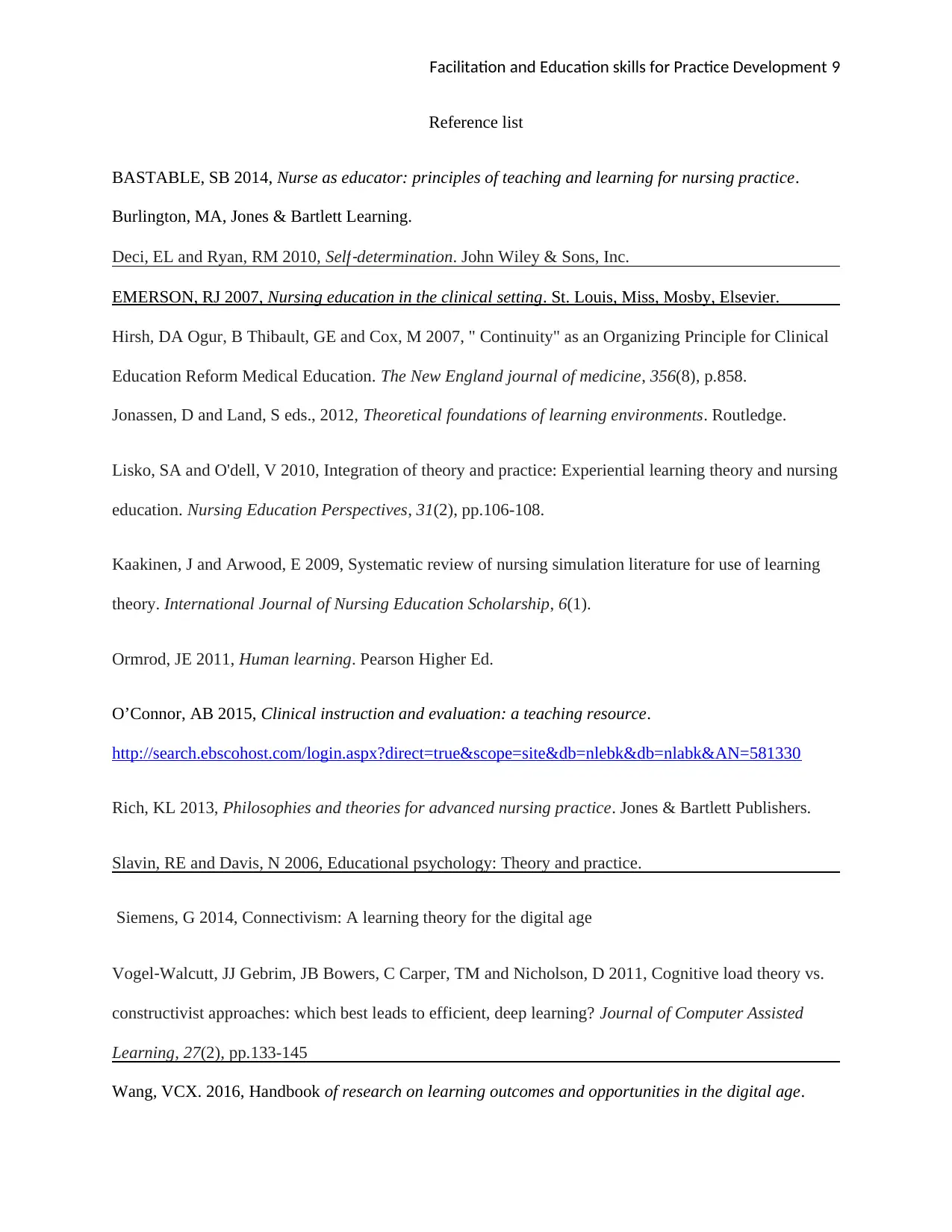
Reference list
BASTABLE, SB 2014, Nurse as educator: principles of teaching and learning for nursing practice.
Burlington, MA, Jones & Bartlett Learning.
Deci, EL and Ryan, RM 2010, Self
‐determination. John Wiley & Sons, Inc.
EMERSON, RJ 2007, Nursing education in the clinical setting. St. Louis, Miss, Mosby, Elsevier.
Hirsh, DA Ogur, B Thibault, GE and Cox, M 2007, " Continuity" as an Organizing Principle for Clinical
Education Reform Medical Education. The New England journal of medicine, 356(8), p.858.
Jonassen, D and Land, S eds., 2012, Theoretical foundations of learning environments. Routledge.
Lisko, SA and O'dell, V 2010, Integration of theory and practice: Experiential learning theory and nursing
education. Nursing Education Perspectives, 31(2), pp.106-108.
Kaakinen, J and Arwood, E 2009, Systematic review of nursing simulation literature for use of learning
theory. International Journal of Nursing Education Scholarship, 6(1).
Ormrod, JE 2011, Human learning. Pearson Higher Ed.
O’Connor, AB 2015, Clinical instruction and evaluation: a teaching resource.
http://search.ebscohost.com/login.aspx?direct=true&scope=site&db=nlebk&db=nlabk&AN=581330
Rich, KL 2013, Philosophies and theories for advanced nursing practice. Jones & Bartlett Publishers.
Slavin, RE and Davis, N 2006, Educational psychology: Theory and practice.
Siemens, G 2014, Connectivism: A learning theory for the digital age
Vogel‐Walcutt, JJ Gebrim, JB Bowers, C Carper, TM and Nicholson, D 2011, Cognitive load theory vs.
constructivist approaches: which best leads to efficient, deep learning? Journal of Computer Assisted
Learning, 27(2), pp.133-145
Wang, VCX. 2016, Handbook of research on learning outcomes and opportunities in the digital age.
Reference list
BASTABLE, SB 2014, Nurse as educator: principles of teaching and learning for nursing practice.
Burlington, MA, Jones & Bartlett Learning.
Deci, EL and Ryan, RM 2010, Self
‐determination. John Wiley & Sons, Inc.
EMERSON, RJ 2007, Nursing education in the clinical setting. St. Louis, Miss, Mosby, Elsevier.
Hirsh, DA Ogur, B Thibault, GE and Cox, M 2007, " Continuity" as an Organizing Principle for Clinical
Education Reform Medical Education. The New England journal of medicine, 356(8), p.858.
Jonassen, D and Land, S eds., 2012, Theoretical foundations of learning environments. Routledge.
Lisko, SA and O'dell, V 2010, Integration of theory and practice: Experiential learning theory and nursing
education. Nursing Education Perspectives, 31(2), pp.106-108.
Kaakinen, J and Arwood, E 2009, Systematic review of nursing simulation literature for use of learning
theory. International Journal of Nursing Education Scholarship, 6(1).
Ormrod, JE 2011, Human learning. Pearson Higher Ed.
O’Connor, AB 2015, Clinical instruction and evaluation: a teaching resource.
http://search.ebscohost.com/login.aspx?direct=true&scope=site&db=nlebk&db=nlabk&AN=581330
Rich, KL 2013, Philosophies and theories for advanced nursing practice. Jones & Bartlett Publishers.
Slavin, RE and Davis, N 2006, Educational psychology: Theory and practice.
Siemens, G 2014, Connectivism: A learning theory for the digital age
Vogel‐Walcutt, JJ Gebrim, JB Bowers, C Carper, TM and Nicholson, D 2011, Cognitive load theory vs.
constructivist approaches: which best leads to efficient, deep learning? Journal of Computer Assisted
Learning, 27(2), pp.133-145
Wang, VCX. 2016, Handbook of research on learning outcomes and opportunities in the digital age.
⊘ This is a preview!⊘
Do you want full access?
Subscribe today to unlock all pages.
Trusted by 1+ million students worldwide
Facilitation and Education skills for Practice Development 10
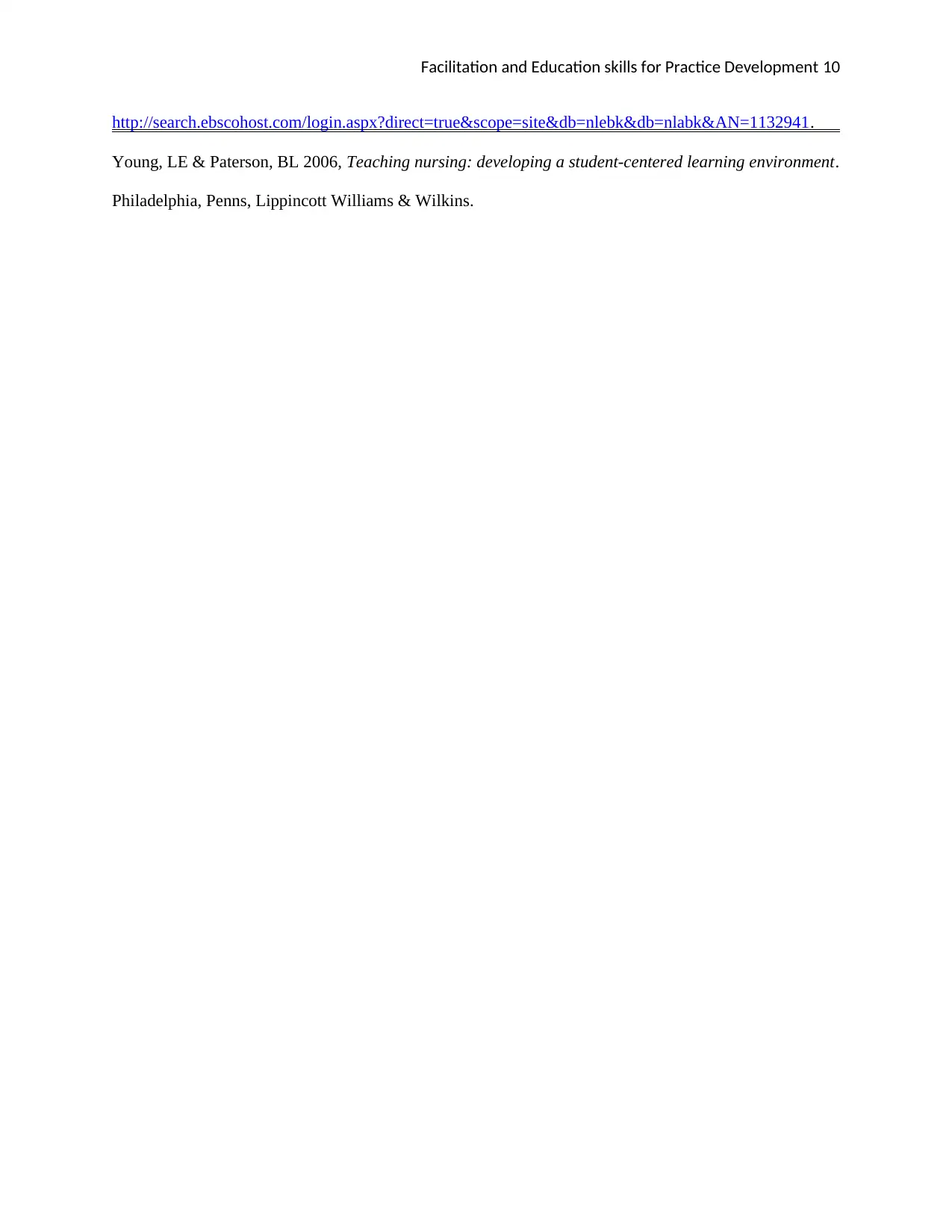
http://search.ebscohost.com/login.aspx?direct=true&scope=site&db=nlebk&db=nlabk&AN=1132941.
Young, LE & Paterson, BL 2006, Teaching nursing: developing a student-centered learning environment.
Philadelphia, Penns, Lippincott Williams & Wilkins.
http://search.ebscohost.com/login.aspx?direct=true&scope=site&db=nlebk&db=nlabk&AN=1132941.
Young, LE & Paterson, BL 2006, Teaching nursing: developing a student-centered learning environment.
Philadelphia, Penns, Lippincott Williams & Wilkins.

1 out of 10


Related Documents


Your All-in-One AI-Powered Toolkit for Academic Success.
+13062052269
info@desklib.com
Available 24*7 on WhatsApp / Email
![[object Object]](/_next/static/media/star-bottom.7253800d.svg)
Unlock your academic potential
Copyright © 2020–2026 A2Z Services. All Rights Reserved. Developed and managed by ZUCOL.