CHC50113 Diploma - Educator's Guide: Gathering Info & Relationships
VerifiedAdded on 2023/06/13
|33
|9445
|131
Practical Assignment
AI Summary
This assignment focuses on the crucial role of educators in gathering information about children from parents/guardians through methods like enrollment forms and open communication, detailing how this information is then used to support the child's education and care. It highlights the importance of communicating with parents through various channels, including phone calls, emails, and meetings, to understand the child's needs, interests, and daily routines. Furthermore, the assignment explores strategies for developing and supporting educator-child relationships, such as orientation days, positive reinforcement, and individualized care plans, with specific examples provided through child information sheets completed by families, focusing on areas like sleep routines, self-help skills, and play preferences. This resource, contributed by a student, provides valuable insights and practical examples for educators in early childhood education and care, with more solved assignments and resources available on Desklib.
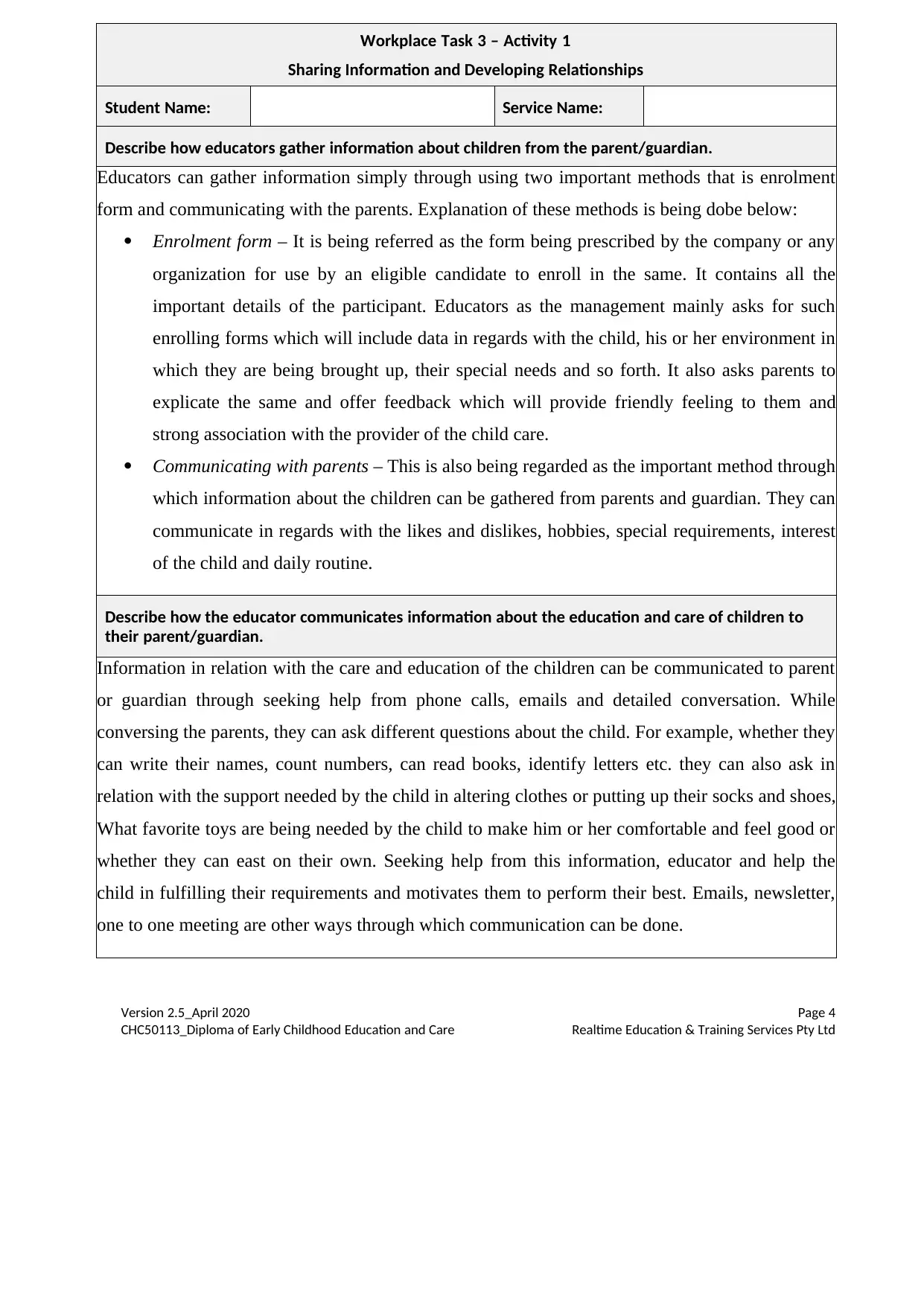
Workplace Task 3 – Activity 1
Sharing Information and Developing Relationships
Student Name: Service Name:
Describe how educators gather information about children from the parent/guardian.
Educators can gather information simply through using two important methods that is enrolment
form and communicating with the parents. Explanation of these methods is being dobe below:
Enrolment form – It is being referred as the form being prescribed by the company or any
organization for use by an eligible candidate to enroll in the same. It contains all the
important details of the participant. Educators as the management mainly asks for such
enrolling forms which will include data in regards with the child, his or her environment in
which they are being brought up, their special needs and so forth. It also asks parents to
explicate the same and offer feedback which will provide friendly feeling to them and
strong association with the provider of the child care.
Communicating with parents – This is also being regarded as the important method through
which information about the children can be gathered from parents and guardian. They can
communicate in regards with the likes and dislikes, hobbies, special requirements, interest
of the child and daily routine.
Describe how the educator communicates information about the education and care of children to
their parent/guardian.
Information in relation with the care and education of the children can be communicated to parent
or guardian through seeking help from phone calls, emails and detailed conversation. While
conversing the parents, they can ask different questions about the child. For example, whether they
can write their names, count numbers, can read books, identify letters etc. they can also ask in
relation with the support needed by the child in altering clothes or putting up their socks and shoes,
What favorite toys are being needed by the child to make him or her comfortable and feel good or
whether they can east on their own. Seeking help from this information, educator and help the
child in fulfilling their requirements and motivates them to perform their best. Emails, newsletter,
one to one meeting are other ways through which communication can be done.
Version 2.5_April 2020 Page 4
CHC50113_Diploma of Early Childhood Education and Care Realtime Education & Training Services Pty Ltd
Sharing Information and Developing Relationships
Student Name: Service Name:
Describe how educators gather information about children from the parent/guardian.
Educators can gather information simply through using two important methods that is enrolment
form and communicating with the parents. Explanation of these methods is being dobe below:
Enrolment form – It is being referred as the form being prescribed by the company or any
organization for use by an eligible candidate to enroll in the same. It contains all the
important details of the participant. Educators as the management mainly asks for such
enrolling forms which will include data in regards with the child, his or her environment in
which they are being brought up, their special needs and so forth. It also asks parents to
explicate the same and offer feedback which will provide friendly feeling to them and
strong association with the provider of the child care.
Communicating with parents – This is also being regarded as the important method through
which information about the children can be gathered from parents and guardian. They can
communicate in regards with the likes and dislikes, hobbies, special requirements, interest
of the child and daily routine.
Describe how the educator communicates information about the education and care of children to
their parent/guardian.
Information in relation with the care and education of the children can be communicated to parent
or guardian through seeking help from phone calls, emails and detailed conversation. While
conversing the parents, they can ask different questions about the child. For example, whether they
can write their names, count numbers, can read books, identify letters etc. they can also ask in
relation with the support needed by the child in altering clothes or putting up their socks and shoes,
What favorite toys are being needed by the child to make him or her comfortable and feel good or
whether they can east on their own. Seeking help from this information, educator and help the
child in fulfilling their requirements and motivates them to perform their best. Emails, newsletter,
one to one meeting are other ways through which communication can be done.
Version 2.5_April 2020 Page 4
CHC50113_Diploma of Early Childhood Education and Care Realtime Education & Training Services Pty Ltd

Paraphrase This Document
Need a fresh take? Get an instant paraphrase of this document with our AI Paraphraser
CHC50113_CHCECE003_Provide Care for Children_Learner Assessment
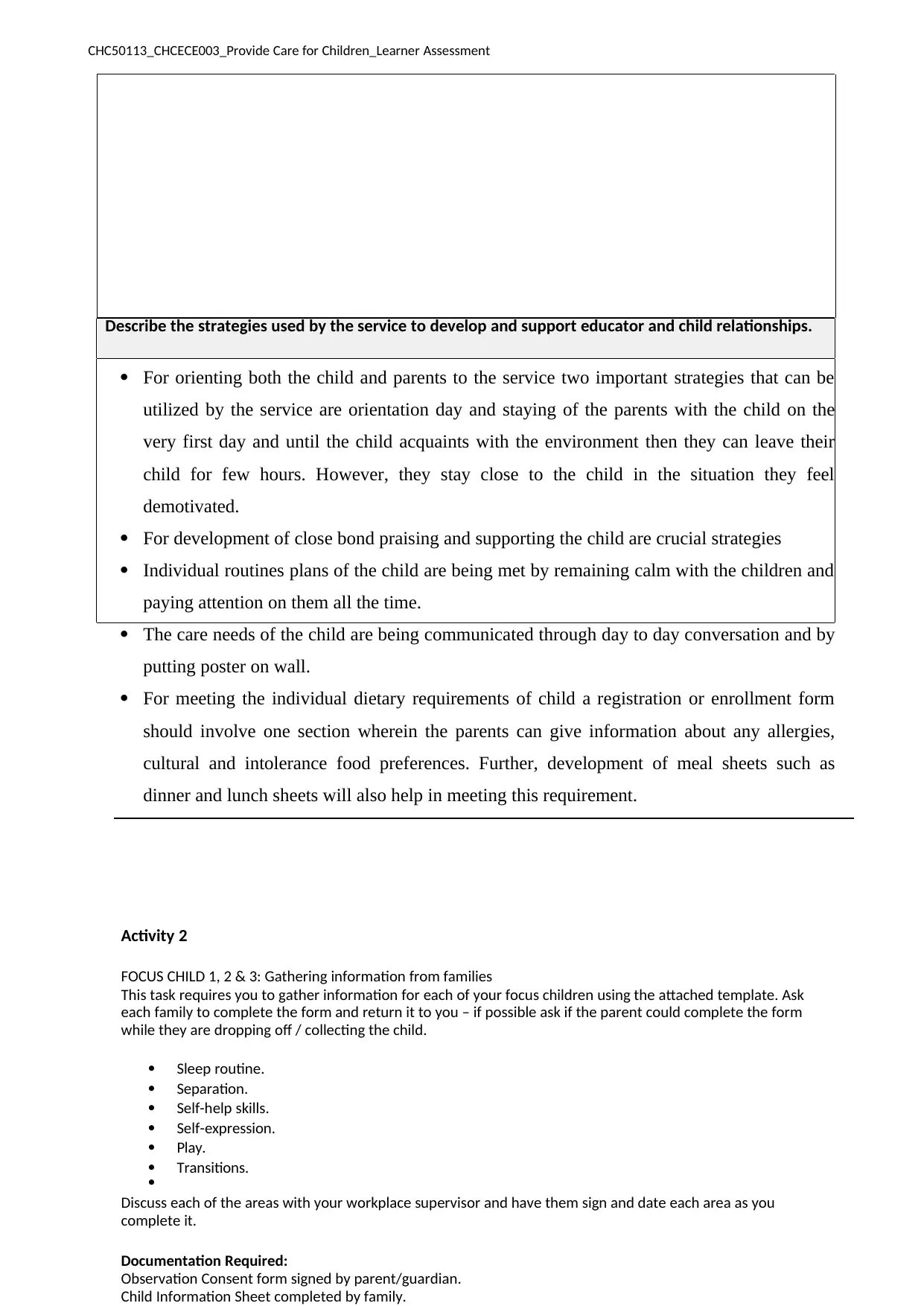
Describe the strategies used by the service to develop and support educator and child relationships.
For orienting both the child and parents to the service two important strategies that can be
utilized by the service are orientation day and staying of the parents with the child on the
very first day and until the child acquaints with the environment then they can leave their
child for few hours. However, they stay close to the child in the situation they feel
demotivated.
For development of close bond praising and supporting the child are crucial strategies
Individual routines plans of the child are being met by remaining calm with the children and
paying attention on them all the time.
The care needs of the child are being communicated through day to day conversation and by
putting poster on wall.
For meeting the individual dietary requirements of child a registration or enrollment form
should involve one section wherein the parents can give information about any allergies,
cultural and intolerance food preferences. Further, development of meal sheets such as
dinner and lunch sheets will also help in meeting this requirement.
Activity 2
FOCUS CHILD 1, 2 & 3: Gathering information from families
This task requires you to gather information for each of your focus children using the attached template. Ask
each family to complete the form and return it to you – if possible ask if the parent could complete the form
while they are dropping off / collecting the child.
Sleep routine.
Separation.
Self-help skills.
Self-expression.
Play.
Transitions.
Discuss each of the areas with your workplace supervisor and have them sign and date each area as you
complete it.
Documentation Required:
Observation Consent form signed by parent/guardian.
Child Information Sheet completed by family.
Describe the strategies used by the service to develop and support educator and child relationships.
For orienting both the child and parents to the service two important strategies that can be
utilized by the service are orientation day and staying of the parents with the child on the
very first day and until the child acquaints with the environment then they can leave their
child for few hours. However, they stay close to the child in the situation they feel
demotivated.
For development of close bond praising and supporting the child are crucial strategies
Individual routines plans of the child are being met by remaining calm with the children and
paying attention on them all the time.
The care needs of the child are being communicated through day to day conversation and by
putting poster on wall.
For meeting the individual dietary requirements of child a registration or enrollment form
should involve one section wherein the parents can give information about any allergies,
cultural and intolerance food preferences. Further, development of meal sheets such as
dinner and lunch sheets will also help in meeting this requirement.
Activity 2
FOCUS CHILD 1, 2 & 3: Gathering information from families
This task requires you to gather information for each of your focus children using the attached template. Ask
each family to complete the form and return it to you – if possible ask if the parent could complete the form
while they are dropping off / collecting the child.
Sleep routine.
Separation.
Self-help skills.
Self-expression.
Play.
Transitions.
Discuss each of the areas with your workplace supervisor and have them sign and date each area as you
complete it.
Documentation Required:
Observation Consent form signed by parent/guardian.
Child Information Sheet completed by family.

Document your answers on the ‘Child Information Sheet’ template.
Version 2.5_April 2020 Page 5
CHC50113_Diploma of Early Childhood Education and Care Realtime Education & Training Services Pty Ltd
Version 2.5_April 2020 Page 5
CHC50113_Diploma of Early Childhood Education and Care Realtime Education & Training Services Pty Ltd
⊘ This is a preview!⊘
Do you want full access?
Subscribe today to unlock all pages.

Trusted by 1+ million students worldwide
CHC50113_CHCECE003_Provide Care for Children_Learner Assessment
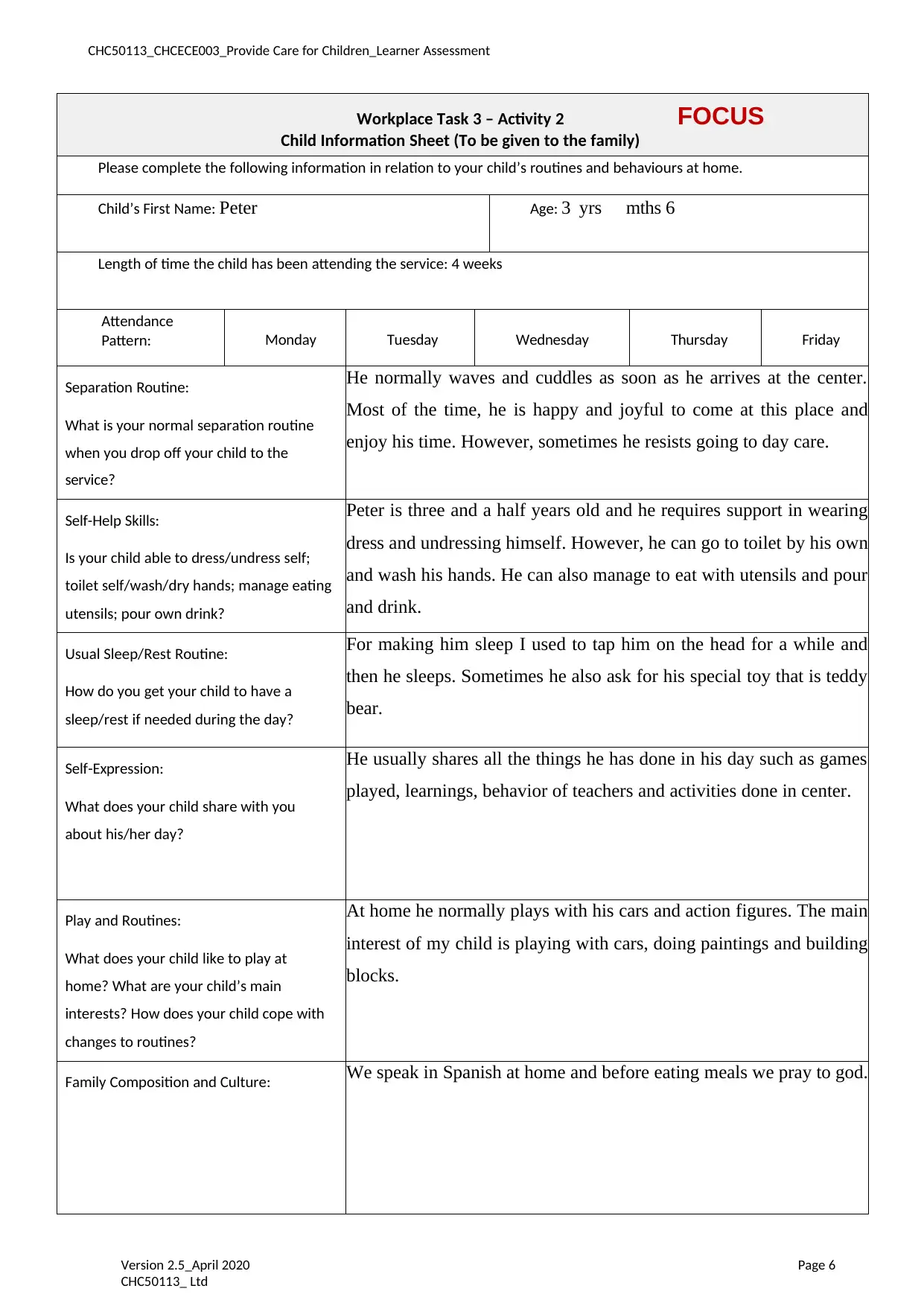
Workplace Task 3 – Activity 2 FOCUS
Child Information Sheet (To be given to the family)
Please complete the following information in relation to your child’s routines and behaviours at home.
Child’s First Name: Peter Age: 3 yrs mths 6
Length of time the child has been attending the service: 4 weeks
Attendance
Pattern: Monday Tuesday Wednesday Thursday Friday
Separation Routine:
What is your normal separation routine
when you drop off your child to the
service?
He normally waves and cuddles as soon as he arrives at the center.
Most of the time, he is happy and joyful to come at this place and
enjoy his time. However, sometimes he resists going to day care.
Self-Help Skills:
Is your child able to dress/undress self;
toilet self/wash/dry hands; manage eating
utensils; pour own drink?
Peter is three and a half years old and he requires support in wearing
dress and undressing himself. However, he can go to toilet by his own
and wash his hands. He can also manage to eat with utensils and pour
and drink.
Usual Sleep/Rest Routine:
How do you get your child to have a
sleep/rest if needed during the day?
For making him sleep I used to tap him on the head for a while and
then he sleeps. Sometimes he also ask for his special toy that is teddy
bear.
Self-Expression:
What does your child share with you
about his/her day?
He usually shares all the things he has done in his day such as games
played, learnings, behavior of teachers and activities done in center.
Play and Routines:
What does your child like to play at
home? What are your child’s main
interests? How does your child cope with
changes to routines?
At home he normally plays with his cars and action figures. The main
interest of my child is playing with cars, doing paintings and building
blocks.
Family Composition and Culture: We speak in Spanish at home and before eating meals we pray to god.
Version 2.5_April 2020 Page 6
CHC50113_ Ltd
Workplace Task 3 – Activity 2 FOCUS
Child Information Sheet (To be given to the family)
Please complete the following information in relation to your child’s routines and behaviours at home.
Child’s First Name: Peter Age: 3 yrs mths 6
Length of time the child has been attending the service: 4 weeks
Attendance
Pattern: Monday Tuesday Wednesday Thursday Friday
Separation Routine:
What is your normal separation routine
when you drop off your child to the
service?
He normally waves and cuddles as soon as he arrives at the center.
Most of the time, he is happy and joyful to come at this place and
enjoy his time. However, sometimes he resists going to day care.
Self-Help Skills:
Is your child able to dress/undress self;
toilet self/wash/dry hands; manage eating
utensils; pour own drink?
Peter is three and a half years old and he requires support in wearing
dress and undressing himself. However, he can go to toilet by his own
and wash his hands. He can also manage to eat with utensils and pour
and drink.
Usual Sleep/Rest Routine:
How do you get your child to have a
sleep/rest if needed during the day?
For making him sleep I used to tap him on the head for a while and
then he sleeps. Sometimes he also ask for his special toy that is teddy
bear.
Self-Expression:
What does your child share with you
about his/her day?
He usually shares all the things he has done in his day such as games
played, learnings, behavior of teachers and activities done in center.
Play and Routines:
What does your child like to play at
home? What are your child’s main
interests? How does your child cope with
changes to routines?
At home he normally plays with his cars and action figures. The main
interest of my child is playing with cars, doing paintings and building
blocks.
Family Composition and Culture: We speak in Spanish at home and before eating meals we pray to god.
Version 2.5_April 2020 Page 6
CHC50113_ Ltd
Paraphrase This Document
Need a fresh take? Get an instant paraphrase of this document with our AI Paraphraser
CHC50113_CHCECE003_Provide Care for Children_Learner Assessment
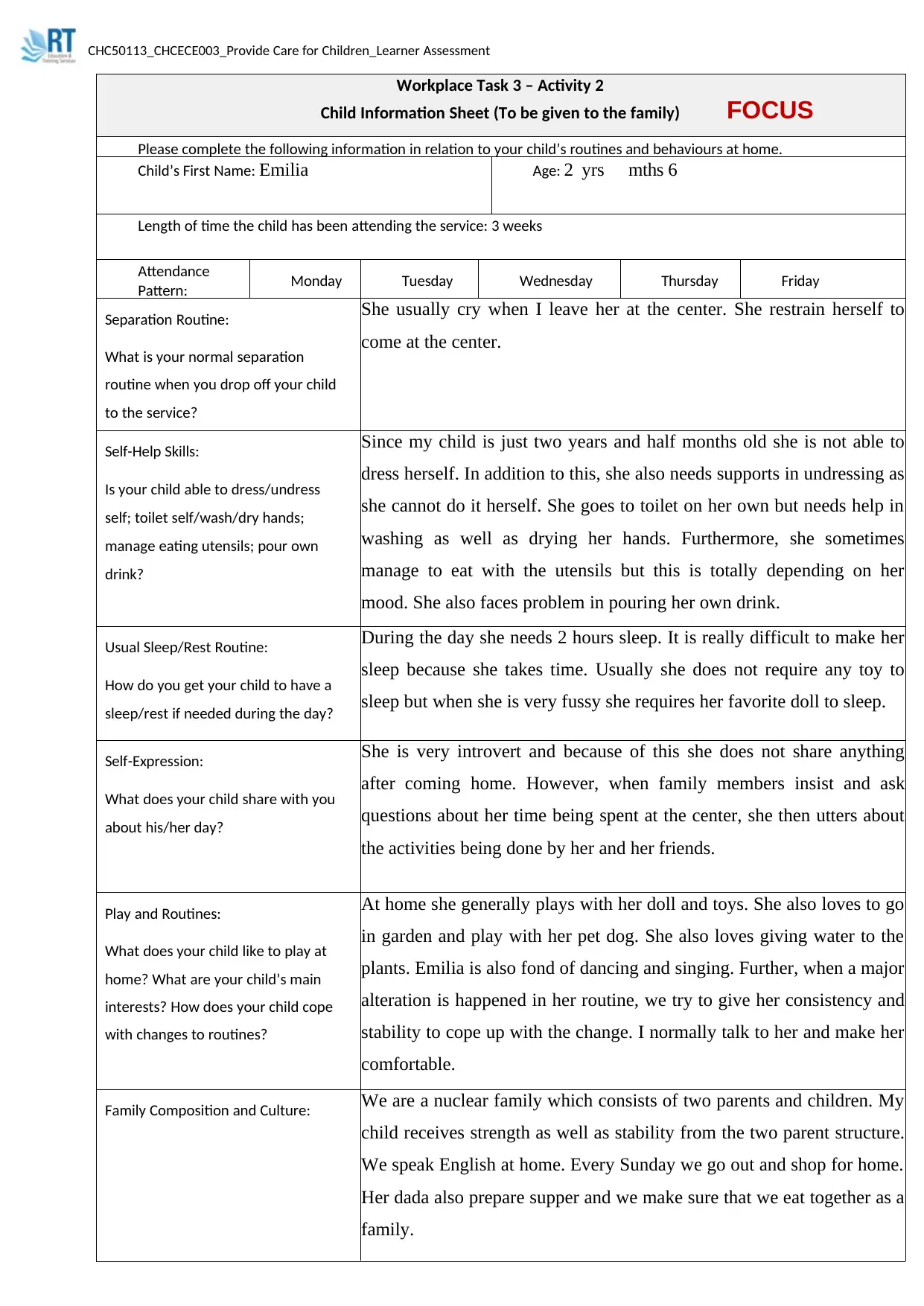
Workplace Task 3 – Activity 2
Child Information Sheet (To be given to the family) FOCUS
Please complete the following information in relation to your child’s routines and behaviours at home.
Child’s First Name: Emilia Age: 2 yrs mths 6
Length of time the child has been attending the service: 3 weeks
Attendance
Pattern: Monday Tuesday Wednesday Thursday Friday
Separation Routine:
What is your normal separation
routine when you drop off your child
to the service?
She usually cry when I leave her at the center. She restrain herself to
come at the center.
Self-Help Skills:
Is your child able to dress/undress
self; toilet self/wash/dry hands;
manage eating utensils; pour own
drink?
Since my child is just two years and half months old she is not able to
dress herself. In addition to this, she also needs supports in undressing as
she cannot do it herself. She goes to toilet on her own but needs help in
washing as well as drying her hands. Furthermore, she sometimes
manage to eat with the utensils but this is totally depending on her
mood. She also faces problem in pouring her own drink.
Usual Sleep/Rest Routine:
How do you get your child to have a
sleep/rest if needed during the day?
During the day she needs 2 hours sleep. It is really difficult to make her
sleep because she takes time. Usually she does not require any toy to
sleep but when she is very fussy she requires her favorite doll to sleep.
Self-Expression:
What does your child share with you
about his/her day?
She is very introvert and because of this she does not share anything
after coming home. However, when family members insist and ask
questions about her time being spent at the center, she then utters about
the activities being done by her and her friends.
Play and Routines:
What does your child like to play at
home? What are your child’s main
interests? How does your child cope
with changes to routines?
At home she generally plays with her doll and toys. She also loves to go
in garden and play with her pet dog. She also loves giving water to the
plants. Emilia is also fond of dancing and singing. Further, when a major
alteration is happened in her routine, we try to give her consistency and
stability to cope up with the change. I normally talk to her and make her
comfortable.
Family Composition and Culture: We are a nuclear family which consists of two parents and children. My
child receives strength as well as stability from the two parent structure.
We speak English at home. Every Sunday we go out and shop for home.
Her dada also prepare supper and we make sure that we eat together as a
family.
Workplace Task 3 – Activity 2
Child Information Sheet (To be given to the family) FOCUS
Please complete the following information in relation to your child’s routines and behaviours at home.
Child’s First Name: Emilia Age: 2 yrs mths 6
Length of time the child has been attending the service: 3 weeks
Attendance
Pattern: Monday Tuesday Wednesday Thursday Friday
Separation Routine:
What is your normal separation
routine when you drop off your child
to the service?
She usually cry when I leave her at the center. She restrain herself to
come at the center.
Self-Help Skills:
Is your child able to dress/undress
self; toilet self/wash/dry hands;
manage eating utensils; pour own
drink?
Since my child is just two years and half months old she is not able to
dress herself. In addition to this, she also needs supports in undressing as
she cannot do it herself. She goes to toilet on her own but needs help in
washing as well as drying her hands. Furthermore, she sometimes
manage to eat with the utensils but this is totally depending on her
mood. She also faces problem in pouring her own drink.
Usual Sleep/Rest Routine:
How do you get your child to have a
sleep/rest if needed during the day?
During the day she needs 2 hours sleep. It is really difficult to make her
sleep because she takes time. Usually she does not require any toy to
sleep but when she is very fussy she requires her favorite doll to sleep.
Self-Expression:
What does your child share with you
about his/her day?
She is very introvert and because of this she does not share anything
after coming home. However, when family members insist and ask
questions about her time being spent at the center, she then utters about
the activities being done by her and her friends.
Play and Routines:
What does your child like to play at
home? What are your child’s main
interests? How does your child cope
with changes to routines?
At home she generally plays with her doll and toys. She also loves to go
in garden and play with her pet dog. She also loves giving water to the
plants. Emilia is also fond of dancing and singing. Further, when a major
alteration is happened in her routine, we try to give her consistency and
stability to cope up with the change. I normally talk to her and make her
comfortable.
Family Composition and Culture: We are a nuclear family which consists of two parents and children. My
child receives strength as well as stability from the two parent structure.
We speak English at home. Every Sunday we go out and shop for home.
Her dada also prepare supper and we make sure that we eat together as a
family.

Version 2.5_April 2020 Page 7
CHC50113_Diploma of Early Childhood Education and Care Realtime Education & Training Services Pty Ltd
CHC50113_Diploma of Early Childhood Education and Care Realtime Education & Training Services Pty Ltd
⊘ This is a preview!⊘
Do you want full access?
Subscribe today to unlock all pages.
Trusted by 1+ million students worldwide
CHC50113_CHCECE003_Provide Care for Children_Learner Assessment
Workplace Task 3 – Activity 2
Child Information Sheet (To be given to the family) FOCUS
Please complete the following information in relation to your child’s routines and behaviours at home.
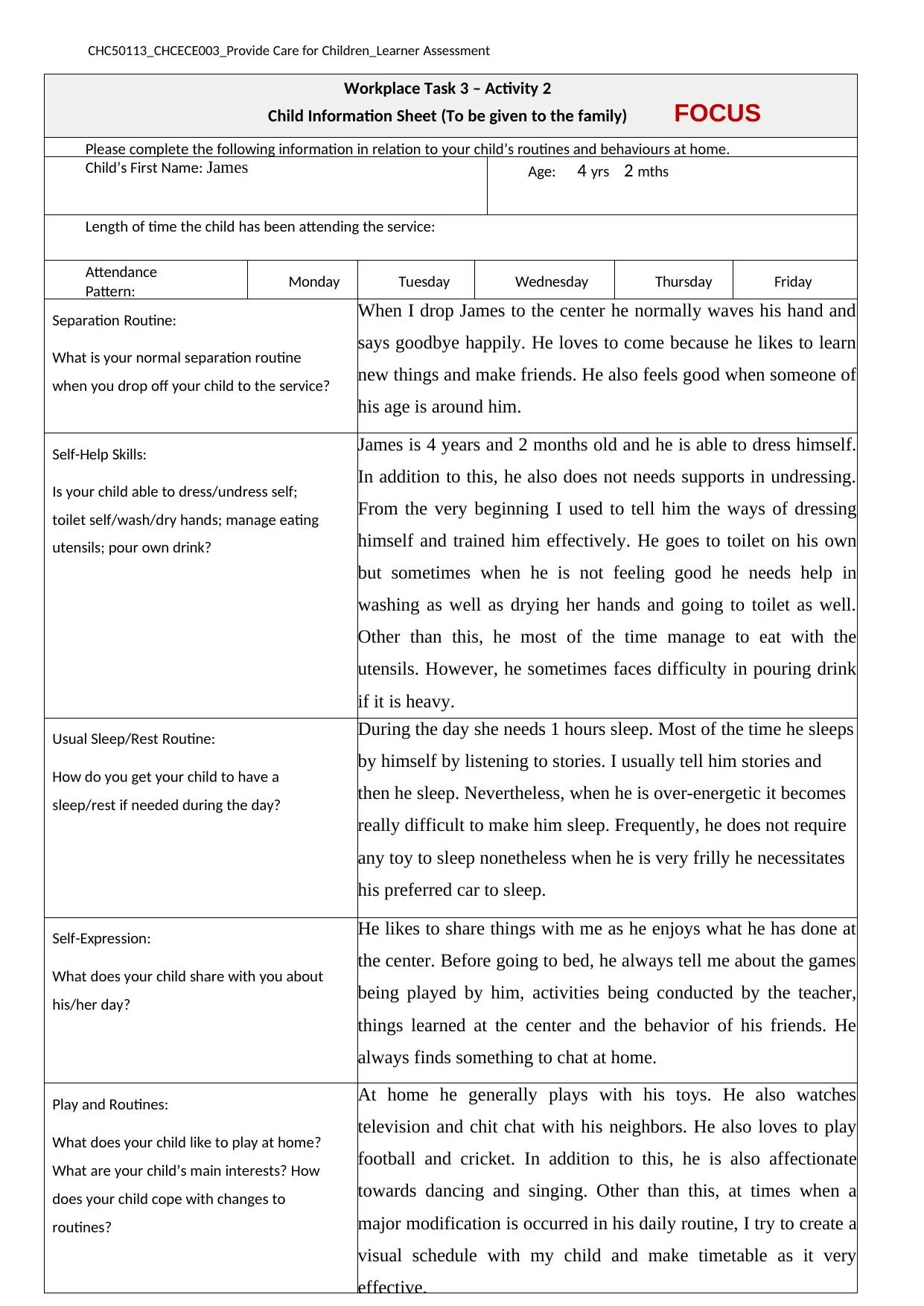
Child’s First Name: James Age: 4 yrs 2 mths
Length of time the child has been attending the service:
Attendance
Pattern: Monday Tuesday Wednesday Thursday Friday
Separation Routine:
What is your normal separation routine
when you drop off your child to the service?
When I drop James to the center he normally waves his hand and
says goodbye happily. He loves to come because he likes to learn
new things and make friends. He also feels good when someone of
his age is around him.
Self-Help Skills:
Is your child able to dress/undress self;
toilet self/wash/dry hands; manage eating
utensils; pour own drink?
James is 4 years and 2 months old and he is able to dress himself.
In addition to this, he also does not needs supports in undressing.
From the very beginning I used to tell him the ways of dressing
himself and trained him effectively. He goes to toilet on his own
but sometimes when he is not feeling good he needs help in
washing as well as drying her hands and going to toilet as well.
Other than this, he most of the time manage to eat with the
utensils. However, he sometimes faces difficulty in pouring drink
if it is heavy.
Usual Sleep/Rest Routine:
How do you get your child to have a
sleep/rest if needed during the day?
During the day she needs 1 hours sleep. Most of the time he sleeps
by himself by listening to stories. I usually tell him stories and
then he sleep. Nevertheless, when he is over-energetic it becomes
really difficult to make him sleep. Frequently, he does not require
any toy to sleep nonetheless when he is very frilly he necessitates
his preferred car to sleep.
Self-Expression:
What does your child share with you about
his/her day?
He likes to share things with me as he enjoys what he has done at
the center. Before going to bed, he always tell me about the games
being played by him, activities being conducted by the teacher,
things learned at the center and the behavior of his friends. He
always finds something to chat at home.
Play and Routines:
What does your child like to play at home?
What are your child’s main interests? How
does your child cope with changes to
routines?
At home he generally plays with his toys. He also watches
television and chit chat with his neighbors. He also loves to play
football and cricket. In addition to this, he is also affectionate
towards dancing and singing. Other than this, at times when a
major modification is occurred in his daily routine, I try to create a
visual schedule with my child and make timetable as it very
effective.
Workplace Task 3 – Activity 2
Child Information Sheet (To be given to the family) FOCUS
Please complete the following information in relation to your child’s routines and behaviours at home.
Child’s First Name: James Age: 4 yrs 2 mths
Length of time the child has been attending the service:
Attendance
Pattern: Monday Tuesday Wednesday Thursday Friday
Separation Routine:
What is your normal separation routine
when you drop off your child to the service?
When I drop James to the center he normally waves his hand and
says goodbye happily. He loves to come because he likes to learn
new things and make friends. He also feels good when someone of
his age is around him.
Self-Help Skills:
Is your child able to dress/undress self;
toilet self/wash/dry hands; manage eating
utensils; pour own drink?
James is 4 years and 2 months old and he is able to dress himself.
In addition to this, he also does not needs supports in undressing.
From the very beginning I used to tell him the ways of dressing
himself and trained him effectively. He goes to toilet on his own
but sometimes when he is not feeling good he needs help in
washing as well as drying her hands and going to toilet as well.
Other than this, he most of the time manage to eat with the
utensils. However, he sometimes faces difficulty in pouring drink
if it is heavy.
Usual Sleep/Rest Routine:
How do you get your child to have a
sleep/rest if needed during the day?
During the day she needs 1 hours sleep. Most of the time he sleeps
by himself by listening to stories. I usually tell him stories and
then he sleep. Nevertheless, when he is over-energetic it becomes
really difficult to make him sleep. Frequently, he does not require
any toy to sleep nonetheless when he is very frilly he necessitates
his preferred car to sleep.
Self-Expression:
What does your child share with you about
his/her day?
He likes to share things with me as he enjoys what he has done at
the center. Before going to bed, he always tell me about the games
being played by him, activities being conducted by the teacher,
things learned at the center and the behavior of his friends. He
always finds something to chat at home.
Play and Routines:
What does your child like to play at home?
What are your child’s main interests? How
does your child cope with changes to
routines?
At home he generally plays with his toys. He also watches
television and chit chat with his neighbors. He also loves to play
football and cricket. In addition to this, he is also affectionate
towards dancing and singing. Other than this, at times when a
major modification is occurred in his daily routine, I try to create a
visual schedule with my child and make timetable as it very
effective.
Paraphrase This Document
Need a fresh take? Get an instant paraphrase of this document with our AI Paraphraser

Family Composition and Culture: We are a single parent family and involves only me and my child.
We speak English at home. We both are very close to each and
find our ways of enjoyment on every Fridays and Sundays. We go
out for shopping. We prepare supper together and on every
Monday we always have a family get together.
Version 2.5_April 2020 Page 8
CHC50113_Diploma of Early Childhood Education and Care Realtime Education & Training Services Pty Ltd
We speak English at home. We both are very close to each and
find our ways of enjoyment on every Fridays and Sundays. We go
out for shopping. We prepare supper together and on every
Monday we always have a family get together.
Version 2.5_April 2020 Page 8
CHC50113_Diploma of Early Childhood Education and Care Realtime Education & Training Services Pty Ltd
CHC50113_CHCECE003_Provide Care for Children_Learner Assessment
Activity 3
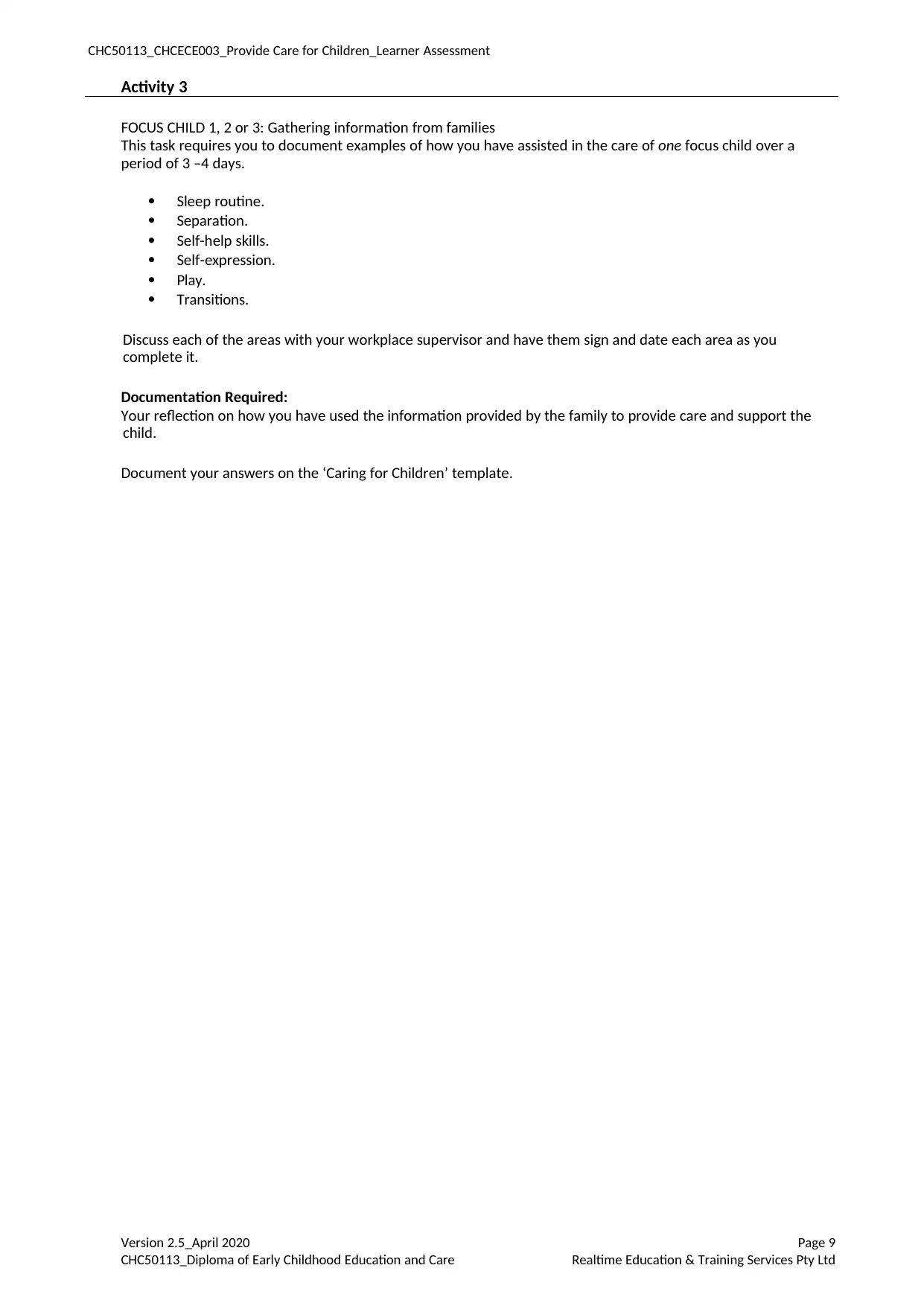
FOCUS CHILD 1, 2 or 3: Gathering information from families
This task requires you to document examples of how you have assisted in the care of one focus child over a
period of 3 –4 days.
Sleep routine.
Separation.
Self-help skills.
Self-expression.
Play.
Transitions.
Discuss each of the areas with your workplace supervisor and have them sign and date each area as you
complete it.
Documentation Required:
Your reflection on how you have used the information provided by the family to provide care and support the
child.
Document your answers on the ‘Caring for Children’ template.
Version 2.5_April 2020 Page 9
CHC50113_Diploma of Early Childhood Education and Care Realtime Education & Training Services Pty Ltd
Activity 3
FOCUS CHILD 1, 2 or 3: Gathering information from families
This task requires you to document examples of how you have assisted in the care of one focus child over a
period of 3 –4 days.
Sleep routine.
Separation.
Self-help skills.
Self-expression.
Play.
Transitions.
Discuss each of the areas with your workplace supervisor and have them sign and date each area as you
complete it.
Documentation Required:
Your reflection on how you have used the information provided by the family to provide care and support the
child.
Document your answers on the ‘Caring for Children’ template.
Version 2.5_April 2020 Page 9
CHC50113_Diploma of Early Childhood Education and Care Realtime Education & Training Services Pty Ltd
⊘ This is a preview!⊘
Do you want full access?
Subscribe today to unlock all pages.
Trusted by 1+ million students worldwide
CHC50113_CHCECE003_Provide Care for Children_Learner Assessment
Workplace Task 3 – Activity 3
Caring for Children FOCUS CHILD: 1, 2 or 3
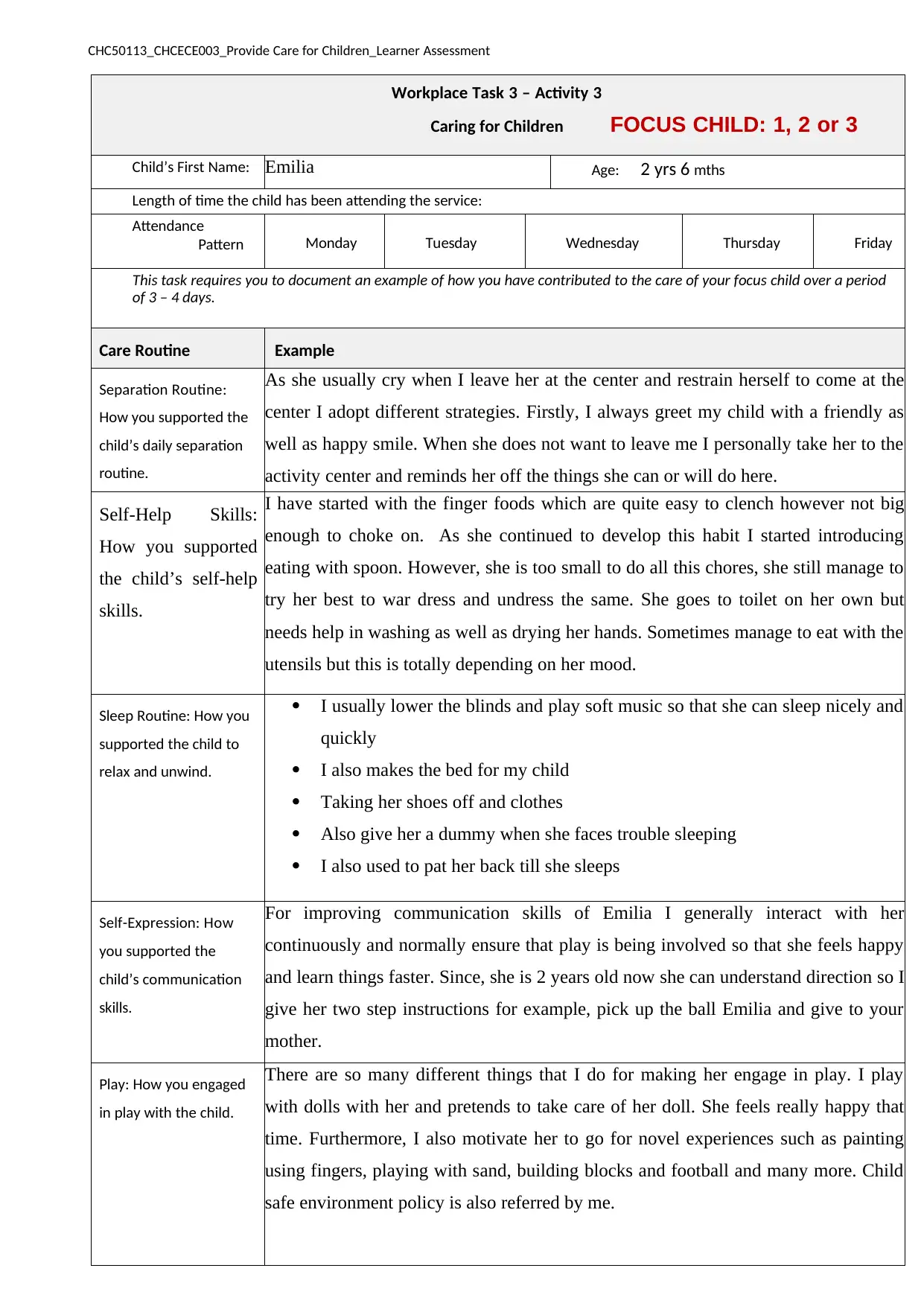
Child’s First Name: Emilia Age: 2 yrs 6 mths
Length of time the child has been attending the service:
Attendance
Pattern Monday Tuesday Wednesday Thursday Friday
This task requires you to document an example of how you have contributed to the care of your focus child over a period
of 3 – 4 days.
Care Routine Example
Separation Routine:
How you supported the
child’s daily separation
routine.
As she usually cry when I leave her at the center and restrain herself to come at the
center I adopt different strategies. Firstly, I always greet my child with a friendly as
well as happy smile. When she does not want to leave me I personally take her to the
activity center and reminds her off the things she can or will do here.
Self-Help Skills:
How you supported
the child’s self-help
skills.
I have started with the finger foods which are quite easy to clench however not big
enough to choke on. As she continued to develop this habit I started introducing
eating with spoon. However, she is too small to do all this chores, she still manage to
try her best to war dress and undress the same. She goes to toilet on her own but
needs help in washing as well as drying her hands. Sometimes manage to eat with the
utensils but this is totally depending on her mood.
Sleep Routine: How you
supported the child to
relax and unwind.
I usually lower the blinds and play soft music so that she can sleep nicely and
quickly
I also makes the bed for my child
Taking her shoes off and clothes
Also give her a dummy when she faces trouble sleeping
I also used to pat her back till she sleeps
Self-Expression: How
you supported the
child’s communication
skills.
For improving communication skills of Emilia I generally interact with her
continuously and normally ensure that play is being involved so that she feels happy
and learn things faster. Since, she is 2 years old now she can understand direction so I
give her two step instructions for example, pick up the ball Emilia and give to your
mother.
Play: How you engaged
in play with the child.
There are so many different things that I do for making her engage in play. I play
with dolls with her and pretends to take care of her doll. She feels really happy that
time. Furthermore, I also motivate her to go for novel experiences such as painting
using fingers, playing with sand, building blocks and football and many more. Child
safe environment policy is also referred by me.
Workplace Task 3 – Activity 3
Caring for Children FOCUS CHILD: 1, 2 or 3
Child’s First Name: Emilia Age: 2 yrs 6 mths
Length of time the child has been attending the service:
Attendance
Pattern Monday Tuesday Wednesday Thursday Friday
This task requires you to document an example of how you have contributed to the care of your focus child over a period
of 3 – 4 days.
Care Routine Example
Separation Routine:
How you supported the
child’s daily separation
routine.
As she usually cry when I leave her at the center and restrain herself to come at the
center I adopt different strategies. Firstly, I always greet my child with a friendly as
well as happy smile. When she does not want to leave me I personally take her to the
activity center and reminds her off the things she can or will do here.
Self-Help Skills:
How you supported
the child’s self-help
skills.
I have started with the finger foods which are quite easy to clench however not big
enough to choke on. As she continued to develop this habit I started introducing
eating with spoon. However, she is too small to do all this chores, she still manage to
try her best to war dress and undress the same. She goes to toilet on her own but
needs help in washing as well as drying her hands. Sometimes manage to eat with the
utensils but this is totally depending on her mood.
Sleep Routine: How you
supported the child to
relax and unwind.
I usually lower the blinds and play soft music so that she can sleep nicely and
quickly
I also makes the bed for my child
Taking her shoes off and clothes
Also give her a dummy when she faces trouble sleeping
I also used to pat her back till she sleeps
Self-Expression: How
you supported the
child’s communication
skills.
For improving communication skills of Emilia I generally interact with her
continuously and normally ensure that play is being involved so that she feels happy
and learn things faster. Since, she is 2 years old now she can understand direction so I
give her two step instructions for example, pick up the ball Emilia and give to your
mother.
Play: How you engaged
in play with the child.
There are so many different things that I do for making her engage in play. I play
with dolls with her and pretends to take care of her doll. She feels really happy that
time. Furthermore, I also motivate her to go for novel experiences such as painting
using fingers, playing with sand, building blocks and football and many more. Child
safe environment policy is also referred by me.
Paraphrase This Document
Need a fresh take? Get an instant paraphrase of this document with our AI Paraphraser
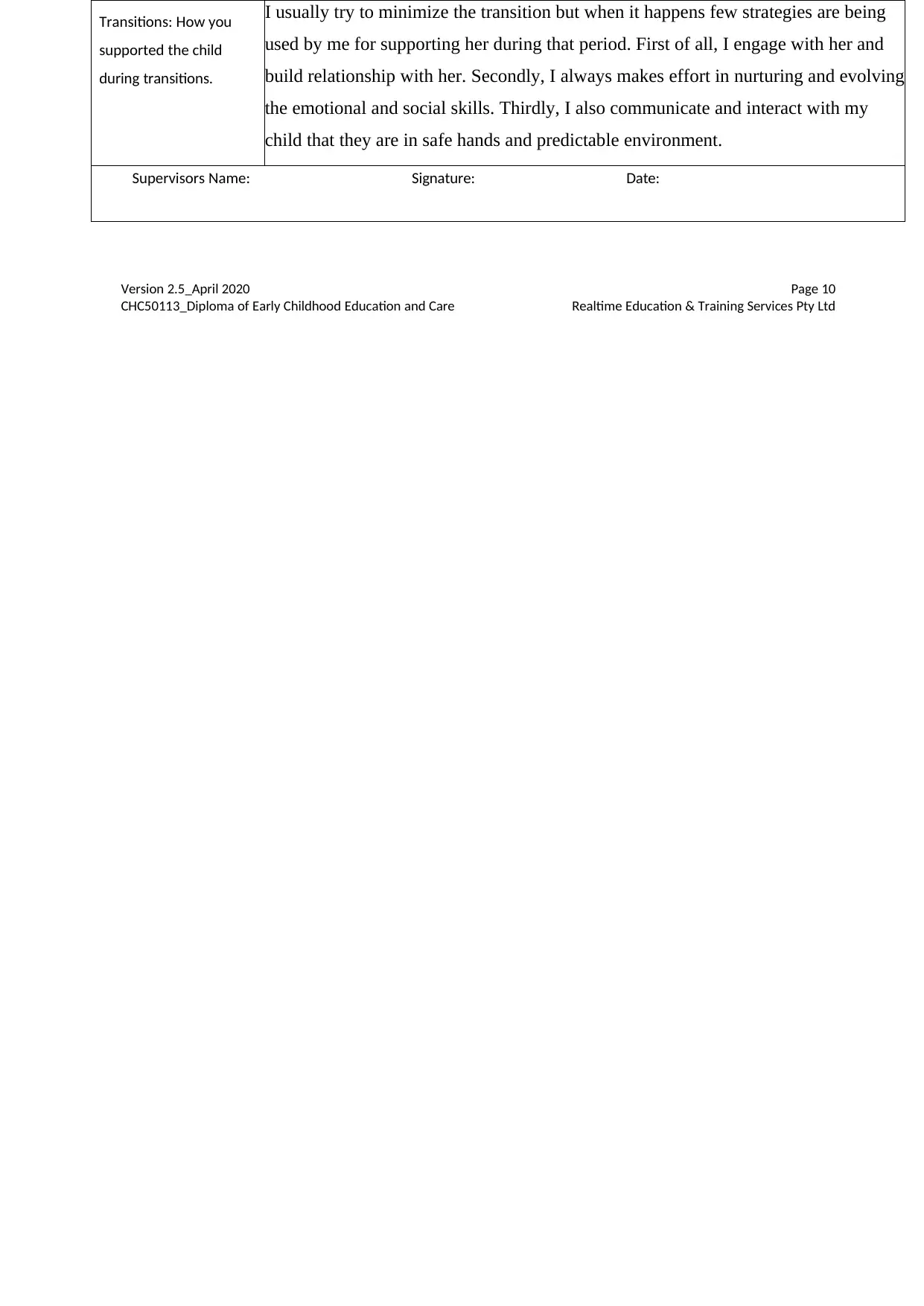
Transitions: How you
supported the child
during transitions.
I usually try to minimize the transition but when it happens few strategies are being
used by me for supporting her during that period. First of all, I engage with her and
build relationship with her. Secondly, I always makes effort in nurturing and evolving
the emotional and social skills. Thirdly, I also communicate and interact with my
child that they are in safe hands and predictable environment.
Supervisors Name: Signature: Date:
Version 2.5_April 2020 Page 10
CHC50113_Diploma of Early Childhood Education and Care Realtime Education & Training Services Pty Ltd
supported the child
during transitions.
I usually try to minimize the transition but when it happens few strategies are being
used by me for supporting her during that period. First of all, I engage with her and
build relationship with her. Secondly, I always makes effort in nurturing and evolving
the emotional and social skills. Thirdly, I also communicate and interact with my
child that they are in safe hands and predictable environment.
Supervisors Name: Signature: Date:
Version 2.5_April 2020 Page 10
CHC50113_Diploma of Early Childhood Education and Care Realtime Education & Training Services Pty Ltd
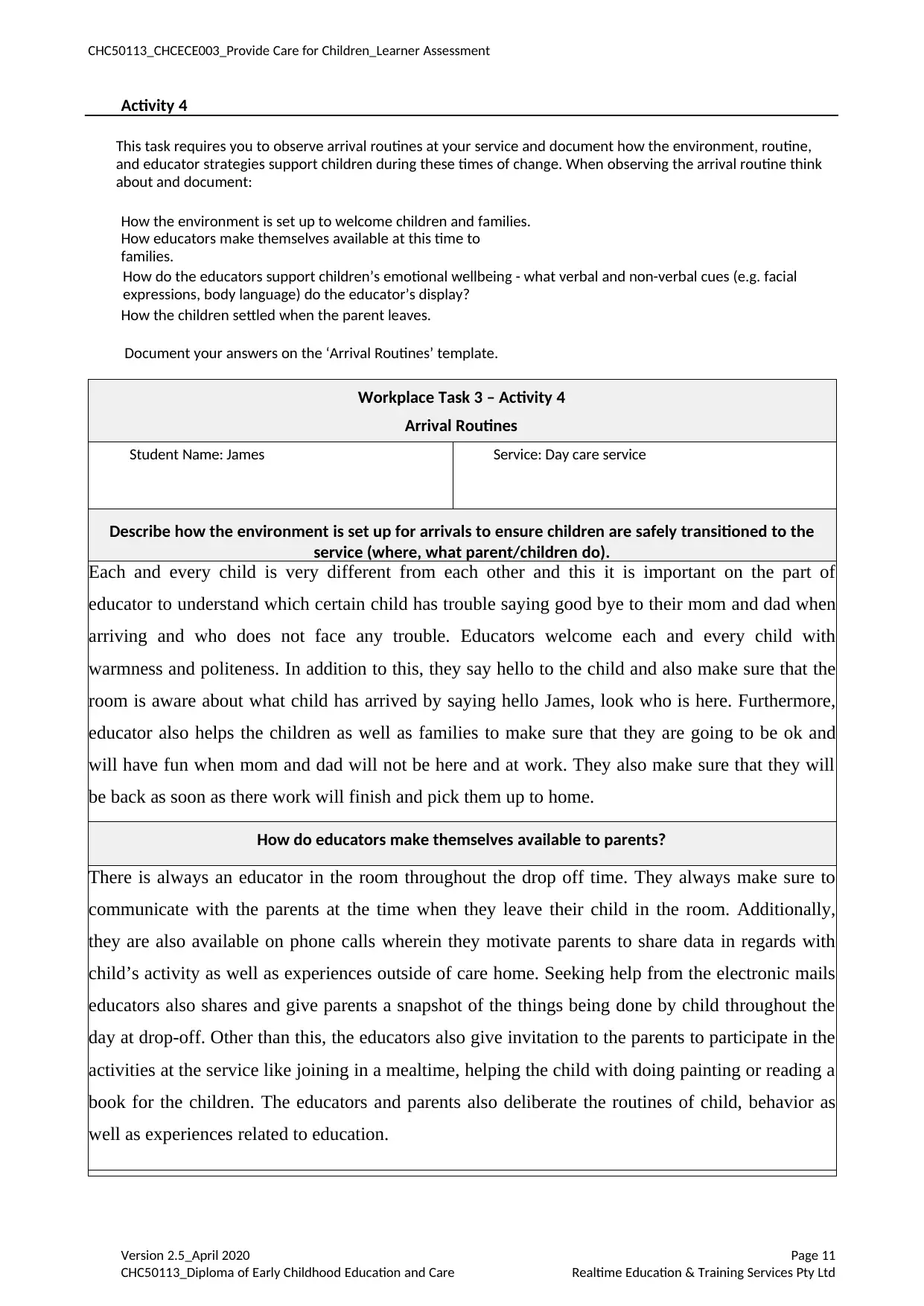
CHC50113_CHCECE003_Provide Care for Children_Learner Assessment
Activity 4
This task requires you to observe arrival routines at your service and document how the environment, routine,
and educator strategies support children during these times of change. When observing the arrival routine think
about and document:
How the environment is set up to welcome children and families.
How educators make themselves available at this time to
families.
How do the educators support children’s emotional wellbeing - what verbal and non-verbal cues (e.g. facial
expressions, body language) do the educator’s display?
How the children settled when the parent leaves.
Document your answers on the ‘Arrival Routines’ template.
Workplace Task 3 – Activity 4
Arrival Routines
Student Name: James Service: Day care service
Describe how the environment is set up for arrivals to ensure children are safely transitioned to the
service (where, what parent/children do).
Each and every child is very different from each other and this it is important on the part of
educator to understand which certain child has trouble saying good bye to their mom and dad when
arriving and who does not face any trouble. Educators welcome each and every child with
warmness and politeness. In addition to this, they say hello to the child and also make sure that the
room is aware about what child has arrived by saying hello James, look who is here. Furthermore,
educator also helps the children as well as families to make sure that they are going to be ok and
will have fun when mom and dad will not be here and at work. They also make sure that they will
be back as soon as there work will finish and pick them up to home.
How do educators make themselves available to parents?
There is always an educator in the room throughout the drop off time. They always make sure to
communicate with the parents at the time when they leave their child in the room. Additionally,
they are also available on phone calls wherein they motivate parents to share data in regards with
child’s activity as well as experiences outside of care home. Seeking help from the electronic mails
educators also shares and give parents a snapshot of the things being done by child throughout the
day at drop-off. Other than this, the educators also give invitation to the parents to participate in the
activities at the service like joining in a mealtime, helping the child with doing painting or reading a
book for the children. The educators and parents also deliberate the routines of child, behavior as
well as experiences related to education.
Version 2.5_April 2020 Page 11
CHC50113_Diploma of Early Childhood Education and Care Realtime Education & Training Services Pty Ltd
Activity 4
This task requires you to observe arrival routines at your service and document how the environment, routine,
and educator strategies support children during these times of change. When observing the arrival routine think
about and document:
How the environment is set up to welcome children and families.
How educators make themselves available at this time to
families.
How do the educators support children’s emotional wellbeing - what verbal and non-verbal cues (e.g. facial
expressions, body language) do the educator’s display?
How the children settled when the parent leaves.
Document your answers on the ‘Arrival Routines’ template.
Workplace Task 3 – Activity 4
Arrival Routines
Student Name: James Service: Day care service
Describe how the environment is set up for arrivals to ensure children are safely transitioned to the
service (where, what parent/children do).
Each and every child is very different from each other and this it is important on the part of
educator to understand which certain child has trouble saying good bye to their mom and dad when
arriving and who does not face any trouble. Educators welcome each and every child with
warmness and politeness. In addition to this, they say hello to the child and also make sure that the
room is aware about what child has arrived by saying hello James, look who is here. Furthermore,
educator also helps the children as well as families to make sure that they are going to be ok and
will have fun when mom and dad will not be here and at work. They also make sure that they will
be back as soon as there work will finish and pick them up to home.
How do educators make themselves available to parents?
There is always an educator in the room throughout the drop off time. They always make sure to
communicate with the parents at the time when they leave their child in the room. Additionally,
they are also available on phone calls wherein they motivate parents to share data in regards with
child’s activity as well as experiences outside of care home. Seeking help from the electronic mails
educators also shares and give parents a snapshot of the things being done by child throughout the
day at drop-off. Other than this, the educators also give invitation to the parents to participate in the
activities at the service like joining in a mealtime, helping the child with doing painting or reading a
book for the children. The educators and parents also deliberate the routines of child, behavior as
well as experiences related to education.
Version 2.5_April 2020 Page 11
CHC50113_Diploma of Early Childhood Education and Care Realtime Education & Training Services Pty Ltd
⊘ This is a preview!⊘
Do you want full access?
Subscribe today to unlock all pages.
Trusted by 1+ million students worldwide

1 out of 33


Related Documents


Your All-in-One AI-Powered Toolkit for Academic Success.
+13062052269
info@desklib.com
Available 24*7 on WhatsApp / Email
![[object Object]](/_next/static/media/star-bottom.7253800d.svg)
Unlock your academic potential
Copyright © 2020–2026 A2Z Services. All Rights Reserved. Developed and managed by ZUCOL.