Integrated Business Research: Advertisement and Branding for Growth
VerifiedAdded on 2023/04/08
|13
|2741
|94
Project
AI Summary
This research proposal investigates the impact of effective advertisement and proper branding on the growth of an organisation, focusing on marketing agencies in Sydney. The study aims to determine how advertisement and branding influence revenue, market share, and customer relations. It examines various advertisement forms, including informative, persuasive, and reminder techniques, and their effect on consumer behavior. The research includes objectives to identify effective advertisement and branding strategies used by Sydney marketing agencies and strategies leaders can implement. The research questions address specific advertisement elements, relationships between variables, effectiveness of techniques, and applicability to non-profit organisations. The study employs a mixed-methods approach, combining quantitative surveys and qualitative analysis to assess perceptions and determine associations. It explores existing literature highlighting the positive relationship between effective advertisement and branding and organisational growth, while acknowledging limitations in previous studies, such as diverse age groups and modern advertising trends. The research design will use a quantitative survey and qualitative interviews to gather data from customers and people that follow advertisements of prominent marketing organisation in Sydney.
Running head: INTEGRATED BUSINESS RESEARCH 1
Topic: How Effective Advertisement and Proper Branding can Impact the Growth of an
Organisation
By (Name of Student)
Draft Research Proposal Template
(Institutional Affiliation)
Subject: Integrated Business Research
(Institutional Affiliation)
Topic: How Effective Advertisement and Proper Branding can Impact the Growth of an
Organisation
By (Name of Student)
Draft Research Proposal Template
(Institutional Affiliation)
Subject: Integrated Business Research
(Institutional Affiliation)

Paraphrase This Document
Need a fresh take? Get an instant paraphrase of this document with our AI Paraphraser
INTEGRATED BUSINESS RESEARCH 2
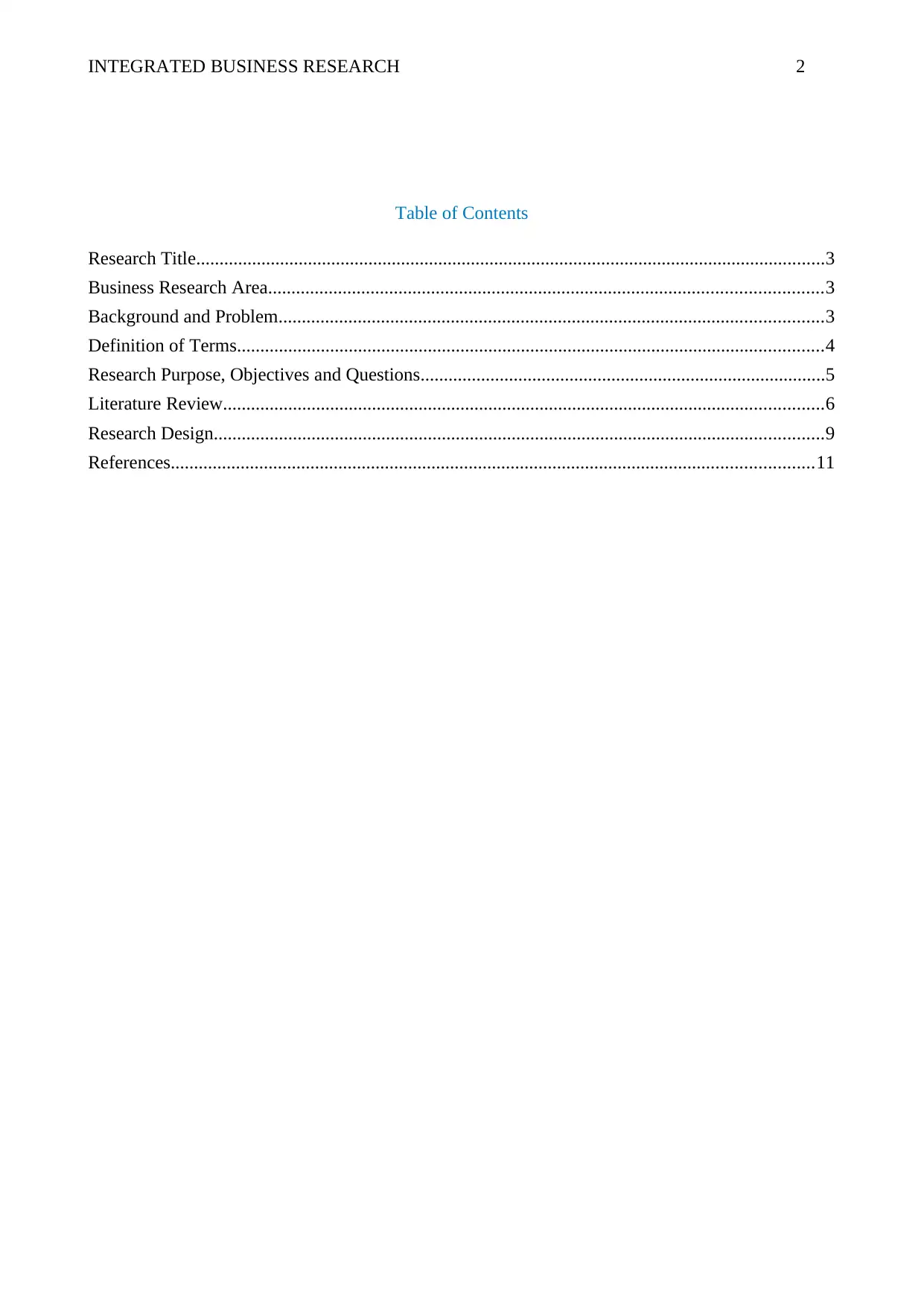
Table of Contents
Research Title.......................................................................................................................................3
Business Research Area.......................................................................................................................3
Background and Problem.....................................................................................................................3
Definition of Terms..............................................................................................................................4
Research Purpose, Objectives and Questions.......................................................................................5
Literature Review.................................................................................................................................6
Research Design...................................................................................................................................9
References..........................................................................................................................................11
Table of Contents
Research Title.......................................................................................................................................3
Business Research Area.......................................................................................................................3
Background and Problem.....................................................................................................................3
Definition of Terms..............................................................................................................................4
Research Purpose, Objectives and Questions.......................................................................................5
Literature Review.................................................................................................................................6
Research Design...................................................................................................................................9
References..........................................................................................................................................11
INTEGRATED BUSINESS RESEARCH 3
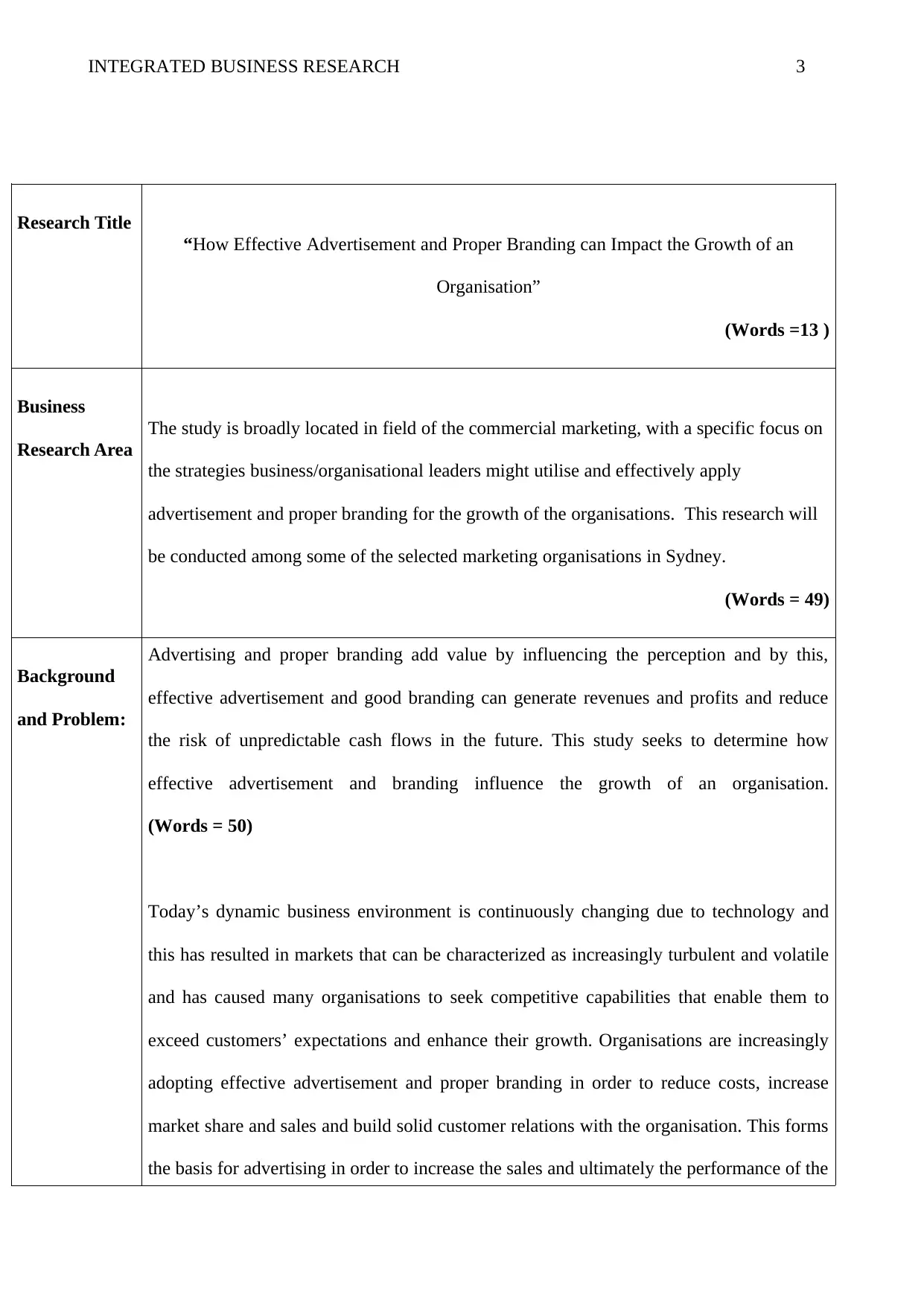
Research Title
“How Effective Advertisement and Proper Branding can Impact the Growth of an
Organisation”
(Words =13 )
Business
Research Area
The study is broadly located in field of the commercial marketing, with a specific focus on
the strategies business/organisational leaders might utilise and effectively apply
advertisement and proper branding for the growth of the organisations. This research will
be conducted among some of the selected marketing organisations in Sydney.
(Words = 49)
Background
and Problem:
Advertising and proper branding add value by influencing the perception and by this,
effective advertisement and good branding can generate revenues and profits and reduce
the risk of unpredictable cash flows in the future. This study seeks to determine how
effective advertisement and branding influence the growth of an organisation.
(Words = 50)
Today’s dynamic business environment is continuously changing due to technology and
this has resulted in markets that can be characterized as increasingly turbulent and volatile
and has caused many organisations to seek competitive capabilities that enable them to
exceed customers’ expectations and enhance their growth. Organisations are increasingly
adopting effective advertisement and proper branding in order to reduce costs, increase
market share and sales and build solid customer relations with the organisation. This forms
the basis for advertising in order to increase the sales and ultimately the performance of the
Research Title
“How Effective Advertisement and Proper Branding can Impact the Growth of an
Organisation”
(Words =13 )
Business
Research Area
The study is broadly located in field of the commercial marketing, with a specific focus on
the strategies business/organisational leaders might utilise and effectively apply
advertisement and proper branding for the growth of the organisations. This research will
be conducted among some of the selected marketing organisations in Sydney.
(Words = 49)
Background
and Problem:
Advertising and proper branding add value by influencing the perception and by this,
effective advertisement and good branding can generate revenues and profits and reduce
the risk of unpredictable cash flows in the future. This study seeks to determine how
effective advertisement and branding influence the growth of an organisation.
(Words = 50)
Today’s dynamic business environment is continuously changing due to technology and
this has resulted in markets that can be characterized as increasingly turbulent and volatile
and has caused many organisations to seek competitive capabilities that enable them to
exceed customers’ expectations and enhance their growth. Organisations are increasingly
adopting effective advertisement and proper branding in order to reduce costs, increase
market share and sales and build solid customer relations with the organisation. This forms
the basis for advertising in order to increase the sales and ultimately the performance of the
⊘ This is a preview!⊘
Do you want full access?
Subscribe today to unlock all pages.

Trusted by 1+ million students worldwide
INTEGRATED BUSINESS RESEARCH 4
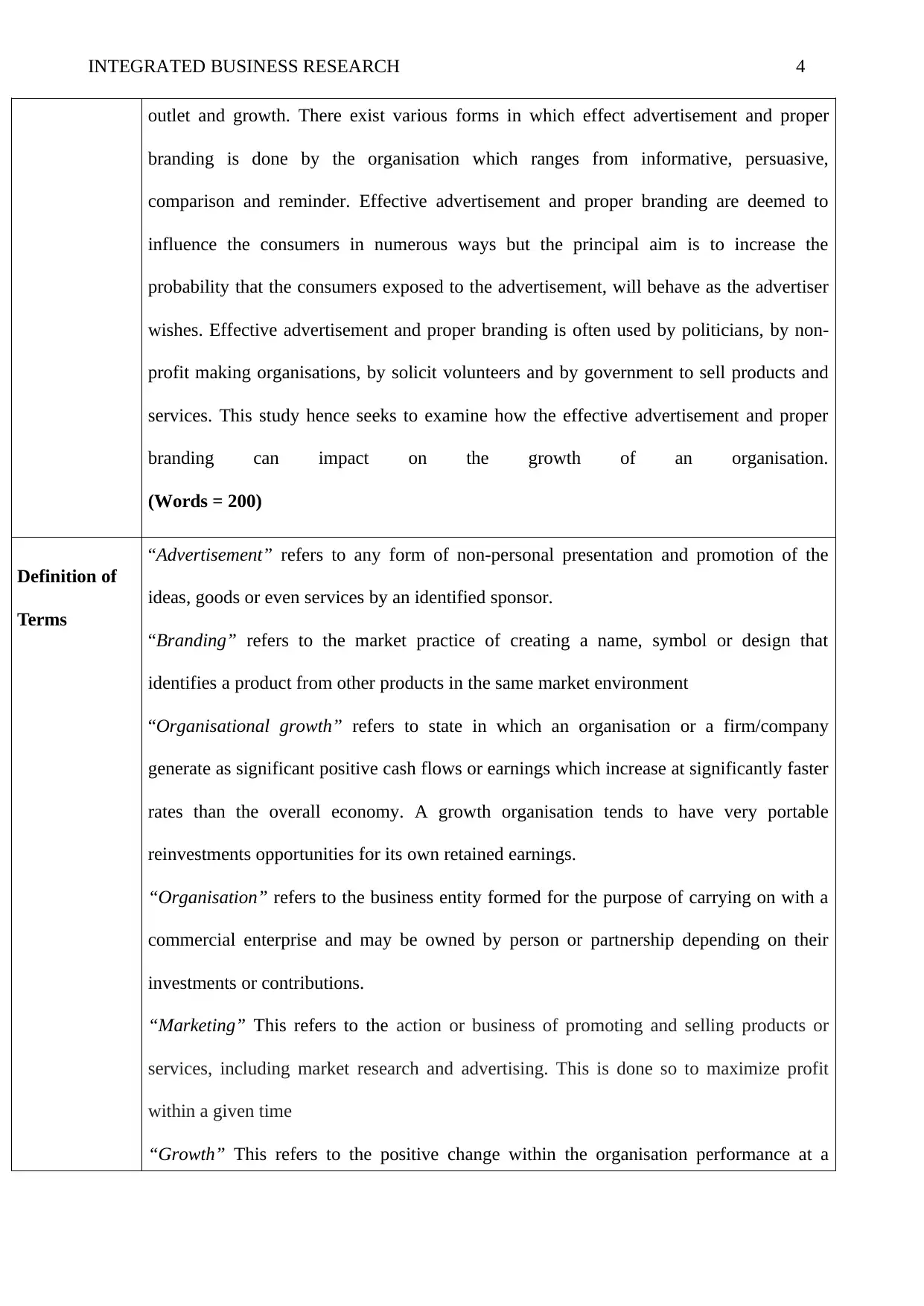
outlet and growth. There exist various forms in which effect advertisement and proper
branding is done by the organisation which ranges from informative, persuasive,
comparison and reminder. Effective advertisement and proper branding are deemed to
influence the consumers in numerous ways but the principal aim is to increase the
probability that the consumers exposed to the advertisement, will behave as the advertiser
wishes. Effective advertisement and proper branding is often used by politicians, by non-
profit making organisations, by solicit volunteers and by government to sell products and
services. This study hence seeks to examine how the effective advertisement and proper
branding can impact on the growth of an organisation.
(Words = 200)
Definition of
Terms
“Advertisement” refers to any form of non-personal presentation and promotion of the
ideas, goods or even services by an identified sponsor.
“Branding” refers to the market practice of creating a name, symbol or design that
identifies a product from other products in the same market environment
“Organisational growth” refers to state in which an organisation or a firm/company
generate as significant positive cash flows or earnings which increase at significantly faster
rates than the overall economy. A growth organisation tends to have very portable
reinvestments opportunities for its own retained earnings.
“Organisation” refers to the business entity formed for the purpose of carrying on with a
commercial enterprise and may be owned by person or partnership depending on their
investments or contributions.
“Marketing” This refers to the action or business of promoting and selling products or
services, including market research and advertising. This is done so to maximize profit
within a given time
“Growth” This refers to the positive change within the organisation performance at a
outlet and growth. There exist various forms in which effect advertisement and proper
branding is done by the organisation which ranges from informative, persuasive,
comparison and reminder. Effective advertisement and proper branding are deemed to
influence the consumers in numerous ways but the principal aim is to increase the
probability that the consumers exposed to the advertisement, will behave as the advertiser
wishes. Effective advertisement and proper branding is often used by politicians, by non-
profit making organisations, by solicit volunteers and by government to sell products and
services. This study hence seeks to examine how the effective advertisement and proper
branding can impact on the growth of an organisation.
(Words = 200)
Definition of
Terms
“Advertisement” refers to any form of non-personal presentation and promotion of the
ideas, goods or even services by an identified sponsor.
“Branding” refers to the market practice of creating a name, symbol or design that
identifies a product from other products in the same market environment
“Organisational growth” refers to state in which an organisation or a firm/company
generate as significant positive cash flows or earnings which increase at significantly faster
rates than the overall economy. A growth organisation tends to have very portable
reinvestments opportunities for its own retained earnings.
“Organisation” refers to the business entity formed for the purpose of carrying on with a
commercial enterprise and may be owned by person or partnership depending on their
investments or contributions.
“Marketing” This refers to the action or business of promoting and selling products or
services, including market research and advertising. This is done so to maximize profit
within a given time
“Growth” This refers to the positive change within the organisation performance at a
Paraphrase This Document
Need a fresh take? Get an instant paraphrase of this document with our AI Paraphraser
INTEGRATED BUSINESS RESEARCH 5
given period of time.
Research
Purpose,
Objectives and
Questions.
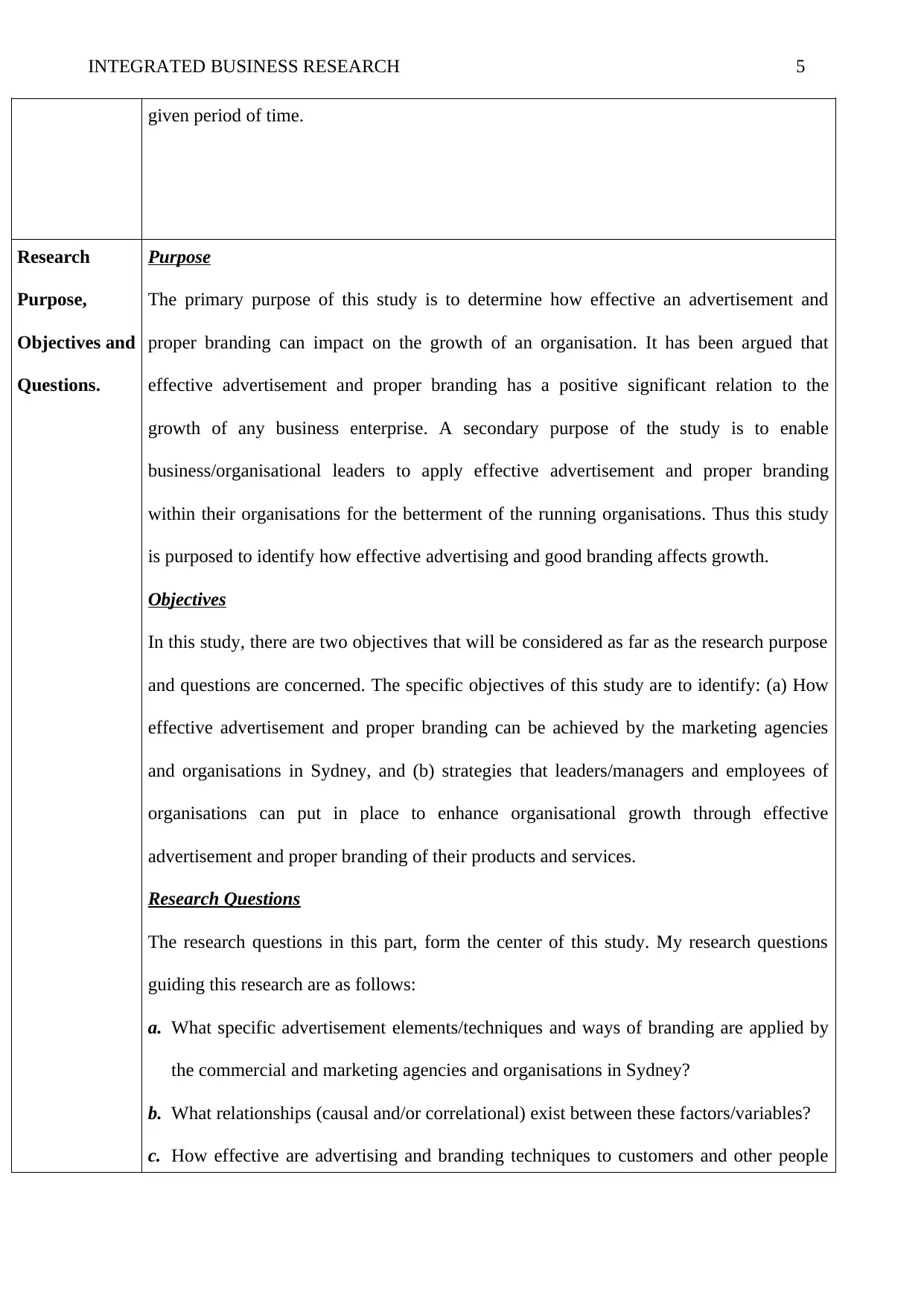
Purpose
The primary purpose of this study is to determine how effective an advertisement and
proper branding can impact on the growth of an organisation. It has been argued that
effective advertisement and proper branding has a positive significant relation to the
growth of any business enterprise. A secondary purpose of the study is to enable
business/organisational leaders to apply effective advertisement and proper branding
within their organisations for the betterment of the running organisations. Thus this study
is purposed to identify how effective advertising and good branding affects growth.
Objectives
In this study, there are two objectives that will be considered as far as the research purpose
and questions are concerned. The specific objectives of this study are to identify: (a) How
effective advertisement and proper branding can be achieved by the marketing agencies
and organisations in Sydney, and (b) strategies that leaders/managers and employees of
organisations can put in place to enhance organisational growth through effective
advertisement and proper branding of their products and services.
Research Questions
The research questions in this part, form the center of this study. My research questions
guiding this research are as follows:
a. What specific advertisement elements/techniques and ways of branding are applied by
the commercial and marketing agencies and organisations in Sydney?
b. What relationships (causal and/or correlational) exist between these factors/variables?
c. How effective are advertising and branding techniques to customers and other people
given period of time.
Research
Purpose,
Objectives and
Questions.
Purpose
The primary purpose of this study is to determine how effective an advertisement and
proper branding can impact on the growth of an organisation. It has been argued that
effective advertisement and proper branding has a positive significant relation to the
growth of any business enterprise. A secondary purpose of the study is to enable
business/organisational leaders to apply effective advertisement and proper branding
within their organisations for the betterment of the running organisations. Thus this study
is purposed to identify how effective advertising and good branding affects growth.
Objectives
In this study, there are two objectives that will be considered as far as the research purpose
and questions are concerned. The specific objectives of this study are to identify: (a) How
effective advertisement and proper branding can be achieved by the marketing agencies
and organisations in Sydney, and (b) strategies that leaders/managers and employees of
organisations can put in place to enhance organisational growth through effective
advertisement and proper branding of their products and services.
Research Questions
The research questions in this part, form the center of this study. My research questions
guiding this research are as follows:
a. What specific advertisement elements/techniques and ways of branding are applied by
the commercial and marketing agencies and organisations in Sydney?
b. What relationships (causal and/or correlational) exist between these factors/variables?
c. How effective are advertising and branding techniques to customers and other people
INTEGRATED BUSINESS RESEARCH 6
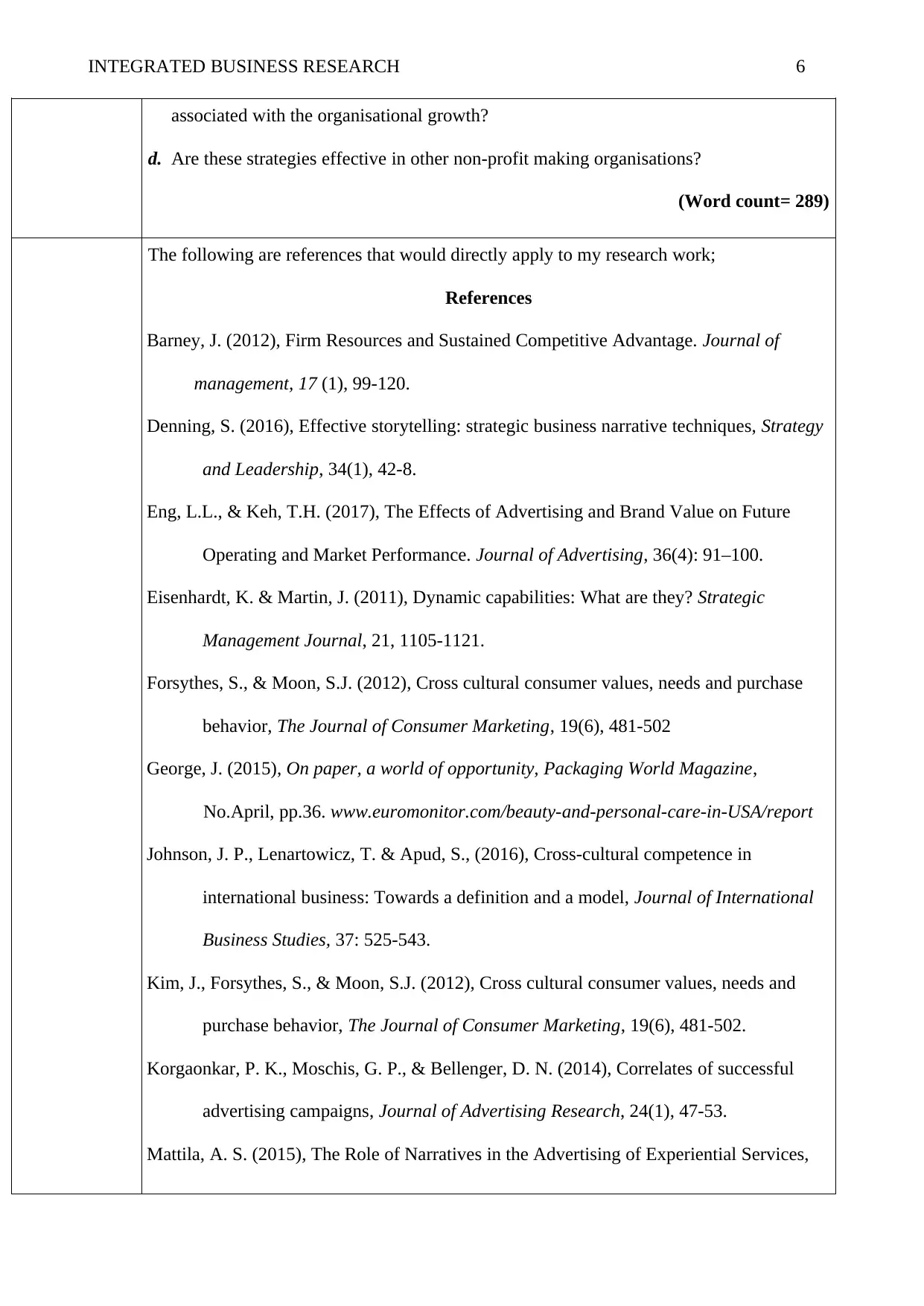
associated with the organisational growth?
d. Are these strategies effective in other non-profit making organisations?
(Word count= 289)
The following are references that would directly apply to my research work;
References
Barney, J. (2012), Firm Resources and Sustained Competitive Advantage. Journal of
management, 17 (1), 99-120.
Denning, S. (2016), Effective storytelling: strategic business narrative techniques, Strategy
and Leadership, 34(1), 42-8.
Eng, L.L., & Keh, T.H. (2017), The Effects of Advertising and Brand Value on Future
Operating and Market Performance. Journal of Advertising, 36(4): 91–100.
Eisenhardt, K. & Martin, J. (2011), Dynamic capabilities: What are they? Strategic
Management Journal, 21, 1105-1121.
Forsythes, S., & Moon, S.J. (2012), Cross cultural consumer values, needs and purchase
behavior, The Journal of Consumer Marketing, 19(6), 481-502
George, J. (2015), On paper, a world of opportunity, Packaging World Magazine,
No.April, pp.36. www.euromonitor.com/beauty-and-personal-care-in-USA/report
Johnson, J. P., Lenartowicz, T. & Apud, S., (2016), Cross-cultural competence in
international business: Towards a definition and a model, Journal of International
Business Studies, 37: 525-543.
Kim, J., Forsythes, S., & Moon, S.J. (2012), Cross cultural consumer values, needs and
purchase behavior, The Journal of Consumer Marketing, 19(6), 481-502.
Korgaonkar, P. K., Moschis, G. P., & Bellenger, D. N. (2014), Correlates of successful
advertising campaigns, Journal of Advertising Research, 24(1), 47-53.
Mattila, A. S. (2015), The Role of Narratives in the Advertising of Experiential Services,
associated with the organisational growth?
d. Are these strategies effective in other non-profit making organisations?
(Word count= 289)
The following are references that would directly apply to my research work;
References
Barney, J. (2012), Firm Resources and Sustained Competitive Advantage. Journal of
management, 17 (1), 99-120.
Denning, S. (2016), Effective storytelling: strategic business narrative techniques, Strategy
and Leadership, 34(1), 42-8.
Eng, L.L., & Keh, T.H. (2017), The Effects of Advertising and Brand Value on Future
Operating and Market Performance. Journal of Advertising, 36(4): 91–100.
Eisenhardt, K. & Martin, J. (2011), Dynamic capabilities: What are they? Strategic
Management Journal, 21, 1105-1121.
Forsythes, S., & Moon, S.J. (2012), Cross cultural consumer values, needs and purchase
behavior, The Journal of Consumer Marketing, 19(6), 481-502
George, J. (2015), On paper, a world of opportunity, Packaging World Magazine,
No.April, pp.36. www.euromonitor.com/beauty-and-personal-care-in-USA/report
Johnson, J. P., Lenartowicz, T. & Apud, S., (2016), Cross-cultural competence in
international business: Towards a definition and a model, Journal of International
Business Studies, 37: 525-543.
Kim, J., Forsythes, S., & Moon, S.J. (2012), Cross cultural consumer values, needs and
purchase behavior, The Journal of Consumer Marketing, 19(6), 481-502.
Korgaonkar, P. K., Moschis, G. P., & Bellenger, D. N. (2014), Correlates of successful
advertising campaigns, Journal of Advertising Research, 24(1), 47-53.
Mattila, A. S. (2015), The Role of Narratives in the Advertising of Experiential Services,
⊘ This is a preview!⊘
Do you want full access?
Subscribe today to unlock all pages.
Trusted by 1+ million students worldwide
INTEGRATED BUSINESS RESEARCH 7
Literature
Review
Journal of Service Research, 3(1), 35-45.
Nowak, G. J., Cameron, G. T. & Krugman, D. M. (2013), How local advertisers choose
and use advertising media, Journal of Advertising Research, 33(6), 39-49.
Powell T.C. (2001), Competitive Advantage: Logical and Philosophical considerations,
Strategic Management Journal 22, 875-888.
Schmidt, J. B. & Spreng, R.A. (2010), A proposed model of external consumer information
search", Academy of Marketing Science Journal, 24(3), 246-57.
Shah, S. Z. A., Stark, A. W., & Akbar, S. (2017), The Value Relevance of Major Media
Advertising Expenditures: International Journal of Accounting, 44(2), 187–206.
Stafford, M. R. & Stafford, T. F. (2013), Advertising the service offering: the effects of
preference heterogeneity, message strategy and gender on radio advertising
effectiveness, Journal of Current Issues and Research in Advertising, 23(1), 17-29.
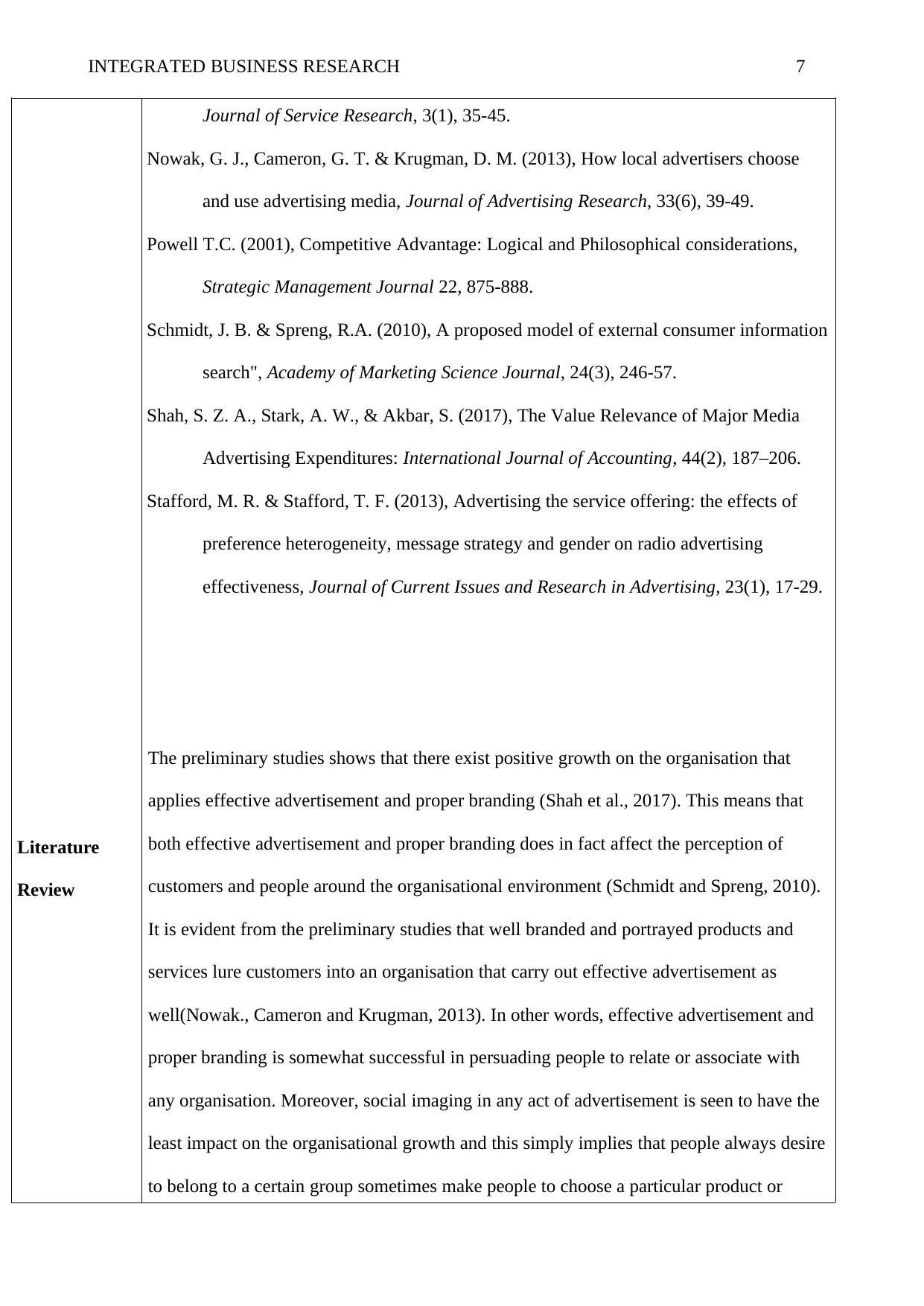
The preliminary studies shows that there exist positive growth on the organisation that
applies effective advertisement and proper branding (Shah et al., 2017). This means that
both effective advertisement and proper branding does in fact affect the perception of
customers and people around the organisational environment (Schmidt and Spreng, 2010).
It is evident from the preliminary studies that well branded and portrayed products and
services lure customers into an organisation that carry out effective advertisement as
well(Nowak., Cameron and Krugman, 2013). In other words, effective advertisement and
proper branding is somewhat successful in persuading people to relate or associate with
any organisation. Moreover, social imaging in any act of advertisement is seen to have the
least impact on the organisational growth and this simply implies that people always desire
to belong to a certain group sometimes make people to choose a particular product or
Literature
Review
Journal of Service Research, 3(1), 35-45.
Nowak, G. J., Cameron, G. T. & Krugman, D. M. (2013), How local advertisers choose
and use advertising media, Journal of Advertising Research, 33(6), 39-49.
Powell T.C. (2001), Competitive Advantage: Logical and Philosophical considerations,
Strategic Management Journal 22, 875-888.
Schmidt, J. B. & Spreng, R.A. (2010), A proposed model of external consumer information
search", Academy of Marketing Science Journal, 24(3), 246-57.
Shah, S. Z. A., Stark, A. W., & Akbar, S. (2017), The Value Relevance of Major Media
Advertising Expenditures: International Journal of Accounting, 44(2), 187–206.
Stafford, M. R. & Stafford, T. F. (2013), Advertising the service offering: the effects of
preference heterogeneity, message strategy and gender on radio advertising
effectiveness, Journal of Current Issues and Research in Advertising, 23(1), 17-29.
The preliminary studies shows that there exist positive growth on the organisation that
applies effective advertisement and proper branding (Shah et al., 2017). This means that
both effective advertisement and proper branding does in fact affect the perception of
customers and people around the organisational environment (Schmidt and Spreng, 2010).
It is evident from the preliminary studies that well branded and portrayed products and
services lure customers into an organisation that carry out effective advertisement as
well(Nowak., Cameron and Krugman, 2013). In other words, effective advertisement and
proper branding is somewhat successful in persuading people to relate or associate with
any organisation. Moreover, social imaging in any act of advertisement is seen to have the
least impact on the organisational growth and this simply implies that people always desire
to belong to a certain group sometimes make people to choose a particular product or
Paraphrase This Document
Need a fresh take? Get an instant paraphrase of this document with our AI Paraphraser
INTEGRATED BUSINESS RESEARCH 8
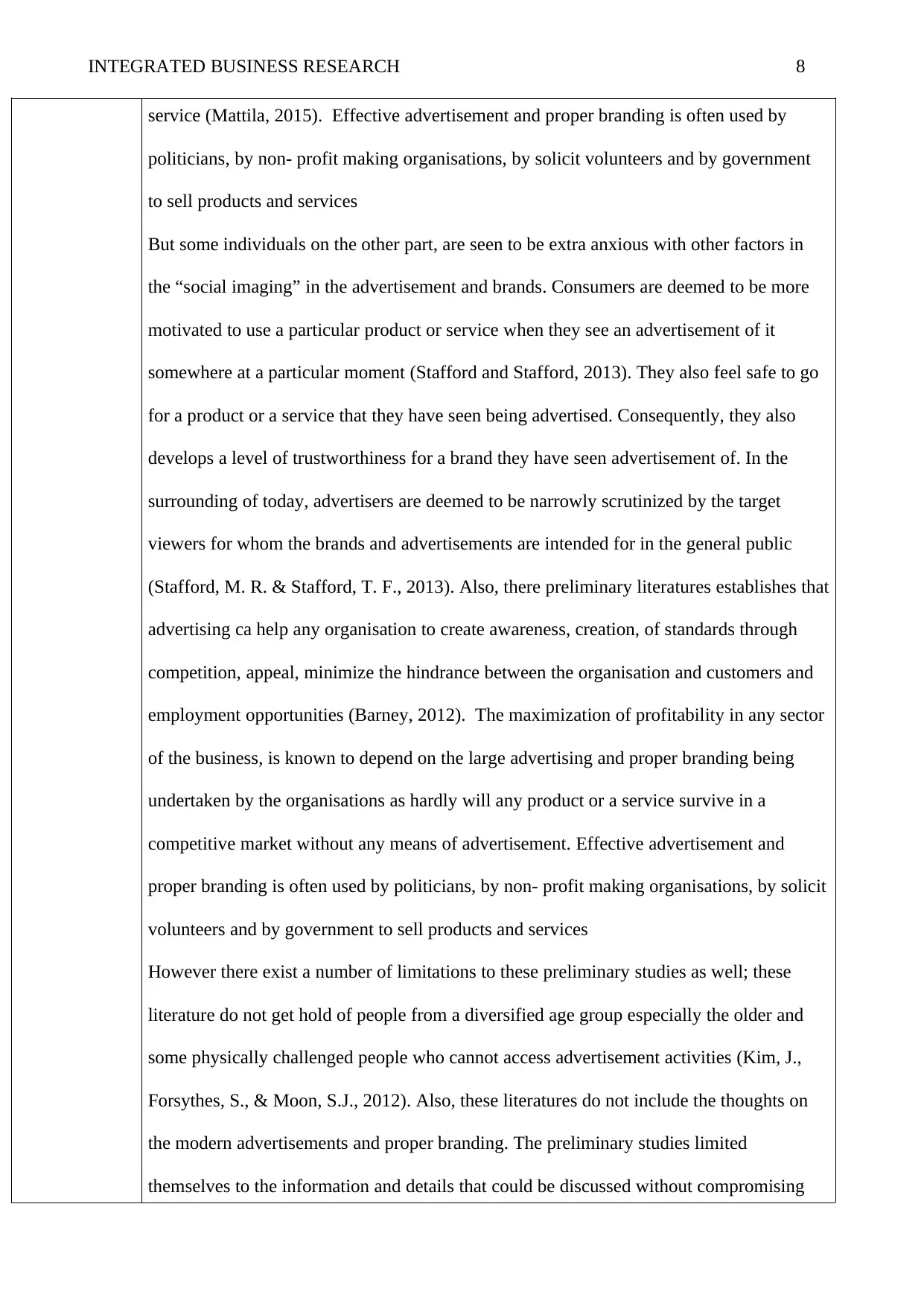
service (Mattila, 2015). Effective advertisement and proper branding is often used by
politicians, by non- profit making organisations, by solicit volunteers and by government
to sell products and services
But some individuals on the other part, are seen to be extra anxious with other factors in
the “social imaging” in the advertisement and brands. Consumers are deemed to be more
motivated to use a particular product or service when they see an advertisement of it
somewhere at a particular moment (Stafford and Stafford, 2013). They also feel safe to go
for a product or a service that they have seen being advertised. Consequently, they also
develops a level of trustworthiness for a brand they have seen advertisement of. In the
surrounding of today, advertisers are deemed to be narrowly scrutinized by the target
viewers for whom the brands and advertisements are intended for in the general public
(Stafford, M. R. & Stafford, T. F., 2013). Also, there preliminary literatures establishes that
advertising ca help any organisation to create awareness, creation, of standards through
competition, appeal, minimize the hindrance between the organisation and customers and
employment opportunities (Barney, 2012). The maximization of profitability in any sector
of the business, is known to depend on the large advertising and proper branding being
undertaken by the organisations as hardly will any product or a service survive in a
competitive market without any means of advertisement. Effective advertisement and
proper branding is often used by politicians, by non- profit making organisations, by solicit
volunteers and by government to sell products and services
However there exist a number of limitations to these preliminary studies as well; these
literature do not get hold of people from a diversified age group especially the older and
some physically challenged people who cannot access advertisement activities (Kim, J.,
Forsythes, S., & Moon, S.J., 2012). Also, these literatures do not include the thoughts on
the modern advertisements and proper branding. The preliminary studies limited
themselves to the information and details that could be discussed without compromising
service (Mattila, 2015). Effective advertisement and proper branding is often used by
politicians, by non- profit making organisations, by solicit volunteers and by government
to sell products and services
But some individuals on the other part, are seen to be extra anxious with other factors in
the “social imaging” in the advertisement and brands. Consumers are deemed to be more
motivated to use a particular product or service when they see an advertisement of it
somewhere at a particular moment (Stafford and Stafford, 2013). They also feel safe to go
for a product or a service that they have seen being advertised. Consequently, they also
develops a level of trustworthiness for a brand they have seen advertisement of. In the
surrounding of today, advertisers are deemed to be narrowly scrutinized by the target
viewers for whom the brands and advertisements are intended for in the general public
(Stafford, M. R. & Stafford, T. F., 2013). Also, there preliminary literatures establishes that
advertising ca help any organisation to create awareness, creation, of standards through
competition, appeal, minimize the hindrance between the organisation and customers and
employment opportunities (Barney, 2012). The maximization of profitability in any sector
of the business, is known to depend on the large advertising and proper branding being
undertaken by the organisations as hardly will any product or a service survive in a
competitive market without any means of advertisement. Effective advertisement and
proper branding is often used by politicians, by non- profit making organisations, by solicit
volunteers and by government to sell products and services
However there exist a number of limitations to these preliminary studies as well; these
literature do not get hold of people from a diversified age group especially the older and
some physically challenged people who cannot access advertisement activities (Kim, J.,
Forsythes, S., & Moon, S.J., 2012). Also, these literatures do not include the thoughts on
the modern advertisements and proper branding. The preliminary studies limited
themselves to the information and details that could be discussed without compromising
INTEGRATED BUSINESS RESEARCH 9
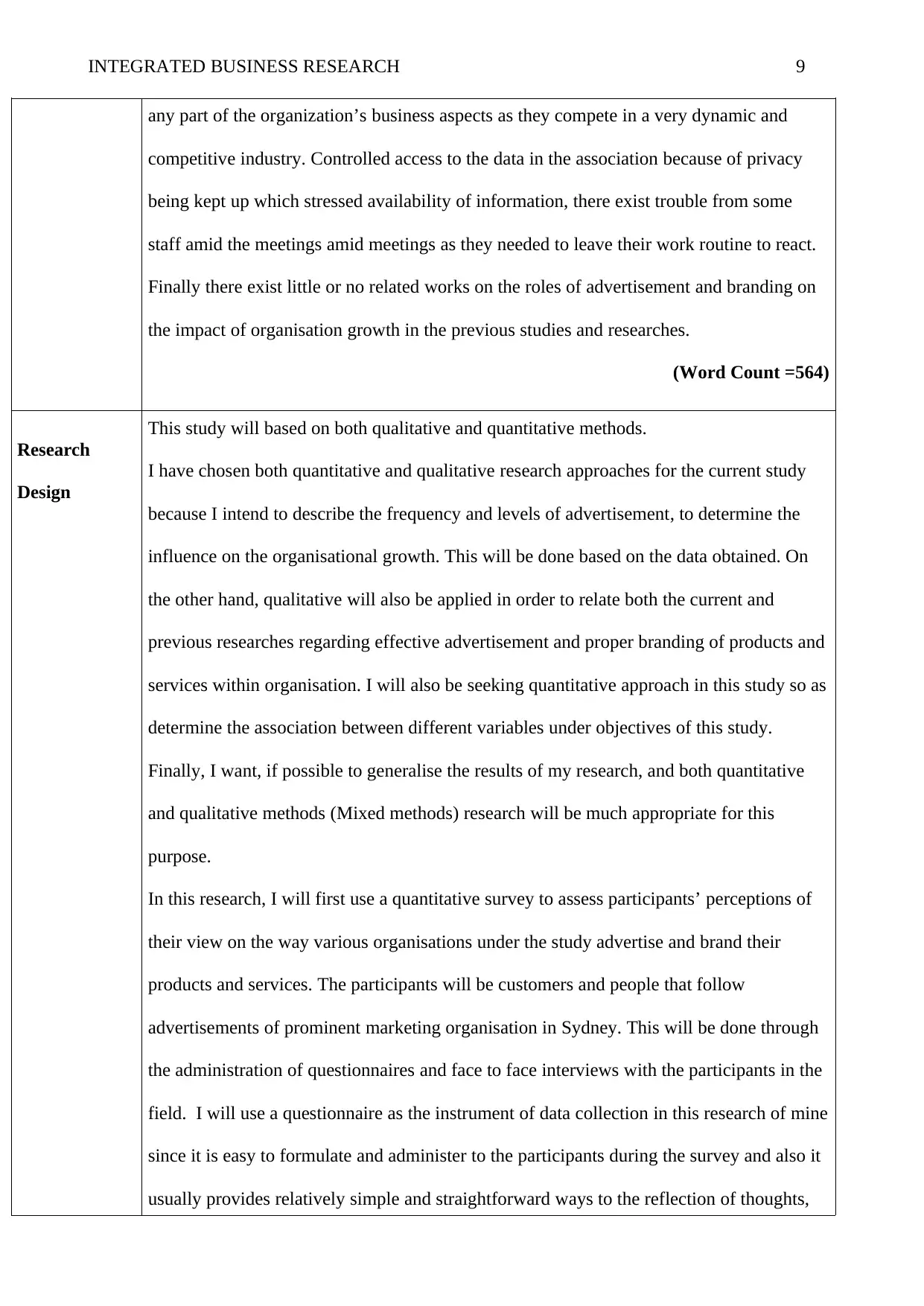
any part of the organization’s business aspects as they compete in a very dynamic and
competitive industry. Controlled access to the data in the association because of privacy
being kept up which stressed availability of information, there exist trouble from some
staff amid the meetings amid meetings as they needed to leave their work routine to react.
Finally there exist little or no related works on the roles of advertisement and branding on
the impact of organisation growth in the previous studies and researches.
(Word Count =564)
Research
Design
This study will based on both qualitative and quantitative methods.
I have chosen both quantitative and qualitative research approaches for the current study
because I intend to describe the frequency and levels of advertisement, to determine the
influence on the organisational growth. This will be done based on the data obtained. On
the other hand, qualitative will also be applied in order to relate both the current and
previous researches regarding effective advertisement and proper branding of products and
services within organisation. I will also be seeking quantitative approach in this study so as
determine the association between different variables under objectives of this study.
Finally, I want, if possible to generalise the results of my research, and both quantitative
and qualitative methods (Mixed methods) research will be much appropriate for this
purpose.
In this research, I will first use a quantitative survey to assess participants’ perceptions of
their view on the way various organisations under the study advertise and brand their
products and services. The participants will be customers and people that follow
advertisements of prominent marketing organisation in Sydney. This will be done through
the administration of questionnaires and face to face interviews with the participants in the
field. I will use a questionnaire as the instrument of data collection in this research of mine
since it is easy to formulate and administer to the participants during the survey and also it
usually provides relatively simple and straightforward ways to the reflection of thoughts,
any part of the organization’s business aspects as they compete in a very dynamic and
competitive industry. Controlled access to the data in the association because of privacy
being kept up which stressed availability of information, there exist trouble from some
staff amid the meetings amid meetings as they needed to leave their work routine to react.
Finally there exist little or no related works on the roles of advertisement and branding on
the impact of organisation growth in the previous studies and researches.
(Word Count =564)
Research
Design
This study will based on both qualitative and quantitative methods.
I have chosen both quantitative and qualitative research approaches for the current study
because I intend to describe the frequency and levels of advertisement, to determine the
influence on the organisational growth. This will be done based on the data obtained. On
the other hand, qualitative will also be applied in order to relate both the current and
previous researches regarding effective advertisement and proper branding of products and
services within organisation. I will also be seeking quantitative approach in this study so as
determine the association between different variables under objectives of this study.
Finally, I want, if possible to generalise the results of my research, and both quantitative
and qualitative methods (Mixed methods) research will be much appropriate for this
purpose.
In this research, I will first use a quantitative survey to assess participants’ perceptions of
their view on the way various organisations under the study advertise and brand their
products and services. The participants will be customers and people that follow
advertisements of prominent marketing organisation in Sydney. This will be done through
the administration of questionnaires and face to face interviews with the participants in the
field. I will use a questionnaire as the instrument of data collection in this research of mine
since it is easy to formulate and administer to the participants during the survey and also it
usually provides relatively simple and straightforward ways to the reflection of thoughts,
⊘ This is a preview!⊘
Do you want full access?
Subscribe today to unlock all pages.
Trusted by 1+ million students worldwide
INTEGRATED BUSINESS RESEARCH 10
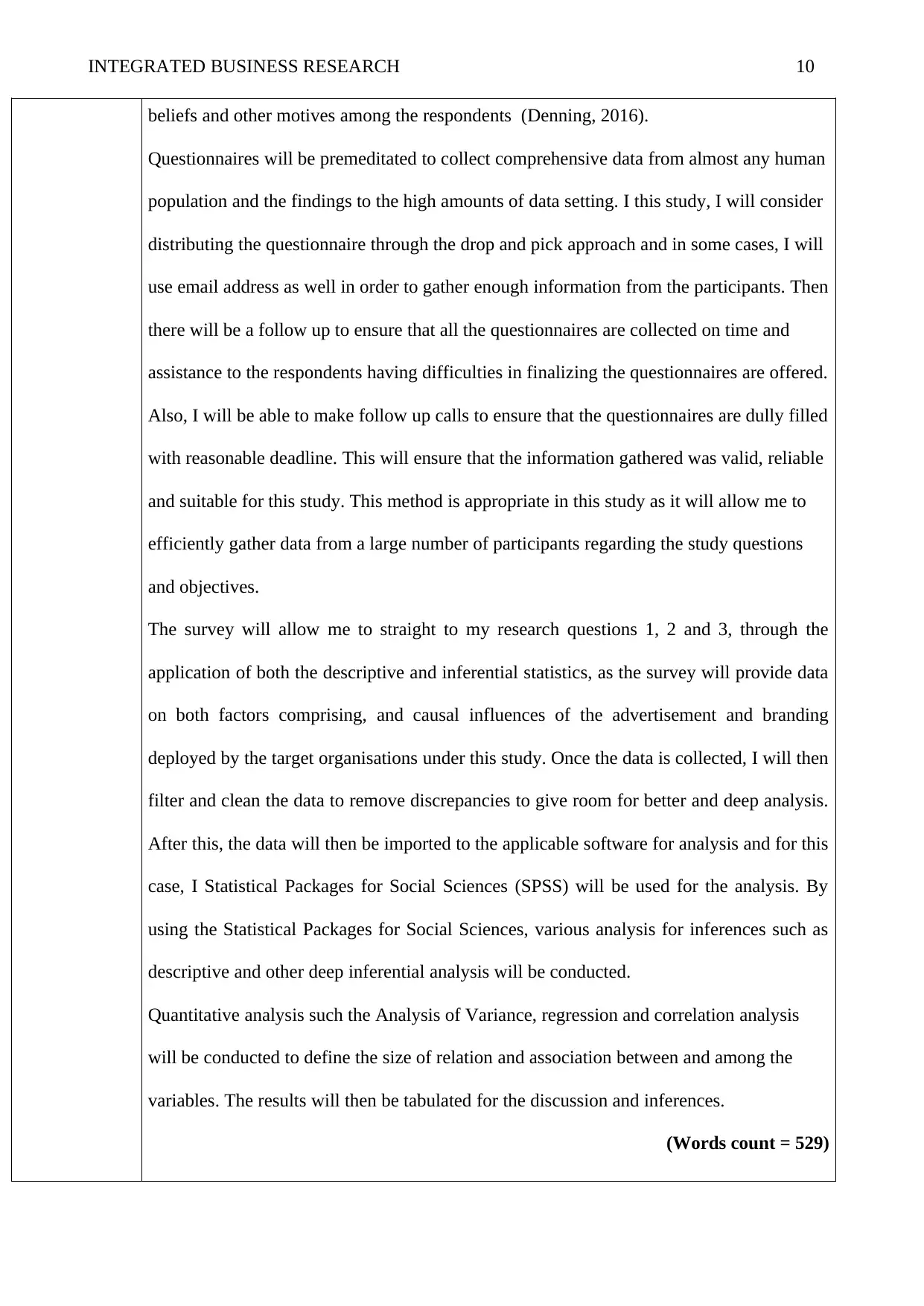
beliefs and other motives among the respondents (Denning, 2016).
Questionnaires will be premeditated to collect comprehensive data from almost any human
population and the findings to the high amounts of data setting. I this study, I will consider
distributing the questionnaire through the drop and pick approach and in some cases, I will
use email address as well in order to gather enough information from the participants. Then
there will be a follow up to ensure that all the questionnaires are collected on time and
assistance to the respondents having difficulties in finalizing the questionnaires are offered.
Also, I will be able to make follow up calls to ensure that the questionnaires are dully filled
with reasonable deadline. This will ensure that the information gathered was valid, reliable
and suitable for this study. This method is appropriate in this study as it will allow me to
efficiently gather data from a large number of participants regarding the study questions
and objectives.
The survey will allow me to straight to my research questions 1, 2 and 3, through the
application of both the descriptive and inferential statistics, as the survey will provide data
on both factors comprising, and causal influences of the advertisement and branding
deployed by the target organisations under this study. Once the data is collected, I will then
filter and clean the data to remove discrepancies to give room for better and deep analysis.
After this, the data will then be imported to the applicable software for analysis and for this
case, I Statistical Packages for Social Sciences (SPSS) will be used for the analysis. By
using the Statistical Packages for Social Sciences, various analysis for inferences such as
descriptive and other deep inferential analysis will be conducted.
Quantitative analysis such the Analysis of Variance, regression and correlation analysis
will be conducted to define the size of relation and association between and among the
variables. The results will then be tabulated for the discussion and inferences.
(Words count = 529)
beliefs and other motives among the respondents (Denning, 2016).
Questionnaires will be premeditated to collect comprehensive data from almost any human
population and the findings to the high amounts of data setting. I this study, I will consider
distributing the questionnaire through the drop and pick approach and in some cases, I will
use email address as well in order to gather enough information from the participants. Then
there will be a follow up to ensure that all the questionnaires are collected on time and
assistance to the respondents having difficulties in finalizing the questionnaires are offered.
Also, I will be able to make follow up calls to ensure that the questionnaires are dully filled
with reasonable deadline. This will ensure that the information gathered was valid, reliable
and suitable for this study. This method is appropriate in this study as it will allow me to
efficiently gather data from a large number of participants regarding the study questions
and objectives.
The survey will allow me to straight to my research questions 1, 2 and 3, through the
application of both the descriptive and inferential statistics, as the survey will provide data
on both factors comprising, and causal influences of the advertisement and branding
deployed by the target organisations under this study. Once the data is collected, I will then
filter and clean the data to remove discrepancies to give room for better and deep analysis.
After this, the data will then be imported to the applicable software for analysis and for this
case, I Statistical Packages for Social Sciences (SPSS) will be used for the analysis. By
using the Statistical Packages for Social Sciences, various analysis for inferences such as
descriptive and other deep inferential analysis will be conducted.
Quantitative analysis such the Analysis of Variance, regression and correlation analysis
will be conducted to define the size of relation and association between and among the
variables. The results will then be tabulated for the discussion and inferences.
(Words count = 529)
Paraphrase This Document
Need a fresh take? Get an instant paraphrase of this document with our AI Paraphraser
INTEGRATED BUSINESS RESEARCH 11
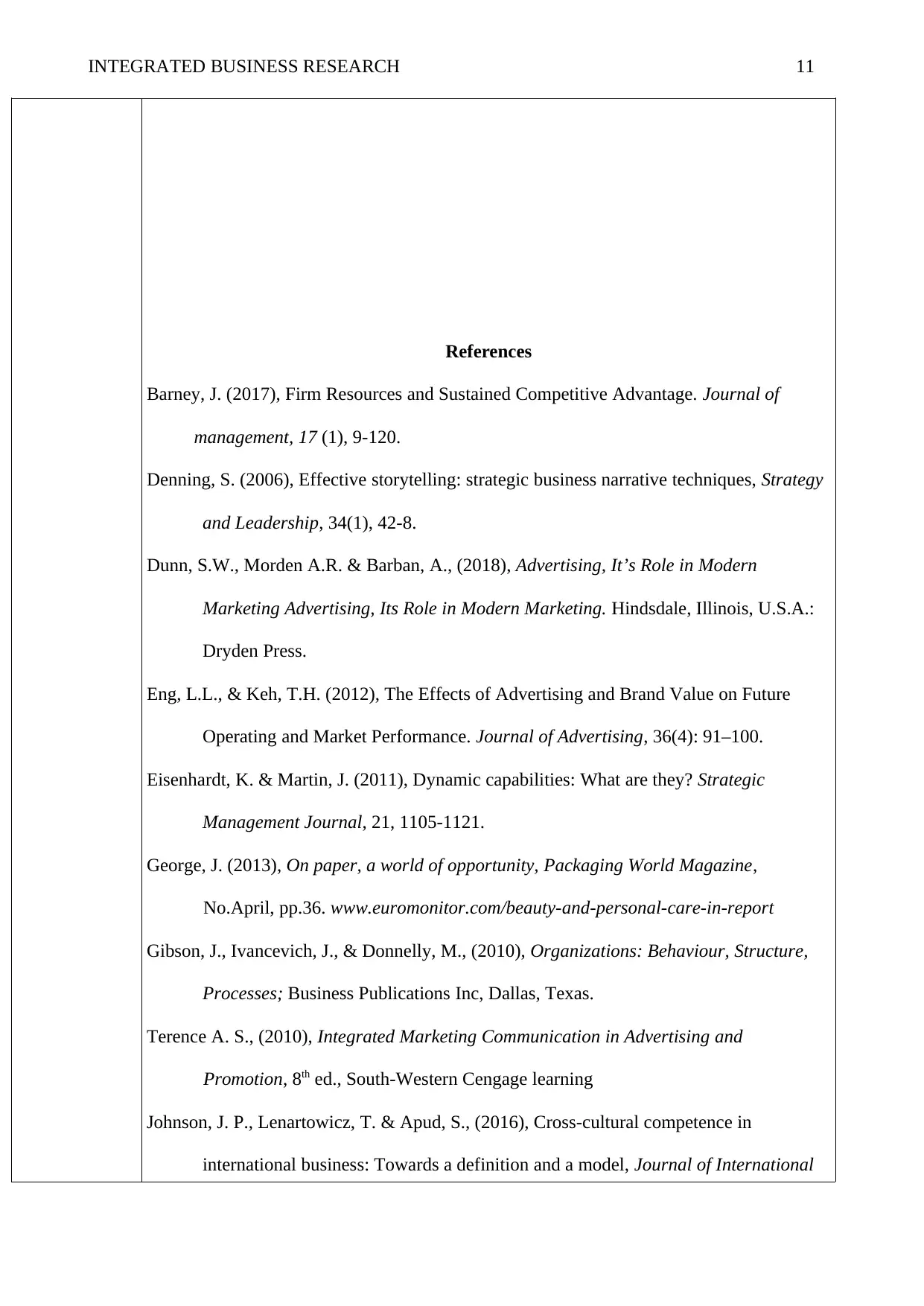
References
Barney, J. (2017), Firm Resources and Sustained Competitive Advantage. Journal of
management, 17 (1), 9-120.
Denning, S. (2006), Effective storytelling: strategic business narrative techniques, Strategy
and Leadership, 34(1), 42-8.
Dunn, S.W., Morden A.R. & Barban, A., (2018), Advertising, It’s Role in Modern
Marketing Advertising, Its Role in Modern Marketing. Hindsdale, Illinois, U.S.A.:
Dryden Press.
Eng, L.L., & Keh, T.H. (2012), The Effects of Advertising and Brand Value on Future
Operating and Market Performance. Journal of Advertising, 36(4): 91–100.
Eisenhardt, K. & Martin, J. (2011), Dynamic capabilities: What are they? Strategic
Management Journal, 21, 1105-1121.
George, J. (2013), On paper, a world of opportunity, Packaging World Magazine,
No.April, pp.36. www.euromonitor.com/beauty-and-personal-care-in-report
Gibson, J., Ivancevich, J., & Donnelly, M., (2010), Organizations: Behaviour, Structure,
Processes; Business Publications Inc, Dallas, Texas.
Terence A. S., (2010), Integrated Marketing Communication in Advertising and
Promotion, 8th ed., South-Western Cengage learning
Johnson, J. P., Lenartowicz, T. & Apud, S., (2016), Cross-cultural competence in
international business: Towards a definition and a model, Journal of International
References
Barney, J. (2017), Firm Resources and Sustained Competitive Advantage. Journal of
management, 17 (1), 9-120.
Denning, S. (2006), Effective storytelling: strategic business narrative techniques, Strategy
and Leadership, 34(1), 42-8.
Dunn, S.W., Morden A.R. & Barban, A., (2018), Advertising, It’s Role in Modern
Marketing Advertising, Its Role in Modern Marketing. Hindsdale, Illinois, U.S.A.:
Dryden Press.
Eng, L.L., & Keh, T.H. (2012), The Effects of Advertising and Brand Value on Future
Operating and Market Performance. Journal of Advertising, 36(4): 91–100.
Eisenhardt, K. & Martin, J. (2011), Dynamic capabilities: What are they? Strategic
Management Journal, 21, 1105-1121.
George, J. (2013), On paper, a world of opportunity, Packaging World Magazine,
No.April, pp.36. www.euromonitor.com/beauty-and-personal-care-in-report
Gibson, J., Ivancevich, J., & Donnelly, M., (2010), Organizations: Behaviour, Structure,
Processes; Business Publications Inc, Dallas, Texas.
Terence A. S., (2010), Integrated Marketing Communication in Advertising and
Promotion, 8th ed., South-Western Cengage learning
Johnson, J. P., Lenartowicz, T. & Apud, S., (2016), Cross-cultural competence in
international business: Towards a definition and a model, Journal of International
INTEGRATED BUSINESS RESEARCH 12
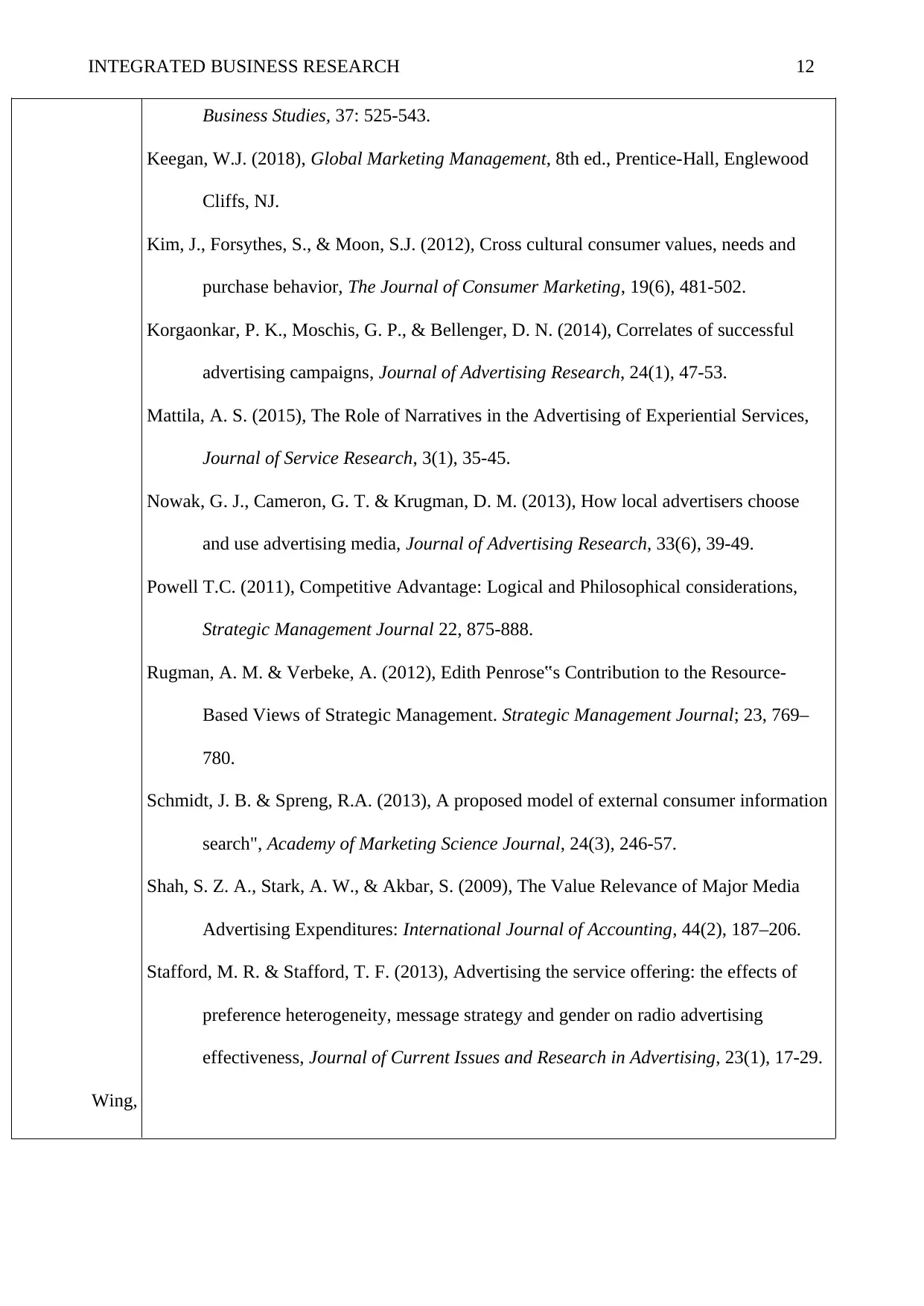
Business Studies, 37: 525-543.
Keegan, W.J. (2018), Global Marketing Management, 8th ed., Prentice-Hall, Englewood
Cliffs, NJ.
Kim, J., Forsythes, S., & Moon, S.J. (2012), Cross cultural consumer values, needs and
purchase behavior, The Journal of Consumer Marketing, 19(6), 481-502.
Korgaonkar, P. K., Moschis, G. P., & Bellenger, D. N. (2014), Correlates of successful
advertising campaigns, Journal of Advertising Research, 24(1), 47-53.
Mattila, A. S. (2015), The Role of Narratives in the Advertising of Experiential Services,
Journal of Service Research, 3(1), 35-45.
Nowak, G. J., Cameron, G. T. & Krugman, D. M. (2013), How local advertisers choose
and use advertising media, Journal of Advertising Research, 33(6), 39-49.
Powell T.C. (2011), Competitive Advantage: Logical and Philosophical considerations,
Strategic Management Journal 22, 875-888.
Rugman, A. M. & Verbeke, A. (2012), Edith Penrose‟s Contribution to the Resource-
Based Views of Strategic Management. Strategic Management Journal; 23, 769–
780.
Schmidt, J. B. & Spreng, R.A. (2013), A proposed model of external consumer information
search", Academy of Marketing Science Journal, 24(3), 246-57.
Shah, S. Z. A., Stark, A. W., & Akbar, S. (2009), The Value Relevance of Major Media
Advertising Expenditures: International Journal of Accounting, 44(2), 187–206.
Stafford, M. R. & Stafford, T. F. (2013), Advertising the service offering: the effects of
preference heterogeneity, message strategy and gender on radio advertising
effectiveness, Journal of Current Issues and Research in Advertising, 23(1), 17-29.
Wing,
Business Studies, 37: 525-543.
Keegan, W.J. (2018), Global Marketing Management, 8th ed., Prentice-Hall, Englewood
Cliffs, NJ.
Kim, J., Forsythes, S., & Moon, S.J. (2012), Cross cultural consumer values, needs and
purchase behavior, The Journal of Consumer Marketing, 19(6), 481-502.
Korgaonkar, P. K., Moschis, G. P., & Bellenger, D. N. (2014), Correlates of successful
advertising campaigns, Journal of Advertising Research, 24(1), 47-53.
Mattila, A. S. (2015), The Role of Narratives in the Advertising of Experiential Services,
Journal of Service Research, 3(1), 35-45.
Nowak, G. J., Cameron, G. T. & Krugman, D. M. (2013), How local advertisers choose
and use advertising media, Journal of Advertising Research, 33(6), 39-49.
Powell T.C. (2011), Competitive Advantage: Logical and Philosophical considerations,
Strategic Management Journal 22, 875-888.
Rugman, A. M. & Verbeke, A. (2012), Edith Penrose‟s Contribution to the Resource-
Based Views of Strategic Management. Strategic Management Journal; 23, 769–
780.
Schmidt, J. B. & Spreng, R.A. (2013), A proposed model of external consumer information
search", Academy of Marketing Science Journal, 24(3), 246-57.
Shah, S. Z. A., Stark, A. W., & Akbar, S. (2009), The Value Relevance of Major Media
Advertising Expenditures: International Journal of Accounting, 44(2), 187–206.
Stafford, M. R. & Stafford, T. F. (2013), Advertising the service offering: the effects of
preference heterogeneity, message strategy and gender on radio advertising
effectiveness, Journal of Current Issues and Research in Advertising, 23(1), 17-29.
Wing,
⊘ This is a preview!⊘
Do you want full access?
Subscribe today to unlock all pages.
Trusted by 1+ million students worldwide

1 out of 13


Related Documents


Your All-in-One AI-Powered Toolkit for Academic Success.
+13062052269
info@desklib.com
Available 24*7 on WhatsApp / Email
![[object Object]](/_next/static/media/star-bottom.7253800d.svg)
Unlock your academic potential
Copyright © 2020–2026 A2Z Services. All Rights Reserved. Developed and managed by ZUCOL.