Effective Brand Management: Strategies and Techniques Report
VerifiedAdded on 2021/03/22
|19
|5824
|278
Report
AI Summary
This report provides a comprehensive overview of brand management, encompassing key concepts and strategies essential for building and maintaining a strong brand. It begins with an introduction to branding as a crucial marketing tool, detailing its emergence and significance in contemporary business practices. The report then delves into the core elements of effective brand management, exploring the importance of branding, brand equity, and successful brand strategies. It analyzes different strategies of portfolio management, brand hierarchy and brand equity management, including the evaluation of brand leveraging and extension strategies, both domestically and internationally. The report also assesses techniques for measuring and managing brand value over time, providing specific organizational examples to illustrate these methods. Through the application of various theories, models, and concepts, the report aims to provide a holistic understanding of the techniques used for measuring and managing brand value about developing a strong and enduring brand.
Unit-42
Brand Management
Brand Management

Paraphrase This Document
Need a fresh take? Get an instant paraphrase of this document with our AI Paraphraser
Contents
Introduction:..................................................................................................................3
LO1 Understanding of how a brand is built and managed over time...........................4
P1 The importance of branding as a marketing tool and why and how it has
emerged in business practice...................................................................................4
M1 Evaluating how brands are managed successfully over time using application
of appropriate theories, models and concepts..........................................................5
P2 The key components of a successful brand strategy for building and managing
brand equity..............................................................................................................7
M2 Appropriate and validated examples within Uniliver...........................................8
LO2 Analyzing how brands are organized in portfolios; how brand hierarchies are
built and managed........................................................................................................9
P3 Analyzing different strategies of portfolio management, brand hierarchy and
brand equity management........................................................................................9
LO3 Evaluate how brands are leveraged/extended over time domestically and
internationally..............................................................................................................11
P4 Evaluate how brands are managed collaboratively and in partnership both at a
domestic and global level........................................................................................11
M4 Critically evaluate the use of different techniques used to leverage and extend
brands.....................................................................................................................14
LO4 Evaluate techniques for measuring and managing brand value over time........14
P5 Evaluate different types of techniques for measuring and managing brand
value using specific organizational examples.........................................................14
M5 Critically evaluate the application of techniques for measuring and managing
brand value about developing a strong and enduring brand..................................15
M5 Critically evaluate the application of techniques for measuring and managing
brand value about developing a strong and enduring brand..................................17
Conclusion..................................................................................................................18
References.................................................................................................................18
2
Introduction:..................................................................................................................3
LO1 Understanding of how a brand is built and managed over time...........................4
P1 The importance of branding as a marketing tool and why and how it has
emerged in business practice...................................................................................4
M1 Evaluating how brands are managed successfully over time using application
of appropriate theories, models and concepts..........................................................5
P2 The key components of a successful brand strategy for building and managing
brand equity..............................................................................................................7
M2 Appropriate and validated examples within Uniliver...........................................8
LO2 Analyzing how brands are organized in portfolios; how brand hierarchies are
built and managed........................................................................................................9
P3 Analyzing different strategies of portfolio management, brand hierarchy and
brand equity management........................................................................................9
LO3 Evaluate how brands are leveraged/extended over time domestically and
internationally..............................................................................................................11
P4 Evaluate how brands are managed collaboratively and in partnership both at a
domestic and global level........................................................................................11
M4 Critically evaluate the use of different techniques used to leverage and extend
brands.....................................................................................................................14
LO4 Evaluate techniques for measuring and managing brand value over time........14
P5 Evaluate different types of techniques for measuring and managing brand
value using specific organizational examples.........................................................14
M5 Critically evaluate the application of techniques for measuring and managing
brand value about developing a strong and enduring brand..................................15
M5 Critically evaluate the application of techniques for measuring and managing
brand value about developing a strong and enduring brand..................................17
Conclusion..................................................................................................................18
References.................................................................................................................18
2
Introduction:
In the competitive market brand is a significant asset for a company. A brand is something
that helps the customer distinguish and identify a company from other companies. Brand
bears the identity of a company. If a brand is famous, it represents the reliability and quality
of the company's products and services. This marketing tool is very effective in positioning
the company image in the customer's mind. Today, every company is trying to improve the
brand value of their products. This way the companies are trying to take over the market. In
this report, effective brand management has been discussed to improve the market equity for
a particular organization.
3
In the competitive market brand is a significant asset for a company. A brand is something
that helps the customer distinguish and identify a company from other companies. Brand
bears the identity of a company. If a brand is famous, it represents the reliability and quality
of the company's products and services. This marketing tool is very effective in positioning
the company image in the customer's mind. Today, every company is trying to improve the
brand value of their products. This way the companies are trying to take over the market. In
this report, effective brand management has been discussed to improve the market equity for
a particular organization.
3
⊘ This is a preview!⊘
Do you want full access?
Subscribe today to unlock all pages.

Trusted by 1+ million students worldwide
LO1 Understanding of how a brand is built and managed over time
P1 The importance of branding as a marketing tool and why and how it has
emerged in business practice.
A brand is a good, service, or concept which is distinguished publicly from the other goods or
services. So that it can be identified and usually communicated or marketed to the customers
(Fenn, Liang, and Prowse, 2003). This name or symbol is of the distinctive goods and
services of a particular company or organization. Branding is the process of making and
selecting the name of a brand (Mosley, 2009). These are expressed in the form of symbols,
icons, logos, infographics of the brand. Brands provide the customers with certain benefits
and values in a marketplace. A brand bears corporate identity in the market and make the
company distinguished from the competitors.
The process of planning and analysis regarding how the brand needs to be perceived by the
customers is known as Brand Management (Mosley, 2009). The brand can make an image in
the mind of the customers through brand management that helps the company to build up a
good relationship with the stakeholders especially with the customers. Indeed, brand
management is very much crucial for a business to make the goods or services produced or
served by the company distinguished from that of the other company (Mosley, 2009).
Branding provides a unique identity of the company or products and the brand management
can make the brand remarked to the market.
As a marketing tool, branding plays an important role in a business organization. Branding
can change the perception of people to a brand. It can help to be run a new business and
enlarge brand awareness. There are several reasons for branding to be a largely used business
practice.
Branding makes Recognition: Through branding company gets recognition and the
customer can come to have a clear concept or perception about the company
(Kapferer, 2012). The iconic symbol is the most important thing of branding. It is
essentially the face of the company.
Branding Increases Business Value: Business value can be ensured by branding. It
increases the value of the business by making perception or knocking the mind of the
customers and by establishing appealing opportunities in the marketplace (Kapferer,
2012).
4
P1 The importance of branding as a marketing tool and why and how it has
emerged in business practice.
A brand is a good, service, or concept which is distinguished publicly from the other goods or
services. So that it can be identified and usually communicated or marketed to the customers
(Fenn, Liang, and Prowse, 2003). This name or symbol is of the distinctive goods and
services of a particular company or organization. Branding is the process of making and
selecting the name of a brand (Mosley, 2009). These are expressed in the form of symbols,
icons, logos, infographics of the brand. Brands provide the customers with certain benefits
and values in a marketplace. A brand bears corporate identity in the market and make the
company distinguished from the competitors.
The process of planning and analysis regarding how the brand needs to be perceived by the
customers is known as Brand Management (Mosley, 2009). The brand can make an image in
the mind of the customers through brand management that helps the company to build up a
good relationship with the stakeholders especially with the customers. Indeed, brand
management is very much crucial for a business to make the goods or services produced or
served by the company distinguished from that of the other company (Mosley, 2009).
Branding provides a unique identity of the company or products and the brand management
can make the brand remarked to the market.
As a marketing tool, branding plays an important role in a business organization. Branding
can change the perception of people to a brand. It can help to be run a new business and
enlarge brand awareness. There are several reasons for branding to be a largely used business
practice.
Branding makes Recognition: Through branding company gets recognition and the
customer can come to have a clear concept or perception about the company
(Kapferer, 2012). The iconic symbol is the most important thing of branding. It is
essentially the face of the company.
Branding Increases Business Value: Business value can be ensured by branding. It
increases the value of the business by making perception or knocking the mind of the
customers and by establishing appealing opportunities in the marketplace (Kapferer,
2012).
4
Paraphrase This Document
Need a fresh take? Get an instant paraphrase of this document with our AI Paraphraser
Generates New Customers: Branding plays the important role for attracting more
and more customer to this company or products. If a brand value is highly positive, it
must make a positive insight to the customers. And this positive view will bring more
customer to the business.
Develop Employee Pride and Satisfaction: An employee also feels proud working
for a high-profile brand. It will give him more satisfaction in the workplace. Working
for a reputed brand is more high respective work to an employee.
Builds Trust Within the Marketplace: A brand can be identified easily from many
other brands in a marketplace. A reputed brand must fulfil the customer satisfaction
(Kapferer, 2012). It targets the needs and wants of the customer. So, the first thinking
of a customer to this particular brand can not be negative when this build enough faith
about this brand in the market.
Branding Supports Advertising: Advertising is another element to branding. An
advertising strategy reflect directly the brand. Advertising such as the use of
promotional products of reputed companies with reputed Branding make it easy to
create an appealing advertising.
M1 Evaluating how brands are managed successfully over time using
application of appropriate theories, models and concepts.
Brand is considered as the identity or the recognition of a goods or service or the company
itself. So, branding plays a very important role for a firm to be progressive. Through a brand,
a company can take the position in the mind of the customers. It can differentiate its product
or services through branding (Kapferer, 2012). So, it is very significant for a company to
manage a brand effectively. A company has to take different types of techniques and
approaches to manage a brand successfully in the marketplace.
There are different types of theories those are related to the techniques of brand management.
Those techniques which support the strategies for better performance are discussed below.
1. Theory of Brand Loyalty:
5
and more customer to this company or products. If a brand value is highly positive, it
must make a positive insight to the customers. And this positive view will bring more
customer to the business.
Develop Employee Pride and Satisfaction: An employee also feels proud working
for a high-profile brand. It will give him more satisfaction in the workplace. Working
for a reputed brand is more high respective work to an employee.
Builds Trust Within the Marketplace: A brand can be identified easily from many
other brands in a marketplace. A reputed brand must fulfil the customer satisfaction
(Kapferer, 2012). It targets the needs and wants of the customer. So, the first thinking
of a customer to this particular brand can not be negative when this build enough faith
about this brand in the market.
Branding Supports Advertising: Advertising is another element to branding. An
advertising strategy reflect directly the brand. Advertising such as the use of
promotional products of reputed companies with reputed Branding make it easy to
create an appealing advertising.
M1 Evaluating how brands are managed successfully over time using
application of appropriate theories, models and concepts.
Brand is considered as the identity or the recognition of a goods or service or the company
itself. So, branding plays a very important role for a firm to be progressive. Through a brand,
a company can take the position in the mind of the customers. It can differentiate its product
or services through branding (Kapferer, 2012). So, it is very significant for a company to
manage a brand effectively. A company has to take different types of techniques and
approaches to manage a brand successfully in the marketplace.
There are different types of theories those are related to the techniques of brand management.
Those techniques which support the strategies for better performance are discussed below.
1. Theory of Brand Loyalty:
5
This theory asserts the relationship between the psychology of the customer and the brand of
a particular company. How the customer perception to a brand is figured out according to this
theory (Grønholdt and Martensen, 2004). Here the behavior of the customer to a brand also
considered. The positive customer behavior brings more success to a brand. The brand is
considered to be loyal or trusted to the customer or in the market. According to this theory,
there is an emotional attachment to a brand. It may be positive or negative. That is, how much
the customer like or dislike the product. If the emotional attachment positive, then the
customer will highly inclined to buy the product or goods under that particular brand.
2. The Branding Theory:
The branding theory is very much significant for branding. This theory gives some guidance
on some significant components of brand management through what brand can be managed
very effectively in a competitive market.
The specific name, icon or symbol can portray the business standards. These standards differ
from that of other companies. That difference adds extra value to the company. An effective
management of branding can make the people aware of that particular brand (Grønholdt and
Martensen, 2004). So, people can easily identify their desired goods and services. And they
can fulfill their demand by their consumption. According to this theory, a company always
try to provide the customer what they want that help the company to establish a relationship
with the customers and then keep on growing.
3.Value-based Brand Theory:
This theory focuses on the value that a company can add to the customer through its offered
goods and services. This theory asserts that the brand that is based on the value can build up
long term customer relationship on the basic of the value addition. The success of a company
depends on the value that a particular brand adds to the potential and existing customers
(Grønholdt and Martensen, 2004). According to this theory it is believed that adding more
value to the customer can differentiate or can give extra advantages than the competitors. So,
a company always try to add value through its brand management techniques. All the
strategies and techniques that a company take have to be taken focusing on the maximization
of customer satisfaction (Grønholdt and Martensen, 2004). As this theory says that customers
are the blood of a brand, a company always try to give maximum emphasis on customer
satisfaction.
6
a particular company. How the customer perception to a brand is figured out according to this
theory (Grønholdt and Martensen, 2004). Here the behavior of the customer to a brand also
considered. The positive customer behavior brings more success to a brand. The brand is
considered to be loyal or trusted to the customer or in the market. According to this theory,
there is an emotional attachment to a brand. It may be positive or negative. That is, how much
the customer like or dislike the product. If the emotional attachment positive, then the
customer will highly inclined to buy the product or goods under that particular brand.
2. The Branding Theory:
The branding theory is very much significant for branding. This theory gives some guidance
on some significant components of brand management through what brand can be managed
very effectively in a competitive market.
The specific name, icon or symbol can portray the business standards. These standards differ
from that of other companies. That difference adds extra value to the company. An effective
management of branding can make the people aware of that particular brand (Grønholdt and
Martensen, 2004). So, people can easily identify their desired goods and services. And they
can fulfill their demand by their consumption. According to this theory, a company always
try to provide the customer what they want that help the company to establish a relationship
with the customers and then keep on growing.
3.Value-based Brand Theory:
This theory focuses on the value that a company can add to the customer through its offered
goods and services. This theory asserts that the brand that is based on the value can build up
long term customer relationship on the basic of the value addition. The success of a company
depends on the value that a particular brand adds to the potential and existing customers
(Grønholdt and Martensen, 2004). According to this theory it is believed that adding more
value to the customer can differentiate or can give extra advantages than the competitors. So,
a company always try to add value through its brand management techniques. All the
strategies and techniques that a company take have to be taken focusing on the maximization
of customer satisfaction (Grønholdt and Martensen, 2004). As this theory says that customers
are the blood of a brand, a company always try to give maximum emphasis on customer
satisfaction.
6
⊘ This is a preview!⊘
Do you want full access?
Subscribe today to unlock all pages.
Trusted by 1+ million students worldwide
P2 The key components of a successful brand strategy for building and
managing brand equity
There needs lots of time for a brand to be strong. So, there needs a long -term strategy to be
strong for a brand. The strategies are considered as guidance of how a company can be bound
to its understanding of the needs of customer. Only effective brand management strategies
can attract the customer fulfilling their needs and demands.
A premium value that a company can makes from a goods or service with a popular name
while comparing is known as Brand Equity (Benner, 2001). A company can generate a brand
equity for its products in the market by making them easily identifiable, highly acceptable,
standard in quality and reliable to the customer. If a company has positive brand equity,
customer will not hesitate to pay higher price for its product. Consumers will to pay higher
price even though they are provided same product from other company for less amount
(Benner, 2001).
There are different types of components for the techniques of an effective brand management
strategy.
1. Brand Purpose
Firstly, a company needs to know why it is creating a brand. It needs the basic purpose or
objective for managing a brand. The purpose or objective is the main reason for the existence
of a business. Though the main purpose is to make profit, but the purpose of a brand is to
clarify it to the customer (Field, 2009). This purpose rings loudly for the targeted and
potential customer. If the purpose of a brand is vivid to the customer, then it will be very
much easy to make position in the mind of the customer. Brand equity can be established
easily.
2. BRAND PROMISE.
The message that is provided to the customer through the brand is known as Brand Promise.
Brand promise says the customers what they expect by buying the product of that company.
There can be a survey by the company to make sure that the company is keeping the promise
that it passes to the customers (Field, 2009). For building up a strong brand equity in the
7
managing brand equity
There needs lots of time for a brand to be strong. So, there needs a long -term strategy to be
strong for a brand. The strategies are considered as guidance of how a company can be bound
to its understanding of the needs of customer. Only effective brand management strategies
can attract the customer fulfilling their needs and demands.
A premium value that a company can makes from a goods or service with a popular name
while comparing is known as Brand Equity (Benner, 2001). A company can generate a brand
equity for its products in the market by making them easily identifiable, highly acceptable,
standard in quality and reliable to the customer. If a company has positive brand equity,
customer will not hesitate to pay higher price for its product. Consumers will to pay higher
price even though they are provided same product from other company for less amount
(Benner, 2001).
There are different types of components for the techniques of an effective brand management
strategy.
1. Brand Purpose
Firstly, a company needs to know why it is creating a brand. It needs the basic purpose or
objective for managing a brand. The purpose or objective is the main reason for the existence
of a business. Though the main purpose is to make profit, but the purpose of a brand is to
clarify it to the customer (Field, 2009). This purpose rings loudly for the targeted and
potential customer. If the purpose of a brand is vivid to the customer, then it will be very
much easy to make position in the mind of the customer. Brand equity can be established
easily.
2. BRAND PROMISE.
The message that is provided to the customer through the brand is known as Brand Promise.
Brand promise says the customers what they expect by buying the product of that company.
There can be a survey by the company to make sure that the company is keeping the promise
that it passes to the customers (Field, 2009). For building up a strong brand equity in the
7
Paraphrase This Document
Need a fresh take? Get an instant paraphrase of this document with our AI Paraphraser
market a company must maintain the brand promise. They should try to give service beyond
the brand promise.
3. BRAND PERCEPTION
Brand perception means the customers belief to a goods or service of a company. It comes
from customer use, experience, acceptability, reputation. It also comes from the word of
mouth recommendation – face to face or indirectly. Brand perception plays an important role
in building a brand equity.
4. BRAND VALUE
The financial value of a brand is considered as Brand Value. It can realize when it is replaced
or sold out. Companies make investment on their brands to make a strong brand value. In the
time of acquisition or selling buyers pays premium amount for the goodwill of the brand.
5. BRAND PERSONALIY
Brand personality means the features associated with a brand that the customer can relate. It
includes different types of characteristics such as conservative, humour, innovative,
inspirational and so forth (Field, 2009). This creates extra value to the company along with
increasing the brand equity.
6. BRAND POSITIONING
It means the position that a brand possesses in the mind of the customers. Basically, a
company always wants to satisfy its consumers and try to provide or add value to the
customers. Through the best service and goods, it can build up a positive insight into the
mind of the consumers. So, the consumers have a positive aspect or view of that brand. Thus,
brand positioning occurs (Ind, 2006). It represents the position of the brand in the market
relative to the competitors of a company. Brand strategy is an important tool that can develop
a brand so that the customers can easily identify and accept that particular brand.
M2 Appropriate and validated examples within Uniliver
Uniliver is a UK-based multinational company which products are available in around 190
countries across the world. The product line of Uniliver includes food and beverage, personal
care product, beauty products. It is a renowned company in the Europe (Unilever global
8
the brand promise.
3. BRAND PERCEPTION
Brand perception means the customers belief to a goods or service of a company. It comes
from customer use, experience, acceptability, reputation. It also comes from the word of
mouth recommendation – face to face or indirectly. Brand perception plays an important role
in building a brand equity.
4. BRAND VALUE
The financial value of a brand is considered as Brand Value. It can realize when it is replaced
or sold out. Companies make investment on their brands to make a strong brand value. In the
time of acquisition or selling buyers pays premium amount for the goodwill of the brand.
5. BRAND PERSONALIY
Brand personality means the features associated with a brand that the customer can relate. It
includes different types of characteristics such as conservative, humour, innovative,
inspirational and so forth (Field, 2009). This creates extra value to the company along with
increasing the brand equity.
6. BRAND POSITIONING
It means the position that a brand possesses in the mind of the customers. Basically, a
company always wants to satisfy its consumers and try to provide or add value to the
customers. Through the best service and goods, it can build up a positive insight into the
mind of the consumers. So, the consumers have a positive aspect or view of that brand. Thus,
brand positioning occurs (Ind, 2006). It represents the position of the brand in the market
relative to the competitors of a company. Brand strategy is an important tool that can develop
a brand so that the customers can easily identify and accept that particular brand.
M2 Appropriate and validated examples within Uniliver
Uniliver is a UK-based multinational company which products are available in around 190
countries across the world. The product line of Uniliver includes food and beverage, personal
care product, beauty products. It is a renowned company in the Europe (Unilever global
8
company website. 2020). Uniliver wants to increase its market share through strengthening
its brand equity. So, it needs to implement proper strategy of brand management techniques.
Uniliver is maintaining the image of its brand very much strongly. The reputation and market
equity of a brand makes its profits. So, Uniliver can attract more customers and can provide
more of the quality service (Unilever global company website. 2020). There are lots of
theories or practices that can upgrade the market equity and position of Uniliver. This
company is working for the betterment of the consumers providing quality goods and
services as well as its employees (Smiley and Donnellan, 2000). If Uniliver wants to launch a
new product it needs to figured out the purpose of the branding that can increase the market
equity. Besides, Uniliver has to make the targeted consumer know about the promise of the
brand. What Uniliver is going to offer is to very much clear to the customers (Unilever global
company website. 2020).
As Uniliver is well-reputed company in UK, it will be bit easier for this organization to make
acquainted to the products offered by this company. The branding of Uniliver has to be such
that the customer can easily relate the products to their expectation from Uniliver. So, this
company has to provide best quality for making a position in the mind of the customers.
Meanwhile, the customers will hold a positive insight about this brand.
LO2 Analyzing how brands are organized in portfolios; how brand
hierarchies are built and managed
P3 Analyzing different strategies of portfolio management, brand hierarchy and
brand equity management.
Portfolio management strategy
There are many portfolio strategies for the management of the company and its brand. But all
the strategies cannot be used in a brand management technique. The few types of brand
strategies that is taken in portfolios are given below:
i. Down to up strategy: According to Down to Up strategy, brands are separated or
divided into according to the products or other criteria. This strategy is only taken in a
portfolio strategy when an organization does well for itself. This strategy is very much
effective for a company.
9
its brand equity. So, it needs to implement proper strategy of brand management techniques.
Uniliver is maintaining the image of its brand very much strongly. The reputation and market
equity of a brand makes its profits. So, Uniliver can attract more customers and can provide
more of the quality service (Unilever global company website. 2020). There are lots of
theories or practices that can upgrade the market equity and position of Uniliver. This
company is working for the betterment of the consumers providing quality goods and
services as well as its employees (Smiley and Donnellan, 2000). If Uniliver wants to launch a
new product it needs to figured out the purpose of the branding that can increase the market
equity. Besides, Uniliver has to make the targeted consumer know about the promise of the
brand. What Uniliver is going to offer is to very much clear to the customers (Unilever global
company website. 2020).
As Uniliver is well-reputed company in UK, it will be bit easier for this organization to make
acquainted to the products offered by this company. The branding of Uniliver has to be such
that the customer can easily relate the products to their expectation from Uniliver. So, this
company has to provide best quality for making a position in the mind of the customers.
Meanwhile, the customers will hold a positive insight about this brand.
LO2 Analyzing how brands are organized in portfolios; how brand
hierarchies are built and managed
P3 Analyzing different strategies of portfolio management, brand hierarchy and
brand equity management.
Portfolio management strategy
There are many portfolio strategies for the management of the company and its brand. But all
the strategies cannot be used in a brand management technique. The few types of brand
strategies that is taken in portfolios are given below:
i. Down to up strategy: According to Down to Up strategy, brands are separated or
divided into according to the products or other criteria. This strategy is only taken in a
portfolio strategy when an organization does well for itself. This strategy is very much
effective for a company.
9
⊘ This is a preview!⊘
Do you want full access?
Subscribe today to unlock all pages.
Trusted by 1+ million students worldwide
ii. Top to down: In this strategy, the manager holds all the power and responsibility to
judge or assess the market (AAKER, 2020). After completion the assessment, the
brands are divided and selected by the managers to manage for making profit for the
company.
iii. Aggressive portfolio: According to this strategy, the brand is highly interested in
high-risk stock in order to making a high profit If proper and sufficient care is not
taken in this strategy, this costs a lot for a company (AAKER, 2020). The cost will be
very much disastrous for that particular organization.
Brand portfolio:
Branding is getting upgraded over the time. The policy and strategy of branding is being
changed day by day. In the modern era of marketing, a brand has different types of diversities
(AAKER, 2020). A strong brand may have different sub- brand. Even, some brands can be
under a single name or symbol. Brand architecture decides how different brands and the sub-
brands will interact with each other. Through brand architecture, different brands help each
other to make profit and build up a strong customer equity. And a strong customer equity
may make the market equity much bigger. The organizations use brand portfolio for getting
brands, sub-brands, and products to work with each other (AAKER, 2020). Moreover, a
strong brand portfolio can make sure that there is no unwanted competition between those
brands.
Brand portfolio strategies:
Brand portfolio strategy is very important for brand portfolio management. The different
brand portfolio strategies are given below:
House of Brand: When products from different branded are housed under a single
company, it is known as a house of brand. P&G is a very common example of a house
of brand. Many different branded products are produced by this company and
marketed under its name (AAKER, 2020). The consumers are familiar with the
product. It is not necessary for the customer to be acquainted with the company.
Branded house: in this portfolio, sub-brands are known as products and the company
itself is the main brand. So, under the main brand name, the products are sold. FedEx
10
judge or assess the market (AAKER, 2020). After completion the assessment, the
brands are divided and selected by the managers to manage for making profit for the
company.
iii. Aggressive portfolio: According to this strategy, the brand is highly interested in
high-risk stock in order to making a high profit If proper and sufficient care is not
taken in this strategy, this costs a lot for a company (AAKER, 2020). The cost will be
very much disastrous for that particular organization.
Brand portfolio:
Branding is getting upgraded over the time. The policy and strategy of branding is being
changed day by day. In the modern era of marketing, a brand has different types of diversities
(AAKER, 2020). A strong brand may have different sub- brand. Even, some brands can be
under a single name or symbol. Brand architecture decides how different brands and the sub-
brands will interact with each other. Through brand architecture, different brands help each
other to make profit and build up a strong customer equity. And a strong customer equity
may make the market equity much bigger. The organizations use brand portfolio for getting
brands, sub-brands, and products to work with each other (AAKER, 2020). Moreover, a
strong brand portfolio can make sure that there is no unwanted competition between those
brands.
Brand portfolio strategies:
Brand portfolio strategy is very important for brand portfolio management. The different
brand portfolio strategies are given below:
House of Brand: When products from different branded are housed under a single
company, it is known as a house of brand. P&G is a very common example of a house
of brand. Many different branded products are produced by this company and
marketed under its name (AAKER, 2020). The consumers are familiar with the
product. It is not necessary for the customer to be acquainted with the company.
Branded house: in this portfolio, sub-brands are known as products and the company
itself is the main brand. So, under the main brand name, the products are sold. FedEx
10
Paraphrase This Document
Need a fresh take? Get an instant paraphrase of this document with our AI Paraphraser
is a such type of example of this type of portfolio. The services that are provided by
FedEx are the sub-brand and FedEx is the main brand of the company.
Hybrid: When a brand portfolio has components of both Branded House and House
of brand, it is called a hybrid portfolio strategy (AAKER, 2020). Coca-Cola is an
example of such a portfolio. Coca-Cola itself is a product and a brand also it has
subsidiary products such as sprite.
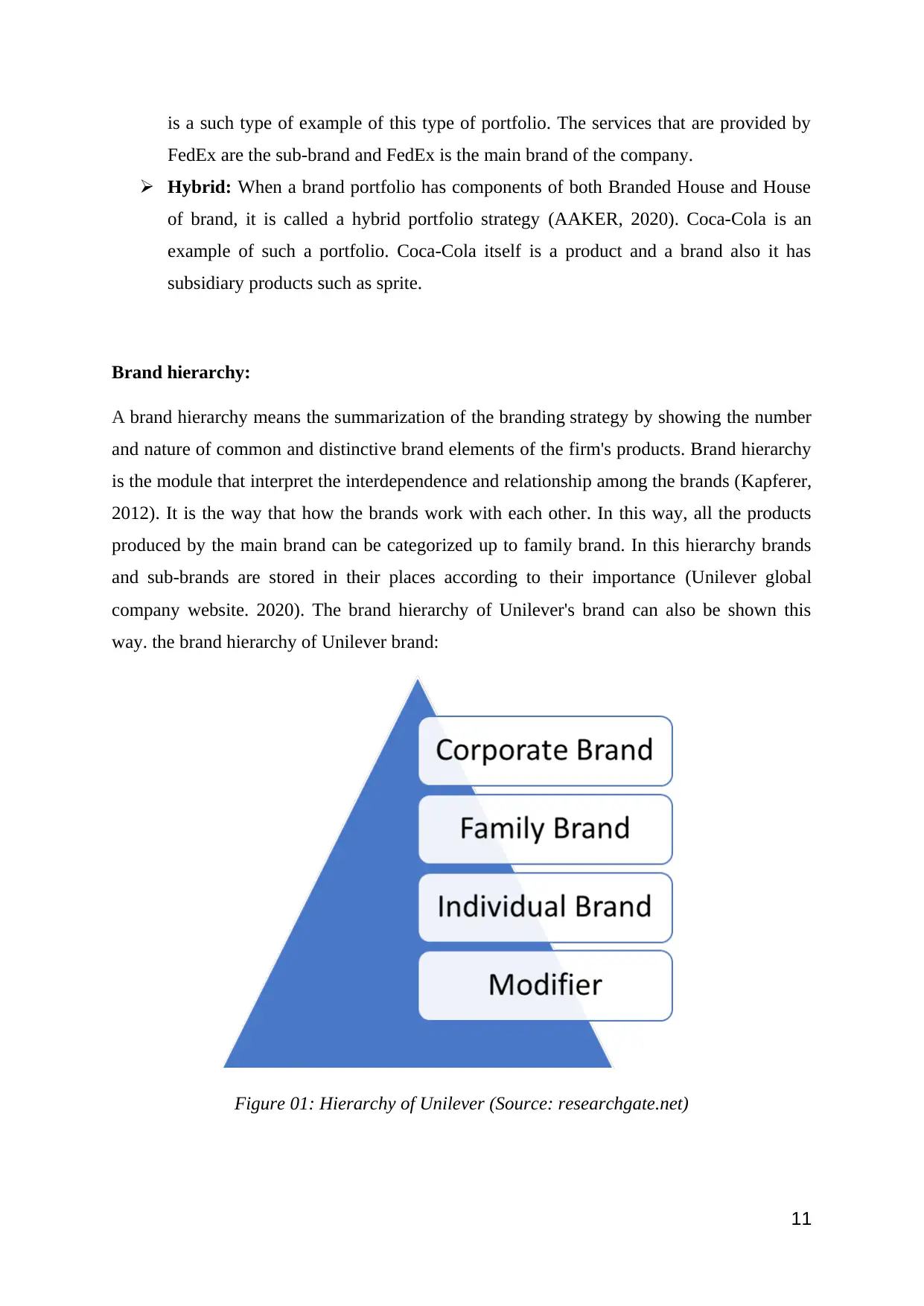
Brand hierarchy:
A brand hierarchy means the summarization of the branding strategy by showing the number
and nature of common and distinctive brand elements of the firm's products. Brand hierarchy
is the module that interpret the interdependence and relationship among the brands (Kapferer,
2012). It is the way that how the brands work with each other. In this way, all the products
produced by the main brand can be categorized up to family brand. In this hierarchy brands
and sub-brands are stored in their places according to their importance (Unilever global
company website. 2020). The brand hierarchy of Unilever's brand can also be shown this
way. the brand hierarchy of Unilever brand:
Figure 01: Hierarchy of Unilever (Source: researchgate.net)
11
FedEx are the sub-brand and FedEx is the main brand of the company.
Hybrid: When a brand portfolio has components of both Branded House and House
of brand, it is called a hybrid portfolio strategy (AAKER, 2020). Coca-Cola is an
example of such a portfolio. Coca-Cola itself is a product and a brand also it has
subsidiary products such as sprite.
Brand hierarchy:
A brand hierarchy means the summarization of the branding strategy by showing the number
and nature of common and distinctive brand elements of the firm's products. Brand hierarchy
is the module that interpret the interdependence and relationship among the brands (Kapferer,
2012). It is the way that how the brands work with each other. In this way, all the products
produced by the main brand can be categorized up to family brand. In this hierarchy brands
and sub-brands are stored in their places according to their importance (Unilever global
company website. 2020). The brand hierarchy of Unilever's brand can also be shown this
way. the brand hierarchy of Unilever brand:
Figure 01: Hierarchy of Unilever (Source: researchgate.net)
11
LO3 Evaluate how brands are leveraged/extended over time
domestically and internationally
P4 Evaluate how brands are managed collaboratively and in partnership both at
a domestic and global level.
Brand collaborations are one of the easiest ways to expand and increase the brand value. The
companies use different brand collaborations in order to make benefit of each other. Two or
more than two brands form a strategic alliance to create a brand collaboration (Kapferer,
2012). Again, companies use brand leverage and extension in order to create more customers.
This helps to extend their product line. Sometimes a domestic brand and a foreign brand
might also become a partner in order to provide extra benefits to the customers and get the
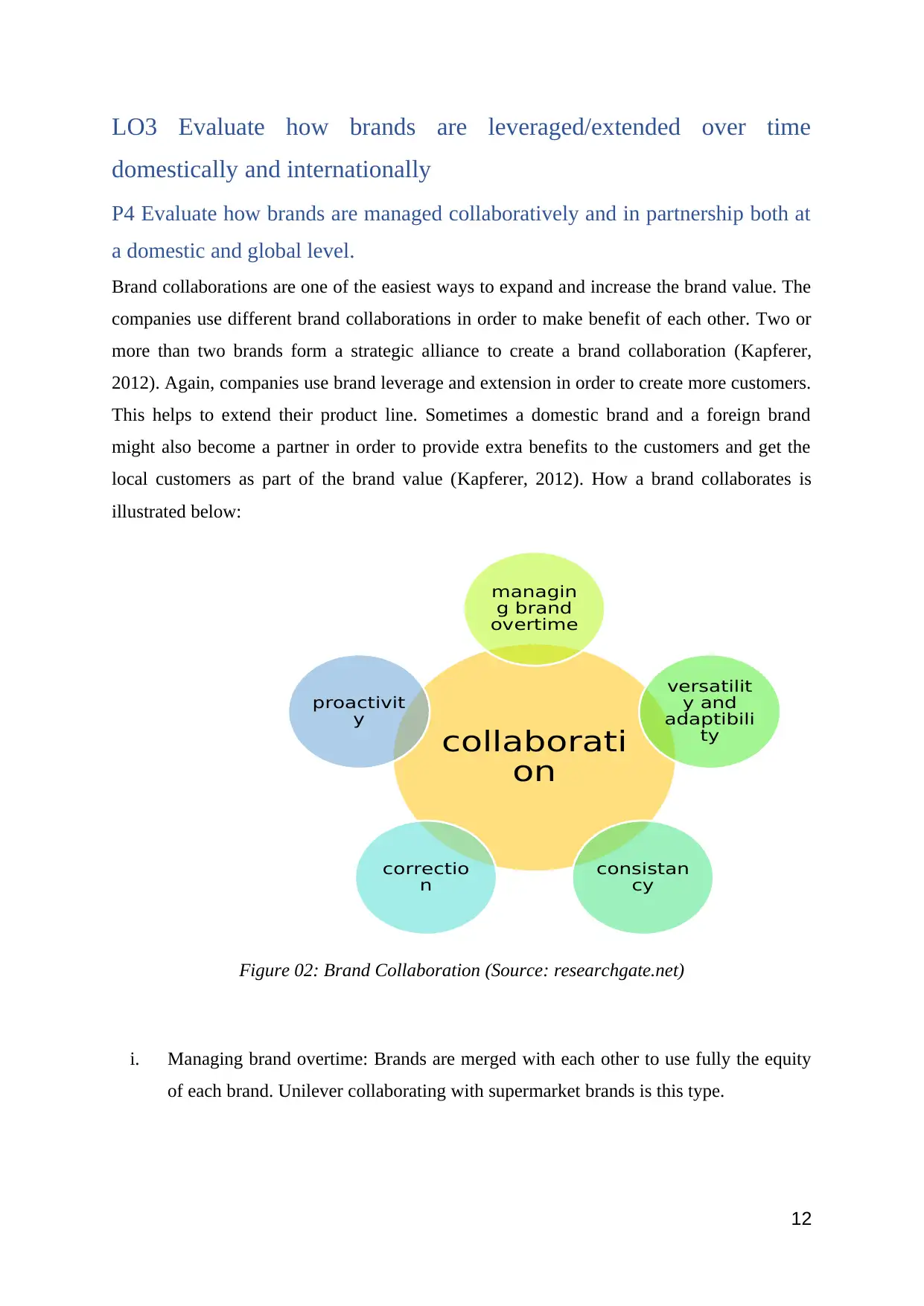
local customers as part of the brand value (Kapferer, 2012). How a brand collaborates is
illustrated below:
Figure 02: Brand Collaboration (Source: researchgate.net)
i. Managing brand overtime: Brands are merged with each other to use fully the equity
of each brand. Unilever collaborating with supermarket brands is this type.
12
collaborati
on
managin
g brand
overtime
versatilit
y and
adaptibili
ty
consistan
cy
correctio
n
proactivit
y
domestically and internationally
P4 Evaluate how brands are managed collaboratively and in partnership both at
a domestic and global level.
Brand collaborations are one of the easiest ways to expand and increase the brand value. The
companies use different brand collaborations in order to make benefit of each other. Two or
more than two brands form a strategic alliance to create a brand collaboration (Kapferer,
2012). Again, companies use brand leverage and extension in order to create more customers.
This helps to extend their product line. Sometimes a domestic brand and a foreign brand
might also become a partner in order to provide extra benefits to the customers and get the
local customers as part of the brand value (Kapferer, 2012). How a brand collaborates is
illustrated below:
Figure 02: Brand Collaboration (Source: researchgate.net)
i. Managing brand overtime: Brands are merged with each other to use fully the equity
of each brand. Unilever collaborating with supermarket brands is this type.
12
collaborati
on
managin
g brand
overtime
versatilit
y and
adaptibili
ty
consistan
cy
correctio
n
proactivit
y
⊘ This is a preview!⊘
Do you want full access?
Subscribe today to unlock all pages.
Trusted by 1+ million students worldwide

1 out of 19


Related Documents


Your All-in-One AI-Powered Toolkit for Academic Success.
+13062052269
info@desklib.com
Available 24*7 on WhatsApp / Email
![[object Object]](/_next/static/media/star-bottom.7253800d.svg)
Unlock your academic potential
Copyright © 2020–2026 A2Z Services. All Rights Reserved. Developed and managed by ZUCOL.