Effective Business Communication: Diagnostic Tests and Reflection
VerifiedAdded on 2020/05/16
|24
|5714
|122
Report
AI Summary
This report provides an in-depth analysis of effective business communication, utilizing various diagnostic tools to assess communication styles and identify areas for improvement. The student conducted self-assessments, including the Self-Perceived Communication Competence Scale (SPCC), Personal Report of Intercultural Communication Apprehension (PRICA), Talkaholic Scale, Personal Report of Public Speaking Anxiety (PRPSA), and Non-Verbal Immediacy Scale Self-Report (NIS-S). The results revealed strengths in intercultural communication but also highlighted public speaking anxiety and a tendency toward excessive talking in certain situations. The report includes personal reflections on communication challenges, a literature review exploring the identified issues, and an action plan to develop competence in communication. The student aims to improve confidence in public speaking and manage tendencies towards compulsive talking. The report also incorporates relevant communication models and behavioral skills, offering a comprehensive understanding of effective business communication practices.
Running head: EFFECTIVE BUSINESS COMMUNICATION
Effective business communication
Name of the student
University name
Author’s note
Effective business communication
Name of the student
University name
Author’s note

Paraphrase This Document
Need a fresh take? Get an instant paraphrase of this document with our AI Paraphraser
1
EFFECTIVE BUSINESS COMMUNICATION
Table of Contents
Diagnosis and reflection:........................................................................................................2
Background................................................................................................................................2
Discussion of communication tools result.................................................................................4
Communication issues...............................................................................................................6
Reflection...................................................................................................................................7
Literature review:...................................................................................................................7
Discussion of the identified communication issues...................................................................7
Models of business communication...........................................................................................9
Conceptual and behavioural skills for developing competence in communication.................10
Action plan...............................................................................................................................12
References............................................................................................................................16
Appendices...........................................................................................................................21
Appendix 1...............................................................................................................................21
Appendix 2...............................................................................................................................21
Appendix 3...............................................................................................................................22
Appendix 4...............................................................................................................................22
Appendix 5...............................................................................................................................23
EFFECTIVE BUSINESS COMMUNICATION
Table of Contents
Diagnosis and reflection:........................................................................................................2
Background................................................................................................................................2
Discussion of communication tools result.................................................................................4
Communication issues...............................................................................................................6
Reflection...................................................................................................................................7
Literature review:...................................................................................................................7
Discussion of the identified communication issues...................................................................7
Models of business communication...........................................................................................9
Conceptual and behavioural skills for developing competence in communication.................10
Action plan...............................................................................................................................12
References............................................................................................................................16
Appendices...........................................................................................................................21
Appendix 1...............................................................................................................................21
Appendix 2...............................................................................................................................21
Appendix 3...............................................................................................................................22
Appendix 4...............................................................................................................................22
Appendix 5...............................................................................................................................23
2
EFFECTIVE BUSINESS COMMUNICATION
Diagnosis and reflection:
Background
Communication serves as one of the important parameters of effective business
policies and procedures. The communication can be divided into a number of following types
such as- verbal communication, non-verbal communication, active listening etc. The business
communication consists of the guidelines using which the employees, management and
administration interact for reaching the organizational goals. In the current assignment, a
number of communication tools have been used for diagnosis, which helps in analysing the
strengths and gaps of the different communication patterns. In order to make the business
communication effective a number of steps could be undertaken such as the establishment of
a hierarchy, use of visual communication for interaction, etc. As commented by Bovee, Thill
& Raina (2016), effective face to face communication helps in resolution of issues in much
shorter time. Communication serves as the organising element within the business context
and helps in learning about the organizational goals.
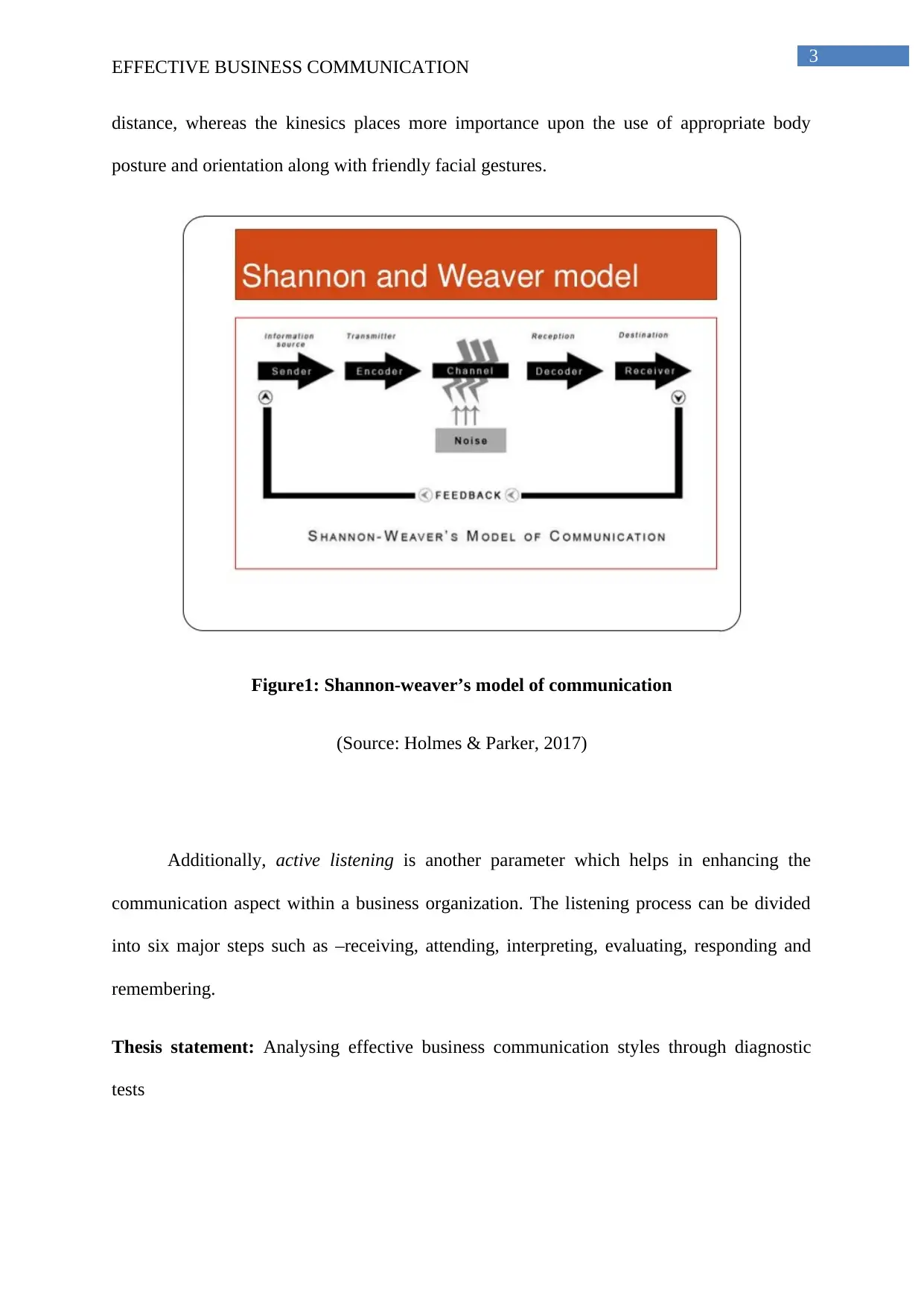
In this respect, the Shannon-weaver’s model of communication can be used in order to
explain the physical process of communication. Here, an information source encodes a
message which is transmitted via a channel to the decoder. However as argued by Holmes &
Parker (2017), the message does not reach the decoder in its intact form as it is disrupted by
several barriers within the communication channel. The theory of non-verbal expectations
theory could be further divided into positive and negative violations. It has been seen that
positive violations produce an approved behaviour outcome. The non-verbal communication
proposes an effective exchange of information through the use of proxemics, kinesics and
paralanguage. The proxemics promotes communication through the use of space and
EFFECTIVE BUSINESS COMMUNICATION
Diagnosis and reflection:
Background
Communication serves as one of the important parameters of effective business
policies and procedures. The communication can be divided into a number of following types
such as- verbal communication, non-verbal communication, active listening etc. The business
communication consists of the guidelines using which the employees, management and
administration interact for reaching the organizational goals. In the current assignment, a
number of communication tools have been used for diagnosis, which helps in analysing the
strengths and gaps of the different communication patterns. In order to make the business
communication effective a number of steps could be undertaken such as the establishment of
a hierarchy, use of visual communication for interaction, etc. As commented by Bovee, Thill
& Raina (2016), effective face to face communication helps in resolution of issues in much
shorter time. Communication serves as the organising element within the business context
and helps in learning about the organizational goals.
In this respect, the Shannon-weaver’s model of communication can be used in order to
explain the physical process of communication. Here, an information source encodes a
message which is transmitted via a channel to the decoder. However as argued by Holmes &
Parker (2017), the message does not reach the decoder in its intact form as it is disrupted by
several barriers within the communication channel. The theory of non-verbal expectations
theory could be further divided into positive and negative violations. It has been seen that
positive violations produce an approved behaviour outcome. The non-verbal communication
proposes an effective exchange of information through the use of proxemics, kinesics and
paralanguage. The proxemics promotes communication through the use of space and
⊘ This is a preview!⊘
Do you want full access?
Subscribe today to unlock all pages.

Trusted by 1+ million students worldwide
3
EFFECTIVE BUSINESS COMMUNICATION
distance, whereas the kinesics places more importance upon the use of appropriate body
posture and orientation along with friendly facial gestures.
Figure1: Shannon-weaver’s model of communication
(Source: Holmes & Parker, 2017)
Additionally, active listening is another parameter which helps in enhancing the
communication aspect within a business organization. The listening process can be divided
into six major steps such as –receiving, attending, interpreting, evaluating, responding and
remembering.
Thesis statement: Analysing effective business communication styles through diagnostic
tests
EFFECTIVE BUSINESS COMMUNICATION
distance, whereas the kinesics places more importance upon the use of appropriate body
posture and orientation along with friendly facial gestures.
Figure1: Shannon-weaver’s model of communication
(Source: Holmes & Parker, 2017)
Additionally, active listening is another parameter which helps in enhancing the
communication aspect within a business organization. The listening process can be divided
into six major steps such as –receiving, attending, interpreting, evaluating, responding and
remembering.
Thesis statement: Analysing effective business communication styles through diagnostic
tests
Paraphrase This Document
Need a fresh take? Get an instant paraphrase of this document with our AI Paraphraser
4
EFFECTIVE BUSINESS COMMUNICATION
Discussion of communication tools result
For understanding the aspect of communication better a number of tests had been
conducted and the scores computed for arriving at the strengths and weaknesses of the
communication process. Some of the tests which had been conducted over here are – self-
perceived communication competence scale (SPCC), personal report of intercultural
communication apprehension (PRICA), talkaholic scale, personal report of personal
speaking anxiety (PRPSA), non-verbal immediacy scale self-report (NIS-S). Therefore,
retrospection and analysis of the scores would help in finding out the personal loopholes of
gaps in the communication process.
I have received a score of 98.66 in the SPCC parameter which means that I am
sufficiently competent to speak in a variety of situations. However, I have received the lowest
score for talking in a large meeting of strangers. This could be due to public speaking anxiety
or difficulty to process and express my thoughts clearly amidst a large group of people. My
overall scores lie within the range of 90-99; which indicates high SPCC. However, the sub-
scores I have arrived are the lowest with respect to talking to a Stanger, whereas the scores
are sufficiently high for talking to a known person (Refer to appendix 1).
The second communication assessment which I had undergone was the personal
report intercultural communication apprehension (PRICA) test, which measures the
apprehensions one feels in communicating with people from different race cultural
backgrounds. In this respect, the difference in language and cultural beliefs serve as major
communication hindrances. I have received a score of 32 after adding up the sub-scores from
different parameters of the PRICA assessment. The scores could lie between 14-70. The
scores below 32 reflect low intercultural communication apprehension. From my personal
reflection through the assessment results I have found that I have found that I low
intercultural communication apprehension and that I am relatively comfortable in
EFFECTIVE BUSINESS COMMUNICATION
Discussion of communication tools result
For understanding the aspect of communication better a number of tests had been
conducted and the scores computed for arriving at the strengths and weaknesses of the
communication process. Some of the tests which had been conducted over here are – self-
perceived communication competence scale (SPCC), personal report of intercultural
communication apprehension (PRICA), talkaholic scale, personal report of personal
speaking anxiety (PRPSA), non-verbal immediacy scale self-report (NIS-S). Therefore,
retrospection and analysis of the scores would help in finding out the personal loopholes of
gaps in the communication process.
I have received a score of 98.66 in the SPCC parameter which means that I am
sufficiently competent to speak in a variety of situations. However, I have received the lowest
score for talking in a large meeting of strangers. This could be due to public speaking anxiety
or difficulty to process and express my thoughts clearly amidst a large group of people. My
overall scores lie within the range of 90-99; which indicates high SPCC. However, the sub-
scores I have arrived are the lowest with respect to talking to a Stanger, whereas the scores
are sufficiently high for talking to a known person (Refer to appendix 1).
The second communication assessment which I had undergone was the personal
report intercultural communication apprehension (PRICA) test, which measures the
apprehensions one feels in communicating with people from different race cultural
backgrounds. In this respect, the difference in language and cultural beliefs serve as major
communication hindrances. I have received a score of 32 after adding up the sub-scores from
different parameters of the PRICA assessment. The scores could lie between 14-70. The
scores below 32 reflect low intercultural communication apprehension. From my personal
reflection through the assessment results I have found that I have found that I low
intercultural communication apprehension and that I am relatively comfortable in
5
EFFECTIVE BUSINESS COMMUNICATION
communicating with people from different cultural races and backgrounds. However, I have
rated myself neutral on the prospect of interacting confidently with people from different
cultural backgrounds. This is could be attributed to language and perception differences. As
commented by Holmes & Parker (2017), language serves an important medium of
communications which if erroneously decoded could lead to communication gaps (Refer to
appendix 2).
The third assessment undertaken over here was rating oneself on the talkaholic scale.
A like yard scale was used for the assessment where the rating was done on a scale of 1 to 5.
Here 1 refers to strongly disagree; 2=disagree; 3=neutral; 4=agree; 5=strongly agree.
Therefore, summing up the scores from different questions asked under the assessment I
received a score of 29. Though, my score does not fall within the range of borderline
compulsive talkers I might have a tendency towards developing that. I think talking less and
listening more in some of the situations would help me develop an effective bond of
understanding with my peers (Refer to appendix 3).
The fourth assessment taken by me was personal report of public speaking anxiety
(PRPSA). The test has an alpha estimate of more than 90 and is highly reliable. Undertaking
the test helped me focus on my individual areas of strengths and weaknesses. I generally feel
nervous and anxiety initially during preparing for a public speech. However, once I get into
the process thee enjoy the experience and it gets easier for me. Additionally, I also get
nervous if I am asked questions pertaining to the areas of my topic I am not well aware of. As
commented by Bargiela-Chiappini & Nickerson (2014), developing an outright clear
conception regarding the topic of the speech can help in coping up with the public speaking
anxiety. (Refer to appendix 4)
EFFECTIVE BUSINESS COMMUNICATION
communicating with people from different cultural races and backgrounds. However, I have
rated myself neutral on the prospect of interacting confidently with people from different
cultural backgrounds. This is could be attributed to language and perception differences. As
commented by Holmes & Parker (2017), language serves an important medium of
communications which if erroneously decoded could lead to communication gaps (Refer to
appendix 2).
The third assessment undertaken over here was rating oneself on the talkaholic scale.
A like yard scale was used for the assessment where the rating was done on a scale of 1 to 5.
Here 1 refers to strongly disagree; 2=disagree; 3=neutral; 4=agree; 5=strongly agree.
Therefore, summing up the scores from different questions asked under the assessment I
received a score of 29. Though, my score does not fall within the range of borderline
compulsive talkers I might have a tendency towards developing that. I think talking less and
listening more in some of the situations would help me develop an effective bond of
understanding with my peers (Refer to appendix 3).
The fourth assessment taken by me was personal report of public speaking anxiety
(PRPSA). The test has an alpha estimate of more than 90 and is highly reliable. Undertaking
the test helped me focus on my individual areas of strengths and weaknesses. I generally feel
nervous and anxiety initially during preparing for a public speech. However, once I get into
the process thee enjoy the experience and it gets easier for me. Additionally, I also get
nervous if I am asked questions pertaining to the areas of my topic I am not well aware of. As
commented by Bargiela-Chiappini & Nickerson (2014), developing an outright clear
conception regarding the topic of the speech can help in coping up with the public speaking
anxiety. (Refer to appendix 4)
⊘ This is a preview!⊘
Do you want full access?
Subscribe today to unlock all pages.
Trusted by 1+ million students worldwide
6
EFFECTIVE BUSINESS COMMUNICATION
The last diagnostic measurement which was undertaken by me was non-verbal
immediacy scale self-report (NIS-S). The scale helps in measurement of positive behaviour
and responses towards another person. The alpha reliability estimates for the test is expected
to be around 90. I found the method more reliable and valid compared to the prior
assessments as the particular test uses more diverse range of questions to analyse the
approach and behaviour of an individual towards others. The values generated in the report
are statistically significant and socially significant in differentiating between male and
females. That is the females are functionally more articulate and expressive than their male
counterparts with regards to non-verbal communication (Cardon & Marshall, 2015).
However, as argued by Bargiela-Chiappini & Nickerson (2014), the reports may vary
depending on the social situation and the internal nature of the person. I did moderately well
in the NIS-S test where I received a score of 107. However, I rated myself on the neutral side
based upon some of the aspects of the assessment. For example, I maintain a close distance or
sufficient vocal animations while interacting with people only under specific situations.
Therefore, I initiate my communication responses based on the stimulus received (Refer to
appendix 5).
Communication issues
From the analysis of the scores received in the different diagnostic interventions, I
could interpret that I was slightly low on confidence in speaking amongst a large group of
strangers. Additionally, I have received a score of 29 which is only one less than 30, which
means that I could have a tendency for the development of borderline talking. In some of my
recent interactions over the last 12 months, I have felt that I need to develop a strong control
and a sense of confidence in my interactions with others.
EFFECTIVE BUSINESS COMMUNICATION
The last diagnostic measurement which was undertaken by me was non-verbal
immediacy scale self-report (NIS-S). The scale helps in measurement of positive behaviour
and responses towards another person. The alpha reliability estimates for the test is expected
to be around 90. I found the method more reliable and valid compared to the prior
assessments as the particular test uses more diverse range of questions to analyse the
approach and behaviour of an individual towards others. The values generated in the report
are statistically significant and socially significant in differentiating between male and
females. That is the females are functionally more articulate and expressive than their male
counterparts with regards to non-verbal communication (Cardon & Marshall, 2015).
However, as argued by Bargiela-Chiappini & Nickerson (2014), the reports may vary
depending on the social situation and the internal nature of the person. I did moderately well
in the NIS-S test where I received a score of 107. However, I rated myself on the neutral side
based upon some of the aspects of the assessment. For example, I maintain a close distance or
sufficient vocal animations while interacting with people only under specific situations.
Therefore, I initiate my communication responses based on the stimulus received (Refer to
appendix 5).
Communication issues
From the analysis of the scores received in the different diagnostic interventions, I
could interpret that I was slightly low on confidence in speaking amongst a large group of
strangers. Additionally, I have received a score of 29 which is only one less than 30, which
means that I could have a tendency for the development of borderline talking. In some of my
recent interactions over the last 12 months, I have felt that I need to develop a strong control
and a sense of confidence in my interactions with others.
Paraphrase This Document
Need a fresh take? Get an instant paraphrase of this document with our AI Paraphraser
7
EFFECTIVE BUSINESS COMMUNICATION
Reflection
In the last month, during the lecture delivery session of my special seminar, I had felt
very anxious and apprehensive as I had to face a huge number of people including my
professors and fellow students. I was very hesitant initially to start talking over the
presentation. However, once started with the process I could gather sufficient courage and
confidence to continue with the process. However, I was very anxious regarding the question
and answer sessions which were about to take place after my presentation delivery. This
made me develop certain restlessness and as a result, I had a very hurried approach during my
presentation session.
For one of my internship programmes, I had to appear for an interview before an
entire boardroom full of professors. I was asked number of interview questions related to my
knowledge regarding the subject, practical knowledge, general knowledge. At times I was
also asked a number of abstract questions which were just to test my perception in general. I
felt that I should have been more precise in my conversation. Some of the questions asked to
me needed little or no explanation. However, I think talking unnecessarily shifted the focus
from the main question and resulted in me scoring fewer marks.
Literature review:
Discussion of the identified communication issues
The diagnostic tools and intervention methods helped in the analysis of the
communication gaps. I had public speaking anxiety along with slight borderline talkaholic
nature. The fear and anxiety of talking to a crowd of strangers could be explained with the
help of several theories. As commented by Wang, Pauleen & Zhang (2016), the moment an
individual is asked to speak in front of a huge crowd of strangers, anxiety enters in the mind
of the person. Public speaking triggers the ability to pick up on angry faces (Cardon &
EFFECTIVE BUSINESS COMMUNICATION
Reflection
In the last month, during the lecture delivery session of my special seminar, I had felt
very anxious and apprehensive as I had to face a huge number of people including my
professors and fellow students. I was very hesitant initially to start talking over the
presentation. However, once started with the process I could gather sufficient courage and
confidence to continue with the process. However, I was very anxious regarding the question
and answer sessions which were about to take place after my presentation delivery. This
made me develop certain restlessness and as a result, I had a very hurried approach during my
presentation session.
For one of my internship programmes, I had to appear for an interview before an
entire boardroom full of professors. I was asked number of interview questions related to my
knowledge regarding the subject, practical knowledge, general knowledge. At times I was
also asked a number of abstract questions which were just to test my perception in general. I
felt that I should have been more precise in my conversation. Some of the questions asked to
me needed little or no explanation. However, I think talking unnecessarily shifted the focus
from the main question and resulted in me scoring fewer marks.
Literature review:
Discussion of the identified communication issues
The diagnostic tools and intervention methods helped in the analysis of the
communication gaps. I had public speaking anxiety along with slight borderline talkaholic
nature. The fear and anxiety of talking to a crowd of strangers could be explained with the
help of several theories. As commented by Wang, Pauleen & Zhang (2016), the moment an
individual is asked to speak in front of a huge crowd of strangers, anxiety enters in the mind
of the person. Public speaking triggers the ability to pick up on angry faces (Cardon &
8
EFFECTIVE BUSINESS COMMUNICATION
Marshall, 2015). As argued by Bargiela-Chiappini & Nickerson (2014), the responses elicited
in the participants is different which is further guided by different levels of exposure. The
confidence to speak in front of a huge crowd is often guided by the amount of subjective
knowledge possessed by individuals which further gives them a positive boost to speak.
Hence, I will need to research well through my topics well before presentation of the subject
matter in front of a crowd of strangers. This will help me in coping up with a public speaking
anxiety. However as argued by Jin, Liu & Austin (2014), the anxious participants are more
sensitive to the angry images of the crowd rather than the happy or the neutral ones. The fear
initiated by public speaking often produces a varied range of symptoms in the speaker such as
drying of the mouth, rapid heartbeat, etc (Cardon & Marshall, 2015).
However, through gradual exposure and adaptability over time the levels of stress
could be reduced. This causes the psychological state anxiety to decrease by a process called
habituation. However, as argued by Zheltukhina et al. (2017), through the causative factors
of the stress is removed an increased level if sensitization can nullify the happy or the
positive surrounding images.
Additionally, I have received near most borderline talkaholic scores which are also a
matter of concern. I also think I have the tendency of becoming a compulsive talker
depending on the situation and the stimulus. As commented by Dulek & Campbell (2015),
the tendency to speak more on certain occasions could stem out of social anxiety. The
compulsive talking either stems out from the inability to manage the burden bestowed by
particular situations or from deep-seated emotions of insecurity. The compulsive talking has
been related to signs of mental restlessness and often makes the listener confused (Lehmann-
Willenbrock, Beck & Kauffeld, 2016). Over talking in situations which do not need much
explanation may not be in the best interest of the speaker. As commented by Varner &
Varner (2014), borderline talkaholics to compulsive talkers often depict a sign of supremacy
EFFECTIVE BUSINESS COMMUNICATION
Marshall, 2015). As argued by Bargiela-Chiappini & Nickerson (2014), the responses elicited
in the participants is different which is further guided by different levels of exposure. The
confidence to speak in front of a huge crowd is often guided by the amount of subjective
knowledge possessed by individuals which further gives them a positive boost to speak.
Hence, I will need to research well through my topics well before presentation of the subject
matter in front of a crowd of strangers. This will help me in coping up with a public speaking
anxiety. However as argued by Jin, Liu & Austin (2014), the anxious participants are more
sensitive to the angry images of the crowd rather than the happy or the neutral ones. The fear
initiated by public speaking often produces a varied range of symptoms in the speaker such as
drying of the mouth, rapid heartbeat, etc (Cardon & Marshall, 2015).
However, through gradual exposure and adaptability over time the levels of stress
could be reduced. This causes the psychological state anxiety to decrease by a process called
habituation. However, as argued by Zheltukhina et al. (2017), through the causative factors
of the stress is removed an increased level if sensitization can nullify the happy or the
positive surrounding images.
Additionally, I have received near most borderline talkaholic scores which are also a
matter of concern. I also think I have the tendency of becoming a compulsive talker
depending on the situation and the stimulus. As commented by Dulek & Campbell (2015),
the tendency to speak more on certain occasions could stem out of social anxiety. The
compulsive talking either stems out from the inability to manage the burden bestowed by
particular situations or from deep-seated emotions of insecurity. The compulsive talking has
been related to signs of mental restlessness and often makes the listener confused (Lehmann-
Willenbrock, Beck & Kauffeld, 2016). Over talking in situations which do not need much
explanation may not be in the best interest of the speaker. As commented by Varner &
Varner (2014), borderline talkaholics to compulsive talkers often depict a sign of supremacy
⊘ This is a preview!⊘
Do you want full access?
Subscribe today to unlock all pages.
Trusted by 1+ million students worldwide
9
EFFECTIVE BUSINESS COMMUNICATION
in their behaviour, which could be attributed to their position within the organization.
Therefore, in order to cope with the compulsion for talking I will need to focus more on the
pathos aspect which will also help me in understanding as well as analysing the thought
process of the listeners.
Models of business communication
The aspect of effective business communication could be described with the help of
several network models. Some of the communication models are – chain network model,
wheel network, circle network, Y network. Depending upon the model of communication
followed the success of an organization is guaranteed. In the centralized chain network, the
information passes from the top to the bottom of the network. As commented by Cornelissen
& Cornelissen (2017), the individual level of satisfaction is moderate over here. However,
much of the information sharing and task allotment under this model of communication is
guided by the organizational ethos and does little to incorporate the self-interests or the
desires of the workers.
The wheel network, on the other hand, shows little or no relation with the different
components within an organization. At this level, the employees are supposed to work more
depending on their individual levels of expertise. As argued by Dulek & Campbell (2015),
this aspect communication is in accordance with the laissez-faire model. In the lack of
responsibility taking, the production of the organization is severely hampered as guidance in
the form of effective communication from the leaders is missing over here. In
decentralization communication network all the members of the group have access to the
same number of communication channels. The equal distribution of resources ensures that
effective information is being transmitted to different channels which will help in addressing
EFFECTIVE BUSINESS COMMUNICATION
in their behaviour, which could be attributed to their position within the organization.
Therefore, in order to cope with the compulsion for talking I will need to focus more on the
pathos aspect which will also help me in understanding as well as analysing the thought
process of the listeners.
Models of business communication
The aspect of effective business communication could be described with the help of
several network models. Some of the communication models are – chain network model,
wheel network, circle network, Y network. Depending upon the model of communication
followed the success of an organization is guaranteed. In the centralized chain network, the
information passes from the top to the bottom of the network. As commented by Cornelissen
& Cornelissen (2017), the individual level of satisfaction is moderate over here. However,
much of the information sharing and task allotment under this model of communication is
guided by the organizational ethos and does little to incorporate the self-interests or the
desires of the workers.
The wheel network, on the other hand, shows little or no relation with the different
components within an organization. At this level, the employees are supposed to work more
depending on their individual levels of expertise. As argued by Dulek & Campbell (2015),
this aspect communication is in accordance with the laissez-faire model. In the lack of
responsibility taking, the production of the organization is severely hampered as guidance in
the form of effective communication from the leaders is missing over here. In
decentralization communication network all the members of the group have access to the
same number of communication channels. The equal distribution of resources ensures that
effective information is being transmitted to different channels which will help in addressing
Paraphrase This Document
Need a fresh take? Get an instant paraphrase of this document with our AI Paraphraser
10
EFFECTIVE BUSINESS COMMUNICATION
the communication gaps. In my opinion adoption of the decentralization, network would help
in ensuring high productivity within the business contexts.
Figure 2: communication networks
(Source: Fulmer & Ostroff, 2016)
Conceptual and behavioural skills for developing competence in communication
The communication aspects with reference to a business organization could be
further explained with the help of a number of theories. Some of these are the face
negotiation theory, group decision emergence theory. Cross-cultural communication is one of
the important aspects of a business organization (Serban et al., 2016). An organization is
managed by people from different cultural background and races. As commented by Marcel
(2015), cultural faith and beliefs further shape the behavioural and communication aspects of
an individual. Therefore, adoption of a friendly body language could help me in bridging the
EFFECTIVE BUSINESS COMMUNICATION
the communication gaps. In my opinion adoption of the decentralization, network would help
in ensuring high productivity within the business contexts.
Figure 2: communication networks
(Source: Fulmer & Ostroff, 2016)
Conceptual and behavioural skills for developing competence in communication
The communication aspects with reference to a business organization could be
further explained with the help of a number of theories. Some of these are the face
negotiation theory, group decision emergence theory. Cross-cultural communication is one of
the important aspects of a business organization (Serban et al., 2016). An organization is
managed by people from different cultural background and races. As commented by Marcel
(2015), cultural faith and beliefs further shape the behavioural and communication aspects of
an individual. Therefore, adoption of a friendly body language could help me in bridging the
11
EFFECTIVE BUSINESS COMMUNICATION
communication gap interaction with a group of strangers. In this respect, a number of theories
could be elaborated for better understanding the aspects of organizational communication.
The face negotiation theory could be explained over here, which places facial expression at
the centre, for commuting value to an individual. As mentioned by Darics (2015), social
image of an individual is shaped up by the amount or the nature of facial expressions
transmitted by them. The external social face maintained by an individual depicts their
position, power and recognition within the society and their place of work (Fulmer & Ostroff,
2016). One of the prime themes of the face negotiation theory is the facework interaction
strategy. It is the communicative behaviour people use to protect the face of their own selves
or others or damage the face value of others for their own self-interests (Zheltukhina et al.,
2017). The facework could be further divided into positive and restorative facework. The
preventive facework is the type of communication adopted by an individual to prevent their
own face value in their place of work. The communication pattern in preventive facework is
measured in its approach; where one shows sufficient apprehension in speaking with people
or public in general (Darics, 2015). The restorative framework could be explained with the
help of compulsive behaviour projection by an individual often in terms of excess talking
(Mikkelson, York & Arritola, 2015). Therefore, the face negotiation theory could be related
to my present state of communication issues.
Similarly, Fisher’s groups’ decision emergence theory could be explained over here
in order to understand the aspect of decision making within a business context. The decision-
making process is established through a number of steps such as –orientation, conflict,
emergence and re-enforcement. The orientation phase is where the team members interact for
the first time, therefore, generally depict low level of trust (De los Rios-Carmenado, Lopez &
Garcia, 2015). As commented by Moshiri & Cardon (2014), the orientation phase often
generates a feeling of social anxiety within an individual. However, placing the interest of the
EFFECTIVE BUSINESS COMMUNICATION
communication gap interaction with a group of strangers. In this respect, a number of theories
could be elaborated for better understanding the aspects of organizational communication.
The face negotiation theory could be explained over here, which places facial expression at
the centre, for commuting value to an individual. As mentioned by Darics (2015), social
image of an individual is shaped up by the amount or the nature of facial expressions
transmitted by them. The external social face maintained by an individual depicts their
position, power and recognition within the society and their place of work (Fulmer & Ostroff,
2016). One of the prime themes of the face negotiation theory is the facework interaction
strategy. It is the communicative behaviour people use to protect the face of their own selves
or others or damage the face value of others for their own self-interests (Zheltukhina et al.,
2017). The facework could be further divided into positive and restorative facework. The
preventive facework is the type of communication adopted by an individual to prevent their
own face value in their place of work. The communication pattern in preventive facework is
measured in its approach; where one shows sufficient apprehension in speaking with people
or public in general (Darics, 2015). The restorative framework could be explained with the
help of compulsive behaviour projection by an individual often in terms of excess talking
(Mikkelson, York & Arritola, 2015). Therefore, the face negotiation theory could be related
to my present state of communication issues.
Similarly, Fisher’s groups’ decision emergence theory could be explained over here
in order to understand the aspect of decision making within a business context. The decision-
making process is established through a number of steps such as –orientation, conflict,
emergence and re-enforcement. The orientation phase is where the team members interact for
the first time, therefore, generally depict low level of trust (De los Rios-Carmenado, Lopez &
Garcia, 2015). As commented by Moshiri & Cardon (2014), the orientation phase often
generates a feeling of social anxiety within an individual. However, placing the interest of the
⊘ This is a preview!⊘
Do you want full access?
Subscribe today to unlock all pages.
Trusted by 1+ million students worldwide

1 out of 24


Related Documents


Your All-in-One AI-Powered Toolkit for Academic Success.
+13062052269
info@desklib.com
Available 24*7 on WhatsApp / Email
![[object Object]](/_next/static/media/star-bottom.7253800d.svg)
Unlock your academic potential
Copyright © 2020–2026 A2Z Services. All Rights Reserved. Developed and managed by ZUCOL.