Assessment 3: Effective Business Communication Skills Reflection Essay
VerifiedAdded on 2020/05/16
|17
|5178
|31
Essay
AI Summary
This reflective essay examines a student's business communication skills through the use of various diagnostic tools, including self-assessment of communication comfort, communication competence, people skills, presentation skills, and non-verbal communication. The essay identifies areas for improvement, particularly in oral and written communication, including presentation skills and communication apprehension. Two professional incidents are described to illustrate these weaknesses, followed by a literature review of oral communication, including public speaking and presentation techniques. The essay concludes with an action plan for improvement over the next six months, aiming to enhance the student's communication abilities for future professional and business success. The essay highlights the importance of strong communication skills for both students and professionals, and the need for continuous development in this area. This is a student contribution to Desklib, a platform providing AI-powered study tools.
Assessment 3
|
|

Paraphrase This Document
Need a fresh take? Get an instant paraphrase of this document with our AI Paraphraser
Assessment 3
Communication is a very important concept under the functions of management and this
is something which the people indulge in on daily basis. Communication gains more significance
when it comes to the professional interactions and in order for making a good impression. In the
business life of a person it helps in formation of a sound business structure, along with enabling
an individual in being linked in a proper manner, with their associates. As per Mikkelson, York
and Arritola (2015) communication is a key element for the purpose of getting the managerial
and organizational effectiveness. By making use of good communication skills, the employees
become more involved in the work done by them and they can also gain a better understanding to
the job being undertaken by them. This is due to the fact that communication not only involves
speaking up, but also elements of listening. Communication skills are not only important for the
professionals but also for the students in their academic life. This is the stage from where the
individuals improve upon their communication skills.
For the very same purpose, this reflective essay is being undertaken, so that I would be
able to gain an understanding and so that I would be able to pin point on the qualities I have and
the things which work against me, particularly with reference to the communication skills.
Reflective essays are means to put a reflection on the present standing of an individual, where
they help the person in understanding who they are, their features, the manner in which they
change, and the factors which have an impact on them. To further help in taking this journey of
presenting a reflective of myself, I need to make use of certain tools which would highlight the
things which work against me. In doing so, I would be using five diagnostic tools, on which I
have gotten an approval for them to be used for this reflective essay. Once I make use of these
|
Communication is a very important concept under the functions of management and this
is something which the people indulge in on daily basis. Communication gains more significance
when it comes to the professional interactions and in order for making a good impression. In the
business life of a person it helps in formation of a sound business structure, along with enabling
an individual in being linked in a proper manner, with their associates. As per Mikkelson, York
and Arritola (2015) communication is a key element for the purpose of getting the managerial
and organizational effectiveness. By making use of good communication skills, the employees
become more involved in the work done by them and they can also gain a better understanding to
the job being undertaken by them. This is due to the fact that communication not only involves
speaking up, but also elements of listening. Communication skills are not only important for the
professionals but also for the students in their academic life. This is the stage from where the
individuals improve upon their communication skills.
For the very same purpose, this reflective essay is being undertaken, so that I would be
able to gain an understanding and so that I would be able to pin point on the qualities I have and
the things which work against me, particularly with reference to the communication skills.
Reflective essays are means to put a reflection on the present standing of an individual, where
they help the person in understanding who they are, their features, the manner in which they
change, and the factors which have an impact on them. To further help in taking this journey of
presenting a reflective of myself, I need to make use of certain tools which would highlight the
things which work against me. In doing so, I would be using five diagnostic tools, on which I
have gotten an approval for them to be used for this reflective essay. Once I make use of these
|
Assessment 3
tools, I would be conducting a literature review, which would present the view of the leading
scholars on this. Based on this, I would be creating an action plan for the coming six months.
To start with this reflective essay, I had to pin-point the flaws which I have and in this
regard, I started making use of the diagnostic tools. I started with Communication Skills Self-
Assessment as this seemed to be the most suitable and matching diagnostic tool for the purpose
of this essay. I have already quoted the work of a scholar in the introduction segment where it is
provided that communication skills are the root of any tree and where this root is not strong, the
tree would not stand. This is important for both students and the professionals and even in the
life of general people. This tool checks the level of comfort which a person feels in all of their
modes used in communication. These include telephonic, written, verbal and the like (Mind
Tools, 2018a). The next tool I went for was the Self-Perceived Communication Competence
Scale or SPCC, which most of my friends were also using. I got curious in terms of comparing
my scores with others and thus opted for this tool. SPCC helps in measuring the communication
apprehensions of a person where they go and communicate with people who are not known to
them, and where the numbers of receivers are quite high. This is particularly helpful in showing
the comfort level of any individual when they have to deal with masses (Neuliep & McCroskey,
1997).
Next I came to the tool which helps the survey taker in learning how good they are when
it comes to their people skills. The skills judged in this tool are the soft skills, which have a
major impact over the person succeeding in their technical skills. In the management and
leadership roles, this tool is particularly helpful (Mind Tools, 2018b). The second last took which
I made use of for this purpose was related to checking my presentation skills and this was the
|
tools, I would be conducting a literature review, which would present the view of the leading
scholars on this. Based on this, I would be creating an action plan for the coming six months.
To start with this reflective essay, I had to pin-point the flaws which I have and in this
regard, I started making use of the diagnostic tools. I started with Communication Skills Self-
Assessment as this seemed to be the most suitable and matching diagnostic tool for the purpose
of this essay. I have already quoted the work of a scholar in the introduction segment where it is
provided that communication skills are the root of any tree and where this root is not strong, the
tree would not stand. This is important for both students and the professionals and even in the
life of general people. This tool checks the level of comfort which a person feels in all of their
modes used in communication. These include telephonic, written, verbal and the like (Mind
Tools, 2018a). The next tool I went for was the Self-Perceived Communication Competence
Scale or SPCC, which most of my friends were also using. I got curious in terms of comparing
my scores with others and thus opted for this tool. SPCC helps in measuring the communication
apprehensions of a person where they go and communicate with people who are not known to
them, and where the numbers of receivers are quite high. This is particularly helpful in showing
the comfort level of any individual when they have to deal with masses (Neuliep & McCroskey,
1997).
Next I came to the tool which helps the survey taker in learning how good they are when
it comes to their people skills. The skills judged in this tool are the soft skills, which have a
major impact over the person succeeding in their technical skills. In the management and
leadership roles, this tool is particularly helpful (Mind Tools, 2018b). The second last took which
I made use of for this purpose was related to checking my presentation skills and this was the
|
⊘ This is a preview!⊘
Do you want full access?
Subscribe today to unlock all pages.

Trusted by 1+ million students worldwide
Assessment 3
tool of “How good are your presentation skills?” This helps in checking the presentation skills of
a person (Mind Tools. 2018c). The last tool I used was not being used by a lot of my friends, but
I still wanted to use this tool to check my skills. This tool was non-verbal communication. This
tool helps in gaining an understanding on the use of body language and the non verbal
communication by a person (Help Guide, 2018).
I made use of these five diagnostic tools and have myself ratings on each of these to get
the results of these tools. In Communication Skills Self-Assessment tool which I used, I got a
scoring of 106, which puts me in the second last category of this rating. This shows that I am
perfectly at ease in the world when it comes to the interpersonal relationships. The next tool I
went for was the Self-Perceived Communication Competence Scale or SPCC, where I got
average scoring in public at 73.33, average scoring in meeting at 73.33, average scoring in group
at 85, average scoring in dyad at 83.33, average scoring in stranger at 76.25, average scoring in
acquaintance at 72.5, average scoring in friend at 87.5, and a total score of 78.75 which puts me
on an overall average rating. This shows that my communication skills are average and I neither
have per se communication apprehension nor lack it.
Next I came to the tool which helps the survey taker in learning how good they are when
it comes to their people skills. In this, I got a score of 44 which placed me in the marking of 37-
58. This shows that I accept that working with others in the workplace is crucial. This however
highlights that there is room of improvement for me as at times I get stressed out and feel
pressure. This could have an impact on the management and leadership roles for me in future.
The second last took which I made use of for this purpose was related to checking my
presentation skills and this was the tool of “How good are your presentation skills?” The score I
|
tool of “How good are your presentation skills?” This helps in checking the presentation skills of
a person (Mind Tools. 2018c). The last tool I used was not being used by a lot of my friends, but
I still wanted to use this tool to check my skills. This tool was non-verbal communication. This
tool helps in gaining an understanding on the use of body language and the non verbal
communication by a person (Help Guide, 2018).
I made use of these five diagnostic tools and have myself ratings on each of these to get
the results of these tools. In Communication Skills Self-Assessment tool which I used, I got a
scoring of 106, which puts me in the second last category of this rating. This shows that I am
perfectly at ease in the world when it comes to the interpersonal relationships. The next tool I
went for was the Self-Perceived Communication Competence Scale or SPCC, where I got
average scoring in public at 73.33, average scoring in meeting at 73.33, average scoring in group
at 85, average scoring in dyad at 83.33, average scoring in stranger at 76.25, average scoring in
acquaintance at 72.5, average scoring in friend at 87.5, and a total score of 78.75 which puts me
on an overall average rating. This shows that my communication skills are average and I neither
have per se communication apprehension nor lack it.
Next I came to the tool which helps the survey taker in learning how good they are when
it comes to their people skills. In this, I got a score of 44 which placed me in the marking of 37-
58. This shows that I accept that working with others in the workplace is crucial. This however
highlights that there is room of improvement for me as at times I get stressed out and feel
pressure. This could have an impact on the management and leadership roles for me in future.
The second last took which I made use of for this purpose was related to checking my
presentation skills and this was the tool of “How good are your presentation skills?” The score I
|
Paraphrase This Document
Need a fresh take? Get an instant paraphrase of this document with our AI Paraphraser
Assessment 3
got I this was 50, which puts me in the presentation skills of average range, which shows that I
have ok presentation skills. This shows I am an average presenter and do not leave a lasting
impact on the audience. The last tool I used was not being used by a lot of my friends, but I still
wanted to use this tool to check my skills. This tool was non-verbal communication. This tool
depicted that I have a good understanding on the non-verbal communication and I got majority
of the answers correct.
From the use of diagnostic tools, I highlighted two key features which I had to work on
improving as I could not find a clear area of weakness. The areas I need to work upon are
improving upon my oral and my written communication skills, which would encompass the
presentation skills. As I have average scorings in communication apprehensions, I would also be
working on improving it.
The two incidents from my professional life which demonstrate my weaknesses are very
small yet need to be mentioned here. The first one is the presentation which I had to give in
training for another course. I was required to present a summary on how Rio Tinto has excelled
in Australia and had created a presentation on it. However, I received average feedbacks on the
presentation as the trainer felt that I had not made the best use of presenting the facts which I had
create. This was particularly due to my lacklustre presentation and the stutter in my words. Even
though by the end of this presentation, I was not stuttering or sweating, but I still was feeling a
bit nervous and my hands were cold.
There is another incident which shows that I lack the proper communication skills and
that I have communication apprehension. As a part of the training program, volunteers were
|
got I this was 50, which puts me in the presentation skills of average range, which shows that I
have ok presentation skills. This shows I am an average presenter and do not leave a lasting
impact on the audience. The last tool I used was not being used by a lot of my friends, but I still
wanted to use this tool to check my skills. This tool was non-verbal communication. This tool
depicted that I have a good understanding on the non-verbal communication and I got majority
of the answers correct.
From the use of diagnostic tools, I highlighted two key features which I had to work on
improving as I could not find a clear area of weakness. The areas I need to work upon are
improving upon my oral and my written communication skills, which would encompass the
presentation skills. As I have average scorings in communication apprehensions, I would also be
working on improving it.
The two incidents from my professional life which demonstrate my weaknesses are very
small yet need to be mentioned here. The first one is the presentation which I had to give in
training for another course. I was required to present a summary on how Rio Tinto has excelled
in Australia and had created a presentation on it. However, I received average feedbacks on the
presentation as the trainer felt that I had not made the best use of presenting the facts which I had
create. This was particularly due to my lacklustre presentation and the stutter in my words. Even
though by the end of this presentation, I was not stuttering or sweating, but I still was feeling a
bit nervous and my hands were cold.
There is another incident which shows that I lack the proper communication skills and
that I have communication apprehension. As a part of the training program, volunteers were
|
Assessment 3
asked for going to a firm for certain work. However, when it came to taking lead on this project,
I became hesitant and one of my friends took a lead on it. I not only lost an opportunity of going
to another firm to gain new experiences, but I also got a low score on taking initiatives and in
being the leader and the responsible one, when it comes to important aspects of the life. If this
issue is not resolved, as highlighted through the core of diagnostic tool, I would not be able to
take lead in my professional or business life. This would in turn result in me not growing and my
career path being stagnant instead of being on a rising path. Even though these two issues are not
as prominent, but these do give important leanings in the context of this discussion.
Oral communication covers the capability of the graduates to get and present feedback, to
participate in the meetings and in verbally communicating in the business context with the others
(Jackson & Chapman, 2012; Jackson, 2014). As per Popescu (2013), it is an interactive and a
dynamic process in which the understanding and the very meaning is exchanged by use of
expressions, inflexions, gestures and body language, which helps in contextualising the spoken
words where the non verbal, para verbal and the verbal language is applied. In context of oral
communication for business, public speaking is a very important concept (Jackson & Chapman,
2012; Paglis, 2013). It also covers oral presentation in which the communication is made to the
audience. It covers the ability of planning and presenting the ideas in a clear and fluent manner,
which is usually in a definite time frame and the ability of varying the pitch, pace and the tone of
the presentation for eliciting the response desired from audience (Wisker, 1994). The presenters
not only are required to hold the knowledge of topic being presented; however, they are also
required to hold a strong command on the language and have the ability of succinctly organizing
and expressions the thoughts which they have (Bodie, 2010). Aryadoust (2015) has identified
|
asked for going to a firm for certain work. However, when it came to taking lead on this project,
I became hesitant and one of my friends took a lead on it. I not only lost an opportunity of going
to another firm to gain new experiences, but I also got a low score on taking initiatives and in
being the leader and the responsible one, when it comes to important aspects of the life. If this
issue is not resolved, as highlighted through the core of diagnostic tool, I would not be able to
take lead in my professional or business life. This would in turn result in me not growing and my
career path being stagnant instead of being on a rising path. Even though these two issues are not
as prominent, but these do give important leanings in the context of this discussion.
Oral communication covers the capability of the graduates to get and present feedback, to
participate in the meetings and in verbally communicating in the business context with the others
(Jackson & Chapman, 2012; Jackson, 2014). As per Popescu (2013), it is an interactive and a
dynamic process in which the understanding and the very meaning is exchanged by use of
expressions, inflexions, gestures and body language, which helps in contextualising the spoken
words where the non verbal, para verbal and the verbal language is applied. In context of oral
communication for business, public speaking is a very important concept (Jackson & Chapman,
2012; Paglis, 2013). It also covers oral presentation in which the communication is made to the
audience. It covers the ability of planning and presenting the ideas in a clear and fluent manner,
which is usually in a definite time frame and the ability of varying the pitch, pace and the tone of
the presentation for eliciting the response desired from audience (Wisker, 1994). The presenters
not only are required to hold the knowledge of topic being presented; however, they are also
required to hold a strong command on the language and have the ability of succinctly organizing
and expressions the thoughts which they have (Bodie, 2010). Aryadoust (2015) has identified
|
⊘ This is a preview!⊘
Do you want full access?
Subscribe today to unlock all pages.
Trusted by 1+ million students worldwide
Assessment 3
three key and basic skills for giving the presentation, i.e., non verbal communication skills, the
verbal communication skills, and the content and its organization.
The success of a presentation requires verbal communication skills which help the
audience in understanding the presentation. The volume, the voice tone and the pitch are some of
the contributory factors in giving effective delivery, as is the speaking at the pace which is
matched to the audience and the content covered under the presentation. Through the research, it
has been shown that the presenters have rich vocabulary and strong grammatical knowledge,
through which they are able to express the thoughts which they have, in a coherent manner.
Further, the individuals holding these qualities are deemed as more proficient and more
competent (Christ, 1994; Luoma, 2004, Aryadoust, 2015). The ones who have the ability of
delivering the content which is logically organized and which flows in a coherent manner, is
another crucial component of the oral communication. As per Aryadoust (2015), the use of
discourse markers, and as per Whetten and Cameron (2011), the use of signposts, are the
indicators of movement in between the topics covered in the content, which contributes to the
comprehension of audience. Through the combination of oral communications with the visual
cues like non verbal communication, text and pictures, the audience in further helped in
understanding the message of the presentation and helps in improving the perception the
perceptions of the presenting party (Aryadoust, 2015). Further, as per Aryadoust (2015), the non
verbal cues which the audience interprets include the eye contact, the facial expressions, body
language and gestures.
There are a number of models and frameworks, when it comes to the practitioner
literatures, which are based on the professional presentations. The typologies range typically
|
three key and basic skills for giving the presentation, i.e., non verbal communication skills, the
verbal communication skills, and the content and its organization.
The success of a presentation requires verbal communication skills which help the
audience in understanding the presentation. The volume, the voice tone and the pitch are some of
the contributory factors in giving effective delivery, as is the speaking at the pace which is
matched to the audience and the content covered under the presentation. Through the research, it
has been shown that the presenters have rich vocabulary and strong grammatical knowledge,
through which they are able to express the thoughts which they have, in a coherent manner.
Further, the individuals holding these qualities are deemed as more proficient and more
competent (Christ, 1994; Luoma, 2004, Aryadoust, 2015). The ones who have the ability of
delivering the content which is logically organized and which flows in a coherent manner, is
another crucial component of the oral communication. As per Aryadoust (2015), the use of
discourse markers, and as per Whetten and Cameron (2011), the use of signposts, are the
indicators of movement in between the topics covered in the content, which contributes to the
comprehension of audience. Through the combination of oral communications with the visual
cues like non verbal communication, text and pictures, the audience in further helped in
understanding the message of the presentation and helps in improving the perception the
perceptions of the presenting party (Aryadoust, 2015). Further, as per Aryadoust (2015), the non
verbal cues which the audience interprets include the eye contact, the facial expressions, body
language and gestures.
There are a number of models and frameworks, when it comes to the practitioner
literatures, which are based on the professional presentations. The typologies range typically
|
Paraphrase This Document
Need a fresh take? Get an instant paraphrase of this document with our AI Paraphraser
Assessment 3
from four to eight Ps and also include the factors like PowerPoint, presentation, planning, pace,
pause, pitch, practice and projection. In the literature covered in Whetten and Cameron (2011),
“five S” approach has been adapted to effective presentations. In this framework, the oral
communication is dynamic. There is a requirement of the ability of adapting the presentation or
communication style, based on the situation faced by the person, who allows for measuring and
developing of this skill imprecise and complex in comparison to training, as well as, the
assessment of discipline based technical skills (Whetten & Cameron, 2011). Owing to the
presentation skills being transferable to such contexts and situations, they become an important
attribute for the graduates.
There have been quite significant changes in the contemporary workplaces which
propagates the employers to seek such graduates who are able to work and collaborate in teams,
are able to think critically and solve the problems (Harpe & David, 2012; Jackson, 2014;
Campbell & Kresyman, 2015). The employers continue to treat communication as the most
important skills which they sought after (GCA, 2014; Jackson, 2014; Campbell & Kresyman,
2015; Sulphey, 2015). In Australia, the employers have ranked communication skills as holding
more significance in comparison to the academic results in consistent manner when they recruit
graduates for the different positions (GCA, 2012; 2013; 2014).
Communication covers the skills in both oral and written expression. For the graduates
seeking employment in the different fields, oral communication is crucial as it is a core attribute
for them in fields like information systems, accounting, science, engineering, entrepreneurial
studies and business (Isaias & Issa, 2014; Barratt et al. 2011; Basturk, 2008; Mercer & Mathews,
2015; Perdigones et al. 2009; Bell, 2015; Caza et al. 2015). However, oral communication is not
|
from four to eight Ps and also include the factors like PowerPoint, presentation, planning, pace,
pause, pitch, practice and projection. In the literature covered in Whetten and Cameron (2011),
“five S” approach has been adapted to effective presentations. In this framework, the oral
communication is dynamic. There is a requirement of the ability of adapting the presentation or
communication style, based on the situation faced by the person, who allows for measuring and
developing of this skill imprecise and complex in comparison to training, as well as, the
assessment of discipline based technical skills (Whetten & Cameron, 2011). Owing to the
presentation skills being transferable to such contexts and situations, they become an important
attribute for the graduates.
There have been quite significant changes in the contemporary workplaces which
propagates the employers to seek such graduates who are able to work and collaborate in teams,
are able to think critically and solve the problems (Harpe & David, 2012; Jackson, 2014;
Campbell & Kresyman, 2015). The employers continue to treat communication as the most
important skills which they sought after (GCA, 2014; Jackson, 2014; Campbell & Kresyman,
2015; Sulphey, 2015). In Australia, the employers have ranked communication skills as holding
more significance in comparison to the academic results in consistent manner when they recruit
graduates for the different positions (GCA, 2012; 2013; 2014).
Communication covers the skills in both oral and written expression. For the graduates
seeking employment in the different fields, oral communication is crucial as it is a core attribute
for them in fields like information systems, accounting, science, engineering, entrepreneurial
studies and business (Isaias & Issa, 2014; Barratt et al. 2011; Basturk, 2008; Mercer & Mathews,
2015; Perdigones et al. 2009; Bell, 2015; Caza et al. 2015). However, oral communication is not
|
Assessment 3
merely significant for assuring future employment, but is a skill which contributes in a crucial
manner to the academic performance of a person (Aryadoust, 2015). Studies have also shown
that the through the strong oral communication skills, the conflict management, cultural
sensitivity and the relationship awareness of a person can be enhanced (Whetten & Cameron,
2011; Campbell & Kresyman, 2015). So, where the oral communication skills are improved
upon by the individual, they develop self confidence which further helps in self achievement, and
when it comes to employment, it helps in progression of their career (Du-Babcock, 2006;
Popescu, 2013; Isaias & Issa 2014).
Since the late 1960’s, communication apprehension has been a key focus in human
communication field (McCroskey, 1966). It is defined as the level of anxiety or fear of an
individual, which is either anticipated or is real in context of them communicating with other
individuals. This is a very stressful situation and has the features of internal feelings of
uneasiness and discomfort. Stress is quite often discussed as anxiety as the constructs share same
effects, opinions and symptoms for treatment. The common symptoms include anxiety and
stress, and are coupled with rapid breathing, irregular heartbeat, trembling, sweating, irritability,
tension, dizziness, and the other related negative side effects. And now anxiety is commonly
associated with stress and vice versa is also true (McCroskey, 1977). In the education setting,
communication apprehensions have a major negative impact on the learning opportunities and
success of the students. Quiggins (1972) has highlighted the research which has show that high
communication apprehension is perceived as less attractive and less credible, which can also
result in rejection in working and social environment. In itself, high communication
apprehension is a negative feeling (Rubin & Rubin, 1989).
|
merely significant for assuring future employment, but is a skill which contributes in a crucial
manner to the academic performance of a person (Aryadoust, 2015). Studies have also shown
that the through the strong oral communication skills, the conflict management, cultural
sensitivity and the relationship awareness of a person can be enhanced (Whetten & Cameron,
2011; Campbell & Kresyman, 2015). So, where the oral communication skills are improved
upon by the individual, they develop self confidence which further helps in self achievement, and
when it comes to employment, it helps in progression of their career (Du-Babcock, 2006;
Popescu, 2013; Isaias & Issa 2014).
Since the late 1960’s, communication apprehension has been a key focus in human
communication field (McCroskey, 1966). It is defined as the level of anxiety or fear of an
individual, which is either anticipated or is real in context of them communicating with other
individuals. This is a very stressful situation and has the features of internal feelings of
uneasiness and discomfort. Stress is quite often discussed as anxiety as the constructs share same
effects, opinions and symptoms for treatment. The common symptoms include anxiety and
stress, and are coupled with rapid breathing, irregular heartbeat, trembling, sweating, irritability,
tension, dizziness, and the other related negative side effects. And now anxiety is commonly
associated with stress and vice versa is also true (McCroskey, 1977). In the education setting,
communication apprehensions have a major negative impact on the learning opportunities and
success of the students. Quiggins (1972) has highlighted the research which has show that high
communication apprehension is perceived as less attractive and less credible, which can also
result in rejection in working and social environment. In itself, high communication
apprehension is a negative feeling (Rubin & Rubin, 1989).
|
⊘ This is a preview!⊘
Do you want full access?
Subscribe today to unlock all pages.
Trusted by 1+ million students worldwide
Assessment 3
There are a number of communication traits which correlate to the communication
apprehensions; though, there is a lack of specific traits to create a casual relationship. Amongst
this skill is shyness. Shyness is, as per McCroskey and Richmond (1982), a tendency of being
reserved, timid and the desire of talking less. This comes only in cases where the receiver is new
and not known to the individual. Individuals who are talkaholics do not necessarily have a low
communication apprehension which reveals that in certain settings, an individual would be
confident particularly where they are dominant, but at other situations, confidence is transferred
to other domains (McCroskey & Richmond, 1995). The third trait is self-esteem where the
perception of self has the ability of influencing the behaviours, evaluations and cognitions of a
person. The support of audience is something which works in the favour of the speaker and plays
a curial role in communication apprehensions. More importantly, Baqutayan (2011) has
highlighted that the perception of an individual regarding the amount of social support they get,
plays a key role in the life of a person in comparison to the actual support which is given.
The manner of dealing with communication apprehensions has been suggested by Jones
(2004). He has stated that there is a need to channel the apprehensions of a person, in such a
manner that instead of letting the anxiety result in negative feelings, the same is channelled in a
positive manner. Ohata (2005) has suggested that by changing the perceptions and by adopting a
positive approach, the individual can learn to deal with the emotions which they feel during the
time they had to communicate with strangers. There is also a need for the individual coping with
communication apprehensions to undergo trainings which could help them in dealing with this
issue in particular. There is a need for the individual to continuously practice speaking in public,
as much is possible for them. There is a need for the individual to take on every opportunity to
|
There are a number of communication traits which correlate to the communication
apprehensions; though, there is a lack of specific traits to create a casual relationship. Amongst
this skill is shyness. Shyness is, as per McCroskey and Richmond (1982), a tendency of being
reserved, timid and the desire of talking less. This comes only in cases where the receiver is new
and not known to the individual. Individuals who are talkaholics do not necessarily have a low
communication apprehension which reveals that in certain settings, an individual would be
confident particularly where they are dominant, but at other situations, confidence is transferred
to other domains (McCroskey & Richmond, 1995). The third trait is self-esteem where the
perception of self has the ability of influencing the behaviours, evaluations and cognitions of a
person. The support of audience is something which works in the favour of the speaker and plays
a curial role in communication apprehensions. More importantly, Baqutayan (2011) has
highlighted that the perception of an individual regarding the amount of social support they get,
plays a key role in the life of a person in comparison to the actual support which is given.
The manner of dealing with communication apprehensions has been suggested by Jones
(2004). He has stated that there is a need to channel the apprehensions of a person, in such a
manner that instead of letting the anxiety result in negative feelings, the same is channelled in a
positive manner. Ohata (2005) has suggested that by changing the perceptions and by adopting a
positive approach, the individual can learn to deal with the emotions which they feel during the
time they had to communicate with strangers. There is also a need for the individual coping with
communication apprehensions to undergo trainings which could help them in dealing with this
issue in particular. There is a need for the individual to continuously practice speaking in public,
as much is possible for them. There is a need for the individual to take on every opportunity to
|
Paraphrase This Document
Need a fresh take? Get an instant paraphrase of this document with our AI Paraphraser
Assessment 3
speak, even when it includes minor speaking time; for instance, introducing a speaker at any
event. The anxiety has to be dealt externally also, in place of working only on internal aspects.
The individual needs to learn on how to focus on the task, in place of the negative feelings which
are associated with them giving any speech (Reis, Clark, & Holmes, 2004).
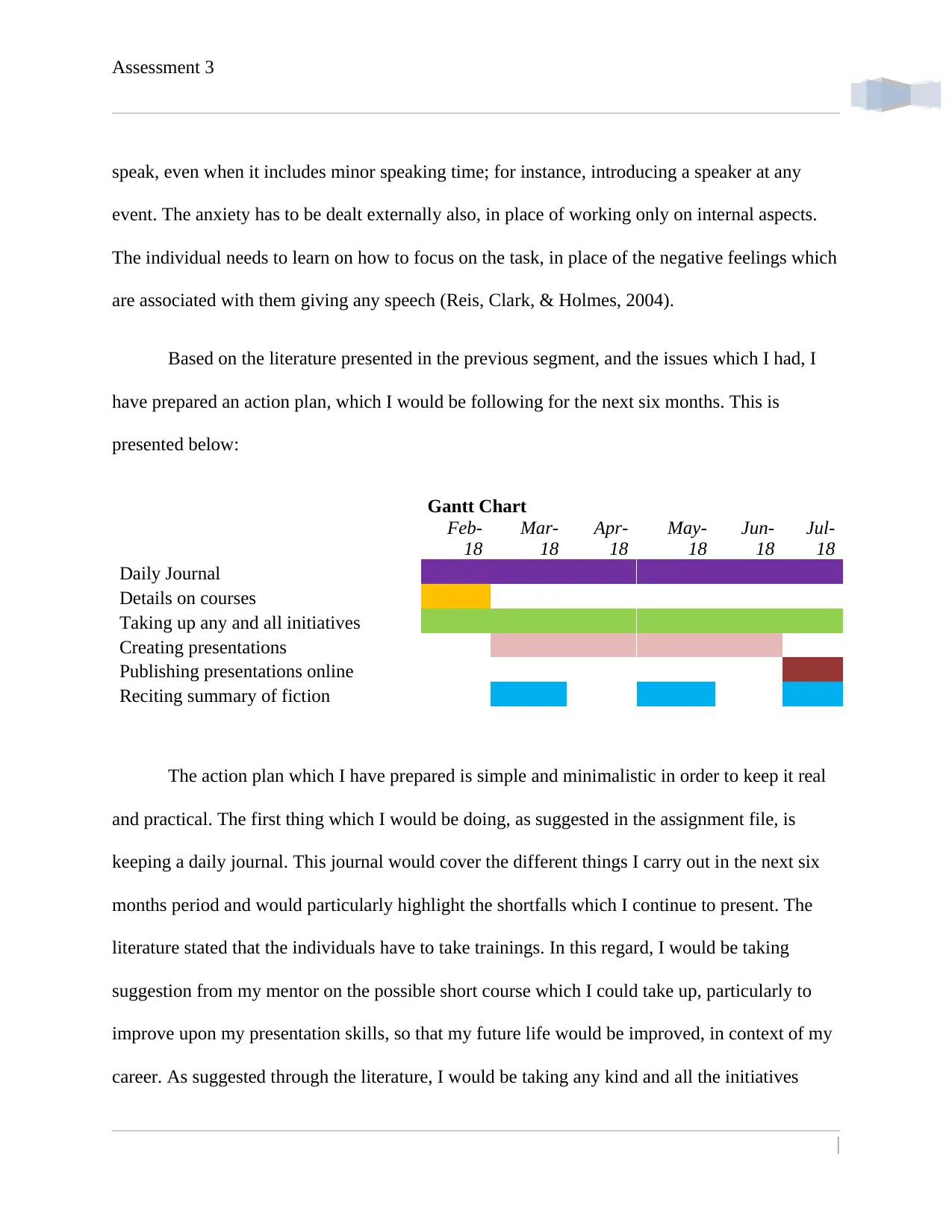
Based on the literature presented in the previous segment, and the issues which I had, I
have prepared an action plan, which I would be following for the next six months. This is
presented below:
Gantt Chart
Feb-
18
Mar-
18
Apr-
18
May-
18
Jun-
18
Jul-
18
Daily Journal
Details on courses
Taking up any and all initiatives
Creating presentations
Publishing presentations online
Reciting summary of fiction
The action plan which I have prepared is simple and minimalistic in order to keep it real
and practical. The first thing which I would be doing, as suggested in the assignment file, is
keeping a daily journal. This journal would cover the different things I carry out in the next six
months period and would particularly highlight the shortfalls which I continue to present. The
literature stated that the individuals have to take trainings. In this regard, I would be taking
suggestion from my mentor on the possible short course which I could take up, particularly to
improve upon my presentation skills, so that my future life would be improved, in context of my
career. As suggested through the literature, I would be taking any kind and all the initiatives
|
speak, even when it includes minor speaking time; for instance, introducing a speaker at any
event. The anxiety has to be dealt externally also, in place of working only on internal aspects.
The individual needs to learn on how to focus on the task, in place of the negative feelings which
are associated with them giving any speech (Reis, Clark, & Holmes, 2004).
Based on the literature presented in the previous segment, and the issues which I had, I
have prepared an action plan, which I would be following for the next six months. This is
presented below:
Gantt Chart
Feb-
18
Mar-
18
Apr-
18
May-
18
Jun-
18
Jul-
18
Daily Journal
Details on courses
Taking up any and all initiatives
Creating presentations
Publishing presentations online
Reciting summary of fiction
The action plan which I have prepared is simple and minimalistic in order to keep it real
and practical. The first thing which I would be doing, as suggested in the assignment file, is
keeping a daily journal. This journal would cover the different things I carry out in the next six
months period and would particularly highlight the shortfalls which I continue to present. The
literature stated that the individuals have to take trainings. In this regard, I would be taking
suggestion from my mentor on the possible short course which I could take up, particularly to
improve upon my presentation skills, so that my future life would be improved, in context of my
career. As suggested through the literature, I would be taking any kind and all the initiatives
|
Assessment 3
which I come across in this academic curriculum, and also in the other spheres of the life. I
would also be creating presentations on regular basis, which would be one every two weeks from
March 2018 onwards. These would be on an array of topics so that not only my knowledge, but
also my skill base is increased. Once these presentations are completed for four months, I would
be setting up a blog and publishing these online. The success of my action plan depends upon the
comments which I get on this blog, particularly from my mentor. As I love to read a lot, I would
be taking up reading of new fiction books and would be reciting them to different crowds. This
would help me in removing the communication apprehensions I have at the present.
In conclusion, this reflective essay was aimed at analysing my communication skills,
particularly in context of the areas I excel at, and the weaknesses which I have. For this purpose,
I had chosen five diagnostic tools, which I read, scored and analysed. The analysis of these
diagnostic tools highlighted that I had average presentation skills and also have moderate
communication apprehensions. As these could have a negative impact on my future career, I
carried out a literature review to analyse the key cause of these shortfalls and also to gain an
understanding on the manner in which these can be improved upon. Once this was done, I
prepared an action plan, based on the suggestions given in the literature to improve the shortfalls
which a person has. The action plan also includes the criteria for judging the success of this six
months action plan. It is expected that through the adoption of this action plan, I would be able to
improve my presentation skills, and would also be able to remove the communication
apprehensions which I have partly.
|
which I come across in this academic curriculum, and also in the other spheres of the life. I
would also be creating presentations on regular basis, which would be one every two weeks from
March 2018 onwards. These would be on an array of topics so that not only my knowledge, but
also my skill base is increased. Once these presentations are completed for four months, I would
be setting up a blog and publishing these online. The success of my action plan depends upon the
comments which I get on this blog, particularly from my mentor. As I love to read a lot, I would
be taking up reading of new fiction books and would be reciting them to different crowds. This
would help me in removing the communication apprehensions I have at the present.
In conclusion, this reflective essay was aimed at analysing my communication skills,
particularly in context of the areas I excel at, and the weaknesses which I have. For this purpose,
I had chosen five diagnostic tools, which I read, scored and analysed. The analysis of these
diagnostic tools highlighted that I had average presentation skills and also have moderate
communication apprehensions. As these could have a negative impact on my future career, I
carried out a literature review to analyse the key cause of these shortfalls and also to gain an
understanding on the manner in which these can be improved upon. Once this was done, I
prepared an action plan, based on the suggestions given in the literature to improve the shortfalls
which a person has. The action plan also includes the criteria for judging the success of this six
months action plan. It is expected that through the adoption of this action plan, I would be able to
improve my presentation skills, and would also be able to remove the communication
apprehensions which I have partly.
|
⊘ This is a preview!⊘
Do you want full access?
Subscribe today to unlock all pages.
Trusted by 1+ million students worldwide

1 out of 17


Related Documents


Your All-in-One AI-Powered Toolkit for Academic Success.
+13062052269
info@desklib.com
Available 24*7 on WhatsApp / Email
![[object Object]](/_next/static/media/star-bottom.7253800d.svg)
Unlock your academic potential
Copyright © 2020–2026 A2Z Services. All Rights Reserved. Developed and managed by ZUCOL.