Google vs. Nokia: Business Communication Strategies and Outcomes
VerifiedAdded on 2023/06/15
|12
|2519
|422
Report
AI Summary
This report provides a comparative analysis of business communication strategies employed by Google and Nokia, highlighting the factors that contributed to their respective successes and failures. It explores key principles of effective business communication, such as clarity, completeness, conciseness, consideration, courtesy, and correctness. The report contrasts Google's open organizational culture, modern communication methods (upward, downward, diagonal, and vertical communication), and employee empowerment with Nokia's rigid communication channels, lack of innovation, and failure to adapt to technological advancements. Ultimately, the report underscores the critical role of effective business communication in organizational success, using Google as a model and Nokia as a cautionary tale. Desklib provides access to similar solved assignments and study resources for students.
[Date]
BUSINESS COMMUNICATION
Strategies for effective business communication (Google and
Nokia)
Student Details
eMAIL iD:
BUSINESS COMMUNICATION
Strategies for effective business communication (Google and
Nokia)
Student Details
eMAIL iD:

Paraphrase This Document
Need a fresh take? Get an instant paraphrase of this document with our AI Paraphraser
Effective Business Communication 1
Contents
Introduction.................................................................................................................................................2
Principles of effective business communication..........................................................................................2
Principles of Clarity..................................................................................................................................3
Principles of Completeness......................................................................................................................3
Principles of Conciseness.........................................................................................................................3
Principles of Consideration......................................................................................................................3
Principles of Courtesy..............................................................................................................................4
Principles of Correctness.........................................................................................................................4
Excellent Business communication (Google)...............................................................................................4
How things work at Google?....................................................................................................................4
Upward Communication..........................................................................................................................4
Downward Communication.....................................................................................................................5
Diagonal Communication........................................................................................................................5
Vertical Communication..........................................................................................................................5
Poor Business Communication (Nokia)........................................................................................................5
Compare and contrast between the natures of communication.................................................................7
What worked and what did not?.................................................................................................................7
Conclusion...................................................................................................................................................7
References...................................................................................................................................................8
Contents
Introduction.................................................................................................................................................2
Principles of effective business communication..........................................................................................2
Principles of Clarity..................................................................................................................................3
Principles of Completeness......................................................................................................................3
Principles of Conciseness.........................................................................................................................3
Principles of Consideration......................................................................................................................3
Principles of Courtesy..............................................................................................................................4
Principles of Correctness.........................................................................................................................4
Excellent Business communication (Google)...............................................................................................4
How things work at Google?....................................................................................................................4
Upward Communication..........................................................................................................................4
Downward Communication.....................................................................................................................5
Diagonal Communication........................................................................................................................5
Vertical Communication..........................................................................................................................5
Poor Business Communication (Nokia)........................................................................................................5
Compare and contrast between the natures of communication.................................................................7
What worked and what did not?.................................................................................................................7
Conclusion...................................................................................................................................................7
References...................................................................................................................................................8
Effective Business Communication 2
Introduction
Business communication is the idea of sharing information in order to promote their
products and services to its potential customers. The ideas are shared inside and outside the
organization so that the company will gain the commercial benefits from its people.
Communication plays a major role in the business. In smaller companies, they do not spend
copious amounts of time to transfer information while the same does not take place in larger
companies. Smaller business often do not have huge number of information to be transferred
because they have limited number of business operations. Basically there are two types of
communication i.e. traditional communication which include memos and written letters. And the
other is electronic communication which include email, chatting, texting and other forms of
Internet-based communication (Belch et al., 2014).
An effective communication is very important for an organization in order to run
smoothly and save time and efforts of the company by reducing the amount of confusing
information. Effective communication also helps to increase the employees’ productivity and
helps them to complete their business functions and also achieve desired objectives (Gao, 2014).
Principles of effective business communication
Introduction
Business communication is the idea of sharing information in order to promote their
products and services to its potential customers. The ideas are shared inside and outside the
organization so that the company will gain the commercial benefits from its people.
Communication plays a major role in the business. In smaller companies, they do not spend
copious amounts of time to transfer information while the same does not take place in larger
companies. Smaller business often do not have huge number of information to be transferred
because they have limited number of business operations. Basically there are two types of
communication i.e. traditional communication which include memos and written letters. And the
other is electronic communication which include email, chatting, texting and other forms of
Internet-based communication (Belch et al., 2014).
An effective communication is very important for an organization in order to run
smoothly and save time and efforts of the company by reducing the amount of confusing
information. Effective communication also helps to increase the employees’ productivity and
helps them to complete their business functions and also achieve desired objectives (Gao, 2014).
Principles of effective business communication
⊘ This is a preview!⊘
Do you want full access?
Subscribe today to unlock all pages.

Trusted by 1+ million students worldwide
Effective Business Communication 3
Principles of Clarity
Every communication cycle gets started with the idea generation. When the idea is generated,
there must occur a huge clarity because this is just the initial stage and if the initial stage is
damaged then the whole communication process will have to suffer later. A business must have
the clarity of the objectives, goals and mission and vision so that it will work on achieving the
same. Once the idea is clarified, there must be use of simple language which should create 100%
transparency and there should be no use of harsh or complex languages (Sweet, 2013).
Let us take an example of a manufacturing company. The company needs to deliver some
goods to its customers. Here, there are two which can be used. The first one is Goods will be sent
soon and the second one is Goods will be sent by (Specific Date). So, the second one gives more
clarity (Dumitrescu & Vinerean, 2010).
Principles of Completeness
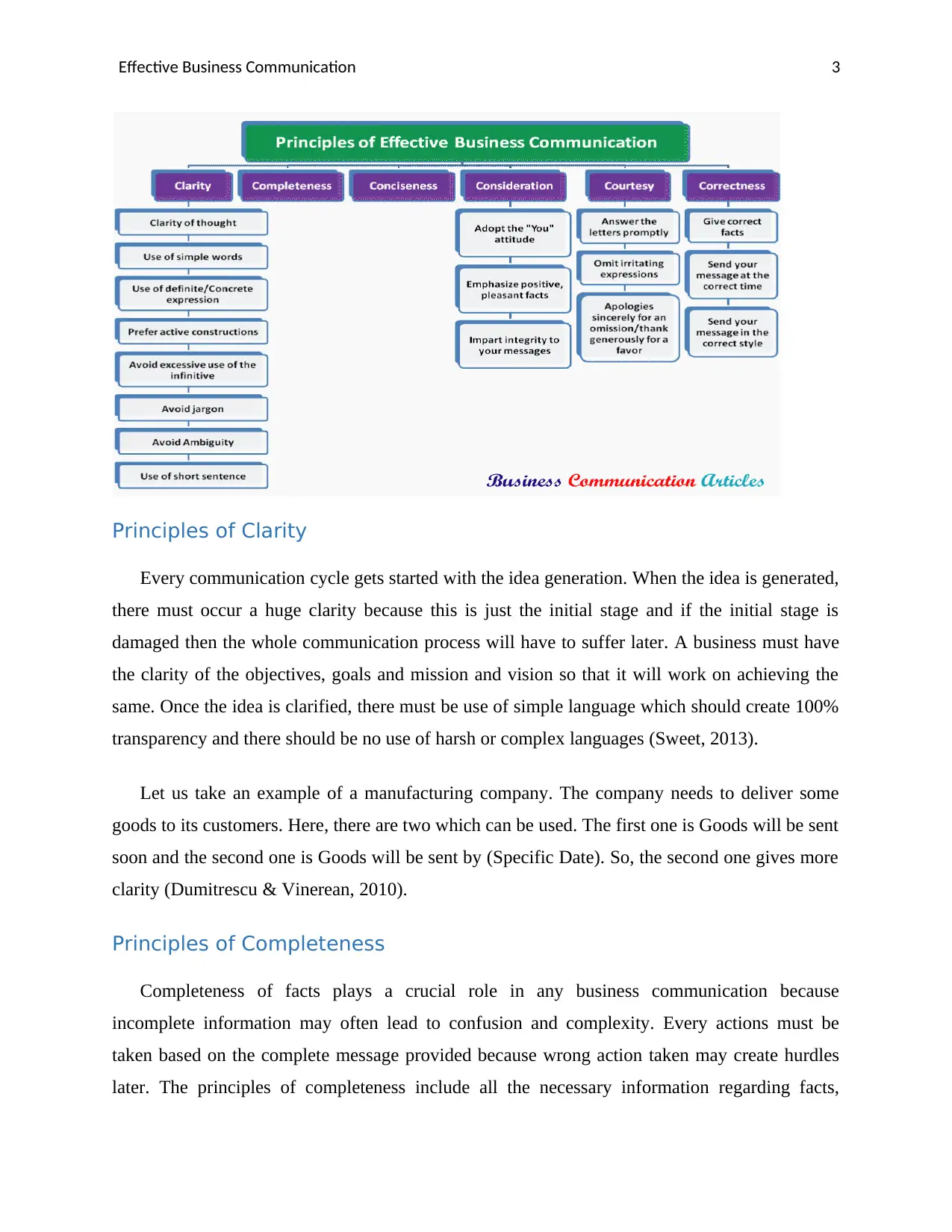
Completeness of facts plays a crucial role in any business communication because
incomplete information may often lead to confusion and complexity. Every actions must be
taken based on the complete message provided because wrong action taken may create hurdles
later. The principles of completeness include all the necessary information regarding facts,
Principles of Clarity
Every communication cycle gets started with the idea generation. When the idea is generated,
there must occur a huge clarity because this is just the initial stage and if the initial stage is
damaged then the whole communication process will have to suffer later. A business must have
the clarity of the objectives, goals and mission and vision so that it will work on achieving the
same. Once the idea is clarified, there must be use of simple language which should create 100%
transparency and there should be no use of harsh or complex languages (Sweet, 2013).
Let us take an example of a manufacturing company. The company needs to deliver some
goods to its customers. Here, there are two which can be used. The first one is Goods will be sent
soon and the second one is Goods will be sent by (Specific Date). So, the second one gives more
clarity (Dumitrescu & Vinerean, 2010).
Principles of Completeness
Completeness of facts plays a crucial role in any business communication because
incomplete information may often lead to confusion and complexity. Every actions must be
taken based on the complete message provided because wrong action taken may create hurdles
later. The principles of completeness include all the necessary information regarding facts,
Paraphrase This Document
Need a fresh take? Get an instant paraphrase of this document with our AI Paraphraser
Effective Business Communication 4
figures, color, size, payments criteria, modes of dispatch and many others. One must deliver the
message with complete information. Completeness also refer to answering five questions like
who, what, where, when and why (Grunig, 2013).
Principles of Conciseness
Every message should be in concise form to avoid unnecessary time wasted on lengthy
messages. More the messages will be in brief form, more the reader gets attracted. Moreover, it
should always be correct, complete and clear (Mack, 2017).
Principles of Consideration
Whenever a message is delivered to the customer, then it should avoid using ‘I attitude rather
than using ‘You’ attitude. Because one must think on the basis of what third party will think
instead of developing ‘I’ attitude. While communicating, there must be positive approach and
one must avoid saying NO because it crates negative impact (Guffey & Loewy, 2010).
Principles of Courtesy
In every business, there must be friendly approach with every employees. Basically there are
three major principles that will help to promote courtesy like answering the letters very quickly,
avoiding irritating expressions and apologizing or thanking generously (Jeffrey, 2014).
Principles of Correctness
There must be accuracy while communicating the information in the business. All the facts
and figures must be accurate and must be delivered at the right time. When a business starts
using unnesaccaery information then it may suffer loss and it will be difficult for it to understand
its correct legal positions as well (Guffey & Loewy, 2012).
Excellent Business communication (Google)
Google was founded on 4th September, 1998 in United State by Larry Page and Sergey Brin.
It is one of the second largest company in terms of revenue. It is an American Multinational
Company which aims at providing internet related products and services to its customers.
figures, color, size, payments criteria, modes of dispatch and many others. One must deliver the
message with complete information. Completeness also refer to answering five questions like
who, what, where, when and why (Grunig, 2013).
Principles of Conciseness
Every message should be in concise form to avoid unnecessary time wasted on lengthy
messages. More the messages will be in brief form, more the reader gets attracted. Moreover, it
should always be correct, complete and clear (Mack, 2017).
Principles of Consideration
Whenever a message is delivered to the customer, then it should avoid using ‘I attitude rather
than using ‘You’ attitude. Because one must think on the basis of what third party will think
instead of developing ‘I’ attitude. While communicating, there must be positive approach and
one must avoid saying NO because it crates negative impact (Guffey & Loewy, 2010).
Principles of Courtesy
In every business, there must be friendly approach with every employees. Basically there are
three major principles that will help to promote courtesy like answering the letters very quickly,
avoiding irritating expressions and apologizing or thanking generously (Jeffrey, 2014).
Principles of Correctness
There must be accuracy while communicating the information in the business. All the facts
and figures must be accurate and must be delivered at the right time. When a business starts
using unnesaccaery information then it may suffer loss and it will be difficult for it to understand
its correct legal positions as well (Guffey & Loewy, 2012).
Excellent Business communication (Google)
Google was founded on 4th September, 1998 in United State by Larry Page and Sergey Brin.
It is one of the second largest company in terms of revenue. It is an American Multinational
Company which aims at providing internet related products and services to its customers.
Effective Business Communication 5
How things work at Google?
Since, Google is a well renowned company and it provides open organization culture and
value its every customers. All the employees there are treated as white collared workers it
focuses on using ultra modem communication ways to communicate with its employees (Gupta,
2015).
Upward Communication
Google follows upward communication strategy where employees are given freedom to
communicate directly to their bosses. No intermediaries are required if a subordinate wants to
talk to any of his bosses. Similarly, every employees have right to put their views if they think is
right. These days Google is trying to reduce “top downiness’ from decision making” strategies.
Google founders have made themselves available among its employees to interact with them and
discuss their views. It is done once a week. Whenever a company uses modern means of
communication, then it has the ability to compete with its competitors.
Downward Communication
Google provides services 24*7 and their employees also works 24*7 based on their shift
timings. Whenever some employees are at home, they still get emails and other messages by
their managers so that the subordinates will remain updated about all the activities of the
company. Sometimes they also conduct video calls to discuss the urgent work. Since Google
never gets involved in papers, it always works on emails and text messages. For an example, the
VP of Google once delivered messages via three minute you tube video and got his message
delivered to its employees (Wickre, 2017).
Diagonal Communication
The diagonal communication takes place same as upward and downward communication.
They basically use electronic medium to communicate with its employees so that they will focus
on their work and set goals to achieve the desired outcomes. Moreover, Google also provides
Employees Grievance officer who is responsible to handle all the grievances that place within the
employees.
How things work at Google?
Since, Google is a well renowned company and it provides open organization culture and
value its every customers. All the employees there are treated as white collared workers it
focuses on using ultra modem communication ways to communicate with its employees (Gupta,
2015).
Upward Communication
Google follows upward communication strategy where employees are given freedom to
communicate directly to their bosses. No intermediaries are required if a subordinate wants to
talk to any of his bosses. Similarly, every employees have right to put their views if they think is
right. These days Google is trying to reduce “top downiness’ from decision making” strategies.
Google founders have made themselves available among its employees to interact with them and
discuss their views. It is done once a week. Whenever a company uses modern means of
communication, then it has the ability to compete with its competitors.
Downward Communication
Google provides services 24*7 and their employees also works 24*7 based on their shift
timings. Whenever some employees are at home, they still get emails and other messages by
their managers so that the subordinates will remain updated about all the activities of the
company. Sometimes they also conduct video calls to discuss the urgent work. Since Google
never gets involved in papers, it always works on emails and text messages. For an example, the
VP of Google once delivered messages via three minute you tube video and got his message
delivered to its employees (Wickre, 2017).
Diagonal Communication
The diagonal communication takes place same as upward and downward communication.
They basically use electronic medium to communicate with its employees so that they will focus
on their work and set goals to achieve the desired outcomes. Moreover, Google also provides
Employees Grievance officer who is responsible to handle all the grievances that place within the
employees.
⊘ This is a preview!⊘
Do you want full access?
Subscribe today to unlock all pages.
Trusted by 1+ million students worldwide
Effective Business Communication 6
Vertical Communication
Google uses shared documentation technology which basically focuses on managing the
work in a team rather than focusing on the individual work. All the employees in the company
work together to deliver each product lines. For an example: Android. How beautifully Google
converged its products into it by reliable communication network.
Poor Business Communication (Nokia)
Generally it happens that the big companies faces big problems and the same happened with
the Nokia. Nokia is a multinational company which was founded in 1985 by Fredrik, Eduard and
Leo. Nokia deals in providing electronic products and services to its potential customers. The
problems faced by Nokia varies from other companies. The major reasons behind its failure is
listed below.
Since a long decade, Nokia has ranked itself in the world’s largest mobile phone
manufacturer but it was successful unless smart phones were introduced. When smart phones
were launched in the market, Nokia lost its edge from the market and turned its products with a
great failure. The major problem found was the habits of communication that generated unclear
plans about the market competitors (Golen, 1990).
Nokia failed to connect with people though it had strong software configuration. Later
when android was announced, it proved that hardware plays more important role than that of
software and Nokia was very slow to meet with its pace. Nokia thought that People would not
love touch screens and touch screens will not have any better future but then it was beyond the
expectation. People loved the touchscreens and Nokia failed to meet its expectation and also
failed to create buzz among its customers.
There was no effective communication strategy used by the company. There was lack of
innovators and human resources which a company should work on. The lack of updates in
Vertical Communication
Google uses shared documentation technology which basically focuses on managing the
work in a team rather than focusing on the individual work. All the employees in the company
work together to deliver each product lines. For an example: Android. How beautifully Google
converged its products into it by reliable communication network.
Poor Business Communication (Nokia)
Generally it happens that the big companies faces big problems and the same happened with
the Nokia. Nokia is a multinational company which was founded in 1985 by Fredrik, Eduard and
Leo. Nokia deals in providing electronic products and services to its potential customers. The
problems faced by Nokia varies from other companies. The major reasons behind its failure is
listed below.
Since a long decade, Nokia has ranked itself in the world’s largest mobile phone
manufacturer but it was successful unless smart phones were introduced. When smart phones
were launched in the market, Nokia lost its edge from the market and turned its products with a
great failure. The major problem found was the habits of communication that generated unclear
plans about the market competitors (Golen, 1990).
Nokia failed to connect with people though it had strong software configuration. Later
when android was announced, it proved that hardware plays more important role than that of
software and Nokia was very slow to meet with its pace. Nokia thought that People would not
love touch screens and touch screens will not have any better future but then it was beyond the
expectation. People loved the touchscreens and Nokia failed to meet its expectation and also
failed to create buzz among its customers.
There was no effective communication strategy used by the company. There was lack of
innovators and human resources which a company should work on. The lack of updates in
Paraphrase This Document
Need a fresh take? Get an instant paraphrase of this document with our AI Paraphraser
Effective Business Communication 7
technology lead to the major failure of the Nokia. The managers of Nokia failed to realize that
was the real need of the customers and what the customers would love to but which other smart
phones were capable enough to identify it. The communication channel was not strong enough
so that new ideas will be given opportunities and their ideas should be welcomed at least once.
Every employees in the organization has to cross the communication channel to express their
views. The communication line was too lengthy and the subordinates were not given an
opportunity to think something different from the other company. The ideas remained constant in
the minds of the employees but they were never implemented which created a great failure
(Thakur, 2014).
Compare and contrast between the natures of
communication
Bigger the company, more will be the problems. Google and Nokia are both well reputed
companies, the business communication strategies of both companies are very different. Google
believes in smart work while Nokia focused on working hard. There was a huge communication
gap between both companies. Since Google has used very effective ways of communication such
as downward communication, upward communication, vertical communication and diagonal
communication. Here, every employees are given an opportunity to put their views and the CEO
of the company meets every employees once in a week which create a positive environment in
the organization. But this strategy lagged behind in terms of Nokia (Chaudhary, 2014). The
employees there were never given an opportunity to put their ideas and innovate something
different. Google always kept on updating new innovations and worked effectively on the
adoption of new technology. Nokia failed to adopt new technology and thus afield to capture the
market too.
technology lead to the major failure of the Nokia. The managers of Nokia failed to realize that
was the real need of the customers and what the customers would love to but which other smart
phones were capable enough to identify it. The communication channel was not strong enough
so that new ideas will be given opportunities and their ideas should be welcomed at least once.
Every employees in the organization has to cross the communication channel to express their
views. The communication line was too lengthy and the subordinates were not given an
opportunity to think something different from the other company. The ideas remained constant in
the minds of the employees but they were never implemented which created a great failure
(Thakur, 2014).
Compare and contrast between the natures of
communication
Bigger the company, more will be the problems. Google and Nokia are both well reputed
companies, the business communication strategies of both companies are very different. Google
believes in smart work while Nokia focused on working hard. There was a huge communication
gap between both companies. Since Google has used very effective ways of communication such
as downward communication, upward communication, vertical communication and diagonal
communication. Here, every employees are given an opportunity to put their views and the CEO
of the company meets every employees once in a week which create a positive environment in
the organization. But this strategy lagged behind in terms of Nokia (Chaudhary, 2014). The
employees there were never given an opportunity to put their ideas and innovate something
different. Google always kept on updating new innovations and worked effectively on the
adoption of new technology. Nokia failed to adopt new technology and thus afield to capture the
market too.
Effective Business Communication 8
What worked and what did not?
Google used several communication strategy to remain in the competitive market and
place its position successfully across the globe. It treated every employees as a valuable assets to
the company and all their grievances were taken into highest priority. But this did not work out
in terms of Nokia. All the communication strategy followed by it failed and they became
unsuccessful to capture the market and remain in the competition. Nokia never bothered in
updating their technology which other smartphones did and worked out. So, it is very necessary
to remain competitive in the market and follow effective communication strategy.
Conclusion
Thus, it can be concluded that an effective business communication plays a major in the
success of the organization. Google has adopted effective business communication strategy and
ranked itself in the world’s largest multinational company but Nokia failed to do the same. Nokia
failed immensely in the market and also lagged behind among its competitors.
References
Belch, G. E., Belch, M. A., Kerr, G. F., & Powell, I. (2014). Advertising: An integrated
marketing communication perspective. McGraw-Hill Education.
Chaudhary, K. (2014). Failure of Nokia. Viewed on 16th February, 2018. Available at:
https://www.slideshare.net/karankamboj313/failure-of-nokia
Dumitrescu, L., & Vinerean, S. (2010). The global strategy of global brands. Studies in Business
and Economics, 5(3), 147-155.
Gao, C. (2014). We are building a future, together. Corporate Communication Strategy. Viewed
on 16th February, 2018. Available at:
https://chuckgao89.files.wordpress.com/2014/04/google-communication-strategy.pdf
What worked and what did not?
Google used several communication strategy to remain in the competitive market and
place its position successfully across the globe. It treated every employees as a valuable assets to
the company and all their grievances were taken into highest priority. But this did not work out
in terms of Nokia. All the communication strategy followed by it failed and they became
unsuccessful to capture the market and remain in the competition. Nokia never bothered in
updating their technology which other smartphones did and worked out. So, it is very necessary
to remain competitive in the market and follow effective communication strategy.
Conclusion
Thus, it can be concluded that an effective business communication plays a major in the
success of the organization. Google has adopted effective business communication strategy and
ranked itself in the world’s largest multinational company but Nokia failed to do the same. Nokia
failed immensely in the market and also lagged behind among its competitors.
References
Belch, G. E., Belch, M. A., Kerr, G. F., & Powell, I. (2014). Advertising: An integrated
marketing communication perspective. McGraw-Hill Education.
Chaudhary, K. (2014). Failure of Nokia. Viewed on 16th February, 2018. Available at:
https://www.slideshare.net/karankamboj313/failure-of-nokia
Dumitrescu, L., & Vinerean, S. (2010). The global strategy of global brands. Studies in Business
and Economics, 5(3), 147-155.
Gao, C. (2014). We are building a future, together. Corporate Communication Strategy. Viewed
on 16th February, 2018. Available at:
https://chuckgao89.files.wordpress.com/2014/04/google-communication-strategy.pdf
⊘ This is a preview!⊘
Do you want full access?
Subscribe today to unlock all pages.
Trusted by 1+ million students worldwide
Effective Business Communication 9
Golen, S. (1990). A factor analysis of barriers to effective listening. The Journal of Business
Communication (1973), 27(1), 25-36.
Grunig, J. E. (Ed.). (2013). Excellence in public relations and communication management.
Routledge.
Guffey, M. E., & Loewy, D. (2010). Business communication: Process and product. Cengage
Learning.
Guffey, M.E., & Loewy, D. (2012). Essentials of business communication. Cengage Learning.
Gupta, S. (2015). Communication networks at Google. Viewed on 16th February, 2018. Available
at: https://www.slideshare.net/yupimdfreak/communication-networks-at-google
Jeffrey, S. (2014). Principles of Effective Communication for Business and Personal Success.
Viewed on 16th February, 2018. Available at: https://scottjeffrey.com/principles-of-
effective-communication/
Mack, O. (2017). Effective Communication: Five Principles to Perfect. . Viewed on 16th February,
2018. Available at: https://magazine.vunela.com/effective-communication-five-
principles-to-perfect-172c9adbe0ee
Sweet, P. (2013). Principles of effective communication. Viewed on 16th February, 2018.
Available at: https://www.slideshare.net/Sweetp999/principles-of-effective-
communication-24566620
Thakur, A. (2014). Presentation on failure of Nokia. Viewed on 16th February, 2018. Available
at: https://www.slideshare.net/abhishekthakur309/presentation-on-failure-of-nokia
Golen, S. (1990). A factor analysis of barriers to effective listening. The Journal of Business
Communication (1973), 27(1), 25-36.
Grunig, J. E. (Ed.). (2013). Excellence in public relations and communication management.
Routledge.
Guffey, M. E., & Loewy, D. (2010). Business communication: Process and product. Cengage
Learning.
Guffey, M.E., & Loewy, D. (2012). Essentials of business communication. Cengage Learning.
Gupta, S. (2015). Communication networks at Google. Viewed on 16th February, 2018. Available
at: https://www.slideshare.net/yupimdfreak/communication-networks-at-google
Jeffrey, S. (2014). Principles of Effective Communication for Business and Personal Success.
Viewed on 16th February, 2018. Available at: https://scottjeffrey.com/principles-of-
effective-communication/
Mack, O. (2017). Effective Communication: Five Principles to Perfect. . Viewed on 16th February,
2018. Available at: https://magazine.vunela.com/effective-communication-five-
principles-to-perfect-172c9adbe0ee
Sweet, P. (2013). Principles of effective communication. Viewed on 16th February, 2018.
Available at: https://www.slideshare.net/Sweetp999/principles-of-effective-
communication-24566620
Thakur, A. (2014). Presentation on failure of Nokia. Viewed on 16th February, 2018. Available
at: https://www.slideshare.net/abhishekthakur309/presentation-on-failure-of-nokia
Paraphrase This Document
Need a fresh take? Get an instant paraphrase of this document with our AI Paraphraser

Effective Business Communication
10
Wickre, K. (2017). What Google’s open communication culture is really like. Viewed on 16th
February, 2018. Available at: https://www.wired.com/story/what-googles-open-
communication-culture-is-really-like/
10
Wickre, K. (2017). What Google’s open communication culture is really like. Viewed on 16th
February, 2018. Available at: https://www.wired.com/story/what-googles-open-
communication-culture-is-really-like/

Effective Business Communication
11
11
⊘ This is a preview!⊘
Do you want full access?
Subscribe today to unlock all pages.
Trusted by 1+ million students worldwide

1 out of 12


Related Documents


Your All-in-One AI-Powered Toolkit for Academic Success.
+13062052269
info@desklib.com
Available 24*7 on WhatsApp / Email
![[object Object]](/_next/static/media/star-bottom.7253800d.svg)
Unlock your academic potential
Copyright © 2020–2026 A2Z Services. All Rights Reserved. Developed and managed by ZUCOL.