A Comprehensive Report on Business Communication and Practices
VerifiedAdded on 2023/01/12
|9
|2079
|87
Report
AI Summary
This report delves into the critical role of effective communication within a business environment, emphasizing its impact on operational performance, efficiency, and productivity. It explores various communication types, including verbal, non-verbal, visual, and written forms, and highlights the importance of selecting the appropriate channel to convey messages clearly. The report identifies key barriers to effective communication, such as planning deficiencies, language barriers, information overload, and an aggressive communication tone. It then analyzes organizational communication principles like formal, informal, and interpersonal communication, and their application in overcoming communication and cultural barriers. The report evaluates communication practices, emphasizing the need for targeted communication, appropriate communication channels, awareness of linguistic barriers, and feedback mechanisms. Finally, it concludes that effective communication is essential for reducing operational errors and delays, ultimately enhancing an organization's productivity and profitability.
Context of Business

Paraphrase This Document
Need a fresh take? Get an instant paraphrase of this document with our AI Paraphraser
Abstract
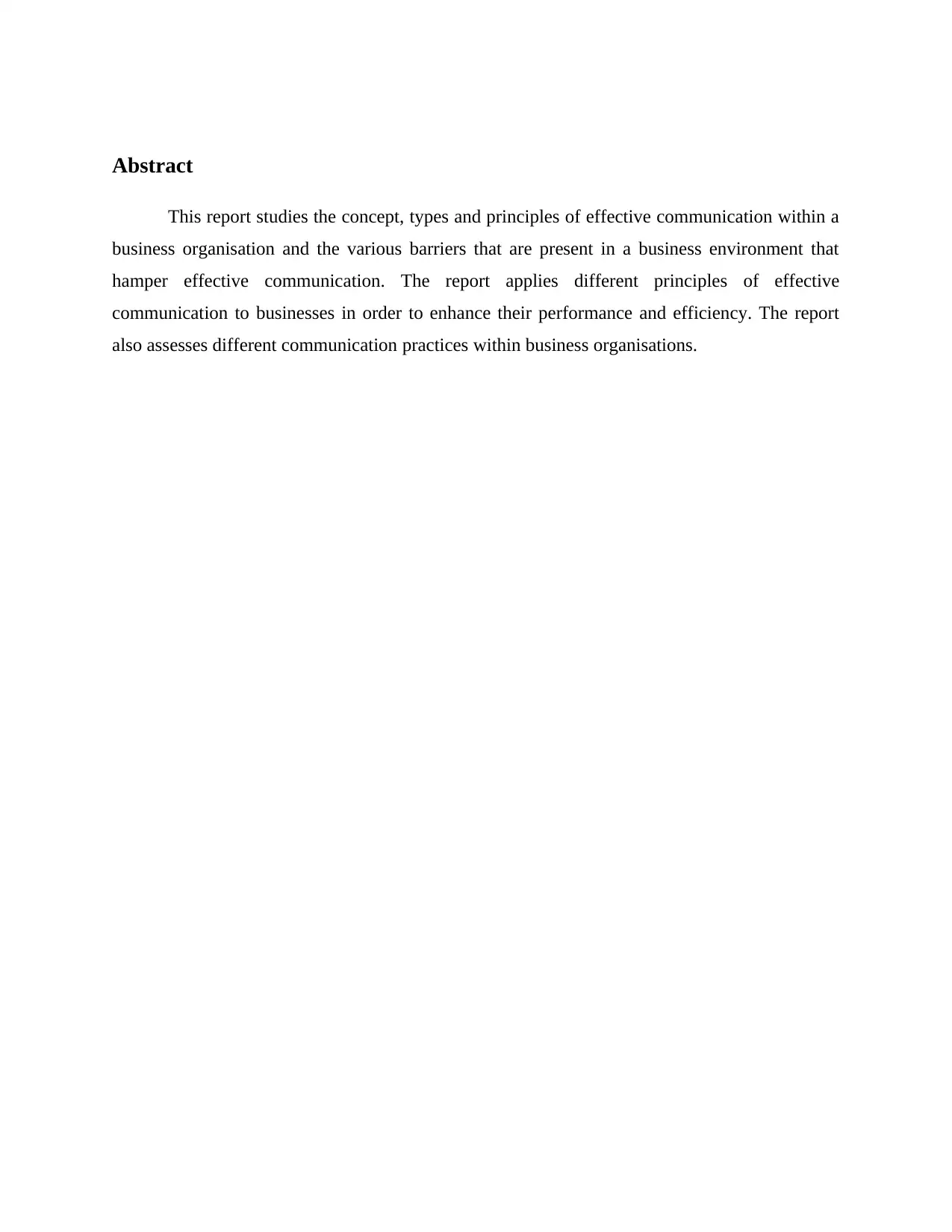
This report studies the concept, types and principles of effective communication within a
business organisation and the various barriers that are present in a business environment that
hamper effective communication. The report applies different principles of effective
communication to businesses in order to enhance their performance and efficiency. The report
also assesses different communication practices within business organisations.
This report studies the concept, types and principles of effective communication within a
business organisation and the various barriers that are present in a business environment that
hamper effective communication. The report applies different principles of effective
communication to businesses in order to enhance their performance and efficiency. The report
also assesses different communication practices within business organisations.
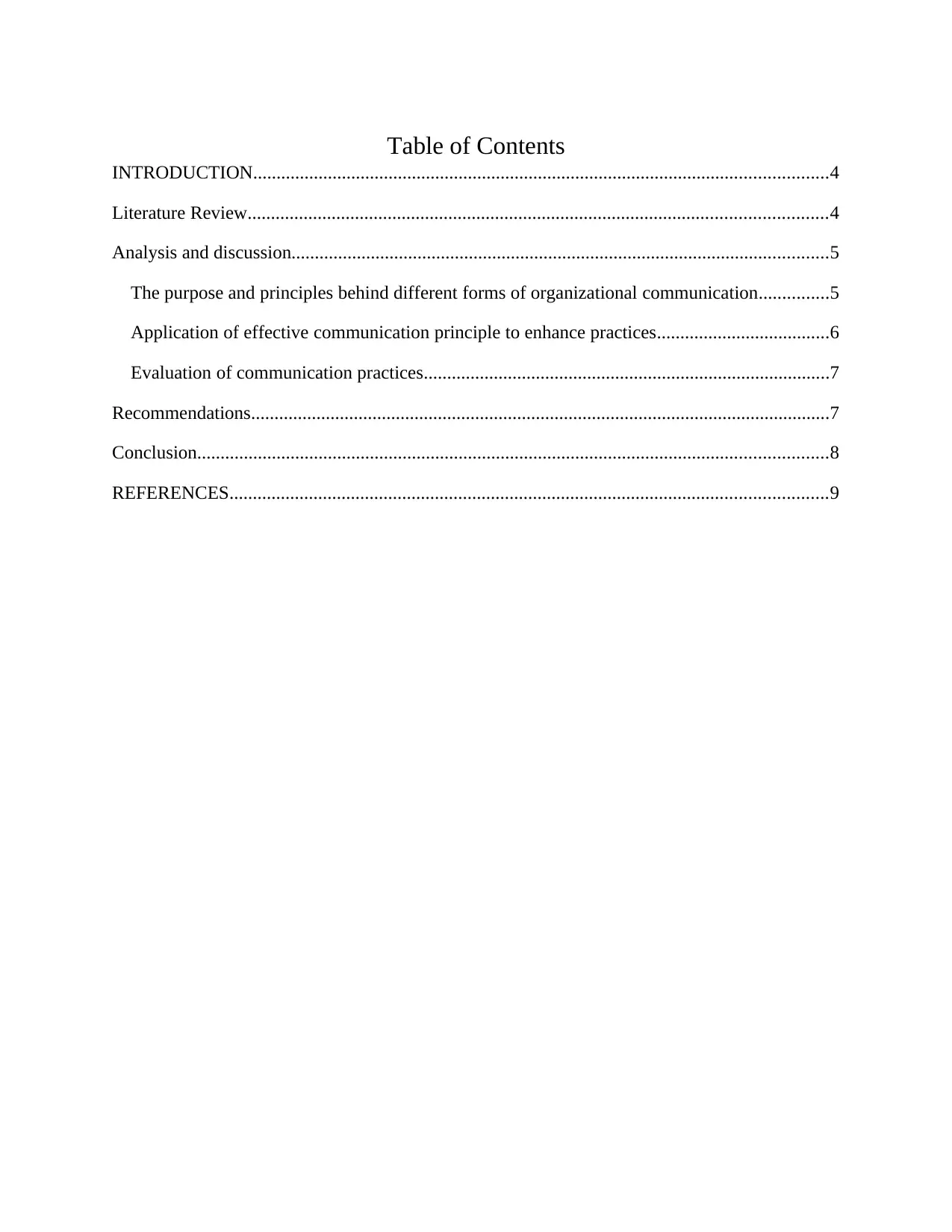
Table of Contents
INTRODUCTION...........................................................................................................................4
Literature Review............................................................................................................................4
Analysis and discussion...................................................................................................................5
The purpose and principles behind different forms of organizational communication...............5
Application of effective communication principle to enhance practices.....................................6
Evaluation of communication practices.......................................................................................7
Recommendations............................................................................................................................7
Conclusion.......................................................................................................................................8
REFERENCES................................................................................................................................9
INTRODUCTION...........................................................................................................................4
Literature Review............................................................................................................................4
Analysis and discussion...................................................................................................................5
The purpose and principles behind different forms of organizational communication...............5
Application of effective communication principle to enhance practices.....................................6
Evaluation of communication practices.......................................................................................7
Recommendations............................................................................................................................7
Conclusion.......................................................................................................................................8
REFERENCES................................................................................................................................9
⊘ This is a preview!⊘
Do you want full access?
Subscribe today to unlock all pages.

Trusted by 1+ million students worldwide
INTRODUCTION
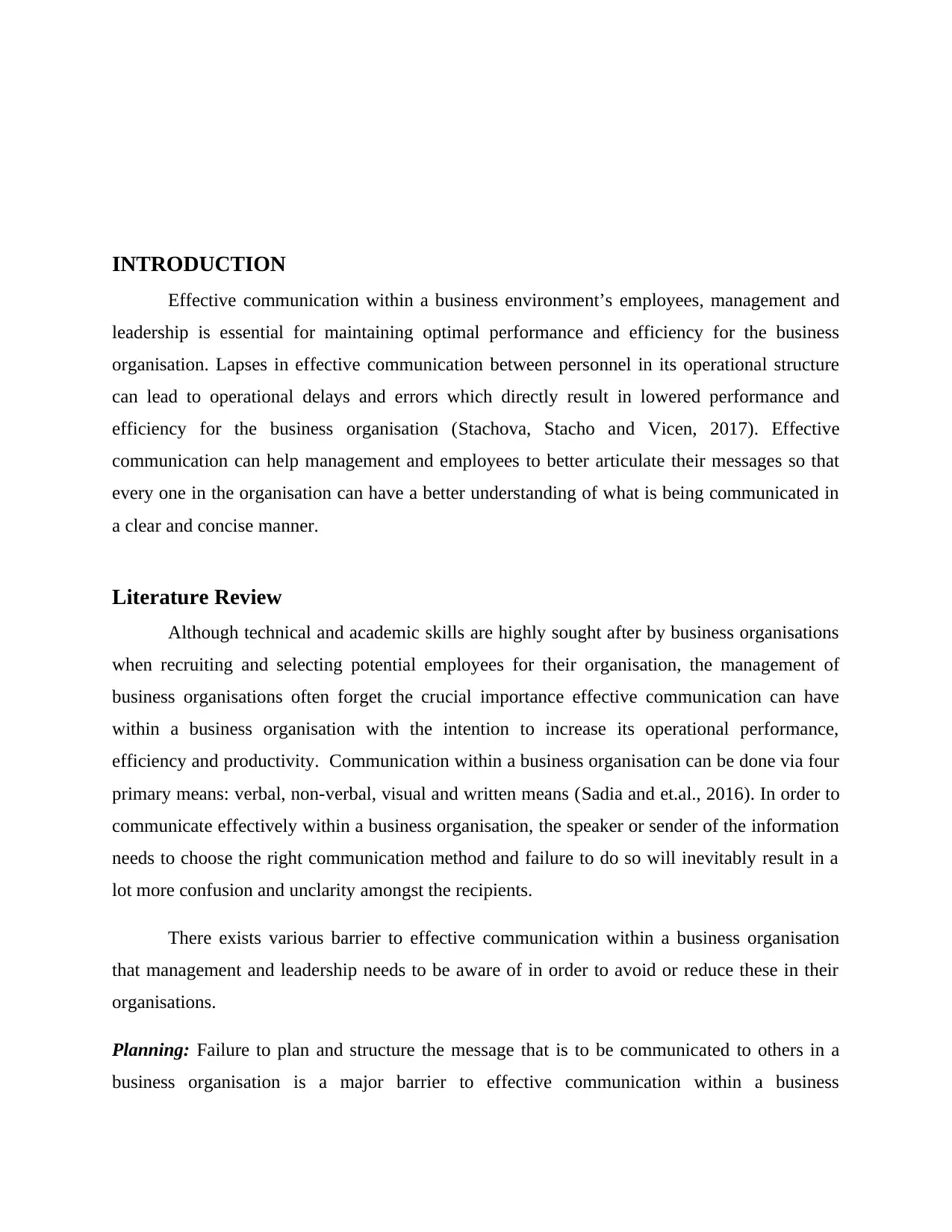
Effective communication within a business environment’s employees, management and
leadership is essential for maintaining optimal performance and efficiency for the business
organisation. Lapses in effective communication between personnel in its operational structure
can lead to operational delays and errors which directly result in lowered performance and
efficiency for the business organisation (Stachova, Stacho and Vicen, 2017). Effective
communication can help management and employees to better articulate their messages so that
every one in the organisation can have a better understanding of what is being communicated in
a clear and concise manner.
Literature Review
Although technical and academic skills are highly sought after by business organisations
when recruiting and selecting potential employees for their organisation, the management of
business organisations often forget the crucial importance effective communication can have
within a business organisation with the intention to increase its operational performance,
efficiency and productivity. Communication within a business organisation can be done via four
primary means: verbal, non-verbal, visual and written means (Sadia and et.al., 2016). In order to
communicate effectively within a business organisation, the speaker or sender of the information
needs to choose the right communication method and failure to do so will inevitably result in a
lot more confusion and unclarity amongst the recipients.
There exists various barrier to effective communication within a business organisation
that management and leadership needs to be aware of in order to avoid or reduce these in their
organisations.
Planning: Failure to plan and structure the message that is to be communicated to others in a
business organisation is a major barrier to effective communication within a business
Effective communication within a business environment’s employees, management and
leadership is essential for maintaining optimal performance and efficiency for the business
organisation. Lapses in effective communication between personnel in its operational structure
can lead to operational delays and errors which directly result in lowered performance and
efficiency for the business organisation (Stachova, Stacho and Vicen, 2017). Effective
communication can help management and employees to better articulate their messages so that
every one in the organisation can have a better understanding of what is being communicated in
a clear and concise manner.
Literature Review
Although technical and academic skills are highly sought after by business organisations
when recruiting and selecting potential employees for their organisation, the management of
business organisations often forget the crucial importance effective communication can have
within a business organisation with the intention to increase its operational performance,
efficiency and productivity. Communication within a business organisation can be done via four
primary means: verbal, non-verbal, visual and written means (Sadia and et.al., 2016). In order to
communicate effectively within a business organisation, the speaker or sender of the information
needs to choose the right communication method and failure to do so will inevitably result in a
lot more confusion and unclarity amongst the recipients.
There exists various barrier to effective communication within a business organisation
that management and leadership needs to be aware of in order to avoid or reduce these in their
organisations.
Planning: Failure to plan and structure the message that is to be communicated to others in a
business organisation is a major barrier to effective communication within a business
Paraphrase This Document
Need a fresh take? Get an instant paraphrase of this document with our AI Paraphraser
organisation and results in redundant information being communicated which isn’t of much use
to the recipients.
Language Barriers: These are one of the most commonly found communication barriers in most
organisation and have a significant impact on a business’s efforts to communicate effectively.
These occur from recipients unfamiliarity with the language used in communications.
Information Overload: The sender or speaker of the information should also take effort not to
overload the recipients with too much information all at once, as recipient’s attention is one of
the most important attributes required during effective communication and information overload
can often bore the recipient and make his mind wander.
Amicable Tone: Another major barrier to effective communication is making the communication
too aggressive or offensive in nature. This happens when the speaker or sender doesn’t try to
communicate to other in a friendly or amicable manner, but instead chooses an aggressive or
humiliating style of communication.
Analysis and discussion
The above discussion stated that communication is important because it passes
information from one person to other. By above study identified communication barriers i.e.
physical barriers, cultural barriers, language barriers and emotional barriers. To overcome these
challenges and improve communication between different offices analyse several strategies.
These are described below:
The purpose and principles behind different forms of organizational communication
Organizational communication can be defined as the communication which takes place in
business environment. It includes individual or mass of communication in the workplace. the
main purpose of organization communication to communicate individual or group of people
effectively which removes misunderstanding and encourages them towards common goal. The
flow of information can be good when communication is better that automatically leads
managerial effectiveness and improves decision making process of HR within workplace. There
are several principles of organizational communication i.e. formal communication, informal
communication, organization culture and interpersonal communication which can help to
to the recipients.
Language Barriers: These are one of the most commonly found communication barriers in most
organisation and have a significant impact on a business’s efforts to communicate effectively.
These occur from recipients unfamiliarity with the language used in communications.
Information Overload: The sender or speaker of the information should also take effort not to
overload the recipients with too much information all at once, as recipient’s attention is one of
the most important attributes required during effective communication and information overload
can often bore the recipient and make his mind wander.
Amicable Tone: Another major barrier to effective communication is making the communication
too aggressive or offensive in nature. This happens when the speaker or sender doesn’t try to
communicate to other in a friendly or amicable manner, but instead chooses an aggressive or
humiliating style of communication.
Analysis and discussion
The above discussion stated that communication is important because it passes
information from one person to other. By above study identified communication barriers i.e.
physical barriers, cultural barriers, language barriers and emotional barriers. To overcome these
challenges and improve communication between different offices analyse several strategies.
These are described below:
The purpose and principles behind different forms of organizational communication
Organizational communication can be defined as the communication which takes place in
business environment. It includes individual or mass of communication in the workplace. the
main purpose of organization communication to communicate individual or group of people
effectively which removes misunderstanding and encourages them towards common goal. The
flow of information can be good when communication is better that automatically leads
managerial effectiveness and improves decision making process of HR within workplace. There
are several principles of organizational communication i.e. formal communication, informal
communication, organization culture and interpersonal communication which can help to
understand communication within organization (Cooren and Seidl, 2019). Formal
communication is quite famous which is used by various organization because information flows
by two forms i.e. upward such as from staff to management while downward where flows of
information from management to staff. while horizontal communication also occurs between
employees such as work group. Other is informal communication which takes place naturally on
regular basis. It makes people happy instead of communicating with people formal way. Thus,
communication takes place in lunch break or tea break between staff. Interpersonal
communication is another principle of organizational communication. It takes place into two
forms verbal communication and non-verbal communication. Verbal communication leads
indirect communication with staff and management through telecommunication and emails.
While non-verbal communication encompasses facial expression, eye contact and body language
which leads direct communication between management and staff. If organization good
command in both type communication like verbal and non-verbal as result can remove confusion
and miscommunication.
Application of effective communication principle to enhance practices
The above discussion states that formal communication, informal communication, interpersonal
communication and organization culture are the principles of organizational communication. To
overcome communication barriers and cultural barriers between different department is the best
option to apply these principles. For example, formal communication which can apply by
management to flow information ideally. It leads two type communication such as upward and
downward. Upward communication such as information passes from staff to management. While
downward communication helps to flow information or message from management to staff. so,
organization can apply this principle which can help to remove communication barriers and
clarify confusion between employees for the task. Organization culture is also considered as an
organizational communication which defines a business norms and standards (Doyle, 2019). A
good culture leads high communication between staff and management and maintains their
wellbeing within workplace. it leads two-way communication so helps to understand staff
behaviour for job responsibility. A good culture helps manager to adapt change as per
requirement and inspires their employees to perform well in each situation. organization culture
is the best option to follow because Interpersonal communication is also best option because it
includes telecommunication and online communication are the best way to communicate
communication is quite famous which is used by various organization because information flows
by two forms i.e. upward such as from staff to management while downward where flows of
information from management to staff. while horizontal communication also occurs between
employees such as work group. Other is informal communication which takes place naturally on
regular basis. It makes people happy instead of communicating with people formal way. Thus,
communication takes place in lunch break or tea break between staff. Interpersonal
communication is another principle of organizational communication. It takes place into two
forms verbal communication and non-verbal communication. Verbal communication leads
indirect communication with staff and management through telecommunication and emails.
While non-verbal communication encompasses facial expression, eye contact and body language
which leads direct communication between management and staff. If organization good
command in both type communication like verbal and non-verbal as result can remove confusion
and miscommunication.
Application of effective communication principle to enhance practices
The above discussion states that formal communication, informal communication, interpersonal
communication and organization culture are the principles of organizational communication. To
overcome communication barriers and cultural barriers between different department is the best
option to apply these principles. For example, formal communication which can apply by
management to flow information ideally. It leads two type communication such as upward and
downward. Upward communication such as information passes from staff to management. While
downward communication helps to flow information or message from management to staff. so,
organization can apply this principle which can help to remove communication barriers and
clarify confusion between employees for the task. Organization culture is also considered as an
organizational communication which defines a business norms and standards (Doyle, 2019). A
good culture leads high communication between staff and management and maintains their
wellbeing within workplace. it leads two-way communication so helps to understand staff
behaviour for job responsibility. A good culture helps manager to adapt change as per
requirement and inspires their employees to perform well in each situation. organization culture
is the best option to follow because Interpersonal communication is also best option because it
includes telecommunication and online communication are the best way to communicate
⊘ This is a preview!⊘
Do you want full access?
Subscribe today to unlock all pages.
Trusted by 1+ million students worldwide
individua effectively or passes information to various department which is included into
interpersonal communication (Wirtz and Zimbres, 2018). So, it can help to overcome cultural
and communication barriers and leads high level communication between different department
and management.
Evaluation of communication practices
It can be evaluated that good communication leads high productivity in certain place i.e.
organization. By the above study can analysed that communication is not helps people to
understand their psychology but also maintains their wellbeing within company or another place.
Several communication barriers i.e. physical barriers, cultural barriers, language barriers and
emotional barriers. These barriers affect people attitudes and their wellbeing as well. By the
above discussion also analysed that cultural barrier and communication are the current barriers
which gives challenges within organization (Smircich, 2017). Formal communication practices
help organization to flow information effectively without creating any type of confusion. Such as
upwards communication when staff has problem related to their salary, work load and take then
can convey message to management without any intermediate. Downward communication
whenever management implements any decision about task regrading or project that directly
convey information to staff. as same interpersonal helps staff and management to communicate
effectively by using telecommunication and emails. So, it can analyse that interpersonal
communication remove communication barrier which takes place between different department
and management. It also evaluates that organization culture lead high communication between
different department and maintain employee’s wellbeing and remove cultural barriers. By
applying organizational communication principles can remove communication barriers and can
lead high level communication between various department and organization.
Recommendations
For improving the effective communication between employees, management and
leadership within a business organisation, it needs to follow the following steps:
Targeted Communication: When communicating to others in a business organisation the sender
or speaker needs to tailor his communication efforts to his audience’s capabilities or language
level in order for them to communicate effectively in a clear and concise manner and to have a
interpersonal communication (Wirtz and Zimbres, 2018). So, it can help to overcome cultural
and communication barriers and leads high level communication between different department
and management.
Evaluation of communication practices
It can be evaluated that good communication leads high productivity in certain place i.e.
organization. By the above study can analysed that communication is not helps people to
understand their psychology but also maintains their wellbeing within company or another place.
Several communication barriers i.e. physical barriers, cultural barriers, language barriers and
emotional barriers. These barriers affect people attitudes and their wellbeing as well. By the
above discussion also analysed that cultural barrier and communication are the current barriers
which gives challenges within organization (Smircich, 2017). Formal communication practices
help organization to flow information effectively without creating any type of confusion. Such as
upwards communication when staff has problem related to their salary, work load and take then
can convey message to management without any intermediate. Downward communication
whenever management implements any decision about task regrading or project that directly
convey information to staff. as same interpersonal helps staff and management to communicate
effectively by using telecommunication and emails. So, it can analyse that interpersonal
communication remove communication barrier which takes place between different department
and management. It also evaluates that organization culture lead high communication between
different department and maintain employee’s wellbeing and remove cultural barriers. By
applying organizational communication principles can remove communication barriers and can
lead high level communication between various department and organization.
Recommendations
For improving the effective communication between employees, management and
leadership within a business organisation, it needs to follow the following steps:
Targeted Communication: When communicating to others in a business organisation the sender
or speaker needs to tailor his communication efforts to his audience’s capabilities or language
level in order for them to communicate effectively in a clear and concise manner and to have a
Paraphrase This Document
Need a fresh take? Get an instant paraphrase of this document with our AI Paraphraser
better chance at connecting with them. The speaker or sender of information should structure the
message to be communicated, in such a way that it matches the ability of the receivers and not
their own ability.
Communication Channels: In order to communicate effectively within a business environment,
the management also needs to choose the correct channel from which to communicate through.
Different communication channels provide their distinct advantages and disadvantages and it is
imperative for effective communication to choose the right communication channel (Lasater,
2019). For example, highly detailed or data driven communications must be done through
written channels, while comparatively succinct communication can be passed on through verbal
channels of communications.
Knowledge of linguistic barriers: The speaker or sender of the information to be communicated
must also be aware of any language barriers that exist between them and the receiving parties so
that they can use alternative methods to communicate effectively. Language barriers are the most
prevalent cause of ineffective communication within business organisations and directly cause
many of the confusions and problems during communication.
Feedbacks: The business organisation as part of its overall communication plan can also choose
to use feedbacks of the receivers, in an effort to better understand which communications are
being done ineffectively and which information is communicated effectively to receivers. Using
this information, the business organisation can improve upon their previous methods of
communicating for information that wasn’t communicated effectively to recipients.
Conclusion
From this report it can be concluded that effective communication plays a majorly
significant role in business organisations in order to increase their operational performance,
efficiency and productivity. Effective communication between employees, management and
leadership of a business organisation can reduce operational delays and errors which is
imperative for increasing the organisations productivity and profitability in the consumer
markets.
message to be communicated, in such a way that it matches the ability of the receivers and not
their own ability.
Communication Channels: In order to communicate effectively within a business environment,
the management also needs to choose the correct channel from which to communicate through.
Different communication channels provide their distinct advantages and disadvantages and it is
imperative for effective communication to choose the right communication channel (Lasater,
2019). For example, highly detailed or data driven communications must be done through
written channels, while comparatively succinct communication can be passed on through verbal
channels of communications.
Knowledge of linguistic barriers: The speaker or sender of the information to be communicated
must also be aware of any language barriers that exist between them and the receiving parties so
that they can use alternative methods to communicate effectively. Language barriers are the most
prevalent cause of ineffective communication within business organisations and directly cause
many of the confusions and problems during communication.
Feedbacks: The business organisation as part of its overall communication plan can also choose
to use feedbacks of the receivers, in an effort to better understand which communications are
being done ineffectively and which information is communicated effectively to receivers. Using
this information, the business organisation can improve upon their previous methods of
communicating for information that wasn’t communicated effectively to recipients.
Conclusion
From this report it can be concluded that effective communication plays a majorly
significant role in business organisations in order to increase their operational performance,
efficiency and productivity. Effective communication between employees, management and
leadership of a business organisation can reduce operational delays and errors which is
imperative for increasing the organisations productivity and profitability in the consumer
markets.
REFERENCES
Books and Journals
Cooren, F. and Seidl, D., 2019. Niklas Luhmann’s radical communication approach and its
implications for research on organizational communication. Academy of Management
Review, (ja).
Doyle, K.A., 2019. Behind closed doors: understanding how Canadian companies utilize internal
communication to engage employees in corporate social responsibility.
Lasater, I., 2019. Words that work in business: A practical guide to effective communication in
the workplace. PuddleDancer Press.
Sadia, A. and et.al., 2016. The relationship between organizational communication and
employees productivity with new dimensions of effective communication flow. Journal
of business and social review in emerging economies. 2(2). pp.93-100.
Smircich, L., 2017. Concepts of culture and organizational analysis. In The Anthropology of
Organisations (pp. 255-274). Routledge.
Stachova, K., Stacho, Z. and Vicen, V., 2017. Efficient involvement of human resources in
innovations through effective communication. Business: Theory and Practice. 18. p.33.
Wirtz, J.G. and Zimbres, T.M., 2018. A systematic analysis of research applying ‘principles of
dialogic communication’to organizational websites, blogs, and social media:
Implications for theory and practice. Journal of public relations research. 30(1-2).
pp.5-34.
Books and Journals
Cooren, F. and Seidl, D., 2019. Niklas Luhmann’s radical communication approach and its
implications for research on organizational communication. Academy of Management
Review, (ja).
Doyle, K.A., 2019. Behind closed doors: understanding how Canadian companies utilize internal
communication to engage employees in corporate social responsibility.
Lasater, I., 2019. Words that work in business: A practical guide to effective communication in
the workplace. PuddleDancer Press.
Sadia, A. and et.al., 2016. The relationship between organizational communication and
employees productivity with new dimensions of effective communication flow. Journal
of business and social review in emerging economies. 2(2). pp.93-100.
Smircich, L., 2017. Concepts of culture and organizational analysis. In The Anthropology of
Organisations (pp. 255-274). Routledge.
Stachova, K., Stacho, Z. and Vicen, V., 2017. Efficient involvement of human resources in
innovations through effective communication. Business: Theory and Practice. 18. p.33.
Wirtz, J.G. and Zimbres, T.M., 2018. A systematic analysis of research applying ‘principles of
dialogic communication’to organizational websites, blogs, and social media:
Implications for theory and practice. Journal of public relations research. 30(1-2).
pp.5-34.
⊘ This is a preview!⊘
Do you want full access?
Subscribe today to unlock all pages.
Trusted by 1+ million students worldwide

1 out of 9


Related Documents


Your All-in-One AI-Powered Toolkit for Academic Success.
+13062052269
info@desklib.com
Available 24*7 on WhatsApp / Email
![[object Object]](/_next/static/media/star-bottom.7253800d.svg)
Unlock your academic potential
Copyright © 2020–2026 A2Z Services. All Rights Reserved. Developed and managed by ZUCOL.