Strategies for Effective International Business Communication in India
VerifiedAdded on 2023/06/18
|10
|2992
|342
Report
AI Summary
This report provides an overview of international business communication, focusing on India as a developing country. It applies intercultural communication theories like Hofstede's model to analyze cultural differences between the UK and India. The report critically evaluates cultural sensitivities that businesses may encounter, such as communication styles, individual vs. group dynamics, and time perception. It also identifies various communication barriers experienced by foreign businesses, including language barriers and misinterpretations. Finally, it recommends appropriate communication strategies to enable organizations to succeed in the Indian market, emphasizing the importance of cultural awareness and adaptation. Desklib offers a range of resources for students, including past papers and solved assignments.

International Business
Communication
Communication

Paraphrase This Document
Need a fresh take? Get an instant paraphrase of this document with our AI Paraphraser
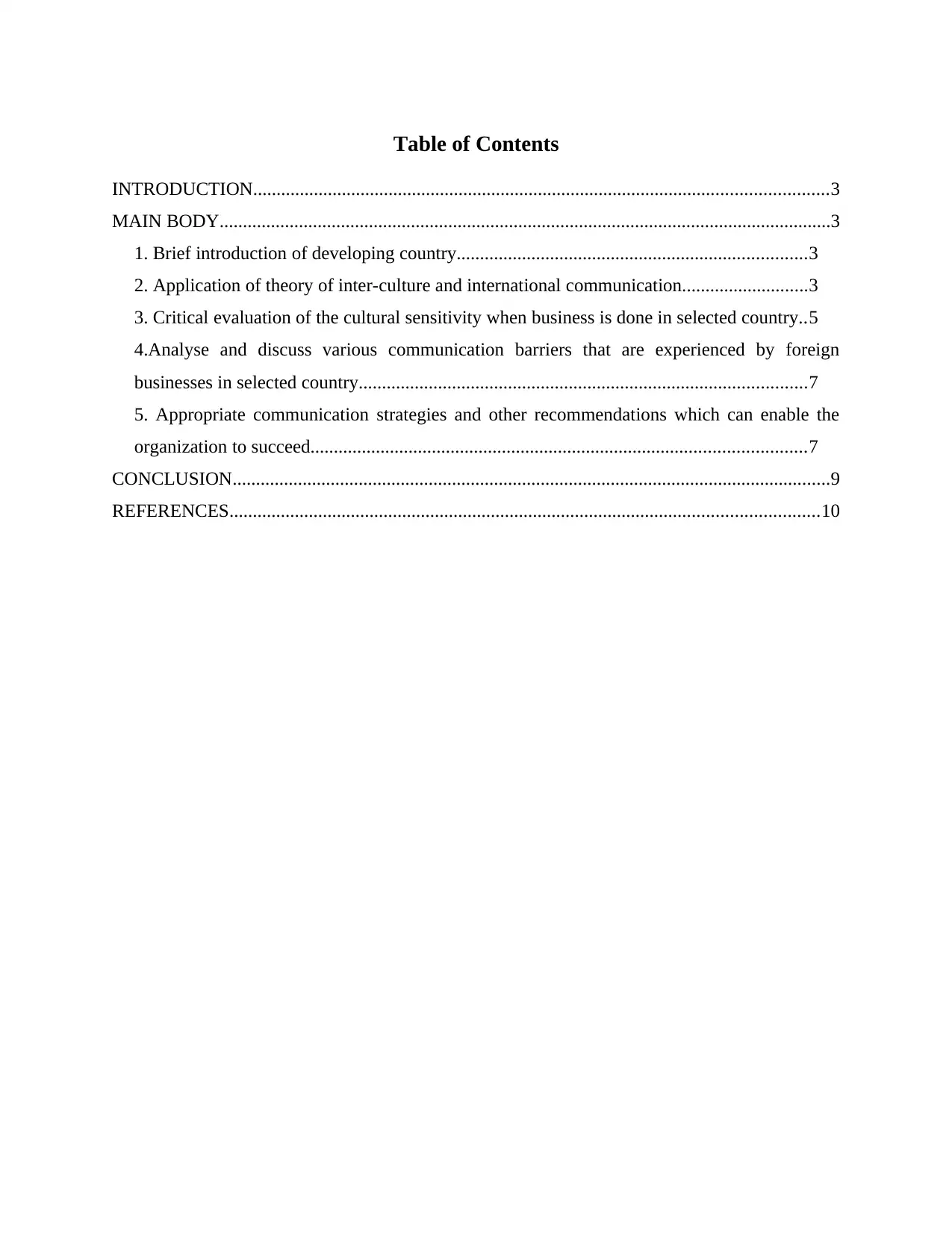
Table of Contents
INTRODUCTION...........................................................................................................................3
MAIN BODY...................................................................................................................................3
1. Brief introduction of developing country...........................................................................3
2. Application of theory of inter-culture and international communication...........................3
3. Critical evaluation of the cultural sensitivity when business is done in selected country..5
4.Analyse and discuss various communication barriers that are experienced by foreign
businesses in selected country................................................................................................7
5. Appropriate communication strategies and other recommendations which can enable the
organization to succeed..........................................................................................................7
CONCLUSION................................................................................................................................9
REFERENCES..............................................................................................................................10
INTRODUCTION...........................................................................................................................3
MAIN BODY...................................................................................................................................3
1. Brief introduction of developing country...........................................................................3
2. Application of theory of inter-culture and international communication...........................3
3. Critical evaluation of the cultural sensitivity when business is done in selected country..5
4.Analyse and discuss various communication barriers that are experienced by foreign
businesses in selected country................................................................................................7
5. Appropriate communication strategies and other recommendations which can enable the
organization to succeed..........................................................................................................7
CONCLUSION................................................................................................................................9
REFERENCES..............................................................................................................................10
INTRODUCTION
International business is something which relates to the situation wherein distribution or
the production of the offering are done on cross borders of countries. It mainly encompasses the
range of the cross borders exchange of the goods, resources and services between the nations
which may be two or more than two. It is essential to have the effective communication channel
between the partners of international business as it is critical to the success of company at global
level. When an organization manages the communication in a proactive manner, it develops the
strong relationship in international business which can facilitate rapid response to the challenges
and opportunities in market (Collinson and et. al., 2020). This report will cover the introduction
of developing country wherein the company is planning to move, theories on inter-culture
communication, evaluation of the cultural sensitivity and various barriers to communication
together with recommendations.
MAIN BODY
1. Brief introduction of developing country.
As India has the rich culinary heritage which has been evolved over the centuries. The
traditional foods provide exquisite vision of the rich culture heritage of India. Its traditional
habits of food are based primarily on holistic approach to the nutrition. The Indians are guided
strongly by their shared values and religions. The position of authority and power are valued
highly in India and they promote respect for the hierarchy and elders.
India is relatively the conservative society and it is essential for its visitors to have
respect for the traditional values and societal norms that underpins many business practices and
customs. The younger employees who are Indian are less particular to the decorum as compared
to the older generation but they adhere still to many of the conventions and traditions when being
around the elders or superiors (Agbim and Eluka, 2018).
2. Application of theory of inter-culture and international communication.
Inter cultural communication can be referred to as the discipline which studies the
communication in different social groups and culture or how the culture affects the
communication. It is basically an idea of knowing as to how to communicate or deliver
information in different parts of the world. International communication can be referred to as the
symbolic interaction which may be made between the people who belongs to distinct nation
International business is something which relates to the situation wherein distribution or
the production of the offering are done on cross borders of countries. It mainly encompasses the
range of the cross borders exchange of the goods, resources and services between the nations
which may be two or more than two. It is essential to have the effective communication channel
between the partners of international business as it is critical to the success of company at global
level. When an organization manages the communication in a proactive manner, it develops the
strong relationship in international business which can facilitate rapid response to the challenges
and opportunities in market (Collinson and et. al., 2020). This report will cover the introduction
of developing country wherein the company is planning to move, theories on inter-culture
communication, evaluation of the cultural sensitivity and various barriers to communication
together with recommendations.
MAIN BODY
1. Brief introduction of developing country.
As India has the rich culinary heritage which has been evolved over the centuries. The
traditional foods provide exquisite vision of the rich culture heritage of India. Its traditional
habits of food are based primarily on holistic approach to the nutrition. The Indians are guided
strongly by their shared values and religions. The position of authority and power are valued
highly in India and they promote respect for the hierarchy and elders.
India is relatively the conservative society and it is essential for its visitors to have
respect for the traditional values and societal norms that underpins many business practices and
customs. The younger employees who are Indian are less particular to the decorum as compared
to the older generation but they adhere still to many of the conventions and traditions when being
around the elders or superiors (Agbim and Eluka, 2018).
2. Application of theory of inter-culture and international communication.
Inter cultural communication can be referred to as the discipline which studies the
communication in different social groups and culture or how the culture affects the
communication. It is basically an idea of knowing as to how to communicate or deliver
information in different parts of the world. International communication can be referred to as the
symbolic interaction which may be made between the people who belongs to distinct nation
⊘ This is a preview!⊘
Do you want full access?
Subscribe today to unlock all pages.

Trusted by 1+ million students worldwide
states. On other side, inter culture communication is exchanging of information between the
people who are from different cultures wherein the values of culture are the obvious factor while
interacting or determining an outcome of interaction (Peltokorpi, 2017).
One of the model which is being widely used in order to analyse the cultural differences
is Hofstede wherein the differences in the culture is being plotted in five dimensions that may be
used as a basis for the purpose of predicting cultural differences among distinct countries. As the
company is planning to expand its operations in different country so the difference in their
culture can be determined by this model which is illustrated below- Power distance: It is that culture which measures an extent to which the hierarchy can
dominate the working environment. It deals with a fact that every individual in the
society is not equal and it expresses an attitude of culture towards the inequalities. In UK,
the power distance index is low as the people believe that the inequalities in people
should be minimized and on other side, in India, it is high as it indicates that the Indian
culture uses the phases such as dependent on boss or the power holder for the acceptance,
direction of the unequal rights between the one who are power privilege and the one who
are lesser. Individualism v. Collectivism: It considers degree to which the societies are integrated
into the groups. In individualism, there is high importance to accomplishing personal
goals while in collectivism, more importance is given to the goals of group (Huo and
Ouyang, 2018). When making a comparison between India and UK, in India there is both
individualism and collectivism traits wherein the former is seen as the result of dominant
religion which is Hinduism. Such people believe in the cycle of death and then rebirth so
therefore the people are responsible for the method by which they live their lives and its
impact will be on their rebirth. In the side of collectivist there is high preference to people
who belongs to large social framework wherein people are expected to work for greater
good of one's group. While in UK, there is more of individualism wherein children are
taught in early age to think about itself only and figure out their unique aim in life. Masculinity and Feminine: The high score of masculine indicates that society is driven
by achievement, success and competition wherein success is defined by best or winner in
the field while the low feminine score states that there are dominant values in the society
which involves quality of life and caring for others. In both UK and India, there is
people who are from different cultures wherein the values of culture are the obvious factor while
interacting or determining an outcome of interaction (Peltokorpi, 2017).
One of the model which is being widely used in order to analyse the cultural differences
is Hofstede wherein the differences in the culture is being plotted in five dimensions that may be
used as a basis for the purpose of predicting cultural differences among distinct countries. As the
company is planning to expand its operations in different country so the difference in their
culture can be determined by this model which is illustrated below- Power distance: It is that culture which measures an extent to which the hierarchy can
dominate the working environment. It deals with a fact that every individual in the
society is not equal and it expresses an attitude of culture towards the inequalities. In UK,
the power distance index is low as the people believe that the inequalities in people
should be minimized and on other side, in India, it is high as it indicates that the Indian
culture uses the phases such as dependent on boss or the power holder for the acceptance,
direction of the unequal rights between the one who are power privilege and the one who
are lesser. Individualism v. Collectivism: It considers degree to which the societies are integrated
into the groups. In individualism, there is high importance to accomplishing personal
goals while in collectivism, more importance is given to the goals of group (Huo and
Ouyang, 2018). When making a comparison between India and UK, in India there is both
individualism and collectivism traits wherein the former is seen as the result of dominant
religion which is Hinduism. Such people believe in the cycle of death and then rebirth so
therefore the people are responsible for the method by which they live their lives and its
impact will be on their rebirth. In the side of collectivist there is high preference to people
who belongs to large social framework wherein people are expected to work for greater
good of one's group. While in UK, there is more of individualism wherein children are
taught in early age to think about itself only and figure out their unique aim in life. Masculinity and Feminine: The high score of masculine indicates that society is driven
by achievement, success and competition wherein success is defined by best or winner in
the field while the low feminine score states that there are dominant values in the society
which involves quality of life and caring for others. In both UK and India, there is
Paraphrase This Document
Need a fresh take? Get an instant paraphrase of this document with our AI Paraphraser
masculine society which is high success oriented wherein work is centre of one's life and
the visible symbol of the success at workplace are very essential (Alabsy, 2018). Uncertainty avoidance: It deals with the way that the society deals with a fact that a
future cannot be known. The extent to which the people of culture feel threatened by the
unknown or ambiguous situation and have also created the institutions and beliefs which
try to prevent these is also reflected in this. India has 40 score in this which means
medium low preference for the avoiding uncertainty while in UK, there is low score of
this which means that country is happy to wake up by not knowing what the day will
bring for them. They feel comfortable in ambiguous culture or situation. Long term orientation: It mainly describes as to how each society maintains some link
with the past whilst dealing with challenges of future and present. In India the dominant
preference in the Indian culture cannot be determined as the concept of 'Karma'
dominated in the philosophical and religious thoughts. While in UK, the dominant
preference cannot be determined of the British culture (Czinkota, Ronkainen and Gupta,
2021).
Indulgence: One of the challenge which confronts the humanity in the past and now is
degree to which the small children are being socialized. It is concerned with the extent to
which the people mainly tries to control their impulses and desires on the basis of their
upbringing or the way they are raised. In India, there is low score of this as it is the
culture of restraint. They do not give much emphasis on the leisure time and have control
on their desires. While in UK, the British culture is classified as indulgent which exhibit
their willingness in order to realise their desires and impulses by enjoying life.
Hence, it can be said that the culture of UK and India are in contrast with each other as
they are opposite of one another. They work on the basis on different values and have distinct
thoughts and beliefs.
3. Critical evaluation of the cultural sensitivity when business is done in selected country.
A culture plays an essential role in the people's life as it is associated closely with them.
Every country has distinct culture wherein some things appear to be rude while somewhere it is
accepted due to cultural differences. The people that are culture sensitive knows that the cultural
differences may create differences in the relationship in context to communication, behaviour,
etc. When people travel from one nation to other, it is important that they conduct proper
the visible symbol of the success at workplace are very essential (Alabsy, 2018). Uncertainty avoidance: It deals with the way that the society deals with a fact that a
future cannot be known. The extent to which the people of culture feel threatened by the
unknown or ambiguous situation and have also created the institutions and beliefs which
try to prevent these is also reflected in this. India has 40 score in this which means
medium low preference for the avoiding uncertainty while in UK, there is low score of
this which means that country is happy to wake up by not knowing what the day will
bring for them. They feel comfortable in ambiguous culture or situation. Long term orientation: It mainly describes as to how each society maintains some link
with the past whilst dealing with challenges of future and present. In India the dominant
preference in the Indian culture cannot be determined as the concept of 'Karma'
dominated in the philosophical and religious thoughts. While in UK, the dominant
preference cannot be determined of the British culture (Czinkota, Ronkainen and Gupta,
2021).
Indulgence: One of the challenge which confronts the humanity in the past and now is
degree to which the small children are being socialized. It is concerned with the extent to
which the people mainly tries to control their impulses and desires on the basis of their
upbringing or the way they are raised. In India, there is low score of this as it is the
culture of restraint. They do not give much emphasis on the leisure time and have control
on their desires. While in UK, the British culture is classified as indulgent which exhibit
their willingness in order to realise their desires and impulses by enjoying life.
Hence, it can be said that the culture of UK and India are in contrast with each other as
they are opposite of one another. They work on the basis on different values and have distinct
thoughts and beliefs.
3. Critical evaluation of the cultural sensitivity when business is done in selected country.
A culture plays an essential role in the people's life as it is associated closely with them.
Every country has distinct culture wherein some things appear to be rude while somewhere it is
accepted due to cultural differences. The people that are culture sensitive knows that the cultural
differences may create differences in the relationship in context to communication, behaviour,
etc. When people travel from one nation to other, it is important that they conduct proper
research in regards to culture wherein they are travelling so that they can get prepared in advance
so that they are saved from embarrassed situation. As in globalized economy, the businesses are
growing at fast pace and they are expanding their operations in international markets.
Cultural sensitivity is referred to as being aware of the cultural similarities and
differences which may exist among people without assigning them the value which may be
negative or positive, right or wrong (Darics and Koller, 2017).
As an organization is planning to expand its business in India, there may be many cultural
sensitivity which will be faced by people which includes in relation to following factors- Communication: Delivering information or interacting with one another is very
important for carrying out the roles and responsibilities. So language of communication
between India and UK are distinct as in India there is more use of the national as well as
regional languages such as Hindi while in UK, English is their national language.
Although in India, English is considered as essential language for the working yet there
may be cultural sensitivity due to language barrier that may be faced by employees of
Bakes and Cakes. Individual versus group: Working and functioning in the businesses may be on
individual or group basis yet there are differences in the Indian and British culture in
terms of this. India emphasis on group working and people define largely themselves by
their groups to which they belong rather than by the status to which an individual alone
belongs to. So here the working of business may be distinct among both British and
Indian culture. For instance, In India when a company will expand and work, it may face
problem relating to working as Britishers are self- centred and likes to work on individual
basis while Indian workers tend to work in groups and think for the benefit of team as a
whole.
Stretchable time: The Indians are not time sensitive as compared to Britishers who tend
to stick to their working hours and not beyond that. For Indian, time is the flexible
concept and they work when they want to and there is no limit for the working hours in a
practical way. Here the expatiates from UK Bakes and Cakes in may face difficulty in
working due to flexibility of time (Khojastehpour and Shams, 2020).
so that they are saved from embarrassed situation. As in globalized economy, the businesses are
growing at fast pace and they are expanding their operations in international markets.
Cultural sensitivity is referred to as being aware of the cultural similarities and
differences which may exist among people without assigning them the value which may be
negative or positive, right or wrong (Darics and Koller, 2017).
As an organization is planning to expand its business in India, there may be many cultural
sensitivity which will be faced by people which includes in relation to following factors- Communication: Delivering information or interacting with one another is very
important for carrying out the roles and responsibilities. So language of communication
between India and UK are distinct as in India there is more use of the national as well as
regional languages such as Hindi while in UK, English is their national language.
Although in India, English is considered as essential language for the working yet there
may be cultural sensitivity due to language barrier that may be faced by employees of
Bakes and Cakes. Individual versus group: Working and functioning in the businesses may be on
individual or group basis yet there are differences in the Indian and British culture in
terms of this. India emphasis on group working and people define largely themselves by
their groups to which they belong rather than by the status to which an individual alone
belongs to. So here the working of business may be distinct among both British and
Indian culture. For instance, In India when a company will expand and work, it may face
problem relating to working as Britishers are self- centred and likes to work on individual
basis while Indian workers tend to work in groups and think for the benefit of team as a
whole.
Stretchable time: The Indians are not time sensitive as compared to Britishers who tend
to stick to their working hours and not beyond that. For Indian, time is the flexible
concept and they work when they want to and there is no limit for the working hours in a
practical way. Here the expatiates from UK Bakes and Cakes in may face difficulty in
working due to flexibility of time (Khojastehpour and Shams, 2020).
⊘ This is a preview!⊘
Do you want full access?
Subscribe today to unlock all pages.
Trusted by 1+ million students worldwide
4.Analyse and discuss various communication barriers that are experienced by foreign businesses
in selected country.
Cross cultural communication now has become the new avenue for the human
development which is encouraged by whole focusing community. In order to maintain the
harmonious relations, communication plays an important role and helps both private and public
enterprises. In order to make the communication easy and successful, it is important that the
receiver attributes same meaning to message which is intended by send of message. At times,
there are instances that some meaning is mainly lost as a message may encounter many barriers.
One such kind of barriers includes- Language barrier: When foreign businesses are initiated in a different country, there is
language barrier as the language in one country may not be used in other. As India is
linguistic country which has different regional languages at different parts of it, so this is
a basic communication barrier which will be faced by a company as the foreign
expatiates may not be able to get understanding of it. Although, Indian are perfect in
speaking English which the national language of UK, but there may be barriers relating to
language, assent, etc. This may create social distancing between the members as the
people do not get every input which it needs.
Misinterpretation of words: There are semantic problems that often arises when there us
gap between meaning which is intended by send and what is understood by receiver. This
may arise when the receiver does not assign same meaning to the symbol or word as a
transmitter have intended. So when an organization plans to expand its business in India,
the expatiates may face the barrier of misinterpretation which may lead to chaos and
confusion in working (Pérez, del Mar García de los Salmones and Liu, 2019).
5. Appropriate communication strategies and other recommendations which can enable the
organization to succeed.
In every workplace, there is a requirement of constant communication which may via
emails, face to face, video conferencing, phone calls or texts. As there are many barriers to the
communication when the foreign business is expanded to new nation. As Bakes and Cakes is
planning to expand in India, it may face barriers. The communication strategy which may be
opted by it in order to overcome the barriers are discussed below-
in selected country.
Cross cultural communication now has become the new avenue for the human
development which is encouraged by whole focusing community. In order to maintain the
harmonious relations, communication plays an important role and helps both private and public
enterprises. In order to make the communication easy and successful, it is important that the
receiver attributes same meaning to message which is intended by send of message. At times,
there are instances that some meaning is mainly lost as a message may encounter many barriers.
One such kind of barriers includes- Language barrier: When foreign businesses are initiated in a different country, there is
language barrier as the language in one country may not be used in other. As India is
linguistic country which has different regional languages at different parts of it, so this is
a basic communication barrier which will be faced by a company as the foreign
expatiates may not be able to get understanding of it. Although, Indian are perfect in
speaking English which the national language of UK, but there may be barriers relating to
language, assent, etc. This may create social distancing between the members as the
people do not get every input which it needs.
Misinterpretation of words: There are semantic problems that often arises when there us
gap between meaning which is intended by send and what is understood by receiver. This
may arise when the receiver does not assign same meaning to the symbol or word as a
transmitter have intended. So when an organization plans to expand its business in India,
the expatiates may face the barrier of misinterpretation which may lead to chaos and
confusion in working (Pérez, del Mar García de los Salmones and Liu, 2019).
5. Appropriate communication strategies and other recommendations which can enable the
organization to succeed.
In every workplace, there is a requirement of constant communication which may via
emails, face to face, video conferencing, phone calls or texts. As there are many barriers to the
communication when the foreign business is expanded to new nation. As Bakes and Cakes is
planning to expand in India, it may face barriers. The communication strategy which may be
opted by it in order to overcome the barriers are discussed below-
Paraphrase This Document
Need a fresh take? Get an instant paraphrase of this document with our AI Paraphraser
Practice active listening: It is one of the effective strategy for improving the cross
cultural communication. Summarize or restate what other person is saying is important in
order to ensure that it has been understood correctly. There must also be frequent asking
of questions so that a rapport is built and important information is not missed or even
misunderstood. The expatiates of of UK company must build this skill so that they do not
misinterpret any word or symbol and clear what they have understood by listening
carefully and asking questions.
Maintain etiquette: There are many cultures which have specific etiquette around the
ways in which it communicates. Before the meeting, the company must offer cross
cultural training to its employees so that it can have high degree of formality at beginning
of the communication among the people. The employees of a company must get familiar
with the familiarity tokens of India so that they can have effective communication. Move,
the training will help in indicating the formality so that a level of etiquette is maintained
(Guercini and Milanesi, 2017).
It is recommended a UK company that it must provide adequate training to the employees
before taking them to India for the business so that they can get familiar with tits culture and
learn the etiquette and language of it in order to avoid any miscommunication or
misunderstanding.
cultural communication. Summarize or restate what other person is saying is important in
order to ensure that it has been understood correctly. There must also be frequent asking
of questions so that a rapport is built and important information is not missed or even
misunderstood. The expatiates of of UK company must build this skill so that they do not
misinterpret any word or symbol and clear what they have understood by listening
carefully and asking questions.
Maintain etiquette: There are many cultures which have specific etiquette around the
ways in which it communicates. Before the meeting, the company must offer cross
cultural training to its employees so that it can have high degree of formality at beginning
of the communication among the people. The employees of a company must get familiar
with the familiarity tokens of India so that they can have effective communication. Move,
the training will help in indicating the formality so that a level of etiquette is maintained
(Guercini and Milanesi, 2017).
It is recommended a UK company that it must provide adequate training to the employees
before taking them to India for the business so that they can get familiar with tits culture and
learn the etiquette and language of it in order to avoid any miscommunication or
misunderstanding.
CONCLUSION
It is concluded from this report that business communication is very important, especially
when the organization operates at international level. In order to make effective business
communication, it is essential to have understanding of its culture so that there is no chaos or
confusion. The Hofstede model of culture is used which helps in understanding the intercultural
dimensions of two states. There are many barriers to the communication when working in
different country which includes language barrier, misinterpretation, etc. but can be improved by
offering cross cultural training, active listening. Hence, when a UK based company expand its
business to India, it must provide proper training to expatiates so that it can get familiarity of the
Indian culture.
It is concluded from this report that business communication is very important, especially
when the organization operates at international level. In order to make effective business
communication, it is essential to have understanding of its culture so that there is no chaos or
confusion. The Hofstede model of culture is used which helps in understanding the intercultural
dimensions of two states. There are many barriers to the communication when working in
different country which includes language barrier, misinterpretation, etc. but can be improved by
offering cross cultural training, active listening. Hence, when a UK based company expand its
business to India, it must provide proper training to expatiates so that it can get familiarity of the
Indian culture.
⊘ This is a preview!⊘
Do you want full access?
Subscribe today to unlock all pages.
Trusted by 1+ million students worldwide
REFERENCES
Books and Journals
Agbim, K.C. and Eluka, J., 2018. Social network and family business internationalization in
South Eastern Nigeria. Journal of Accounting, Business and Finance Research. 3(2).
pp.64-74.
Alabsy, N., 2018. The impact of electronic banking services on customer satisfaction in the
Sudanese banking sector. International Business Research.
Collinson, S., and et. al., 2020. International business. Pearson UK.
Czinkota, M.R., Ronkainen, I.A. and Gupta, S., 2021. International business. Cambridge
University Press.
Darics, E. and Koller, V., 2017. Language in business, language at work. Palgrave.
Guercini, S. and Milanesi, M., 2017. Extreme luxury fashion: business model and
internationalization process. International Marketing Review.
Huo, D. and Ouyang, R., 2018. Internationalization strategy of Chinese E-business
companies. Emerging Markets Finance and Trade. 54(4). pp.801-810.
Khojastehpour, M. and Shams, S.R., 2020. Addressing the complexity of stakeholder
management in international ecological setting: A CSR approach. Journal of Business
Research. 119. pp.302-309.
Peltokorpi, V., 2017. Absorptive capacity in foreign subsidiaries: The effects of language-
sensitive recruitment, language training, and interunit knowledge transfer. International
Business Review. 26(1). pp.119-129.
Pérez, A., del Mar García de los Salmones, M. and Liu, M.T., 2019. Maximising business
returns to corporate social responsibility communication: An empirical test. Business
Ethics: A European Review. 28(3). pp.275-289.
Books and Journals
Agbim, K.C. and Eluka, J., 2018. Social network and family business internationalization in
South Eastern Nigeria. Journal of Accounting, Business and Finance Research. 3(2).
pp.64-74.
Alabsy, N., 2018. The impact of electronic banking services on customer satisfaction in the
Sudanese banking sector. International Business Research.
Collinson, S., and et. al., 2020. International business. Pearson UK.
Czinkota, M.R., Ronkainen, I.A. and Gupta, S., 2021. International business. Cambridge
University Press.
Darics, E. and Koller, V., 2017. Language in business, language at work. Palgrave.
Guercini, S. and Milanesi, M., 2017. Extreme luxury fashion: business model and
internationalization process. International Marketing Review.
Huo, D. and Ouyang, R., 2018. Internationalization strategy of Chinese E-business
companies. Emerging Markets Finance and Trade. 54(4). pp.801-810.
Khojastehpour, M. and Shams, S.R., 2020. Addressing the complexity of stakeholder
management in international ecological setting: A CSR approach. Journal of Business
Research. 119. pp.302-309.
Peltokorpi, V., 2017. Absorptive capacity in foreign subsidiaries: The effects of language-
sensitive recruitment, language training, and interunit knowledge transfer. International
Business Review. 26(1). pp.119-129.
Pérez, A., del Mar García de los Salmones, M. and Liu, M.T., 2019. Maximising business
returns to corporate social responsibility communication: An empirical test. Business
Ethics: A European Review. 28(3). pp.275-289.

1 out of 10


Related Documents


Your All-in-One AI-Powered Toolkit for Academic Success.
+13062052269
info@desklib.com
Available 24*7 on WhatsApp / Email
![[object Object]](/_next/static/media/star-bottom.7253800d.svg)
Unlock your academic potential
Copyright © 2020–2026 A2Z Services. All Rights Reserved. Developed and managed by ZUCOL.