Communication Strategies in Child Development: Methods and Techniques

Verified

Added on  2020/12/10

|1
|483
|127
Homework Assignment
AI Summary
This assignment explores the crucial role of communication in child development, emphasizing its importance for fostering positive relationships and supporting overall growth. It highlights the need for effective communication between parents, children, and young people, and discusses methods to build rapport and trust. The assignment outlines various communication methods, including expressive, receptive, pre-symbolic, non-symbolic, and symbolic communication, providing examples of how these methods are used. It also references key theories and studies in child development, such as those by Deater-Deckard, Freud, Havnes, and Keenan, to support the discussion. The content underscores the significance of adapting communication styles to suit the developmental stage of the child, ensuring effective interaction and promoting social development. The assignment serves as a resource for understanding and implementing effective communication strategies in the context of child development.
Document Page
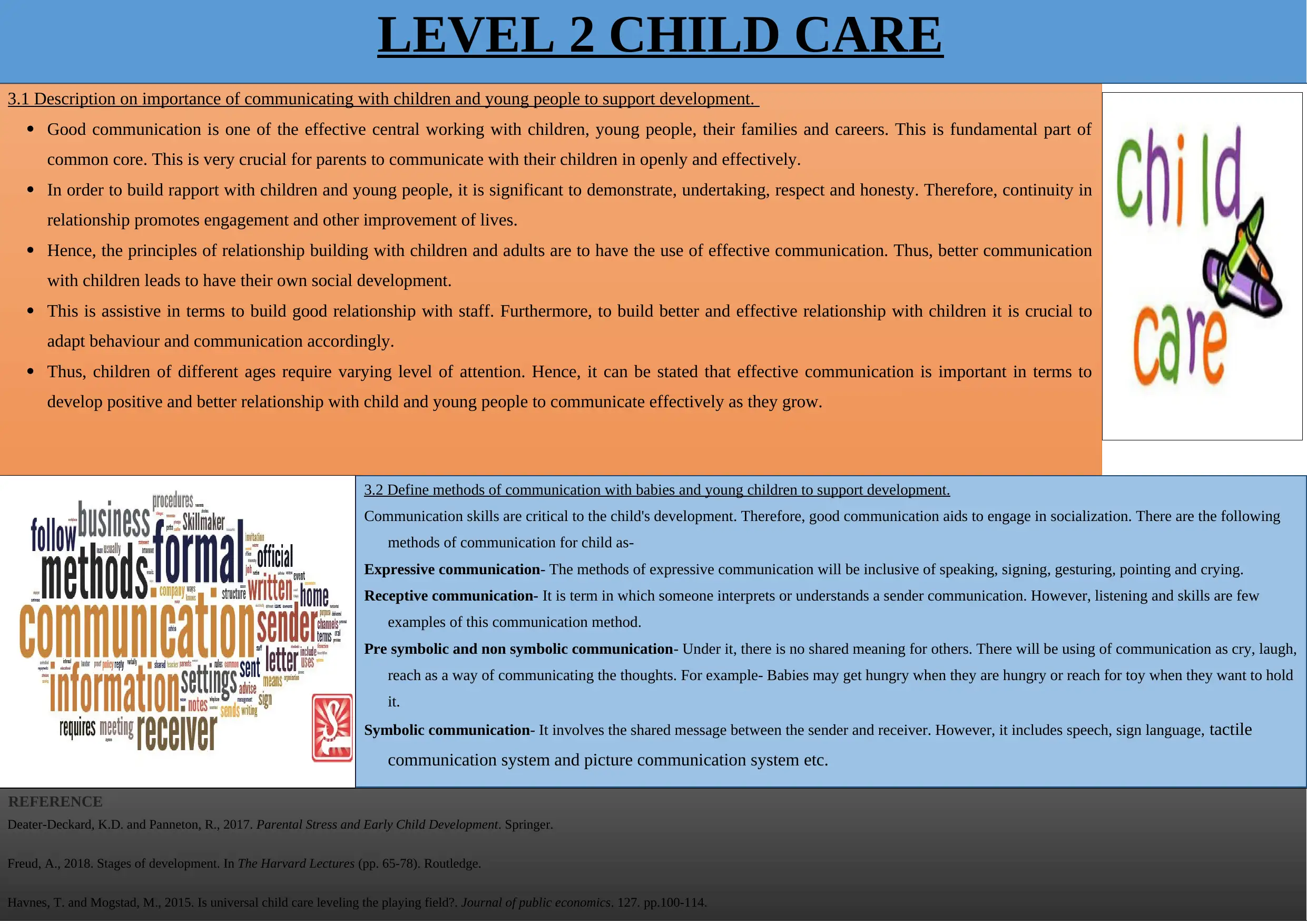
LEVEL 2 CHILD CARE
3.1 Description on importance of communicating with children and young people to support development.
Good communication is one of the effective central working with children, young people, their families and careers. This is fundamental part of
common core. This is very crucial for parents to communicate with their children in openly and effectively.
In order to build rapport with children and young people, it is significant to demonstrate, undertaking, respect and honesty. Therefore, continuity in
relationship promotes engagement and other improvement of lives.
Hence, the principles of relationship building with children and adults are to have the use of effective communication. Thus, better communication
with children leads to have their own social development.
This is assistive in terms to build good relationship with staff. Furthermore, to build better and effective relationship with children it is crucial to
adapt behaviour and communication accordingly.
Thus, children of different ages require varying level of attention. Hence, it can be stated that effective communication is important in terms to
develop positive and better relationship with child and young people to communicate effectively as they grow.
REFERENCE
Deater-Deckard, K.D. and Panneton, R., 2017. Parental Stress and Early Child Development. Springer.
Freud, A., 2018. Stages of development. In The Harvard Lectures (pp. 65-78). Routledge.
Havnes, T. and Mogstad, M., 2015. Is universal child care leveling the playing field?. Journal of public economics. 127. pp.100-114.
3.2 Define methods of communication with babies and young children to support development.
Communication skills are critical to the child's development. Therefore, good communication aids to engage in socialization. There are the following
methods of communication for child as-
Expressive communication- The methods of expressive communication will be inclusive of speaking, signing, gesturing, pointing and crying.
Receptive communication- It is term in which someone interprets or understands a sender communication. However, listening and skills are few
examples of this communication method.
Pre symbolic and non symbolic communication- Under it, there is no shared meaning for others. There will be using of communication as cry, laugh,
reach as a way of communicating the thoughts. For example- Babies may get hungry when they are hungry or reach for toy when they want to hold
it.
Symbolic communication- It involves the shared message between the sender and receiver. However, it includes speech, sign language, tactile
communication system and picture communication system etc.
tabler-icon-diamond-filled.svg

Paraphrase This Document

Need a fresh take? Get an instant paraphrase of this document with our AI Paraphraser
[object Object]