Effective Interpersonal Communication: A Key Attribute for Employees
VerifiedAdded on 2023/06/05
|11
|3223
|422
Essay
AI Summary
This essay examines the critical role of interpersonal communication as a vital attribute for all employees within an organization. It begins by defining interpersonal communication and its significance in fostering effective teamwork, negotiation, problem-solving, and strategic decision-making. The essay then explores the barriers to organizational effectiveness that arise from poor interpersonal skills, such as difficulties in understanding job responsibilities, lack of employee engagement, and hindered coordination. Highlighting the importance of interpersonal communication, the essay emphasizes how it facilitates better understanding among employees, boosts motivation and excitement, enhances self-awareness, promotes employee involvement, expands opportunities, and cultivates leadership qualities. It further explains how interpersonal communication creates trust and transparency within the organization. Finally, the essay provides practical ways to improve interpersonal communication skills, including seeking feedback, active listening, maintaining eye contact and body language, and building strong relationships. Overall, the essay underscores the importance of interpersonal communication as a cornerstone of organizational success and employee development.
INTERPERSONAL COMMUNICATION IS AN IMPORTANT
ATTRIBUTE FOR ALL EMPLOYEES
1
ATTRIBUTE FOR ALL EMPLOYEES
1

Paraphrase This Document
Need a fresh take? Get an instant paraphrase of this document with our AI Paraphraser
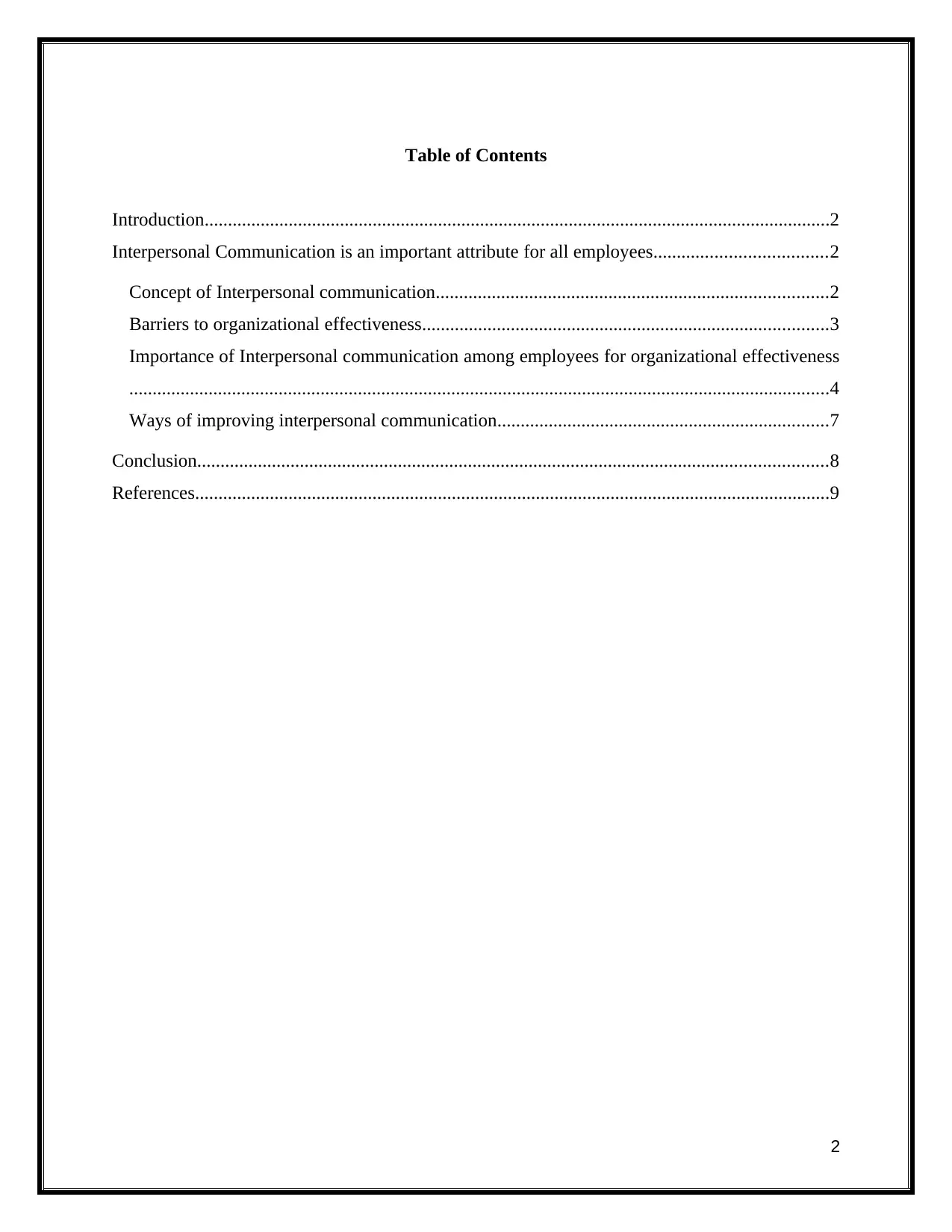
Table of Contents
Introduction......................................................................................................................................2
Interpersonal Communication is an important attribute for all employees.....................................2
Concept of Interpersonal communication....................................................................................2
Barriers to organizational effectiveness.......................................................................................3
Importance of Interpersonal communication among employees for organizational effectiveness
......................................................................................................................................................4
Ways of improving interpersonal communication.......................................................................7
Conclusion.......................................................................................................................................8
References........................................................................................................................................9
2
Introduction......................................................................................................................................2
Interpersonal Communication is an important attribute for all employees.....................................2
Concept of Interpersonal communication....................................................................................2
Barriers to organizational effectiveness.......................................................................................3
Importance of Interpersonal communication among employees for organizational effectiveness
......................................................................................................................................................4
Ways of improving interpersonal communication.......................................................................7
Conclusion.......................................................................................................................................8
References........................................................................................................................................9
2
Introduction
Interpersonal communication is a specific approach of exchanging feelings. Interaction with
people has required in every stage of life either it is personal life or professional life. In an
organisation, it is required that employees are integrated with each other so that they can
implement appropriate teamwork. Interpersonal communication is much required for inter-team
communication where team members will be able to exchange shared goals with each other. In
an organisation, communication can be done in both verbally and non-verbally. However
interpersonal communication determines face-to-face communication where employees will
exchange their information with their hierarchy. It has been observed that an employee with s
skill of interpersonal communication ability, not only has effective communication skills, but
also the employee will be an active listener. These attributes will contribute to improving
employees’ productivity as well as organisation's performance. Thus, the thesis statement of this
essay will be to assess whether interpersonal communication is an important attribute of
employees within an organisation or.
Interpersonal Communication is an important attribute for all employees
Concept of Interpersonal communication
Interpersonal communication basically means the transformation of information between two
people. Interpersonal communication involves the ability of negotiation, problem solving,
assertiveness and decision making1. Thus, it is necessary factor in order to attain the goals of an
organisation. Interaction is important to understand the ideas, feelings and emotions of people. It
is true that organisational success depends on the interpersonal communication skill of its
employees as it leads to strategic decision-making. If the employees are able to share their ideas
and information with each other then both employees as well as organisation will be benefitted.
A person can be said to have interpersonal communication skill if he or she is able to present his
or her thought with great confidence, posture, and gesture as well as with proper facial
expression. The effectiveness of organisation depends on the interpersonal communication
1 Hargie, O., 2016. Skilled interpersonal communication: Research, theory and practice. Abingdon: Routledge.
3
Interpersonal communication is a specific approach of exchanging feelings. Interaction with
people has required in every stage of life either it is personal life or professional life. In an
organisation, it is required that employees are integrated with each other so that they can
implement appropriate teamwork. Interpersonal communication is much required for inter-team
communication where team members will be able to exchange shared goals with each other. In
an organisation, communication can be done in both verbally and non-verbally. However
interpersonal communication determines face-to-face communication where employees will
exchange their information with their hierarchy. It has been observed that an employee with s
skill of interpersonal communication ability, not only has effective communication skills, but
also the employee will be an active listener. These attributes will contribute to improving
employees’ productivity as well as organisation's performance. Thus, the thesis statement of this
essay will be to assess whether interpersonal communication is an important attribute of
employees within an organisation or.
Interpersonal Communication is an important attribute for all employees
Concept of Interpersonal communication
Interpersonal communication basically means the transformation of information between two
people. Interpersonal communication involves the ability of negotiation, problem solving,
assertiveness and decision making1. Thus, it is necessary factor in order to attain the goals of an
organisation. Interaction is important to understand the ideas, feelings and emotions of people. It
is true that organisational success depends on the interpersonal communication skill of its
employees as it leads to strategic decision-making. If the employees are able to share their ideas
and information with each other then both employees as well as organisation will be benefitted.
A person can be said to have interpersonal communication skill if he or she is able to present his
or her thought with great confidence, posture, and gesture as well as with proper facial
expression. The effectiveness of organisation depends on the interpersonal communication
1 Hargie, O., 2016. Skilled interpersonal communication: Research, theory and practice. Abingdon: Routledge.
3
⊘ This is a preview!⊘
Do you want full access?
Subscribe today to unlock all pages.

Trusted by 1+ million students worldwide
among employees due to its ability for negotiation2. An organisation having effective
interpersonal communication skill among its employees is always able to achieve its goal
because of their flexible interaction on every project. Employees having great interpersonal skills
are always motivated by their work and share the information or ideas with each other that leads
the organisation to success.
Barriers to organisational effectiveness
The effectiveness of organisation depends on the interpersonal skill of employees. It has been
seen that organisation face some difficulties due to lack of interpersonal skills3. Due to lack of
interpersonal communication, an employee would not be able to communicate her difficulties in
understanding his or her job responsibilities. They will hesitate to ask questions to clear the
doubt due to lack of communication skill. An organisation requires effective employee
engagement however without ability to communicate interpersonally, it is not possible. Even, the
employees will not able to coordinate with each other which will lead to unproductive
performance. As per Maslow's hierarchy of needs, the thirst motivational factor is belongings
among team members4. Thus, if an employee has formal relationship with each other then they
motivate each other to work. However, due to lack of interaction, they do not feel motivated or
excited which will resist the growth of an organisation. In an organisation, one's personality can
be determined by, his or her views5. This personality trait ensures the corporate image of that
particular employee. If the personality of employees is not presentable then they are not able to
attain the organisational goal which will hinder the organisational growth.
2 Reece, B. and Reece, M., 2016. Effective human relations: Interpersonal and organizational applications. Boston:
Cengage Learning.
3 Lane, S.D., 2016. Interpersonal communication: Competence and contexts. Abingdon: Routledge.
4 Benzer, J.K., Cramer, I.E., Burgess, J.F., Mohr, D.C., Sullivan, J.L. and Charns, M.P., 2015. How personal and
standardized coordination impact implementation of integrated care. BMC health services research, [Online] 15(1),
p.448. Retrieved from: https://bmchealthservres.biomedcentral.com/articles/10.1186/s12913-015-1079-6
5 Ruck, M.K. ed., 2015. Exploring internal communication: Towards informed employee voice. Farnham: Gower
Publishing, Ltd.
4
interpersonal communication skill among its employees is always able to achieve its goal
because of their flexible interaction on every project. Employees having great interpersonal skills
are always motivated by their work and share the information or ideas with each other that leads
the organisation to success.
Barriers to organisational effectiveness
The effectiveness of organisation depends on the interpersonal skill of employees. It has been
seen that organisation face some difficulties due to lack of interpersonal skills3. Due to lack of
interpersonal communication, an employee would not be able to communicate her difficulties in
understanding his or her job responsibilities. They will hesitate to ask questions to clear the
doubt due to lack of communication skill. An organisation requires effective employee
engagement however without ability to communicate interpersonally, it is not possible. Even, the
employees will not able to coordinate with each other which will lead to unproductive
performance. As per Maslow's hierarchy of needs, the thirst motivational factor is belongings
among team members4. Thus, if an employee has formal relationship with each other then they
motivate each other to work. However, due to lack of interaction, they do not feel motivated or
excited which will resist the growth of an organisation. In an organisation, one's personality can
be determined by, his or her views5. This personality trait ensures the corporate image of that
particular employee. If the personality of employees is not presentable then they are not able to
attain the organisational goal which will hinder the organisational growth.
2 Reece, B. and Reece, M., 2016. Effective human relations: Interpersonal and organizational applications. Boston:
Cengage Learning.
3 Lane, S.D., 2016. Interpersonal communication: Competence and contexts. Abingdon: Routledge.
4 Benzer, J.K., Cramer, I.E., Burgess, J.F., Mohr, D.C., Sullivan, J.L. and Charns, M.P., 2015. How personal and
standardized coordination impact implementation of integrated care. BMC health services research, [Online] 15(1),
p.448. Retrieved from: https://bmchealthservres.biomedcentral.com/articles/10.1186/s12913-015-1079-6
5 Ruck, M.K. ed., 2015. Exploring internal communication: Towards informed employee voice. Farnham: Gower
Publishing, Ltd.
4
Paraphrase This Document
Need a fresh take? Get an instant paraphrase of this document with our AI Paraphraser
Importance of Interpersonal communication among employees for organizational
effectiveness
The interpersonal skill of communication among the employees helps organisational
effectiveness.
Proper understanding
If the employees of an organisation have well interpersonal communication skill they can
understand each other well. With the help of interpersonal communication skills, employees will
be able to understand diversified perspective while working in a team. Caltex has found that the
employees feel free to interact and clear their thoughts while taking training. Employees having
interpersonal skill feel free to ask question if he or she is not clear with the work. If they interact
with each other then they can also help each other in work which can benefit the organisation.
Sometimes it has been seen that some employees do not clear with the training provided and
even they do not ask the trainer to clear6. This can affect the job responsibility of the employee.
On the contrary, it has been seen that some employees ask too many irrelevant questions to the
trainer which disturbance among employees and degrade one's personality.
Motivation and Excitement among employees
Employees having interpersonal skill work with unity and feel excited as well as motivated by
each other. It is true that motivation and excitement are integral attributes for any work because
this helps the employees to complete the work with satisfaction7. In Woolworths, the employees
are found to do the work with motivation which has befitted the reach top position Australian
retail market. It has been finding that the person who has well interpersonal skills keep him or
her excited and motivated to fulfil the work. Motivation comes from the successful work that
helps the organisation to earn profit.
Self Awareness of Employees
Interaction with each other helps the employees to share their feelings, ideas among each other
so that they can improve their self-image. Interpersonal skill does not help only the organisation
6 Slack, R.E., Corlett, S. and Morris, R., 2015. Exploring employee engagement with (corporate) social
responsibility: A social exchange perspective on organisational participation. Journal of Business Ethics, 127(3),
pp.537-548.
7 Men, L.R., 2014. Strategic internal communication: Transformational leadership, communication channels, and
employee satisfaction. Management Communication Quarterly, 28(2), pp.264-284.
5
effectiveness
The interpersonal skill of communication among the employees helps organisational
effectiveness.
Proper understanding
If the employees of an organisation have well interpersonal communication skill they can
understand each other well. With the help of interpersonal communication skills, employees will
be able to understand diversified perspective while working in a team. Caltex has found that the
employees feel free to interact and clear their thoughts while taking training. Employees having
interpersonal skill feel free to ask question if he or she is not clear with the work. If they interact
with each other then they can also help each other in work which can benefit the organisation.
Sometimes it has been seen that some employees do not clear with the training provided and
even they do not ask the trainer to clear6. This can affect the job responsibility of the employee.
On the contrary, it has been seen that some employees ask too many irrelevant questions to the
trainer which disturbance among employees and degrade one's personality.
Motivation and Excitement among employees
Employees having interpersonal skill work with unity and feel excited as well as motivated by
each other. It is true that motivation and excitement are integral attributes for any work because
this helps the employees to complete the work with satisfaction7. In Woolworths, the employees
are found to do the work with motivation which has befitted the reach top position Australian
retail market. It has been finding that the person who has well interpersonal skills keep him or
her excited and motivated to fulfil the work. Motivation comes from the successful work that
helps the organisation to earn profit.
Self Awareness of Employees
Interaction with each other helps the employees to share their feelings, ideas among each other
so that they can improve their self-image. Interpersonal skill does not help only the organisation
6 Slack, R.E., Corlett, S. and Morris, R., 2015. Exploring employee engagement with (corporate) social
responsibility: A social exchange perspective on organisational participation. Journal of Business Ethics, 127(3),
pp.537-548.
7 Men, L.R., 2014. Strategic internal communication: Transformational leadership, communication channels, and
employee satisfaction. Management Communication Quarterly, 28(2), pp.264-284.
5
to achieve the goal but it also helps the employees to build confidence and be presentable in front
of people to present their thoughts and ideas8. If employees are confident and can able to present
their organisational values in front of people then the organisation will run in profit and achieve
the goal within short time.
Involvement of Employees
The employees of an organisation interact with each other and also with the managers or
hierarchy then they can involve in the work and present their own ideas or thoughts. It has been
found that if the organisation shares the information or thoughts on any project with the
employees then employees can present their own thoughts for the project9. Wesfarmers shares
the thoughts to their employees and employees help them by presenting their ideas. Interpersonal
skills help the employees to involve in such activity. Interaction with employees is important but
if employees interact much more with each other then it is not well for the organisation.
Expanding opportunities
It has been seen that the employees who always interact with their hierarchy can get opportunity
for different work as they have well interpersonal communication skills. Managers like the
employee who interacts with them and provides different work based on his or her quality.
Employees get different opportunities due to their interpersonal skills and prove their quality.
Cash Converters has given different opportunities to employees interacting with them regularly10.
On the other side the employees who do not interact with managers, have low self-image and do
not get different opportunities. At the same time if someone always interacts with managers
without any reason then it casts the negative effect on managers.
Leadership
Interpersonal skill helps the organisation to find great leader. Organisation chooses its leaders
according to interpersonal skills such as ways of communicating and treating people, body
language, gesture, posture, open-minded, motivated, and excited and having quality to lead a
8 Mishra, K., Boynton, L. and Mishra, A., 2014. Driving employee engagement: The expanded role of internal
communications. International Journal of Business Communication, 51(2), pp.183-202.
9 Karanges, E., Johnston, K., Beatson, A. and Lings, I., 2015. The influence of internal communication on employee
engagement: A pilot study. Public Relations Review, 41(1), pp.129-131.
10 Yildiz, A.K., 2017. Effective communication skills to manage the library: relations between managers and
librarians. Qualitative and Quantitative Methods in Libraries, 1(2), pp.141-153.
6
of people to present their thoughts and ideas8. If employees are confident and can able to present
their organisational values in front of people then the organisation will run in profit and achieve
the goal within short time.
Involvement of Employees
The employees of an organisation interact with each other and also with the managers or
hierarchy then they can involve in the work and present their own ideas or thoughts. It has been
found that if the organisation shares the information or thoughts on any project with the
employees then employees can present their own thoughts for the project9. Wesfarmers shares
the thoughts to their employees and employees help them by presenting their ideas. Interpersonal
skills help the employees to involve in such activity. Interaction with employees is important but
if employees interact much more with each other then it is not well for the organisation.
Expanding opportunities
It has been seen that the employees who always interact with their hierarchy can get opportunity
for different work as they have well interpersonal communication skills. Managers like the
employee who interacts with them and provides different work based on his or her quality.
Employees get different opportunities due to their interpersonal skills and prove their quality.
Cash Converters has given different opportunities to employees interacting with them regularly10.
On the other side the employees who do not interact with managers, have low self-image and do
not get different opportunities. At the same time if someone always interacts with managers
without any reason then it casts the negative effect on managers.
Leadership
Interpersonal skill helps the organisation to find great leader. Organisation chooses its leaders
according to interpersonal skills such as ways of communicating and treating people, body
language, gesture, posture, open-minded, motivated, and excited and having quality to lead a
8 Mishra, K., Boynton, L. and Mishra, A., 2014. Driving employee engagement: The expanded role of internal
communications. International Journal of Business Communication, 51(2), pp.183-202.
9 Karanges, E., Johnston, K., Beatson, A. and Lings, I., 2015. The influence of internal communication on employee
engagement: A pilot study. Public Relations Review, 41(1), pp.129-131.
10 Yildiz, A.K., 2017. Effective communication skills to manage the library: relations between managers and
librarians. Qualitative and Quantitative Methods in Libraries, 1(2), pp.141-153.
6
⊘ This is a preview!⊘
Do you want full access?
Subscribe today to unlock all pages.
Trusted by 1+ million students worldwide
team. David Jones has found to have leadership quality among employees based on interpersonal
skills. Leadership quality depends on interpersonal skills but there are also other qualities that a
leader should have11. Organisations depend on leaders to achieve the goal because a good leader
leads the team well and complete the target in time. At the same time if leaders do not have such
skills then organisation cannot achieve the goal within time and the work will not be effective.
Creating Trust
For an organisation, transparency is important to the employees so that the organisation shares
the thoughts with the employees and builds trust with each other. It is true that organisational
manager does not trust all employees. Employees, who have well interpersonal skills, are able to
interact with the managers about their thoughts and ideas. Organisation does not able to complete
any task without the support of the employees and the employees having such skill can support
the organisation12. Country Road trusted their employees and face difficulties. It is also true that
too much trust in employees is not well for an organisation because it can face difficulties if
employees do anything that is not right.
Ways of improving interpersonal communication
There are several ways that help the people to improve the interpersonal communication skill.
Asking feedback
If employees or people ask for the feedback of their thought or communication then they can
understand their negative parts and improve that to build great interpersonal skills. Feedbacks
help the people to correct the mistakes done by them13. It is not only for employees but it is also
necessary for an organisation to know the feedback from the customers in order to modify the
products and services. In the same way, people also need feedback to modify or improve them.
Listen Actively
11 Kimball, M.A., 2015. Training and education: Technical communication managers speak out. Technical
Communication, 62(2), pp.135-145.
12 Sarapaivanich, N. and Patterson, P.G., 2015. The role of interpersonal communication in developing small-
medium size enterprise (SME) client loyalty toward an audit firm. International Small Business Journal, 33(8),
pp.882-900.
13 Yamao, S. and Sekiguchi, T., 2015. Employee commitment to corporate globalization: The role of English
language proficiency and human resource practices. Journal of World Business, 50(1), pp.168-179.
7
skills. Leadership quality depends on interpersonal skills but there are also other qualities that a
leader should have11. Organisations depend on leaders to achieve the goal because a good leader
leads the team well and complete the target in time. At the same time if leaders do not have such
skills then organisation cannot achieve the goal within time and the work will not be effective.
Creating Trust
For an organisation, transparency is important to the employees so that the organisation shares
the thoughts with the employees and builds trust with each other. It is true that organisational
manager does not trust all employees. Employees, who have well interpersonal skills, are able to
interact with the managers about their thoughts and ideas. Organisation does not able to complete
any task without the support of the employees and the employees having such skill can support
the organisation12. Country Road trusted their employees and face difficulties. It is also true that
too much trust in employees is not well for an organisation because it can face difficulties if
employees do anything that is not right.
Ways of improving interpersonal communication
There are several ways that help the people to improve the interpersonal communication skill.
Asking feedback
If employees or people ask for the feedback of their thought or communication then they can
understand their negative parts and improve that to build great interpersonal skills. Feedbacks
help the people to correct the mistakes done by them13. It is not only for employees but it is also
necessary for an organisation to know the feedback from the customers in order to modify the
products and services. In the same way, people also need feedback to modify or improve them.
Listen Actively
11 Kimball, M.A., 2015. Training and education: Technical communication managers speak out. Technical
Communication, 62(2), pp.135-145.
12 Sarapaivanich, N. and Patterson, P.G., 2015. The role of interpersonal communication in developing small-
medium size enterprise (SME) client loyalty toward an audit firm. International Small Business Journal, 33(8),
pp.882-900.
13 Yamao, S. and Sekiguchi, T., 2015. Employee commitment to corporate globalization: The role of English
language proficiency and human resource practices. Journal of World Business, 50(1), pp.168-179.
7
Paraphrase This Document
Need a fresh take? Get an instant paraphrase of this document with our AI Paraphraser
Listening is also necessary to have great interpersonal communication skills. Unless and until
people listen to each other they cannot build well relationship14. In order to understand the
thoughts and ideas of others, one should be a good listener. After understanding anything, one
can work for that.
Eye Contact and Body Language
While communicating with others, people should also focus on eye contact as well as body
language. They should maintain their gesture, posture while talking and look into the eyes of
listener. It helps to build great interpersonal skills15. A good leader of an organisation always
focus on the body language and look into the eyes of people while speaking to them.
Build Relationship
In order to build interpersonal skills, people have to focus on their behaviour with others and
always try to build relationship with them16. A successful person is always respected by many
people because of his well behaviour with them.
Conclusion
The study helps to understand the importance of interpersonal communication skills for the
employees. The growth or effectiveness of an organisation depends on the different skills of the
employees such as their unity, motivation, leadership quality, way of speaking and treating
people, listening attitude and many others. Interpersonal communication has some negative
impacts also such as too much interaction among employees is not well for the organisation. Too
much interaction creates conflicts within an organisation. It is true that interpersonal
communication skills of employees help the organisation to achieve the goal within short time.
14 Men, L.R., 2015. The internal communication role of the chief executive officer: Communication channels, style,
and effectiveness. Public Relations Review, 41(4), pp.461-471.
15 Heide, M., von Platen, S., Simonsson, C. and Falkheimer, J., 2018. Expanding the scope of strategic
communication: Towards a holistic understanding of organizational complexity. International Journal of Strategic
Communication, [Online] 12(4), pp.452-468. Retrieved from:
https://www.tandfonline.com/doi/abs/10.1080/1553118X.2018.1456434
16 Bao, Y., Zhu, F., Hu, Y. and Cui, N., 2016. The research of interpersonal conflict and solution
strategies. Psychology, [Online] 7(04), p.541. Retyrieved from:
http://www.scirp.org/journal/PaperInformation.aspx?paperID=65687
8
people listen to each other they cannot build well relationship14. In order to understand the
thoughts and ideas of others, one should be a good listener. After understanding anything, one
can work for that.
Eye Contact and Body Language
While communicating with others, people should also focus on eye contact as well as body
language. They should maintain their gesture, posture while talking and look into the eyes of
listener. It helps to build great interpersonal skills15. A good leader of an organisation always
focus on the body language and look into the eyes of people while speaking to them.
Build Relationship
In order to build interpersonal skills, people have to focus on their behaviour with others and
always try to build relationship with them16. A successful person is always respected by many
people because of his well behaviour with them.
Conclusion
The study helps to understand the importance of interpersonal communication skills for the
employees. The growth or effectiveness of an organisation depends on the different skills of the
employees such as their unity, motivation, leadership quality, way of speaking and treating
people, listening attitude and many others. Interpersonal communication has some negative
impacts also such as too much interaction among employees is not well for the organisation. Too
much interaction creates conflicts within an organisation. It is true that interpersonal
communication skills of employees help the organisation to achieve the goal within short time.
14 Men, L.R., 2015. The internal communication role of the chief executive officer: Communication channels, style,
and effectiveness. Public Relations Review, 41(4), pp.461-471.
15 Heide, M., von Platen, S., Simonsson, C. and Falkheimer, J., 2018. Expanding the scope of strategic
communication: Towards a holistic understanding of organizational complexity. International Journal of Strategic
Communication, [Online] 12(4), pp.452-468. Retrieved from:
https://www.tandfonline.com/doi/abs/10.1080/1553118X.2018.1456434
16 Bao, Y., Zhu, F., Hu, Y. and Cui, N., 2016. The research of interpersonal conflict and solution
strategies. Psychology, [Online] 7(04), p.541. Retyrieved from:
http://www.scirp.org/journal/PaperInformation.aspx?paperID=65687
8

Employees work with unity, excitement and motivation and have good relationship with each
other. Interpersonal communication skills help the employees to become a good leader as they
have qualities to lead the team. Interpersonal communication skills of employees do not only
help the organisation to achieve its goal but also it helps the employees to increase their
confidence and self-image.
9
other. Interpersonal communication skills help the employees to become a good leader as they
have qualities to lead the team. Interpersonal communication skills of employees do not only
help the organisation to achieve its goal but also it helps the employees to increase their
confidence and self-image.
9
⊘ This is a preview!⊘
Do you want full access?
Subscribe today to unlock all pages.
Trusted by 1+ million students worldwide
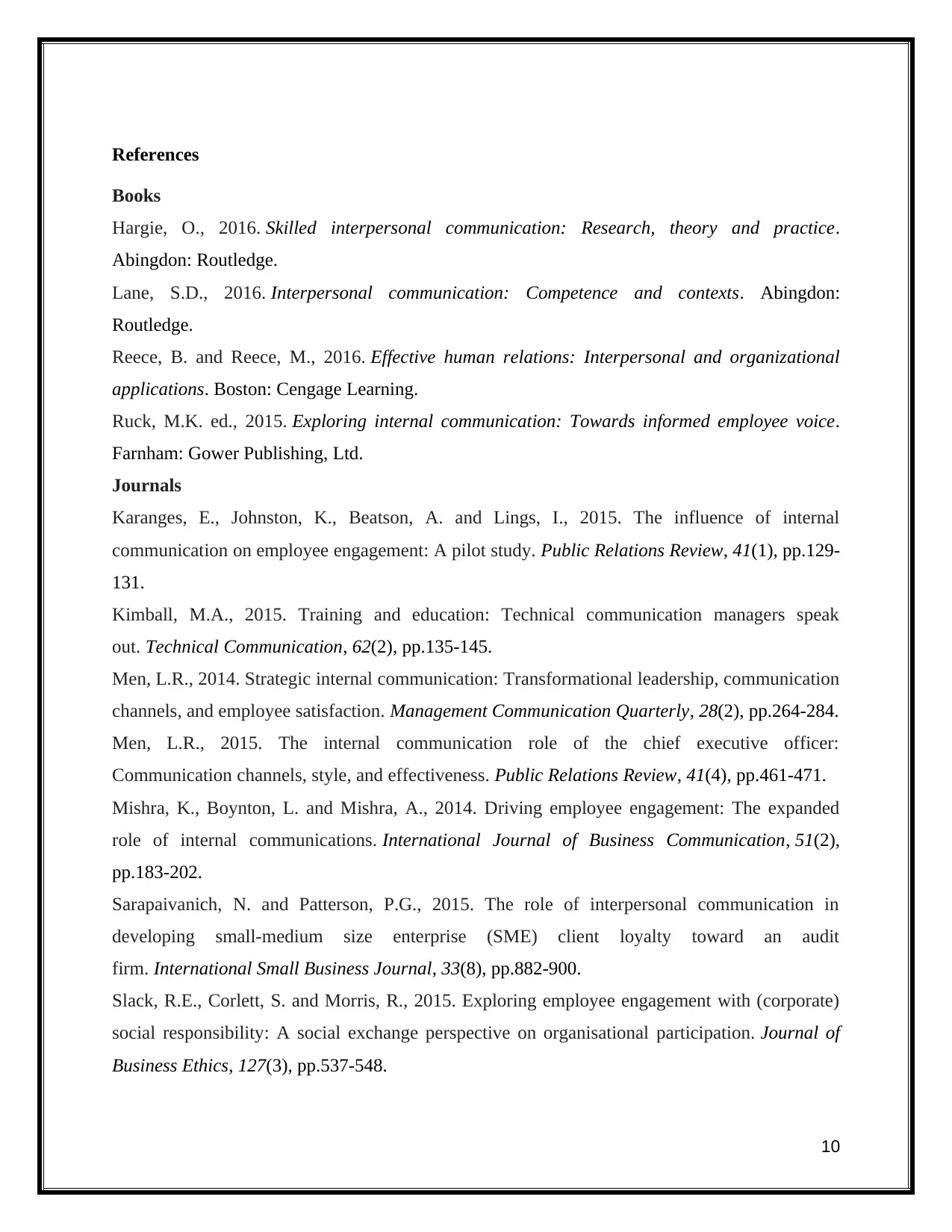
References
Books
Hargie, O., 2016. Skilled interpersonal communication: Research, theory and practice.
Abingdon: Routledge.
Lane, S.D., 2016. Interpersonal communication: Competence and contexts. Abingdon:
Routledge.
Reece, B. and Reece, M., 2016. Effective human relations: Interpersonal and organizational
applications. Boston: Cengage Learning.
Ruck, M.K. ed., 2015. Exploring internal communication: Towards informed employee voice.
Farnham: Gower Publishing, Ltd.
Journals
Karanges, E., Johnston, K., Beatson, A. and Lings, I., 2015. The influence of internal
communication on employee engagement: A pilot study. Public Relations Review, 41(1), pp.129-
131.
Kimball, M.A., 2015. Training and education: Technical communication managers speak
out. Technical Communication, 62(2), pp.135-145.
Men, L.R., 2014. Strategic internal communication: Transformational leadership, communication
channels, and employee satisfaction. Management Communication Quarterly, 28(2), pp.264-284.
Men, L.R., 2015. The internal communication role of the chief executive officer:
Communication channels, style, and effectiveness. Public Relations Review, 41(4), pp.461-471.
Mishra, K., Boynton, L. and Mishra, A., 2014. Driving employee engagement: The expanded
role of internal communications. International Journal of Business Communication, 51(2),
pp.183-202.
Sarapaivanich, N. and Patterson, P.G., 2015. The role of interpersonal communication in
developing small-medium size enterprise (SME) client loyalty toward an audit
firm. International Small Business Journal, 33(8), pp.882-900.
Slack, R.E., Corlett, S. and Morris, R., 2015. Exploring employee engagement with (corporate)
social responsibility: A social exchange perspective on organisational participation. Journal of
Business Ethics, 127(3), pp.537-548.
10
Books
Hargie, O., 2016. Skilled interpersonal communication: Research, theory and practice.
Abingdon: Routledge.
Lane, S.D., 2016. Interpersonal communication: Competence and contexts. Abingdon:
Routledge.
Reece, B. and Reece, M., 2016. Effective human relations: Interpersonal and organizational
applications. Boston: Cengage Learning.
Ruck, M.K. ed., 2015. Exploring internal communication: Towards informed employee voice.
Farnham: Gower Publishing, Ltd.
Journals
Karanges, E., Johnston, K., Beatson, A. and Lings, I., 2015. The influence of internal
communication on employee engagement: A pilot study. Public Relations Review, 41(1), pp.129-
131.
Kimball, M.A., 2015. Training and education: Technical communication managers speak
out. Technical Communication, 62(2), pp.135-145.
Men, L.R., 2014. Strategic internal communication: Transformational leadership, communication
channels, and employee satisfaction. Management Communication Quarterly, 28(2), pp.264-284.
Men, L.R., 2015. The internal communication role of the chief executive officer:
Communication channels, style, and effectiveness. Public Relations Review, 41(4), pp.461-471.
Mishra, K., Boynton, L. and Mishra, A., 2014. Driving employee engagement: The expanded
role of internal communications. International Journal of Business Communication, 51(2),
pp.183-202.
Sarapaivanich, N. and Patterson, P.G., 2015. The role of interpersonal communication in
developing small-medium size enterprise (SME) client loyalty toward an audit
firm. International Small Business Journal, 33(8), pp.882-900.
Slack, R.E., Corlett, S. and Morris, R., 2015. Exploring employee engagement with (corporate)
social responsibility: A social exchange perspective on organisational participation. Journal of
Business Ethics, 127(3), pp.537-548.
10
Paraphrase This Document
Need a fresh take? Get an instant paraphrase of this document with our AI Paraphraser
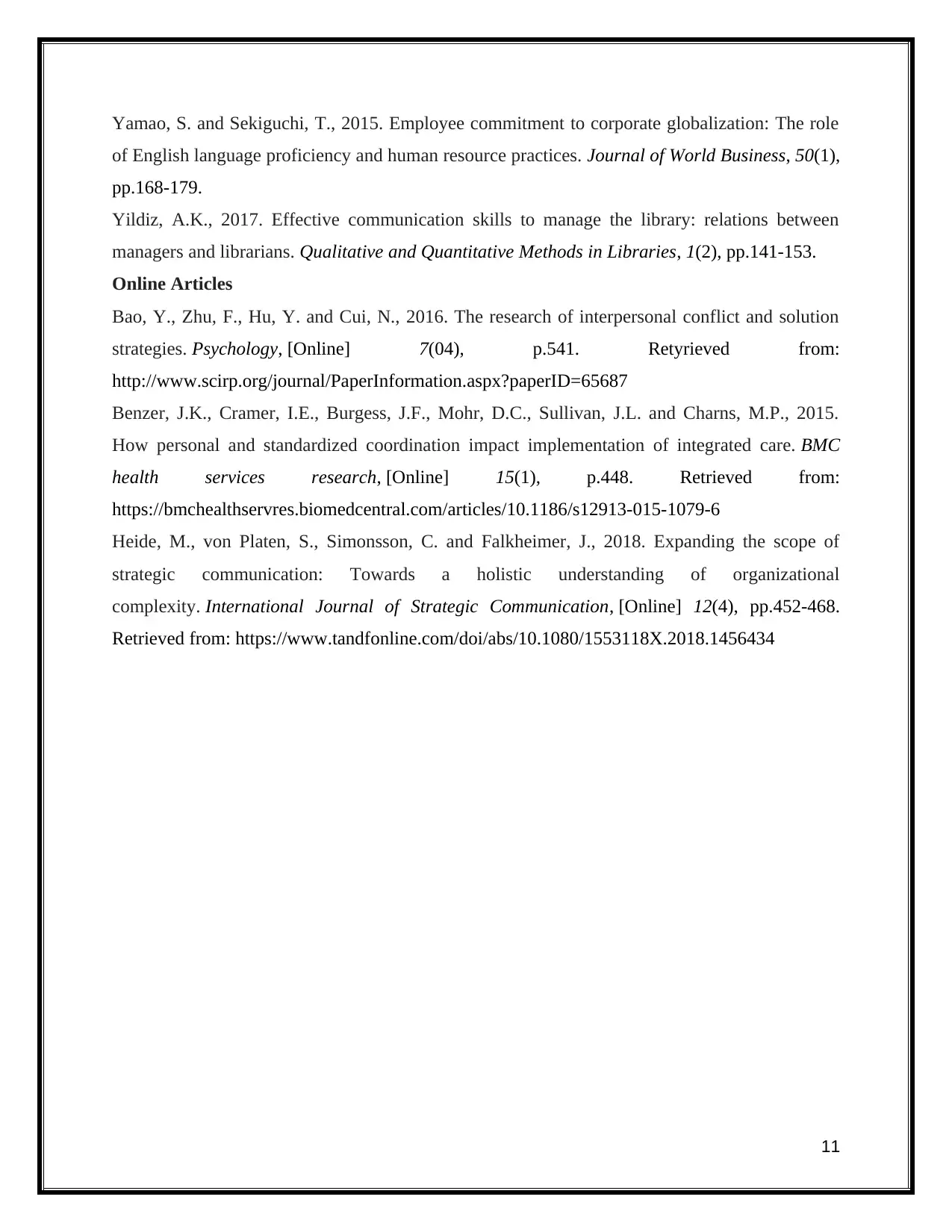
Yamao, S. and Sekiguchi, T., 2015. Employee commitment to corporate globalization: The role
of English language proficiency and human resource practices. Journal of World Business, 50(1),
pp.168-179.
Yildiz, A.K., 2017. Effective communication skills to manage the library: relations between
managers and librarians. Qualitative and Quantitative Methods in Libraries, 1(2), pp.141-153.
Online Articles
Bao, Y., Zhu, F., Hu, Y. and Cui, N., 2016. The research of interpersonal conflict and solution
strategies. Psychology, [Online] 7(04), p.541. Retyrieved from:
http://www.scirp.org/journal/PaperInformation.aspx?paperID=65687
Benzer, J.K., Cramer, I.E., Burgess, J.F., Mohr, D.C., Sullivan, J.L. and Charns, M.P., 2015.
How personal and standardized coordination impact implementation of integrated care. BMC
health services research, [Online] 15(1), p.448. Retrieved from:
https://bmchealthservres.biomedcentral.com/articles/10.1186/s12913-015-1079-6
Heide, M., von Platen, S., Simonsson, C. and Falkheimer, J., 2018. Expanding the scope of
strategic communication: Towards a holistic understanding of organizational
complexity. International Journal of Strategic Communication, [Online] 12(4), pp.452-468.
Retrieved from: https://www.tandfonline.com/doi/abs/10.1080/1553118X.2018.1456434
11
of English language proficiency and human resource practices. Journal of World Business, 50(1),
pp.168-179.
Yildiz, A.K., 2017. Effective communication skills to manage the library: relations between
managers and librarians. Qualitative and Quantitative Methods in Libraries, 1(2), pp.141-153.
Online Articles
Bao, Y., Zhu, F., Hu, Y. and Cui, N., 2016. The research of interpersonal conflict and solution
strategies. Psychology, [Online] 7(04), p.541. Retyrieved from:
http://www.scirp.org/journal/PaperInformation.aspx?paperID=65687
Benzer, J.K., Cramer, I.E., Burgess, J.F., Mohr, D.C., Sullivan, J.L. and Charns, M.P., 2015.
How personal and standardized coordination impact implementation of integrated care. BMC
health services research, [Online] 15(1), p.448. Retrieved from:
https://bmchealthservres.biomedcentral.com/articles/10.1186/s12913-015-1079-6
Heide, M., von Platen, S., Simonsson, C. and Falkheimer, J., 2018. Expanding the scope of
strategic communication: Towards a holistic understanding of organizational
complexity. International Journal of Strategic Communication, [Online] 12(4), pp.452-468.
Retrieved from: https://www.tandfonline.com/doi/abs/10.1080/1553118X.2018.1456434
11

1 out of 11


Related Documents


Your All-in-One AI-Powered Toolkit for Academic Success.
+13062052269
info@desklib.com
Available 24*7 on WhatsApp / Email
![[object Object]](/_next/static/media/star-bottom.7253800d.svg)
Unlock your academic potential
Copyright © 2020–2026 A2Z Services. All Rights Reserved. Developed and managed by ZUCOL.